Lockheed Martin F-35 Lightning II variant
Lockheed Martin F-35 Lightning II F-35B Lightning II
Short take-off and vertical landing (STOVL) variant of the F-35, conceived for the United States Marine Corps and also flown by the United Kingdom, Italy and Japan. Its Rolls-Royce lift fan, driven by the shaft of the F135-PW-600, lets it operate from amphibious ships and makeshift bases at the cost of about a third of its fuel and any internal gun. It first flew on 11 June 2008 and was the first version to enter service, on 31 July 2015.
Lockheed Martin F-35 Lightning II sheet

- June 11, 2008
- First flight
- 1,667 km
- Range
History
The F-35B is the short take-off and vertical landing (STOVL) variant of the Lightning II and, to a large extent, the reason the programme exists. Its roots lie in DARPA's ASTOVL programme, which between 1983 and 1994 sought a Harrier replacement for the United States Marine Corps and the British Royal Navy; within it, Lockheed's Skunk Works studied a stealthy supersonic STOVL fighter and the shaft-driven lift fan concept. The X-35B demonstrator proved the idea by taking off in about 150 m, flying supersonic and landing vertically. With the Marines it is meant to replace the AV-8B Harrier II and the F/A-18 Hornet; in the United Kingdom, the Harrier GR9.
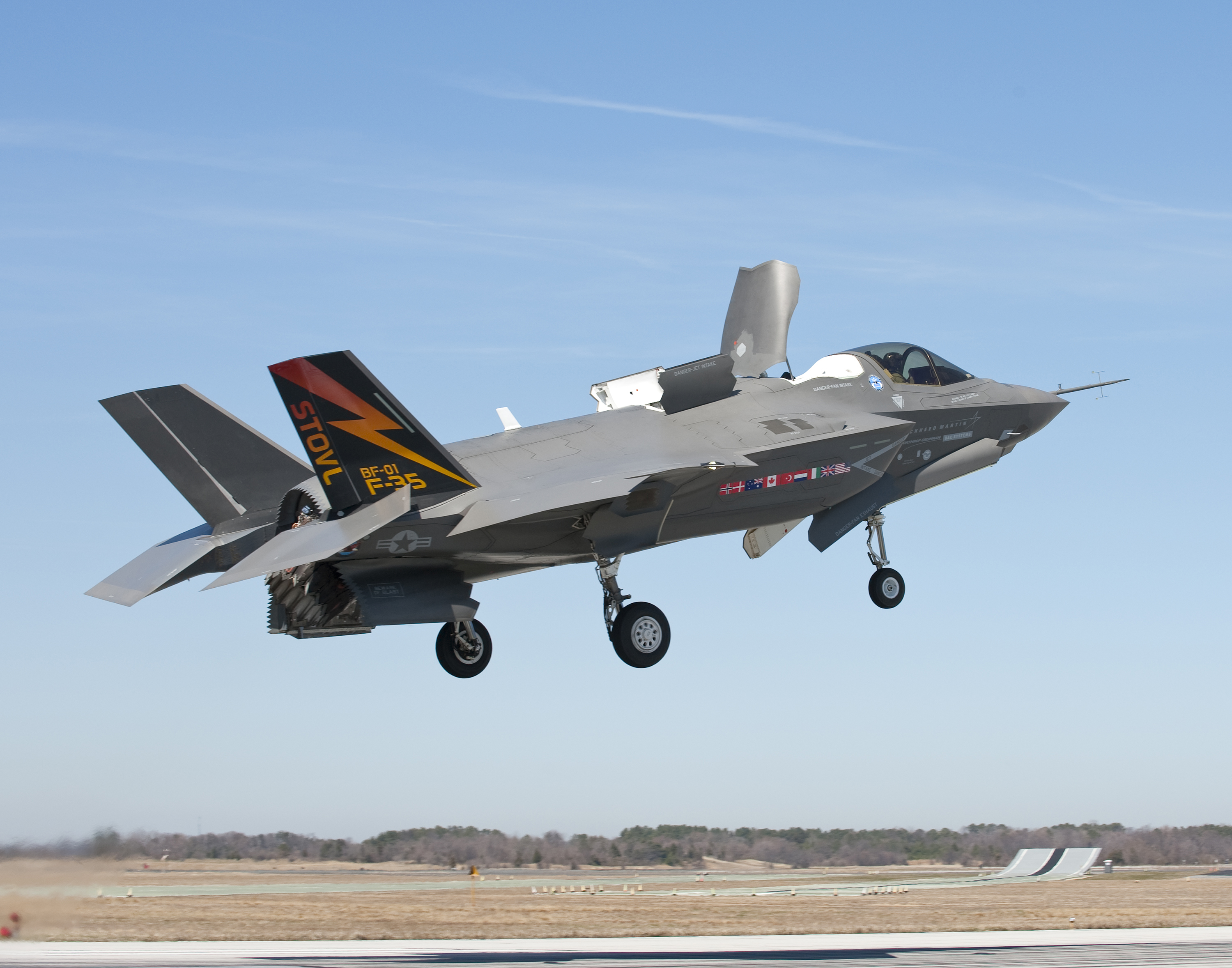
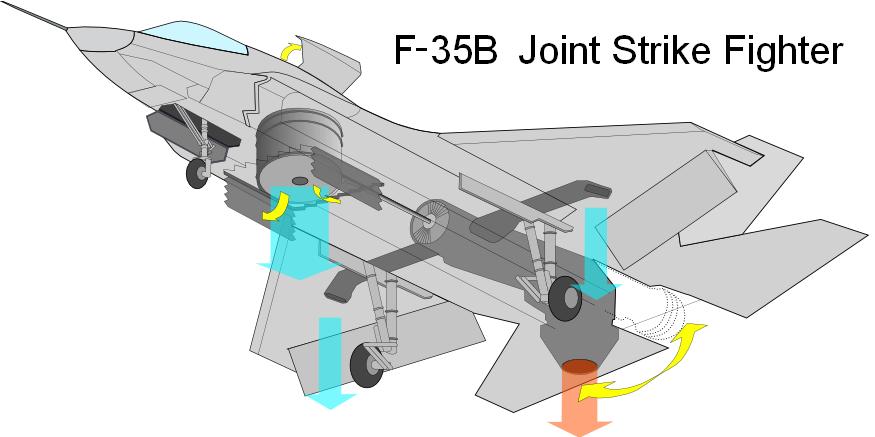
Its engine, the Pratt & Whitney F135-PW-600, forms with the Rolls-Royce LiftSystem the Integrated Lift Fan Propulsion System. In vertical flight the low-pressure turbine drives, through a shaft extension and a clutch, a two-stage fan ahead of the engine that provides about 46% of the vertical thrust; another 46% comes from the exhaust nozzle, which swivels on three bearings until it points at the ground, and the remaining 8% from a nozzle in each wing fed with air from the bypass duct. At the same time an auxiliary inlet opens on top of the aircraft to feed the engine during the hover. Transferring roughly a third of the power to the fan augments thrust by 50% with no increase in fuel flow and lowers the temperature and velocity of the jet striking the ground. Unlike the Harrier's Pegasus, which lifts the aircraft with direct engine thrust alone, the F-35B adds the fan's thrust to that of the nozzle.
The variant came close to missing its requirements. The 2003 decision to enlarge the weapons bays for commonality with the other versions added about 1,000 kg, over 8%, and the F-35B was missing every STOVL key performance parameter threshold. In December 2003 the STOVL Weight Attack Team (SWAT) was formed; it thinned airframe members, shrank the weapons bays and vertical stabilizers, fed less thrust to the roll posts and redesigned the wing-mate joint, and by September 2004 the F-35B's weight had come down by more than 1,400 kg. The Department of Defense also accepted a longer take-off run, and its estimated combat radius was reduced by 15 percent.
The first aircraft, BF-1, flew on 11 June 2008; it first hovered on 17 March 2010 and landed vertically for the first time the next day. On 5 November 2010 the Block 1 software flew for the first time aboard BF-4. At Patuxent River, five F-35Bs handled envelope expansion and STOVL suitability testing. Fatigue testing revealed premature cracking that forced a redesign of the structure. Sea trials took place on the amphibious assault ship USS Wasp: in October 2011 two F-35Bs completed three weeks of initial trials; in August 2013 the second campaign added 19 night-time vertical landings using DAS imagery, and in May 2015 six aircraft carried out the first operational testing on board. In June 2015 it made its first launch from a ski-jump, at Patuxent River.
It was also the most threatened version. In November 2010 the co-chairs of the National Commission on Fiscal Responsibility and Reform suggested cancelling it, and Pentagon officials doubted it because its short range would force it to operate from bases or ships within reach of ballistic missiles. In 2011 Defense Secretary Robert Gates placed it on a two-year probation under threat of cancellation; his successor, Leon Panetta, ended it on 20 January 2012, judging that it had made sufficient progress. For the Marines there was no alternative replacement for the AV-8B Harrier II.
The Marines' training squadron was formed at Eglin in 2012 and moved to MCAS Beaufort in 2014; another was stood up at Miramar in 2020. On 16 November 2012 squadron VMFA-121 received its first F-35B at Yuma, and on 31 July 2015 the Marine Corps declared initial operational capability in the Block 2B configuration, with limitations in night operations, mission systems and weapons carriage: it was the first variant to enter US service, ahead of the F-35A (2016) and the F-35C (2019). In July 2016 it took part in its first Red Flag, flying 67 sorties. The first deployment came in 2017 at Iwakuni, Japan; combat employment began in July 2018 from USS Essex, and on 27 September 2018 it flew its first strike, against a Taliban target in Afghanistan. For it the Marines devised distributed STOVL operations: flying from temporary bases inside enemy missile engagement zones and relocating within the adversary's 24- to 48-hour targeting cycle. Such makeshift strips need metal planking to protect the surface from the engine exhaust.
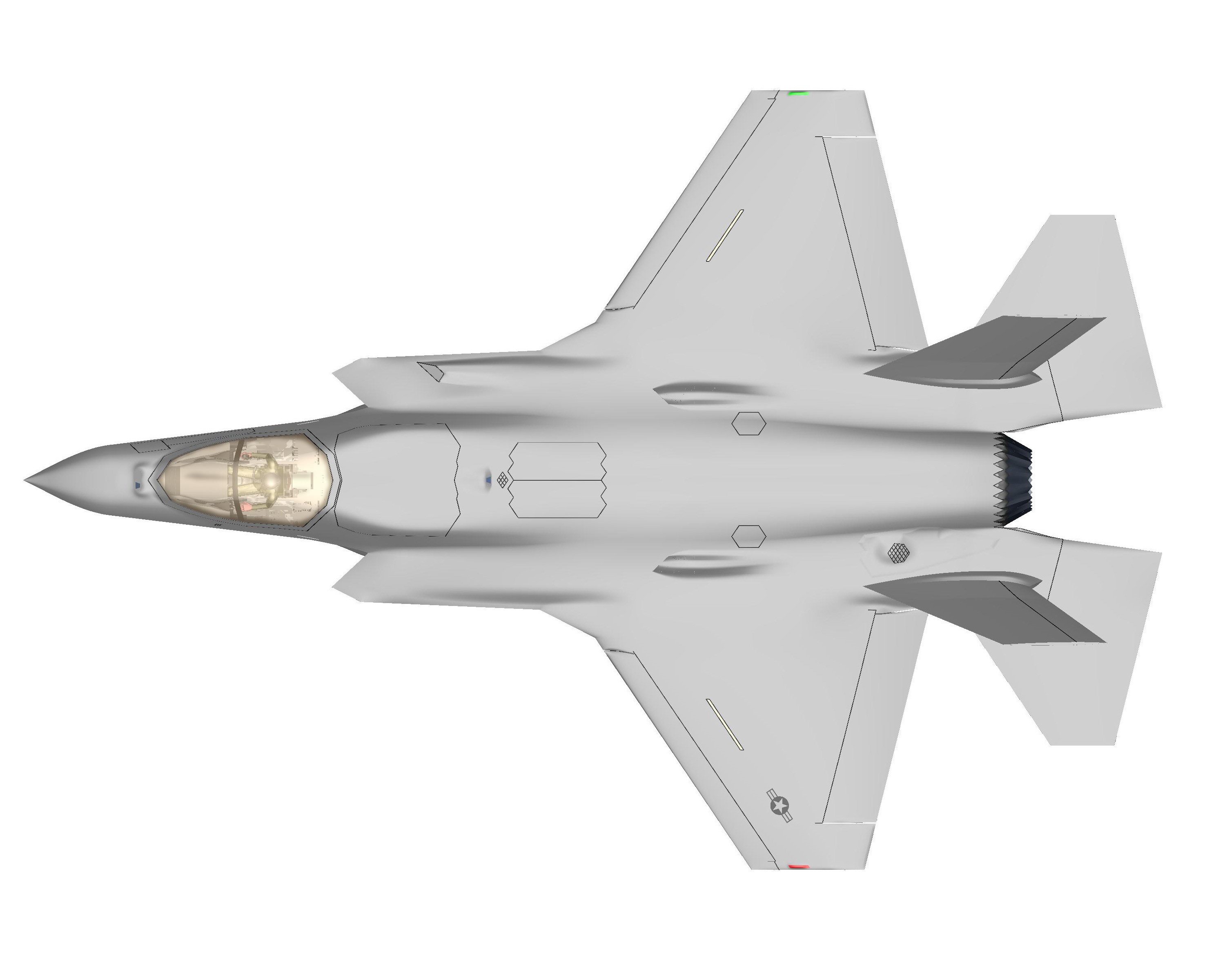
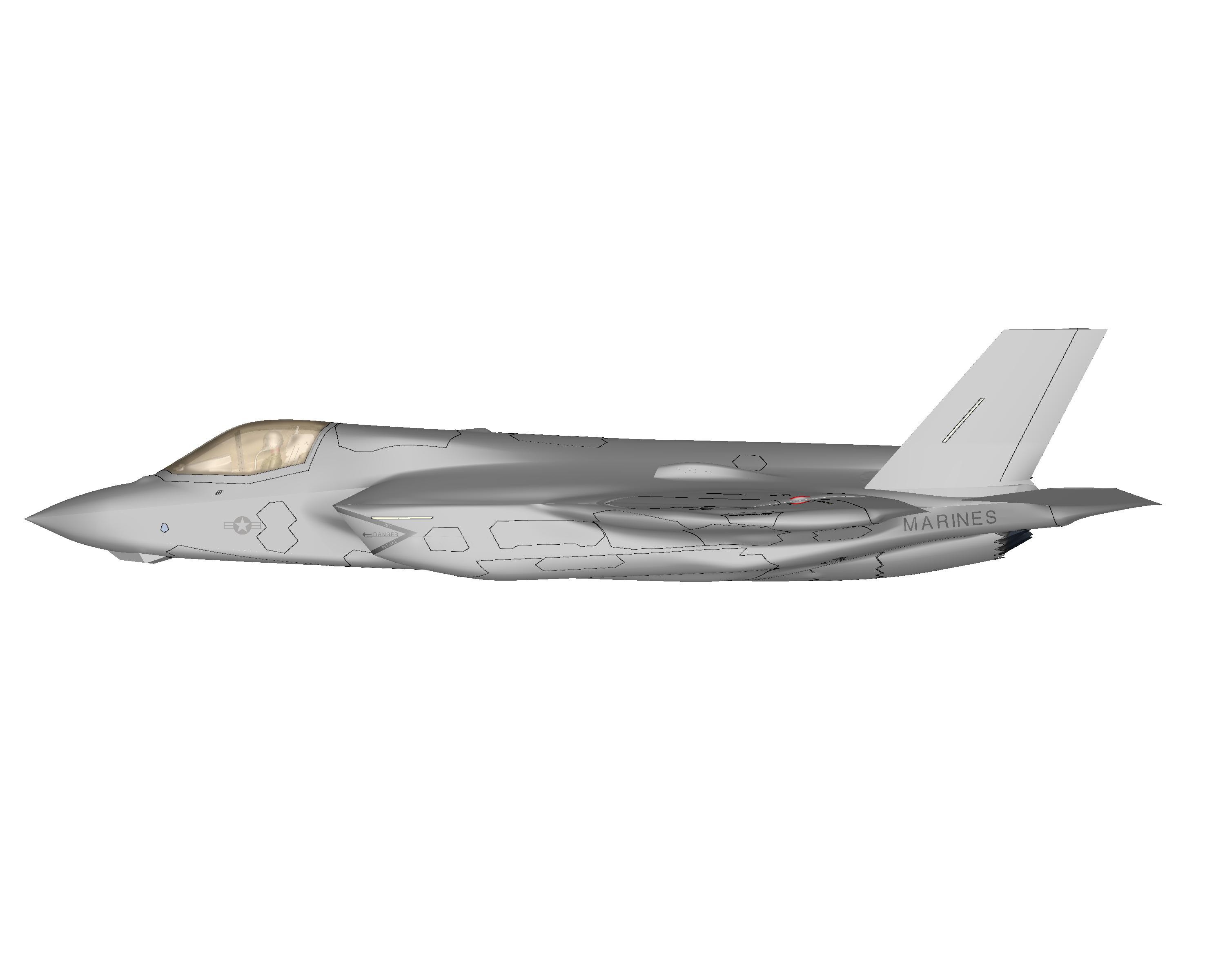
Outwardly it is almost identical to the F-35A, sharing the short wingspan set by the need to fit amphibious ships' elevators and parking areas. But the fan takes the place of the gun and of about a third of the fuel: it has no internal gun and can carry on the centreline a Terma pod with the 25 mm GAU-22/A and 220 rounds, a development of the AV-8B's GAU-12. Its shorter bays accept up to 680 kg on each outboard station and three Small Diameter Bombs per station instead of four. It is limited to 7 g, reaches Mach 1.6 and has no hook: the STOVL/HOOK control instead engages conversion between conventional and vertical flight.
In the United Kingdom, where it is simply called Lightning, the Royal Air Force and Royal Navy operate it jointly; it has replaced the Harrier GR9, retired in 2010, and the Tornado GR4, retired in 2019. No. 617 Squadron was the first RAF front-line unit to receive it, with four aircraft flown from Beaufort to Marham. In October 2018 a Royal Navy F-35 made the first rolling landing on board HMS Queen Elizabeth, and on 25 June 2019 the RAF used it in combat for the first time, on an armed reconnaissance flight against Islamic State in Iraq and Syria. On 17 November 2021 a British F-35B crashed into the Mediterranean while taking off from HMS Queen Elizabeth; of 48 received, 47 remain operational, and in June 2025 a further 15 were announced. On 3 March 2026 a British F-35B shot down a hostile drone over Jordan, the first target destroyed on operations by a UK F-35.
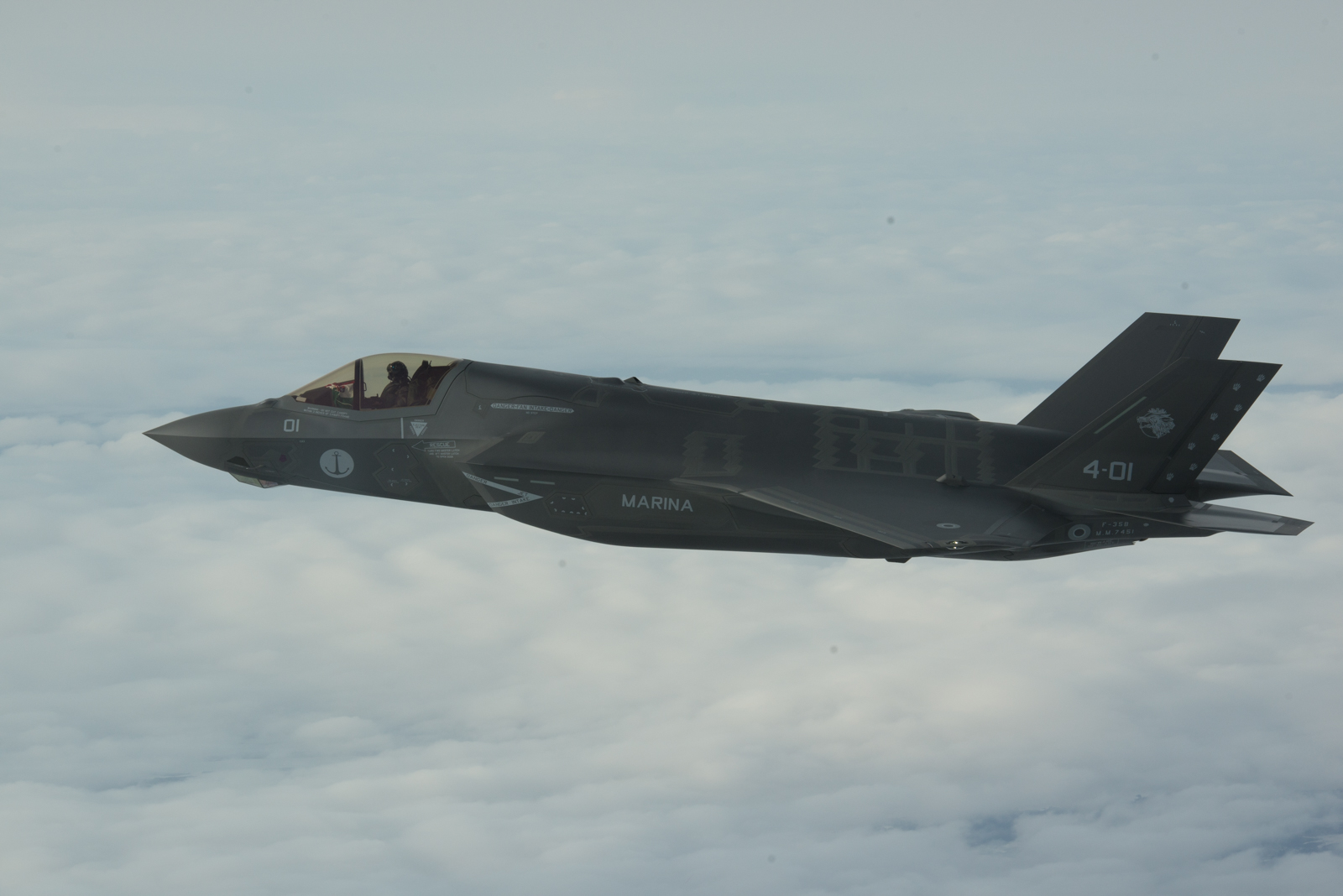
Italy ordered 20 for its air force, which had received 8 by April 2025, and another 20 for its navy, with 6 delivered by September 2024 and embarked on the carrier Cavour, from which they drilled with the United States in the Philippine Sea in 2024. Japan included 42 F-35Bs in its order for 147 aircraft, and the first three landed at Nyutabaru Air Base on 7 August 2025. Singapore has 12 on order: four for 2026 and eight for 2028.
Its accidents include a crash near Beaufort in September 2018, caused by a fuel tank problem, and the loss of a Marine Corps aircraft at Miramar on 31 July 2026.
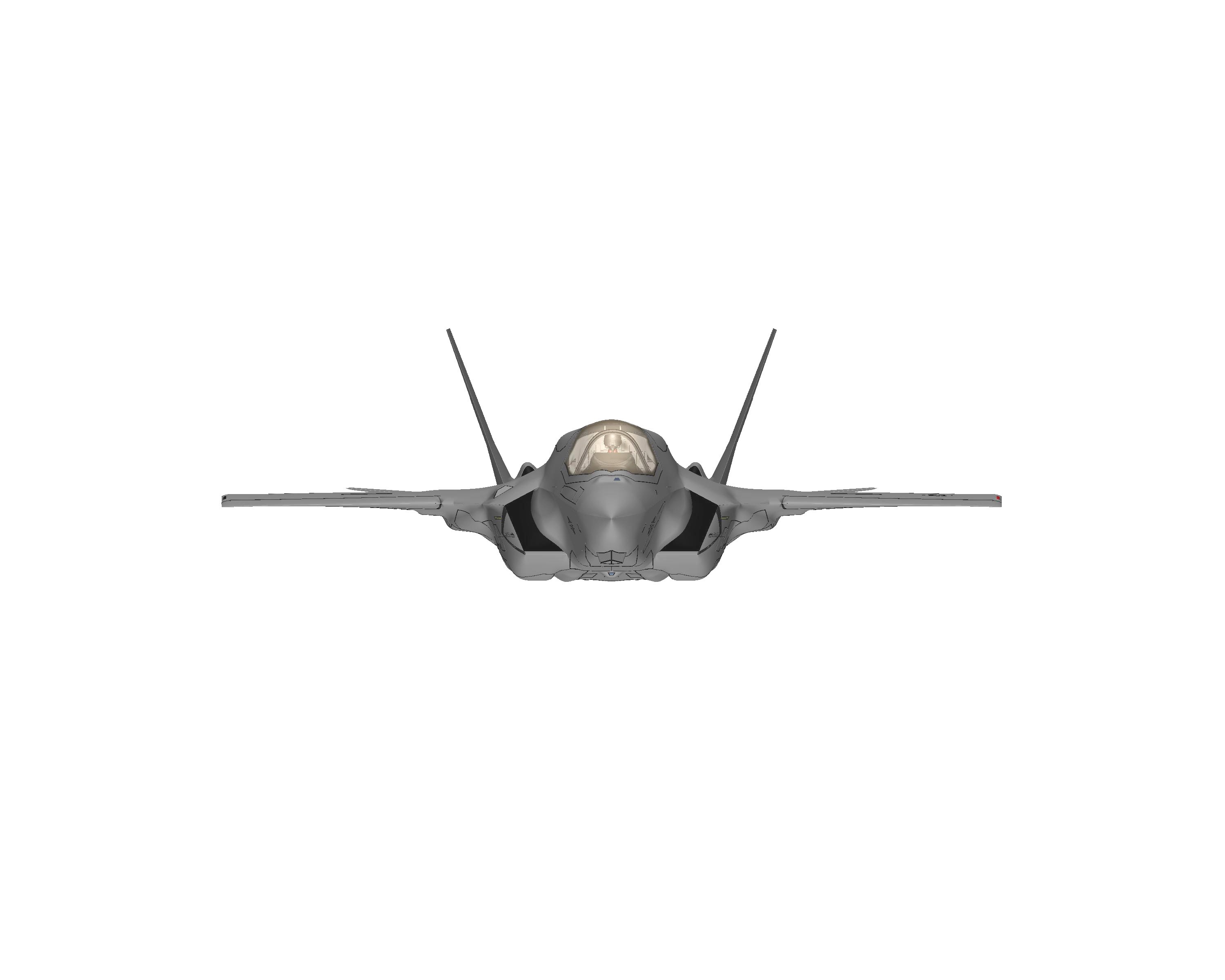
Three-view drawing
Multimedia


-1600.webp)
-1600.webp)
-1600.webp)


-1600.webp)
%2C_Nov_2016-1600.webp)
-1600.webp)

-1600.webp)
Elsewhere
Videos


Photos
- Flickr — Lockheed MartinDisparo real de un misil ASRAAM desde el F-35B ↗
- Flickr — Lockheed MartinFuego real del cañón de 25 mm en cápsula del F-35B ↗
- Rolls-RoyceEl LiftSystem de Rolls-Royce que hace posible el F-35B ↗
- Flickr — Marina MilitareArchivo fotográfico oficial de la Marina Militare, operadora del F-35B ↗