Airliner · Civil · Russia
Ilyushin Il-86
- December 22, 1976
- First flight
- 1980
- Introduced
- In service
- Status
- 106
- Units built

-1600.webp)

-800.webp)


-1600.webp)
-1600.webp)
-1600.webp)
-1600.webp)

-800.webp)
_Russian_Air_Force_CKL_UUWW_(36027917255)-800.webp)

%2C_Russia_-_Air_Force_AN1743338-800.webp)

-800.webp)
_RA-86148_(6395892863)-800.webp)
-800.webp)
-1600.webp)
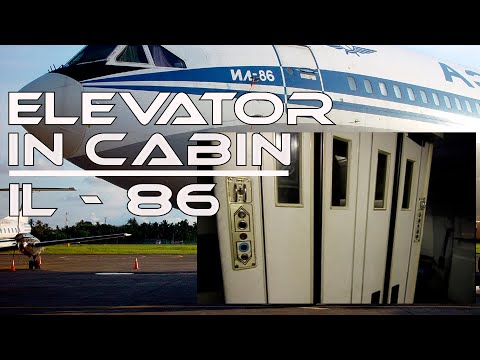
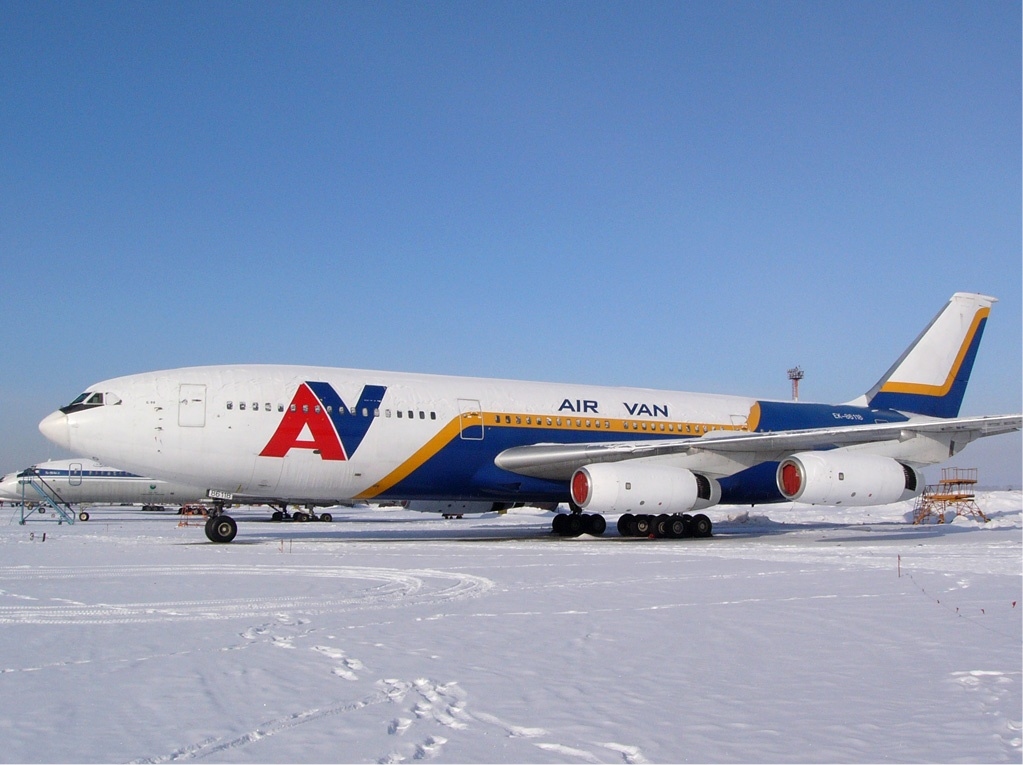
The Ilyushin Il-86 (NATO reporting name «Camber») was the first wide-body airliner built in the Soviet Union. Designed by the Ilyushin bureau during the 1970s in response to the «aerobus» requirement issued by the Ministry of Civil Aviation, it is a low-wing quadjet with its engines slung on pylons beneath the wing, a configuration previously unused on large Soviet aircraft. Its most distinctive feature was the «luggage at hand» system: three lower-deck doors with built-in hydraulic airstairs let passengers board without a jetway and stow their own suitcases in below-floor lockers, a solution devised to avoid enlarging Soviet terminals that were too small for such an aircraft. The prototype flew at Khodynka on 22 December 1976 and the type entered Aeroflot service on 26 December 1980 with an inaugural flight from Moscow to Tashkent; the first international service, between Moscow and East Berlin, followed on 2 July 1981. A total of 106 aircraft were built between 1976 and 1991, of which one never flew and only three were exported, going to China Xinjiang Airlines in 1990. The lack of a suitable engine dogged the programme: range fell well short of the original target and became the aircraft's defining limitation. Withdrawn from commercial passenger service in 2011, it remains active in its Il-86VKP airborne command post form.
Related sheets
Category
History
The Soviet «aerobus»
By the mid-1960s the United States and Western Europe were planning airliners that would double the prevailing 200-seat maximum, and the Soviet leadership wanted an equivalent of its own. Aeroflot expected to pass one hundred million passengers a year within a decade, a figure it duly reached on 29 December 1976. In October 1967 the government approved a specification for a 350-seat aerobus able to fly 3,600 km with a 40-tonne payload, or 5,800 km with a full cabin and no freight, operating from 2,600 m runways. The preliminary project was entrusted to Ilyushin on 8 September 1969 and detailed operational requirements followed on 22 February 1970.
A difficult design
The first model, shown at Vnukovo-2 on 17 May 1971, still resembled the Il-62 with rear-mounted engines; detailed design was authorised on 9 March 1972 and the final configuration moved the engines under the wing, a politically sensitive matter within the Soviet industry. The 6.07 m fuselage diameter gave the Il-86 the second-widest cabin of any airliner until the Boeing 777. The problem never solved was the powerplant: the Soloviev D-30 could not deliver the required thrust and in March 1975 the less advanced, noisy and thirsty Kuznetsov NK-86 had to be adopted instead. Attempts to buy Western technology came to nothing; neither the TriStar demonstrated in Moscow in March 1974 nor the General Electric CF6-50 engines ordered in 1978 were cleared for export.
Service and retirement
The prototype flew on 22 December 1976 and in-house testing ended on 20 October 1978. State acceptance trials ran from 24 April 1979 to 24 December 1980, so the aircraft arrived too late for the Moscow Olympics, which had been the target date. Production was split between the Voronezh factory and Poland's PZL Mielec, which from May 1977 built empennages, control surfaces and engine pylons. Scheduled services proper began after 1 February 1981, and from 1982 the type flew to Havana via Shannon and Gander as well as to Buenos Aires, Montevideo, Lima, Rio de Janeiro and São Paulo. In September 1981 a crew captained by G. Volokhov set eighteen FAI records with payloads of up to 80 tonnes. The international ban on noisier aircraft from April 2002 hastened the end; Aeroflot announced withdrawal in November 2006 and the last passenger services were flown in 2011. Throughout its commercial career the Il-86 was never involved in a fatal accident while carrying passengers.
Variants
| Il-86 | Il-86VKP (Il-80 / Il-82 / Il-87) | Il-86 (CFM56-5C2) | Il-86D | Il-86D (Lotarev D-18) | Il-86 (sin sistema «equipaje a mano») | Il-86 (V2500) | Il-86V (450 plazas) | Il-86V (RB211-22) | Il-86V (RB211-524G) | |
|---|---|---|---|---|---|---|---|---|---|---|
| First flight | December 22, 1976 | March 5, 1987 | — | — | — | — | — | — | — | — |
| Aircraft type | Wide-body airliner | Airborne command post | Re-engined wide-body airliner (project) | Long-range wide-body airliner (project) | Long-range wide-body airliner (project) | Wide-body airliner | Re-engined wide-body airliner (project) | High-density wide-body airliner | Re-engined wide-body airliner (project) | Re-engined wide-body airliner (project) |
| Powerplant | 4 × Kuznetsov NK-86 turbofan of 127.5 kN each, in underwing pods with cascade thrust reversers. Low-bypass and essentially a 1960s design, they were reliable but noisy and thirsty, and left no growth margin for later versions. | 4 × Kuznetsov NK-86 turbofan of 127.5 kN each, inherited from the civil airframe that was converted. | 4 × CFM International CFM56-5C2 turbofan, the Franco-American engine of the Airbus A340. | Four underwing turbofans, as on the production aircraft. The project never settled on a definitive powerplant — precisely the problem that dogged the whole programme. | 4 × Lotarev D-18 turbofan, the first large Soviet high-bypass engine, which was not available until the mid-1980s. | 4 × Kuznetsov NK-86 turbofan of 127.5 kN each, unchanged from the production aircraft. | 4 × International Aero Engines V2500 turbofan, offered in 1995 to five Il-86 operators to re-engine 25 aircraft. | 4 × Kuznetsov NK-86 turbofan of 127.5 kN each: as a «minimum-change» development of the production airframe, it kept the Il-86 powerplant. | 4 × Rolls-Royce RB211-22 turbofan, the British high-bypass engine Soviet industry had spent years trying to obtain for the Il-86. | 4 × Rolls-Royce RB211-524G turbofan, the most powerful version of the British family. |
| Powerplant | 4 × Kuznetsov NK-86 | 4 × Kuznetsov NK-86 | 4 × CFM International CFM56-5C2 | 4 × turbofan | 4 × Lotarev D-18 | 4 × Kuznetsov NK-86 | 4 × International Aero Engines V2500 | 4 × Kuznetsov NK-86 | 4 × Rolls-Royce RB211-22 | 4 × Rolls-Royce RB211-524G |
| Thrust per engine | 128 kN Best value in this row | 128 kN Best value in this row | — | — | — | 128 kN Best value in this row | — | 128 kN Best value in this row | — | — |
| Length | 59.9 m | — | — | — | — | — | — | — | — | — |
| Wingspan | 48.1 m | — | — | — | — | — | — | — | — | — |
| Height | 15.8 m | — | — | — | — | — | — | — | — | — |
| Wing area | 320 m² | — | — | — | 325 m² Best value in this row | 320 m² | — | — | — | — |
| Empty weight | 115,010 kg Best value in this row | — | — | — | 147,500 kg | — | — | — | — | — |
| MTOW | 208,000 kg | — | — | — | 300,000 kg Best value in this row | — | — | — | — | — |
| Top speed | 950 km/h | — | — | — | — | — | — | — | — | — |
| Max speed altitude | 10,670 m | — | — | — | — | — | — | — | — | — |
| Cruise speed | 900 km/h | — | — | — | — | — | — | — | — | — |
| Cruise altitude | 10,670 m | — | — | — | — | — | — | — | — | — |
| Service ceiling | 12,000 m | — | — | — | — | — | — | — | — | — |
| Initial climb rate | 15 m/s | — | — | — | — | — | — | — | — | — |
| Range | 3,600 km | — | — | 8,500 km | 10,200 km Best value in this row | — | — | — | 9,000 km | — |
| Ferry range | 5,250 km | — | — | — | — | — | — | — | — | — |
| Combat radius | 0 km Best value in this row | 0 km Best value in this row | 0 km Best value in this row | 0 km Best value in this row | 0 km Best value in this row | 0 km Best value in this row | 0 km Best value in this row | 0 km Best value in this row | 0 km Best value in this row | 0 km Best value in this row |
| Range conditions | Range was the type's weak point: designed for 5,000 km, NK-86 fuel burn cut it to some 3,600 km in everyday service and up to 3,800 km at maximum take-off weight. With full tanks and a lighter load, 5,250 km is quoted. | On top of the Il-86 airframe's range, the in-flight refuelling probe lets the aircraft stay airborne well beyond what the airliner allows. | No published figure of its own: lack of finance precluded any progress in 1991. | Around 8,500 km thanks to a slightly greater span and extra fuel; Russian sources quote over 9,000 km. Neither figure ever flew: the study led instead to the Il-96. | 10,200 km planned, close to three times the Il-86's actual range. The version evolved into the Il-96. | With the cabin 3,000 kg lighter, range improves on the production aircraft, at a 7% lower seat-mile cost. | No published figure of its own: the offer was not taken up. | No published figure of its own; Russian sources place the mission between 3,600 and 4,000 km. | Over 9,000 km, or alternatively more payload at the standard range. The collapse of the Soviet economy left the project nowhere. | No published figure of its own. It did not progress either. |
| Armament | None | None | None | None | None | None | None | None | None | None |
| Max weapons load | 0 kg Best value in this row | 0 kg Best value in this row | 0 kg Best value in this row | 0 kg Best value in this row | 0 kg Best value in this row | 0 kg Best value in this row | 0 kg Best value in this row | 0 kg Best value in this row | 0 kg Best value in this row | 0 kg Best value in this row |
| Payload | 42,000 kg | — | — | — | — | — | — | — | — | — |
| Cargo capacity | Up to 350 seats in a single class and 314 in a three-class layout, with a 42,000 kg payload. The holds under the main deck have their own access, and the built-in airstairs let passengers drop their suitcase at aircraft level before climbing to the cabin. | No passenger cabin: the interior houses workstations and the command and communications suite. It has no windows other than the flight deck portholes, and carries two electrical generator pods inboard of the engines. | — | Cabin planned for 330 seats according to Russian sources, on the same Il-86 wide-body fuselage. | A 325 m² wing and some 150,000 kg of fuel on an airframe appreciably larger than the production Il-86. | Dropping the «luggage at hand» system buys seats: 375 instead of 350, or the same cabin 3,000 kg lighter. | — | 450 seats: the underfloor vestibules are fitted out with seats and the main-deck layout is reworked. | — | 450 seats, like the other high-density Il-86V. |
| Crew | 3 | — | — | — | — | — | — | — | — | — |
| Passengers | 350 | — | — | 330 | — | 375 | — | 450 Best value in this row | — | 450 Best value in this row |
| Units built | 102 Best value in this row | 4 | — | — | — | — | — | — | — | — |
Images



![Ilyushin IL-86 Promotional Video [ENGLISH SUBTITLE]](https://i.ytimg.com/vi/X66z7F1hvuM/hqdefault.jpg)