Airliner · Civil · Russia
Ilyushin Il-62
- January 3, 1963
- First flight
- 1967
- Introduced
- In service
- Status
- 289–292
- Units built
-1600.webp)


-1600.webp)
The Ilyushin Il-62 (NATO reporting name «Classic») was the first long-range passenger jet built in the Soviet Union. Conceived in 1960 as a successor to the turboprop Il-18, it is a narrow-body quadjet with its engines paired on either side of the rear fuselage under a T-tail, a layout it shares only with the British Vickers VC10. With room for almost 200 passengers and crew, it was the world's largest jet airliner when it first flew. The prototype took off on 3 January 1963 fitted with interim Lyulka AL-7PB engines, because the intended Kuznetsov NK-8 turbofans were not ready; the first aircraft with the definitive powerplant flew in 1964. The Il-62 entered Aeroflot service on 15 September 1967 with an inaugural passenger flight from Moscow to Montreal and remained the Soviet standard on intercontinental routes for several decades. It was the first Soviet jet with six-abreast seating and the first with a pressurised non-circular fuselage cross-section. A total of 292 aircraft were built between 1963 and 1995, comprising five prototypes, 94 Il-62s and 193 Il-62Ms. More than thirty countries operated the type, over eighty examples were exported, and some fourteen nations used it as head-of-state transport. Its high operating cost compared with newer-generation airliners sharply reduced its commercial presence after the economic crisis of 2008.
Related sheets
Category
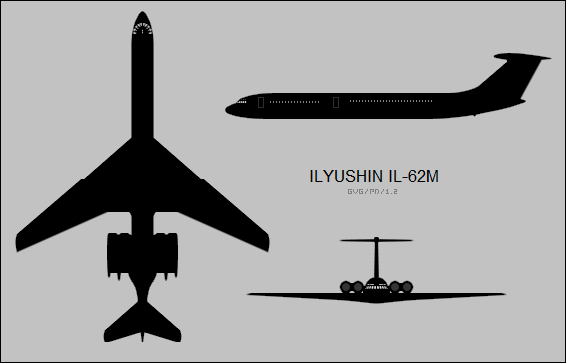
Three-view drawing
History
A jet for the long routes
The Ilyushin bureau put forward its proposal for a four-engined long-range jetliner in February 1960 and was given the go-ahead by the Soviet Council of Ministers on 18 June that year, with the Kuznetsov bureau instructed at the same time to develop the NK-8 turbofan. The official specification demanded 165 economy passengers over 4,500 km or 100 first-class passengers over 6,700 km. The Il-62 was to replace the turboprop Tu-114, then only just entering service, which gave Ilyushin an unhurried design and test programme. The rear-engine layout was dictated by TsAGI and allowed an aerodynamically clean wing, at the cost of a heavier wing and rear fuselage structure and the risk of deep stall, countered by the aircraft's characteristic leading-edge dog-tooth.
Production, variants and exports
The prototype flew on 3 January 1963 with interim engines and was later lost during a maximum-weight test flight. Production aircraft used Kuznetsov NK-8-4 engines, whose fatigue and overheating problems could trigger false fire warnings; early machines were involved in two fatal losses, both with LOT Polish Airlines: Flight 007 on 14 March 1980, with 87 fatalities, and Flight 5055 on 9 May 1987, with 183. The Il-62M variant, first flown in 1971 and introduced in 1973, brought more powerful, quieter and more efficient Soloviev D-30KU engines along with simpler flaps and spoilerons; the Il-62MK followed in 1978, seating up to 198. Exports only began in late 1969, when ČSA received the first aircraft; Interflug eventually owned 24, LOT operated 23, Cuban carriers flew 27 in all, and Russia's Domodedovo Airlines, the largest non-state operator, acquired 45.
Decline and final flights
The Il-62M became the longest-serving model in its airliner class, the average age of examples in service exceeding 32 years by 2016. Aeroflot used it on trans-polar and trans-Pacific links, and from 1984 to the mid-1990s funnelled through Shannon a traffic that peaked at 2,400 transit flights and 250,000 passengers a year. The 2008 recession pushed the last commercial machines off scheduled Russian routes; by September 2009 a total of 38 remained in service worldwide against 88 in 2006, and Cubana retired its final civil examples in 2011, 33 years after taking its first. As of April 2015 thirteen aircraft were still flying, almost all in government or VIP transport roles.
Variants
| Il-62 (prototype) | Il-62 | Il-62 / Il-62M Salon (VIP) | Il-62M | Il-62M airborne command post | Il-62MGr (Il-62MF) | Il-62MK | |
|---|---|---|---|---|---|---|---|
| First flight | January 3, 1963 | — | — | — | — | — | — |
| Aircraft type | Long-haul airliner prototype | Long-haul airliner | Long-haul airliner (VIP version) | Long-haul airliner | Airborne command post | Long-haul freighter | Long-haul airliner |
| Powerplant | 4 × Lyulka AL-7PB turbojets, fitted as a stopgap because the intended Kuznetsov NK-8 was not ready. | 4 × Kuznetsov NK-8-4 turbofans of 103 kN each | 4 × turbofans: 103 kN Kuznetsov NK-8-4 on Il-62 airframes and 107.9 kN Soloviev D-30KU on Il-62M airframes. | 4 × Soloviev D-30KU turbofans of 107.9 kN each | 4 × Soloviev D-30KU turbofans of 107.9 kN each | 4 × Soloviev D-30KU turbofans of 107.9 kN each | 4 × Soloviev D-30KU turbofans of 107.9 kN each |
| Powerplant | 4 × Lyulka AL-7PB | 4 × Kuznetsov NK-8-4 | 4 × Kuznetsov NK-8-4 (Il-62) / Soloviev D-30KU (Il-62M) | 4 × Soloviev D-30KU | 4 × Soloviev D-30KU | 4 × Soloviev D-30KU | 4 × Soloviev D-30KU |
| Thrust per engine | — | 103 kN | — | 108 kN Best value in this row | 108 kN Best value in this row | 108 kN Best value in this row | 108 kN Best value in this row |
| Length | — | 53.1 m Best value in this row | — | 53.1 m Best value in this row | — | — | — |
| Wingspan | — | 43.2 m Best value in this row | — | 43.2 m Best value in this row | — | — | — |
| Height | — | 12.4 m Best value in this row | — | 12.4 m Best value in this row | — | — | — |
| Wing area | — | 280 m² Best value in this row | — | 280 m² Best value in this row | — | — | — |
| Empty weight | — | 66,400 kg Best value in this row | — | 71,600 kg | — | — | — |
| MTOW | — | 162,000 kg | — | 165,000 kg Best value in this row | — | — | — |
| Top speed | — | 900 km/h Best value in this row | — | 900 km/h Best value in this row | — | — | — |
| Max speed altitude | — | 10,000 m | — | 10,000 m | — | — | — |
| Cruise speed | — | 850 km/h | — | 880 km/h Best value in this row | — | — | — |
| Cruise altitude | — | 10,500 m | — | 10,500 m | — | — | — |
| Service ceiling | — | 12,000 m Best value in this row | — | 12,000 m Best value in this row | — | — | — |
| Initial climb rate | — | 18 m/s Best value in this row | — | 18 m/s Best value in this row | — | — | — |
| Range | — | 6,700 km | — | 10,000 km Best value in this row | — | 5,500 km | — |
| Ferry range | — | 10,633 km | — | 11,600 km Best value in this row | — | — | — |
| Combat radius | 0 km Best value in this row | 0 km Best value in this row | 0 km Best value in this row | 0 km Best value in this row | 0 km Best value in this row | 0 km Best value in this row | 0 km Best value in this row |
| Range conditions | The stopgap, lower-thrust engines left the prototype badly underpowered and well short of the production aircraft's performance. | 6,700 km with maximum payload; up to 10,633 km ferrying without payload. | Keeps the range of the donor airframe: of the order of 10,000 km on Il-62M conversions. | 10,000 km carrying a 10,000 kg payload; up to 11,600 km ferrying without payload. | Keeps the range of the Il-62M it derives from, of the order of 10,000 km. | 5,500 km with the maximum 40,000 kg load. | Conceived as the medium-range version: the structural reinforcement buys payload rather than range. |
| Armament | None | None | None | None | None | None | None |
| Max weapons load | 0 kg Best value in this row | 0 kg Best value in this row | 0 kg Best value in this row | 0 kg Best value in this row | 0 kg Best value in this row | 0 kg Best value in this row | 0 kg Best value in this row |
| Payload | — | 24,100 kg | — | 23,000 kg | — | 40,000 kg Best value in this row | — |
| Cargo capacity | Development airframe: no commercial passenger or cargo service. | Up to 174 seats in airline layout and a maximum structural payload of 24,100 kg. | Cabin reconfigured as a salon, with a conference room and enhanced communications for heads of state, carrying far fewer people than the airline layout. | Seating for 168 to 186 passengers and up to 23,000 kg maximum payload, with containerised baggage and freight. | A single aircraft (RA-86570) converted to direct emergency operations: the cabin houses command and communications stations instead of airline seating. | Rare freighter version, with a reinforced fuselage to carry up to 40,000 kg of cargo. | Up to 195 seats thanks to the strengthened wing and landing gear, which allow higher take-off weights. |
| Crew | — | 5 Best value in this row | — | 5 Best value in this row | — | — | 5 Best value in this row |
| Passengers | — | 174 | — | 186 | — | — | 195 Best value in this row |
| Units built | 5 | 94 | — | 193 Best value in this row | 1 | — | — |
Images