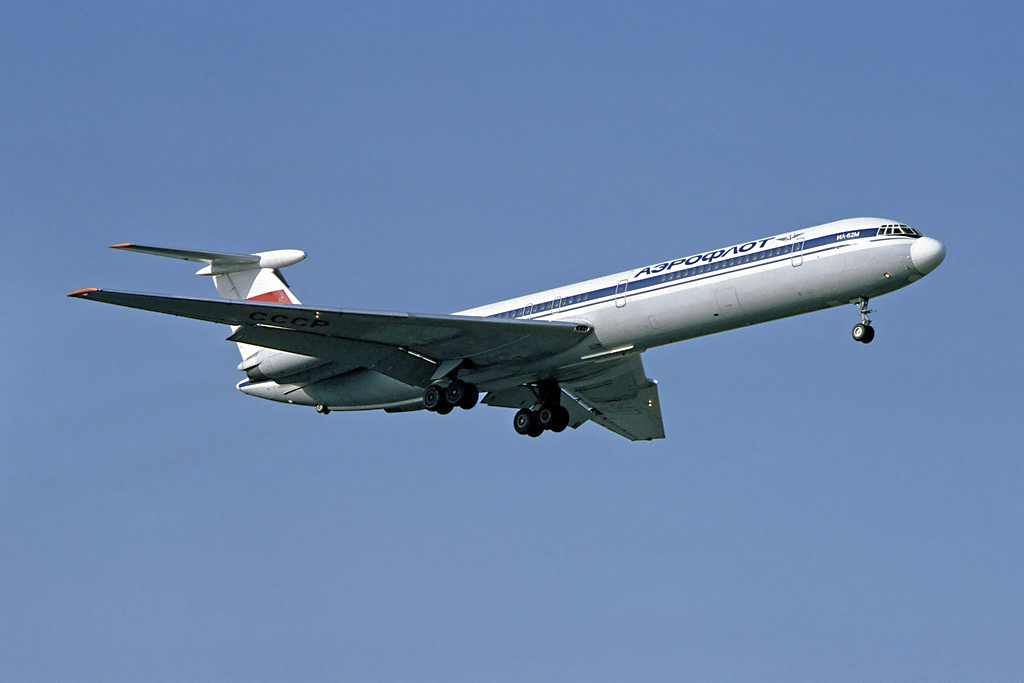
Ilyushin Il-62 variant
Ilyushin Il-62M
Re-engined Il-62 with four Soloviev D-30KU turbofans fitted with thrust reversers, an extra fuel tank in the fin and longer range; the most-built variant of the family and the one that kept it in service for decades.

- 193
- Units built
- 10,000 km
- Range
- 186
- Passengers
History
The Il-62M was conceived to cure the original Il-62's weak point: its Kuznetsov NK-8-4 engines. According to Russian Wikipedia, on 13 October 1967 a Soviet government resolution instructed the Ilyushin bureau to modify the aircraft with the new Soloviev D-30KU two-spool turbofans, designed by P. A. Solovyov's team. Work was led by Genrikh Novozhilov, and the engines were installed on the thirteenth production aircraft, which also received changes to improve its performance and the crew's working conditions. The same source dates the first flight of that modified aircraft to 13 March 1969, whereas English and Spanish Wikipedia and aircraftinvestigation.info give 1971 as the year of the first flight; that same year the first Il-62M, CCCP-86673, was shown publicly at the Paris Air Show at Le Bourget, where it appeared again in 1973.
From 1969 the design bureau developed the improved version under the internal designation Il-62M-200, which in service was simply called the Il-62M. The changes were wide-ranging: a strengthened airframe, a larger range of horizontal stabiliser travel (up to 11 degrees) with automated control and a new fairing at the fin-tailplane junction, spoilers that also work differentially as ailerons, new control columns, a redesigned instrument panel, white instead of red cockpit lighting, and a flight and navigation suite that allowed ICAO Category II approaches. A 5000-litre fuel tank was added in the fin, the auxiliary power unit was replaced by the TA-6A, and a mechanised containerised baggage loading system was introduced. As a result, maximum take-off weight rose from 160.5 t to 164.7 t, an increase of 4200 kg.
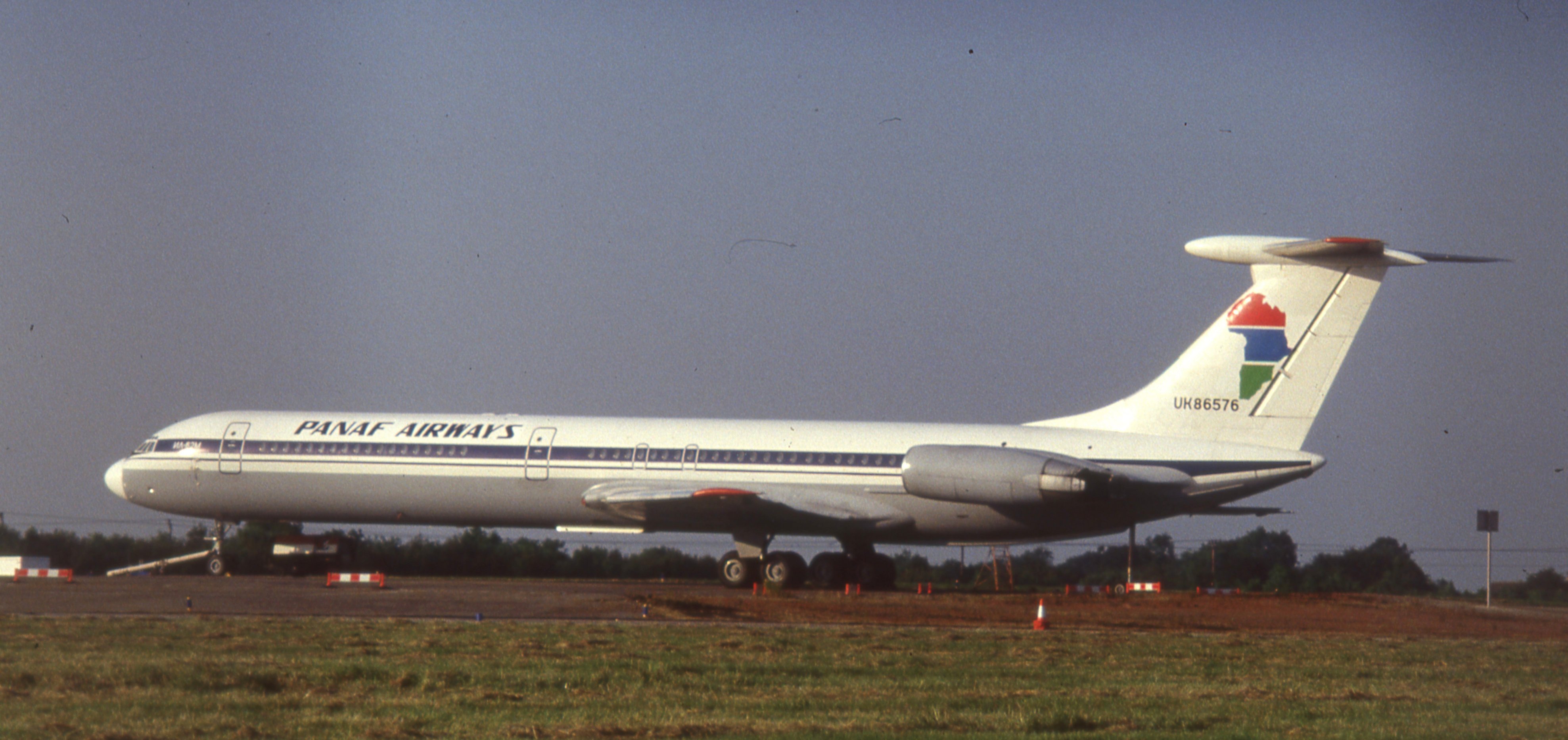
The D-30KU, rated at 107.9 kN of thrust each according to Jane's, was more powerful, more economical and quieter than the NK-8-4. The engines sat in new, aerodynamically cleaner nacelles, each with its own air starter, and had electro-hydraulic clamshell thrust reversers. English Wikipedia adds that the Il-62M could use idle reverse thrust in flight during the final approach to shorten the landing run, and that from 1978 its Doppler navigation radar was replaced by inertial navigation sets.
According to Jane's 1988-89, the Il-62M was 53.12 m long with a 43.20 m wingspan, weighed 71,600 kg empty and 165,000 kg at take-off, carried 105,300 litres of fuel and flew 10,000 km with a 10,000 kg payload, seating 168 to 186 passengers. Russian Wikipedia's comparison table credits it with a maximum range of 11,050 km against 10,000 km for the Il-62, and a maximum payload of 23,000 kg. With 10 t of freight, according to English Wikipedia, it flew 10,300 km, against 9,412 km for the VC10 with the same load; with 23 t, 8000 km, against 6,920 km for the Boeing 707. That range allowed it to fly non-stop between Moscow and Havana.
Sources disagree on when it entered service: Russian Wikipedia places it in January 1973, while English Wikipedia and aircraftinvestigation.info give March 1974 with Aeroflot. The Soviet airline assigned it to its longest routes, and in 1975 an Il-62M flew from Moscow to Seattle across the North Pole. Aeroflot progressively replaced its NK-8-powered Il-62s with the new version; with the airline the Il-62M achieved a 97% dispatch rate, with some aircraft flying up to 17 hours a day, and it came to be regarded as the most reliable type in the fleet.
It was built at the Kazan plant: Russian Wikipedia counts 193 aircraft completed between 1970 and 1996, plus individual aircraft assembled later to special order and five airframes that were laid down but never finished. Exports began in 1977 with Cubana, which flew it on international routes until March 2011. Interflug in East Germany had 16 Il-62Ms; ČSA, six; Tarom, two; LOT flew both Il-62s and Il-62Ms; and the North Korean government keeps two Il-62Ms with VIP interiors, operated by Air Koryo under the call sign "Chammae".
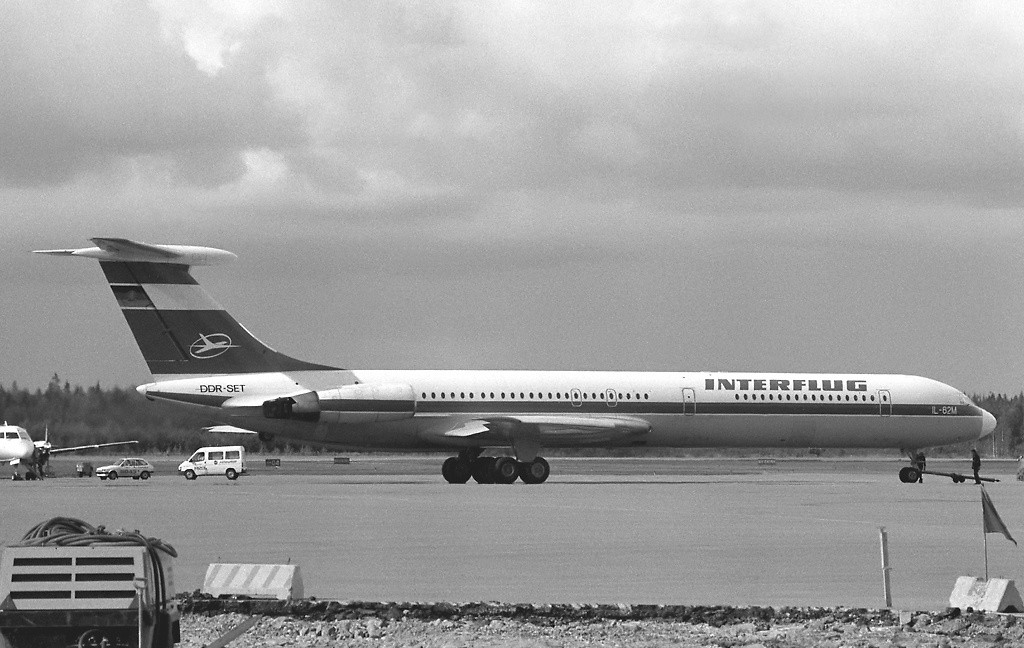
The ASN database lists 14 accidents or incidents involving the Il-62M out of 25 for the whole family. The worst was LOT Flight 5055 on 9 May 1987, which killed 183 people: a fire in the rear fuselage led to loss of control as the aircraft was returning to Warsaw. Even so, English Wikipedia states that the Il-62M had the lowest hull-loss rate within its group of comparable airliners. From 1 April 2002 it was banned from flying to the European Union for failing to meet noise standards, and in late 2008 the economic crisis removed it from scheduled passenger services in Russia. The Russian Aerospace Forces kept using it: from the end of 2015 their Il-62Ms were frequently reported at Khmeimim air base in Syria. In 2016 the average age of the examples still in service exceeded 32 years. Preserved aircraft include Interflug's DDR-SEG, "Lady Agnes", which on 23 October 1989 landed on an 860 m grass strip at Stölln-Rhinow in Germany, where it is now a museum, and Cubana's CU-T1208, displayed at Parque Lenin in Havana.
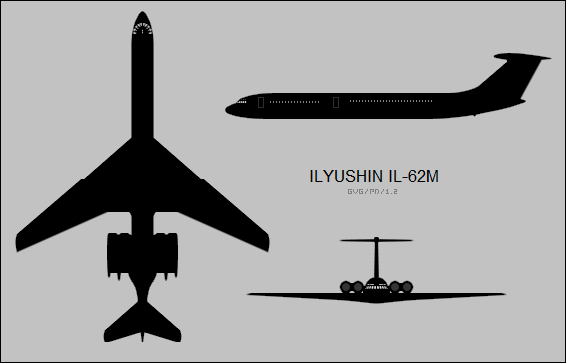
Three-view drawing
Multimedia


-800.webp)

-800.webp)
_2012-04-07_Andre_Gerwing_Collection_ID_009602-1600.webp)
_2012-04-07_Andre_Gerwing_Collection_ID_009601-1600.webp)

-800.webp)