Ilyushin Il-62 variant
Ilyushin Il-62
Initial production Il-62, built at Kazan with four Kuznetsov NK-8 engines (NK-8-4 from the 13th aircraft); it opened Aeroflot's Moscow–Montreal route in 1967.

- 94
- Units built
- 6,700 km
- Range
- 174
- Passengers
History
The production Il-62 is the initial series version of Ilyushin's long-range four-jet airliner, the aircraft that took Aeroflot into the intercontinental jet age before the re-engined Il-62M replaced it. It should not be confused with the prototypes: the first flew with interim Lyulka AL-7 turbojets because the intended engines were not ready, and the second received Kuznetsov NK-8 engines in 1964. The series aircraft used Kuznetsov engines from the start, four of them mounted in pairs on either side of the rear fuselage, beneath a T-tail.
Series production was ordered by a decree of 1 February 1964, which tasked the S. P. Gorbunov aircraft plant in Kazan with preparing it. The first production aircraft was completed in January 1966 and five more followed before the end of the year; the Ilyushin design bureau set up a branch office at the plant. The first production machines were fitted with NK-8-2 engines of 9500 kgf (about 93 kN) take-off thrust. From the 13th production aircraft onwards the NK-8-4 of 10,500 kgf was installed (103.0 kN according to aircraftinvestigation.info), in nacelles with a frontal area reduced by 1.4 m². That aircraft, first flown on 31 May 1968, also introduced an alternating-current electrical system, flat wingtips with rounded leading edges in place of the spindle-shaped tip fairings, a new shape for the leading-edge dog-tooth, doors and emergency exits sized to international standards, and compliance with ICAO requirements; all later Il-62s were built with these changes. Thrust reversers were fitted to the outer engines only.
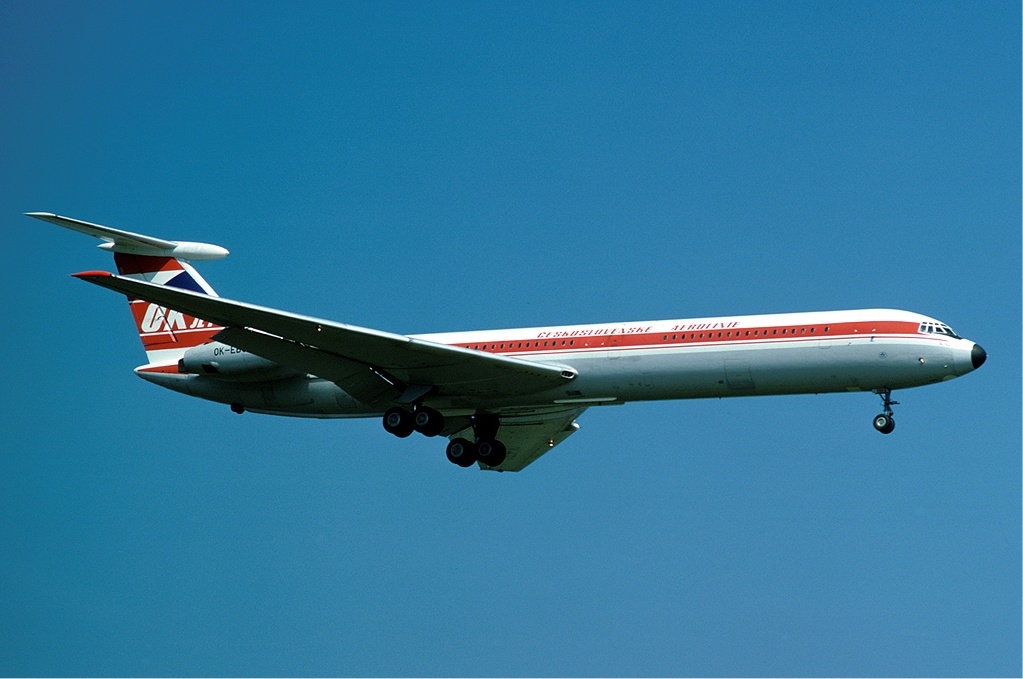
Aeroflot began using the type in 1967 on cargo services; on 10 March it inaugurated passenger and mail flights on the Moscow–Khabarovsk and Moscow–Novosibirsk routes, and on 15 September 1967 it opened the Moscow–Montreal service with it, making the Il-62 the Soviet Union's first long-range four-engined intercontinental jet transport in service. It quickly replaced the Tu-114 turboprop on long international routes, and exports only began once those needs had been met: the first, in late 1969, went to Czechoslovakia's ČSA. By mid-1973 Aeroflot was operating 60 Il-62s.
The typical two-class cabin seated 150 (12 business and 138 economy, six abreast), with up to 186 in high-density layout; the flight crew numbered five. According to aircraftinvestigation.info, empty weight was 66,400 kg, maximum take-off weight 162,000 kg and range with maximum fuel at maximum take-off weight 9200 km, with an economical cruise of 850 km/h at 10,500 m; the Virtual Aircraft Museum (aviastar.org) instead gives 157,500 kg for take-off and 67,800 kg empty. The design goal was to fly the 7700 km from Moscow to New York with more than 150 passengers and reserves. That range proved short: in 1965 the Il-62D was studied to carry 70 passengers from Moscow to Havana via Murmansk, but with NK-8-4 engines this was only possible by fitting additional tanks totalling 30,000 litres in the rear of the cabin, and Sergey Ilyushin rejected that solution. Service life was initially set at 30,000 flight hours.
Early NK-8-4-powered Il-62s suffered from engine fatigue and overheating, which sometimes caused false fire alarms and could lead crews to shut down a pair of engines on the same side, leaving the aircraft unbalanced and difficult to control. Later modifications largely cured the problem. The worst accident involving this version was LOT Flight 007 on 14 March 1980: an unmodified early Il-62 crashed with 87 fatalities after being fitted with an engine that had already caused vibration problems on two other aircraft of the airline; the investigation suggested the turbine disc had been damaged before installation.
Foreign users included ČSA, Interflug (six Il-62s), LOT, China's CAAC, Tarom (three) and Cubana. After the Il-62M arrived, Aeroflot gradually upgraded and then replaced its NK-8-powered Il-62s. Sources disagree on the number built: aircraftinvestigation.info counts 94 Il-62s at Kazan, while Russian Wikipedia gives 97 built between 1966 and 1977.
Multimedia

-800.webp)
-800.webp)
-1600.webp)
-800.webp)
.jpg)
-800.webp)