Attack · Military · United Kingdom
British Aerospace Harrier II
- April 30, 1985
- First flight
- In service
- Status


The Harrier II is the second generation of the vertical/short take-off and landing (V/STOL) combat aircraft pioneered by the British Harrier. It is a single-engine attack jet, powered by one Rolls-Royce Pegasus turbofan with four vectoring nozzles, built in the United States by McDonnell Douglas (now part of Boeing) as the AV-8B and in the United Kingdom by British Aerospace as the Harrier GR5, GR7 and GR9. Both branches share the airframe, wing and engine but differ in avionics, weapons and self-protection systems, which is why this entry treats them as a single family. The programme began in 1973 as a joint Anglo-American effort to cure the first Harrier's main weakness, its limited range and payload. Britain pulled out in 1975, and McDonnell Douglas carried on alone, reworking the AV-8A with a larger supercritical composite wing, a raised cockpit and a new fuselage. The first development AV-8B flew on 5 November 1981, the year British Aerospace rejoined the project, and the first GR5 assembled at Dunsfold took off on 30 April 1985. Later upgrades added night attack (AV-8B Night Attack and GR7) and radar (Harrier II Plus); around 340 aircraft were built over a production run of some twenty-two years that closed in 2003. The United States Marine Corps flew the type in front-line service from January 1985; the Spanish Navy became its first export customer with the EAV-8B Matador II, and the Italian Navy took it to sea aboard its light carriers. In Britain it served with the RAF and, through Joint Force Harrier, with the Royal Navy as well. Operating from assault ships, small carriers and rough forward bases, it saw combat in the 1991 Gulf War, the Balkans, Afghanistan, Iraq and Libya. The United Kingdom retired its fleet abruptly in December 2010 for budgetary reasons and sold the airframes to the United States as a source of spares; the Marine Corps stood down its last Harriers in June 2026. Its successor is the F-35B Lightning II, direct heir to the idea of a combat aircraft able to live away from conventional runways.
Related events
- First flight of the YAV-8B, the Harrier II prototype
- First flight of the full-scale development AV-8B Harrier II
- Spain orders 12 AV-8Bs, the Harrier II's first export customer
- The AV-8B Harrier II enters service with the US Marine Corps
- First flight of the British Aerospace Harrier II
- The Harrier GR5 enters RAF service
- Spanish Navy 9th Squadron formed to fly the EAV-8B
- First flight of the Harrier GR7
- Giuseppe Garibaldi sails for Somalia with three Harrier IIs
- Last operational flights of the Harrier II in the UK
- UK sells 72 Harrier IIs to the US Marine Corps
Related sheets
Category
British Aerospace Harrier II in the news
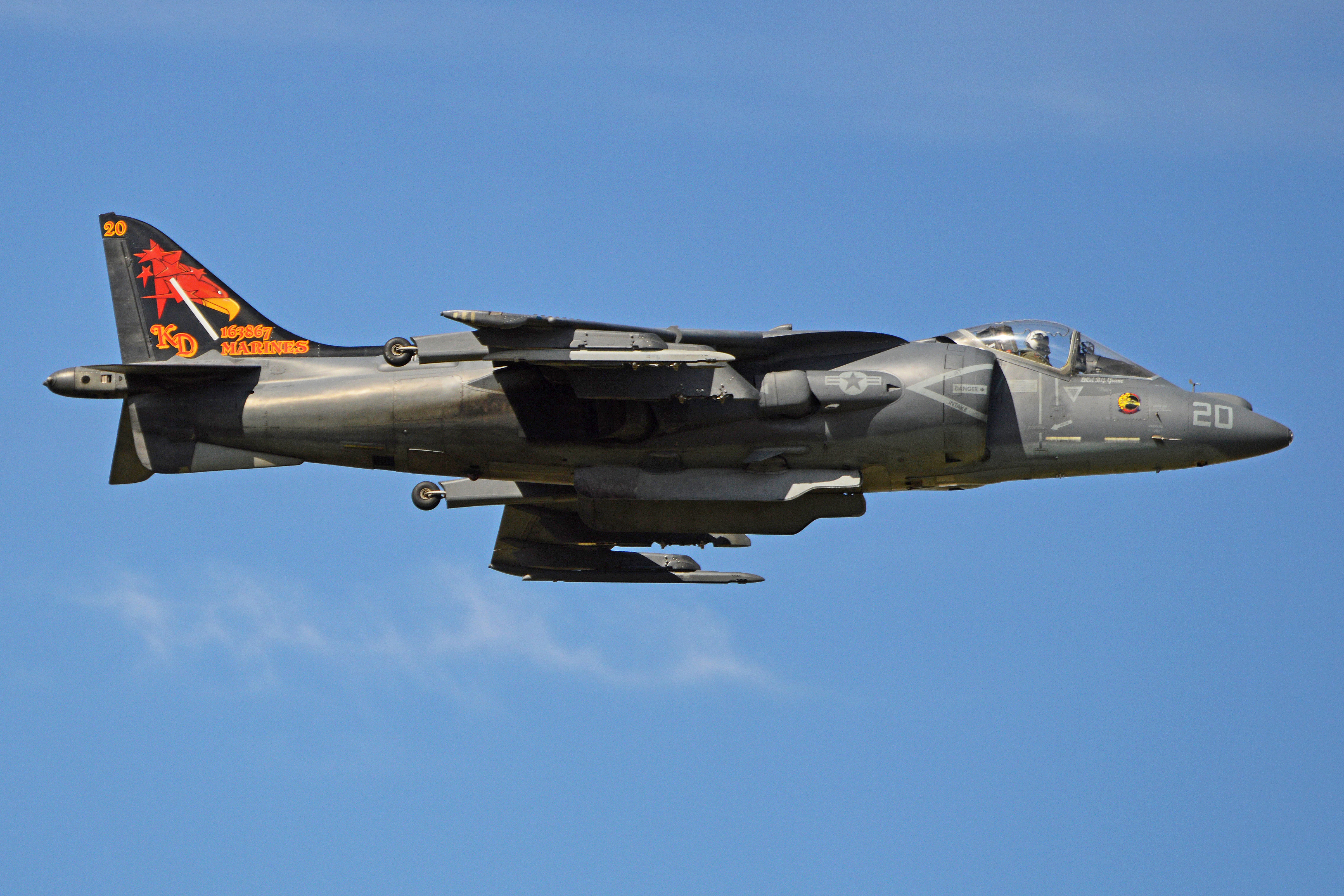
Harrier GR.7 Famous throughout the world as the first jet fighter capable of vertical take-off and landing, the Harrier was utilised by the Royal Air Force as a ground attack and reconnaissance…

After completing their final operations with the Marine Corps, US AV-8B Harrier II+ aircraft began finding new destinations following their retirement. One of the most notable cases is…
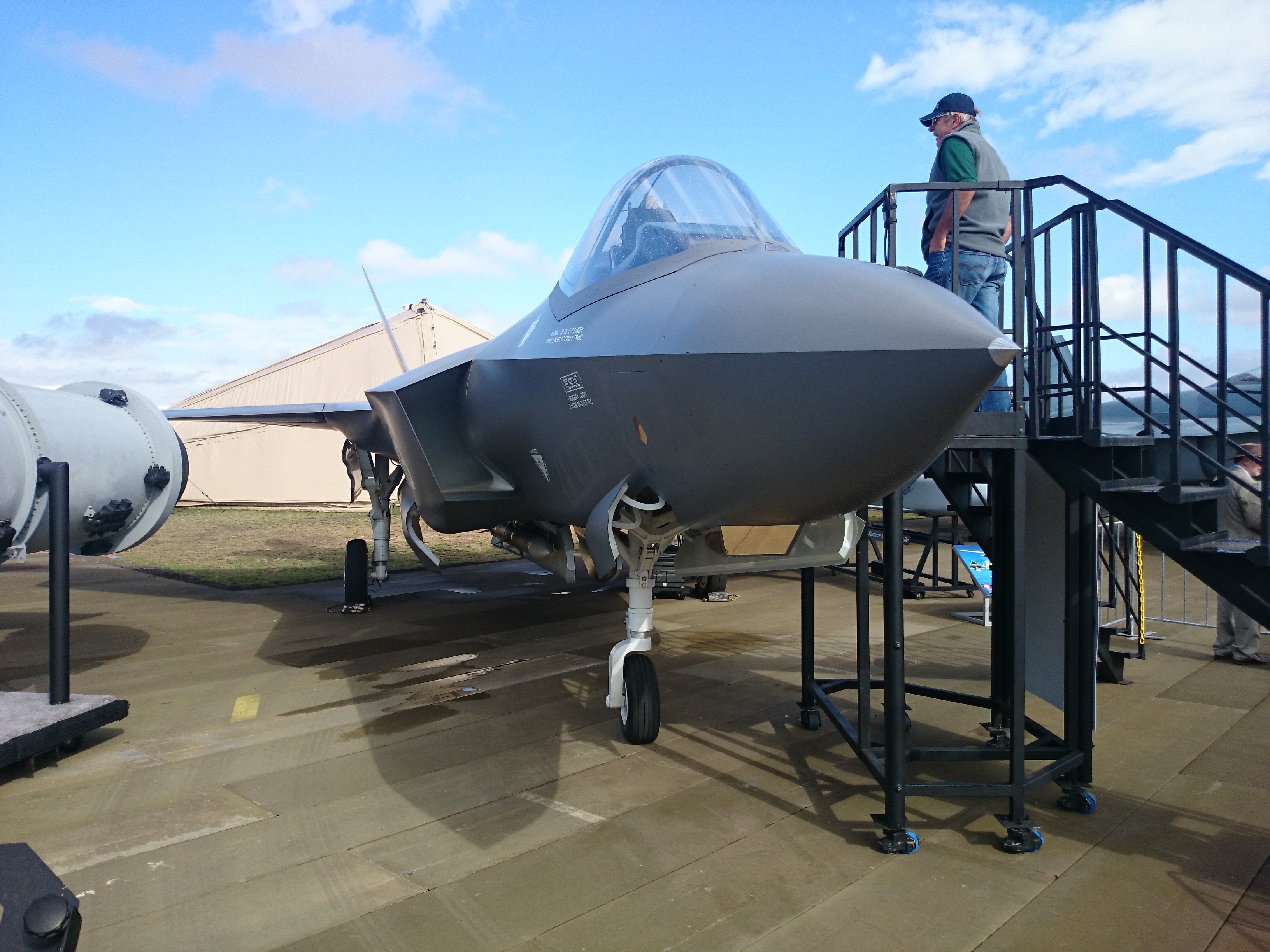
Spain is heading toward a historic shift in its naval aviation. The Armada Española's AV-8B Harrier II Plus jets will remain operational for the coming years, but it's already clear the fleet…

History
Looking for a better Harrier
When the first-generation Harriers joined the Royal Air Force and the United States Marine Corps (USMC) in the late 1960s and early 1970s, their ability to operate from almost anywhere came at a price: short range and a modest payload. In a short take-off, the AV-8A, as the Americans designated the Harrier, lifted less than half the bomb load of the small A-4 Skyhawk. In 1973 Hawker Siddeley and McDonnell Douglas began working together on a more capable successor.
The first approach relied on a more powerful engine, the Pegasus 15 then under test at Bristol Siddeley, but it was some 70 mm too wide to fit the Harrier comfortably. In December 1973 a joint team completed a project document for an advanced Harrier built around it, intended to replace the RAF and USMC Harriers and the Marines' A-4s. Because it aimed to double the AV-8's payload and range, it was informally called the AV-16. Britain withdrew in March 1975, citing shrinking defence budgets, rising costs and an RAF requirement for only 60 aircraft; unwilling to fund development alone, the United States dropped the project later that year.

The two companies then went separate ways. Hawker Siddeley studied a larger metal wing that could be retrofitted to existing Harriers, while McDonnell Douglas used the lessons of the AV-16, minus the bigger engine, to pursue a less ambitious aircraft tailored to the Marines that kept the basic structure and the existing Pegasus.
The AV-8B takes shape and Britain returns
The Department of Defense authorised Harrier II development in 1976. The Navy, which bought the Marines' aircraft, demanded flight verification, so McDonnell Douglas rebuilt two AV-8As with new wings, revised intakes, redesigned nozzles and other aerodynamic changes. Designated YAV-8B, the first flew on 9 November 1978 at Lambert–St. Louis airport, making three vertical take-offs and hovering for seven minutes. The second followed on 19 February 1979 but was lost that November after an engine flameout; the pilot ejected safely. The tests showed higher drag than expected, which cut maximum speed, but payload, range and V/STOL results were encouraging, and a development contract followed in 1979 for 12 initial aircraft and a further 324.
Between 1978 and 1980 the Pentagon and the Navy repeatedly tried to kill the programme, the Navy preferring the Marines to adopt a version of the future Hornet for close air support. Even so, the Harrier II appeared in the 1981 budget and five-year defence plan. In August 1981 British Aerospace and McDonnell Douglas signed a memorandum of understanding that brought Britain back in, attracted by the lower unit cost of a long production run and by a development effort already paid for by the United States. Having left earlier, BAe returned as a subcontractor rather than a full partner, with 40% of the airframe work by man-hours; on the engine, Rolls-Royce took 75% and Pratt & Whitney 25%. The plan was for 400 Harrier IIs, 336 for the Marines and 60 for the RAF. According to the British material, full UK involvement was confirmed in 1982, with a 280 million US dollar contribution to development, a commitment to buy at least 60 aircraft and BAe building sections such as the rear fuselage for every customer.
Four full-scale development aircraft were built. The first, used mainly for performance and handling trials, flew on 5 November 1981; the second and third, which introduced leading-edge root extensions and revised intakes, followed in April of the next year, and the fourth in January 1984. The first production AV-8B reached training squadron VMAT-203 at Cherry Point on 12 December 1983, and the last of the first batch of 12 went to front-line squadron VMA-331 in January 1985, when the type reached initial operating capability. These early aircraft used the 95.4 kN F402-RR-404A engine; improved engines arrived from 1990.
Design: composites, a supercritical wing and a raised cockpit
Outwardly the Harrier II resembles the original, with shoulder-mounted wings of pronounced anhedral, horizontal stabilisers and a single Pegasus fed by two intakes and exhausting through four synchronised nozzles, two cold ones forward and two hot ones aft, plus small reaction-control nozzles in the nose, tail and wingtips for low-speed control. Underneath, McDonnell Douglas redesigned almost everything. The cockpit was raised by 27 cm under a new canopy to improve forward, side and rearward view, the rear fuselage was stretched by 46 cm to compensate, and the taller fin of the Sea Harrier was adopted.
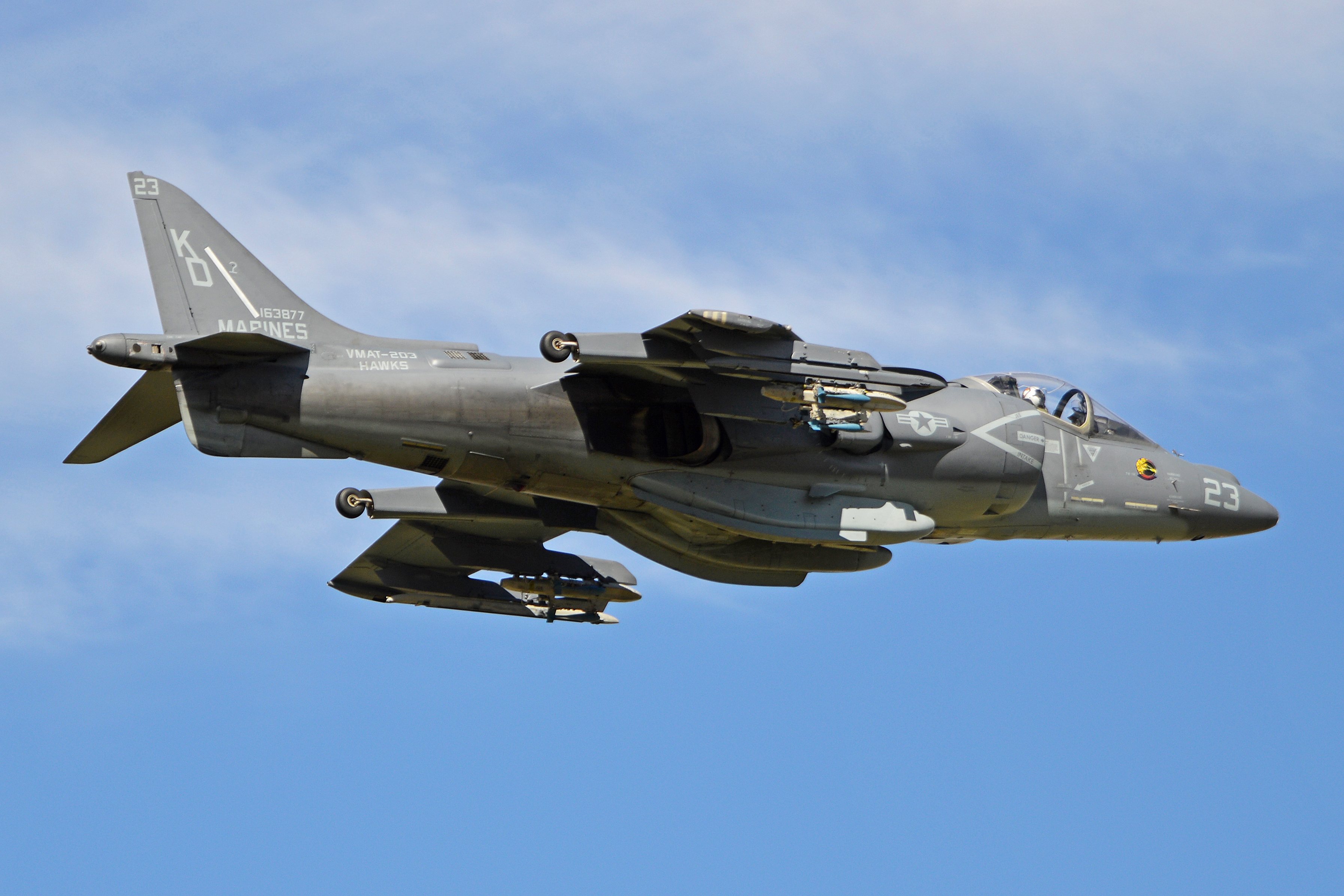
The biggest change was the wing: a one-piece supercritical composite structure, thicker and of greater span than the AV-8A's, with sweep reduced from 40° to 37°, area increased from 18.6 to 21.4 m², automatic manoeuvring flaps and drooped ailerons. Combined with the root extensions, it allowed far heavier loads after a short take-off run, yet weighed 150 kg less than the smaller wing it replaced. The Harrier II was the first combat aircraft to make extensive use of carbon-fibre composites, in the wings, rudder, flaps, nose, forward fuselage and tail; they made up 26% of the structure and saved 217 kg over a metal design. Lift-improvement devices under the fuselage trapped the engine exhaust reflected from the ground, adding up to 544 kg of extra lift in the hover.
The AV-8B gained a centreline station and six wing hardpoints, compared with four on the first Harrier, plus two fuselage stations for the 25 mm GAU-12 cannon and its ammunition. Internal fuel rose by 50%, and with drop tanks and probe-and-drogue refuelling the combat radius was about 556 km. The cockpit adopted hands-on-throttle-and-stick controls and a large multi-purpose display taken from the F/A-18, and pilots sat on UPC/Stencel 10B zero-zero ejection seats. Together with greater lateral stability, these changes made the aircraft fundamentally easier to fly than its predecessor.
The British branch: GR5, GR7 and GR9
The British Harrier II was an Anglicised AV-8B in which British Aerospace acted as prime contractor and McDonnell Douglas as subcontractor, with final assembly at Dunsfold. The first BAe-built development GR5 flew on 30 April 1985, the type entered service in July 1987 and the first RAF squadron to receive it was declared operational in December 1989. Compared with the Marines' aircraft, the GR5 had different avionics, weapons and equipment; its wing used a stainless steel leading edge to meet tougher bird-strike requirements, which changed its flex characteristics, and it carried an extra missile pylon ahead of each main landing gear leg. Its ZEUS electronic countermeasures suite was one of the costliest parts of the package, estimated at 1.7 million US dollars per set. The cockpit had a head-up display, two colour multi-purpose displays, a digital moving map and inertial navigation. Forty-one GR5s and twenty-one GR5As were built, the latter a minor variant prepared for the next upgrade.
Unlike the Sea Harrier and the AV-8B Plus, British Harrier IIs never carried radar, relying on the short-range Sidewinder for air combat. When the Sea Harrier was retired, transferring its Blue Vixen radar was suggested, but the Ministry of Defence rejected the idea as risky and costly, at an estimated price of more than 600 million pounds.
Even before the GR5 entered service, it was clear it needed more for the interdiction role. The GR7, developed alongside a parallel USMC programme, added night capability and new avionics: a nose-mounted forward-looking infrared sensor, night-vision goggles, a missile approach warning system, countermeasures, new displays and a replacement moving map. It first flew in May 1990, and once 34 GR7s had been delivered in 1991 every GR5 was upgraded to the same standard. Some aircraft received the Pegasus Mk 107, about 13 kN more powerful than the Mk 105, and became GR7As, with better take-off, landing and load-carrying performance. From 1998 a small number of TIALD laser designator pods became available, though they were always scarce, and the Kosovo war prompted the fitting of encrypted radios to communicate with other NATO aircraft.
The final major upgrade was the GR9, produced through the Joint Update and Maintenance Programme (JUMP), which modernised avionics, communications and weapons in stages during scheduled maintenance. It replaced the GR7's composite rear fuselage with a metal one less vulnerable to engine vibration and added the AGM-65 Maverick, Paveway guided bombs, the RAIDS debriefing system, SIFF identification and the Digital Joint Reconnaissance Pod. Brimstone missile trials began in February 2007 but the weapon was never cleared on the GR9, and that year the Sniper pod replaced TIALD under an urgent requirement for Afghanistan. In July 2007 BAE Systems completed the last of seven replacement rear fuselages under a three-year, 20 million pound programme, and in 2008 Qinetiq won a contract to support the fleet until 2018, then the expected retirement date. Every GR9 could take either the Mk 105 or the Mk 107; with the latter fitted it became a GR9A. The two-seat T10, based on the TAV-8B but fully combat-capable, followed the same path: nine were updated as T12s, and a T12A configuration with the Mk 107 was proposed for hover training in hot summer months.
Night Attack, Harrier II Plus and the end of production
In 1984 funding for eight AV-8Bs was diverted to a two-seat TAV-8B trainer, with a lengthened forward fuselage for the second cockpit and an enlarged fin; it first flew on 21 October 1986 and was also ordered by Italy and Spain. Export interest from Brazil, Japan and Italy encouraged McDonnell Douglas to start work on a night-attack version in 1985. The 87th production AV-8B left the line with the new equipment in June 1987, and the first of 66 AV-8B(NA)s was delivered in September 1989. Originally called AV-8D, the Night Attack Harrier was fielded in 1991 with a FLIR above the nose, a wide Smiths Industries head-up display, night-vision goggle compatibility, a digital moving map and the more powerful and reliable F402-RR-408 engine.

In June 1987 BAe, McDonnell Douglas and Smiths Industries agreed, as a private venture, to develop the Harrier II Plus, adding an APG-65 multi-mode radar taken from early F/A-18s in a longer nose and the ability to fire beyond-visual-range missiles such as the AIM-120 AMRAAM. The United States, Spain and Italy signed a memorandum in September 1990, and on 30 November that year McDonnell Douglas received the development contract. The Marines ordered 30 new and 72 rebuilt aircraft, Italy 16 Plus and two TAV-8Bs, and Spain eight; besides the American plant, aircraft were produced at CASA in Seville and Alenia in Turin. The prototype flew on 22 September 1992 and the first production aircraft on 17 March 1993. Although the General Accounting Office concluded in 1996 that buying new aircraft was cheaper than rebuilding old ones, remanufacture went ahead: the last new AV-8B was delivered in 1997 and the last rebuilt Spanish aircraft in December 2003, ending production. Between 1969 and 2003, 824 Harriers of all models were delivered. From 1990 McDonnell Douglas and British Aerospace also studied a larger Harrier III with an enlarged folding wing, abandoned in the early 2000s.
With the Marines
The AV-8B's operational evaluation ran from 31 August 1984 to 30 March 1985, testing deep and close air support, interdiction, armed reconnaissance, escort and combat air patrol from bases in California, Arizona and Canada. In the Gulf War, AV-8Bs flew from USS Nassau, USS Tarawa and shore bases, entering combat on 17 January 1991 against Iraqi artillery shelling Khafji. The 86 aircraft involved kept mission availability above 90%; five were lost to surface-to-air missiles and two pilots were killed. General Norman Schwarzkopf named the AV-8B among the seven weapons that played a crucial role in the war. Southern Watch patrols over Iraq followed, then Kosovo in 1999 with twelve aircraft split between two expeditionary units, Afghanistan from 3 November 2001 and the 2003 invasion of Iraq, where 60 AV-8Bs operated from ships and forward arming points. Their main limitation was short time on station, about fifteen to twenty minutes.
On 20 March 2011 Harriers from USS Kearsarge joined the Libya operation, and on 14 September 2012 a Taliban raid on Camp Bastion destroyed six AV-8Bs, described as the worst loss of US air power in a single incident since Vietnam. From 2014 the type flew against the Islamic State in Iraq and, in 2016, in Libya; in January 2024, during the Red Sea crisis, a Harrier modified for air defence shot down seven Houthi drones. The aircraft also had a high accident rate, linked to the share of time spent in critical take-off and landing phases. The Marine Corps officially retired its Harriers in June 2026, replacing them with the F-35B.
Italy and Spain
In Italy, a 1937 law barred the navy from flying fixed-wing aircraft; it was amended in 1989, and in May that year two TAV-8Bs were ordered, followed by 16 AV-8B Plus, almost all assembled by Alenia from US-supplied kits. The two-seaters reached Grottaglie in August 1991. Embarked on Giuseppe Garibaldi, Italian Harriers deployed to Somalia in 1995, flew their first combat missions over Kosovo in 1999, supported Enduring Freedom in 2001 and 2002 with 131 missions, and in Libya in 2011 eight aircraft dropped 160 guided bombs. They are to be replaced by the F-35Bs of the carrier Cavour.
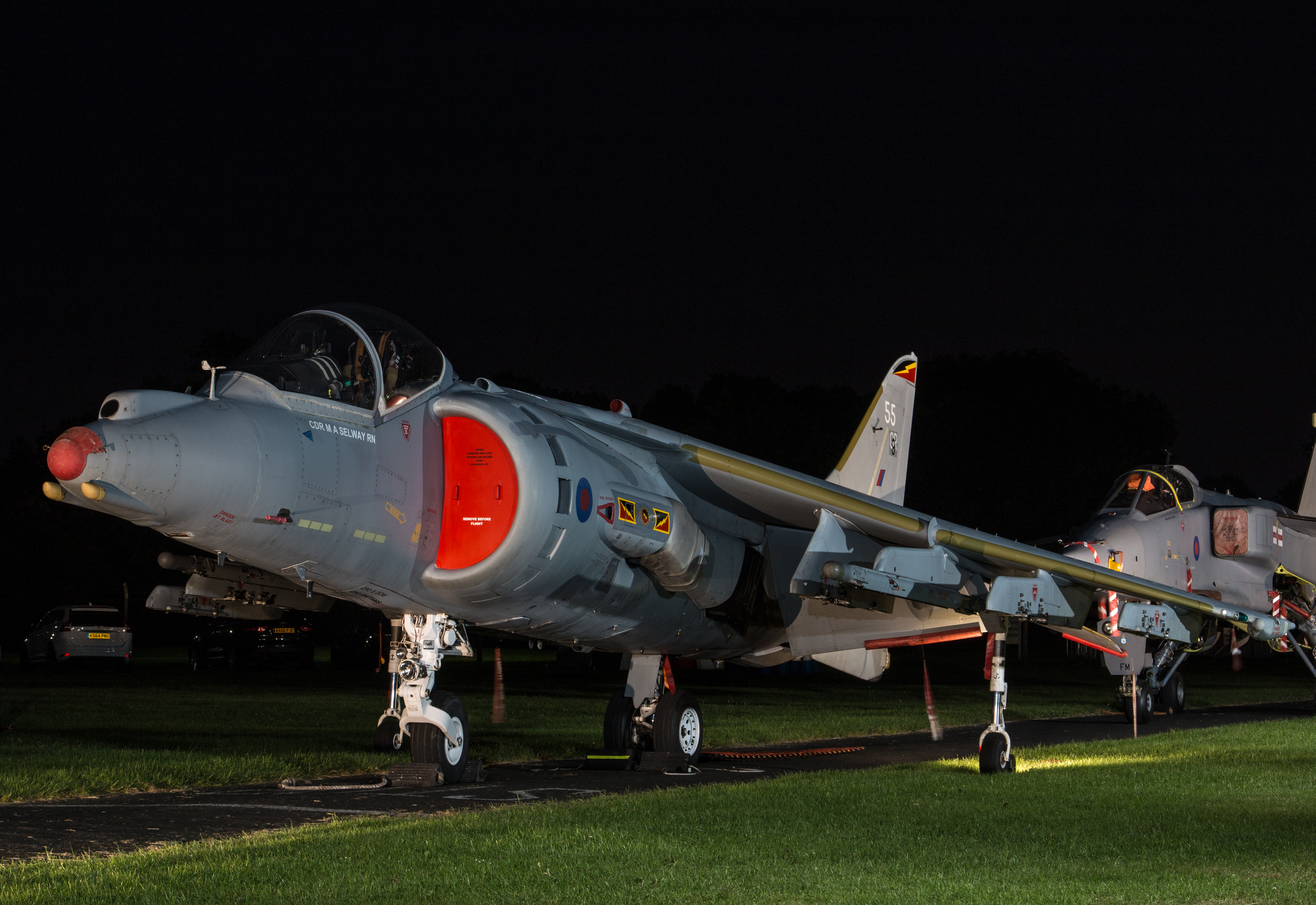
Spain, already flying the AV-8S Matador, became the first export customer for the AV-8B with an order for 12 in March 1983; the navy called it VA-2 Matador II and the manufacturer EAV-8B. The first three arrived at Rota on 6 October 1987 for the 9a Escuadrilla, formed on 29 September that year, and in July 1989 BAe test pilots cleared the carrier Príncipe de Asturias, with its 12° ski-jump. Eight EAV-8B Plus and a two-seater were ordered in March 1993, with deliveries from 1996, and in 2000 a contract was signed to bring earlier aircraft up to Plus standard; five were eventually converted, the last in December 2003. Spanish Harriers took part in Deny Flight over Bosnia; in 2014 the government chose to extend their service beyond 2025 for lack of funds for a replacement, and since Príncipe de Asturias was decommissioned in 2013 their only ship has been Juan Carlos I.
The RAF and Joint Force Harrier at war
The first British squadrons were based with RAF Germany, tasked with deterring the Warsaw Pact and, in war, striking ground targets; the type's greater range and survivability shifted the emphasis towards interdiction. It was judged too immature for the 1991 Gulf War, but from 1993 it patrolled the no-fly zones over Iraq, and by 1994 it had fully replaced the first-generation Harriers. In 1995 a squadron at Gioia del Colle flew more than 126 strike sorties over Bosnia, often with Jaguars designating targets for laser-guided bombs. The GR7 carried out trials on the Invincible-class carriers in June 1994 and began operational embarkations in 1997, over Iraq from the Persian Gulf in 1998 and over Sierra Leone in 2000 alongside Sea Harrier FA2s. The 1998 Strategic Defence Review created Joint Force Harrier, based mainly at Cottesmore, which merged RAF and Navy operations and served as a rehearsal for joint F-35 operations.
Over Kosovo in 1999, twelve GR7s flew alongside RAF Tornados and logged 870 sorties during the 78-day air campaign. During the 2003 invasion of Iraq (Operation Telic), GR7s flew reconnaissance and strike missions in the south, partly to hunt Scud launchers, used the newly integrated Maverick, firing 38 of them, and struck fuel depots, tanks and artillery in the battle of Basra. In September 2004 six GR7s arrived at Kandahar to replace a US AV-8B detachment; on 14 October 2005 a rocket attack destroyed a GR7A on the ground. The Helmand campaign sent demand soaring: between July and September 2006 the munitions expended by British Harriers rose from 179 to 539, mostly CRV-7 rockets, and the aircraft moved to round-the-clock availability. The GR9 made its operational debut at Kandahar in January 2007, and after five years of continuous operations and more than twenty-two thousand flying hours the last Harriers left Afghanistan in June 2009, replaced by Tornado GR4s.
British retirement and succession
In 2005 Parliament heard claims that maintenance standards had fallen after servicing was concentrated at Cottesmore. In 2006 the Sea Harrier was retired and the GR7/9 fleet took over its missions: 800 Naval Air Squadron re-formed with them in April 2006, 801 joined in 2007, and the two became the Naval Strike Wing. The last GR7s were retired by July 2010. The GR9 was meant to serve until at least 2018, but the Strategic Defence and Security Review of 19 October 2010 announced its withdrawal, a controversial decision that left Britain without carrier-capable fixed-wing aircraft until the F-35B arrived aboard the Queen Elizabeth-class carriers. On 24 November 2010 a Harrier made the last launch from HMS Ark Royal, and on 15 December the fleet flew its final operational sorties with flypasts over several bases. In November 2011 the Ministry of Defence sold 72 Harrier IIs and spares to the United States for 116 million pounds (180 million US dollars) to support the AV-8B fleet; reports that some would fly again were denied by NAVAIR in June 2012. Surviving GR5, GR7 and GR9 airframes are preserved at museums including the RAF Museum at Hendon, the Fleet Air Arm Museum at Yeovilton, the Imperial War Museum in London and the Pima Air & Space Museum in Arizona.
Variants
| YAV-8B | AV-8B Harrier II | Harrier GR.5 | TAV-8B Harrier II | AV-8B Harrier II Plus | AV-8B Harrier II Night Attack | EAV-8B Matador II | EAV-8B Matador II Plus | Harrier GR.5A | Harrier GR.7 | Harrier GR.7A | Harrier GR.9 | Harrier GR.9A | Harrier T.10 | Harrier T.12 | Harrier T.12A | TAV-8B Harrier II Plus | |
|---|---|---|---|---|---|---|---|---|---|---|---|---|---|---|---|---|---|
| First flight | November 9, 1978 | November 5, 1981 | April 30, 1985 | October 21, 1986 | September 22, 1992 | — | — | — | — | — | — | — | — | — | — | — | — |
| Powerplant | — | 1 × Rolls-Royce F402-RR-404A | 1 × turbofan | 1 × Rolls-Royce F402-RR-406A | 1 × Rolls-Royce Pegasus F402-RR-408 (Mk 107) | 1 × Rolls-Royce Pegasus 11 | — | — | 1 × turbofan | 1 × Rolls-Royce Pegasus Mk. 105 | 1 × Rolls-Royce Pegasus Mk 107 | 1 × turbofan | 1 × Rolls-Royce Pegasus Mk 107 | 1 × turbofan | 1 × Rolls-Royce Pegasus 105 | 1 × Rolls-Royce Pegasus Mk 107 | — |
| Thrust per engine | — | 95.4 kN | — | 95.4 kN | 105 kN Best value in this row | — | — | — | — | 96.7 kN | — | — | — | — | — | — | — |
| Length | — | — | — | — | 14.1 m Best value in this row | — | — | — | — | 14.1 m Best value in this row | — | — | — | — | — | — | — |
| Wingspan | — | — | — | — | 9.3 m Best value in this row | — | — | — | — | 9.3 m Best value in this row | — | — | — | — | — | — | — |
| Height | — | — | — | — | 3.6 m | — | — | — | — | 3.6 m Best value in this row | — | — | — | — | — | — | — |
| Wing area | — | — | — | — | 22.6 m² Best value in this row | — | — | — | — | 22.6 m² | — | — | — | — | — | — | — |
| Empty weight | — | — | — | — | 6,340 kg | — | — | — | — | 5,670 kg Best value in this row | — | — | — | — | — | — | — |
| MTOW | — | — | — | — | 14,100 kg Best value in this row | — | — | — | — | 14,061 kg | — | — | — | — | — | — | — |
| Top speed | — | — | — | — | 1,083 km/h Best value in this row | — | — | — | — | 1,065 km/h | — | — | — | — | — | — | — |
| Service ceiling | — | — | — | — | — | — | — | — | — | 15,000 m | — | — | — | — | — | — | — |
| Initial climb rate | — | — | — | — | 75 m/s Best value in this row | — | — | — | — | 74.8 m/s | — | — | — | — | — | — | — |
| Range | — | — | — | — | 2,200 km | — | — | — | — | — | — | — | — | — | — | — | — |
| Ferry range | — | — | — | — | 3,300 km Best value in this row | — | — | — | — | 3,256 km | — | — | — | — | — | — | — |
| Combat radius | — | — | — | — | 556 km Best value in this row | — | — | — | — | 556 km Best value in this row | — | — | — | — | — | — | — |
| Max weapons load | — | — | — | — | — | — | — | — | — | 3,650 kg | — | — | — | — | — | — | — |
| Crew | — | 1 Best value in this row | 1 Best value in this row | 2 | 1 Best value in this row | 1 Best value in this row | 1 Best value in this row | 1 Best value in this row | 1 Best value in this row | 1 Best value in this row | 1 Best value in this row | 1 Best value in this row | 1 Best value in this row | 2 | 2 | 2 | 2 |
| Units built | 2 | — | 41 | — | — | 66 Best value in this row | 12 | — | 21 | 34 | — | — | — | — | — | — | 2 |
Images
Elsewhere
- 2nd Marine Aircraft WingAV-8B Harrier II of VMA-223 at Cherry Point, June 2026 (retirement of the type) ↗
- Marines.milAV-8B Harrier II, US Marine Corps official photo ↗
- MCAS Cherry PointAV-8B Harrier II landing at MCAS Cherry Point, 2017 ↗
- Air Combat CommandAV-8B Harrier II of the 22nd MEU landing at Al Dhafra Air Base, 2019 ↗
- Digital Public Library of AmericaAV-8B Harrier II of VMA-513 at Yuma, Desert Shield era (1992), NARA ↗
- Boeing ImagesAV-8B Harrier II, Boeing image library ↗
- JetPhotosAV-8B Harrier II of VMA-214 aboard USS Bonhomme Richard, 2013 ↗
- JetPhotosAV-8B Harrier II at Yuma airshow, 2009 ↗
- Aerospaceweb.orgAV-8B Harrier II gallery: Italian, Spanish and British variants ↗
- Royal International Air TattooEAV-8B Matador II Plus of the Spanish Navy at RIAT 2019 ↗
- FlightAwareSpanish Navy EAV-8B Harrier II Plus (Matador II+) ↗
- AirHistory.netBAe Harrier GR9 ZG477 at RAF Museum Cosford, 2012 ↗