British Aerospace Harrier II variant
British Aerospace Harrier II Harrier GR.9
The last version of the British Harrier II, produced by upgrading the GR7 step by step under the JUMP programme: new avionics, communications and weapons and a metal rear fuselage. It deployed to Afghanistan from January 2007, replaced the GR7 and was retired early in December 2010 after the Strategic Defence and Security Review; the following year the fleet was sold to the US Marine Corps as a source of spares.
British Aerospace Harrier II sheet

History
Upgrading without grounding the fleet
The Harrier GR9 was the last major step in the British Harrier II story. It was produced from the GR7 through the Joint Update and Maintenance Programme (JUMP), which upgraded the fleet's avionics, communications and weapons incrementally, taking advantage of each aircraft's scheduled maintenance. That way the aircraft did not have to be taken out of service for long periods.
Capability by capability
The improvements were organised as successive capabilities. The first brought software upgrades to the communications, ground proximity warning and navigation systems, followed by integration of the AGM-65 Maverick air-to-ground missile. Capability C added the RAF's Rangeless Airborne Instrumentation Debriefing System (RAIDS), Raytheon's Successor Identification Friend or Foe (SIFF) and Paveway guided bombs, and Capability D brought the Digital Joint Reconnaissance Pod (DJRP). Capability E would have added a Link 16 data link, an auxiliary communications system and a Tactical Information Exchange Capability also planned for the Tornado GR4.
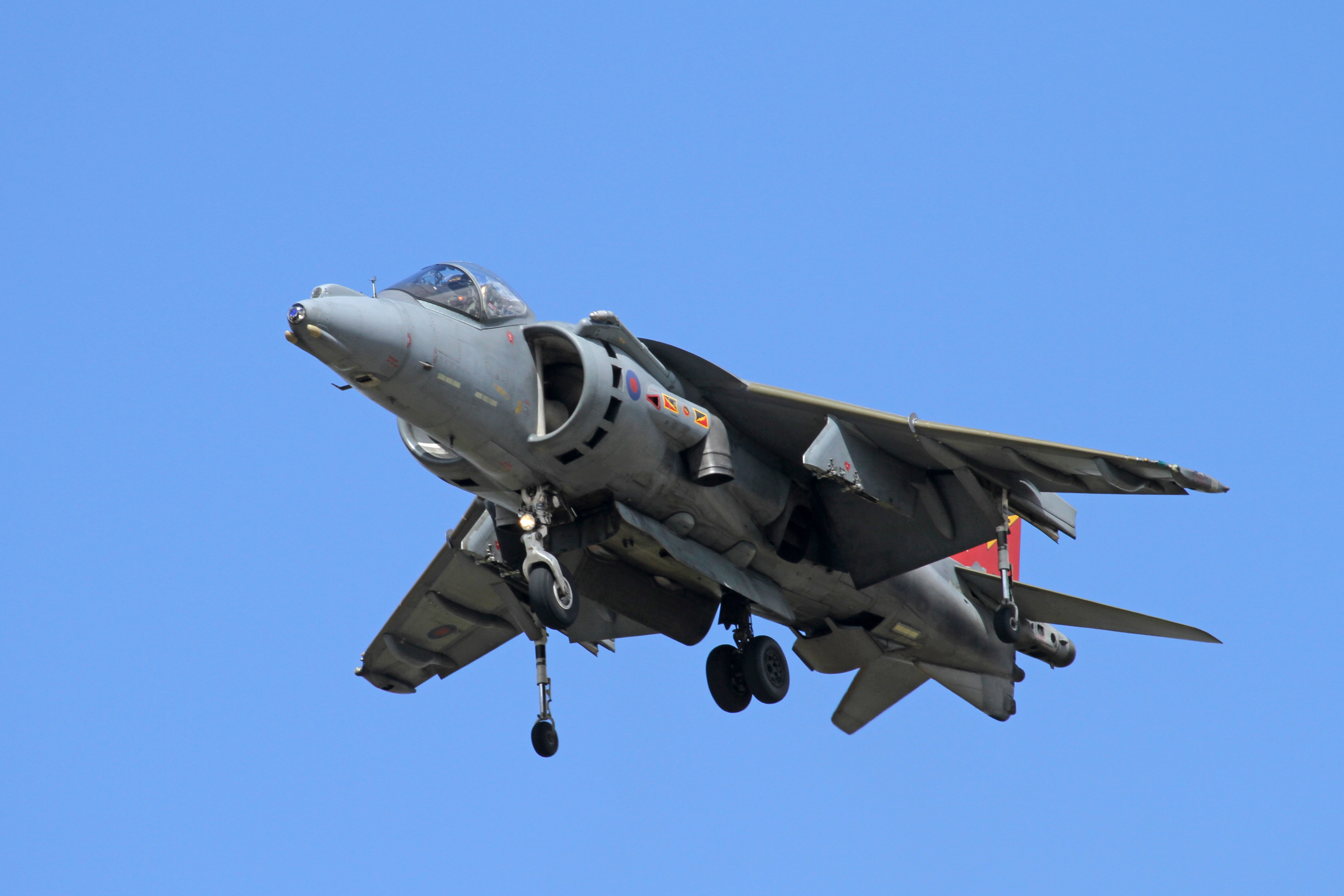
Not everything came to fruition. Handling trials of the Brimstone missile began in February 2007, but the weapon was never cleared on the GR9 before its early retirement. On the other hand, the same year the Sniper pod replaced the less accurate TIALD under an urgent operational requirement for Afghanistan.
A metal rear fuselage
The GR9 also changed the structure, replacing the GR7's composite rear fuselage with a metal one that was less vulnerable to damage from engine vibration. In July 2007 BAE Systems completed the last of seven replacement rear fuselages for the Ministry of Defence, under a three-year, 20-million-pound programme. In July 2008 Qinetiq won a contract to upgrade and maintain the fleet until 2018, then the planned out-of-service date.
GR9, GR9A and the trainers
Every GR9 was modified to take either the Pegasus Mk 105 or the more powerful Mk 107. An airframe with a Mk 107 fitted became a GR9A, and if a Mk 105 was later refitted it reverted to GR9; the Ministry of Defence had bought only a limited number of Mk 107s and allocated them by tasking. Converted GR7As kept the A suffix. To accompany the GR9, nine T10 two-seaters received the JUMP updates as T12s, keeping the Pegasus 105; the T12A configuration, with the Mk 107, allowed longer hover training at higher fuel weights in hot summer months.
Afghanistan
In January 2007 the GR9 began its first operational deployment at Kandahar, as part of NATO's International Security Assistance Force, and the GR7s were progressively withdrawn in its favour. After five years of continuous operations, the last British Harriers left Afghanistan in June 2009, having flown over 22,000 hours on 8,500 sorties, and were replaced by Tornado GR4s.
At sea and retirement
When the Sea Harrier was retired in 2006, the GR7 and GR9 took over its embarked missions: 800 Naval Air Squadron re-formed with them in April 2006, 801 joined it in 2007, and the two later became the Naval Strike Wing. The GR9 was expected to serve until at least 2018, but on 19 October 2010 the Strategic Defence and Security Review announced its retirement by April 2011. The decision was controversial because it left Britain without fixed-wing aircraft able to fly from its carriers. On 24 November 2010 the Harrier made its last carrier flight, which was also the last from HMS Ark Royal, and the final operational flights took place on 15 December 2010. In November 2011 the Ministry of Defence sold 72 Harrier IIs and spares to the US Marine Corps for 116 million pounds as a source of components; a magazine reported that some GR9s and GR9As would fly again, but US Naval Air Systems Command denied it in June 2012.
Multimedia


