British Aerospace Harrier II variant
British Aerospace Harrier II AV-8B Harrier II Plus
The radar-equipped Harrier II, derived from the Night Attack with an APG-65 radar in a lengthened nose that lets it fire beyond-visual-range AIM-120 AMRAAM missiles. Begun as a private venture in 1987 and developed jointly by the United States, Italy and Spain, its prototype flew on 22 September 1992, and it served with the US Marine Corps, the Italian Navy and the Spanish Navy.
British Aerospace Harrier II sheet

- September 22, 1992
- First flight
- 2,200 km
- Range
History
A private venture
The Night Attack had given the Harrier II eyes for the dark, but it still had no radar, which limited its air-defence value and its use of long-range missiles. In June 1987, as a private venture, British Aerospace, McDonnell Douglas and Smiths Industries agreed to develop what became the AV-8B Plus, adding radar and wider missile compatibility. The US Marine Corps endorsed the idea and, after much consideration, the Spanish and Italian navies drew up a joint requirement for a fleet of air-defence Harriers.
A three-nation programme
The United States, Spain and Italy signed a memorandum of understanding in September 1990 that set out each country's responsibilities and created a Joint Program Office. On 30 November 1990 the US Navy, acting for all three, awarded McDonnell Douglas the contract to develop the improved Harrier. The Marines' order followed in December: 30 new aircraft and 72 rebuilt from existing airframes. Italy ordered 16 Harrier II Plus and two TAV-8B two-seaters, and Spain signed for eight. Besides McDonnell Douglas' own plant, production was shared with CASA in Seville and Alenia Aeronautica in Turin, and the United Kingdom built components.
Production was authorised on 3 June 1992. The prototype flew on 22 September that year, opening a smooth flight-test programme; the first production aircraft took off on 17 March 1993 and new-build deliveries ran from April 1993 to 1995.
Hornet radar in a longer nose
The Harrier II Plus is very close to the Night Attack, adding an APG-65 multi-mode pulse-Doppler radar in an extended nose that allows it to launch beyond-visual-range missiles such as the AIM-120 AMRAAM. To make room, the television and laser angle-rate bombing system of earlier versions was removed. The radars came from early F/A-18s that had been upgraded with the APG-73. According to Lon Nordeen the changes added a little drag and weight, but there was hardly any difference in performance from the Night Attack. Reference figures are a length of 14.12 m, a span of 9.25 m, an empty weight of 6,340 kg, a rolling take-off maximum weight of 14,100 kg, a top speed of 1,083 km/h and the 105 kN Pegasus F402-RR-408 (Mk 107) engine.
Rebuilding instead of building
In parallel, the plan to convert existing AV-8Bs to Plus standard with new and refurbished parts went ahead. The Defense Acquisition Board approved it on 11 March 1994, initially for 70 aircraft; conversion began in April 1994 and the first aircraft reached the Marines in January 1996. That year the General Accounting Office argued that buying new aircraft was cheaper than rebuilding old ones, but the programme continued and in 2003 the 72nd and last remanufactured aircraft was delivered to the Marines. Spain also rebuilt its EAV-8Bs: the contract was finalised on 11 May 2000 and the last of five modified aircraft was delivered on 5 December 2003, ending AV-8B production; the final new aircraft had come off the line in 1997. Sources disagree on the number of new-builds: one gives 46, another 43 built from 1993 to 1997, plus the 72 conversions.
In Italian service
In 1989 Italy lifted the law that barred its navy from flying fixed-wing aircraft. Apart from the two-seaters and the first three single-seaters, its Harrier II Plus fleet was assembled by Alenia from kits shipped from the United States. Early in 1995 the carrier Giuseppe Garibaldi sailed for Somalia with three Harriers aboard; in 1999 the Italian aircraft saw combat over Kosovo, flying more than 60 sorties, and from November 2001 to March 2002 eight of them flew 131 missions in support of Enduring Freedom. Over Libya in 2011 the eight embarked AV-8Bs dropped 160 guided bombs in 1,221 flight hours, also armed with AMRAAMs and Sidewinders.
Spain's Matador II Plus
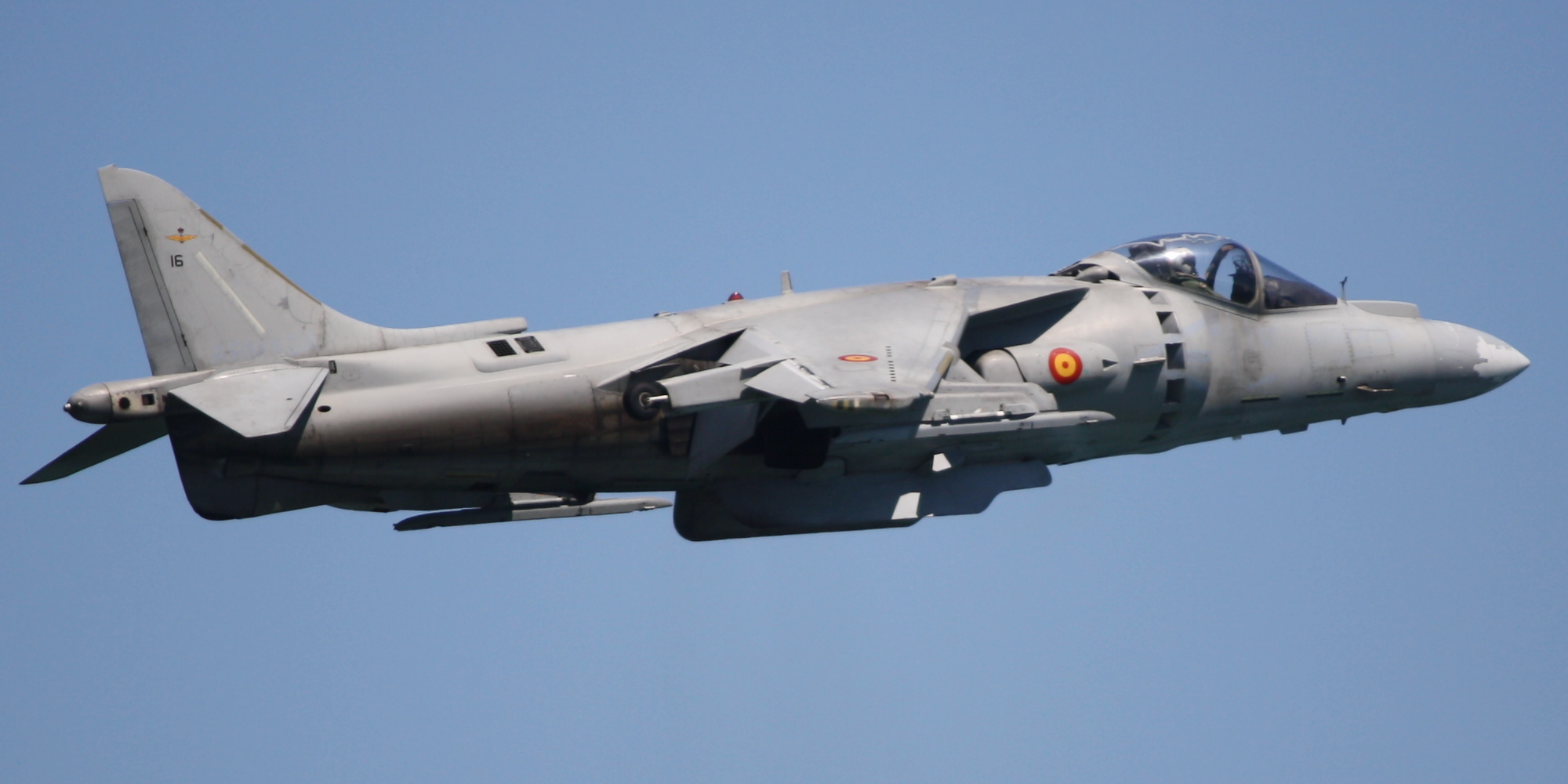
The Spanish Navy ordered eight EAV-8B Plus in March 1993, together with a TAV-8B, and deliveries began in 1996. The upgrade gave its aircraft the ability to carry four AMRAAMs, new radar and avionics and a new engine, and since Príncipe de Asturias was decommissioned in 2013 they have operated only from the amphibious assault ship Juan Carlos I.
Multimedia


