British Aerospace Harrier II variant
British Aerospace Harrier II AV-8B Harrier II
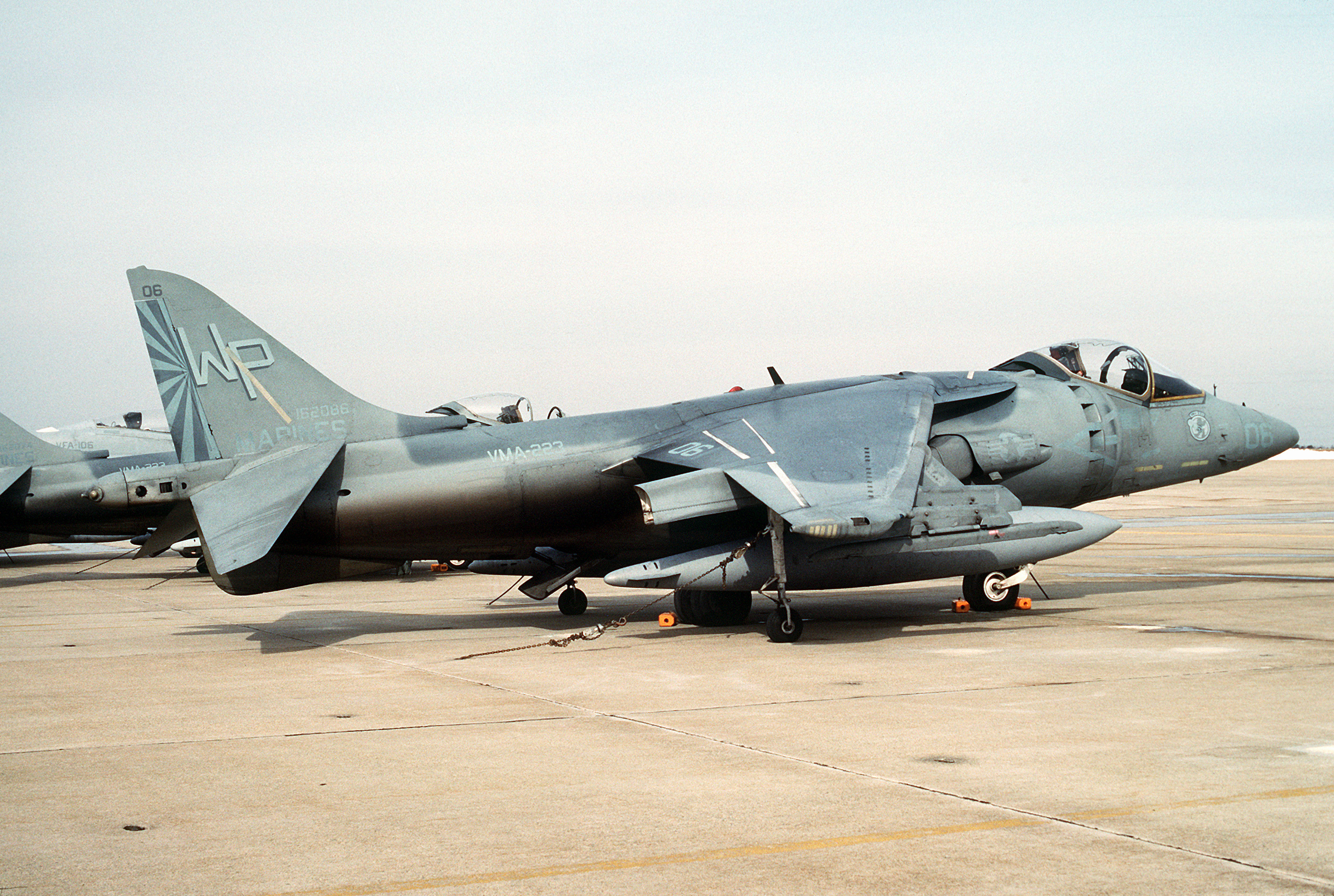
The first production version of the Harrier II for the United States Marine Corps, known as the 'Day Attack' variant. It grew out of two modified AV-8As, flew in full-scale development form in November 1981, reached initial operating capability in 1985 with squadron VMA-331 and fought in the Gulf War before most examples were upgraded to the Night Attack or Harrier II Plus standards.
British Aerospace Harrier II sheet

- November 5, 1981
- First flight
History
A better Harrier without a new engine
In the mid-1970s the United States Marine Corps (USMC) wanted a Harrier substantially better than the first-generation AV-8A, but without funding a new engine. The Department of Defense authorised the Harrier II plan in 1976, and the Navy, which traditionally bought the Marines' aircraft, insisted that the design be proven in flight first. McDonnell Douglas therefore rebuilt two AV-8As with new wings, revised intakes, redesigned nozzles and other aerodynamic changes; the raised cockpit and new forward fuselage of later aircraft were not fitted to these prototypes. Designated YAV-8B, the first flew on 9 November 1978. Testing showed more drag than expected, which held back top speed, but payload, range and vertical take-off performance were convincing enough for a development contract to be awarded in 1979, covering 12 initial aircraft and a further 324.
Between 1978 and 1980 the Pentagon and the Navy repeatedly tried to cancel the programme. The Navy favoured an attack version of the fighter that became the F/A-18 Hornet and pressed the Marines to adopt it for close air support. Even so, in 1981 the Department of Defense put the Harrier II into its budget and five-year plan, although the Navy declined to buy any for itself.
Full-scale development and production
In August 1981 British Aerospace and McDonnell Douglas signed a memorandum of understanding that brought the United Kingdom back into the programme, now as a subcontractor holding 40 per cent of the airframe work in man-hours. Rolls-Royce took 75 per cent of the engine work and Pratt & Whitney the remainder. The partners expected to build 400 Harrier IIs: 336 for the Marines and 60 for the RAF. Main manufacturing took place at McDonnell Douglas in St. Louis, Missouri, and at BAe's Kingston and Dunsfold sites.
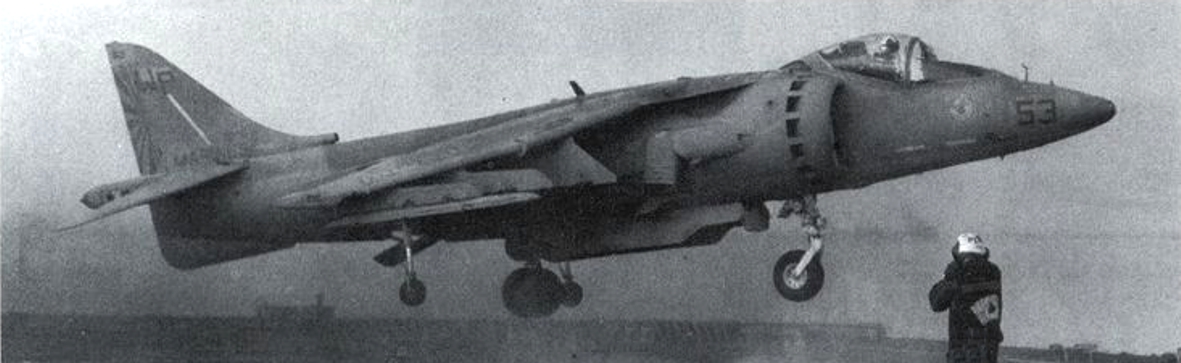
Four full-scale development aircraft were built. The first, used mainly to explore performance and handling, flew on 5 November 1981; the second and third, which introduced the wing leading-edge root extensions and revised intakes, followed in April of the next year, and the fourth in January 1984. Behind them came 162 production aircraft, built between 1983 and 1989. The first was handed to training squadron VMAT-203 at Cherry Point on 12 December 1983, and the last of the initial batch of 12 reached front-line squadron VMA-331 in January 1985. They were powered by the F402-RR-404A turbofan of 95.4 kN thrust; aircraft built from 1990 onwards received improved engines.
A new aircraft inside a familiar outline
Although it kept the layout of the original Harrier, McDonnell Douglas redesigned the whole airframe. The cockpit was raised by 27 cm under a new canopy that improved the view forward, sideways and to the rear. The one-piece supercritical wing, almost entirely made of composites, was thicker and longer than the AV-8A's, with less sweep and more area, yet lighter. Overall, about a quarter of the structure was carbon-fibre composite, a first for a combat aircraft. The main attack system was the nose-mounted Hughes AN/ASB-19 angle-rate bombing set, which paired a television imager with a laser tracker for very accurate targeting; self-protection came from AN/ALE-39 chaff and flare dispensers, an AN/ALR-67 radar warning receiver and an AN/ALQ-126C jammer pod. The cockpit was also used for early trials of direct voice input, with a system developed by Smiths Industries.
Evaluation and service entry
Operational evaluation ran from 31 August 1984 to 30 March 1985. Four pilots and their maintainers tested the aircraft under combat conditions from Camp Pendleton, China Lake, Cold Lake in Canada and Yuma, flying close and deep air support, interdiction and armed reconnaissance, and in a second phase escort, combat air patrol and deck-launched intercept missions. Shortfalls were found and later fixed, but the evaluation was judged a success. The AV-8B reached initial operating capability in January 1985 with VMA-331.
Baptism of fire in the Gulf
The Harrier II went into combat on 17 January 1991, during Operation Desert Storm, answering a forward air controller's call against Iraqi artillery shelling Khafji. Flying from USS Nassau and Tarawa and from shore bases, 86 AV-8Bs logged 3,380 flights and about 4,100 hours with mission availability above 90 per cent. Five aircraft were lost to surface-to-air missiles and two pilots were killed. General Norman Schwarzkopf later named the AV-8B among the seven weapons that played a crucial role in the war.
What became of the Day Attack aircraft
The daytime version was soon overtaken by its derivatives. Most of the original AV-8Bs were upgraded to the Night Attack or Harrier II Plus standards, the latter through a remanufacturing programme that reused components from existing airframes, and the rest were withdrawn from service.
Multimedia


