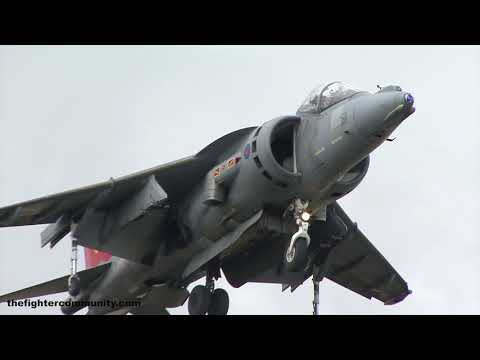
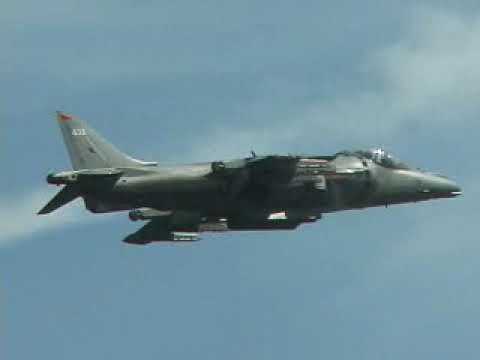
British Aerospace Harrier II variant
British Aerospace Harrier II Harrier GR.7
The night-attack version of the Royal Air Force Harrier II, the British counterpart of the AV-8B Night Attack. It flew in May 1990, 34 new aircraft were delivered in 1991 and every GR5 was upgraded to its standard. It fought over Bosnia, Kosovo, Iraq and Afghanistan, flew from Royal Navy carriers within Joint Force Harrier and was retired by July 2010.
British Aerospace Harrier II sheet

- 34
- Units built
History
From day jet to night striker
Even before the Harrier GR5 entered service, the RAF knew changes were needed for the aircraft to be truly effective as an interdictor. The answer was the Harrier GR7, developed mainly to add night-time operational capability and better avionics, in step with a similar Marine Corps initiative for its AV-8Bs. It gained a nose-mounted forward-looking infrared sensor, night-vision-goggle compatibility, a missile approach warning system, an electronic countermeasures suite, new cockpit displays and a replacement moving map. The GR7 first flew in May 1990. After the full delivery of 34 new-build GR7s in 1991, every GR5 went through the same avionics upgrade and became a GR7 as well.
Improvements along the way
Some GR7s received the more powerful Pegasus Mk 107 engine and were redesignated GR7A; they had much better take-off and landing performance and could carry heavier loads. From 1998 the fleet had access to TIALD laser designator pods for guided bombs, although these were so scarce that they were often unavailable even for training. Difficulties communicating with other NATO aircraft during the 1999 Kosovo War led to the fitting of encrypted communications. Like every British Harrier II, the GR7 never carried a radar and relied on the Sidewinder for air combat.
Bosnia and the carriers
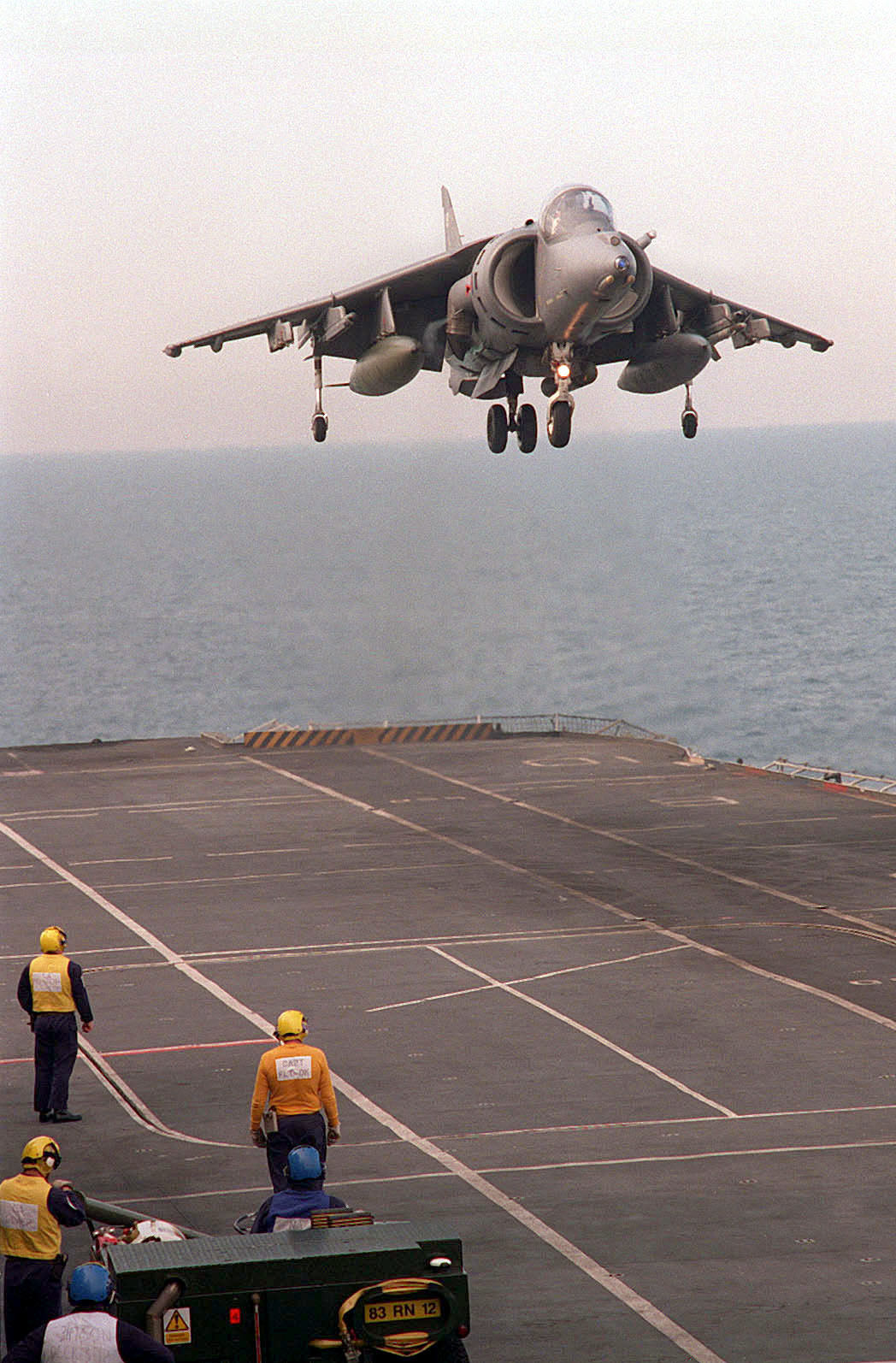
The GR7 made its first operational deployment in August 1995 over the former Yugoslavia. A Harrier II squadron was based at Gioia del Colle in Italy, relieving Jaguars; the aircraft were quickly modified for GPS navigation and flew more than 126 strike sorties, often with Jaguars designating targets for Paveway II bombs. In June 1994 the GR7 had begun trials aboard the Invincible-class carriers, and operational naval deployments started in 1997: in 1998 it operated over Iraq from carriers in the Persian Gulf, and in 2000 it flew presence and reconnaissance sorties over Sierra Leone alongside Sea Harrier FA2s. The 1998 Strategic Defence Review formalised Joint Force Harrier, based mainly at Cottesmore, bringing RAF and Royal Navy Harriers together.
Kosovo and Iraq
In Operation Allied Force in 1999 the RAF contributed 12 Harrier GR7s alongside 16 Tornados. Over the 78-day bombing campaign the Harrier IIs flew 870 sorties, and the BBC reported an 80 per cent direct hit rate. In 2003, during Operation Telic, the GR7 played a prominent part: it flew reconnaissance and strike missions in southern Iraq, reportedly against Scud launchers, and introduced the AGM-65 Maverick missile, firing 38 of them. In the Battle of Basra it hit fuel depots, tanks, boats and artillery, and around 30 per cent of its operations were close air support.
Afghanistan
In September 2004 six GR7s arrived at Kandahar to replace a US AV-8B detachment. On 14 October 2005 a Taliban rocket destroyed one GR7A and damaged another on the ramp, without injuries. Demand soared during the Helmand campaign: between July and September 2006 the munitions used by British Harriers rose from 179 to 539, mostly CRV-7 rockets, and the fleet moved to round-the-clock availability. From January 2007 the GR9 progressively replaced the GR7 in theatre.
Retirement
In 2006, with the Sea Harrier gone, the GR7 and GR9 took over its missions and 800 Naval Air Squadron re-formed with them. All Harrier GR7s had been retired by July 2010.
Multimedia