Project Gemini · NASA · Crewed
Gemini IX-A
- Jun 3, 1966, 1:39 PM
- Launch date
- 2
- Crew size
- 3 days
- Duration
- Partial success
- Outcome


-1600.webp)


-1600.webp)


-1600.webp)


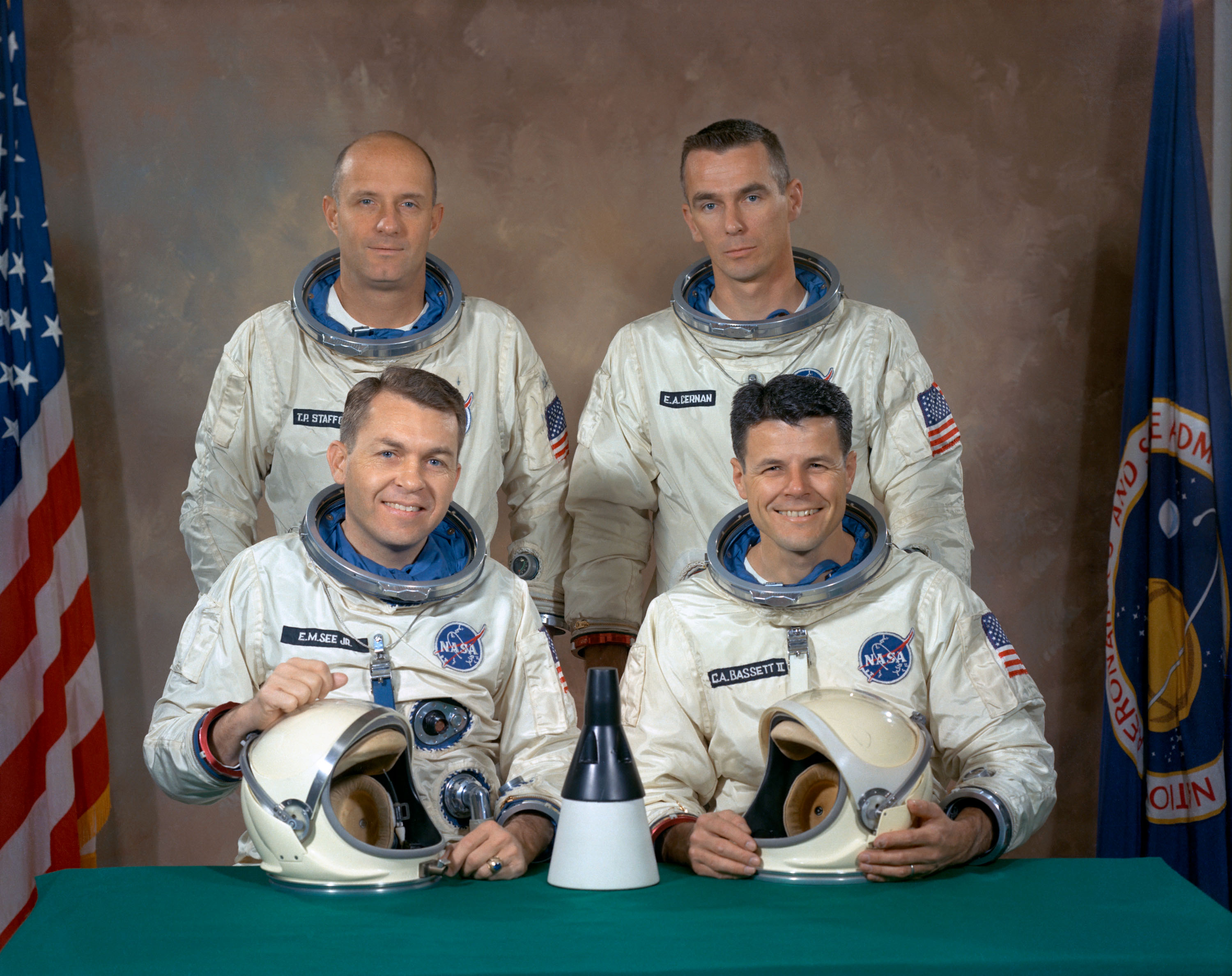
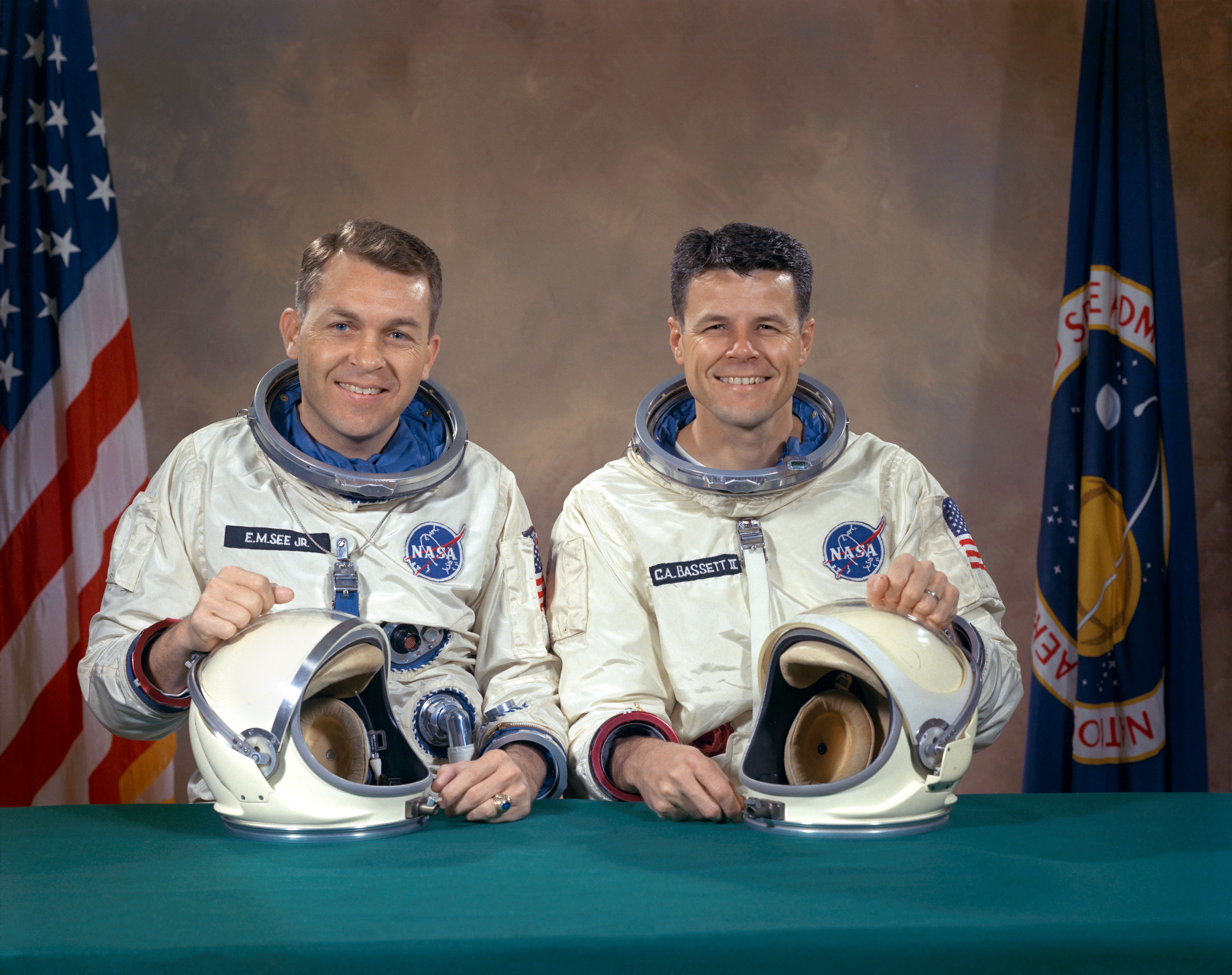
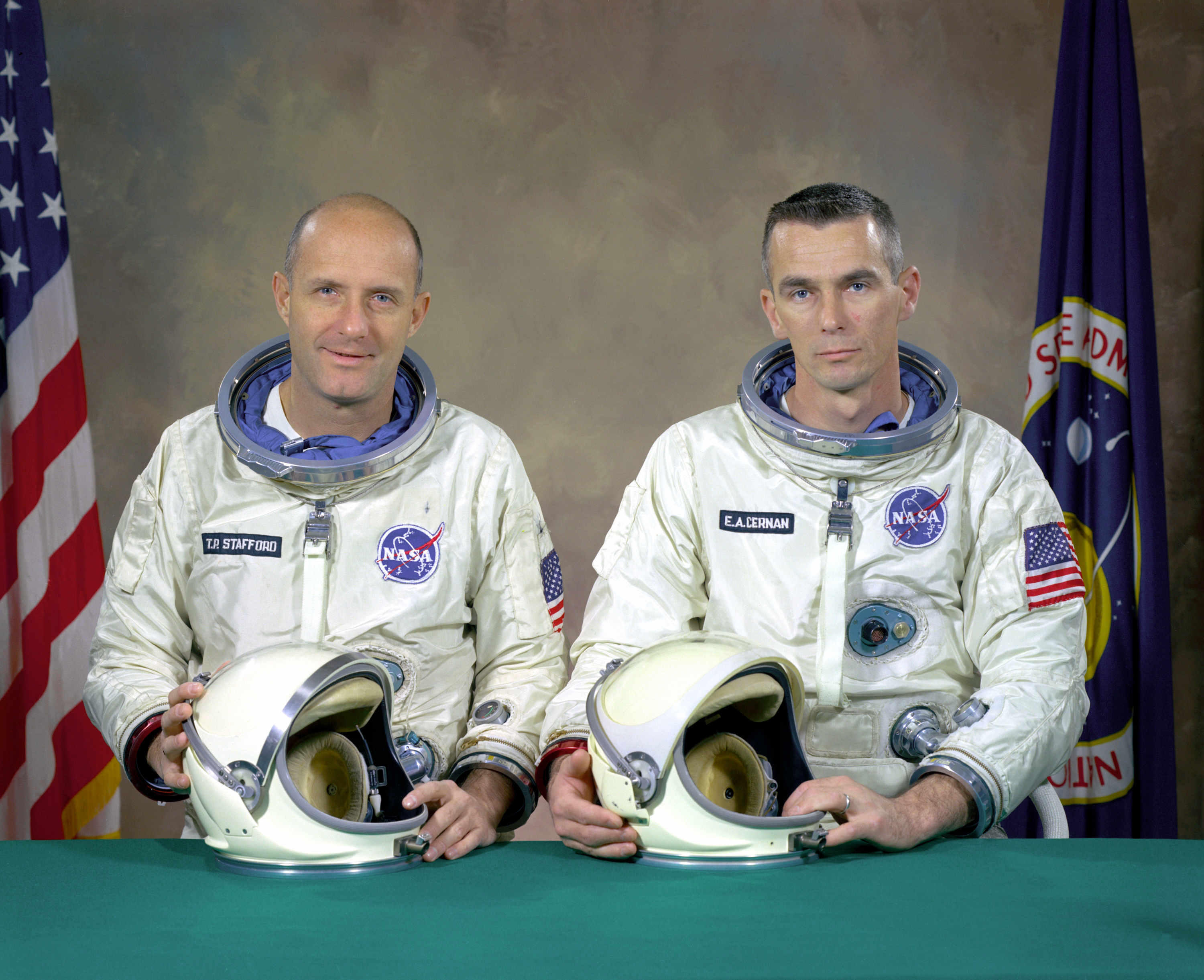
Gemini IX-A was the seventh crewed flight of the Gemini program, flown between 3 and 6 June 1966 with Thomas P. Stafford in command and Eugene A. Cernan as pilot. Neither man had originally been assigned to it: the seats belonged to Elliot See and Charles Bassett, killed on 28 February 1966 when their T-38 struck Building 101 of the McDonnell plant in St. Louis, the very building where the spacecraft they were to fly was being assembled. It was the first time in NASA history that a backup crew took over a crewed mission. The mission also changed its name and its target. On 17 May 1966 the Atlas carrying the Gemini IX Agena target vehicle pitched over two minutes into flight because of a pinched autopilot wire and fell into the Atlantic, and the flight was redesignated Gemini IX-A. In its place, the Augmented Target Docking Adapter (ATDA) was launched on 1 June, a backup target built by McDonnell from already proven hardware. It reached an almost perfect 298-kilometre orbit, but the shroud covering the docking cone failed to separate: the disconnect lanyards had been taped under the small fairings protecting the explosive bolts, the end of a chain of decisions that left the installation in the hands of a crew unfamiliar with the part. Stafford and Cernan reached the ATDA four hours into the flight and found it rotating slowly with the shroud hanging open like a jaw. "It looks like an angry alligator out here rotating around", Stafford said, and the phrase became the mission's signature. Docking, the primary objective, was impossible: cutting the wires would have released two steel bands capable of slicing a pressure suit. Instead the crew completed three different kinds of orbital rendezvous in under twenty-four hours — the third-orbit rendezvous, the equiperiod exercise and the approach from above — a repertoire designed with Apollo in mind. On 5 June, Cernan went outside to fly the Astronaut Maneuvering Unit, the Air Force's propulsive backpack. He never did. The pressurised suit had "all the flexibility of a rusty suit of armor", the handholds were inadequate, his pulse climbed to about 180 beats per minute and the air-cooling system was overwhelmed by his sweat: sixty-three minutes after the hatch opened his visor fogged and left him effectively blind. With the backpack already prepared, Cernan and Stafford called the exercise off. The spacewalk lasted 128 minutes instead of the planned 167. On 6 June, on the 45th revolution, Gemini IX-A splashed down 0.70 kilometres from the planned point, close enough for the crew to see USS Wasp from inside the capsule: the closest splashdown to a recovery ship of any crewed spacecraft to that date. The mission achieved neither of its two main objectives, but its lessons were decisive: the AMU never flew on Gemini again, Apollo suits were changed to water cooling, later crews carried anti-fog solution, and extravehicular work was redesigned around handholds and measured pacing, leading to Aldrin's untroubled spacewalk on Gemini XII.
Objectives
The first mission objective was to dock with a target vehicle, as had first been achieved on Gemini VIII. The second was an extravehicular activity in which the pilot was to move to the rear of the spacecraft and strap himself into the Air Force's Astronaut Maneuvering Unit, a rocket pack that would have given him controlled flight independent of the capsule's life support system. The third was to carry out seven scientific experiments.
Payload
Thomas Stafford and Eugene Cernan flew with the Augmented Target Docking Adapter (ATDA) as the orbital target and the Air Force's Astronaut Maneuvering Unit stowed in the adapter section. The science programme included bioassay of body fluids (M-5), UHF/VHF polarization (D-14), airglow horizon photography (S-11), a micrometeorite collector operated remotely by the crew (S-12) and zodiacal light photography (S-1), which was rescheduled to be shot from inside the cabin.
| Crew | Role | Agency | Extravehicular activity |
|---|---|---|---|
| Thomas P. Stafford | Commander | NASA · United States | — |
| Eugene A. Cernan | Pilot | NASA · United States | 1 · 2 hr 8 min |
History
An inherited mission
Gemini IX-A was the seventh crewed flight of the Gemini program, the fifteenth crewed American flight and the twenty-third spaceflight in history if the X-15 ascents above 100 km are counted. It flew between 3 and 6 June 1966 with Thomas P. Stafford in command and Eugene A. Cernan as pilot, and neither man had originally been assigned to it. The mission reached the pad with two names, two docking targets and a crew that was not its own: the letter added to the number recalled a launch failure, and the two men aboard occupied the seats of two colleagues killed four months earlier.
That double detour defines the flight better than any list of objectives. Gemini IX-A was to dock with an Agena target vehicle, as Gemini VIII had done in March, and it was also to send an astronaut outside to fly the Astronaut Maneuvering Unit, the propulsive backpack the Air Force had spent years preparing. It accomplished neither. What it did accomplish was three different orbital rendezvous in less than twenty-four hours, the visual inspection of an object tumbling out of control, the certainty that working outside a spacecraft was far harder than anyone had supposed, and a splashdown so precise that the crew could wave at the carrier coming to collect them.
October 1965: See and Bassett get the assignment
In October 1965, Elliot See and Charles A. Bassett II learned from the chief of the astronaut office, Donald Slayton, that they would fly Gemini IX. Slayton told them at the same time who their backups would be: Thomas Stafford and Eugene Cernan. Stafford was then busy as pilot of Gemini VI, and when that mission was frustrated and remade as VI-A to rendezvous with Gemini VII, See, Bassett and Cernan came to wonder whether their colleague would finish in time to join the preparation.
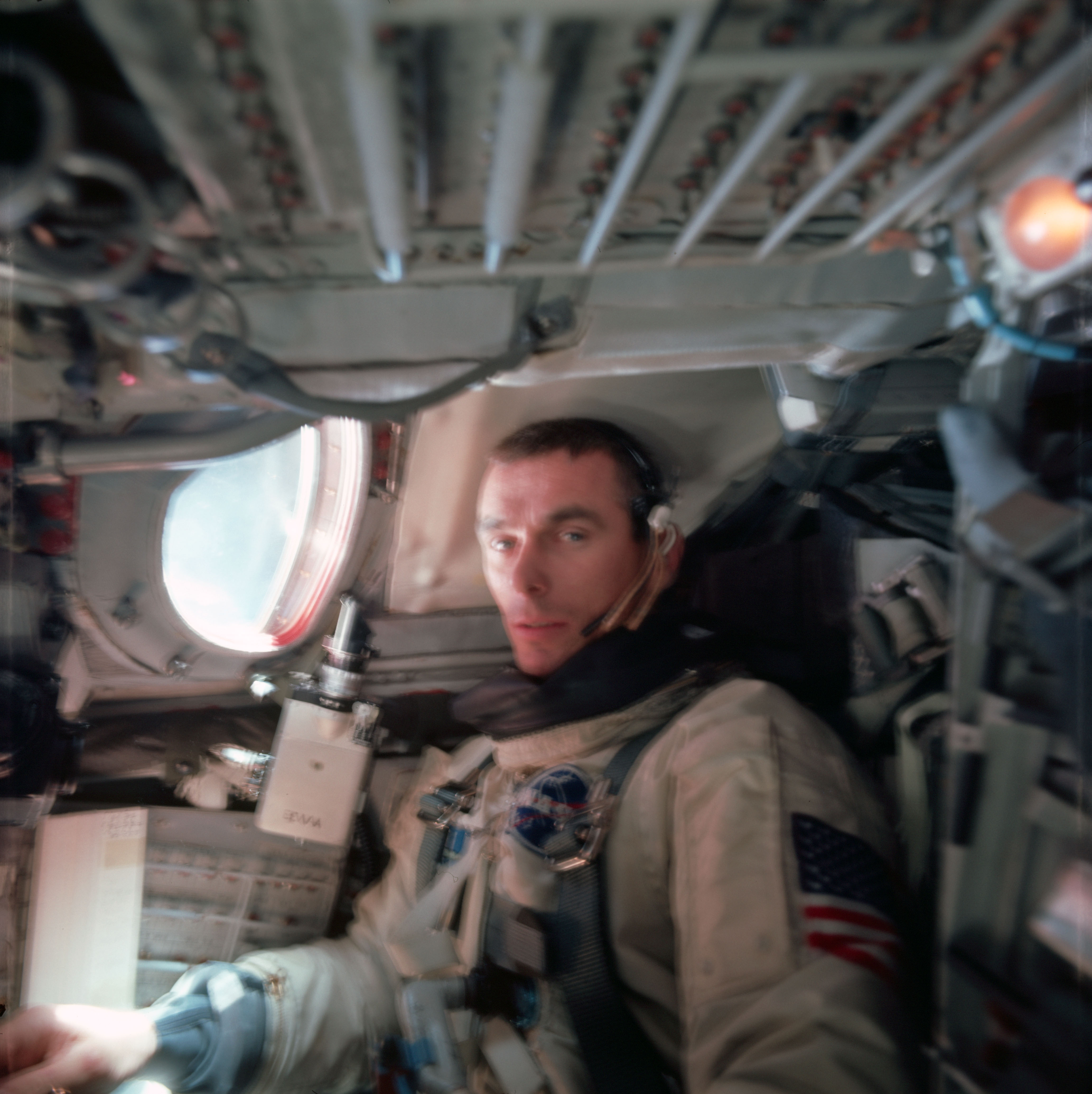
They could not wait for him. The three began training in November, fitting their simulator sessions between those of the other crews. They followed spacecraft 9 through its construction and its tests, familiarised themselves with the systems and helped shape a provisional flight plan. Bassett and Cernan concentrated on the extravehicular activity, because one of the two was going to go outside and mount the AMU. In December they broke the routine to work as capsule communicators in the Houston control centre during the joint VII/VI-A mission, and then returned to training. Stafford, who still had his own postflight debriefing to get through, joined them in February 1966.
Elliot McKay See Jr. was born on 23 July 1927 in Dallas, Texas. He entered the United States Merchant Marine Academy in 1945, graduated in 1949 in marine engineering with a Naval Reserve commission and joined that same September the Aircraft Gas Turbine Division of General Electric, the firm his father had worked for. By 1953 he was a flight test engineer at the Evendale plant in Ohio; like many reservists he was called to active duty by the Korean War, and in 1956 he rejoined General Electric, where he became a group leader and experimental test pilot at Edwards Air Force Base, flying the latest jets with the company's engines. NASA selected him in 1962, in the second group of astronauts, and Gemini IX was to be his first spaceflight.
Charles Arthur Bassett II was born on 30 December 1931 in Dayton, Ohio. He studied for two years at Ohio State University, enrolled in Air Force ROTC in 1952 and entered as an aviation cadet; he later graduated from Texas Tech in electrical engineering. He passed through Squadron Officer School at Maxwell, the Air Force Experimental Flight Test Pilot School and the Aerospace Research Pilot School. NASA chose him in October 1963, with the third group, and on 8 November 1965 he was named pilot of Gemini IX. Like See, he had never flown in space.
28 February 1966: St. Louis
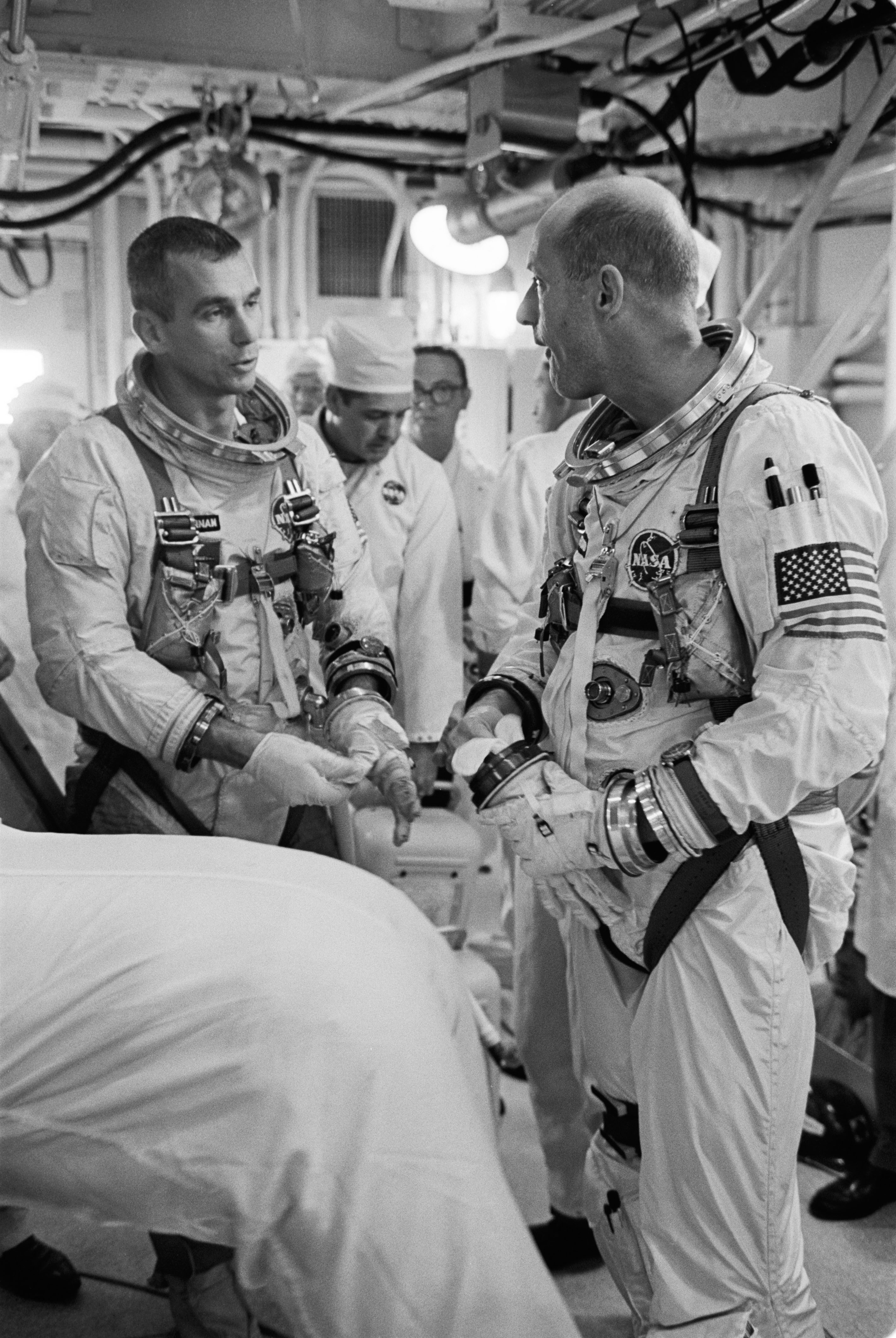
On the morning of the last day of February 1966, the four men of Gemini IX reported to Ellington Air Force Base in Texas to file the flight plan to St. Louis in two two-seat T-38s. They were going to spend several days practising in the rendezvous simulator at the McDonnell plant.
At Ellington they learned that the weather in St. Louis was poor: a cloud ceiling at 180 metres, visibility of 3 kilometres, rain and fog, with no improvement forecast. They would have to fly on instruments. See telephoned the St. Louis controllers to warn them he would arrive in a couple of hours and discussed with Cernan the various runways at Lambert Field. He then settled into the front seat of one of the aircraft with Bassett behind him; Stafford and Cernan took the other. They lifted off at 7:35 in the morning, See and Bassett leading and the other pair in formation.
They reached St. Louis shortly before nine. The tower reported that the ceiling had risen to 240 metres since the earlier call, but visibility had dropped to 2.4 kilometres and light snow showers had joined the rain and fog. Descending through the cloud layer, the pilots found themselves too far along the runway to land. See decided not to lose sight of the field and turned left below the clouds. Stafford followed the missed-approach procedure, climbed straight ahead to 600 metres and landed without incident on the next attempt.
See continued his turn. The aircraft came around facing McDonnell's Building 101, where technicians were at that moment working on the very spacecraft he and Bassett were to fly. Realising that his rate of descent was excessive, See engaged the afterburners and attempted a tight turn to the right, but it was too late: the aircraft struck the roof of the building and fell into an inner courtyard. Both pilots were killed instantly.
.jpg)
NASA appointed a seven-member investigation board chaired by astronaut Alan B. Shepard Jr., which reviewed the aircraft's maintenance, the pilots' experience, their medical records and the weather conditions. It found nothing wrong with the aircraft: it had worked properly up to the impact. See and Bassett had renewed their instrument ratings within the previous six months and both were in good physical and mental condition according to their medical examinations and the conversations recorded before and during the flight. See also had a reputation as an excellent test pilot: careful, sensible and technically competent. The conclusion was that the weather had been the primary cause and that a piloting error, driven by the determination not to lose sight of the field, had taken them too low.
On Wednesday 2 March 1966, spacecraft number 9 passed on its way to the shipping dock, bound for Cape Kennedy, alongside a flag at half-staff at the McDonnell plant. The next day Elliot See and Charles Bassett were buried at Arlington National Cemetery, accompanied by their fellow astronauts.
The backup crew moves up
NASA assigned the prime crew positions of Gemini IX to Stafford and Cernan. It was the first time in the history of the agency's crewed spaceflight that a backup crew had taken over a mission; the closest precedent, Mercury-Atlas 7 in 1962, had not been the same, because when Donald Slayton was grounded by a heart anomaly his backup Walter Schirra did not fly, but Scott Carpenter, who had backed up John Glenn's flight. On 21 March, James Lovell and Edwin Aldrin received the backup duties. There was no delay whatsoever in the launch schedule.
That move had consequences nobody calculated at the time. Lovell and Aldrin were the planned backups for Gemini X; the usual rotation — two missions of rest between backup and prime assignment — would have placed Aldrin on the prime crew of a flight after Gemini XII that never came to exist. By moving them up to the Gemini IX backup crew, Aldrin ended up flying as prime on Gemini XII, and that flight weighed decisively in his selection for the Apollo 8 backup crew and the Apollo 11 prime crew.
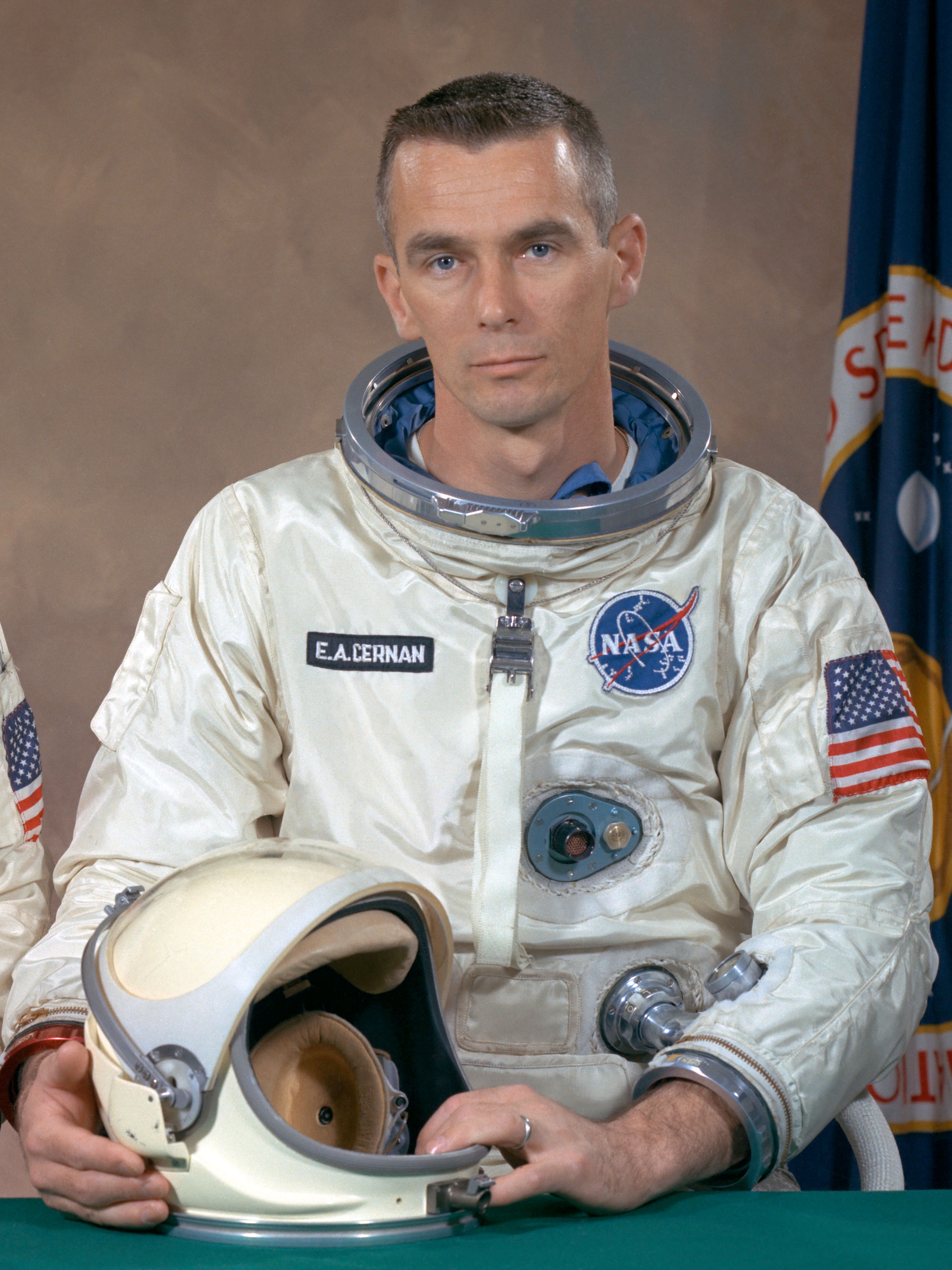
Thomas Patten Stafford was born on 17 September 1930 in Weatherford, Oklahoma, the son of a dentist and a former teacher. After graduating from the Naval Academy he was commissioned in the Air Force, flew the F-86 Sabre and became a test pilot; NASA selected him in 1962 and he had already flown on Gemini VI-A. Eugene Cernan was born on 14 March 1934 in Chicago, the son of a father of Slovak descent and a mother of Czech ancestry; he took a degree in electrical engineering at Purdue, entered the Navy through the NROTC in 1956 and was selected by NASA in October 1963, with the third group. Gemini IX-A would be his first flight. The two would fly together again on Apollo 10 in May 1969, and Cernan would command Apollo 17 in December 1972, the last lunar landing of the program. Stafford commanded the Apollo-Soyuz Test Project in 1975, the first joint Soviet-American mission, and as a brigadier general became the first general officer to fly in space.
Three arguments before the flight
For Gemini IX, the three great preparation arguments were not technological but procedural: whether the spacewalk should be made with an umbilical or without one, whether the rendezvous should be brought forward to the third orbit, and whether to rely on radar or on optical tracking from the spacecraft.
Work by Chance Vought and the aero propulsion laboratory at Wright-Patterson Air Force Base in Ohio on the Astronaut Maneuvering Unit set the first one going. The hand-controlled unit was propelled by hot hydrogen peroxide gas and had shown in numerous tests that it would let an astronaut control his attitude and stay stable while manoeuvring. When the Air Force was offered the chance to place experiments aboard the Gemini spacecraft in early 1963, the AMU was an obvious choice: it could help with tasks of particular interest to the Department of Defense — maintenance, repair, resupply, crew transfer, rescue, satellite inspection and the assembly of structures — even though none of them was yet a primary or secondary objective for NASA.
The tether entered the scene as a safety factor. The Air Force initially thought of a 60-metre line, but studies suggested that an astronaut might become entangled in a weightless cable. That could be countered with a reel mechanism to keep it taut, although the real question soon became whether a tether was needed at all: could redundant systems offer the same safety as tying a man to the spacecraft? The Air Force believed they could and part of NASA agreed; tether development was cancelled. Colonel Daniel McKee, head of the Air Force office in Houston, argued that knowing an astronaut would fly the system untethered would force contractors to build it to extremely high reliability. Warren J. North, chief of the crew support division at the Houston centre, replied that tethers are a man's best friend in space, "especially if they have oxygen in them".
The dispute was at times bitter. NASA headquarters set its position unambiguously: William Schneider, deputy director of mission operations, wired Gemini program manager Charles Mathews that extravehicular activity would be based on the use of a tether on all flights through Gemini XII inclusive. McKee did not give up and in February 1966 was still arguing that the question should be left open until Gemini XII, when the backpack's second flight was planned; he prepared a position paper noting that all critical AMU systems were duplicated and that its testing had been oriented towards free flight, which was its ultimate purpose. The Houston centre director, Robert Gilruth, took the case to George Mueller, in charge of the crewed programs, who was not persuaded: all Gemini astronauts would be tethered, although the experience might be useful to the Air Force on future free flights. A new document described spacecraft manoeuvres intended to keep the umbilical slack in order to simulate free activity.
The uncontrolled flight of Gemini VIII on 16 March gave the Air Force an opening to force the door: what would have happened if David Scott had been outside and tied to the spacecraft when it began to spin? He might have been wound up like a broken blind. The Air Force proposed adding at least an emergency disconnect device for as long as NASA insisted on the tether. The agency's managers had also turned that scenario over. Scott maintained that he would have been able to detect the thruster problem and come back inside to help Armstrong; much of the crewed flight office, by contrast, was convinced that in the face of a malfunction the best thing an astronaut outside could do was to get back in as fast as possible. There were too many dangers in diagnosing failures from outside to give up the safety of the lifeline as well. That closed the active debate, although some continued to consider the idea a good one for future programs.
The second matter — when to rendezvous with the target — was handled with less acrimony. The Gemini VI planners had concluded that rendezvous should not be attempted before the fourth orbit, and Walter Schirra and Stafford himself had demonstrated that brilliantly. But some engineers in the Apollo program office wanted to go further: a rendezvous on the first orbit, or at least on the third, would look much more like rendezvous in lunar orbit. In September 1965 the planners began working on an M=3 rendezvous — on the spacecraft's third orbit — for Gemini IX and X, and went on refining it all year.
Representatives of NASA, the Air Force and industry met in Houston on 20 January 1966 to review the result. After the spacecraft separated from the launch vehicle, the first manoeuvre — IVAR, an ungainly acronym for "insertion velocity adjust routine" — would reduce orbital insertion errors: the crew would use the inertial guidance system to raise or lower the trajectory at once. At apogee on the first revolution would come a "phase adjustment" to establish the correct relationship between spacecraft and target. An orbit and a half later would come a simultaneous triple correction of phase, height and out-of-plane errors. The final manoeuvre would circularise the trajectory two and a quarter revolutions after insertion, leaving the spacecraft some 28 kilometres below the target and ready to begin the chase. Nobody doubted the sequence would work; what some could not see was the need to do it.
Spacecraft 9 and the backpack
The spacecraft needed specific work for the tasks outside. At NASA's request, McDonnell glued eighty Velcro patches onto the surface of the vehicle, and pads that would grip them were added to Cernan's gloves to hold him in place as he moved. Since body position was decisive for checking out and donning the AMU, two handholds and a foot bar were installed as restraints, with Velcro on the bar and on the boots as well. In zero-gravity parabolic flights that proved insufficient; only after stirrups were added could Cernan and Aldrin check out the unit without difficulty in the following practice sessions.
The AMU was an Air Force design, the service planning to use the Gemini spacecraft as part of the Manned Orbiting Laboratory. It was a backpack propelled by hydrogen peroxide. Because the gas it expelled came out extremely hot, Cernan's suit was modified with "pants" woven from the nickel alloy Chromel-R, a material developed by the Air Force Systems Command for high-temperature deceleration devices that would later be used on the gloves and lunar boots of Apollo suits. The backpack also carried its own stabilisation, its own oxygen and its own biomedical and systems telemetry, so that whoever flew it would be independent of the capsule's life support.
17 May 1966: the Atlas-Agena goes into the sea
Everything was ready for Gemini IX on 17 May 1966. In the control centre, Eugene Kranz took over as flight director at the head of a three-shift operation, with Glynn S. Lunney and Clifford Charlesworth as directors of the other two. Only two hundred reporters were present, against the thousand and more who had covered Gemini IV the year before: the program was becoming routine and therefore less newsworthy.
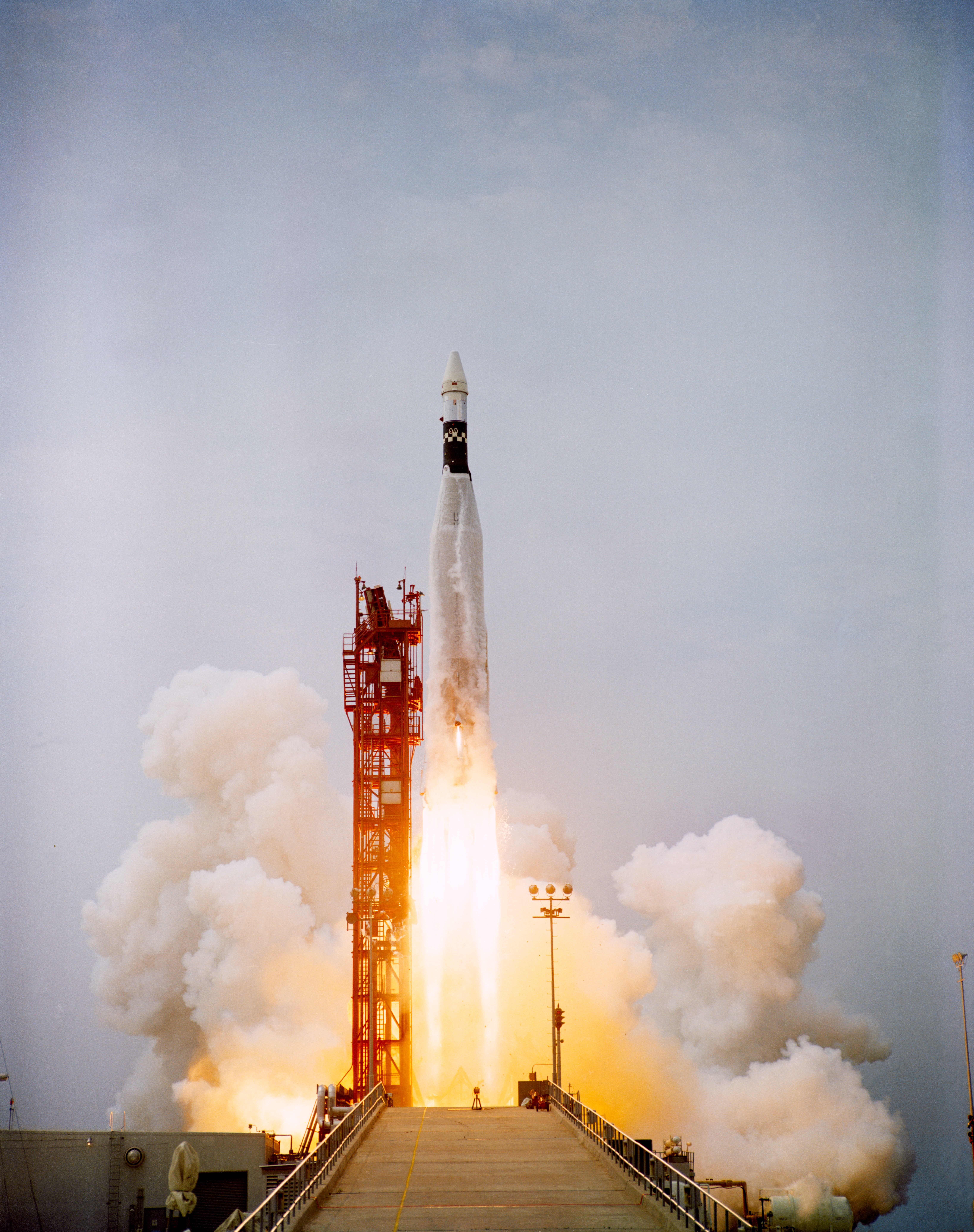
After an uneventful countdown, Atlas 5303 lifted off from Pad 14 at 10:12 in the morning. For two minutes its three engines pushed Agena 5004 upwards. Ten seconds before the two outboard engines were due to shut down, however, one of them swivelled and jammed in a position of extreme pitch-down. The whole assembly — Atlas and Agena — turned over and dived like a runaway torpedo back towards Cape Kennedy.
Shortly after booster engine cutoff, the guidance officer reported that he had lost contact with the launch vehicle. Richard W. Keehn, director of the Gemini Atlas program at General Dynamics, was alarmed and puzzled: telemetry showed that the sustainer engine had shut down and then came an Agena separation signal. Signals from the Agena kept arriving until 456 seconds after liftoff; then, silence. Keehn hurried to Hangar J, the General Dynamics data station, where the telemetry tapes pointed to an Atlas engine problem. But television reports implied that the target vehicle had failed again, and Lockheed's managers winced every time they heard about the "Agena bird": it was ironic in the light of the trouble and delays the Atlas had caused in the Mercury program and the Agena's success on Gemini VIII. The Gemini IX Atlas and Agena fell into the Atlantic 198 kilometres from where they had started.
The subsequent analysis was quick. Keehn packed up the tapes and flew to San Diego; within a week his group traced the cause to the electrical wiring: a pinched autopilot wire producing a short circuit. Work had to be done on the electrical connectors and General Dynamics asked NASA for an extra day to prepare Atlas 5304. Lockheed, meanwhile, remained uneasy about telemetry signals indicating a problem in an Agena inverter that fed both the gyroscope and the sequence timer; the awkward question was whether the target would have reached orbit had the Atlas performed. A series of cameras at Melbourne Beach, Florida, reassured the company: images of the Atlas outer loop showed that the Agena had passed through the ionised gases of the booster exhaust, which caused a short circuit and the inverter failure.
The ATDA, a spare target
When the Agena failed, the agency for the first time had something stored in the hangar. After the Agena explosion of October 1965 that left Gemini VI without a target, NASA had directed General Dynamics/Convair to be able to supply a backup Atlas within fourteen days in the event of another such catastrophe, and had developed an alternative target: the Augmented Target Docking Adapter, ATDA, a smaller spacecraft consisting of the docking adapter with an attitude control system but without the Agena's orbital change engine. It was built by McDonnell, the same manufacturer as the Gemini spacecraft, replacing the Agena rocket with the reentry control section of a Gemini and using already tested equipment. In April 1966, a month before the failed attempt, Schneider had already reminded Merritt Preston that he would have to launch the alternative target in a hurry if the Agena again missed its orbital appointment. On 18 May, Mathews wired Colonel John Hudson, deputy commander for launch vehicles of the Air Force space systems division, to prepare Atlas 5304 for a launch on 31 May in a mission now called Gemini IX-A.
With the backup plan in force, the next question was what to do if the ATDA failed as well. At a meeting on 18 May, Mathews announced that Gemini IX-A would be launched anyway to rendezvous with the Gemini VIII Agena, still in orbit. McDonnell, for its part, had confidence in the ATDA: when Mathews asked in St. Louis the next day whether anyone had reservations about flying it, the answer was no. Just as well, because the idea of a rendezvous with the old Agena had to be abandoned soon afterwards: its orbit had not decayed as expected and it was still circling at an altitude of 402 kilometres. Without the Agena's own help, flying that high might consume too much fuel and leave the crew with no way of coming down to the orbit needed for retrofire. Deputy Administrator Robert Seamans and Mueller agreed with Mathews that the rendezvous with Agena 8 was too risky, but also that Gemini IX-A would fly even if the substitute target did not arrive: the extravehicular activity with the AMU was worth the flight on its own.
1 June: the shroud that would not let go
On 1 June 1966, men and machines gathered again at Cape Kennedy to send the alternative target and Gemini IX-A into coordinated orbit. At the appointed hour, ten in the morning, the Atlas rose from Pad 14. After a six-minute powered phase it placed the ATDA into an almost perfect 298-kilometre orbit. Because the ATDA had no propulsion of its own, the launch required an extended sustainer burn: while sustainer cutoff normally occurred at T+300 seconds, here it was extended to T+348 seconds, a duration never attempted in almost three hundred Atlas launches, for which a double-sized lubricant oil tank was used to guarantee turbopump operation. The experiment went well and the long phase was uneventful; the vernier solo phase lasted another eighteen seconds and the ATDA separated at T+383 seconds.
Only one thing spoiled the picture: telemetry suggested that the shroud covering the docking cone had opened only partially and had not come away.
At the same time, on Pad 19, Stafford and Cernan were working through their own countdown. At the three-minute mark a planned hold was called so that the spacecraft would lift off precisely at the instant giving the best chase trajectory. Almost immediately problems appeared in the Cape's ground control equipment as it tried to transmit the refined launch azimuth information to the spacecraft. The window — only forty seconds long — closed, and mission director Schneider postponed the flight by forty-eight hours. For the second time, Stafford and Cernan had to ride the elevator back down. "Frank and Jim will have more flight hours," said Stafford, referring to Borman and Lovell, "but nobody piled up more pad hours than I did in Gemini." By the time Gemini IX-A finally lifted off, he had sat ready for launch in two different spacecraft, 6 and 9, a total of six times. The press gave him the title of "Mayor of Pad 19".
3 June: liftoff and the first rendezvous
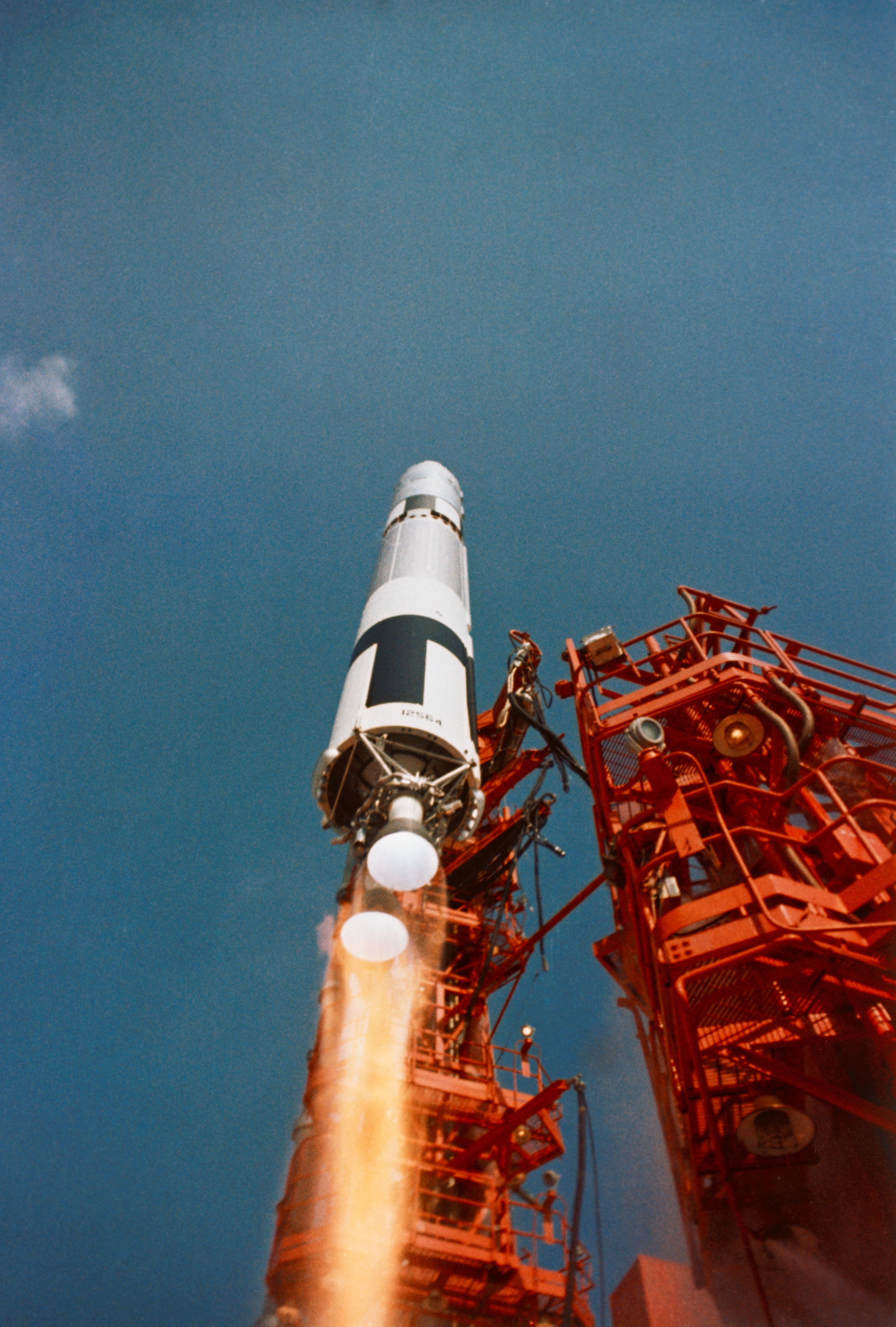
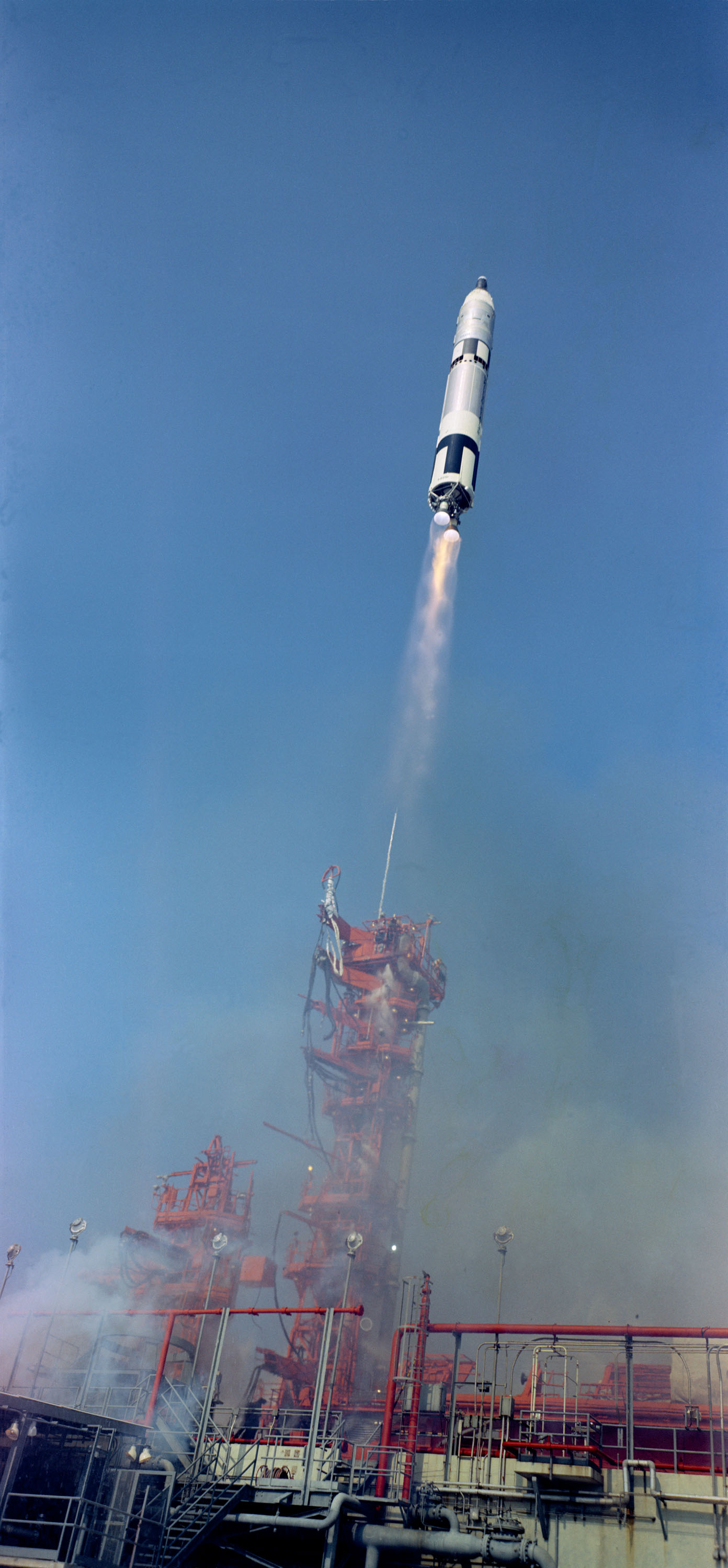
On 3 June there were no setbacks. The flight began at 13:39:33 UTC from Complex 19 at Cape Kennedy, on a Titan II GLV with serial number 62-12564. Launch vehicle performance was very close to nominal: two small roll transients were evident at liftoff and pogo effects were the lowest yet recorded on a Gemini launch. The spacecraft, with a launch mass of 3750 kilograms (8300 pounds), entered orbit with a perigee of 158.8 kilometres and an apogee of 266.9 kilometres, at an inclination of 28.91 degrees and a period of 88.78 minutes.
Stafford watched the instruments more closely than his predecessors, because he had the new IVAR in hand to start the rendezvous sequence. Six minutes after liftoff, capcom Neil Armstrong gave him the go-ahead and the commander fired the thrusters in pursuit of a target 1060 kilometres ahead. As they passed over the Canary Islands, barely seventeen minutes after launch, the computers had finished their calculations and Armstrong transmitted the phase adjustment data for near the first apogee. At 49 minutes into the flight, the thrusters added 22.7 metres per second to the spacecraft's speed and raised the perigee from 160 to 232 kilometres. "I felt that one, Tom!" Cernan exclaimed.
During the hour before the triple correction of phase, height and out-of-plane errors, the crew checked systems, went over the stowage lists, took off gloves and helmets and prepared the cameras. To circularise the trajectory, at 2 hours and 24 minutes into the flight Stafford pitched the nose down forty degrees and yawed three degrees left of the trajectory; fifty-one seconds later he fired the aft thrusters to add 16.2 metres per second. The orbit ended up at 274 by 276 kilometres: 22 kilometres below and 201 kilometres behind the target, closing at 38 metres per second.
Over Tananarive, twelve minutes before that burn, the radar had given the first flickers of contact with the target at a range of 240 kilometres. The radar's builders at Westinghouse breathed easier: they had worried about acquiring a target that moved and wobbled, because the Agena was a stabilised vehicle and the ATDA was not, so its reflectivity changed with attitude. Within 222 kilometres, however, the electronic lock was reasonably good.
At 3 hours and 20 minutes, the crew sighted their goal at 93 kilometres. For a while it drifted in and out of the field of the optical sight; at 56 kilometres it became sharp and was never lost again. As they closed in, Stafford reported that he could see the acquisition lights flashing. For a moment he thought the shroud must have come off after all — "very good, this is going" — because it did not seem possible to see the lights so clearly if the fairing were still in place. The fine corrections were awkward because moonlight coming through his window nearly blinded him; but the Moon turned out to be a help once its rays began reflecting off the ATDA.
"It looks like an angry alligator"
Stafford began braking at 4 hours and 6 minutes. During the approach he peered out of the window trying to see whether the shroud was there or not. Then he exclaimed: "Look at that moose!" As the distance shrank he understood that he had been fooling himself: "The shroud is half open on that thing!" Seconds later Cernan remarked: "You could almost knock it off!" When the final braking was complete the two vehicles were only thirty metres apart, in stationkeeping position, but it did not look plausible that the spacecraft's nose could go into the mouth of that creature and dock.
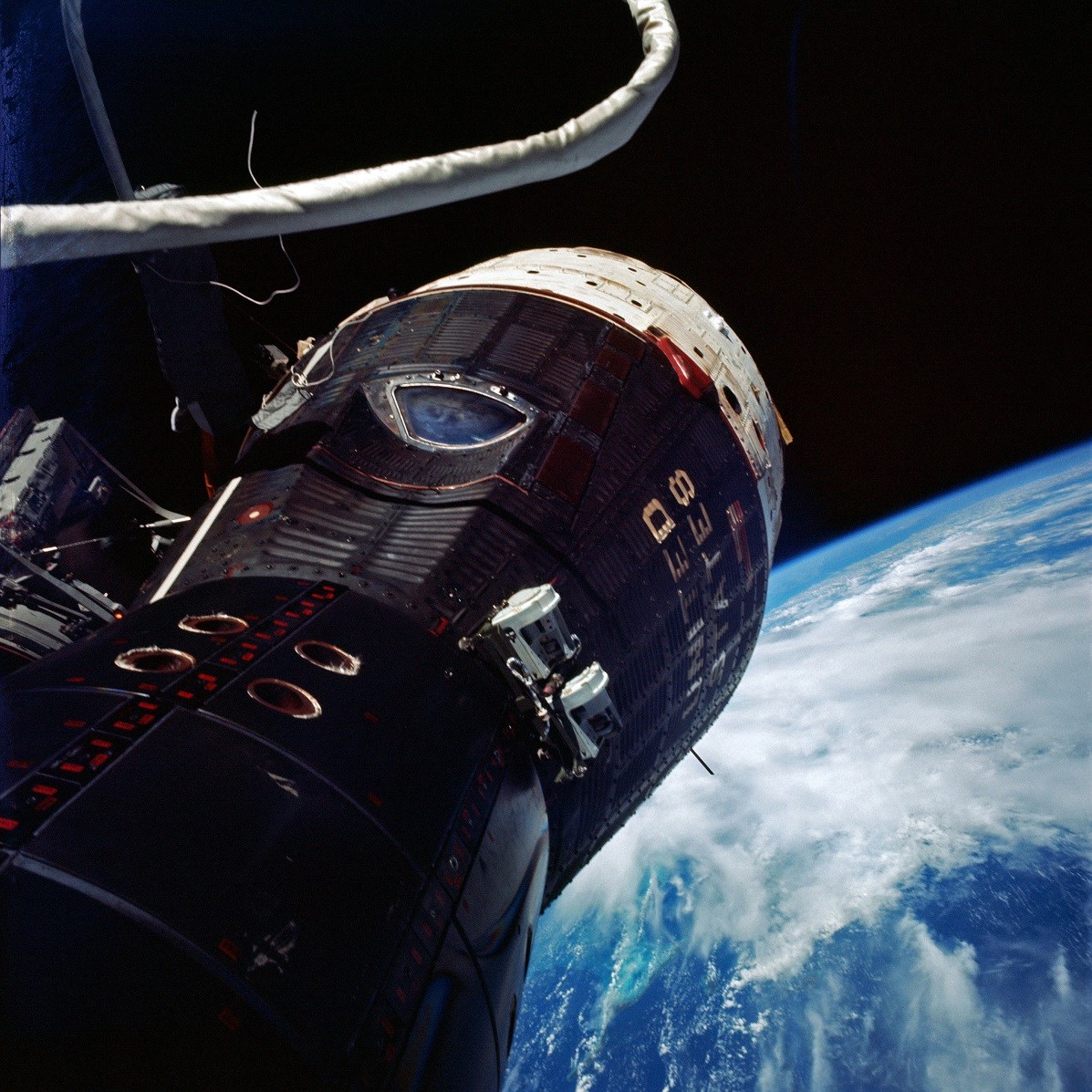
The crew described the shroud in detail and wondered aloud what could be done. One of Stafford's phrases, graphic and memorable, became the trademark of the entire mission: switching animals, he said it "looks like an angry alligator out here rotating around". He was tempted to push the fairing with the docking bar to open its jaws, but flight director Kranz ordered him to restrain the impulse.
Perhaps the most significant part of the episode was the close examination of an unstable body while it was discussed over the air-to-ground loop. Stafford held between nine and twelve metres from the target, though he came within a few centimetres at one point, in a delicate position, in daylight. Since the ATDA was rotating slowly, he turned his spacecraft upside down to follow the movements of that strange-looking machine. His performance in practice fulfilled one of the objectives the Department of Defense was pursuing with the AMU: locating and inspecting unidentified satellites. Stafford could see clearly that the explosive bolts had fired but that two neatly taped lanyards were holding the shell partly in place. From the ground he was assured that those wires had a very high tensile strength, so pushing at the jaws might not be a good idea.
The crew explained what they were seeing: the explosive bolts had fired, but because the quick-disconnect lanyards meant to release the electrical connectors to the bolts had not been hooked up, the electrical wiring held together the two steel shroud retaining bands, an inch and a half wide. If the wires were cut on one side, the two bands would immediately straighten and, still held by the wires on the opposite side, would follow a path impossible to predict; their ability to rip open a space suit like a razor blade ended the idea of a salvage operation. At the Cape, backup pilot Buzz Aldrin proposed that Cernan cut the wires with the surgical scissors from the onboard equipment pack. A test on the ground demonstrated that they would indeed cut, but also that the ATDA bristled with dangerous edges. The controllers were, in Deke Slayton's words, "just aghast" at the idea, which took no account of the energy stored in the released bands, the constant spinning of the ATDA, or the possibility that the bands might whip back and puncture Cernan's suit.
Schneider telephoned James McDivitt and Scott, who were in Los Angeles, to go to the Douglas plant to examine an identical shroud and see whether the wires could be cut or the fairing removed in some way in flight. The astronauts reported that the wires could indeed be cut, but that there were many sharp edges that might tear the suit. Meanwhile, controllers sent signals to the target to tighten and loosen the docking cone in the hope of releasing the shroud. It stayed where it was: there would be no docking on Gemini IX-A.
The chain of errors behind the shroud
The episode was embarrassing and triggered another investigation. The explanation turned out to be simple, a textbook case of too many cooks spoiling the broth. Douglas built the shroud, Lockheed fitted it to the Agena, and the ATDA, by contrast, was manufactured by McDonnell. Before the McDonnell technicians made the final installation at the Cape, a Douglas engineer supervised a test, except for the last part: the lanyards that operated the electrical disconnect of the explosive bolts, which for safety were not connected. Before the mission, the Douglas engineer went home to his pregnant wife.
The underlying cause lay one decision earlier. Douglas had built the shroud to be mounted on the Agena second stage, but the Air Force decided at the last minute that the Atlas could reach the desired orbit on its own without the second stage; that dropped NASA out of the launch and meant that the ATDA and the fairing would be installed directly on the Atlas, and by a McDonnell crew instead of the usual Lockheed one. NASA had contracted the Douglas engineer to witness, inspect and sign off on the fairing installation on the second stage; since the Agena was not going to be used, it would be McDonnell personnel, unfamiliar with the part, who mounted it, and they refused him access to the gantry despite his protests and those of NASA personnel, saying it was a simple structure and they needed no help.
On launch day, the McDonnell crew followed procedures published by Lockheed, which had in turn been copied from Douglas documents. The instructions said "see blueprint", but the Lockheed drawing was not used. The Douglas technician who normally hooked up the lanyards knew what to do with the loose ends even without the blueprint, but he was not there; the strangers fitting the shroud looked at the dangling straps, wondered what to do with them and taped them carefully under the small fairings that protected the explosive bolts. In orbit, Stafford photographed that neat piece of work. After the flight, the Douglas engineer, with Lockheed's help, set up a backup fairing and demonstrated the problem to McDonnell personnel and to George Mueller. Scott Simpkinson, the program's test operations manager, summed up the three lessons: simulate complete processes, keep experienced people in place, and follow written procedures to the letter.
Second and third rendezvous
Gemini IX-A then began its equiperiod rendezvous. Five hours after launch, Stafford pitched the nose down ninety degrees and fired the forward thrusters for thirty-five seconds to increase speed by six metres per second. The crew soon confirmed that the target was disappearing below them; later, in darkness, they fixed its position with a sextant and compared the result with the solution worked out on a chart. The planning had been right: to complete the rendezvous all they had to do was brake. At 6 hours and 15 minutes, Stafford began a series of four manoeuvres that brought the spacecraft back to stationkeeping alongside the target. The second of the three rendezvous exercises proved easy.
Less than an hour after returning to the target, at 6 hours and 36 minutes into the flight, the crew prepared to leave again, this time with the third planned rendezvous in view. At 7 hours and 15 minutes, Stafford fired the aft thrusters to reduce speed by 1.1 metres per second and widen the distance between the two satellites. Then they could relax a little. It had been an exhausting day. Still itching to tear the alligator's jaws off, they talked with the controllers about the shroud, checked systems, ate and tried to sleep. The noises and lights of the cabin made it difficult: they dozed in stretches of about forty minutes and their scheduled eight hours of sleep were, at best, restless.
The next day, 4 June, the spacecraft was 111 kilometres ahead of its target. That retrograde manoeuvre had lowered its orbit, which now measured 289 by 296 kilometres, while the target stayed at an almost constant altitude of 298 kilometres. The spacecraft, closer to Earth, thus illustrated the paradox of braking in order to move faster relative to the surface than the object flying above. The stage was set for a rendezvous from above, but first they had to accelerate in the direction of motion to jump to an altitude greater than the target's; then, automatically, the target flying lower would begin to cut into the spacecraft's lead. To complete the rendezvous they would only have to cancel the altitude and velocity vectors that had put them above and ahead.
A phase adjustment at 18 hours and 23 minutes was followed a little over half an hour later by a height adjustment. Another burn left the spacecraft in an orbit of 307 by 309 kilometres. The slant range to the target, which had stretched to 155 kilometres, began to shorten: within a quarter of an hour Stafford reported the vehicles at 100 kilometres; forty minutes later Cernan called the 37-kilometre mark; at 21 hours and 2 minutes the separation was 28.6 kilometres. Stafford pitched the nose down nineteen degrees and yawed one hundred and eighty degrees to the left, pointing at the other vehicle, which was still below and behind.
Over the Atlantic, then the Sahara and the rest of the African continent, the two men had trouble locating the target, although the radar's electronic eye never lost it. At 37 kilometres they had seen it shine by moonlight and later by sunlight; at dawn, however, they lost it completely. The distance had come down to less than six kilometres when Stafford saw something that looked to him like "a pencil dot on a sheet of paper". Without the radar, he said, "we would have blown that rendezvous". At 21 hours and 42 minutes after launch, IX-A and its target were side by side again: three different kinds of rendezvous completed in less than twenty-four hours.
At the end of the third, the controller at Carnarvon, Australia, told Cernan that flight director Charlesworth wanted the crew to start preparing for the spacewalk. Stafford had begun to worry about the fuel he would burn holding station beside the target: unless the controllers believed Cernan could do something about the shroud, the commander preferred to move away from the ATDA before the pilot went outside. They were also tired. Passing over Houston, Armstrong told Stafford to postpone the extravehicular activity to the third day and leave the ATDA. Stafford accelerated by one metre per second and moved away for good from the angry alligator.
5 June: Cernan goes outside
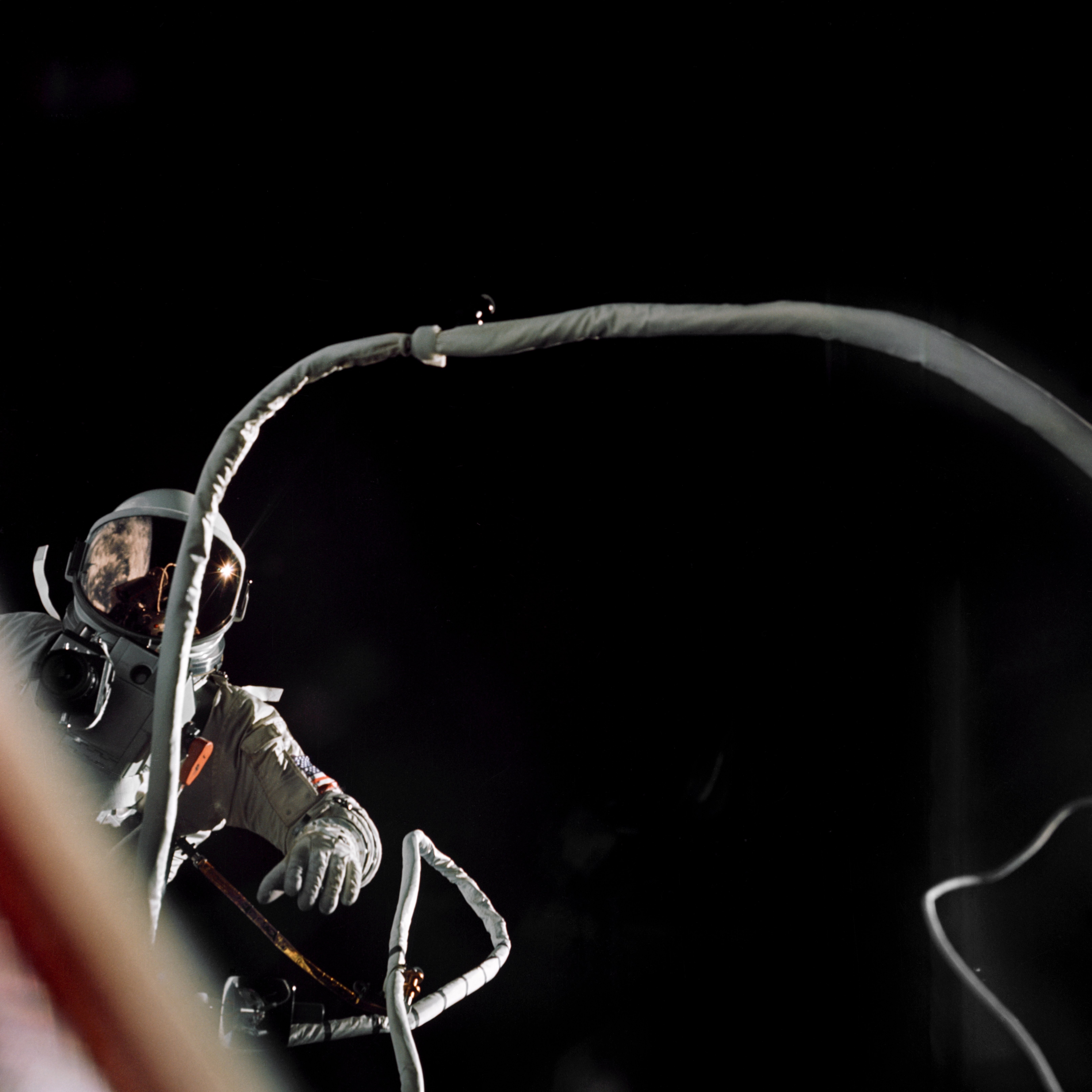
On 5 June at 5:30 in the morning, nearly forty-five and a half hours after liftoff, the crew began the preparations for Cernan to go outside. In the cramped cabin they worked, rested and worked again, and finished ten minutes before sunset. Near dawn, Cernan cracked his hatch open. It took more effort than he expected, but he was soon standing in the opening, looking at infinity and waiting for the first signs of light. He felt no disorientation and no sense at all of being lost in the darkness of space. He threw out a waste bag and began an exercise planned to last 167 minutes, during which the pilot would stand, walk, float or fly almost twice around the world.
The trouble started at once. With the suit pressurised to 3.5 pounds per square inch, in Cernan's own words "the suit took on a life of its own and became so stiff that it didn't want to bend at all". As soon as he left the spacecraft he began tumbling uncontrollably, and the umbilical, moving wildly, did not help; he ended up calling it "the snake", because the moment he let it out any distance it became hard to govern. With an effort he made his way back to the hatch area.
.jpg)
He first did some simple experiments to get the feel of working in space, and was surprised to discover that everything took longer than the simulators had led him to suppose. He confessed afterwards that he had no idea how to work in slow motion at orbital speed: every movement of an arm or a leg in free fall demanded a reaction from his whole body, and minimal forces that on the ground are barely noticed threw him off balance; merely moving his fingers was enough to set him in motion. On Gemini IV, Edward White had already spoken of the need for handholds; Cernan now discovered that even those fitted to spacecraft 9 were insufficient and that the Velcro was not enough to keep his body in position as he made his way to the rear adapter. He had to fight constantly with the limited mobility of the suit, and the effort took its toll.
When he finally reached the adapter, some of the lights installed expressly to help him were not on. He asked Stafford to switch them on and only one lit up. Moving about the adapter was no easier than the rest of the spacecraft. Even so he began preparing the backpack: he positioned lights; opened and checked the nitrogen and oxygen shutoff valves; sorted out the side controls, the umbilicals and the restraint harness; hooked up the AMU tether; connected the unit's electrical power and switched to the electrical umbilical. Everything, absolutely everything, took far longer than planned. He drifted out of control again and again and was unable to hold his body position; the few foot bars, stirrups and handholds were not enough for any task requiring leverage. While making the connections his pulse rose to about 155 beats per minute and then soared to nearly 180, and the flight surgeon on the ground came to fear he would lose consciousness. Sweat began to fog his visor, and he rubbed his nose against the glass to clear a spot he could see through.
The fogged visor and the decision to stop
Ten minutes after sunset, Cernan's visor began to fog, so he rested. But there was no complete rest out there, because of the tendency to drift. He went back to work and the visor fogged again; with the next sunrise the moisture decreased, though it returned as soon as he moved. The strange thing was that he felt neither cold nor hot: his only problems were the blind visor and tasks that had to be done with one hand when they really needed two.
With eighty per cent of the work done he had to stop again. Like a mountaineer with his pack, he sat down on the maneuvering unit and found there his most peaceful moment in that strange environment: his body moulded to the seat, his feet against a bar and his arms on the controls, he enjoyed the first instant of comfort since he had come outside. The flight passed into shadow and, by the light there was in the adapter, Cernan could see just how far his visor had closed over.
He then began to wonder whether he should continue. He ran mentally through what was left on the list: strapping in, switching to the AMU oxygen supply, starting to breathe from the unit's supply and releasing his personal transport from the adapter. He knew from repeated experience in zero-gravity flights that he could do all of that with his eyes shut. But what then? "You make the connections... and if you can't see, you can't go flying, because you don't know what to expect." And if he flew anyway? He knew he could finish putting it on, because he was secured in the adapter; but when it came to taking it off he would be standing in free space. Could he do it with one hand while holding onto the spacecraft with the other? Would it be wise to try without being able to see? Better to end the exercise now, he thought. He and Stafford decided to cancel the rest of the spacewalk and mission control agreed.
Carefully, Cernan released himself from his comfortable seat and left the sun visor raised in case that helped clear the fog. At sunrise he disconnected the AMU electrical umbilical and hooked his lifeline back to the spacecraft. Almost blind, he groped his way out of the adapter and along the spacecraft to the cabin. He slid into the hatch and stayed there a few moments: Stafford held onto his legs so he could rest. Little by little the visor began to clear in the centre and left him a narrow field of view. He then tried to retrieve a mirror mounted outside that the commander had used to watch what was happening behind the cabin, and while he struggled with it the suit cooling system was overloaded: for the first time he became extremely hot and the visor fogged over completely.
Stafford helped him in and between them they closed the hatch and began repressurising the cabin. With their helmets almost touching, Stafford still could not see Cernan's face through the visor. Cernan also felt excruciating pain as he moved back into his seat, because the suit was still fully pressurised and he had to get down far enough for the hatch to close. The extravehicular exercise had lasted 128 minutes instead of the 167 planned, and the fogging had begun 63 minutes after the hatch was opened. The spacewalk was officially recorded as an activity of 2 hours and 7 minutes, between 15:02 and 17:09 UTC on 5 June 1966.
Stafford said in a 1999 interview that there was a real concern that Cernan would not be able to get back into the capsule. Since it would not have been acceptable to cut him loose in orbit, his plan was to reenter with the astronaut still attached by his umbilical, although such an action would have killed them both.
Why it failed: the air-cooled suit
The Gemini suit was air-cooled. As the workload increased, the astronaut began to sweat and, within the confined volume of the suit, the cooling system was overwhelmed and the visor fogged; he was then effectively blind, because he had no way of wiping the faceplate. After the mission the phenomenon was reproduced in an altitude chamber with the life support system of spacecraft 9 and Cernan's own suit: when a small area of the visor was treated with an anti-fog solution, that area stayed clear, and as a result later Gemini crews carried anti-fog solution to apply just before going outside.
The extravehicular suit had no temperature probes: they had been removed to make room for additional extravehicular life support system equipment, so no temperature data from inside were available. Cernan reported that the back of the suit was very hot, and postflight examination found a tear in the suit insulation that could have allowed high temperature buildups by letting the Sun's rays through.
On subsequent Gemini flights the astronauts' workload outside was reduced, but it was clear that in lunar exploration workloads could be heavy, and the approach was changed at the root: the Apollo extravehicular suit would be water-cooled, by means of an undergarment with a network of thin tubes circulating water near the skin. It proved so effective that there were very few cases in which astronauts needed to select "high" cooling, even while working hard in the 100 °C sunlight of the lunar surface. As a result of Cernan's experience, the AMU never flew on Gemini again; it was not essential to developing the technology for the Moon landing. Maneuvering units were not tested in space until February 1984, when a modified version, the Manned Maneuvering Unit, was flown by Bruce McCandless on Space Shuttle mission STS-41-B, using nitrogen gas propellant, which remains cold when vented.
The experiments
The third great objective of Gemini IX-A, after rendezvous and extravehicular activity, was the experiment program, and Stafford and Cernan gave it more sustained attention than any previous Gemini crew. When the spacewalk was postponed to the third day, they devoted almost all of the second to experiments and rest, and would hardly tolerate any conversation from the ground other than about their workload; on more than one occasion the controllers had to be reminded that the crew was busy.
The only medical experiment, M-5, was a bioassay of body fluids that required collecting and labelling waste as in a laboratory. Like the other Gemini crews, Stafford and Cernan detested that complicated and messy task, and they did not enjoy the blood draws before and after the flight either; Stafford went so far as to equate the physical effort of M-5 with a rendezvous and a half. The Department of Defense sponsored, besides the AMU, experiment D-14 on UHF/VHF polarisation, intended to measure inconsistencies in the electron field along the orbit and to study the structure and variations of the lower ionospheric region; the extendable antenna was mounted on the adapter section. Stafford and Cernan operated the transmitter five times over Hawaii and once over Antigua on five successive revolutions and everything worked well, although the number of measurements was limited by the poor location of the antenna. Later, while struggling outside, Cernan accidentally broke the D-14 antenna.
The remaining four experiments were scientific. Two involved collecting micrometeorites: S-10 was a package mounted on the ATDA that Cernan was to retrieve during his spacewalk, which he could not do since there was no docking, although the astronauts did photograph it during the close approaches and the images showed the device in excellent condition; S-12, by contrast, was on the spacecraft itself and was operated by remote control, and while Cernan was at the adapter he heard Stafford close and lock the box, after which he retrieved the package and stowed it aboard. The last two experiments used cameras: S-1, zodiacal light photography, and S-11, photography of atmospheric airglow at the horizon. The S-11 shots were taken on three successive night passes, between hours 29 and 33 of the flight, in difficult conditions, because the tendency to float upwards complicated aiming the camera; 45 good photographs were obtained, of which three showed actual airglow. The zodiacal light photography was scheduled for the spacewalk, but a fogged visor is no help in aiming a camera, so it had to be taken from inside once Cernan was back in his seat: holding the camera against his chest, aiming through the window and calling out directions to Stafford to align the spacecraft, he obtained 17 good photographs. D-12, which investigated control of the AMU, was lost with the cancellation of the spacewalk.
6 June: splashdown alongside the Wasp
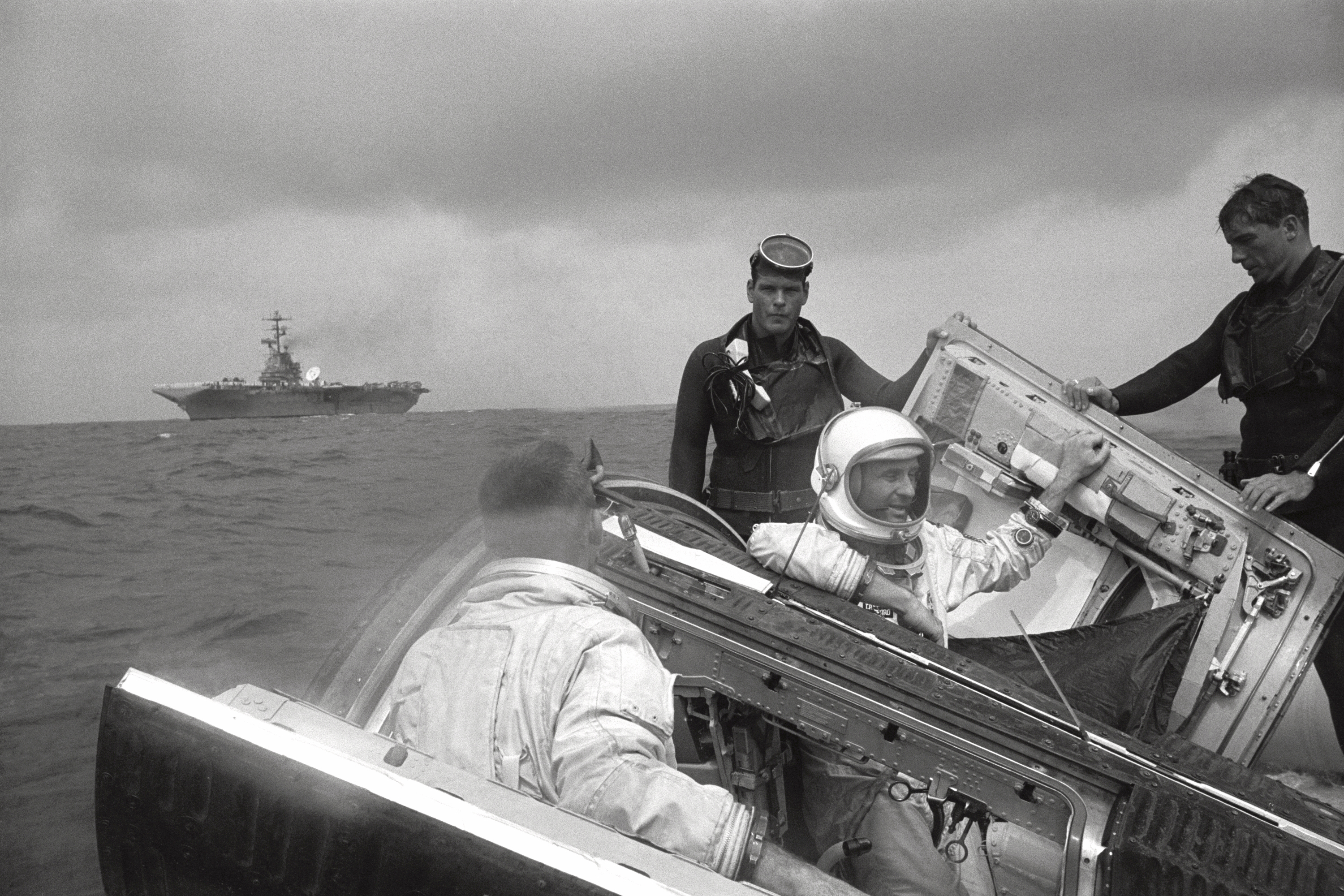
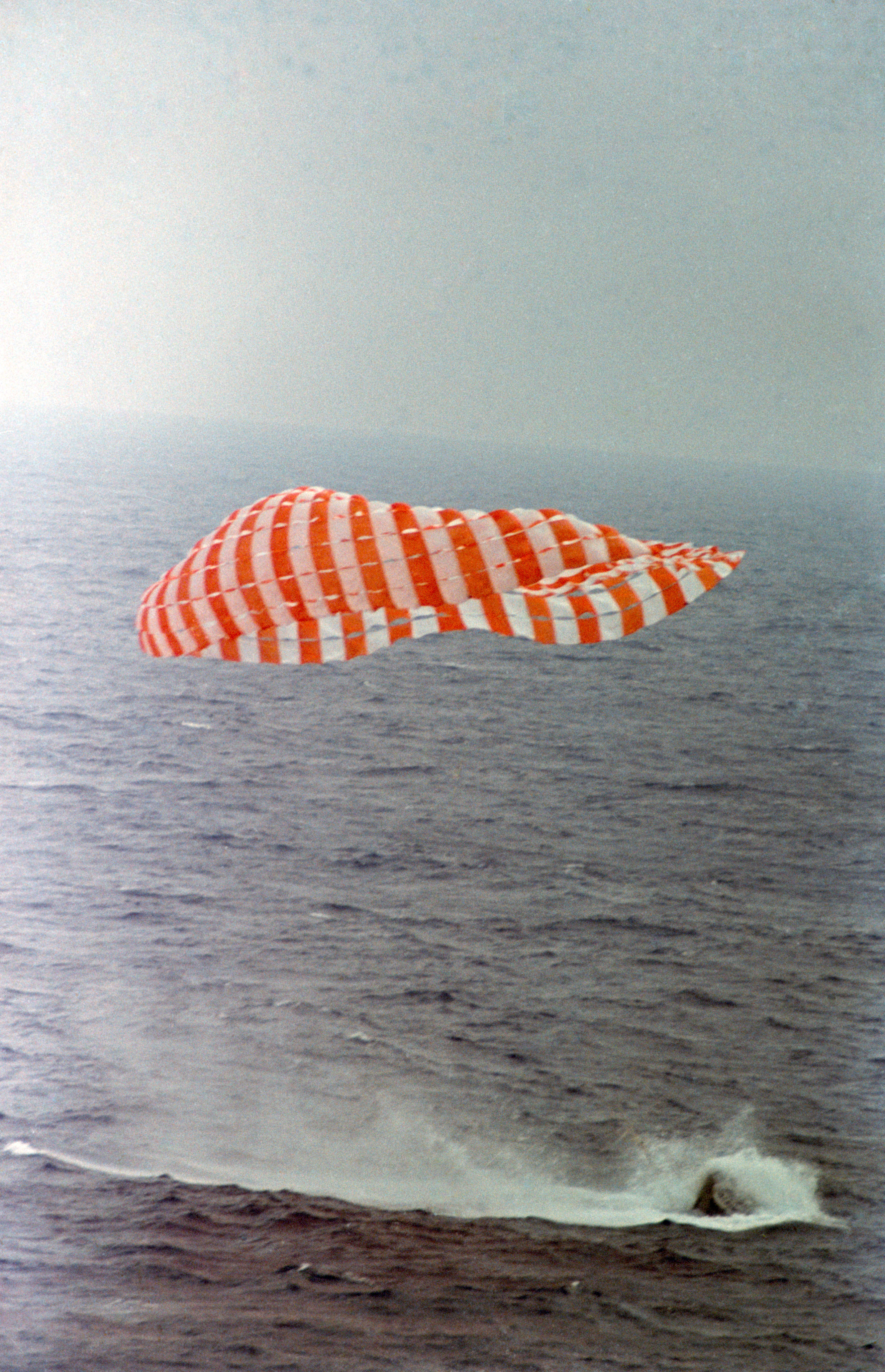
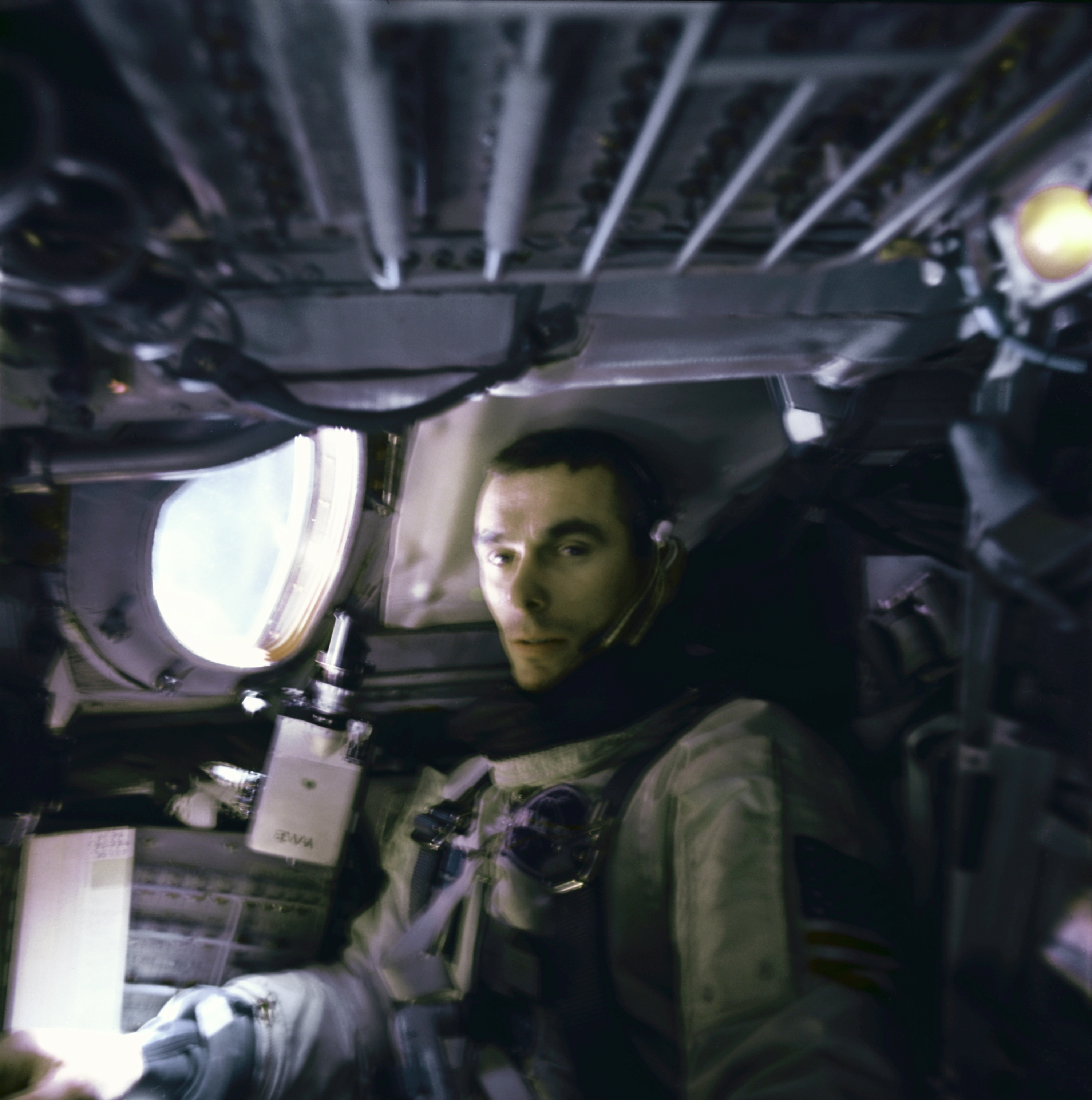
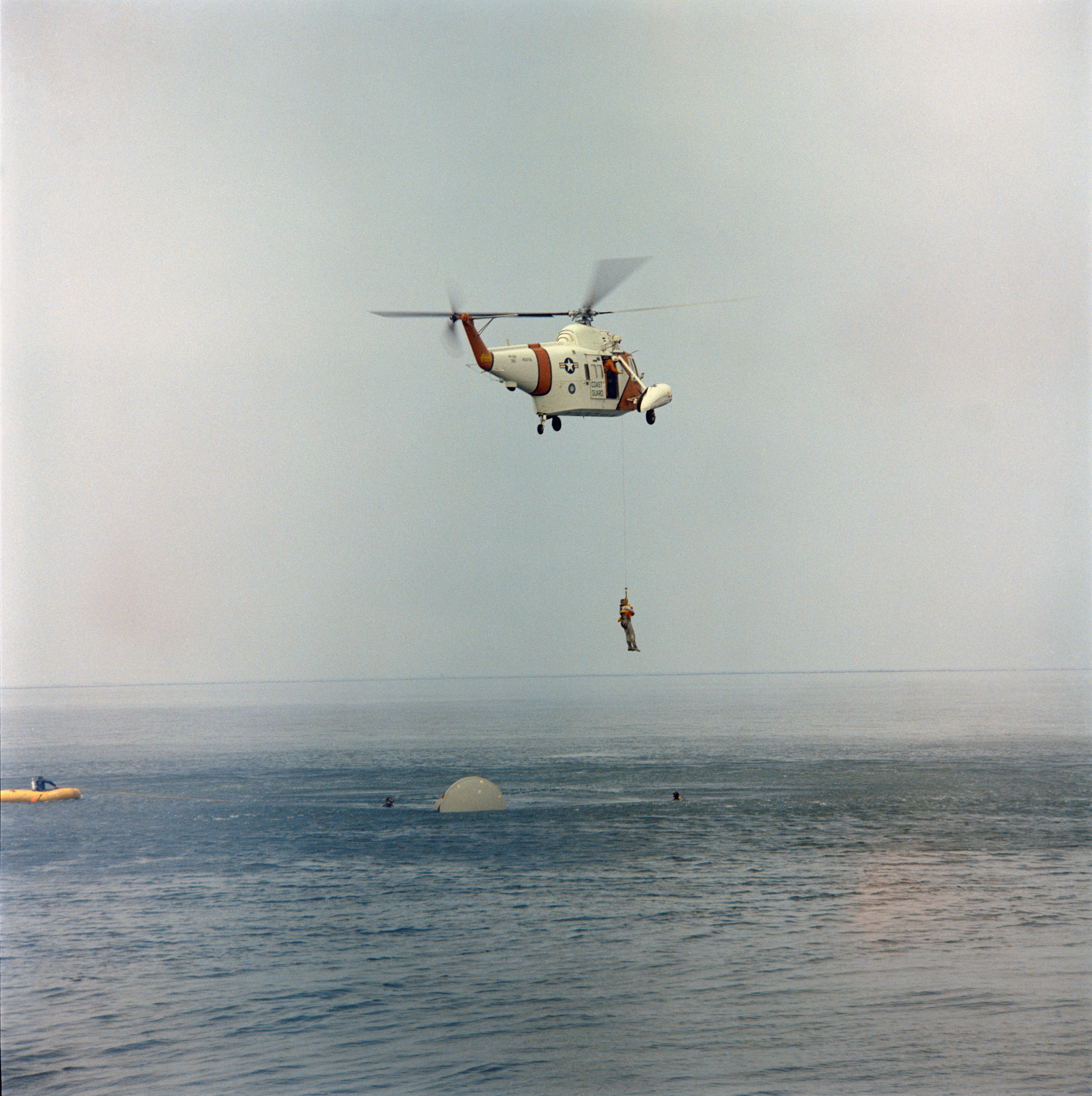
On 6 June, during revolution 45, the crew prepared to come home. This time the computer worked perfectly. Gemini IX-A touched the water 0.70 kilometres from the planned impact point in the Atlantic, 72 hours, 20 minutes and 50 seconds after liftoff, so close to the recovery ship that they could see USS Wasp from the capsule: it was the closest splashdown to the recovery ship of any crewed spacecraft to date. After going over the panels and throwing a few switches, the two men opened both hatches, relaxed and looked at the sea; they were close enough to raise an arm and thumb a ride from the Wasp. They stayed in the spacecraft until it was hoisted onto the ship's deck. When the usual commotion died down, Cernan kept telling anyone who would listen that extravehicular activity was not easy, nowhere near as easy as people believed, and he seemed bitterly disappointed at not having been able to fly the Air Force backpack.
The postflight medical examination found that Stafford had lost five pounds of weight and Cernan up to thirteen, ten and a half of them during the spacewalk. Stafford said afterwards that Cernan's suit was flown back to Houston and "they had about a pound or a pound and a half of water out of each boot". Dehydration, exhaustion and a slight reduction in breathing intake were the physiological effects of those two hours outside. Neither man had had much time to eat during the flight, given the crowded schedule, nor to document what they consumed, so it could not be determined how much of Cernan's difficulties were due to insufficient caloric intake; approximately half the food supply was eaten and the crew registered no complaints about its quality in the postflight debriefings. The mission was supported by 92 aircraft and 15 ships of the Department of Defense.
What remained
For the public, the frustrations of Gemini IX-A — the impregnable shroud and the fogged visor — eclipsed its achievements. Stationkeeping with an unstable body and examining it at close range had been useful experience, and even more significant were the advanced rendezvous manoeuvres, which showed that controllers and crews could handle sophisticated techniques applicable to Apollo. Had Gemini IX-A been the eighth mission, it might have been judged differently, as part of the learning; but docking, the primary objective, had not been achieved, and the extravehicular activity had not served to evaluate the backpack. Some engineers in the crew systems division in Houston thought too much was being attempted too soon: the simpler maneuvering unit planned for Gemini VIII would have been the logical second step in mastering work outside.
Immediately after the flight, Deputy Administrator Seamans expressed his dissatisfaction with the results and with the way missions were being managed, and a review committee was set up to ensure that the objectives planned for each mission were realistic and of direct benefit to Apollo. The underlying lesson of Cernan's spacewalk — that without adequate restraints, without sufficient cooling and without a measured working pace the human body exhausts itself in minutes — was taken up in the redesign of subsequent spacewalks and culminated in Gemini XII, where Aldrin, with handholds, footholds and timed tasks, worked outside without wearing himself out.
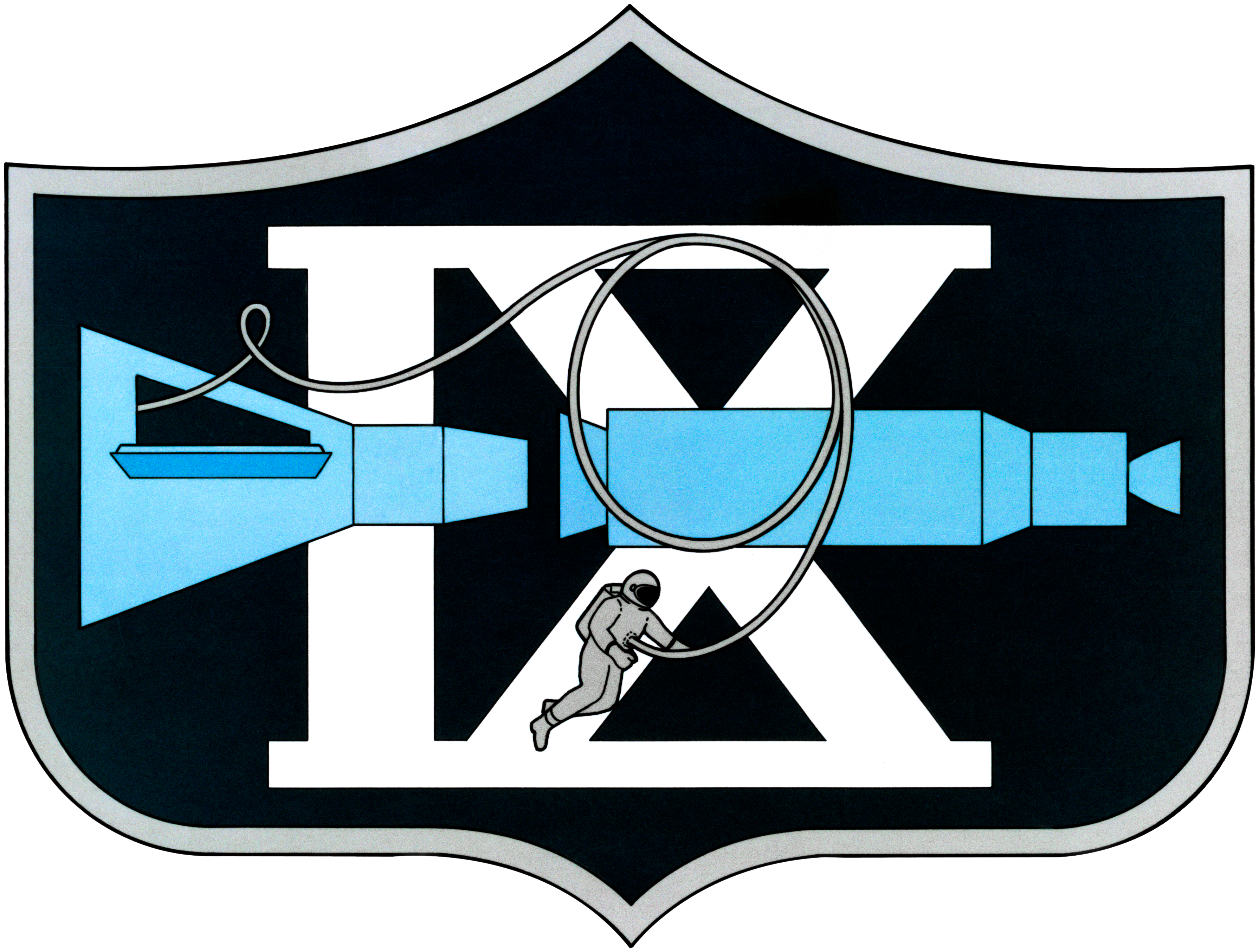
The mission emblem, shaped like a shield, shows the Gemini spacecraft docked to the Agena and a spacewalking astronaut whose tether forms the figure nine. Although the mission changed to use the ATDA, the emblem was not changed. The spacecraft, catalogued internationally as 1966-047A and with tracking number 2191, is preserved on display at the Kennedy Space Center Visitor Center in Florida.
Images
Elsewhere
- NASALooking Back at the Gemini IX Spacecraft ↗
- Smithsonian National Air and Space MuseumCapsule, Gemini IX-A ↗
- Smithsonian National Air and Space MuseumPatch, Mission, Gemini IX ↗
- Smithsonian National Air and Space MuseumHelmet, Stafford, Gemini 9 ↗
- Smithsonian National Air and Space MuseumAstronaut Maneuvering Unit, Gemini, Mock-up ↗
- Smithsonian National Air and Space MuseumPressure Suit Coverlayer, Gemini EVA, Cernan Developmental, Gemini 9 ↗
- American SpacecraftGemini IX-A: cápsula expuesta en el Kennedy Space Center Visitor Complex ↗
- FlickrGemini 9A — Eugene Cernan durante el paseo espacial (EVA), 6 de junio de 1966 ↗
- Google Arts & CultureLa nave Gemini 9 durante la EVA vista por el astronauta Eugene Cernan ↗
- Kennedy Space Center Visitor ComplexCápsula Gemini 9A en la exposición Heroes and Legends ↗
- Space.comGemini 9: la accidentada misión de reunión orbital de la NASA, en fotos ↗




![GEMINI 9 GATV High Frame Rate Launch Sequences [HD] (1966-05-17) - Agena Target Vehicle](https://i.ytimg.com/vi/jwrojwTKjCk/hqdefault.jpg)