Project Gemini · NASA · Crewed
Gemini X
- Jul 18, 1966, 10:20 PM
- Launch date
- 2
- Crew size
- 2 days 22 hr
- Duration
- Success
- Outcome


-1600.webp)


-10_-_LIFTOFF_-_KALEIDOSCOPE_EFFECT_-_CAPE_(s66-42762)-1600.webp)
-1600.webp)
_and_Michael_Collins_(left)%2C_prime_crew_for_the_Gemini-10_spaceflight-1600.webp)


-1600.webp)


-1600.webp)


-1600.webp)
Gemini X was the eighth crewed mission of the Gemini programme and flew from 18 to 21 July 1966 with John W. Young as command pilot and Michael Collins as pilot. Conceived after Gemini IX-A had left much of its objectives unmet, it was the most complex flight attempted up to that time: in three days it was to rendezvous with two different target vehicles, fire an Agena's main engine for the first time with a crew docked to it, and send a man out into vacuum twice. The mission achieved all three. After a first rendezvous that proved expensive in propellant, the final manoeuvres costing nearly 181 kilograms, three times more than any earlier flight, because optical navigation with the sextant failed, Young docked with Agena 10 five hours and 52 minutes into the flight. An 80-second burn of the target's engine lifted the combination to an apogee of 763.8 kilometres, the highest any human being had ever been, a record Gemini XI would surpass two months later. With successive burns of the same Agena the crew then descended to the plane of the target vehicle abandoned by Gemini VIII, inert since March and without a radar transponder, and picked it out optically exactly where NORAD said it would be. There Collins performed the first translation EVA between two vehicles in history: he pushed off to the dead Agena, lost his grip on the smooth docking cone, recovered his position with a nitrogen-powered zip gun and pulled the S-10 micrometeorite collector off the vehicle after four months of exposure to space. It was the first time a human being had visited an object abandoned in orbit. The flight also exposed the limits of 1966 technique. An earlier standup EVA devoted to ultraviolet photography of the southern Milky Way ended early with both crewmen in tears, caused by running both suit fans at once; Collins' Hasselblad camera worked loose and was lost during the second excursion, which was cut short after 39 minutes for lack of propellant; and the collector retrieved from the side of the spacecraft itself floated out of the hatch when the used equipment was jettisoned. Gemini X splashed down in the western Atlantic 5.4 kilometres from the aiming point and was recovered by USS Guadalcanal after 43 revolutions and 70 hours and 46 minutes of flight. Its legacy applied directly to Apollo: it showed that a crewed vehicle could use another as a space tug, that high orbits could be flown while dodging trapped radiation, and that working outside the spacecraft remained by far the programme's least solved problem.
Objectives
The primary purpose was to conduct rendezvous and docking tests with the Agena target vehicle. The mission plan also called for a rendezvous with the Agena left in orbit by Gemini VIII, two extravehicular excursions and the performance of fifteen scientific, technological and medical experiments.
Payload
John Young and Michael Collins flew with the Agena launched for the mission and, as a second passive target, the Gemini VIII Agena. The fifteen onboard experiments covered zodiacal light, synoptic terrain and synoptic weather photography, micrometeorite collection, an ultraviolet astronomical camera, ion wake measurement and meteoroid erosion; the instrumented package included the tri-axis magnetometer (MSC-3), the beta spectrometer (MSC-6) and the bremsstrahlung spectrometer (MSC-7).
History
A mission born of dissatisfaction
When Gemini IX-A splashed down on 6 June 1966, the mood at NASA was not one of celebration. Deputy Administrator Robert C. Seamans put his dissatisfaction with the results, and with the way missions were being handled, in writing: although the flight, ground and operations crews had performed well in what they did, the achievements fell too far short of the mission objectives. Seamans wanted a mission review board, and he ticked off the items such a group should study: corrective measures for the Atlas-Agena failure, the guidance update problem that had delayed the launch by two days, the shroud incident on the augmented target docking adapter, and the suit environmental control difficulties. He also wanted the board to make sure that objectives and alternatives were carefully selected well in advance of launch.
George E. Mueller established the Gemini Mission Review Board with his deputy, James C. Elms, as chairman; its other members were Edgar M. Cortright, NASA Deputy Associate Administrator for Science and Applications, Major General Vincent G. Huston, commander of the Air Force Eastern Test Range, and Charles W. Mathews, manager of the Gemini Program Office. The board began by laying out ground rules for drafting recommendations for each of the remaining missions: benefits for Apollo and for science and technology would be weighed against risks to crew safety, and mission planning policy itself would be examined, asking whether too much was being programmed or too little.
For Gemini X, however, the board arrived late. With the launch scheduled for 18 July, planning for that flight was nearly firm. The board did measure the mission objectives against the new ground rules, but there was neither time nor opportunity for more than minor changes. Gemini X therefore flew as it had been conceived: like Gemini VIII and IX, a complex flight with multiple objectives, except that this time the objectives were the most ambitious ever attempted in the programme.
The decision to fly a dual rendezvous
The central objective was a dual rendezvous involving two Agena vehicles: one launched for the mission, and one passive target left over from Gemini VIII, which had been circling the Earth without electrical power since March. To reach that second target, the main engine of the first would be used: the docked spacecraft would ride the Agena as a space tug.
Using the target's main engine while it was docked to a spacecraft had been hotly debated on two previous missions without ever being tried. When the Atlas dropped into the Atlantic Ocean on 17 May 1966, the time for discussion was past. Neither Gemini VIII nor IX-A had provided the hoped-for experience of firing the Agena's main engine while docked; there were only three flights left in the programme, and there would be no preliminary, low-level practice first. The next day Mathews told his staff the decision: Gemini X would dock with Agena 10 and together they would climb to Agena 8.
The second part of the double rendezvous was by far the trickier. Agena 8, like all Earth-orbital vehicles, had been precessing above and below the equator along its orbital path for months. With no help possible from a dead target, both the Gemini X Agena and the spacecraft would have to be launched at very precise times. And if something delayed the launches? It had happened before, more often than not. The mission planners would have to come up with a new set of numbers in a hurry. With events so closely related, delay or failure at any point threatened all the aims of the flight at once.
Young and Collins: "they must be out of their minds"
On 24 January 1966 NASA announced that John W. Young and Michael Collins would fly Gemini X. Young, a veteran of Gemini 3, would be command pilot; Collins, of the third astronaut group, would make his first flight as pilot. James Lovell and Edwin Aldrin had originally been named as the backup crew, but on 21 March 1966, after the deaths of Elliot See and Charles Bassett in a T-38 crash, the reshuffle of assignments moved them and Alan Bean and Clifton Williams became the Gemini X backups.
When Young first heard about the dual rendezvous plan, he thought, as he later recalled, "they must be out of their minds." He had two very concrete worries. The first was whether he could slow the linked vehicles down and stop them in time to keep from crashing into the second Agena. The second was whether he could even locate it: Gemini VIII's Agena, having run out of electrical power, was dead, with no radar transponder or other apparatus to help in the search. It would have to be spotted with optical equipment alone. "We hadn't worked on any of these procedures," Young recalled. "The problem with an optical rendezvous is that you can't tell how far away you are from the target. With the kind of velocities we were talking about, you couldn't really tell at certain ranges whether you were opening or closing."
Young also remarked that "we didn't have an EVA program," but that soon changed. Collins would do experiments, retrieve packages from both the spacecraft and the passive target, test a zip gun and visit an unstabilised vehicle. The manoeuvring backpack that Eugene Cernan had been unable to use on Gemini IX-A was dropped for missions X and XI and replaced by a 15-metre umbilical supplying oxygen and electrical support from the spacecraft.
Plotting the way up
Deciding what to do was only the beginning; how to do it was the bigger challenge. While shaping Gemini X for the dual rendezvous, the planners took the opportunity to give the crew some helpful experience in onboard navigation using optical equipment, charts and the spacecraft computer: the crew would join its first target on the fourth orbit, computing much of the approach from the cockpit.
.jpg)
Mission sequence was the next consideration. When should the dual rendezvous take place, on the second day or the third? It was eventually decided that the second day should be devoted to experiments and the third to chasing the passive target, which in itself appeared to create a conflict of aims: although Agena 10 was needed to carry the spacecraft to the second target, many of the planned experiments could not be performed while the vehicles were docked. About fifty people kicked the problem around at a trajectories and orbits meeting on 28 April 1966. Obviously the launch dates would have to be jockeyed to get the best phase relationship between spacecraft and target, serving both the dual rendezvous and the experiments.
Even assuming that both launches went as planned, shaping the second rendezvous was an exacting task. The North American Air Defense Command, NORAD, at Colorado Springs, had kept track of Agena 8's whereabouts ever since it ran out of electrical power. To begin the rendezvous, the docked Gemini X/Agena 10 combination should first go into a large elliptical orbit, 298 kilometres at perigee and 752 kilometres at apogee. After six revolutions to judge phase relationships, Agena 10 would then manoeuvre down to an approximately 398-kilometre circular orbit near Agena 8's space lane, as reported by NORAD.
The radiation ceiling
The high-altitude aspect of the flight raised its usual qualms. Although the Gemini Program Office no longer resisted the use of the big Agena engine while the vehicles were docked, McDonnell did not like the idea of the vehicles passing through so many high orbits, which might affect a safe emergency reentry if the retrorockets did not perform as needed. There was also the South Atlantic radiation zone to consider.
At a trajectories and orbits meeting at the end of June 1966 the maximum acceptable altitude for the dual rendezvous was set at 298 by 1,065 kilometres, based on radiation constraints and actual radiation levels measured in 1964. But the decision to use the Agena for docked manoeuvres had already been made, and any misgivings had to be laid aside. After careful study, the planners concluded that an emergency reentry from an elliptical orbit with a perigee of 298 kilometres could be made even if only three out of the four retrorockets fired. Finally, they plotted the spacecraft's orbital track with great care to avoid the heavy radiation patches.
With the memory of past flights still fresh, when no one had been sure what target, if any, would be waiting, alternate and contingency plans were drawn up. If the target vehicle for this flight did not reach orbit, the mission would be renamed X-A and the spacecraft would be launched into a 162- by 385-kilometre orbit to rendezvous with Agena 8 on the 16th revolution. The alternate plans also covered experiments, extravehicular activity and systems tests.
18 July 1966: two launches one hundred minutes apart
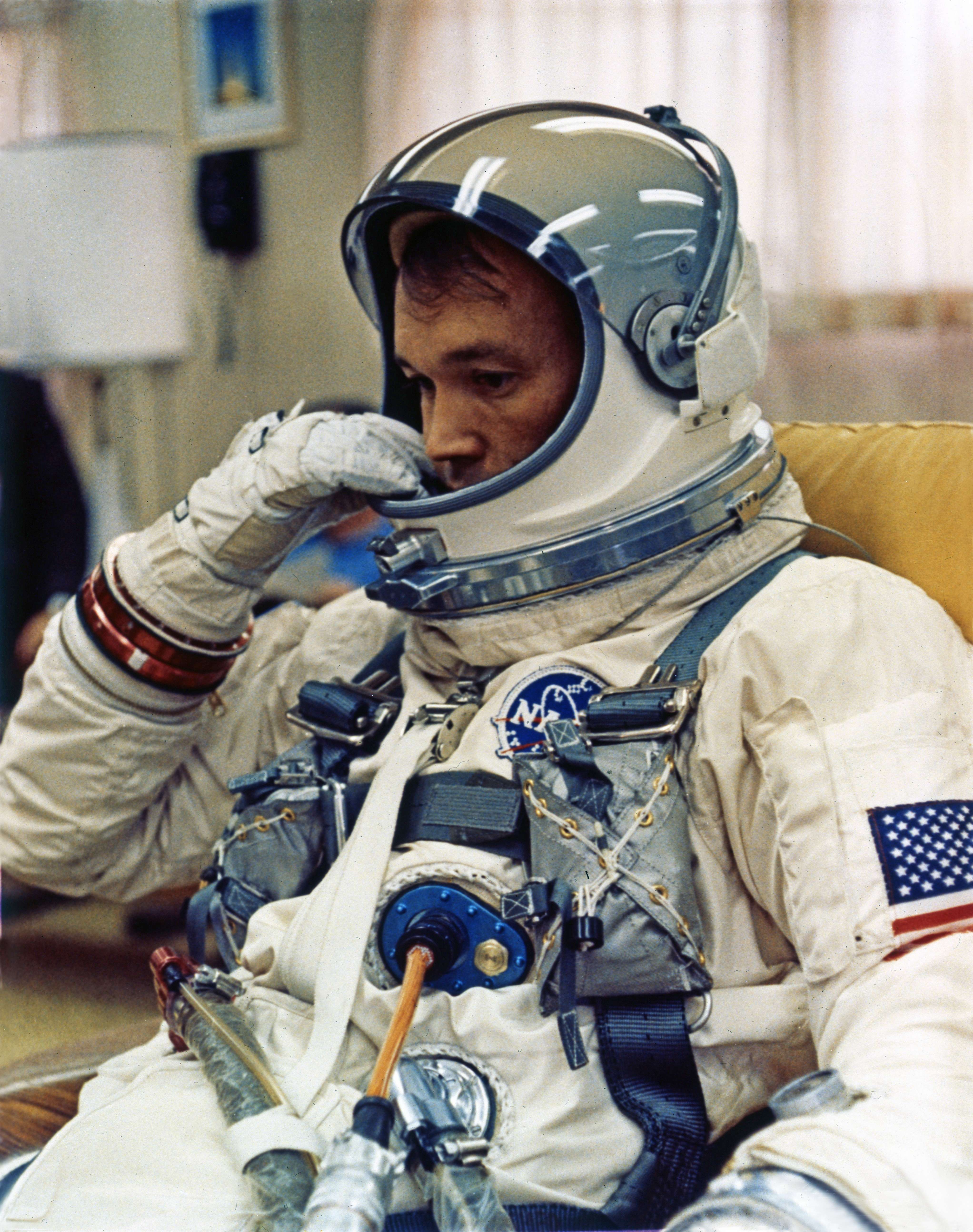
After the premission review, the traditional meal and the ritualistic suiting up, Young and Collins left the crew quarters on 18 July 1966 for pad 19, to begin the most complex manned flight so far. They had been awakened at noon for a 5:20 p.m. takeoff, when a 35-second window offered the best chance of rendezvous with the two Agenas.
The Atlas lifted its payload toward space at 3:39 p.m., just two seconds late; it was the 299th Atlas launch and the 100th for NASA. One hundred minutes later, the Titan II GLV boosted the spacecraft skyward exactly on time. Except for a slight shaking and a buzzing in their ears, Young and Collins had a nice ride to start chasing their first target.
At entry into orbit, on a 159.9 by 268.9 kilometre path, Gemini X trailed its Agena by 1,800 kilometres. Flight Director Glynn Lunney told the crew they were all set for a fourth-orbit rendezvous.
The sextant, the airglow and a bill of 181 kilograms
Collins unstowed a Kollsman sextant to sight on selected stars for an attempt at optical navigation. Young pointed the spacecraft while his crewmate tried to make out the horizon. Collins realised he was using the wrong reference when he saw stars below the line: he had been mistaking the airglow, a band of radiant light from the upper atmosphere, for the horizon. Even after he corrected this, he could not get the lens of the sextant to work properly, as the optical image of the stars did not agree with what he had been taught. He laid the Kollsman aside and tried an Ilon instrument, but that was little help as the Ilon had a severely limited field of view.
Young and Collins checked their figures with Lunney, who had been watching their activities carefully through telemetry. When the trio saw that the numbers did not agree with those of the ground computers, Gordon Cooper, the Houston CapCom, passed the word that the crew would have to use the ground computations. Young then fired the thrusters to adjust their orbit to 265 by 272 kilometres.
When he aligned the platform for the terminal phase, the command pilot did not realise that the spacecraft was turned slightly. As he thrusted toward the target, Young needed two large midcourse corrections: the spacecraft path toward the Agena was not lined up properly, so he had to stop thrusting briefly and take off on a new track. The final translational manoeuvres to reach the Agena cost nearly 181 kilograms of fuel, three times more than any earlier mission. That expenditure, made in the first hours of a three-day flight with two rendezvous ahead, coloured everything that followed.
The docking and the decision to press on
Five hours and 52 minutes after launch, Young reported a rigid dock. Because too much fuel had been used, Lunney decided to omit the docking practice, backing away and returning to the target's cone, that had been scheduled to give the crew experience.
.jpg)
Young and Collins wondered whether the second rendezvous might also be cancelled. But some six and a half hours into the mission the ground controllers started giving the crew the data they would need for the burn, and an hour later the CapCom at Hawaii cleared them to try for the second rendezvous. It was also decided to keep the Gemini docked to the Agena as long as possible, since that would let them use the propellant aboard the target for attitude control and preserve their own.
The switch engine
The Agena main engine roared into life exactly on time. For 80 seconds the target vehicle thrust the spacecraft upward, adding 129 metres per second to their speed. The crew, at that moment flying backward, had little to say about their reactions to a negative one-g force, a shove to the front of the body, "eyeballs out", rather than a push on their backsides, "eyeballs in", as during launch. They were thrown forward from the seats against the body straps.
Young later described the first ride on a space switch engine: "At first, the sensation I got was that there was a pop [in front of our eyes], then there was a big explosion and a clang. We were thrown forward in the seats. We had our shoulder harnesses fastened. Fire and sparks started coming out of the back end of that rascal. The light was something fierce, and the acceleration was pretty good. The vehicle yawed off - I don't remember whether it was to the right or to the left - but it was the kind of response that the Lockheed people had predicted we would get. . . . The shutdown on the PPS [primary propulsion system] was just unbelievable. It was a quick jolt . . . and the tailoff . . . I never saw anything like that before, sparks and fire and smoke and lights."
It was the first time a crew had fired an Agena's main engine while docked to it. The demonstration that one spaceborne vehicle could meet another, latch onto it and use it as a kind of space tug opened possibilities for spaceflight concepts that then existed only on paper: shuttles, space stations and space laboratories.
The altitude record
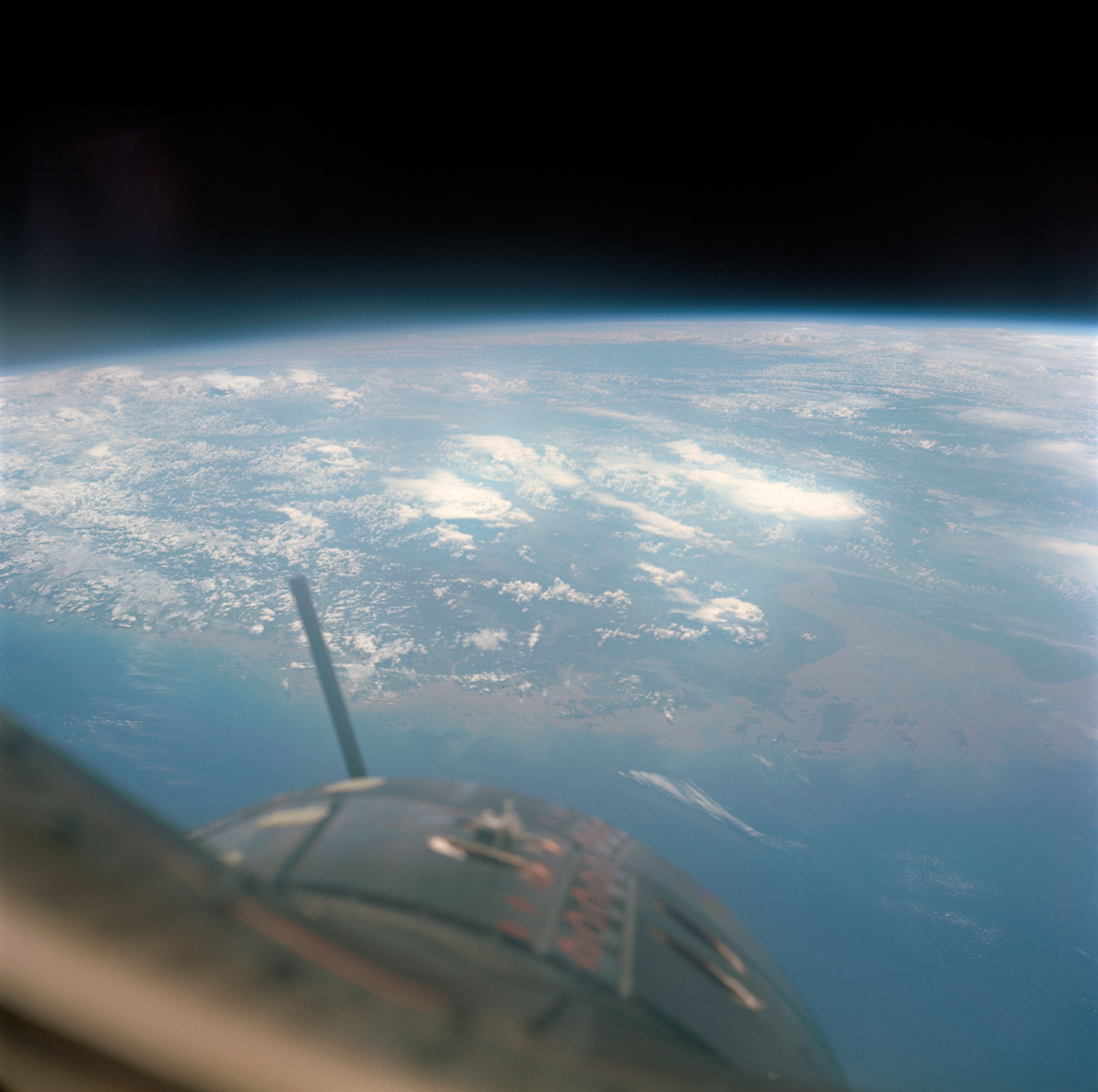
Gemini X reached an orbit that measured 763 kilometres at the top and 294 at the bottom. The Agena had pushed the spacecraft more than 463 kilometres above its initial apogee. Young and Collins now viewed Earth from a higher elevation than any human beings ever had; the record stands at 412.4 nautical miles, 763.8 kilometres.
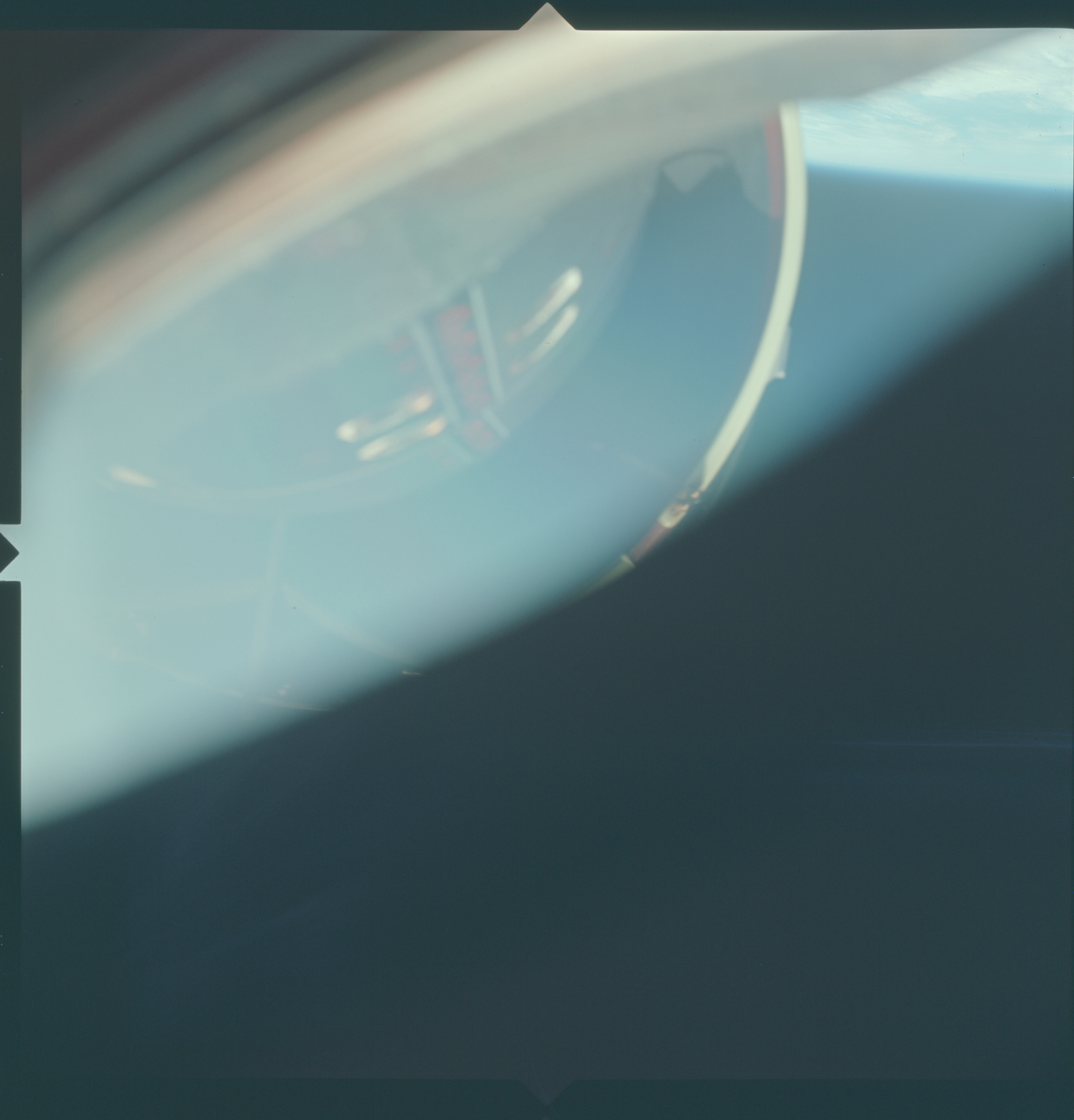
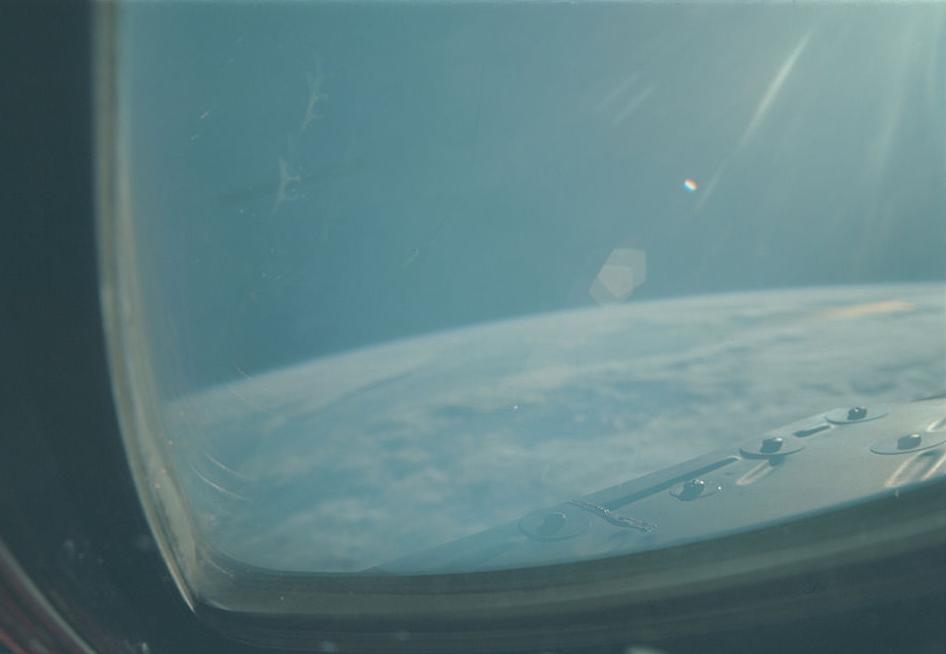
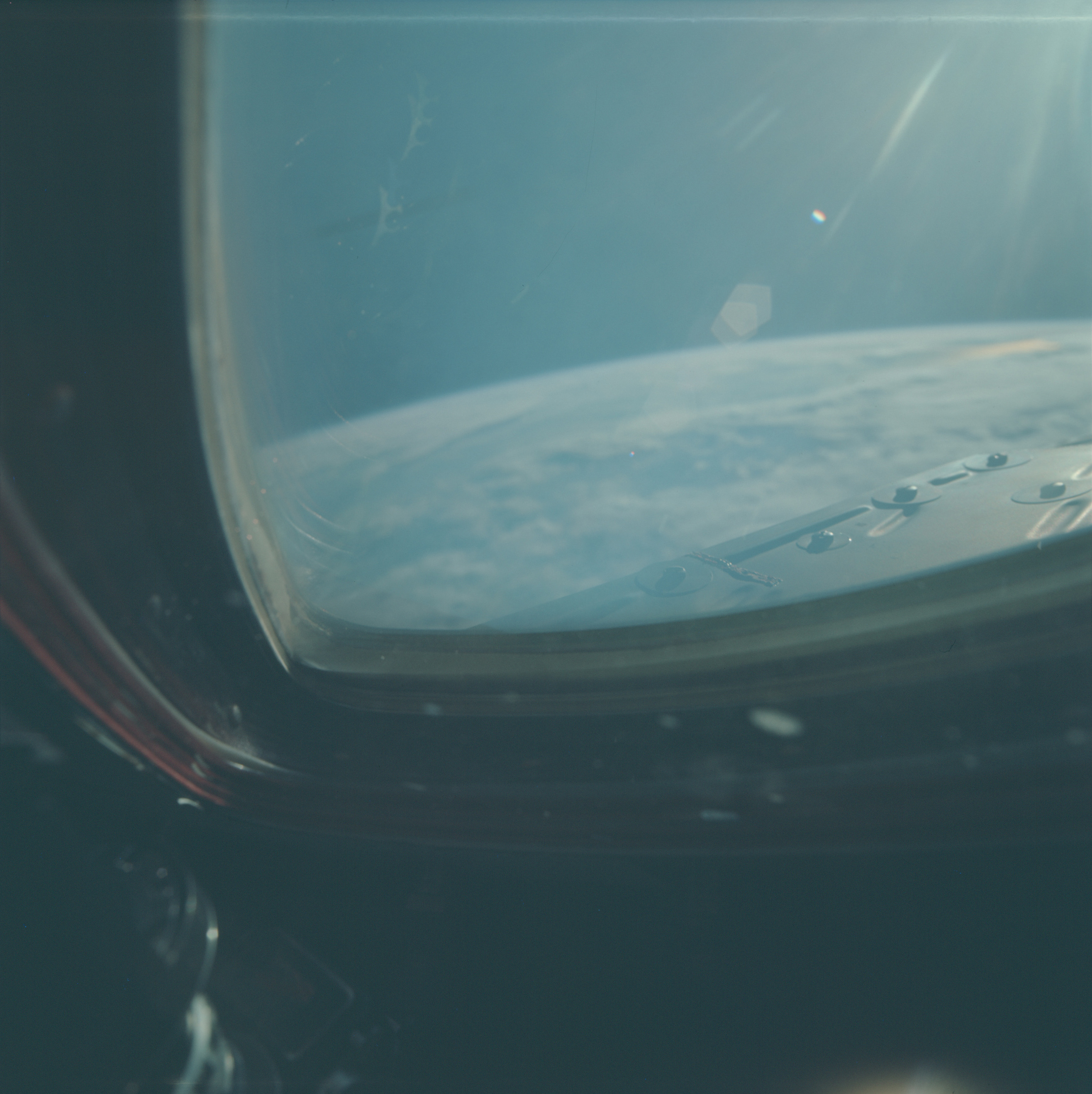
Instead of gazing at the planet in wonderment, however, they confined their attention to their own little artificial world: they watched spacecraft systems and kept an eye on the radiation dosage readings, which remained within tolerable limits. During his technical debriefing Young only reported, "We took some pictures at apogee. . . . I don't know where it was, but it shows the curvature of the Earth. . . . We took some pictures coming down hill. I think it was the Red Sea area."
In rating one impression over the other, record high altitude versus Agena ignition, Young and Collins were far more affected by the firing of the switch engine than by the unique vantage point they had reached. This lack of awe at their record height was caused, at least in part, by the fact that the switch engine blocked much of the downward view. The manned altitude record did not last long: Gemini XI surpassed it two months later.
Coming down to Agena 8's plane
Nine hours into the flight the pilots bedded down and slept fitfully. Both were still wondering whether the second rendezvous would be done. Besides, as Collins said, neither was "really bone-tired." Cliff Charlesworth's shift in Mission Control was busy that night, reviewing alternate plans for adapting the mission to fulfil its objectives.
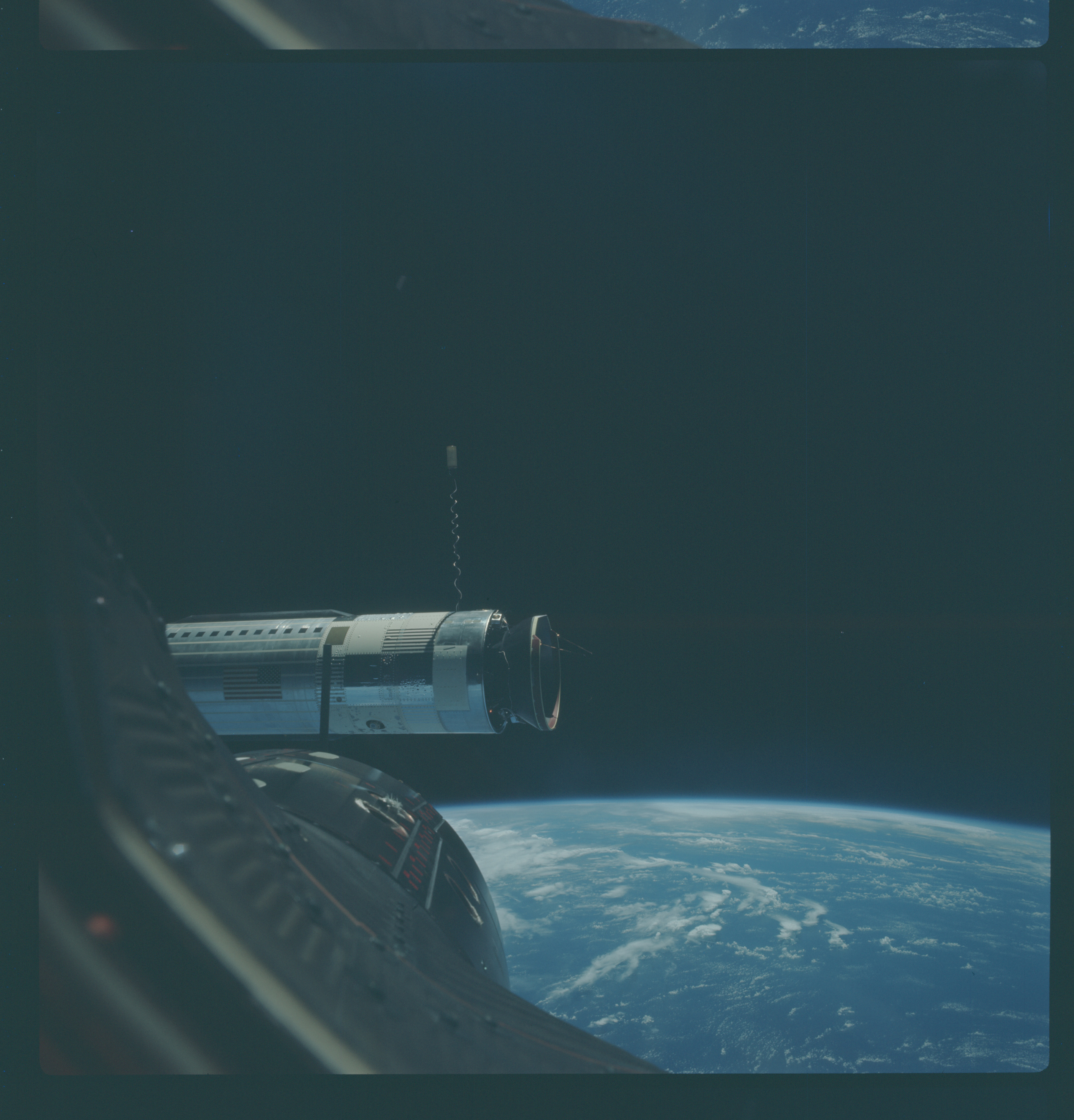
When Young and Collins opened for business after 18 hours of flight, their spirits lifted as the CapCom at Carnarvon gave them the numbers for the next target vehicle firing. With the Agena/spacecraft combination faced about so the main engine would fire directly into the flight path, Young made a 78-second burn to reduce the velocity by 105 metres per second and lower the apogee to 382 kilometres. The pilots were again pressed forward in their seats, but this time they were impressed more by the firepower of the Agena than by its fireworks. "It may be only 1 g, but it's the biggest 1 g we ever saw! That thing really lights into you," Young commented.
Like rendezvous manoeuvres in the past, the next Agena burn, and the final one with the main engine, aimed at circularising the orbit. At 22 hours and 37 minutes elapsed time the target drove the spacecraft along the flight path to add 25 metres per second to the speed. This brought the low point of the orbit up to 377.6 kilometres, only 17 kilometres below Agena 8.
The experiments
Although rendezvous and docked manoeuvres were the high point of the first day, the crew also spent a good part of that time on the fourteen experiments they carried. Sixteen had originally been scheduled. Gemini X lost MSC-5, lunar ultraviolet spectral reflectance, which was to determine the ultraviolet spectral reflectance of the lunar surface and aid in designing equipment to protect Apollo astronauts from sunburn and eye damage: the Moon was out of phase and the chore was deleted before the flight. M-5, bioassays of body fluids, also fell; it had been the bane of all crews since Gemini VII, Mathews had tried in vain to get it out of earlier missions, and this time he succeeded. Its cancellation on 12 July 1966 marked the end of medical experiments in the Gemini programme.
Twenty minutes after launch the crew turned on a switch to start the tri-axis magnetometer, MSC-3, used as it had been on other flights to measure the radiation levels in the South Atlantic Anomaly. Two other experiments were also devoted to radiation: MSC-6, a beta spectrometer mounted in the adapter to measure potential radiation doses for future missions, and MSC-7, a bremsstrahlung spectrometer installed in the cabin to detect radiation flux as a function of energy when the spacecraft passed through the Anomaly.
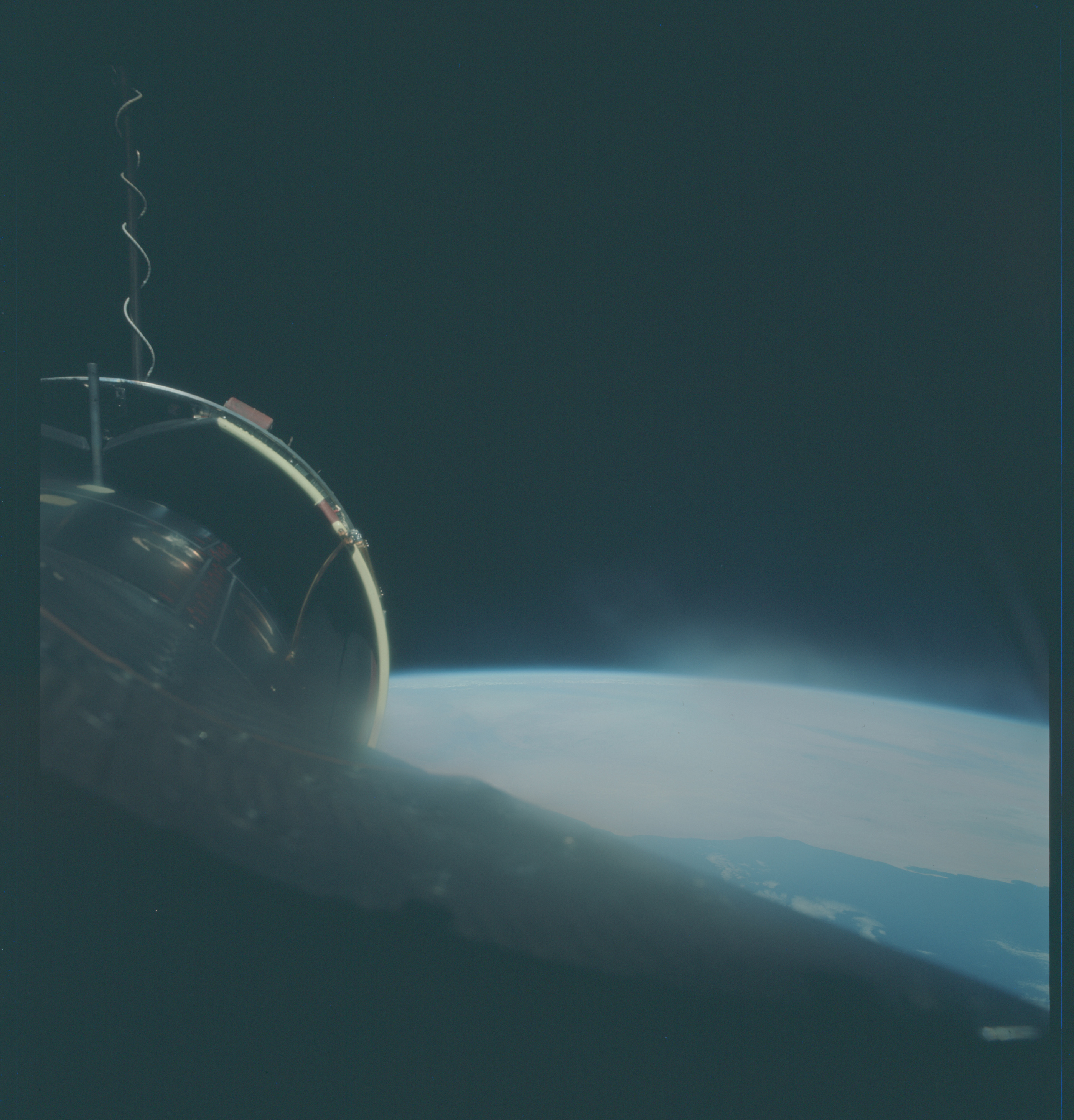
The science programme also included synoptic terrain photography (S-5) and synoptic weather photography (S-6), the S-26 ion wake measurement, which studied the ion and electron structure of the spacecraft's wake and could only be done once undocked, ultraviolet astronomical photography (S-13), colour patch photography (MSC-8), and the two micrometeorite collectors Collins was to retrieve outside.
The first EVA: standing in the hatch
Before the third Agena burn, Collins got ready for his first exposure to outer space: a standup EVA, body out of the open hatch and feet on the seat. Preparations went well and the hatch opened easily.
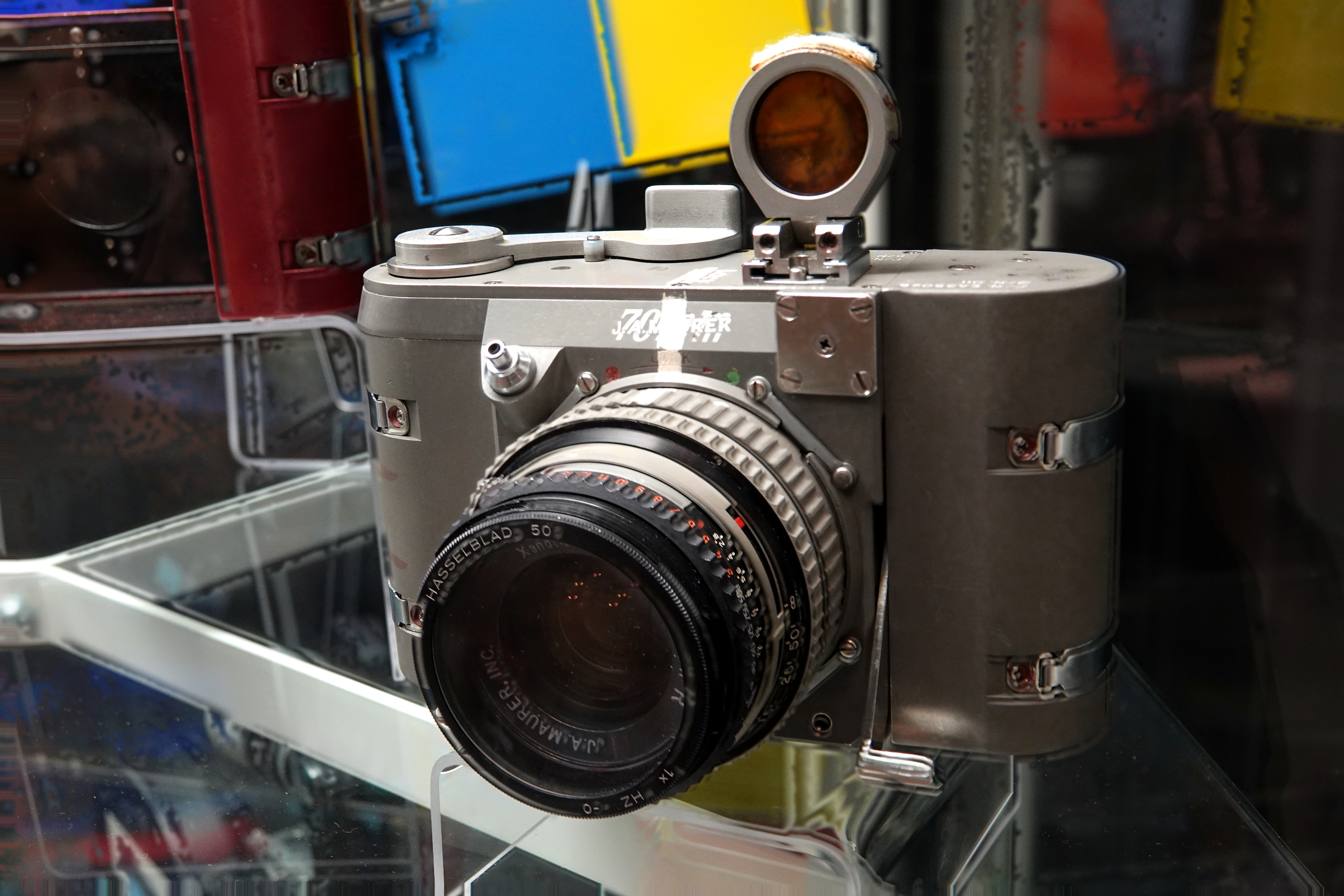
At sunset Collins stood in his seat, setting up a 70-mm general-purpose camera for S-13, a photographic study of stellar ultraviolet radiation. He aimed the camera at the southern Milky Way, scanning from Beta Crucis to Gamma Velorum, and exposed 22 frames. The entire night pass was devoted to this task. Young helped Collins identify the stars while at the same time controlling the spacecraft and target vehicle combination, no trivial operation with two vehicles joined together and a man leaning out of the hatch.
With the beginning of daylight, Collins began MSC-8, colour patch photography, to see whether film could accurately reproduce colours in space. He did not complete the assignment.
Watering eyes and two suit fans
Collins' eyes began to fill with tears. Young had the same problem. They suspected at first that the anti-fog compound inside their faceplates was irritating their eyes. They closed the hatch at 24 hours and 13 minutes elapsed time, about six minutes early.
They had also noticed a strange odour that they thought might have been the lithium hydroxide used in the environmental control system, but ground engineers finally concluded that their smarting eyes were caused by having both suit fans on at once. They turned one fan off and, at 30 hours elapsed time, began a second sleep period. Bone-tired this time, they rested well. The episode, minor in appearance, illustrates how little was still known about the interaction between suit, cabin and man: a ventilation setting was enough to abort an experiment halfway through.
Chasing a dead target
Young and Collins awakened to a "morning" of increased activity. In addition to the normal systems checks, the ground network reminded them of the experiments expected that day: the S-26 ion wake measurement, to be made after undocking from the Agena, and synoptic terrain and weather photography. The pilots also had to work in two manoeuvres to help them catch up with Agena 8.
Their switch engine had accomplished its task, and more. After being hooked to it for 39 hours, however, they were getting a little tired of looking at it. Young said that watching the Agena out his window was just like "backing down the railroad [track] in a diesel engine looking at a big boxcar in front of you. . . . The big drawback of having the Agena up there is that you can't see the outside world. The view out of the window with the Agena on there is just practically zilch."
On freeing themselves from their Agena, the crewmen began preparing for Collins' exit from the spacecraft. Young still had to make the final manoeuvres to get the spacecraft close enough to Agena 8 for Collins to reach it. Collins connected the 15-metre umbilical to his suit and then fastened it out of the way until time to use it.
"45:38. First sighting of Gemini VIII," Young said. "At this minute it's blurry." After the distance between the two vehicles had been calculated, the Houston CapCom, on the remote line through the Canton station, informed Young: "Your range, Gemini X, is 95 [nautical] miles [176 kilometres]." The crew then learned that what they had been looking at was their own Agena, just 5.5 kilometres away. Houston offered consolation, "95 miles is a pretty long range," and Young answered, "You have to have real good eyesight for that." They did not see the Gemini VIII Agena until it was 30 to 37 kilometres from them, looking to Young like "a dim star-like dot until the sun rose above the spacecraft nose." NORAD's constant care had paid off: they found Agena 8 just where it was supposed to be.
At 47 hours and 26 minutes Young started the final closure, with Collins computing the figures for two midcourse corrections. The crew found the old Agena pretty stable, and Young moved in to stationkeep about three metres above it. In less than 30 minutes he told the Houston CapCom that they were going down for a closer look at the micrometeorite collection package. Back in Mission Control, fuel usage during stationkeeping was being very closely watched; when it proved to be reasonable, Gemini X received a go for the next extravehicular exercise. "Glad you said that," Young answered, "because Mike's going outside right now."
The translation EVA to Gemini VIII's Agena
Collins emerged from the spacecraft at dawn. Like Cernan on Gemini IX-A, he found that all tasks took longer than he expected. He picked off the S-12 micrometeorite collection package from the exterior of his own spacecraft, accomplishing it with some difficulty. Next he moved to the adapter to attach his zip gun to the nitrogen fuel supply. Back in the cockpit area once again, he held on while Young moved the spacecraft to within two metres of the Agena.
Collins pushed off from the spacecraft, floated freely in space and grasped the outer lip of the docking cone on the target. As he clutched at the experiment package he wished for handholds, or for more hands. Cernan had warned him it would be hard, and it was. He soon lost his grip on the smooth lip and drifted away from the package and from the Agena. He had to decide quickly whether to pull on the umbilical, coiling about like a snake, or to use the hand-held gun. Being about five metres away from the spacecraft, Collins chose the gun. It worked, and he propelled himself first to the spacecraft and then back to the Agena, using a series of squirts to get to the package. This time he clung to wire bundles and struts behind the adapter cone and grasped the S-10 experiment. He was supposed to attach a replacement device in its place, but he abandoned the idea, fearing he would lose the one he had picked up. Using the umbilical, he pulled himself hand over hand back to the cockpit and gave the S-10 package to Young.
During that work, as Collins tried to keep his tether clear of the Gemini and the Agena, his Hasselblad camera worked itself free and drifted away, so he was unable to photograph the activity. That is why no pictures taken by Collins himself exist of the only visit ever made to an inert vehicle abandoned in orbit months earlier.
So far the umbilical had been snubbed so it would extend only six metres. The pilot now unsnapped the buckle that released the remaining nine, intending to evaluate the gun. But the gun play stopped before it started. The Hawaii CapCom told Young, "We don't want you to use any more fuel [for stationkeeping]." Young replied, "Well, then, he'd better get back in," and to Collins he said, "Come on back in the house."
Tangled umbilical and a switched-off radio
Getting back into the spacecraft was surprisingly difficult. Collins had got himself tangled in the umbilical, and since the pressurised suit made it hard to see or feel just where the line had wrapped itself about him, he had to wait while Young helped unwind him and got him back into the seat.
.jpg)
But fuel remained the big question. Houston called them, "just . . . to confirm that you're not using any fuel." Young replied, "We've got everything shut off." More was shut off than he realised: he soon discovered that the radio transmitter had also been turned off. By then Collins was back in his seat. Young reported that hatch closing had been easy. With the long lifeline coiling all over the cabin, Young thought it made "the snakehouse at the zoo look like a Sunday school picnic."
A little over an hour later the crew reopened the hatch and tossed out the chestpack and umbilical. The operation only took three minutes: McDonnell had done an excellent job on the right-hand hatch. Along with that gear went, apparently floating out of the hatch, the micrometeorite collector Collins had retrieved from the side of his own spacecraft. Of the two packages picked up in space, the one that came back to Earth was the one that had spent four months attached to Gemini VIII's Agena; the spacecraft's own, S-12, was lost. It was the only Gemini X experiment that obtained no data, along with the landmark contrast measurement, which was deleted for lack of fuel.
Orbit shaping, reentry and USS Guadalcanal
Because of the time spent struggling with the umbilical, Collins and Young had to hurry to get set up for an important manoeuvre that would make the point of reentry more precise. They carried out the orbit-shaping activity exactly on time, at 51 hours and 38 minutes: a retrograde firing of 30 metres per second that brought the spacecraft perigee down 106 kilometres, making the orbital parameters safe for reentry. After another round of experiments, this time synoptic terrain and weather photographs taken as the spacecraft drifted through space, the crew began their third sleep period.
On awakening, about 63 hours into the flight, on homecoming day, Young and Collins spent more time on experiments and did their packing. Then, 70 hours and 10 minutes after liftoff, the crew felt the first retrorocket ignite as they passed over the Canton Island tracking station during their 43rd revolution. Reentry went remarkably well, with Young steering bank angles by computer solutions.
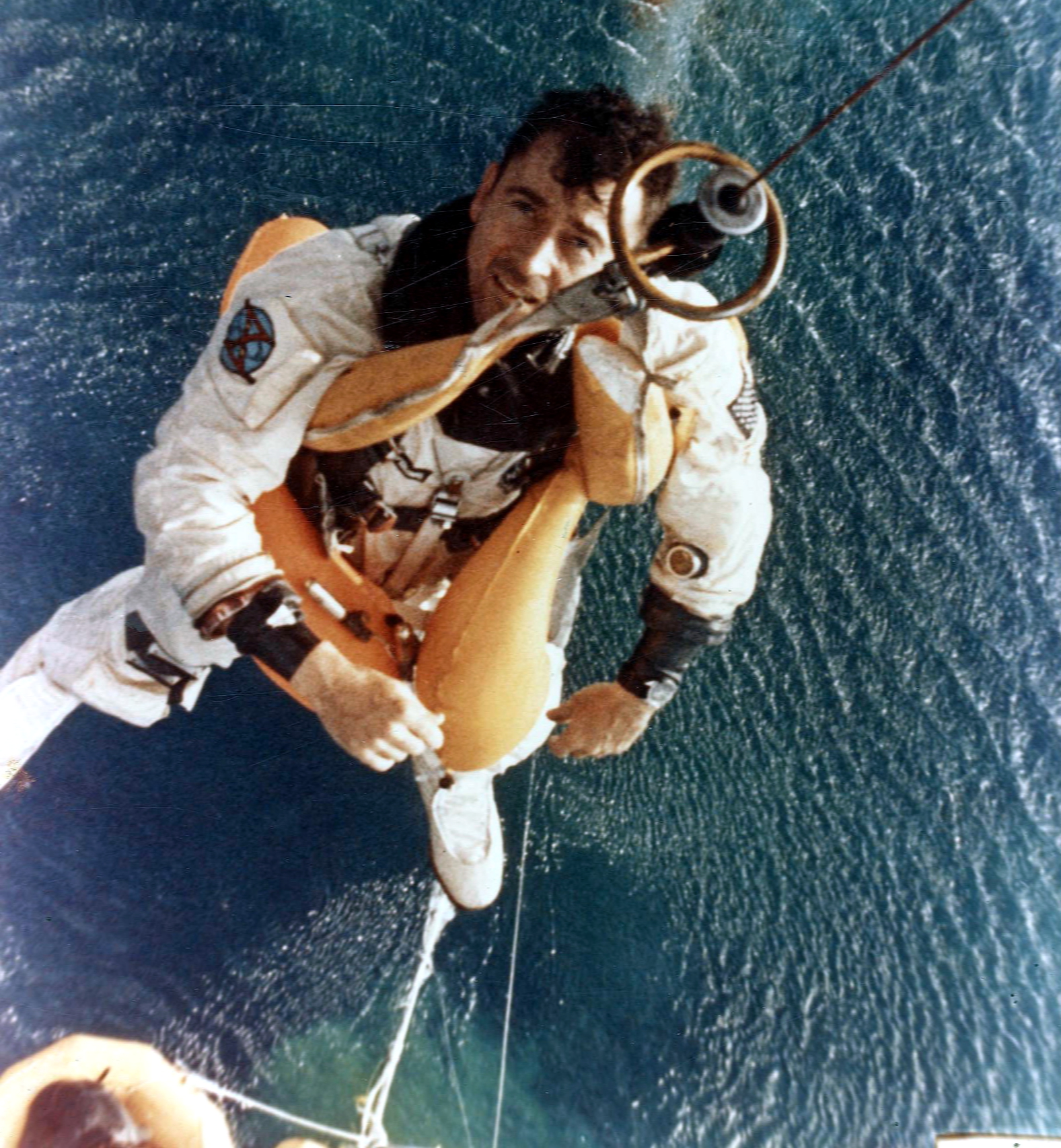
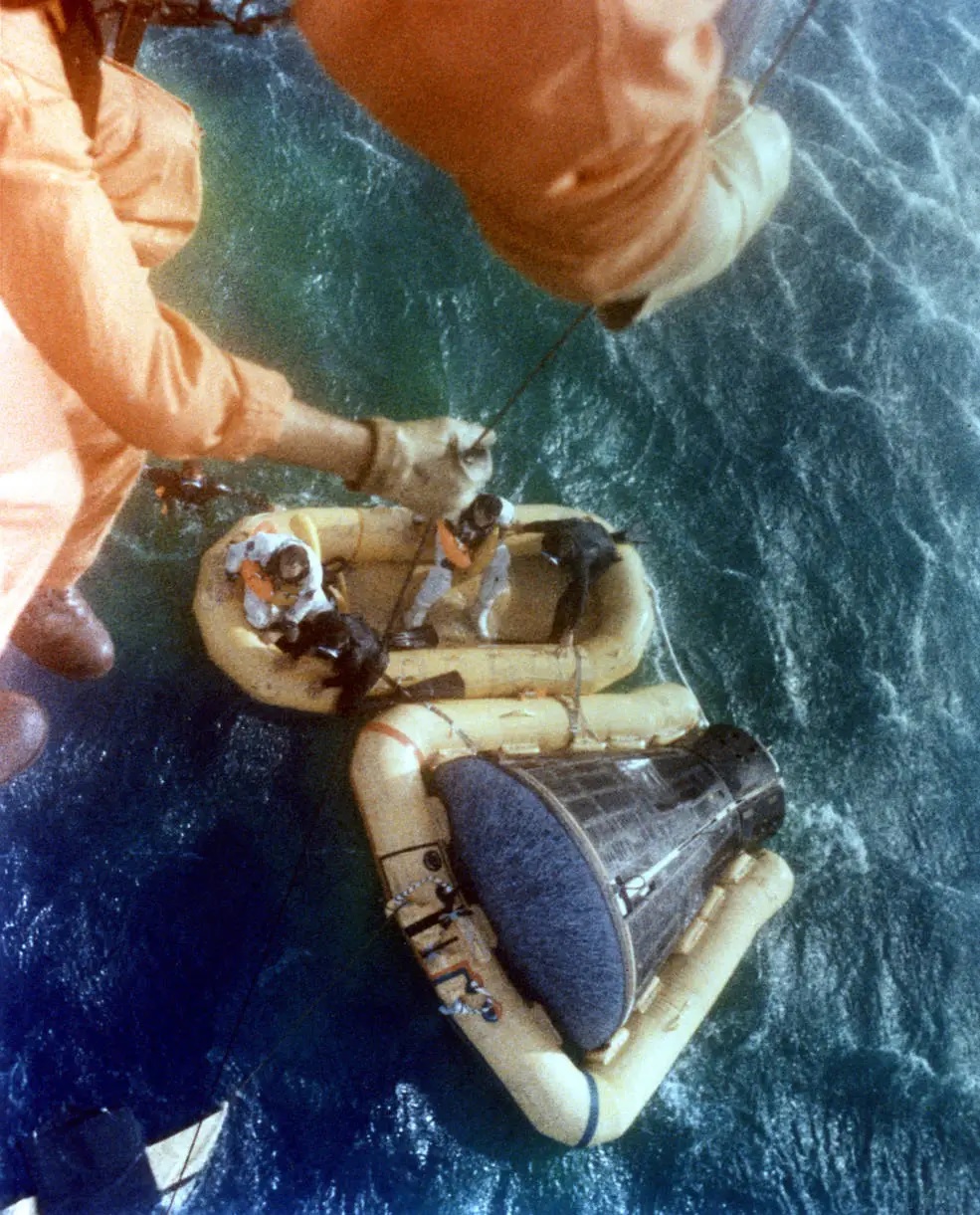
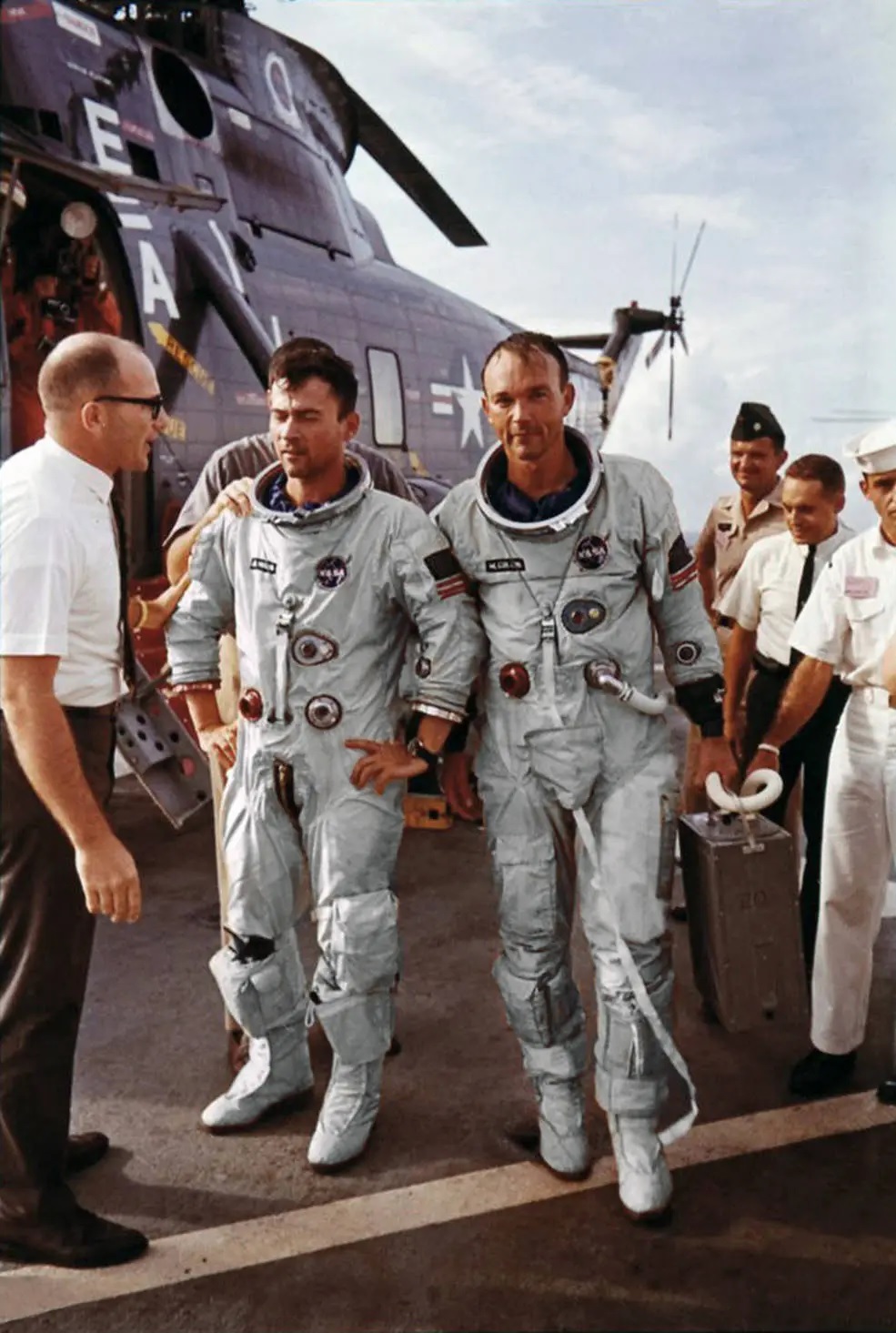
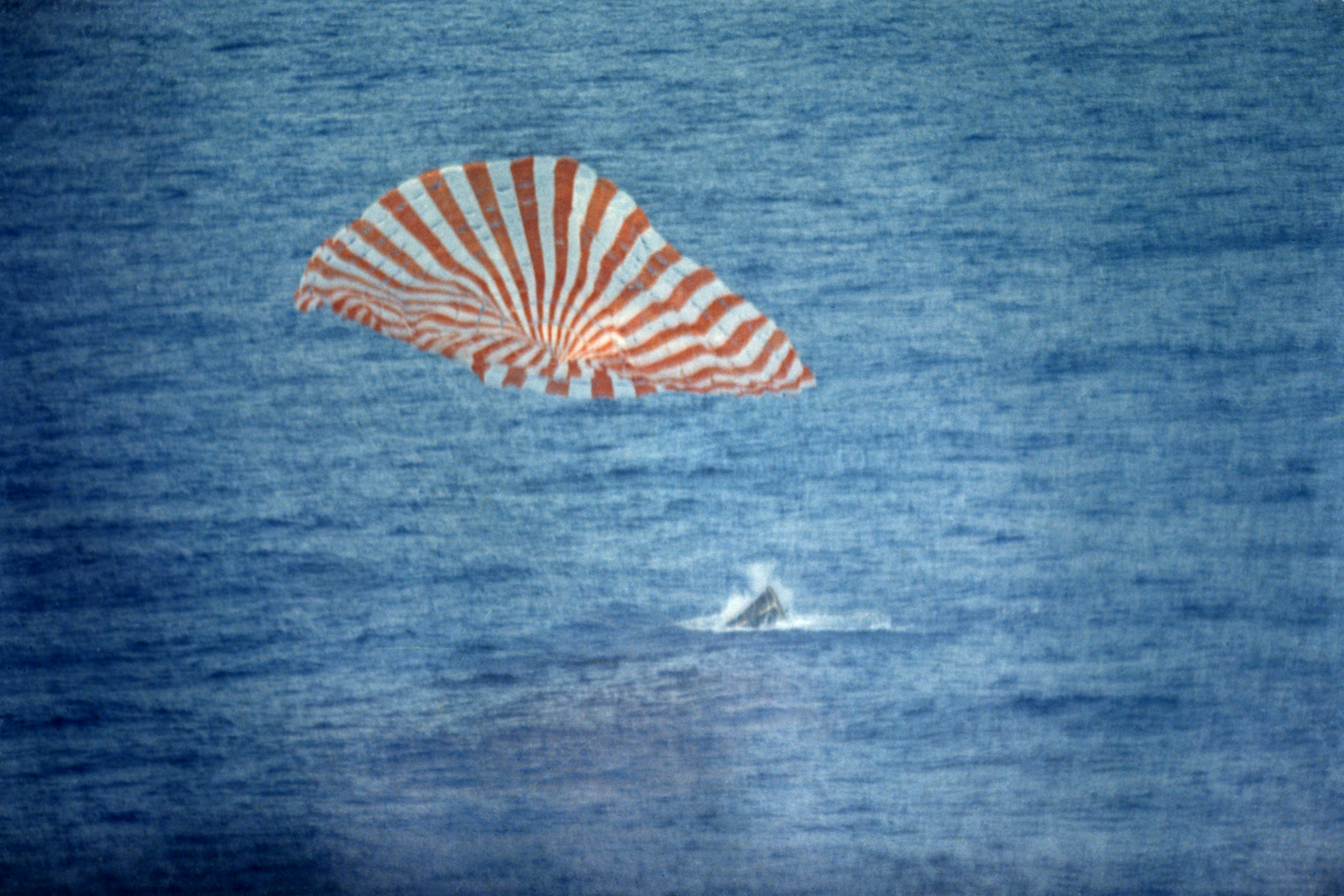
Landing in the western Atlantic at 70 hours and 46 minutes elapsed time, 4:07 p.m. on 21 July 1966, was only 5.4 kilometres from the aiming point. The crew of the primary recovery vessel, the helicopter carrier USS Guadalcanal, watched the spacecraft hit the water. Once the swimmers had attached the flotation collar and positioned the raft, Young and Collins climbed out and were lifted by helicopter to the deck of the recovery ship. The mission had lasted two days, 22 hours, 46 minutes and 39 seconds.
Agena 10 after the mission
With that part of the mission completed, the flight controllers put the Gemini X Agena through its paces. Over a 12-hour period the main engine was fired twice and the small engine once. Since the first manoeuvre was intended to study temperatures at higher altitudes, the controllers sent the Agena up to a 1,390- by 385-kilometre orbit. They watched it for almost seven hours and found that the temperatures varied little from those at lower orbits. The vehicle was then returned to a circular orbit of 352 kilometres that would make it available as an alternate target for later flights. The programme thus squeezed the last use out of a vehicle that had already done its main job.
What Gemini X left to Apollo
Gemini IX-A and X had successfully grappled with some of the specific needs of the Apollo programme, acquiring operational experience while fostering healthy debates between the two programmes on procedures and equipment. Perhaps the greatest benefit to Apollo was the demonstration and practice of several types of rendezvous, each of which provided a storehouse of information.
In addition, the orbit-shaping manoeuvres to the higher altitudes established that the trapped-radiation hazards could be avoided on trips into deep space. And the very fact that one spaceborne vehicle could meet another, latch onto it and use it as a kind of space tug offered many possibilities for such spaceflight concepts as shuttles, space stations and space laboratories.
There had been problems, but missions IX-A and X had logged a combined total of three hours and 41 minutes of open-hatch experience. Although the extravehicular hiatus between the fourth and ninth flights adversely affected both equipment and operational development, Cernan and Collins had shown that tasks outside the spacecraft were feasible. They found that all chores took longer than foreseen and that body positioning was difficult. During technical debriefings each extravehicular pilot pointed out the need for more and better restraints and handholds; those aids were already being developed. Overall, perhaps, extravehicular activity remained Gemini's greatest problem. It was and is dangerous, difficult and deceptive, despite its delights.
The ninth and tenth flights also took several steps forward in experiment performance. Despite operational constraints, usually brought on by limited fuel resources, each situation was modified to wring the utmost from specific experiments. More and more, principal investigators were being brought in to help with modifications and to assist in rescheduling their tasks for later in the missions if necessary. These real-time flight changes could not have been carried out in an unmanned flight and would not have been done in an earlier Gemini mission: in Gemini IX-A and X the experiments programme began to achieve maturity.
Epilogue: the programme heads for the finish
By the end of Gemini X, many of the men and women who had worked full time on the programme had begun to have a strong feeling of anticlimax and to wonder about their next jobs. Some had already gone on to other fields, but Mathews tried to control this exodus and to hold enough people together to finish the flights. Shortly after IX-A he told his staff that the Gemini Program Office, as such, would not be continued: its people would be absorbed into other Manned Spacecraft Center activities, mainly Apollo and Apollo Applications.
By early August a personnel placement committee had begun work; it soon arranged four to six interviews for each of the 193 project office people. This allayed any immediate fears, although Mathews still warned his staff to refrain from making personal contacts for new jobs until the committee could complete its arrangements. There were two more flights in the Gemini programme, but it already seemed to be heading into history.
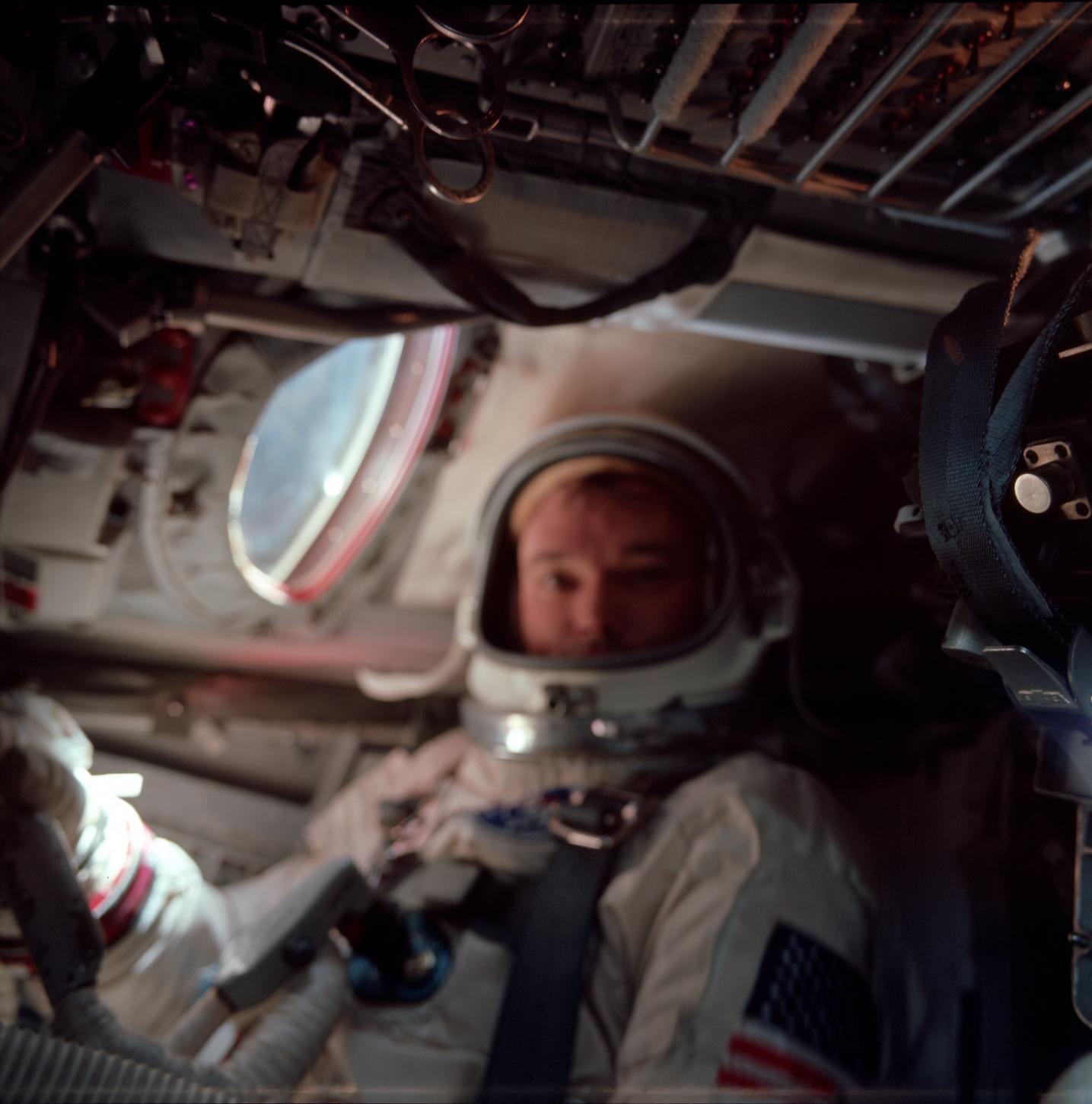
For Young and Collins, by contrast, Gemini X was a beginning. Young would go on to fly Apollo 10, walk on the Moon in command of Apollo 16 and command the first flight of the Space Shuttle. Collins would be the command module pilot of Apollo 11, the man who stayed in lunar orbit while his crewmates set foot on the Sea of Tranquillity. The techniques they rehearsed in July 1966, meeting a target in orbit, docking with it, using its engine for propulsion and going out into vacuum to work on another vehicle, are exactly the ones that made that voyage possible three years later.
Images
Elsewhere
- Smithsonian National Air and Space MuseumWatching the Gemini 10 Launch ↗
- Smithsonian National Air and Space MuseumHatch, Right, Gemini 10 ↗
- Smithsonian National Air and Space MuseumChecklist Card, Hasselblad Pictures, Gemini 10 ↗
- Smithsonian National Air and Space MuseumChecklist, Gemini 10 ↗
- Space.comGemini 10: NASA's Epic 1st Double Rendezvous Mission in Photos ↗
- Space.comGemini 10: NASA's Epic 1st Double Rendezvous Mission in Photos (page 2) ↗
- Naval History and Heritage CommandGemini 10 and NASA ↗
- NASAGemini X ↗
- NASAGemini X Set Records for Rendezvous, Altitude Above Earth ↗
- Getty ImagesGemini 10 Stock Photos ↗
- March to the MoonGemini Program Galleries ↗