Project Gemini · NASA · Crewed
Gemini XI
- Sep 12, 1966, 2:42 PM
- Launch date
- 2
- Crew size
- 2 days 23 hr
- Duration
- Success
- Outcome


_visto_desde_el_Gemini_11-1600.webp)


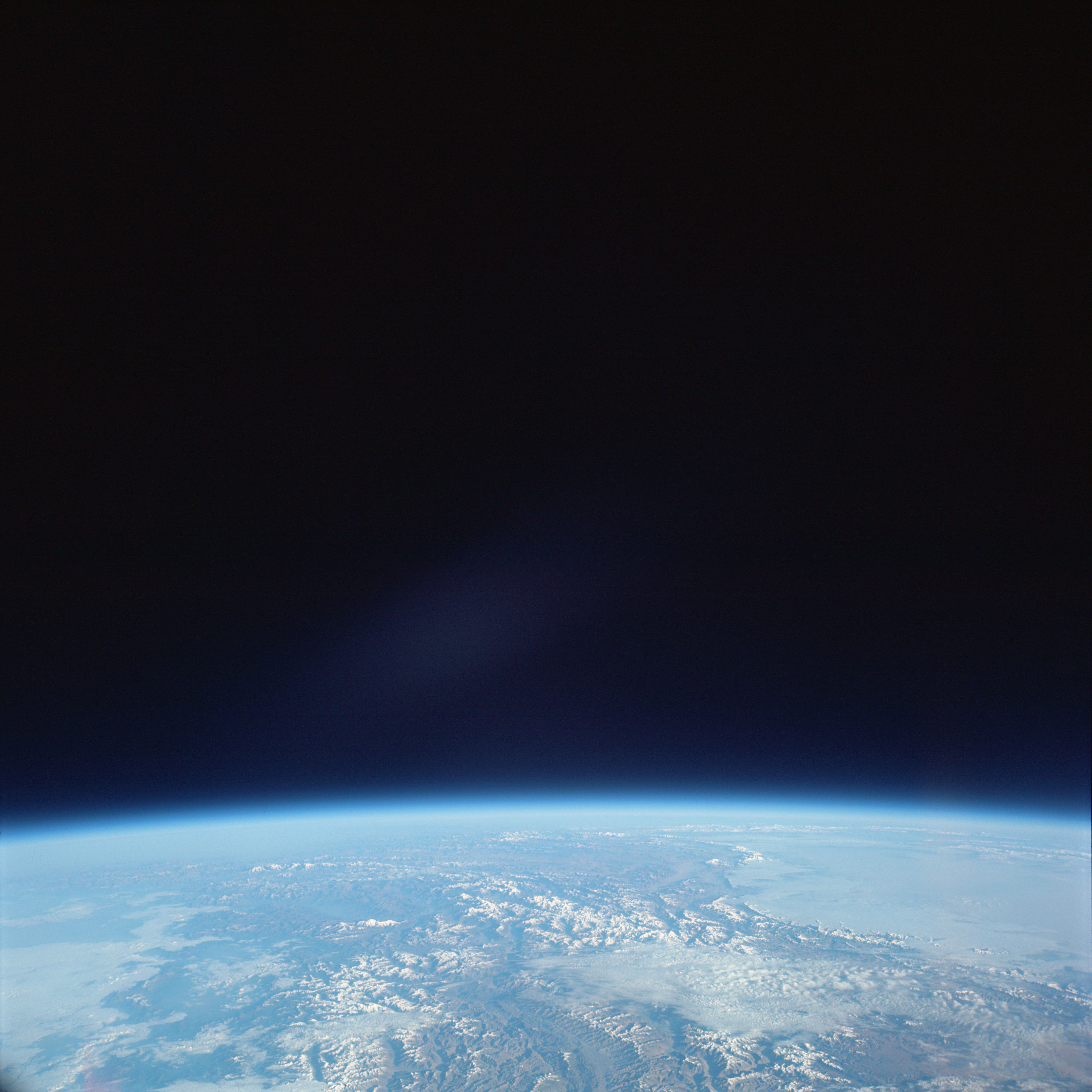
Gemini XI was the penultimate crewed flight of the Gemini programme and the one that pushed orbital rendezvous to its most demanding form. It lifted off from Pad 19 at Cape Kennedy on 12 September 1966 with Charles «Pete» Conrad in command and Richard Gordon as pilot, after two postponements and through a launch window barely two seconds wide: catching the Agena target vehicle on the very first trip around the world — the manoeuvre known as M = 1 — left no room for a late departure. Docking came one hour and thirty-four minutes into the flight, with the crew computing the solution on board from their own radar and computer, exactly as a lunar module would have to do after lifting off from the Moon to meet the mother ship in orbit. With the Agena attached, Conrad fired its main engine and climbed to an apogee of 1374 kilometres, the greatest altitude ever reached by a crewed mission in Earth orbit, a record that would fall only when human beings left for the Moon. From up there Gordon photographed the planet: these were the first pictures taken by human eyes from high enough to see the Earth as a complete sphere rather than a curved horizon. Two revolutions later a second Agena burn brought the spacecraft back down to low orbit. Extravehicular activity was again the programme's sore point. Gordon's first excursion, on the umbilical, was meant to last more than an hour and a half and was cut short after thirty-three minutes: fighting to hold his body astride the nose of the spacecraft without adequate restraints left him soaked in sweat, half-blinded and exhausted, the same picture the Gemini IX-A pilot had already suffered. He did manage to clamp the thirty-metre tether between the two vehicles, but the rest of the task list was abandoned. The second excursion, standing on the seat and held by a short tether, passed instead without incident through one hundred and twenty-eight minutes of ultraviolet astronomical photography, and even included the first nap ever taken by a human being in vacuum. Tied together by that tether, Conrad and Gordon attempted the first artificial-gravity experiment in history. The gravity-gradient mode failed, defeated by a snagging line and an unsettled Agena, but the spin-up mode worked: the combination stabilised itself, held a steady rotation and produced an acceleration so small that it could only be detected by releasing a camera and watching it drift in a straight line towards the rear of the cabin. There was still time for a second rendezvous, in what was called coincident orbit, also completed within a single revolution. On 15 September, after 70:41 hours of flight and forty-four revolutions, Gemini XI performed the first reentry in history flown automatically under computer guidance, with the commander's hand off the controller: the capsule splashed down 4,6 kilometres from the USS Guam. The mission met every one of its primary objectives and handed Apollo three certainties — first-orbit rendezvous, propulsion from a docked stage and automatic reentry — plus one warning: working outside the spacecraft remained unsolved, and that evidence forced a complete rewrite of the final Gemini flight plan.
Objectives
The three-day mission was designed to achieve first-orbit rendezvous and docking with the Agena target vehicle, to accomplish two extravehicular activity tests, to perform docking practice, docked-configuration manoeuvres and tethered operations, to park the Agena target vehicle and to demonstrate an automatic re-entry.
Payload
Charles "Pete" Conrad and Richard Gordon flew with the Agena as their target and eight scientific and four technological experiments on board. The scientific set comprised the synergistic effect of zero-g and radiation on white blood cells, synoptic terrain photography, synoptic weather photography, nuclear emulsions, airglow horizon photography, ultraviolet astronomical photography, Gemini ion wake measurement and dim sky photography; the technological set included power tool evaluation (D-16), which was not carried out.
History
The setting: Gemini nears its end
By the late summer of 1966 the Gemini programme had already delivered most of what Apollo had asked of it. Rendezvous had been achieved and repeated, docking had been demonstrated, long-duration flight had been proved, and the spacecraft's systems had been wrung out over nine crewed missions. Two flights remained, and the questions still open were narrower but harder: could a crew catch its target immediately after launch, in the first trip around the world, the way a lunar module would have to catch its mother ship after lifting off from the Moon? Could the propulsion of a docked stage be used to change orbital regime radically and come back? Could a crew work outside the spacecraft as fluently as inside it? And could reentry be handed over to the computer?
That was the view from the outside. From the inside, the programme that had taught the United States to fly in orbit was already being taken apart. Apollo, the Apollo Applications Program and the Air Force's Manned Orbiting Laboratory had spent months picking Gemini over for equipment and, above all, for people: engineers still working on the two-seat spacecraft were being called away to qualify somebody else's heat shield, to design airlocks for another project, or to pour their launch vehicle experience into Apollo. NASA Headquarters was at the same time pressing the Manned Spacecraft Center to squeeze the interval between flights further still, from two months down to six weeks, and in that climate spares began to run short. The internal question stopped being whether the mission would go well and became whether enough hardware would be left to finish the programme at all. Scott Simpkinson, who ran Gemini test operations, summed it up afterwards in shop-floor language: it was touch and go, but we made it. The deadline had no slack in it — the end of January 1967 — with Gemini XI pencilled in for 11 September and Gemini XII for late October 1966.
Gemini XI was assigned the first, the second and the fourth of those questions, and it was expected to make progress on the third. The mission was, in the language of the programme, a rendezvous and docking flight with a high-apogee excursion, a tether exercise, two periods of extravehicular activity and a long list of experiments. It was also, in practice, the last chance to test anything that Apollo would need beyond the extravehicular problem, because the final flight was already being reshaped around that single unresolved issue.
Precisely because only two flights were left, the objectives handed to them stopped being repetitions of what had already been achieved. The Apollo programme office pushed successfully for one of the missions to perform the rendezvous in the spacecraft's first revolution: not another approach exercise, but a direct rehearsal of the profile a lunar module would have to fly on lifting off from the Moon to catch its mother ship in orbit. To that was added a second objective, almost domestic in appearance and anything but obvious in its physics — to join the spacecraft to its Agena target with a tether and spin the pair to produce something resembling artificial gravity. More ambitious ideas were floated and died in review: a rendezvous between Gemini XII and an Apollo spacecraft, and a fly-by of an orbiting astronomical observatory. And there was still a debt outstanding to the Air Force: to fly the Astronaut Manoeuvring Unit that Eugene Cernan had been forced to abandon on Gemini IX-A.
The Agena target vehicle had by then earned its place. After the failures and improvisations of the earlier flights — the target lost before Gemini VI, the docked spacecraft that would not stop tumbling on Gemini VIII, the shroud that refused to release on Gemini IX-A — the Gemini Agena Target Vehicle had become a dependable partner: a stage with a restartable main engine, its own attitude control, command reception from the ground and from the docked spacecraft, and a docking cone with the latches and the rigidising mechanism that made a hard dock possible. Gemini XI would ask more of it than any previous mission.
In that division of labour Gemini XI was the mission of the three great technical risks: to catch the target on the first trip around the world, to climb with the Agena's engine far higher than anyone had ever been, and to tie itself to another vehicle with a thirty-metre cable and see what happened. All three came off, though none of them exactly as written in the flight plan.
Planning a manoeuvre nobody had attempted
The first-orbit rendezvous, designated M = 1, was the mission's defining feature and its greatest constraint. In every previous rendezvous flight the crew had climbed into a lower orbit and spent hours, sometimes a full day, catching up with a target that circled ahead of them; the catch-up rate was set by the difference in orbital periods, and the plan could absorb a launch delay of minutes by simply adding revolutions. M = 1 removed that cushion entirely. To meet the Agena on the first revolution the spacecraft had to be inserted into orbit at a very particular point behind the target, which meant lifting off at a very particular instant.
The result was a launch window of about two seconds. Everything upstream had to be built for it: the countdown, the range, the target vehicle's own launch several hours earlier, and above all the crew's ability to compute and fly the closing manoeuvres themselves. Mission planners wanted the crew's onboard solution — radar, computer, charts and the commander's judgement — to be the primary method, with the ground as backup, precisely because a lunar-module crew would have no ground to fall back on at the critical moment.
On paper the first-orbit rendezvous was a propellant problem, and it was scrutinised as one. The Gemini Mission Review Board went through the proposal with an uncomfortable precedent in front of it: John Young and Michael Collins had burned far more propellant than planned during their rendezvous on Gemini X, and what was being asked here was harder still — a link-up on the first revolution computed for the most part on board. Flight director Glynn Lunney defused the objection with an operational argument: Mission Control could give the crew backup data on orbital insertion and on the accuracy of their first manoeuvre, and the tracking network would have more than enough information to help them begin the terminal phase. The board concluded that even if the rendezvous ate half the propellant — some 187 kilograms — enough would remain for the rest of the mission. Not everyone was convinced. William Schneider, deputy director of Mission Operations, bet the board's chairman, James Elms, a dollar that it could not be done that cheaply.
The flight plan that emerged was dense. After docking, the crew would practise undocking and redocking, including a docking flown by the pilot and one flown at night, so that the technique would not depend on a single man or on good lighting. There would be an umbilical extravehicular period on the first day, with a list of tasks that included clamping a tether stored in the Agena's docking adapter to the spacecraft's docking bar. On the second day the Agena's main engine would push the docked pair up to a high apogee and then bring it back down. A standing extravehicular period would follow, devoted to ultraviolet astronomical photography. Then would come the tether exercise itself, in two modes, and finally a separation, a second rendezvous and an automatically guided reentry. Twelve experiments were manifested across the flight, covering meteorology, terrain photography, night image intensification, low-light photography, nuclear emulsion, radiation dosimetry and medical measurements, though the sources differ on how they were divided between scientific and technological categories.
The tether experiment drew less attention from the board but a good deal of prior engineering. McDonnell's guidance and control group determined that nylon or Dacron lines no longer than fifty metres, spun at rates below ten degrees per second, produced a reasonable tension, and recommended that the pilots practise the spin-up in the simulator to learn how to conserve propellant. The planners had conceived the tether first as an aid to formation flying — holding relative position without spending fuel — and only afterwards as a route to inducing some degree of artificial gravity; the minimum rotation rate depended on which of the two ends was being pursued. NASA decided to attempt both, though it would have settled for finding "an inexpensive and feasible method of long-term unattended station keeping", and chose a thirty-metre Dacron line. The board's only serious doubt was how to get free again: the plan was to fire a pyrotechnic charge that would eject the docking bar perpendicular to the flight path, and if that failed there was a weak link in the tether itself that a small separation velocity would be enough to break.
On the high-altitude excursion the board was relaxed. The radiation dose measured on Gemini X had turned out to be a tenth of the pre-flight estimate, so it confined itself to asking that the Manned Spacecraft Center and Goddard keep a close watch on the latest measurements. The precaution actually taken was one of orbital geography: the high-apogee orbits were planned so that the spacecraft would cross the Van Allen belts over Australia, where the density of trapped particles is comparatively low.
The crew and the shadow of the spacewalks
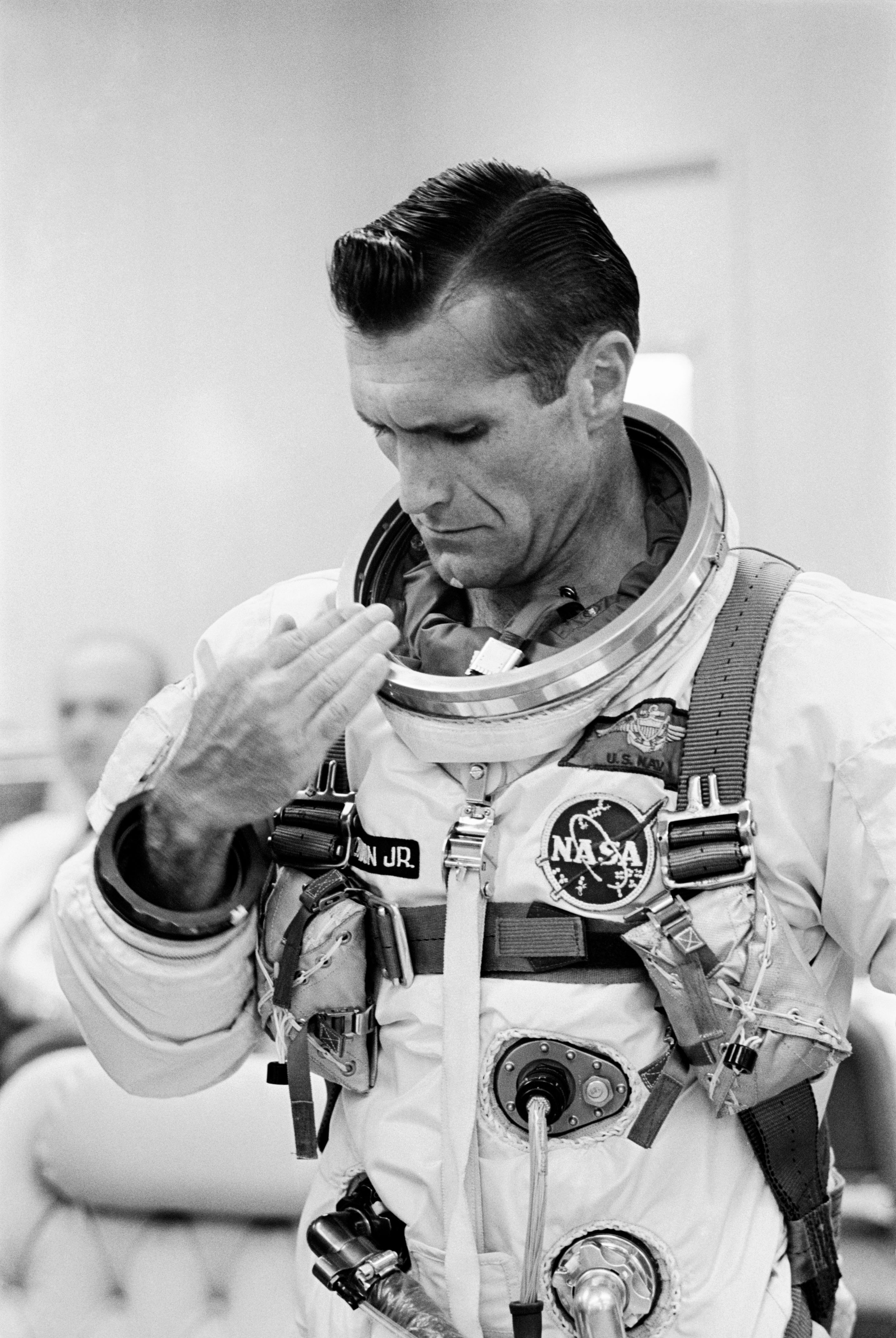
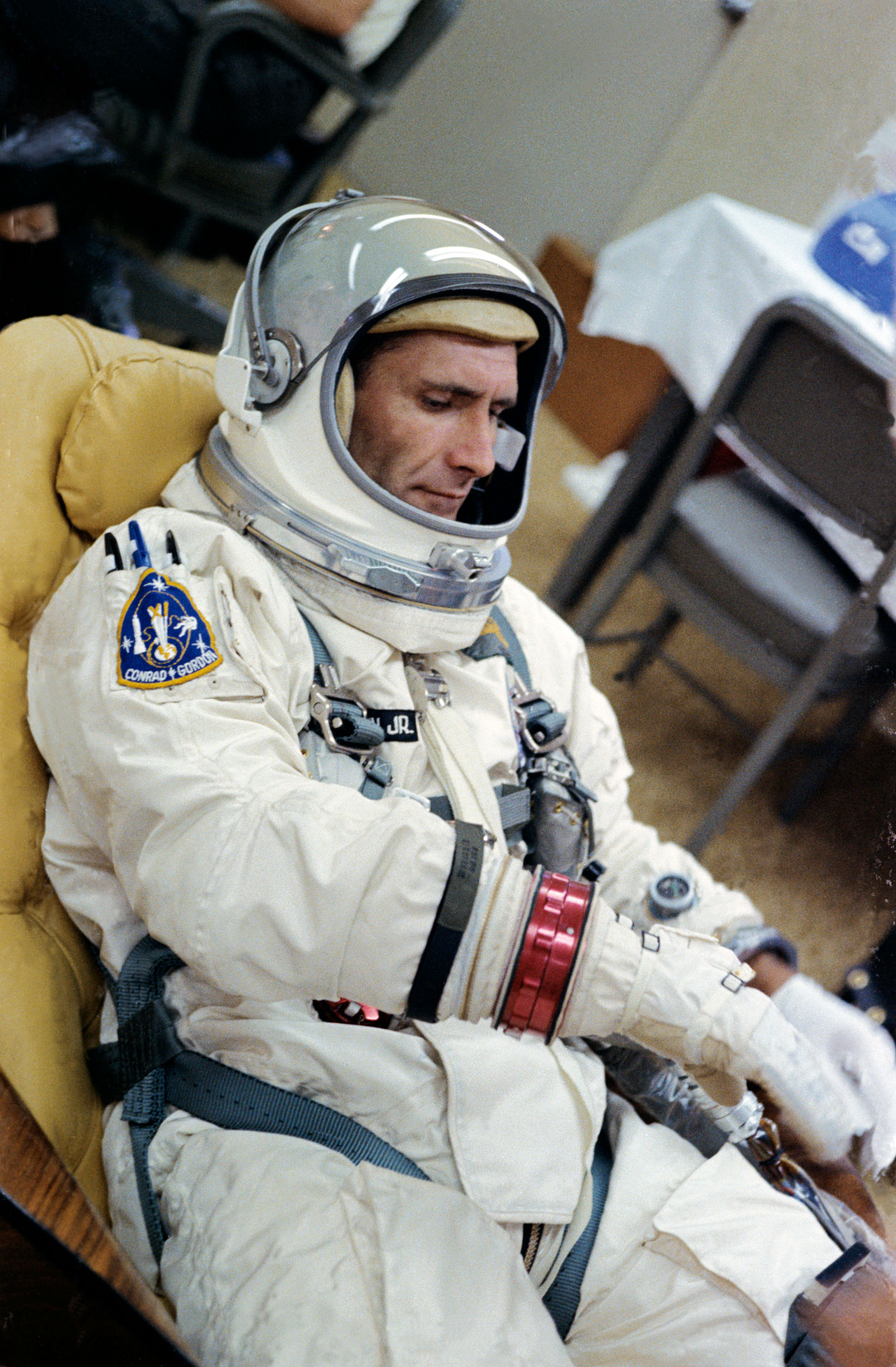
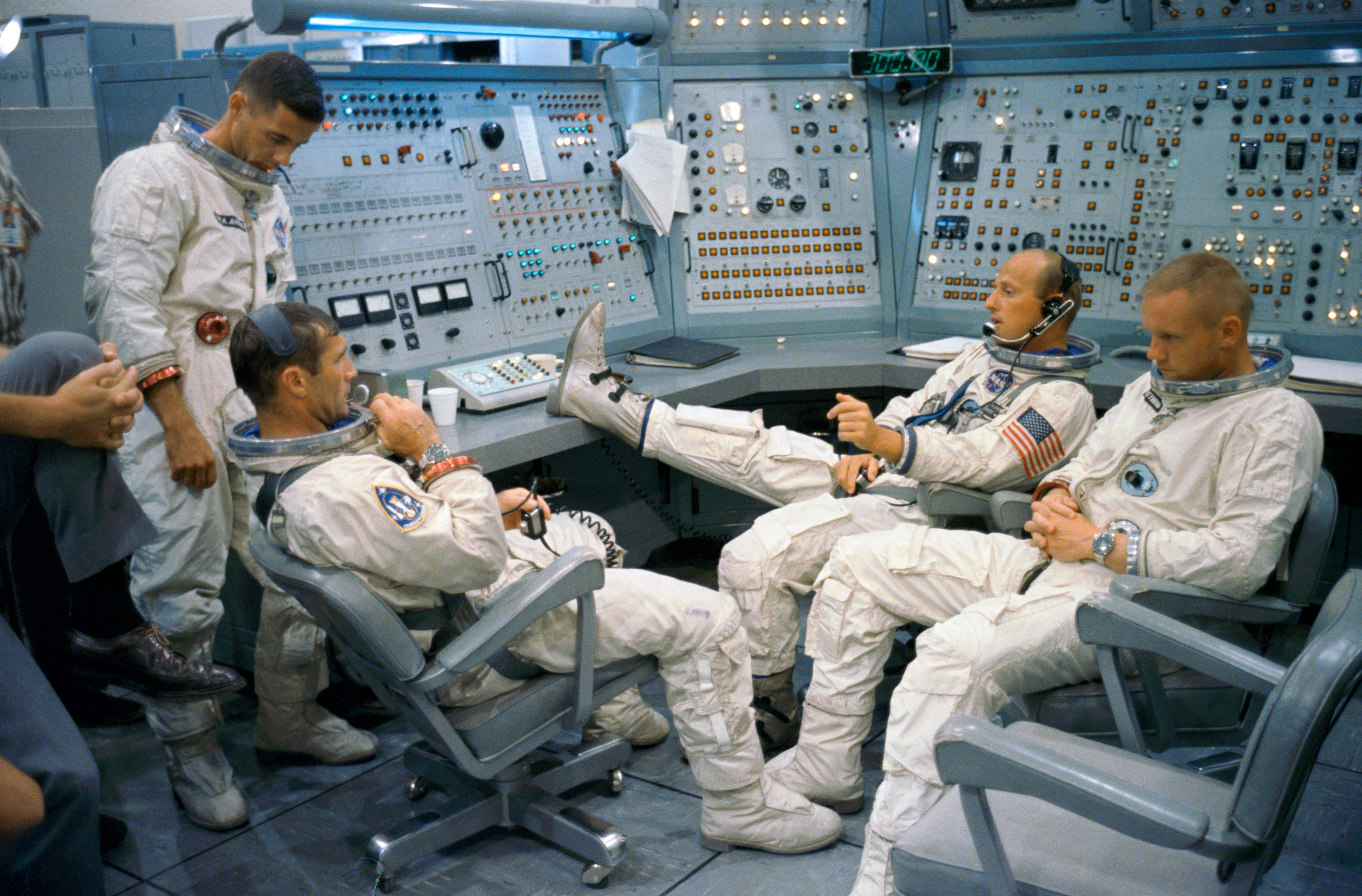
On 21 March 1966 NASA named Charles "Pete" Conrad command pilot and Richard F. Gordon Jr. pilot of Gemini XI, with Neil Armstrong and William A. Anders as the backup crew. Conrad, selected in 1962 with the second group of astronauts, arrived with a long-duration mission already behind him; Gordon was a naval test pilot flying for the first time. The two got on well, and their flight transcript is probably the funniest in the programme.
Charles Conrad, the commander, had flown Gemini V with Gordon Cooper, a long-duration mission that had spent much of its time nursing a degraded fuel cell and improvising a rendezvous with an imaginary target. He was a naval aviator with an appetite for the practical and a running commentary that would fill the air-to-ground loop for three days. Richard Gordon, the pilot, was making his first flight; he had been Conrad's choice, and the two men knew each other well enough for the commander to read his pilot's condition through a helmet.
The shadow over the mission was extravehicular activity. Edward White's excursion on Gemini IV had been exhilarating and short. Eugene Cernan's on Gemini IX-A had been a physical ordeal: without adequate handholds and restraints, every simple task became a wrestling match with a pressurised suit, and the pilot had overheated so badly that his visor fogged and he had to be brought back in. Michael Collins on Gemini X had fared better in some respects and had also run into trouble. The lesson had been passed along in person — Cernan had briefed both Collins and Gordon; Collins had pressed his own experience on Gordon — and Gordon took it seriously. He would still be astonished by how much harder the simplest job turned out to be, and the support engineers, for their part, still had not provided satisfactory restraints.
The black spot in the preparation lay not in the rendezvous or the tether but in the suit. After what had happened on Gemini IX-A — Cernan finishing exhausted, visor fogged, heart rate through the roof — NASA looked for training methods that resembled real flight conditions more closely. One of them was to immerse a suited, pressurised subject in water, where buoyancy almost cancels weight and forces the man to contend with mass and inertia much as he would in space. The idea moved forward despite internal reluctance: the Center's director, Robert Gilruth, would recall that there were "a lot of mixed feelings here at the Center; some of our people didn't think the neutral buoyancy work was worth anything". Cernan, who tried the method at Gilruth's request, found that moving underwater in a pressurised suit was very like his real exertion in orbit. And here is the key to what would happen later: **those findings never made it into Gordon's training for Gemini XI**.
Aware of the fatigue problem, the planners did make one useful change: they scheduled periods of light activity immediately after heavy workloads, so that an exhausted pilot would not have to go straight into another demanding task. That change would prove its worth.
The hardware, on the other hand, was changed. Handholds were added to the target vehicle's docking cone; the umbilical was shortened — Collins and Young had complained about the fifteen-metre "snake" that had tangled Collins, and their proposal to cut it to nine metres was accepted — and work went into better foot restraints for the adapter section. McDonnell was developing two types, a spring clamp in the manner of a ski binding and a bucket model; NASA chose the second, which was promptly christened "the golden slippers".
The flight plan carried twelve experiments, two of them new to Gemini — photography of the Earth-Moon libration region and low-light-level orthicon photography — and the rest inherited from earlier missions: synoptic weather, terrain and airglow horizon photography, radiation and zero-gravity effects, ion-wake measurement, nuclear emulsion, ultraviolet astronomical camera, mass determination, night image intensification and power tool evaluation. On 25 August the Manned Spacecraft Center reported that all of them were ready to fly.
Two postponements and a two-second window
The countdown began on schedule on 9 September 1966 and did not end the same way. With the launch vehicle already loaded, the launch team found a pinhole leak in the oxidiser tank of the Titan II's first stage. The technicians plugged it with a sodium silicate solution and an aluminium patch, and mission director Schneider moved the launch to the following day. The second attempt went wrong somewhere else and much later in the count: Conrad and Gordon had already completed the customary rituals and were on their way to Pad 19 when they learned that the Atlas due to put the Agena into orbit, barely 1,800 metres away, had a problem with its autopilot. The General Dynamics test conductor stopped the count; his engineers were receiving faulty readings and were running checks before deciding whether to replace the part. When the hold reached an hour, Schneider slipped two more days. The cause turned out to be a combination of a chattering valve, unusually strong winds and an over-sensitive telemetry recorder; nothing had to be changed.
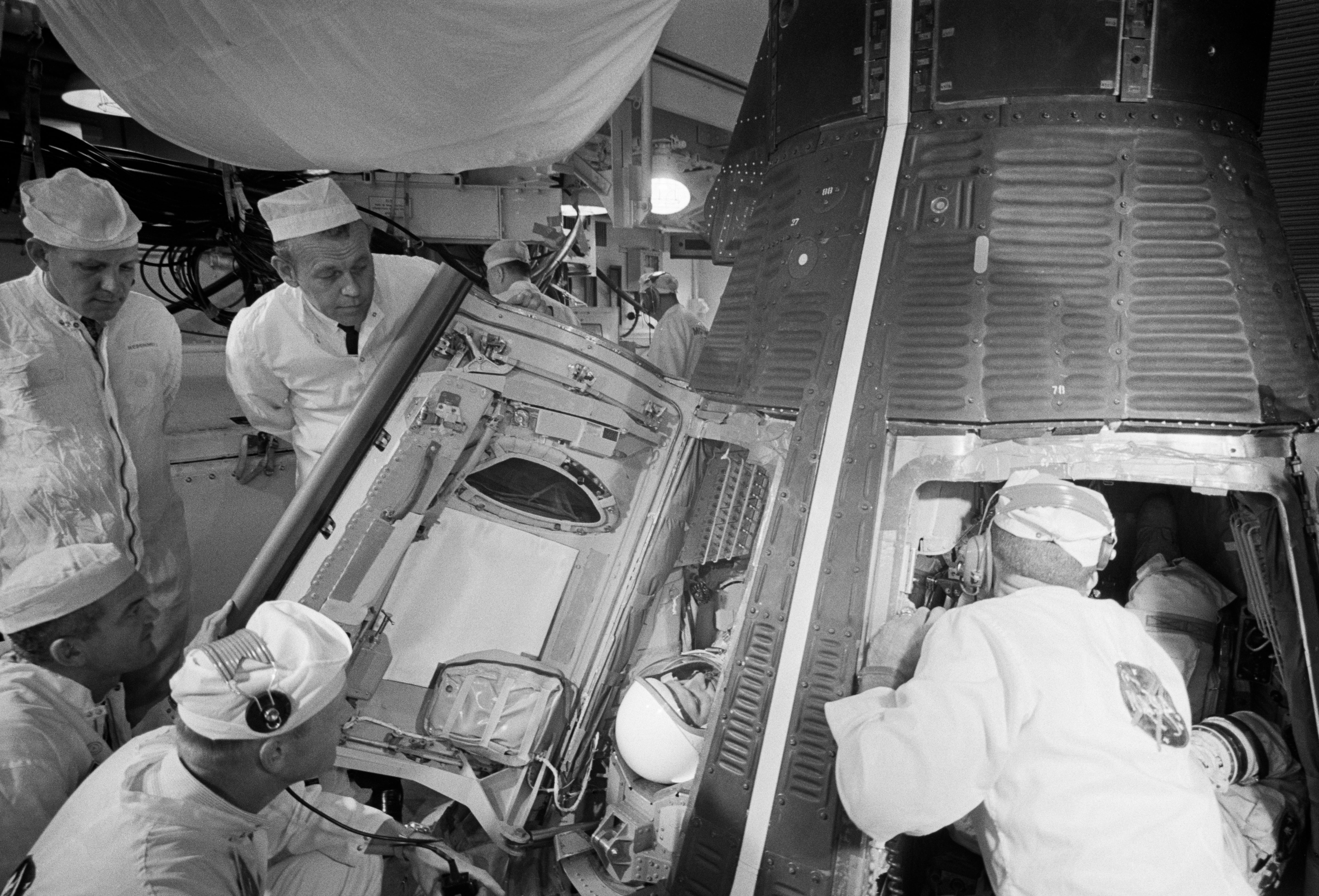
On 12 September 1966 the crew reached the pad and sat down exactly on time. Guenter Wendt, McDonnell's pad leader, told his men to close the hatches, but Conrad's had to be opened again: he suspected oxygen was escaping on his side of the cabin, and he was right. With the hatch fixed, the count went on. At 8:05 in the morning the Atlas lifted off with a roar and Gemini XI had its target in orbit.
What came next has no equivalent in the programme. To reach the Agena on the first revolution the spacecraft had to leave the pad inside a ridiculously narrow window. Gemini X had been given thirty-five seconds in which to lift off; Gemini XII would have thirty. Charles Mathews had warned McDonnell and the Space Systems Division that the Gemini XI window allowed only an "on-time launch"; the post-flight report put its real duration at two seconds. Conrad called the count in his own style — "…three, the bolts blew and we have liftoff" — at 9:42:26.5 in the morning, half a second into a two-second gap. The Titan pushed Gemini XI towards the first-orbit rendezvous with near-perfect accuracy and, six minutes in, the flight control loop transmitted the phrase that authorised everything: "Gemini XI, you have a GO for M equals one." It came at booster separation, with the debris visibly falling away past the window; Gordon had promised himself he would not look, and looked.
From that moment the crew were flying a problem with a hard deadline: the closing manoeuvres had to be executed within the first revolution or the plan would revert to a conventional multi-orbit catch-up and the M = 1 objective would be lost.
M = 1: catching the target on the first trip around the world
Immediately after insertion — into an orbit of 160.5 by 279.1 kilometres — Conrad and Gordon executed the insertion velocity adjustment routine, which corrects the trajectory up or down, left or right, and adds or subtracts speed. It is a delicate moment: any braking is done with extreme care because of the risk of meeting the spent launch vehicle again, and the rules obliged the pilots to have the booster in sight before slowing down. Their computer confirmed that the corrections had been very precise and that they would serve to run down a target 430 kilometres ahead.
The first onboard calculation had worked; now it had to be repeated without a net. Gemini XI was outside telemetry and communications range, so there would be no help from the ground. At the appointed instant Conrad executed a one-metre-per-second out-of-plane manoeuvre and pitched the nose thirty-two degrees above the horizontal plane of flight. Then they switched on the rendezvous radar: the electronic lock-on registered at once. Relieved, the crew set the computer to rendezvous mode and began preparing the terminal phase of the chase. When contact with the ground returned, Gordon reported that they were about ninety-three kilometres from the target.
Young, capsule communicator in Houston, passed them the numbers for the rest of the chase through the remote station at Tananarive. Conrad and Gordon compared them with their own and found the differences so small that either set would have done; they kept theirs. Just as the spacecraft was approaching the high point of its orbit, Conrad fired the thrusters to produce changes in several directions at once — forward, down and to the right — and cover the remaining thirty-nine kilometres. Suddenly the Agena, whose flashing lights they had been following in the dark, came into sunlight over the Pacific and very nearly blinded them: there was a scramble for sunglasses before Conrad manoeuvred to a station fifteen metres from the target's docking cone. Over the coast of California, barely an hour and a half after liftoff, the first-orbit rendezvous was a fact.
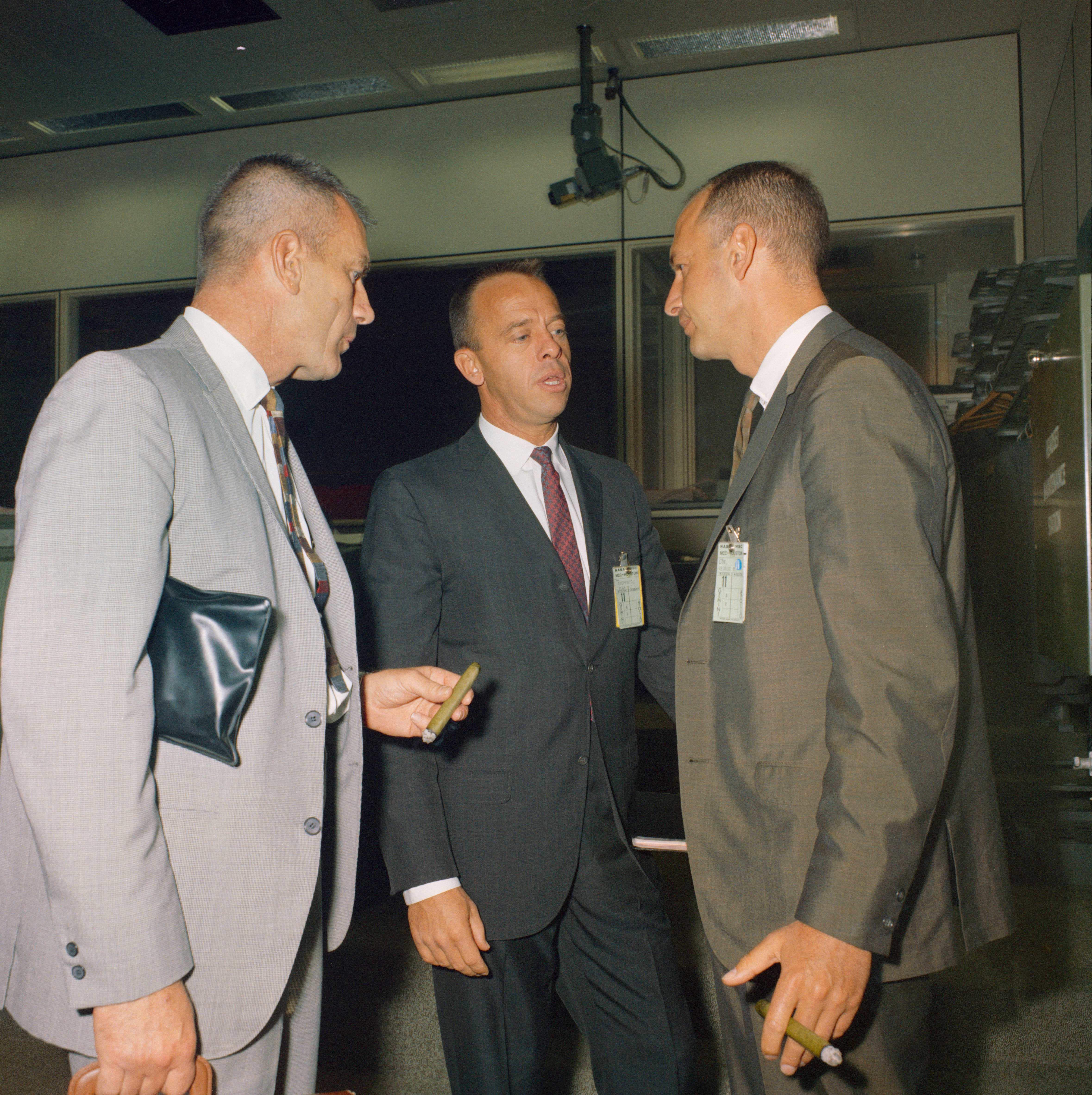
The crew celebrated it on the radio with a question addressed to the director of flight operations: "Mr Kraft, would you believe M equals one?" He would. And they still had 56 per cent of their manoeuvring propellant. The transmission also converted the sceptical Schneider, who dug into his trouser pocket, pulled out a dollar bill and scribbled on it for Elms a breakdown of the propellant spent per manoeuvre, with a closing note: "Never lost a dollar better spent." Shortly afterwards, with Young's clearance, came the second milestone of the morning, announced by Conrad with complete matter-of-factness: "We're docked." By NASA's chronology the docking was completed at 1 hour 34 minutes ground elapsed time, still within the first revolution.
It was an achievement with an operational point rather than a sporting one. A lunar module ascending from the surface would have exactly this problem — a rigid launch instant, a single revolution in which to close, and no time to consult the ground. Gemini XI showed that a two-man crew with a radar, a computer and a set of charts could do it.
Docking practice, experiments and a first warning
With the target secured, the crew moved through the docking exercises. They undocked and redocked several times; Gordon flew at least one of the dockings himself, and one was performed in darkness, deliberately, to prove that the technique did not depend on daylight. The Agena's behaviour under command was checked and rechecked, since the flight plan would later place the crew directly in front of its engine.
Because the target had been secured so early, there was time for something NASA had wanted for a while. Each man undocked and re-entered the cone once in daylight and once at night. It proved easy — much easier, Conrad said, than in the ground translation and docking trainer — and for the first time a pilot who was not the commander had the chance to dock the spacecraft to a target vehicle.
Between exercises the experiments went on. Synoptic terrain and weather photography needed the right light and the right cloud cover; the nuclear emulsion package had to be deployed and retrieved; dosimeters were read out and reported to the ground. The crew ate, ran through systems checks, and took the medical readings that came with every mission.
The docking practice served another flight objective as well: mounted on the Agena's docking adapter rode the experiment that studied the structure of the ion wake during those very manoeuvres. In the same hours the nuclear emulsion package was set going — the crew activated it shortly after the hard dock, and Gordon would later retrieve it from behind the commander's hatch — along with a modified version of the libration-region photography experiment. That last one could not be done as planned because of the three-day launch slip: the Milky Way was by then covering the intended target, so the crew photographed the gegenschein and two comets instead.
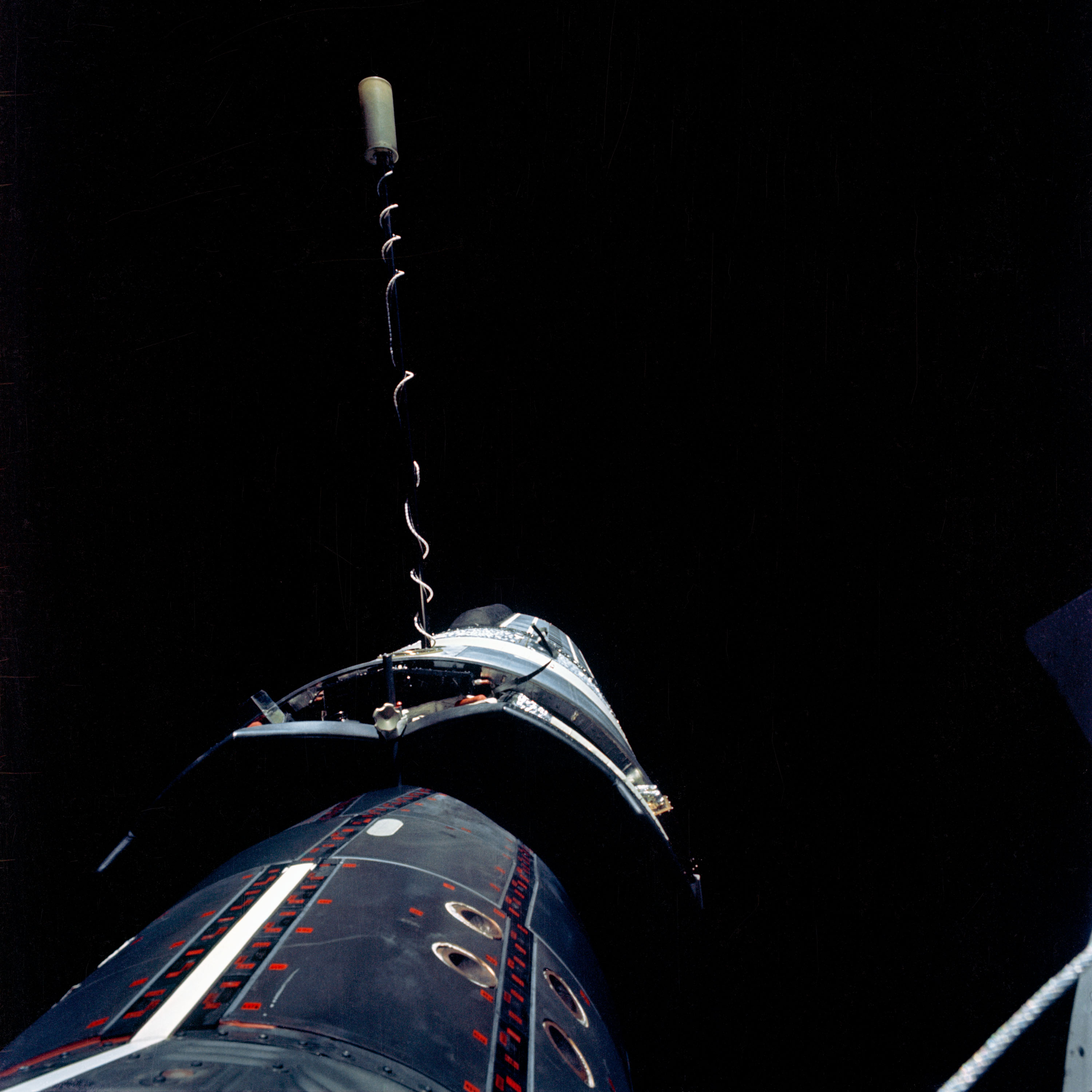
After the final docking came the rehearsal of the Agena's main engine before the great climb. Oriented ninety degrees out of the flight path, Conrad lit the target vehicle's main engine and added thirty-three metres per second to shift into a new orbital lane. The impression it made was enormous. Gordon, speaking to Young, who had flown the Agena-spacecraft combination on Gemini X, put it without ceremony: riding that primary propulsion system was the biggest thrill of the day.
After six hours of hard but untroubled work the crew powered down systems, ate, and were wished good night by the tracking network. They slept and rested for eight hours, still docked to the Agena, and woke — in Gordon's words — fresh as a daisy. Their only complaint was dirty windows, an affliction that had accompanied every Gemini flight; since Gemini IX-A the spacecraft had carried disposable covers for the launch phase, but they did not seem to help much.
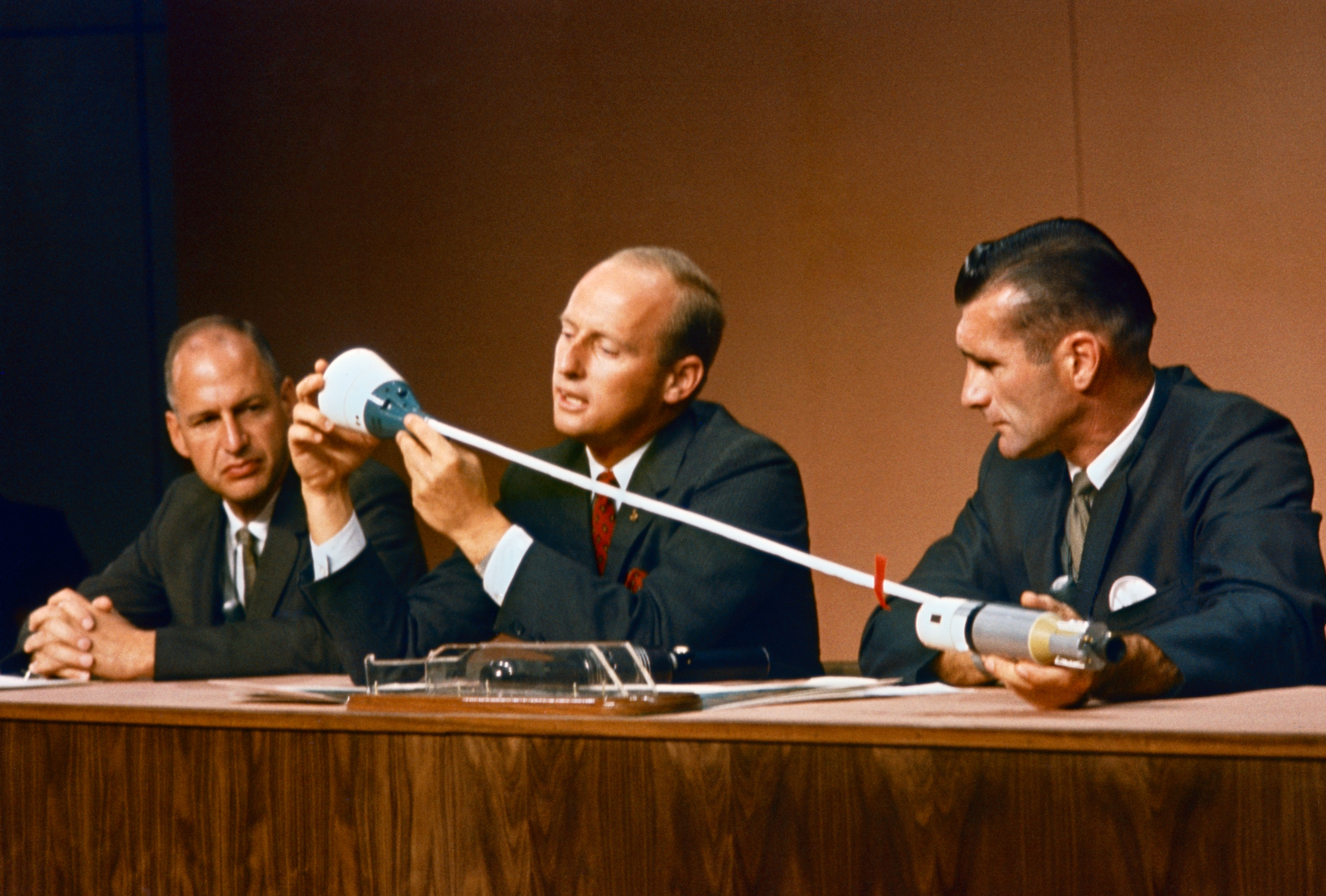
There was one small piece of unfinished business that would later matter more than it should have. Conrad's window had picked up a film of deposits that blurred his view and interfered with pointing the spacecraft. CapCom Alan Bean asked the crew to have the pilot wipe half of the commander's window with a dry cloth during the excursion and bring the cloth back for analysis. It was a minor item on a list that would prove far harder than anyone expected.
The first excursion: thirty-three minutes of exhaustion
Preparation for the umbilical excursion began four hours before the hatch was due to open. The crew had rehearsed the sequence so often on the ground that in fifty minutes they had the equipment laid out and running, with only a few steps left before Gordon could go outside. Conrad called a halt, and there the two of them sat, as he put it, with all their gear on. An hour later they connected Gordon's extravehicular life support system and the pilot ran a check of the oxygen flow; that was another mistake, and they saw it at once, because the system dumped oxygen into the cabin, which then had to vent the excess overboard — an expense they could not afford. Conrad had Gordon go back on the spacecraft system, which the pilot, uncomfortably warm by then, was glad to do: the extravehicular heat exchanger was designed to work in vacuum, not inside a pressurised cabin.
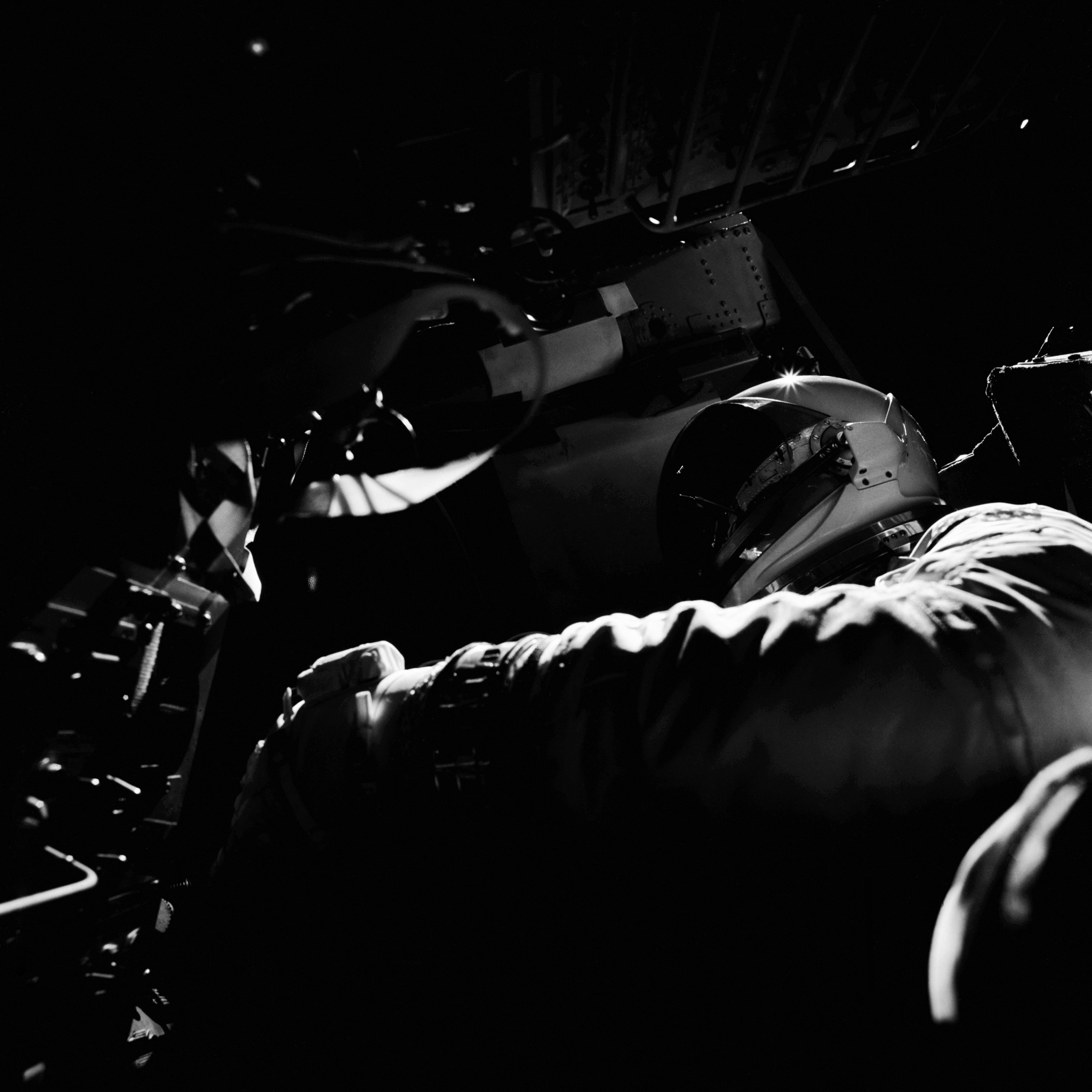
The two men went so far as to consider asking flight director Clifford Charlesworth to let Gordon go out a revolution early, but they decided to keep to the schedule, and soon regretted it. With the opening almost due, Gordon began fitting his sun visor over the faceplate, a job that should have been done before he put on all that additional equipment. Conrad managed to fasten the left side but could not reach across his pilot for the right. Gordon, getting hotter by the minute, fought the right-hand fastener for five minutes before it closed, and tore the visor in the process. He was completely out of breath before he ever left his seat. Even so, he opened the hatch and stood up at twenty-four hours and two minutes ground elapsed time, exactly on schedule.
"Here come the garbage bags", Conrad warned. Everything unsecured in the cabin began floating up and out, Gordon included; it was caused by the environmental system outgassing and the crew had expected it. Conrad grabbed a strap on his companion's suit leg and held him in the seat. Gordon deployed a handrail, which was easy; he retrieved the nuclear emulsion package and handed it to Conrad, who stowed it between his legs in the footwell; and then he tried to mount a camera on a bracket to film his own movements, which was not easy at all. The commander had to let enough umbilical slide through his glove for the pilot to float above the camera and punch it into place.
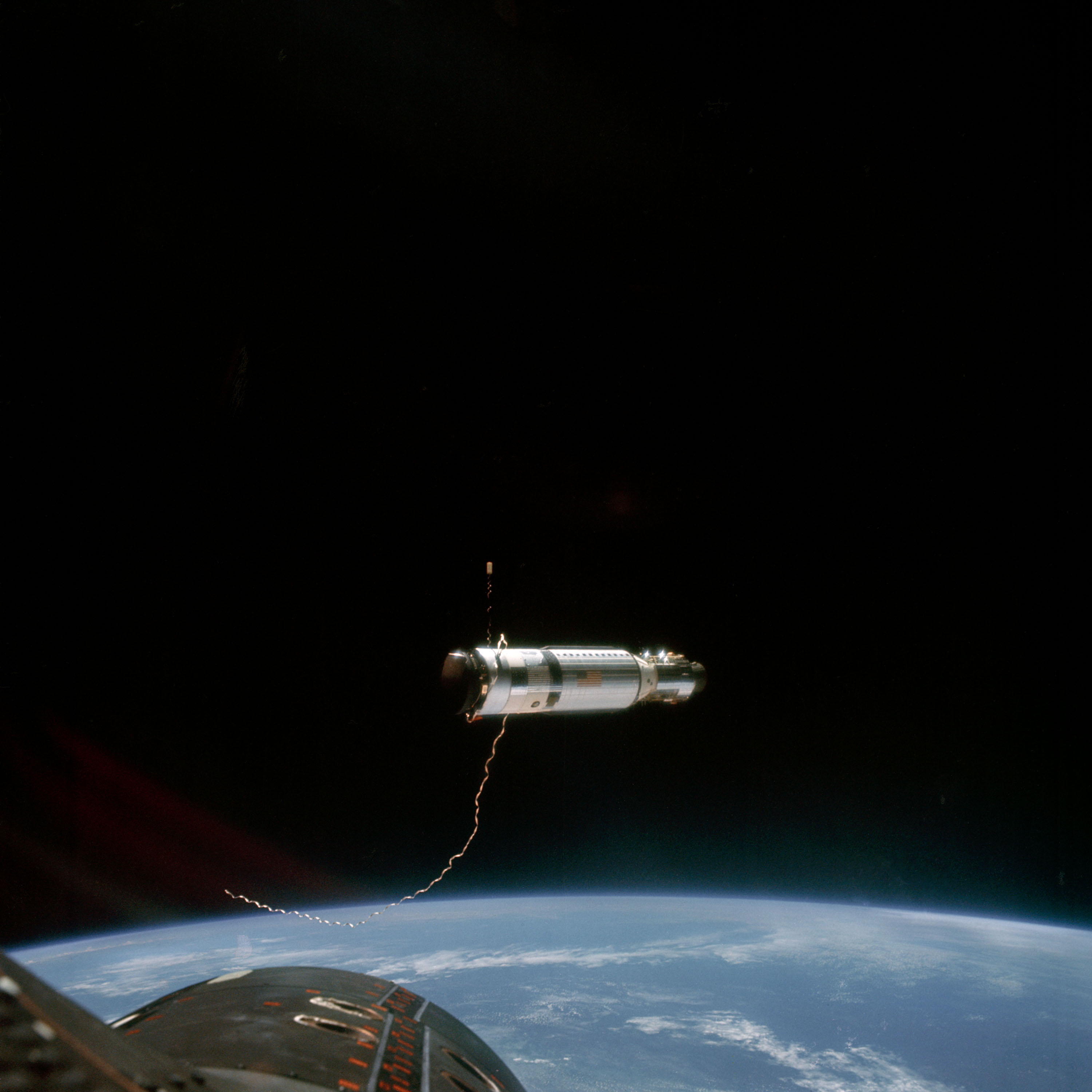
Then came the central task: to move forward to the nose and clamp to the spacecraft's docking bar the thirty-metre tether stowed in the Agena's docking adapter. When Gordon pushed off, he missed, arcing over the target's adapter and around in a half-circle that left him behind the spacecraft; Conrad had paid out only two of the nine metres of umbilical, so he pulled him back to the hatch to start again. On the second attempt Gordon reached the target and grasped the fixed handholds to straddle the nose of the spacecraft. "Ride 'em, cowboy!", Conrad shouted.
Riding bareback, with his feet and legs wedged between the two docked vehicles, turned out to be far harder than it had been in the parabolic training flights. There Gordon had been able to push off, mount the reentry and recovery section and lock his legs between the docking adapter and the spacecraft, leaving both hands free to attach the tether and close the clamp. In real spaceflight it did not work: he had to fight his pressurised suit to keep from floating away, with no saddle and no stirrups to help, holding on with one hand while trying to work the clamp with the other. He struggled for six minutes before the line was secure. At least the tether experiment was ready for later. To Conrad, though, it was plain that his pilot was running out of strength: with sweat streaming down his face and his eyes stinging, Gordon was groping blindly. He tried to release a mirror from the docking bar so that Conrad could watch him when he moved to the rear of the spacecraft, pulled at the mounting and got nothing; he abandoned the mirror as not worth the effort. Nor had he had any chance to clean his commander's window.
As the pilot worked his way back to the hatch, with all the help Conrad could give him, they discussed whether he should go to the adapter for the manoeuvring gun stowed there. His right eye was still burning and Conrad could see exactly how exhausted he was. The commander reported to John Young, through the remote station at Tananarive, that he had brought Dick back in because he had got so hot and sweaty that he could not see. Gordon had no trouble getting in or closing the hatch, which had been open for only thirty-three minutes instead of the hundred and seven that had been planned. An hour later they opened it again to jettison all the umbilical extravehicular equipment that had left them surrounded by loose gear.
The balance of that excursion was harsh. The power-tool evaluation was lost for the second time in the programme — it had already been frustrated on Gemini VIII — and the feasibility of working outside the spacecraft remained unsettled. Cernan had told Collins and Gordon about his troubles, and Collins had pressed his own on Gordon; and yet each new pilot was astonished that the simplest tasks were so much harder than expected. "Gene Cernan warned me about this and I took it seriously", Gordon said afterwards. "I knew it was going to be tougher, but I had no idea of the magnitude". Apparently the support engineers had no idea either, since they still were not providing satisfactory restraints.
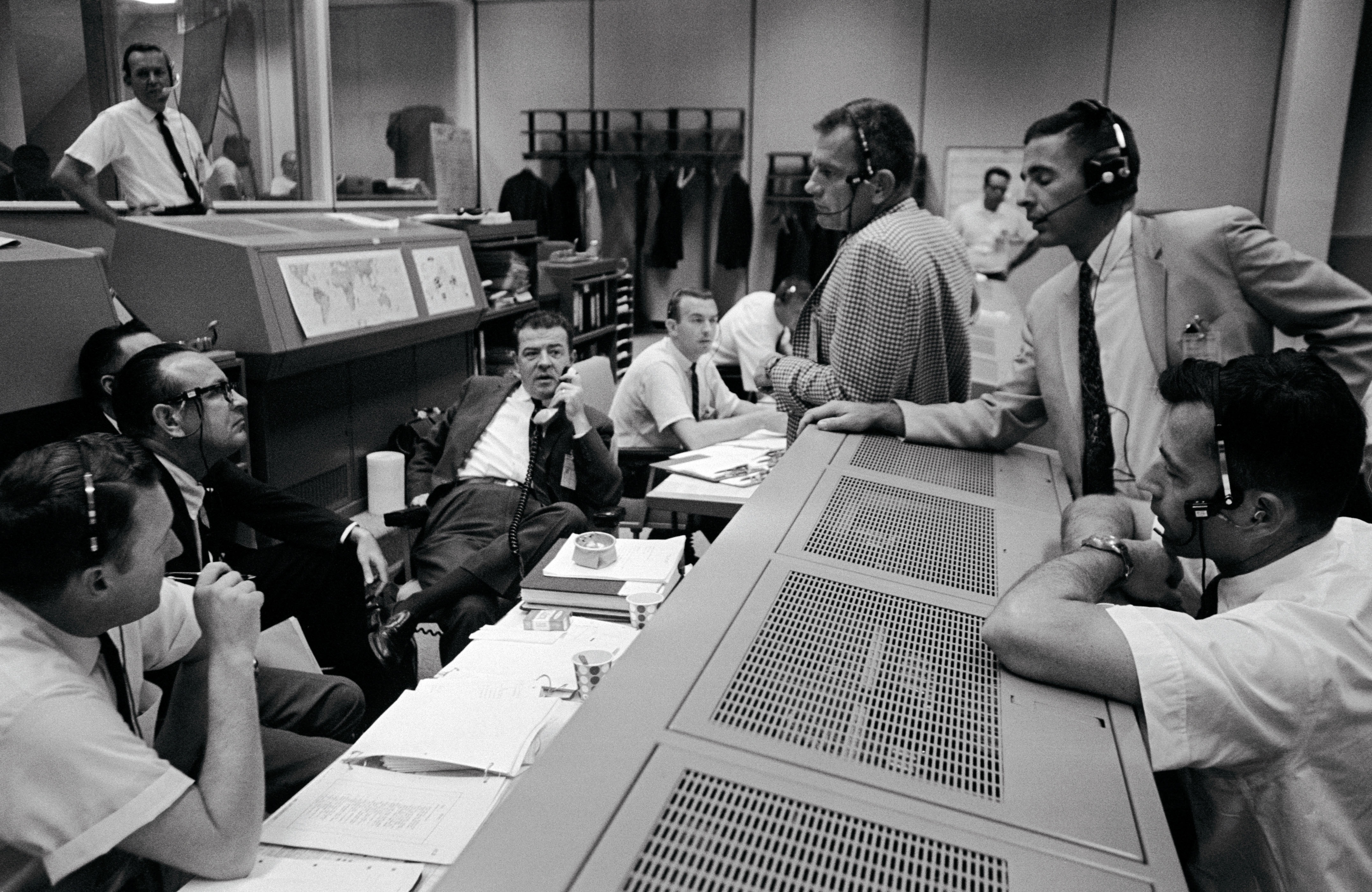
One lesson learned did work, however. The extreme fatigue of earlier extravehicular pilots had damaged the remainder of their missions; Gordon's did not. The planners had learned to schedule light activity immediately after heavy workloads, so Conrad and Gordon spent an unhurried period restowing equipment and restoring order to the cabin. Communications with the ground were reduced to brief transmissions about systems and medical checks. Conrad tested a sluggish thruster and found it improved. They ate and photographed the airglow horizon. Half an hour before the sleep period, the controller aboard the tracking ship Rose Knot Victor passed them the numbers for the next great event: the climb.
Higher than anyone: the apogee record with the Agena's engine
The next day the crew skipped breakfast to have the cabin ready before the push arrived at stomach level. They wanted everything buttoned up as though for reentry: they suited up, lowered their visors and stowed everything they could. In the pre-burn check they noticed that the Agena did not accept their commands at once, and that the commands had to be repeated before they were acknowledged. Conrad reported it to Bean and learned that the target vehicle was responding correctly: the problem, apparently, lay in the spacecraft's indicators. "What a time for a failure like that to show up", the commander protested, but the Canary Islands station confirmed that everything was in order and that they were go for the burn.
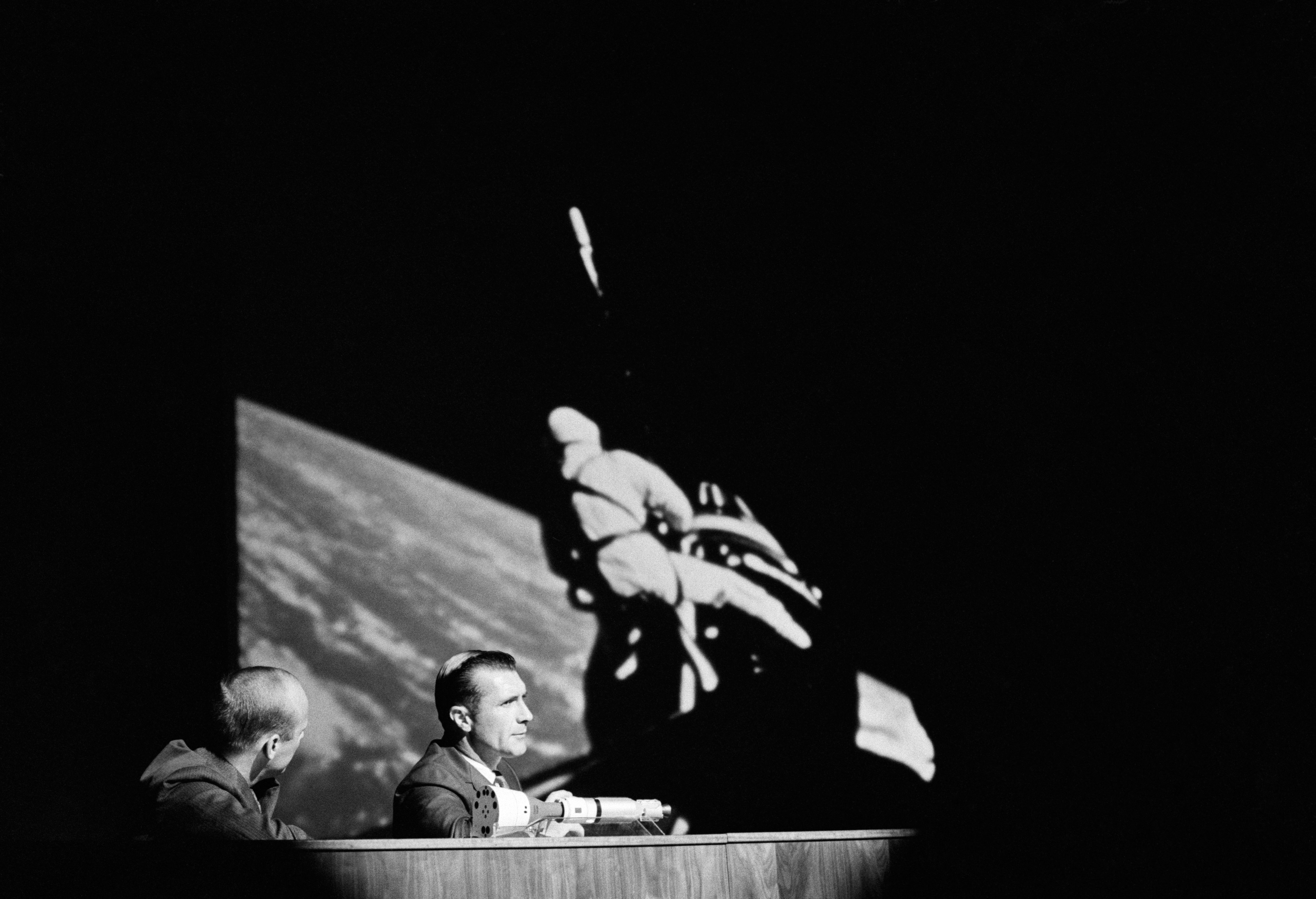
At forty hours and thirty minutes into the flight, on the twenty-sixth revolution, Conrad triggered the ignition signal to the target vehicle's main engine. For twenty-six seconds the Agena threw out a plume of fire that added 279.6 metres per second to their velocity. "Whoop-de-doo!", Conrad shouted, "the biggest thrill of my life". Because they were flying facing the Agena, the acceleration pushed the crew back against their seat harnesses while they watched the great round ball of the Earth recede. So what does orbital mechanics say now, they wondered: are we going to stop? From Carnarvon, 1372 kilometres below, came a "hello there up above". Conrad's answer was a torrent: this was go, the world was round, you could see all the way from one end to the other over the top, about a hundred and fifty degrees. When Bean asked him to expand on his impressions from that vantage point, the commander went on: it really was blue, the water stood out and everything looked blue, the curvature of the Earth was very pronounced, there was a lot of cloud over the ocean but Africa, India and Australia were clear; and looking straight down it was just as sharp, with no loss of colour and extraordinary detail. NASA's chronology puts the apogee reached at 1374 kilometres, an altitude record for a crewed mission that would fall only when human beings left for the Moon.
They were not mere tourists on the way up, even though they used the tourist's favourite instrument. Gordon shot synoptic terrain and weather photographs: the weather experiment needed cloud cover, and the terrain experiment needed clear views of land. Conrad's description of one glance across the eastern hemisphere delighted the principal investigators, who were waiting impatiently for the more than three hundred photographs taken.
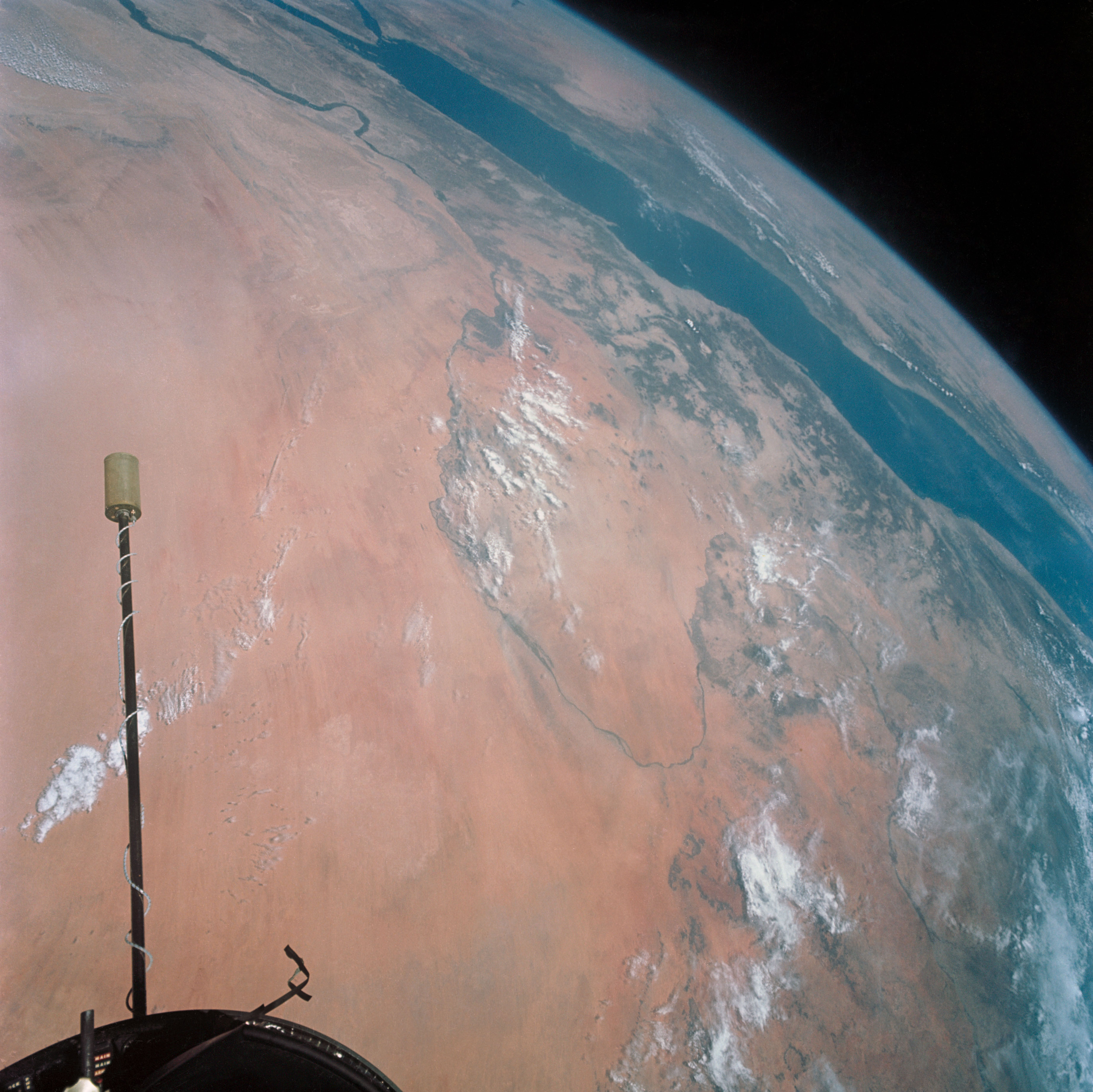
The radiation dose at high altitude had been a pre-flight worry, and for that reason the high-apogee passes had been planned over Australia, where the Van Allen belts are comparatively less dense. Conrad reported to Carnarvon that his dosimeter read three tenths of a rad per hour, Gordon corrected it to two tenths, and Bean answered that it sounded safer up there than having a chest X-ray. Conrad summed it up afterwards by saying that in their two orbits at about 1570 kilometres they had taken less radiation than the Gemini X crew had in their longest period at eight hundred and thirty kilometres.
Over the United States, on the twenty-eighth revolution, Conrad used the Agena to bring the apogee back down: a twenty-three-second burn subtracted two hundred and eighty metres per second and returned the 1372-kilometre orbit to something over three hundred. Another mission objective could be signed off.
The standing excursion: ultraviolet astronomy and a nap in vacuum
After the trip to altitude it was time to prepare for the second extravehicular period, but Conrad told Bean they were trying to grab a bite because they had not eaten all day. "Be our guest", the capsule communicator replied. Even so they had time to spare, and on the twenty-ninth revolution, over Madagascar, Gordon opened the hatch and stood watching the sunset.
This time the pilot stayed standing on the floor of the spacecraft, held by a short tether like the one Collins had used on Gemini X. The detail changed everything: he could forget about maintaining body position and had both hands free. He mounted cameras on their brackets without any difficulty and called his two hours in the hatch "the most enjoyable". He was so relaxed and oriented that the doctors monitoring him reported that, medically speaking, the standing excursion had been relatively uneventful. NASA puts its duration at one hundred and twenty-eight minutes.
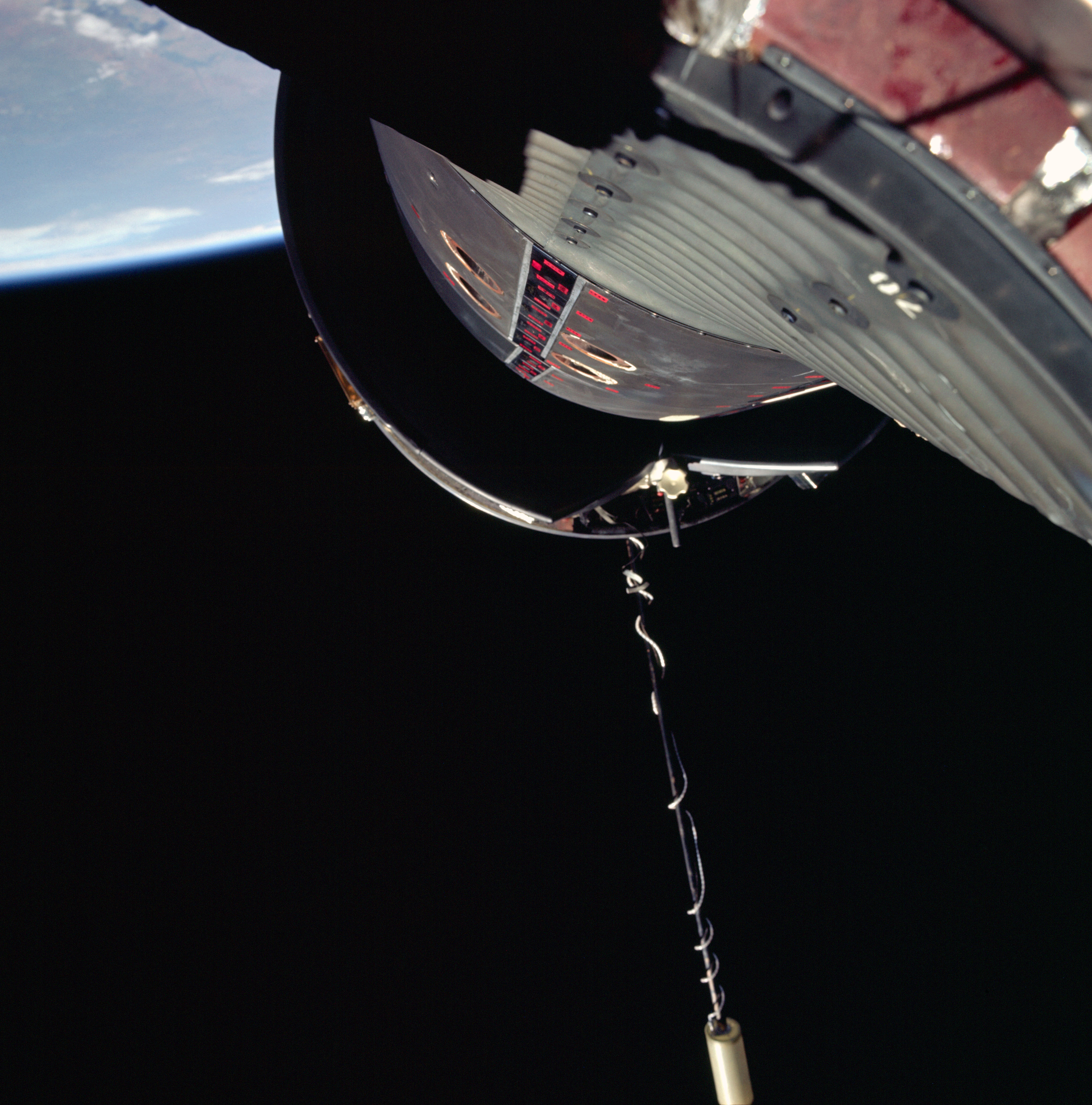
His main task over two night passes was to photograph several star fields with the ultraviolet astronomical camera. The dirty window made it hard for Conrad to point the spacecraft-Agena combination in the right direction, but Gordon, with his unobstructed view into open space, talked his commander into position. The Agena's stabilisation proved somewhat erratic and even so the docked vehicles held steady enough for about a third of the photographs to come out excellent.
Neither man was really tired after the first half of the photographic session. Conrad considered closing the hatch and resting until the next night pass, and asked the Hawaii communicator whether there was enough oxygen. There was; but the sky was clear over the United States and they might want more pictures there, so the hatch stayed open. They passed over their own home town, Houston, and then over Florida and the Atlantic with nothing to do, until Gordon broke the silence to announce that they had taken a nap: there they were, Conrad reported, one asleep hanging outside the hatch on his tether and the other asleep sitting inside the spacecraft. "That's a first", Young answered: the first time anyone had slept in vacuum. "Boy, my legs are tired", Gordon said as he closed up. "I'm tired all over. I'm pooped!", Conrad replied. This time the fatigue came from concentration on an experiment, and had little to do with the physical fight Gordon had waged outside on the umbilical.
The tether: a skipping rope in orbit and a trace of gravity
The tether experiment allowed two modes. In the first, called gravity-gradient, the docked combination would take up the position of a pole always pointing at the centre of the Earth, with the Agena's engine bell as the tip and the spacecraft's adapter section as the upper end. Once the pole was aligned, the crew would back slowly out of the Agena's docking cone until the thirty-metre tether pulled taut. With the combination properly placed, a minimum thrust of barely three centimetres per second would be enough to keep the line tight, and the elongated pole would drift around the Earth with the two vehicles holding their relative position and attitude. If that failed, they would move to the spin-up mode studied by McDonnell: with the vehicles undocked, Conrad would use the thrusters to induce a rotation of one degree per second in the Gemini XI-Agena combination, which would follow its orbital path in a slow continuous cartwheel about their common centre of gravity, located somewhere along the tether; centrifugal force would keep the line taut and the vehicles apart, while the tether itself supplied the centripetal force that kept them in balance.
Over the Hawaii station, the crew cautiously separated the two vehicles to attempt the gravity-gradient method. The initial tension in the tether was enough to unsettle the Agena and to displace the spacecraft to the right, towards the target's docking adapter. Conrad corrected quickly and the Agena righted itself without trouble. The commander kept backing away, but the tether snagged — probably in its stowage container — with about fifteen metres deployed. A burst of thrusters freed it, and it caught again, this time on the Velcro that had held the Agena end until separation. Conrad had to take the spacecraft out of vertical alignment to peel the line off the Velcro, which upset the Agena once more; and there were still about three metres of line to come out. To carry out the manoeuvre "without spin", as Conrad called it, both vehicles had to be tethered and aligned vertically with respect to the Earth. The engineers had expected the Agena to take about seven minutes to settle; when it seemed to take longer, they feared a failure in its attitude control system and told the crew to abandon the attempt and go to the second mode.
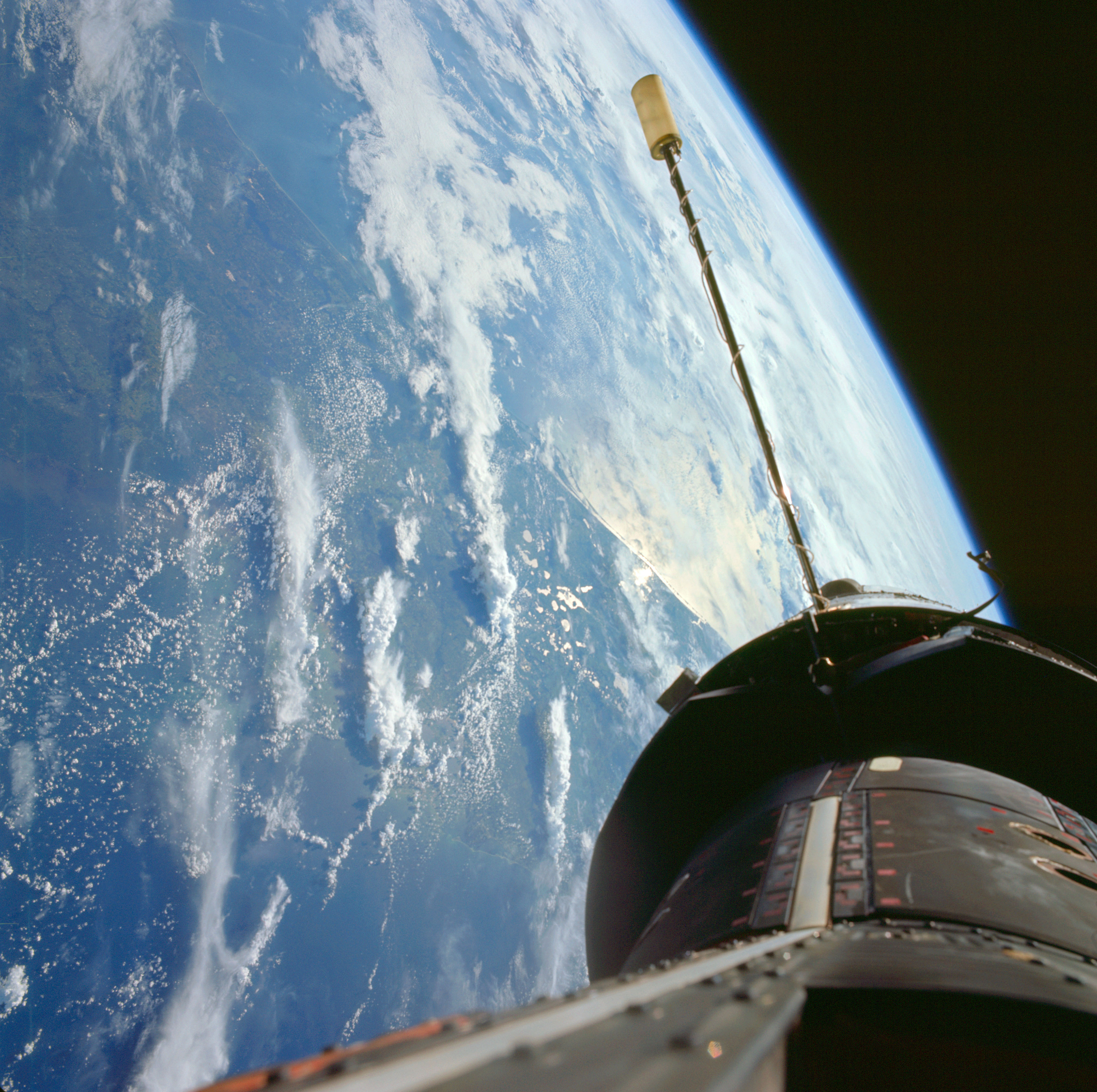
Trying to start the rotation, Conrad ran into another problem: he could not get the tether taut, and it seemed to be turning counter-clockwise. Surprised, he reported to Young that the thing was doing something he would never have imagined, that it was as though he and the Agena had a skipping rope between them and it was rotating and forming a great loop. "What a weird phenomenon we have here!", he added; "somebody is going to take a while to figure this one out". The curious part was that the line, curved as it was, still had tension in it. For ten minutes the crew worked the thrusters to straighten the arc and finally succeeded, though afterwards neither man could remember exactly what they had done to stop the behaviour.
With the tether taut, Conrad rolled the spacecraft and pulsed the thrusters to begin the slow cartwheel. Gentle as he was, it seemed to him that he had stretched the line, because when he stopped firing he had a great loop. His hands itched to do something more, but the engineers on the ground told him to leave it alone. "So we gritted our teeth" and waited, Conrad said. And indeed: centrifugal force took charge, the line smoothed out, the two vehicles swayed a little at the ends and settled by themselves, without the pilots having to do anything. A rotation rate of thirty-eight degrees per minute was obtained and held steady through the whole night pass. The crew grew so used to seeing the Agena floating nearby that they almost stopped looking at it; they had dinner.
The satisfaction lasted until orbital sunrise, when the Hawaii communicator asked them to increase the spin rate. The crew agreed reluctantly. Gordon suddenly shouted: "Look at that slack! It's going to snap and tear everything apart". "That's what I was afraid of, dammit", Conrad replied; and Gordon complained to flight director Charlesworth that they had just spoiled something that was working well. As the added acceleration began, the line went taut and slack, and the crew felt what Conrad called "this great slingshot effect": it swung them in pitch through as much as sixty degrees. Conrad was not prepared to tolerate that oscillation and steadied his vehicle with the hand controller; to his surprise, the Agena again stabilised on its own.
The rotation rate was verified at fifty-five degrees per minute, and the crew could at last go looking for the minute artificial gravity. They put a camera against the instrument panel and let it go: it moved in a straight line towards the rear of the cabin, parallel to the direction of the tether. They themselves felt no physiological effect whatever. After three hours tied to the Agena, the pilots ended the exercise by jettisoning the spacecraft's docking bar. It had been, on the whole, an interesting and puzzling experience: there was disappointment at not having completed the gravity-gradient mode, but also confidence that the spin-up had shown station-keeping could be done cheaply.
Coincident orbit: a second rendezvous, again in one revolution
The controllers had asked several times about the remaining propellant, and the answer was a good one: consumption was running below plan. For once there was room for real-time planning on the credit side, rather than in response to degraded fuel cells, "angry alligators" or spacecraft tumbling out of control: an exercise planned only for contingencies could be fitted into the mission because almost everything had gone well.
Conrad had intended to brake the spacecraft so that Gemini XI, in a lower orbit, would run ahead and leave the Agena behind. Instead, the controllers asked him to prepare for a "coincident orbit" rendezvous, later renamed "stable orbit": the spacecraft would trail the Agena by about twenty-eight kilometres in its exact orbital path, which amounted to station-keeping at very long range and at very little cost in propellant. The change of plan altered the separation manoeuvre: instead of a retrograde burn that would leave the Agena above and behind, Conrad and Gordon added speed and altitude so that the target would pass below and ahead. Watching the Agena move swiftly over the South American terrain beneath them, they understood why Thomas Stafford and Cernan had found it so hard to keep track of their target during the rendezvous-from-above exercise on Gemini IX-A. Then they burned to put themselves in the same orbit as the Agena, trailing it; three-quarters of the way around the world later, Conrad slowed and the spacecraft dropped into the Agena's track some thirty kilometres behind, with no relative velocity between them.
During that long-range formation flight the crew worked on the night image intensification experiment, which they thoroughly enjoyed: the point was to see whether equipment that scanned objects on the ground and displayed them on an internal monitor improved night vision. While Conrad aimed the spacecraft at the lights of towns and cities, cloud formations, lightning, horizon and stars, airglow, coastlines and peninsulas, Gordon watched the screens and both described what they saw into the tape recorder. The dirty window hampered Conrad, and the glow of the monitor kept him from adapting fully to the darkness; even so, two revolutions — about three hours — of looking and photographing proved very agreeable. The most impressive image was the lights of Calcutta, whose outline on the monitor matched an official map of the city almost exactly.
At one point in the experiment they saw the Agena's lights and asked the ground how far away it was. The Rose Knot Victor controller answered that they were still thirty kilometres behind and closing very slowly: they could expect about twenty-six kilometres when they woke up. But when they broke off their sleep period on the forty-first revolution, the target was forty-six kilometres ahead. It made no difference. Gemini XI's second rendezvous, like the first, took a single orbit: at sixty-five hours and twenty-seven minutes into the flight Conrad pitched the nose fifty-three degrees above the horizontal and fired the forward thrusters to brake and descend into a lower orbit, ready for the catch-up manoeuvre. While waiting for the final approach they completed the low-light-level orthicon photography experiment, capturing gegenschein and zodiacal light, and closed out the night image intensification work. An hour after starting the catch-up, with the spacecraft nearly level and pointing ahead, Conrad pulsed the aft thrusters to raise the orbit; the Agena came out right above them, its tether pointing upward. Conrad braked, and six minutes later reported that he was in position and stable alongside the Agena. Gordon noticed that the target's tether had begun to wave slowly and supposed it was the effect of the spacecraft's thruster exhaust. Twelve minutes later they separated from the target vehicle for the last time. "We did the one-metre-per-second retrograde burn and left behind the best friend we ever had", Conrad would say. Gordon added that they were sorry to see that Agena go, because it had been very good to them.
Conrad suggested over the radio to flight director Glynn Lunney that he send up a tanker: the crew would be delighted to refuel, stay in orbit and keep working. While the air-to-ground joke ran its course, the two men were preparing to come home.
The first automatic reentry in history
One important event remained, and it was a secondary objective that would shape the future. The commanders of previous Gemini flights had flown their spacecraft through reentry themselves, using the capsule's offset centre of gravity to generate lift and correct the trajectory: in that way they had been able to introduce corrections of as much as five hundred and fifty kilometres in range and fifty kilometres in crossrange. Conrad, by contrast, would not fly with his hand controller following the computer's cues: the spacecraft would obey those commands automatically.
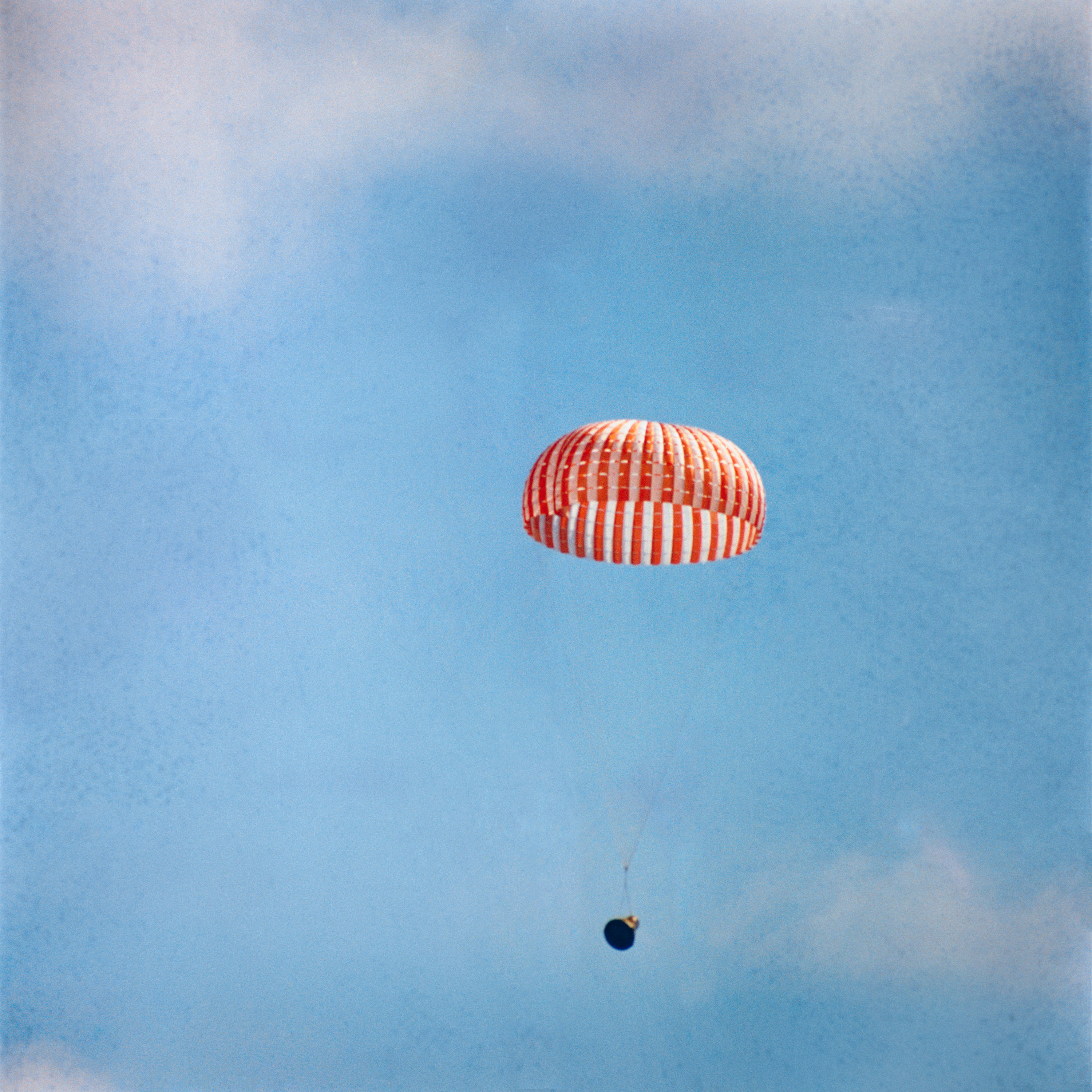
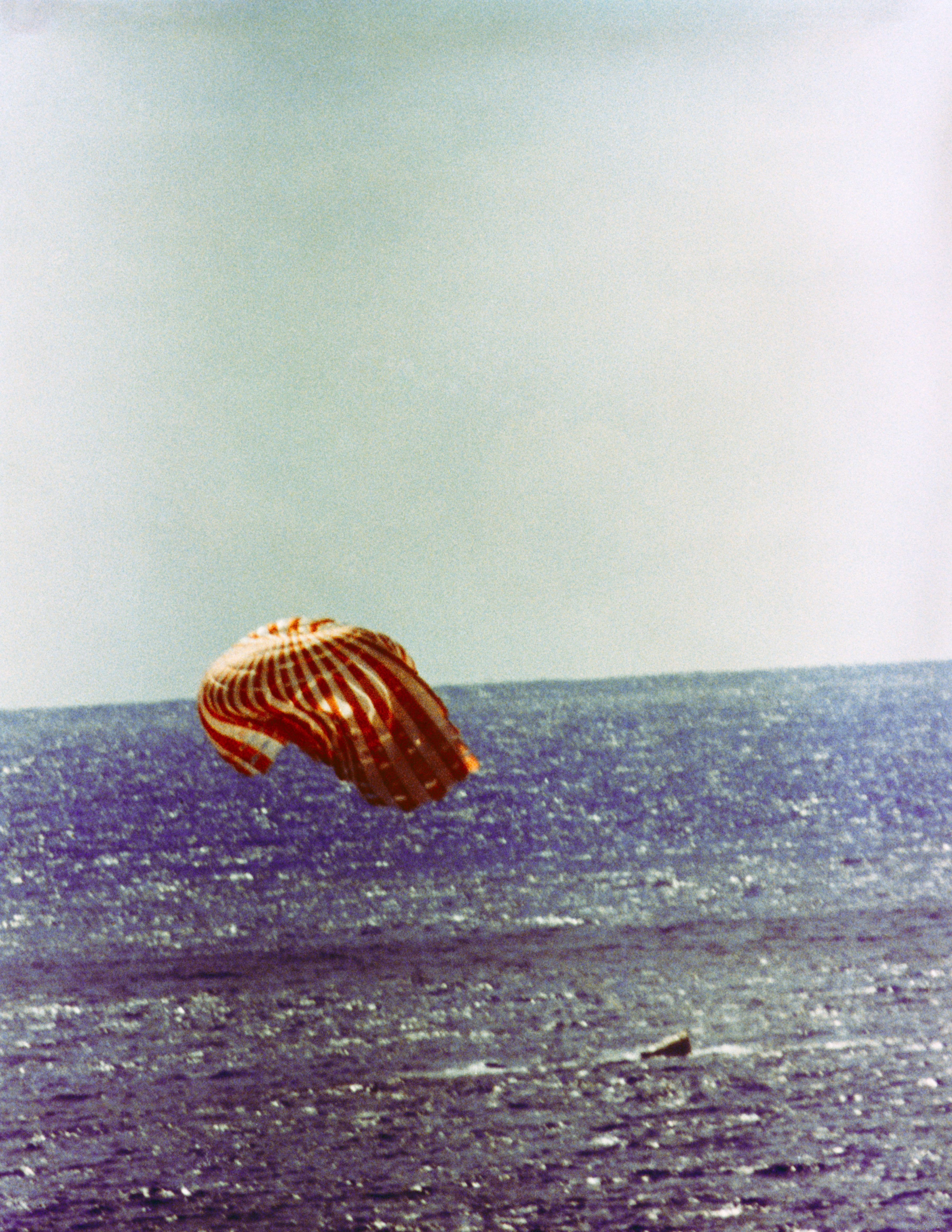
On 15 September 1966, after 70:41 hours of flight and on the forty-fourth revolution, the retrorockets fired. Conrad and Gordon watched the computer closely; it appeared to be working well. The commander disengaged his controller and put the system in automatic. When the first crossrange errors appeared, the computer commanded changes in bank angle. On several occasions the spacecraft displayed an almost human characteristic, hesitating before accepting its orders, but the system recovered quickly and behaved beautifully, using a minimum of reentry control propellant. The accuracy of that automatic reentry — the first closed-loop computer-guided reentry on a crewed flight — was demonstrated beyond argument when the capsule splashed down 4.6 kilometres from the USS Guam, the primary recovery ship, a floating helicopter platform. As it descended under its parachute, at seventy-one hours and seventeen minutes ground elapsed time, Young radioed: "You're on television". Helicopters picked up the crew and carried them to the Guam, and shortly afterwards the spacecraft itself was hoisted aboard. Gemini XI had ended with all of its primary objectives accomplished.
What Gemini XI left behind
The flight proved three things that Apollo needed. First, that a spacecraft could catch and dock with another on its first trip around the world, computing the solution on board and departing through a two-second launch window: exactly the problem of ascent from the lunar surface. Second, that the propulsion of a docked stage allowed a radical change of orbital regime and a return, with the documentary bonus of the first photographs of the Earth taken by human beings from high enough to see it as a complete sphere rather than a curved horizon. And third, that reentry could be left to the computer without losing accuracy: automatic guidance put the capsule practically on top of the recovery ship.
The tether experiment left a more ambiguous and more interesting result. The gravity-gradient mode was never completed, the line behaved like a rotating skipping rope and there was an unpleasant slingshot effect when the spin was increased; but the combination ended up stabilising itself, held a steady rotation and produced an acceleration so small that it could be detected only by releasing a camera. It was the first demonstration of artificial gravity in space. As an exercise in station-keeping without fuel consumption, the conclusion was positive; as a source of usable gravity, it was clear that a great deal more than a thirty-metre cable and a gentle spin would be needed.
The negative balance was outside the spacecraft. Gordon's difficulties with the umbilical, after Cernan's on Gemini IX-A and despite Collins's apparent success on Gemini X, left the question of extravehicular activity as open as before, and enormously complicated the planning of the final mission. Gordon himself, once his post-flight debriefings were over, left with Neil Armstrong on a three-week goodwill tour of fourteen cities in eleven Latin American countries, while in Houston the Mission Review Board became, in effect, what James Elms would call the EVA review board. Its first pre-Gemini XII meeting was taking place at the very moment Gordon was fighting the umbilical in orbit. Its recommendation was blunt: delete the Astronaut Manoeuvring Unit from the last flight, because the chances that the pilot could get into it and use it successfully were slim, because its potential value did not justify the risks, and because the hundred and twenty minutes of planned extravehicular activity should be devoted to a series of simple tasks whose workload could be measured precisely. George Mueller agreed and explained to the Air Force that extravehicular techniques and procedures had been built on analyses, theories and experimental concepts that, at critical moments and for reasons then beyond their grasp, were not entirely accurate.
Out of that diagnosis came the Gemini XII work programme, with Buzz Aldrin training underwater and relying on restraints and handholds, which finally closed the problem. Seen that way, Gemini XI gave Apollo two legacies of opposite sign, both indispensable: the proof that fast rendezvous and automatic reentry were feasible, and the definitive evidence that working outside a spacecraft demanded a complete rethink of training.
Images
Elsewhere
- Smithsonian National Air and Space MuseumCapsule, Gemini XI ↗
- Smithsonian National Air and Space MuseumPressure Suit, G4-C, Gordon, Gemini 11, Flown ↗
- Smithsonian National Air and Space MuseumChronograph, Gordon, Gemini 11 and Apollo 12 ↗
- Naval History and Heritage CommandGemini 11 and NASA ↗
- Naval History and Heritage CommandGemini 11 Spacecraft Recovery ↗
- Hampton Roads Naval Museum1965/1966: Recovering Gemini 11 ↗
- FlickrGemini-Titan 11 Launch ↗
- FlickrGemini 11 (photo album) ↗
- FlickrGemini Titan GT-11 photo of Earth and sky ↗
- NASAAstronauts Conrad and Gordon — negatives, Gemini 11 ↗
- National ReviewPhotos: Gemini 11 Space Mission ↗