Project Gemini · NASA · Crewed
Gemini XII
- Nov 11, 1966, 8:46 PM
- Launch date
- 2
- Crew size
- 3 days 22 hr
- Duration
- Success
- Outcome


-12_-_insertion%2C_fisheye_view%2C_Cape-800.webp)


-12_-_Agena_Target_Docking_Vehicle_on_tether-1600.webp)

-1600.webp)

-12_-_Agena_rendezvous%2C_stereo_view_from_Gemini_12-1600.webp)
-1600.webp)

-1600.webp)


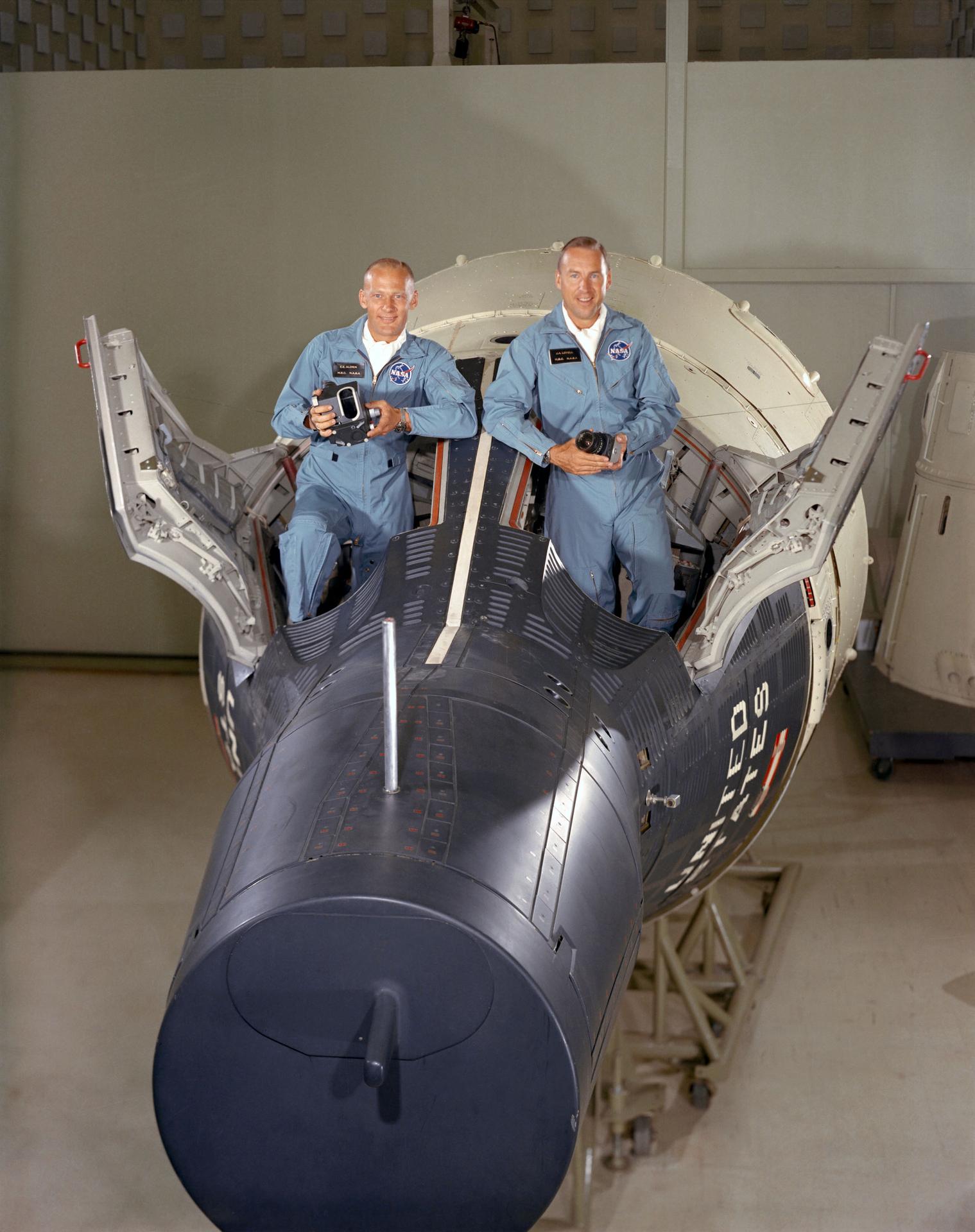
Gemini XII, flown on 11-15 November 1966 by command pilot James A. Lovell Jr. and pilot Edwin E. "Buzz" Aldrin Jr., was the tenth and last crewed flight of Project Gemini. It lifted off from Launch Complex 19 at Cape Kennedy at 3:46:33 p.m. EST aboard a Titan II GLV, ninety-eight minutes after its Agena target vehicle had gone up on an Atlas, and it came home three days, twenty-two hours, thirty-four minutes and thirty-one seconds later after fifty-nine revolutions. On paper it was a rendezvous and docking mission with a long list of experiments. In practice it existed to settle one question that the four previous flights had failed to answer: whether a human being could do useful work outside a spacecraft without exhausting himself. The question was urgent. Ed White's first American spacewalk on Gemini IV had been a joyride, not a job. Eugene Cernan on Gemini IX-A had fogged his visor solid and had to be talked back inside; Michael Collins on Gemini X had found himself unable to hold position; Richard Gordon on Gemini XI had been ordered back in after half an hour, soaked in his own sweat, with one eye blinded by perspiration. Three crews in a row had come up against the same wall: with nothing to hold on to, every action produced an equal and opposite reaction, and simply staying in place cost more effort than the task itself. An EVA review board convened after Gemini XI stripped Gemini XII of its Air Force manoeuvring unit and rebuilt the exercise from scratch. The fix owed nothing to new technology. It came from three things: training in a water tank, where neutral buoyancy reproduced the mechanics of weightlessness closely enough to rehearse every movement; forty-four separate handholds, waist tethers, foot restraints and a handrail bolted around the spacecraft and the Agena; and a rewritten task order in which each job was followed by a scheduled two-minute rest. Aldrin, who had written his MIT doctoral thesis on orbital rendezvous and was known in the office as "Dr. Rendezvous", worked through seventeen manual tasks on two work panels, tightened bolts with a torque wrench, cut metal, connected and disconnected electrical fittings, wiped Lovell's window and came back inside with his reserves intact. Across three hatch openings he logged five hours and thirty minutes of extravehicular activity: a two-hour-twenty-nine-minute standup period, a two-hour-six-minute umbilical excursion on a nine-metre line, and a final fifty-five-minute standup. The rest of the flight was a demonstration that the programme's hard-won techniques held up when the hardware did not. The rendezvous radar failed at a range of about 120 kilometres, and Aldrin fell back on a hand-held sextant and the onboard charts he had helped devise, feeding corrections into the computer while Lovell flew them to the target on 127 kilograms of propellant. The Agena's main engine had suffered a momentary pressure drop during insertion, so mission director William Schneider and flight director Glynn Lunney cancelled the high-altitude excursion; in its place the flight controllers improvised a photographic pass over a total solar eclipse, using the target's secondary propulsion system, and the crew reported catching it "right on the money". A fault in the water storage system cost the crew somewhere between fifteen and eighteen kilograms of tankage for fuel-cell water, and they nursed the cell for more than eighty hours by drinking hard and purging often. The tethered-vehicle experiment produced its gravity gradient despite a slack line and a spacecraft that rolled whenever Lovell tried to pitch or yaw. Gemini XII flew an automatically controlled re-entry on the fifty-ninth revolution, splashed down at 2:21:04 p.m. EST on 15 November within 4.8 kilometres of its aim point and 5.5 kilometres of the carrier Wasp, and rang down the curtain on the programme. Data were obtained on twelve of the fifteen assigned experiments. President Lyndon Johnson noted that ten times in twenty months two men had been placed in orbit in the most advanced spacecraft in the world, and ten times brought home. The three obstacles Gemini had been created to clear for Apollo - human endurance, rendezvous and docking, and work outside the spacecraft - were all cleared, the last of them by the last flight. The spacecraft is on display today at the Adler Planetarium in Chicago, where Lovell and Aldrin were reunited with it on 9 November 2006.
Objectives
The flight plan called for rendezvous and docking with the Agena target vehicle, three extravehicular activity operations, a tethered stationkeeping exercise, docked manoeuvres using the Agena propulsion system to change orbit, and a demonstration of automatic re-entry.
Payload
James Lovell and Edwin "Buzz" Aldrin flew with the Gemini Agena Target Vehicle as their target and fourteen scientific, medical and technological experiments on board, among them the ultraviolet astronomical camera (S-13), ion wake measurement (S-26), Earth-Moon libration region photography (S-29) and dim light image-orthicon photography (S-30). The EVA plan was rebuilt after the Astronaut Maneuvering Unit, once a primary objective of the flight, was deleted.
History
A mission without a mission
For most of 1966 Gemini XII was the flight nobody quite knew what to do with. The programme's three great objectives - long duration, rendezvous and docking, and extravehicular activity - had all been assigned to earlier missions. Gemini VII had spent fourteen days in orbit. Gemini VIII had docked. Gemini XI had gone to a record altitude behind its Agena. The last flight of a series tends to inherit whatever is left over, and for months the planners argued over what that leftover ought to be.
When Gemini XI splashed down on 15 September 1966, the programme had discharged almost everything the 1961 development plan had asked of it. Men had flown fourteen consecutive days. They had manoeuvred in orbit, hunted down a target in the vacuum and found it, docked with it four times, and climbed higher than any human being had ever been. One mission remained on the manifest and, on the face of it, nothing important left to do with it.
James Lovell, named commander of that last flight, put it without ornament: at bottom Gemini XII had no mission. It was, by elimination, the flight assigned to close the programme and to sweep up whatever the earlier ones had left undone. For weeks the only firm item in the flight plan was the Air Force's Astronaut Manoeuvring Unit, the individual propulsion rig that Cernan had been unable to use on Gemini IX-A and that had been waiting ever since for a second chance.
That appearance of a spare flight was deceptive. The one thing everybody agreed on was that the flight had to fly. Gemini existed to clear the ground for Apollo, and the schedule left no room to send Apollo out with an unanswered question behind it. Gemini was carrying a failure it had not managed to explain, one that bore directly on Apollo: nobody yet knew why working outside a spacecraft was so brutally difficult. By the autumn of 1966 exactly one such question remained, and it was not a small one.
The ghost of the spacewalks
The American record of working outside a spacecraft was, at that point, a record of failures dressed up as successes. Ed White's twenty minutes outside Gemini IV in June 1965 had been a triumph of morale and told the engineers almost nothing about work, because White had not been asked to do any. Everything after that had gone wrong.
Eugene Cernan, on Gemini IX-A, had tried to reach the manoeuvring unit stowed in the adapter section and found that every push sent him tumbling. His heart rate soared, his visor fogged over completely, and he had to be guided back to the hatch half blind. Michael Collins, on Gemini X, retrieved a micrometeoroid package from the Agena and discovered that holding station beside a free-flying vehicle with nothing to grip was nearly impossible; he lost a camera in the process. Richard Gordon, on Gemini XI, had to attach a tether to the Agena's docking cone. He got there, straddled the nose like a man riding a horse, and fought the job for so long that sweat filled his helmet and blinded one eye. Pete Conrad ordered him back inside after thirty-three minutes.
The pattern was unmistakable. Newton's third law does not care about intentions: with no anchorage, every torque a man applies to a bolt applies itself equally to the man. Three consecutive crews had spent their entire physical reserve simply trying to stay in one place. Apollo's lunar surface operations, and the contingency transfers built into every plan, depended on the assumption that this was solvable. Nobody had yet shown that it was.
The review board and the death of the manoeuvring unit
After Gemini XI, NASA convened a review board on extravehicular activity. The first of the pre-Gemini XII meetings was held in Houston, and its timing was almost theatrical: the members were being walked through the workings of the Astronaut Manoeuvring Unit at the very moment when Gordon, in orbit, was fighting his umbilical. The board acknowledged that the device appeared to be "a well-qualified piece of space hardware, though complex to operate", and moved on with its agenda.
At the following meeting the four men became, in effect, the EVA review board that Elms would remember. They agreed that the extravehicular experience of the earlier missions was the single factor with a serious potential impact on Gemini XII, and their first recommendation was to strike the manoeuvring unit from the last flight. The reasoning ran to three points: the odds that the pilot would succeed in getting himself into the rig and using it appeared slim; the potential value of the trial did not justify the risk; and the hundred and twenty minutes of extravehicular activity budgeted for the final mission ought to be spent on a series of simple tasks that could be measured precisely in terms of workload.
Its conclusions were unsentimental. The Air Force's Astronaut Manoeuvring Unit, which had already defeated Cernan and had been carried and never used since, was removed from the Gemini XII flight plan altogether. The board judged that flying a jet-propelled backpack before anyone had demonstrated the ability to hold still was a case of running before walking.
George Mueller backed the board. On 30 September he explained to the Air Force why the unit was being withdrawn: the accumulated experience showed that the problems of extravehicular activity had resisted straightforward engineering solutions more stubbornly than any other matter in the programme. The tasks had been designed to grow progressively more complex and more demanding with each mission, and although what was learned on each flight had been carefully applied to the next, the result had fallen well short of satisfactory. Mueller concluded that the programme's last period of extravehicular activity should be given over to a basic investigation of the fundamentals of EVA, through the repetitive execution of elementary tasks that were easy to monitor and to calibrate.
While the board was receiving its first briefing on the manoeuvring unit, Aldrin was practising with it underwater in a pool at McDonogh, in Maryland. A flight-ready example was later installed in the adapter section of spacecraft number 12 at Cape Kennedy. On 23 September - the same day Elms sent Mueller the board's recommendations - it was taken back out. Aldrin, who had worked in the Air Force experiments office in Houston, regretted the loss and was left uneasy about what would fill that hole in a flight that was already upon them.
What replaced it was deliberately modest: a set of body restraints, handholds and work panels, and a task list designed to measure how much a man could actually accomplish and at what physiological cost. Gemini XII would not attempt anything spectacular outside. It would attempt ordinary things, carefully, and establish what ordinary things cost.
The tank: the discovery that changed the training
Until then, crews had prepared for the vacuum aboard zero-gravity aircraft. The method was good for getting a feel for weightlessness and for practising going out through the hatch and coming back in, but not for much more. In a Keplerian parabola the pilot had to move fast and secure himself before the aircraft began its pull-out under several g; in space, by contrast, everything had to be done slowly and deliberately. And the kind of fatigue that Cernan and Gordon had suffered was impossible to reproduce in parabolic flight, because the interval between parabolas imposed a rest whether the trainee wanted one or not. Accumulating fifteen minutes of weightlessness meant spending the better part of a day inside the aeroplane.
By the middle of 1966 underwater simulation had matured enough to cover those gaps. The decisive change happened on the ground, in water. Neutral buoyancy - weighting a suited man in a tank so that he neither rises nor sinks - had been proposed for some time as a way to simulate weightlessness. It is an imperfect analogue: water resists motion, and the suit behaves differently under pressure. But moving through a viscous fluid that also holds you up turned out to resemble, closely, moving against the resistances of a pressurised suit in vacuum; and it reproduces the one thing that mattered here, which is that a body with nothing to push against goes where the reaction sends it.
Aldrin trained in the tank repeatedly, running the full task sequence in a mock-up of the spacecraft adapter and the Agena docking cone. Every handhold was tried, every foot restraint tested, every movement rehearsed until the order of operations was automatic. Where the water showed a task to be awkward, the hardware was changed or the task was moved. Working submerged, he was able to form a far more accurate idea of the time and the physical effort each job on the work panels - the programme called them "task boxes" - would demand during the real flight. Because the zero-gravity aircraft remained useful for the sensation of weightlessness itself, it was not abandoned: Aldrin went on training in it as well.
It is worth being precise about where the credit belongs, because popular memory has shifted it. The book and documentary *Moon Shot*, of 1994, and the documentary *When We Left Earth: The NASA Missions*, of 2008, credit Aldrin with inventing the spacewalking innovations, underwater training included. The article "Inventing Underwater Training for Walking in Space", published by Michael Neufeld in 2016, shows that experimentation with neutral buoyancy had begun in aerospace companies and at NASA's Langley Research Center, in Hampton, Virginia, some years before the first Gemini mission flew. What Gemini XII contributed was not the idea but its systematic application to the preparation of one specific flight.
The importance of this cannot be overstated, and it is the reason Gemini XII is remembered. It was not a new suit, a new tool or a new propulsion system that solved the extravehicular problem. It was a swimming pool and the discipline to use it.
Forty-four restraints
The second half of the answer was hardware, and it was almost comically simple. Gemini XII carried forty-four separate restraint devices distributed over the spacecraft and the target vehicle: handholds, handrails, waist tethers, and foot restraints shaped like overshoes - the "golden slippers" - bolted into the adapter section.
.jpg)
The foot restraints were the piece that mattered most. With his boots locked into them, Aldrin could relax completely, lean forty-five degrees to either side and ninety degrees backwards, and still have both hands free. A man standing in them was, for the first time, a man standing.
A handrail ran forward along the spacecraft to the Agena's docking cone, so that the traverse Gordon had fought could be made hand over hand. Work panels were mounted on the rear of the adapter and on the target vehicle, each carrying a set of tasks: bolts to be torqued, connectors to be mated and demated, metal to be cut, a hook-and-ring fastener, an Apollo torque wrench to be tried with two waist tethers, then one, then none.
The order of tasks
The Crew Systems Division at the Manned Spacecraft Center had been turning Cernan's exhaustion over in its mind ever since Gemini IX-A. Collins's relative success on Gemini X suggested that the key might lie not only in the hardware but in the order of events: Collins had first made a stand-up excursion in the open hatch, closed up and rested, and only then gone outside altogether. After Gordon was forced to come back in ahead of time on Gemini XI, the programme office decided that Aldrin would begin with a stand-up exercise at the hatch and pass to the more demanding activity only afterwards.
.jpg)
The third element was scheduling. Earlier EVAs had been written as continuous sequences, on the assumption that a man in weightlessness does not tire. Onto that sequence was grafted an idea just as simple: build in rests. Gemini XII's umbilical excursion was written as a series of short jobs separated by roughly a dozen deliberate two-minute pauses, precisely so that Aldrin would not overload himself as the men before him had done. He was instructed to work slowly, to do one thing and then stop, and to report how he felt.
This sounds trivial. It was the difference between an exhausted crewman being talked back through a hatch and a pilot who finished every assigned task and had breath left over to offer to change his commander's oil.
A flight plan that would not settle
In July the crew began to receive somewhat more precise objectives, and the flight was stretched to four days to make room for experiments that depended on night-time operations. The plan was nevertheless slow to set. In July the primary objectives were rendezvous and docking, preferably on the spacecraft's second orbit, and extravehicular activity with the manoeuvring unit. Two of the secondary objectives were repeats: a second rendezvous from above, inherited from Gemini IX-A, and a tethered-vehicle exercise, inherited from Gemini XI.
Then came the decision to strike the manoeuvring unit, and Mueller told Mathews that he was opposed to the second rendezvous as well. After that the docking moved from the second orbit to the third, something that had already been done before. Every change forced the flight plan to be rebuilt. As late as the middle of September, Mathews still had to tell the centre's management that the hardware would be ready for launch but that what would be done during the flight remained unsettled. The definitive version of the plan was not ready until 20 October, and it held no surprises: the only novelty was the gravity-gradient stationkeeping mode without rotation, and even that was not entirely new, because Conrad and Gordon had attempted it without success on Gemini XI. The last flight of the programme was not going to break new ground.
-12_-_Agena_rendezvous%2C_stereo_view_from_Gemini_12.jpg)
Even with the EVA rebuilt, the rest of the flight plan kept moving. The high-altitude excursion behind the Agena, a repeat of what Gemini XI had done, was in and then out. A solar eclipse photography task was included, then dropped when a two-day slip from 9 to 11 November put the eclipse squarely on top of the excursion. Rendezvous options were traded back and forth. The planners were still working when the vehicles were on the pads.
And yet, if Gemini XII had no mission, it did have a theme: to bore through the mystery of working in space. The strain Cernan and Gordon had suffered did not merely shadow Gemini; it cast doubt over Apollo. That failure of understanding became the preoccupation that shaped the final flight, and NASA at last organised a careful, systematic study of the basic features of extravehicular activity.
An Agena and an Atlas at the last minute
The hardest part of the preparation was the flight plan, but the hardware could have been far worse: spares were beginning to run short. The risk had been foreseen and reasonable precautions taken well before the planned launch date, yet the programme's managers could not help being nervous at the prospect of a part failing suddenly with nothing to replace it.
When the Gemini IX Agena fell into the Atlantic, Gemini XII was left facing a serious shortage: it lacked both an Agena and an Atlas to launch it with. Replacing the Agena proved manageable. Lockheed's first production article, 5001, which had been used in development testing at the Cape, had already gone back to the Sunnyvale plant for refurbishment; it only had to be adapted to the mission.
Finding a new Atlas was another matter entirely. General Dynamics did not keep launch vehicles in a warehouse waiting for a buyer, so the programme office had to locate one earmarked for another project. The slip of a Lunar Orbiter flight in May freed one that could be acquired, and by the time Mueller approved the purchase of the spare vehicle on 1 June the centre was already negotiating for an Atlas at Vandenberg Air Force Base, in California. But that was not the standard vehicle Gemini had been using: it was the first of a new series with features that had never flown. The Langley Research Center, responsible for the Orbiter payload, was then persuaded to hand its Atlas to Gemini in exchange for the Californian one. Langley's Orbiter Atlas differed from the Gemini version in only nine respects, and the swap reassured the programme's engineers. By the end of September the new Atlas was waiting on pad 14 at Cape Kennedy.
The target vehicle had its own troubles. GATV-5001A was prepared and the Atlas that would carry it was readied by the 6555th Aerospace Test Wing at the Cape. The launch slipped from 9 to 11 November. On the day, the Atlas lifted at 2:07:59 p.m. EST and put the Agena into orbit - but eight minutes after launch the target's main engine suffered a momentary six per cent drop in thrust chamber pressure, with a corresponding loss of turbine speed. Nobody on the ground yet knew what it meant.
Lovell and Aldrin
The crew were an unusual pairing. James A. Lovell Jr., selected in NASA's second astronaut group in 1962, had already flown the record-breaking fourteen-day Gemini VII mission in December 1965 with Frank Borman - the flight that cleared away the medical doubts about human endurance under prolonged weightlessness. He was, by November 1966, one of the most experienced spacefarers alive, and Gemini XII returned him to space as a commander. Later would come Apollo 8, in 1968, when he was one of the first three human beings to orbit the Moon, and Apollo 13, in April 1970, the mission he helped steer home after the explosion that came close to costing the crew their lives.
Edwin E. "Buzz" Aldrin Jr., an engineer and a fighter pilot in the Korean War, had been selected in the third astronaut group, and Gemini XII was his first flight. He had come to the corps by way of a doctorate at the Massachusetts Institute of Technology on manned orbital rendezvous techniques, which earned him from his colleagues the nickname Dr. Rendezvous, used with a mixture of respect and irony; he had been part of the team that planned and developed the backup chart procedures for rendezvous. In July 1969 he would walk on the Moon with Neil Armstrong.
The backup crew were L. Gordon Cooper Jr. as commander and Eugene A. Cernan as pilot. The support team included Stuart A. Roosa as capsule communicator at the Cape and Charles "Pete" Conrad Jr. and William A. Anders as capsule communicators in Houston.
The assignment came to them by the ordinary rotation, and by an accident: they were the backup crew for Gemini X, and moved up when Charles Bassett and Elliot See were killed in an aircraft crash in 1966, reshuffling every crew behind them.
The clock emblem
The mission patch said what the flight was. Its striking orange and black are explained by the date on which the mission was originally to have flown, close to Halloween. A Roman numeral XII sits at the twelve o'clock position of a clock face, marking the last hour of the programme, and the Gemini spacecraft points towards it like an hour hand: the final mission of the series, closing the full turn of the dial. To the left, a crescent Moon marks the ultimate objective of the whole effort, the one that already belonged to Apollo, with the two stars of Gemini - Castor and Pollux - above. It was a patch about ending something and handing it on.
Two launches on the afternoon of 11 November
The launch had been set for 9 November 1966, but it was called off on the 8th when a faulty power supply was found. The curtain snagged twice before it would go up. The spares gave exactly the trouble everyone had feared: an autopilot and a rate gyro on the launch vehicle had to be replaced, and then the replacements themselves had to be replaced. But on Veterans Day, 11 November, flight director Glynn Lunney gave the signal for the overture to begin.
-12_-_insertion%2C_fisheye_view%2C_Cape.jpg)
The Atlas-Agena went first, at 2:07:59 p.m. EST on 11 November 1966: the substitute Atlas lifted the refurbished Agena off Pad 14 and put it into orbit. A few minutes earlier, over at Pad 19, the suited crew had ridden up the access ramp with two placards taped to their backs - "THE" on Lovell's and "END" on Aldrin's. The joke was more than symbolism, because when launch vehicle number 12 broke its ties thirty seconds after 3:46 p.m., the Gemini launch preparation team passed into history. Francis Carey, Martin's chief test conductor, and Colonel John Albert, head of the Gemini Launch Vehicle Division of the 6555th Aerospace Test Wing, could take justified pride in a record of twelve for twelve, while regretting that the work was over and the team about to be dispersed. That it had ended could not have been underlined more vividly: almost at once the demolition machines began turning the launch stand into scrap. The future was Apollo. As an announcement of that new era, Lunar Orbiter II had lifted off barely five days earlier, on 6 November, bound for the Moon to photograph candidate landing sites.
Ninety-eight minutes after the Atlas, at 3:46:33 p.m. EST - 20:46:33 UT - the Titan II GLV lifted Gemini XII off Pad 19 with Lovell and Aldrin aboard. The interval between the two launches - one hour and thirty-nine minutes - stands as the record for the fastest turnaround between two consecutive orbital launches from United States territory.
The launch vehicle's systems behaved normally through powered flight, with two known anomalies. At staging there was a repeat of the first-stage oxidiser tank rupture first seen on the Gemini X launch, and on this occasion the fuel tank appeared to rupture as well, because a white cloud came out of the spent stage alongside the orange nitrogen tetroxide. At second-stage engine cutoff the phenomenon the programme called "the Green Man" appeared once more: pitch oscillations caused by pressure building up in the second stage's protective skirt.
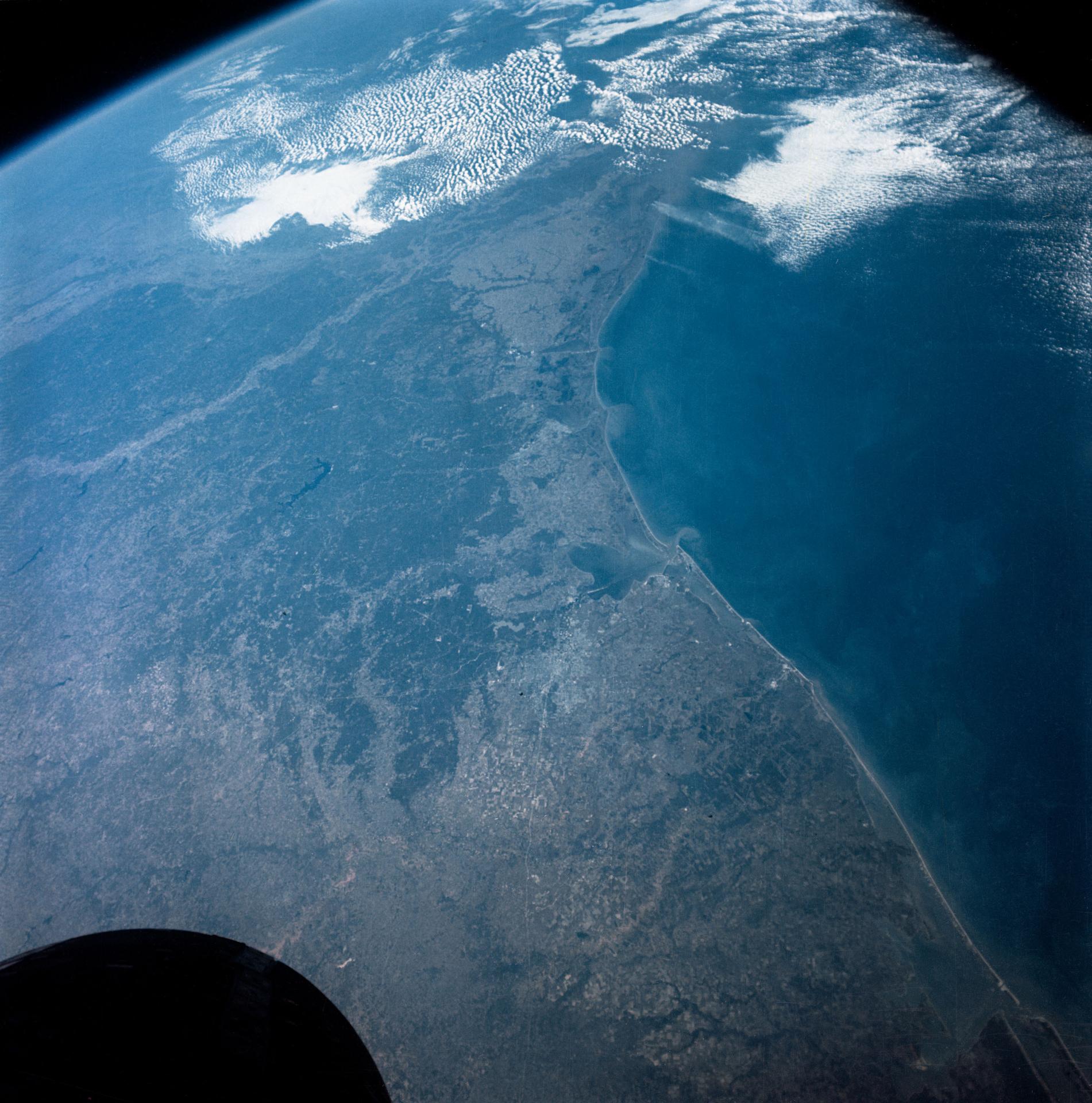
Insertion came at 3:52:40. The spacecraft weighed 3,762 kilograms and entered an orbit of 160.8 by 270.6 kilometres, inclined 28.87 degrees, with a period of 88.87 minutes. It received the international designation 1966-104A and catalogue number 2566.
Twenty-five minutes of silence
No sooner were they in orbit than Lovell and Aldrin began to wonder whether everybody on the ground had gone home early. For twenty-five minutes, with one brief exception, they heard nothing at all. The tracking station on Ascension Island had the wrong acquisition-of-signal time and its communicators never managed to speak to the pilots. Lovell was audibly relieved when he heard Pete Conrad calling him over the Tananarive remote line with figures he needed for a manoeuvre due in a matter of minutes.
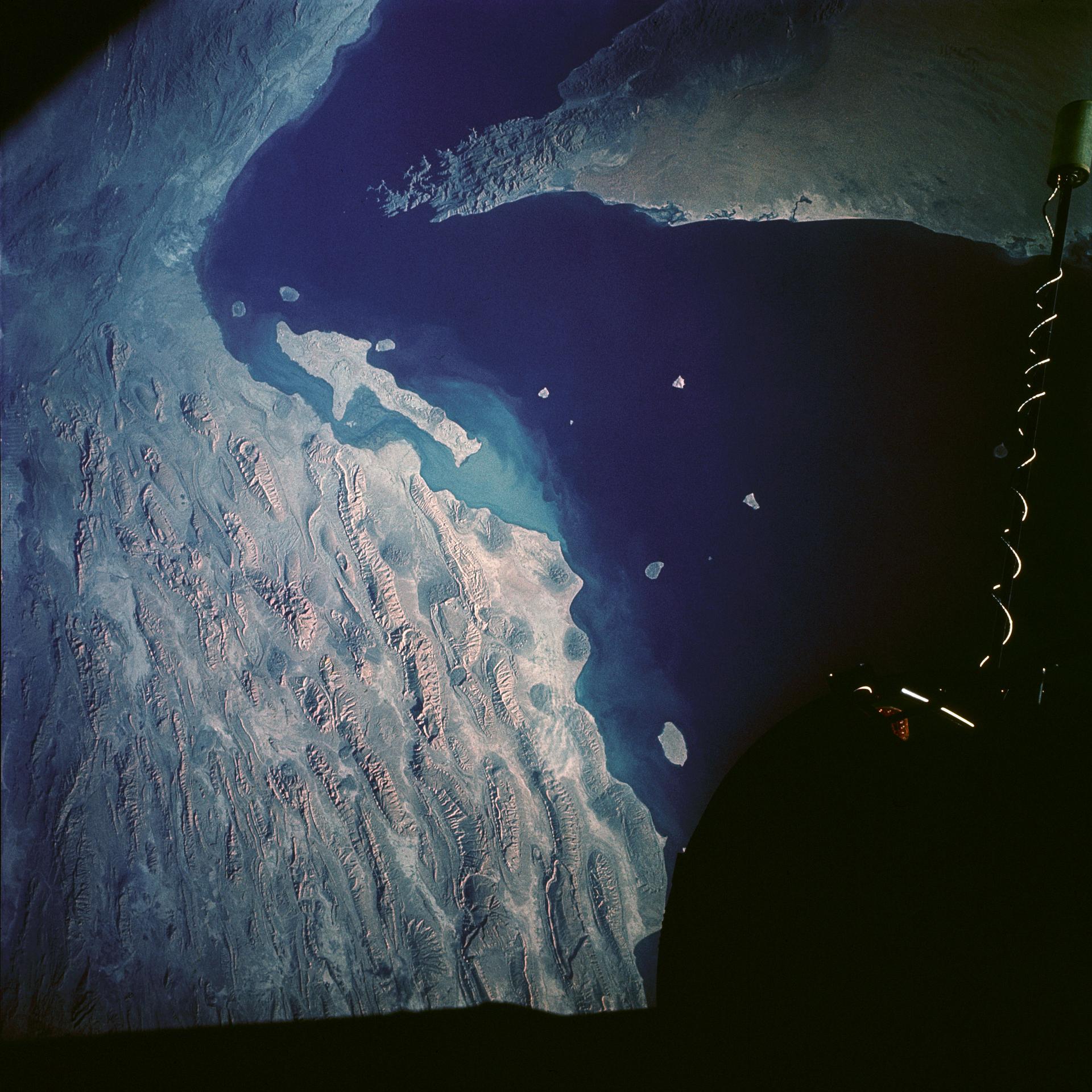
After that, things began to run smoothly. The rendezvous began well. A little over an hour after launch, Aldrin reported solid radar lock at a range of 235.52 nautical miles - 436.18 kilometres. From Houston, Conrad answered that the radar looked as though it was meeting its specification. The crew settled into the standard sequence of phasing manoeuvres, and as the spacecraft moved into a circular orbit below and behind the target the radar placed the Agena 120 kilometres away. That was the last figure the crew could trust: reception degraded so badly that the onboard computer refused to accept the radar's intermittent readings. With the target about 120 kilometres ahead, the radar had quit.
For a rendezvous flown on radar and computer, this was the failure that mattered. The onboard computer would no longer be fed range and range rate; it stayed in a pursuit mode, and the numbers it produced could not be trusted without an independent check. Gemini XII had, in that moment, become the test case for every backup procedure the programme had written and never needed.
The sextant instead of the radar
The radar failure meant that Gemini XII would have to complete the rendezvous using the backup charts carried on board. Aldrin had been part of the team that planned and developed those procedures, and he now had the chance to establish whether his doctoral work at MIT and his hours in the simulators at St. Louis with the McDonnell and centre engineers were worth anything in actual spaceflight. The pilot they called Dr. Rendezvous had already taken out and used the hand-held T-2 navigational sextant to get a look at the target. When the radar broke, that experimental piece of equipment became operationally decisive.
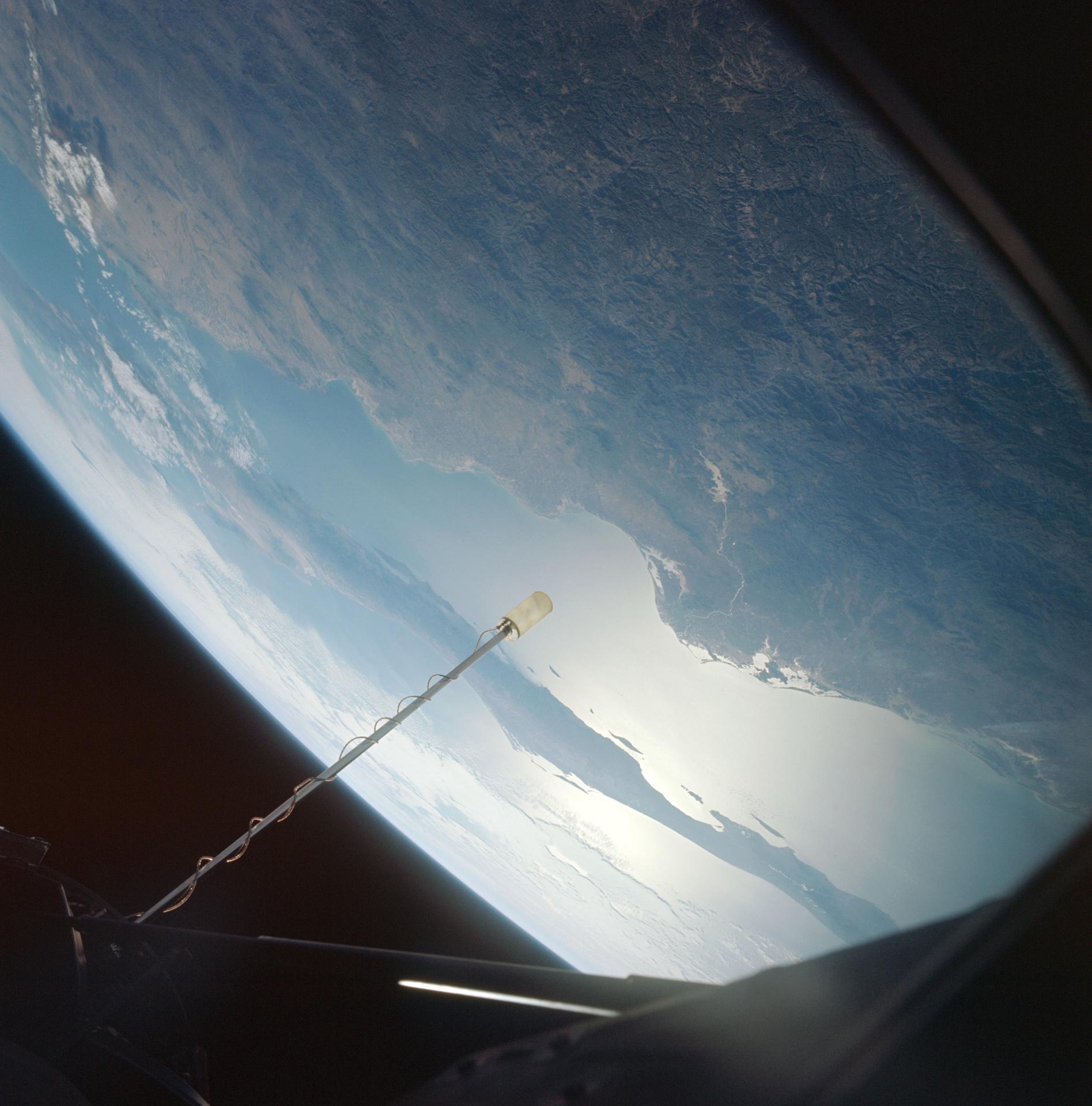
In the automatic rendezvous mode, the radar would have fed range and range rate to the computer and Lovell would have flown by the resulting numbers. This time the computer stayed in the pursuit mode, and Aldrin, mission control, or both had to compute range and range rate to check whether the computer was right. For that backup method Aldrin measured with the sextant the angle between the spacecraft's local horizontal and that of the Agena, which was running ahead and above. He checked the information against his rendezvous chart and entered the necessary corrections into the computer. Lovell flew the spacecraft on those numbers and reached the target three hours and forty-five minutes after liftoff, having burned only 127 kilograms of propellant.
"We are docked"
Lovell called the tracking ship Coastal Sentry Quebec at four hours and thirteen minutes ground elapsed time to say that they were docked. But Gemini XII was the fourth flight to make that announcement, and the shipboard controller simply acknowledged. It was the programme's fifth orbital rendezvous and fourth docking with an Agena, and it excited nobody.
For the second time, a Gemini crew was able to practise undocking and redocking. They released the vehicles and Lovell attempted the manoeuvre during the night phase. The spacecraft was misaligned and the target's docking cone would not release; instead the two hung up on one of the three latches, like a pair of bumpers locked together. Like a driver stuck in mud, Lovell fired the thrusters fore and aft trying to rock the spacecraft loose. The two vehicles shook, but it came free without damage to either. A few minutes later Aldrin docked without difficulty.
The damaged Agena
The next item on the agenda was to fire the Agena's engine to climb to a higher orbit, and that part of the flight plan had to change. Eight minutes after the Agena's launch its main engine had suffered a momentary six per cent drop in thrust chamber pressure, with a corresponding loss of turbine revolutions. So while Lovell and Aldrin chased and caught the Agena and practised docking, mission director William Schneider and flight director Glynn Lunney had to decide whether or not to fire the main engine. They chose prudence: it would not be fired.
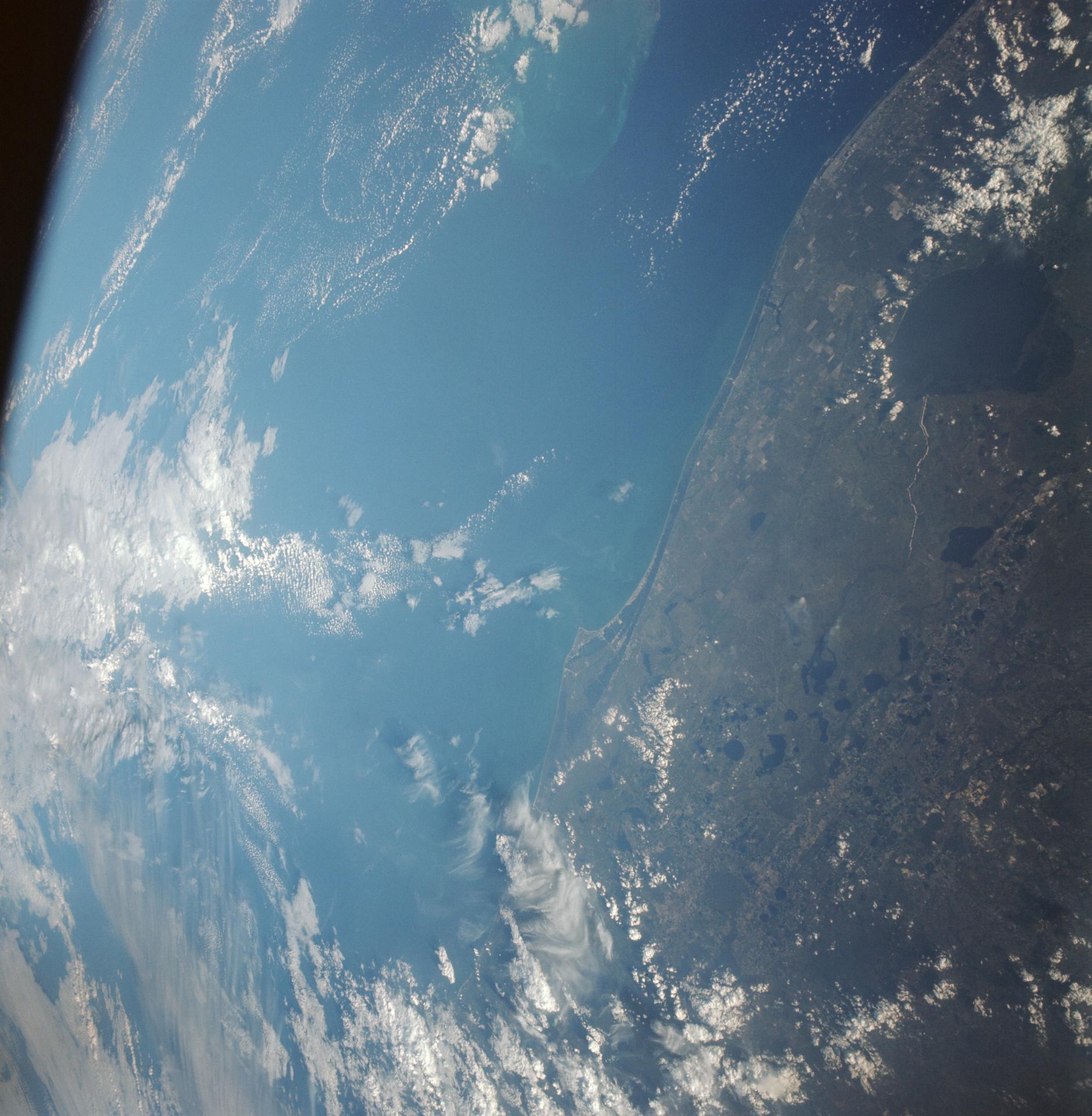
The later analysis was more detailed. During orbital insertion the target vehicle's engine had experienced a drop in turbopump speed lasting about two and a half seconds; afterwards, pump performance returned to normal. Telemetry indicated erratic pump speeds, but engine performance did not reflect that irregularity. The anomaly was later identified as a brief thirty pounds per square inch drop in the thrust chamber. Ground controllers were unwilling to risk the planned orbit-raising manoeuvre because the exact reason for the pump slowdown was not clear. After the re-entry of Gemini XII, on the Agena's sixty-third revolution, an attempt was made to fire the propulsion system, but a stuck fuel valve prevented ignition. It was suspected that a turbopump bearing failure had produced the anomalous conditions during insertion, followed by heating and melting of pump components; the inability to start the engine on the sixty-third revolution may have been caused by melted or loose debris blocking the valve. The telemetry data falsely reporting erratic speeds was attributed to that same debris striking the measurement probes.
The recovered eclipse
The pilots had lost their trip to high orbit, but Lunney soon gave them something to do with the free time. The flight plan had originally called for photographing a solar eclipse if it did not interfere with the rest of the mission. The task had been dropped when the two-day postponement - from 9 to 11 November - made the eclipse coincide with the high-altitude excursion. With the main engine burn cancelled, two of the planners thought of restoring the eclipse photography. Schneider and Lunney checked with James R. Bates, the experiments advisory officer for Gemini XII, to see how it would affect the rest of the science programme. Since the flight plan had to be rewritten anyway, said Bates, why not include it?
That consultation marked a significant change in the operation of mission control. Until then the experimenters' representative had worked from an adjacent support room; on Gemini XII the engineers in charge allowed him to operate as part of the flight control team inside the main room. Although Gemini X had already had an experiments console in the control room, it was manned only occasionally. Bates was the first full-time experiments officer, on Gemini XII. The experiment worked so well that the practice carried over into Apollo.
Even after the eclipse had been dropped, the planners had gone on plotting its track. Now there was an opportunity to return the experiment to the mission. The Agena's secondary propulsion system had power enough to place the spacecraft in position for an eight-second photographic pass at the right moment. Schneider and Lunney agreed that this real-time planning would give the flight an extra fillip.
"The eclipse finally caught up with us," Lovell remarked. "Yes, it sure looks that way," Conrad replied. Although the crew had wanted to do the experiment when it was first proposed, these sudden preparations came at a bad time: they were still working with the Agena and were scheduled to eat, sleep and attend to other experiments.
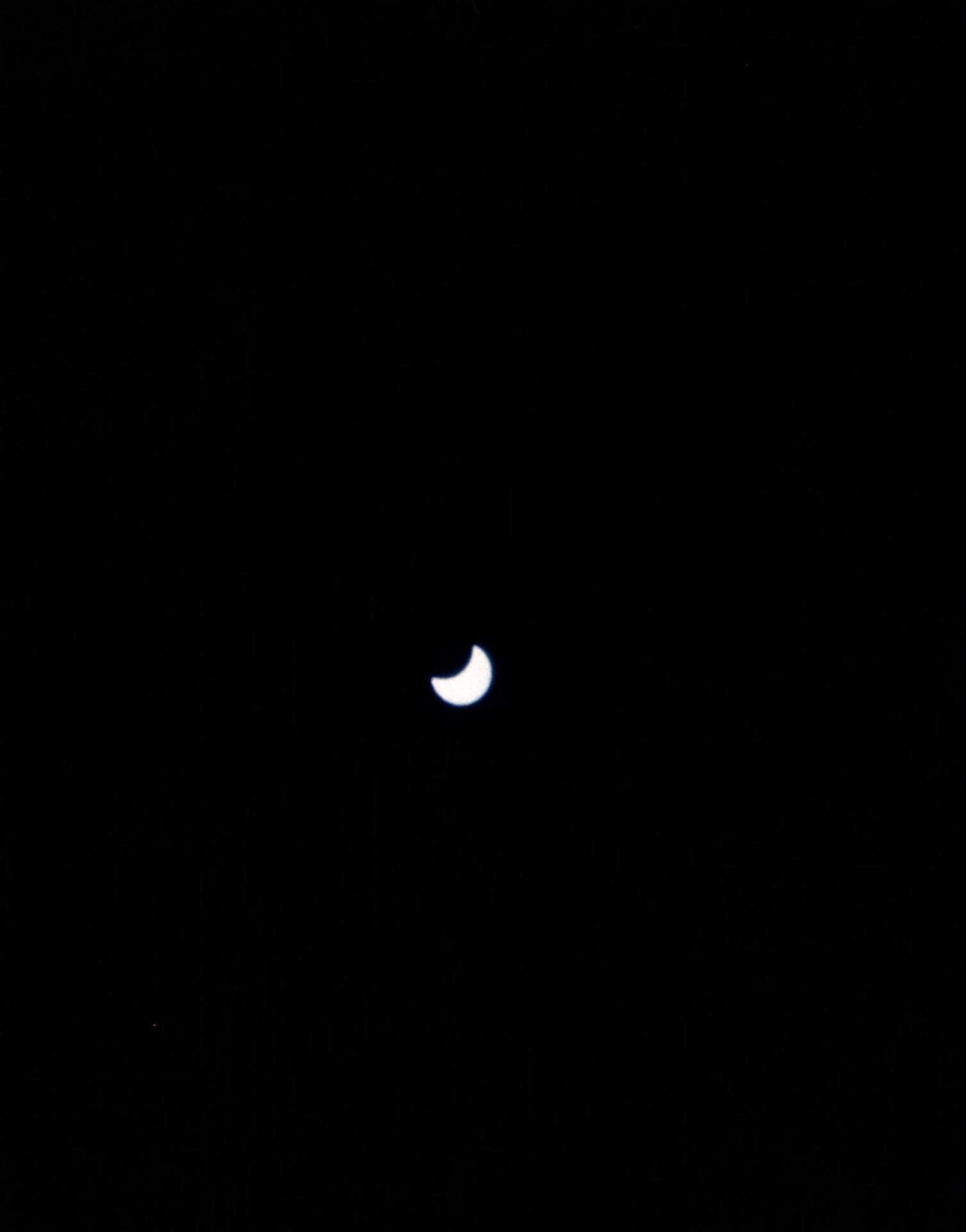
Even so, at seven hours and five minutes after launch Lovell fired the Agena's small engines to brake thirteen metres per second. The Agena still had its doubters - Conrad had told them that if it got away from them they should overpower it with the spacecraft - but the target vehicle behaved beautifully and the crew went to sleep. In the morning the Canary Islands controller greeted them with the news that there would be a second manoeuvre, five metres per second forward, to line the vehicles up properly. It came off perfectly: the crew reported seeing the eclipse "right on the money" at 16:01:44 ground elapsed time. The shadow swept across South America from north of Lima, Peru, nearly to the southern tip of Brazil. For a moment they thought they were slightly off, but the aim had been good.
First EVA: standing in the hatch
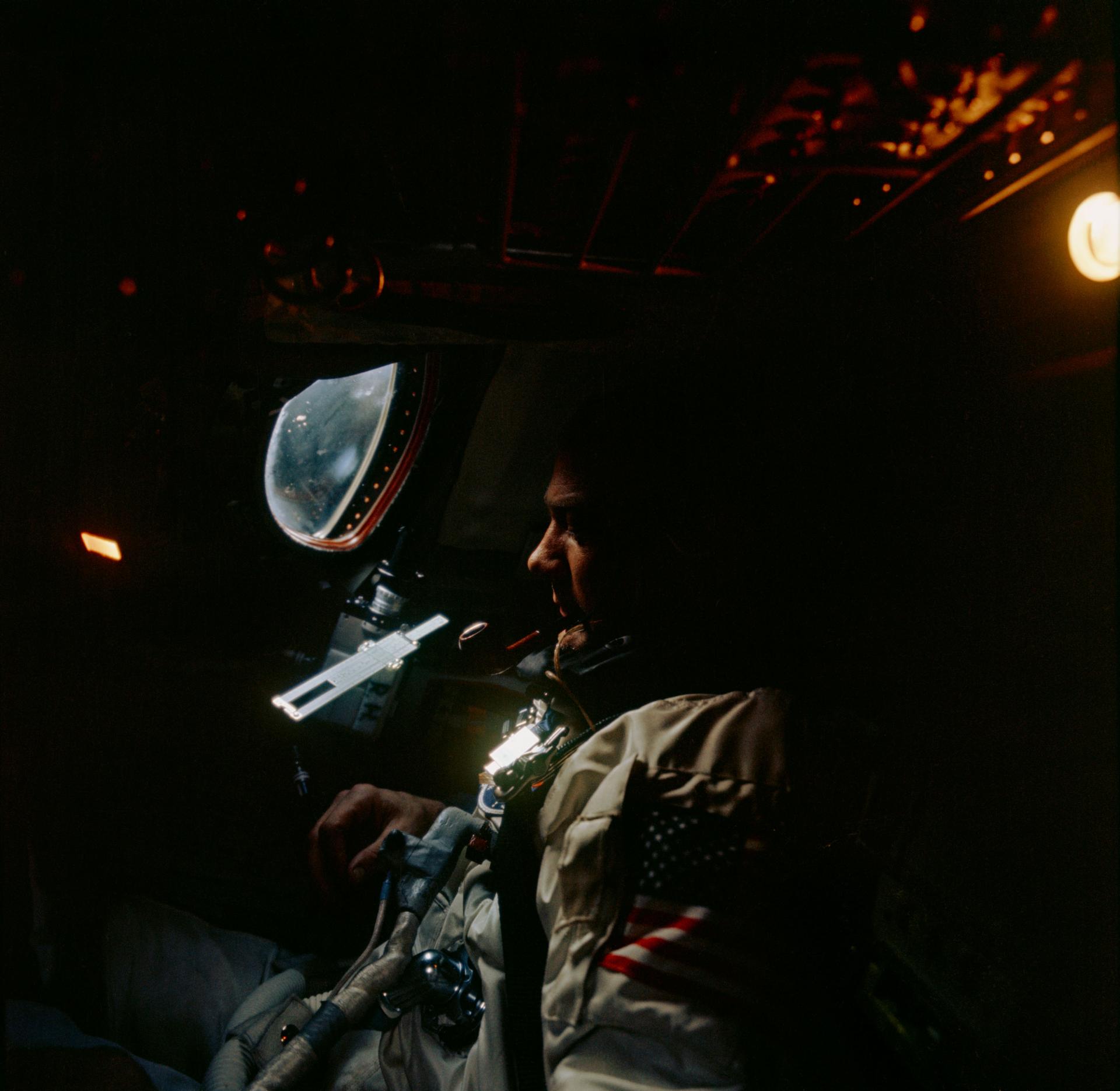
The sudden change in the flight plan had worried the crew because of its possible interference with the first extravehicular exercise, which was, after all, the heart of the mission. Despite the interruptions - particularly the one caused by the second manoeuvre - the hatch opened on schedule, some twenty minutes before orbital sunset. It happened at 11:15 a.m. EST, at nineteen hours and twenty-nine minutes ground elapsed time. Aldrin, nearly speechless, exclaimed, "Man! Look at that!" He was amazed and awed by seeing so much of the Earth and the universe spread out before him.
He worked slowly and deliberately, doing a short task and then resting. First he simply stood in the hatch, getting used to it. Then he released a bag of rubbish. Moments later he muttered, "Stars in the daytime? I don't believe it." He soon realised that what he was seeing was the bag drifting away. He spent eight minutes in darkness before his eyes adapted and he could see real stars and planets. Aldrin studied each of his movements - every action and every reaction - so that he could later compare the standup exercise with the umbilical period.
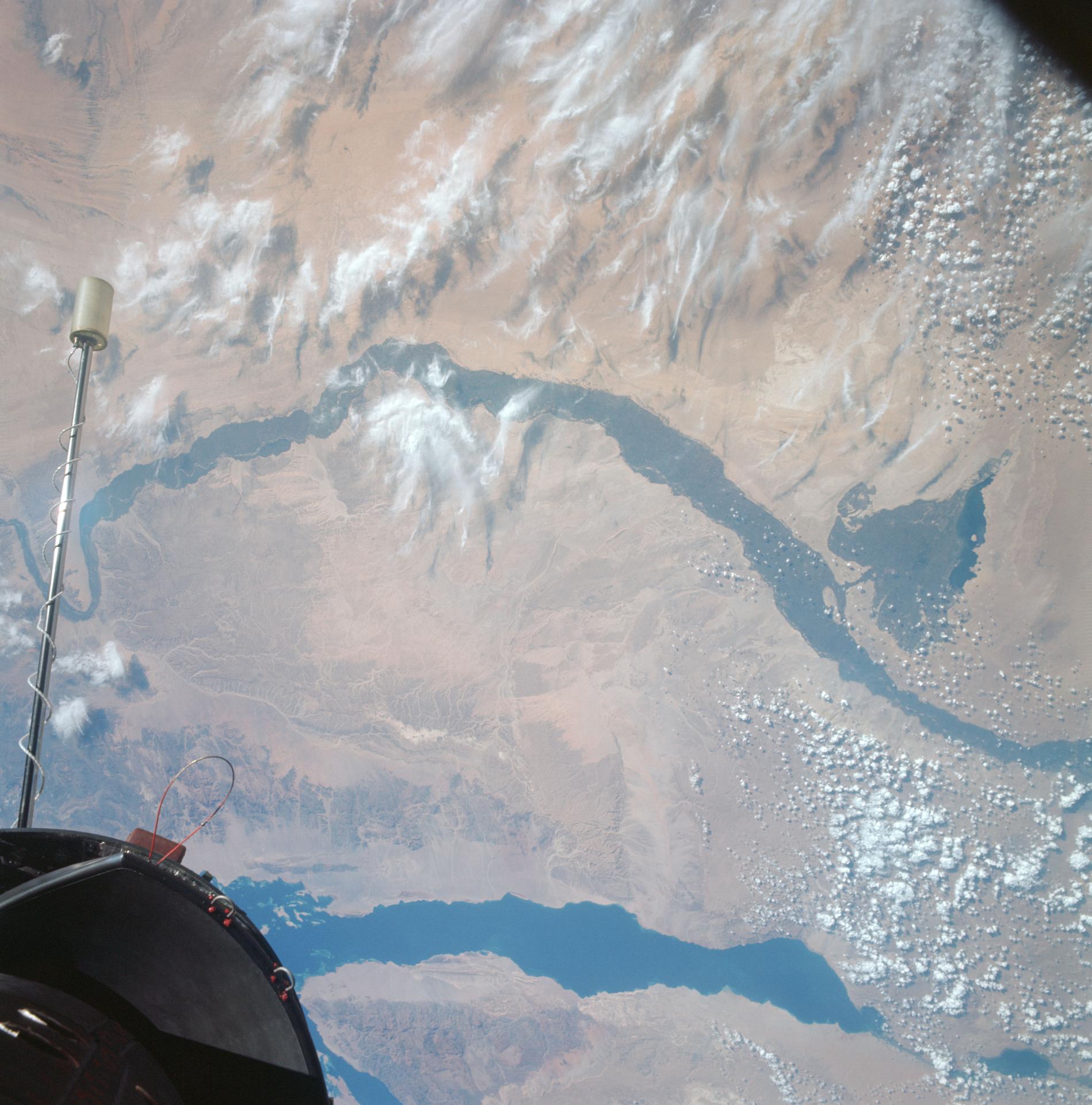
He mounted an ultraviolet astronomical camera. Through two night passes he photographed star fields, although Lovell had trouble pointing the spacecraft in specific directions because the Agena's tanks were nearly full. In daylight the pilot installed a movie camera, attached a handrail running to the target's docking adapter cone, dismounted the ultraviolet camera, reloaded it and put it back, retrieved a micrometeorite collection package and took photographs. At 1:44 p.m. the crew closed up the spacecraft again after logging a very satisfactory first exercise of two hours and twenty-nine minutes.
The umbilical EVA: the one that solved the problem
The next day Lovell and Aldrin prepared for the centrepiece of the mission: establishing whether a man could perform useful tasks in space at the end of an umbilical. At 7:16 a.m. the crew reported that two of the manoeuvring thrusters were giving little or no thrust. At 10:34, at forty-two hours and forty-eight minutes ground elapsed time, the hatch opened; at 10:38 Aldrin was outside, secured by a nine-metre umbilical.
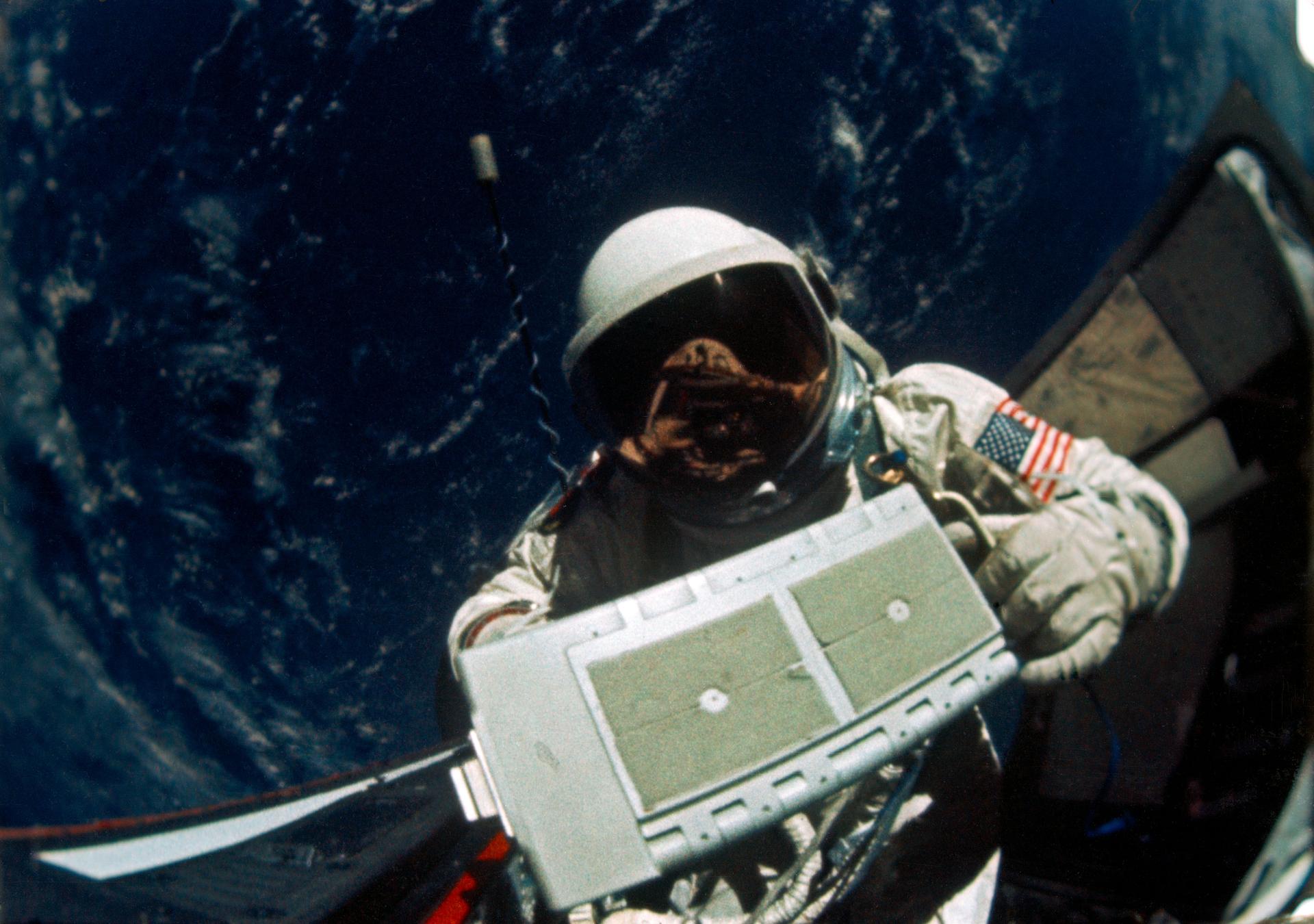
Near forty-three hours into the flight, Aldrin stood up in his seat and reinstalled the movie camera as easily as he had done the day before; then he dismounted it, went out into space and mounted it again, using only a handrail to hold position. He then moved hand over hand along the handrail to the nose of the Agena's docking adapter. Using his waist tether as a restraint, he attached the two vehicles for the gravity gradient experiment without any of the problems Gordon had encountered.
The pilot floated back to the hatch area and exchanged cameras with Lovell. Working down the handrail, he went aft to the spacecraft adapter. He slipped his feet into the golden slippers - the overshoe-shaped restraints - and moved his body back and forth and side to side to test whether those restraints helped him hold position as much as the programme office expected. They allowed him to relax completely and to lean up to forty-five degrees to either side and ninety degrees backwards.
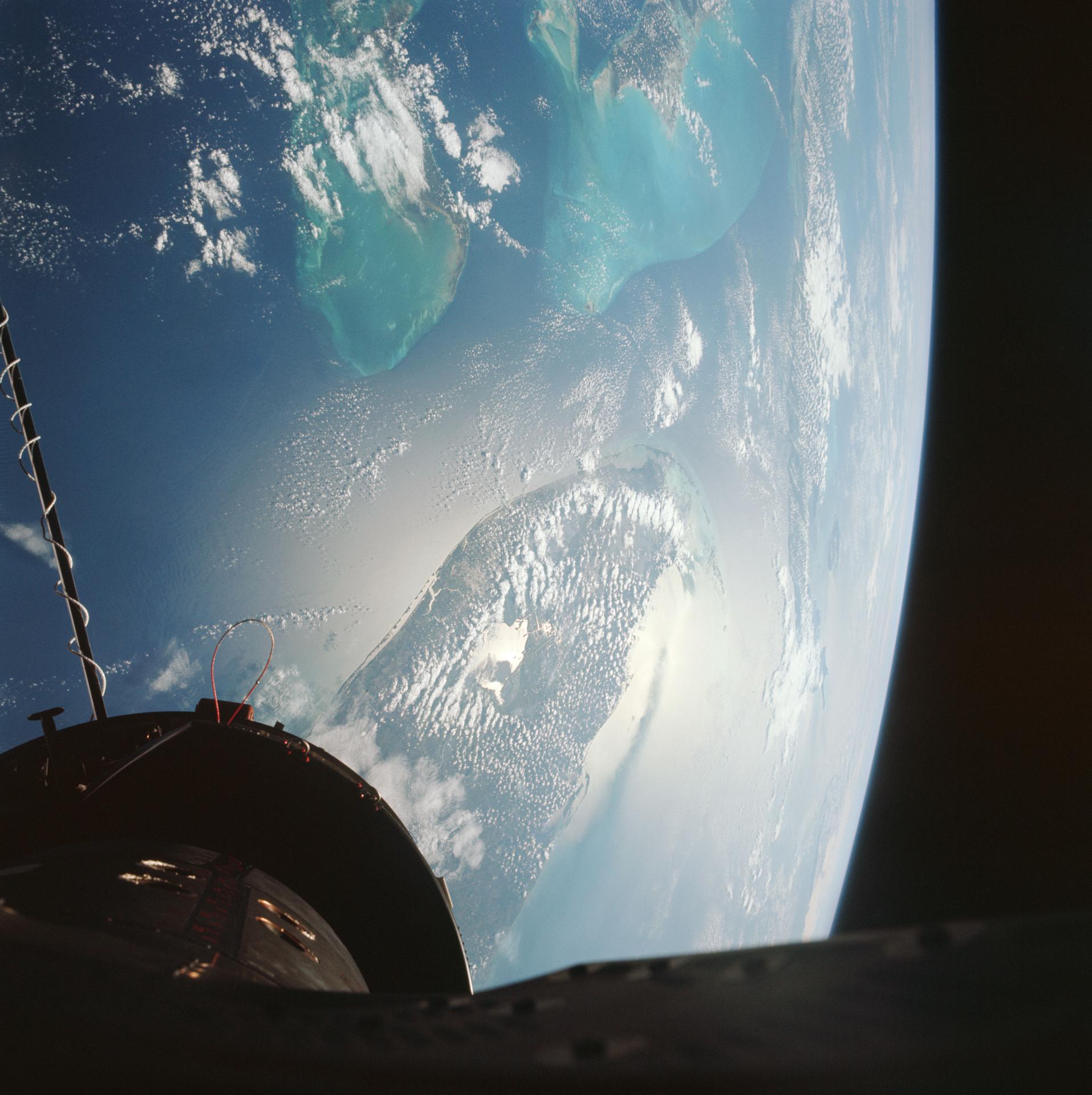
He then unpacked small floodlights and set to work on the work panel, torquing bolts and cutting metal: seventeen relatively simple manual tasks on a panel mounted on the rear of the adapter. At one point a bolt and a washer floated free. Aldrin manoeuvred the weightless pieces into a corner and captured them, one in each hand. Lovell asked him over the intercom whether he was playing orbital mechanics back in the adapter, and the pilot answered that he was, that he had had to do a little rendezvous.
At sunrise he returned to the open hatch. After resting a few minutes he went forward again to the Agena, this time to a work panel fixed to the target vehicle. Lovell watched him separate electrical connectors and mate them again. Aldrin also tried a torque wrench designed for the Apollo programme; for that task he used first two waist tethers, then one, then none. He hooked to the Gemini adapter arm a thirty-metre tether stowed in the Agena adapter. Throughout the excursion about a dozen two-minute rests were scheduled to keep him from overloading himself.
Back at the hatch, to finish his two hours of extravehicular time, Aldrin stopped to wipe the commander's window with a cloth. As he did so, Lovell asked whether he would change the oil while he was at it. The "air in the tyres" was fine, so Aldrin climbed aboard, stood up in the hatch and watched Lovell fire some thrusters. Then he sat down in his seat. The door closed without effort and Aldrin bled the oxygen from his life support system to help repressurise the cabin. He was back inside at 12:33 and the hatch was closed at 12:40. All tasks were completed and the total time was two hours and six minutes.
It was the first time in history that a human being had worked outside a spacecraft for hours and come back in without having burned his reserves. What was remembered of Gemini XII was precisely that: Aldrin's flawless performance during well-planned extravehicular periods.
The thirty-metre tether
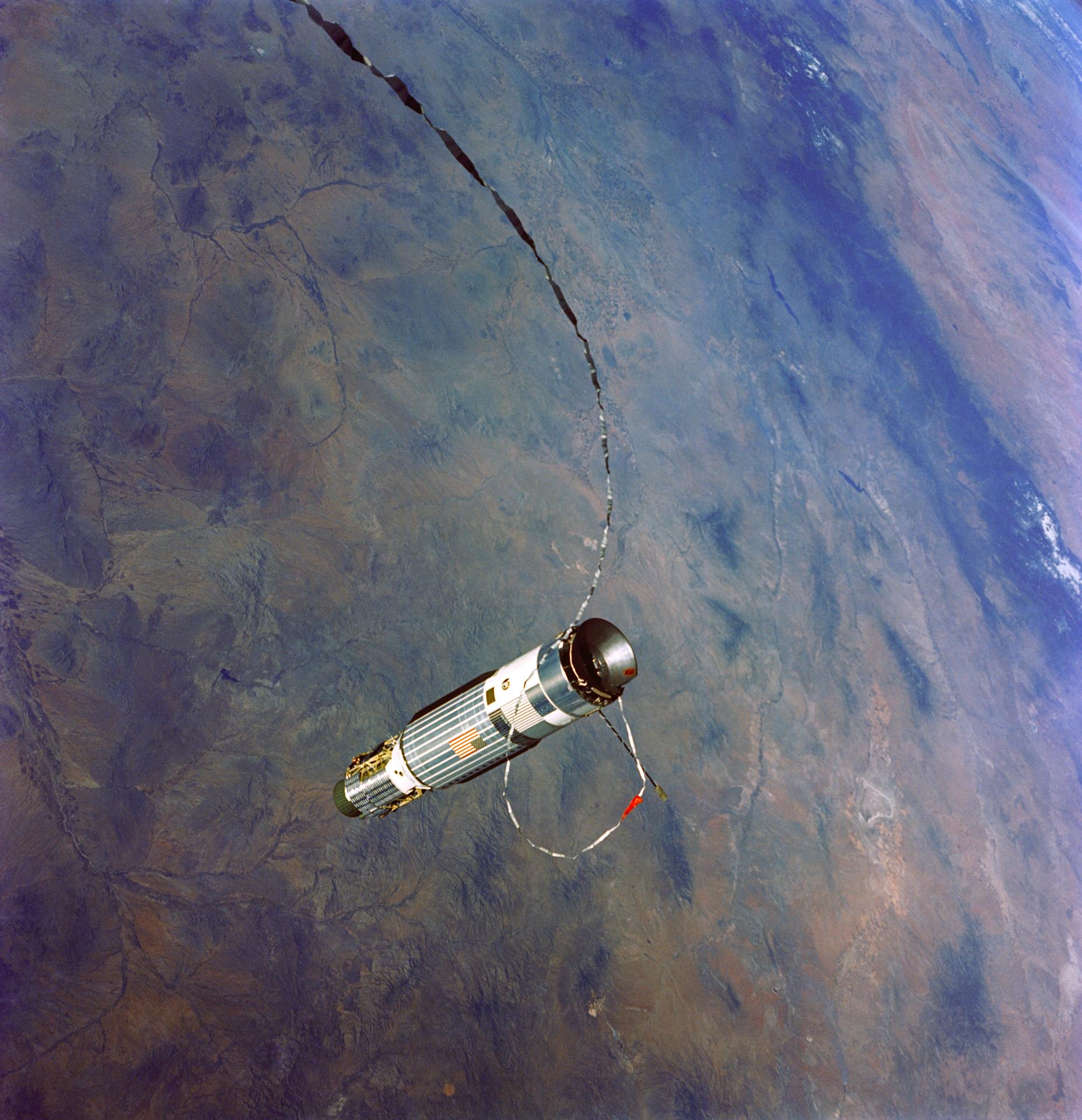
At 3:09 p.m. Gemini XII undocked from the Agena, moved to the end of the tether joining the two vehicles and began the tethered vehicle experiment, moving in a circular orbit around the target. Lovell carefully backed away from the Agena into a vertical pole arrangement with respect to the Earth. The tether deployed smoothly, with one brief hang-up, but stayed slack. Lovell was exasperated at being unable to tighten it with the spacecraft's thrusters: "we had a little problem then," he said; "every time I wanted to pitch or yaw, I rolled."
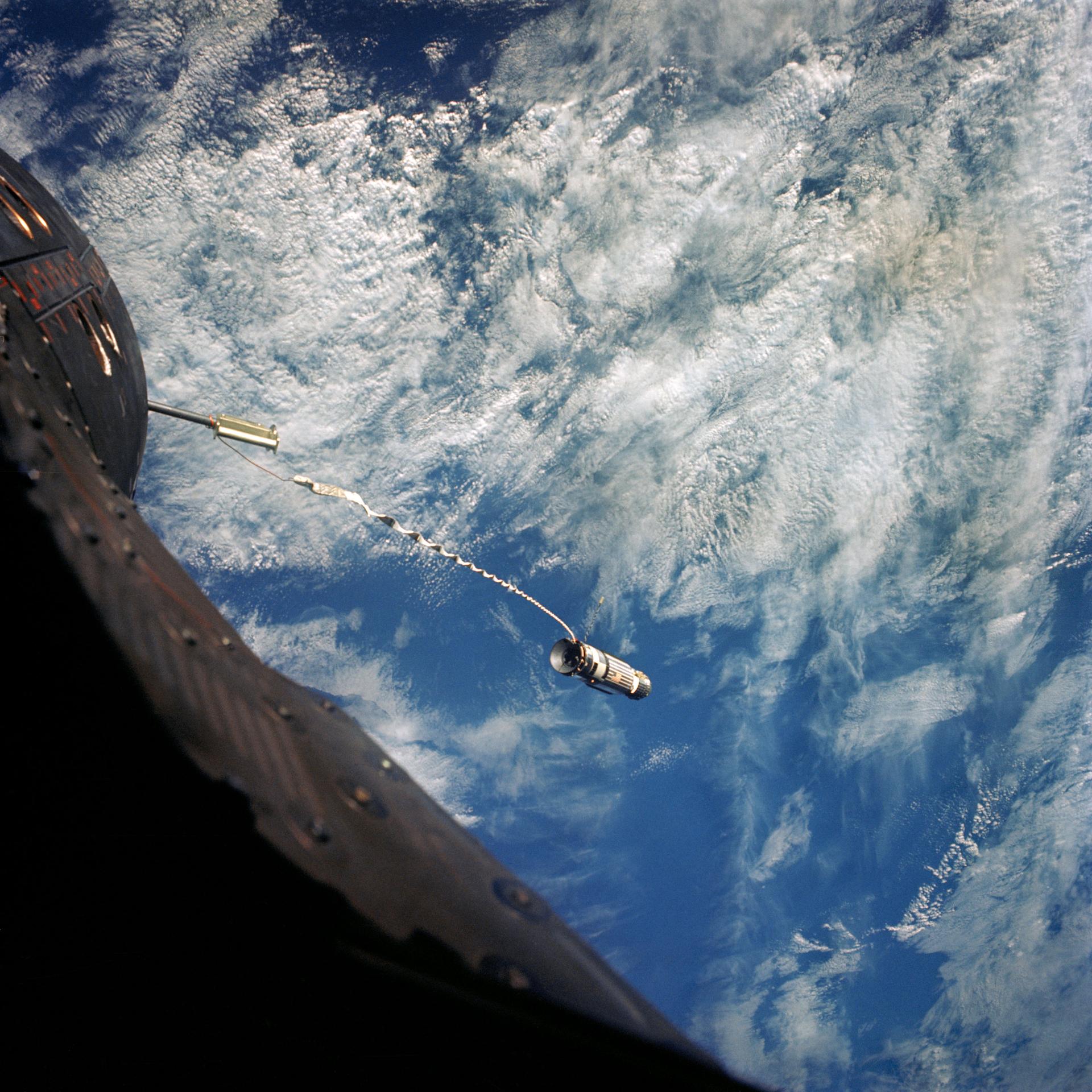
Despite the control problem, the crew obtained the gravity gradient they were after, although the two vehicles were disturbed on a few occasions and the spacecraft wobbled through some three hundred degrees. The cause of those disturbances, as the programme office admitted in its formal mission report, was not completely understood, nor was the behaviour of the system during and immediately after those excursions. The exercise lasted four hours and the tether was released at 7:37 p.m., which showed that controllers and crew alike had confidence enough to hold this form of relative station through night passes.
The fuel cell and the water
Around the time of the docking and undocking practice, the fuel cell had begun to hint that it might not last four days. Thirty hours passed before any real power loss was recorded. The specialists eventually concluded that there must be too much water in the tanks: every time the crew drank or prepared food, the fuel cell warning light went out.
The controllers never knew for certain what had happened to the two tanks of the water storage system, which held the crew's drinking water and - separated by a membrane - the water produced by the fuel cell. But one way or another the astronauts had lost the place to store somewhere between fifteen and eighteen kilograms of fuel-cell water. So if they wanted to complete the mission they had to drink more water to make room in the tanks and purge the system more often to clear the gases accumulating in the cell. Drinking hard and watching the red warning light, they nursed the cell for more than eighty hours. The flight was drawing to a close when the batteries had to take over the electrical load.
The third excursion
The third hatch opening - and the second standup period - came on the fourth day and lasted barely an hour. On 14 November the hatch opened at 9:52 a.m., at sixty-six hours and six minutes ground elapsed time. The pilot threw overboard much of the equipment he had used during the umbilical excursion, along with some empty food containers. The astronauts were not litterbugs: objects discarded on the flights, like anything else in low Earth orbit, eventually re-enter and burn up in the atmosphere. Aldrin then took several ultraviolet photographs of constellations. That done, he came back inside and closed the hatch at 10:47: the last extravehicular performance of the Gemini programme had ended, fifty-five minutes after it began. NASA's engineers, planners and astronauts now believed they knew a great deal more about the fundamentals of working in vacuum.
Added together, the three hatch openings gave five hours and thirty minutes of extravehicular activity.
Automatic re-entry and the loose pouch
Despite the problems with the radar, the Agena's main engine and the fuel cell, Gemini XII went very well. Nearly all mission objectives were met, and of fifteen experiments assigned to the flight, data were obtained on twelve. At several points a good deal of ingenuity was needed to get around the shortcomings of the equipment.
Compared with other flights, the achievements of Gemini XII tended to overshadow its technical problems, which on this final mission were more than its fair share. Some setbacks that forced revisions to the flight plan turned into triumphs: the radar failure during the terminal phase of the rendezvous, for example, underlined that the backup techniques based on charts and onboard computation really did work. The failure scarcely disturbed the routine. Other problems annoyed and frustrated the crew, and some had adverse effects on operations; but not even those managed to tarnish the impression of success.
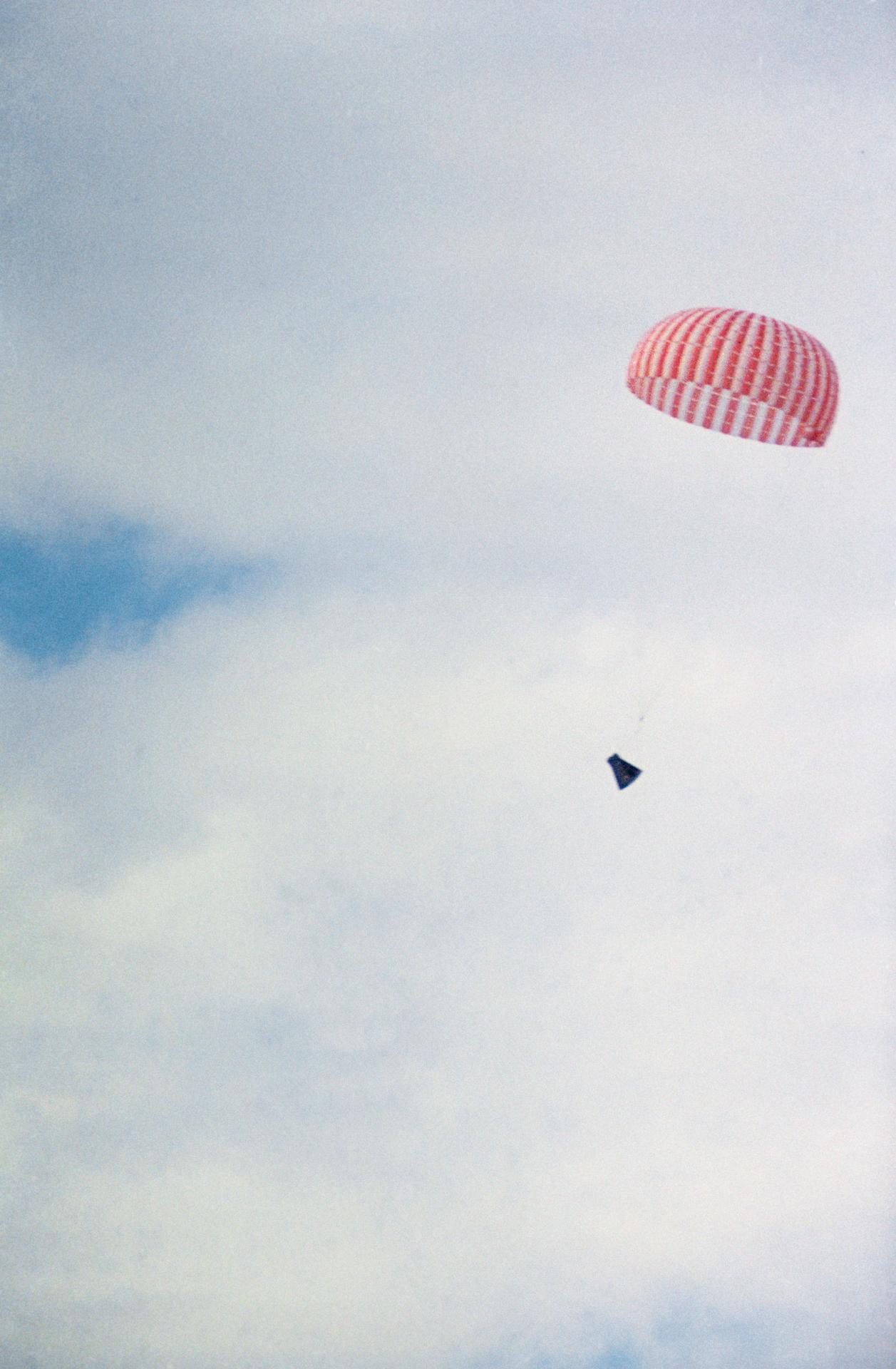
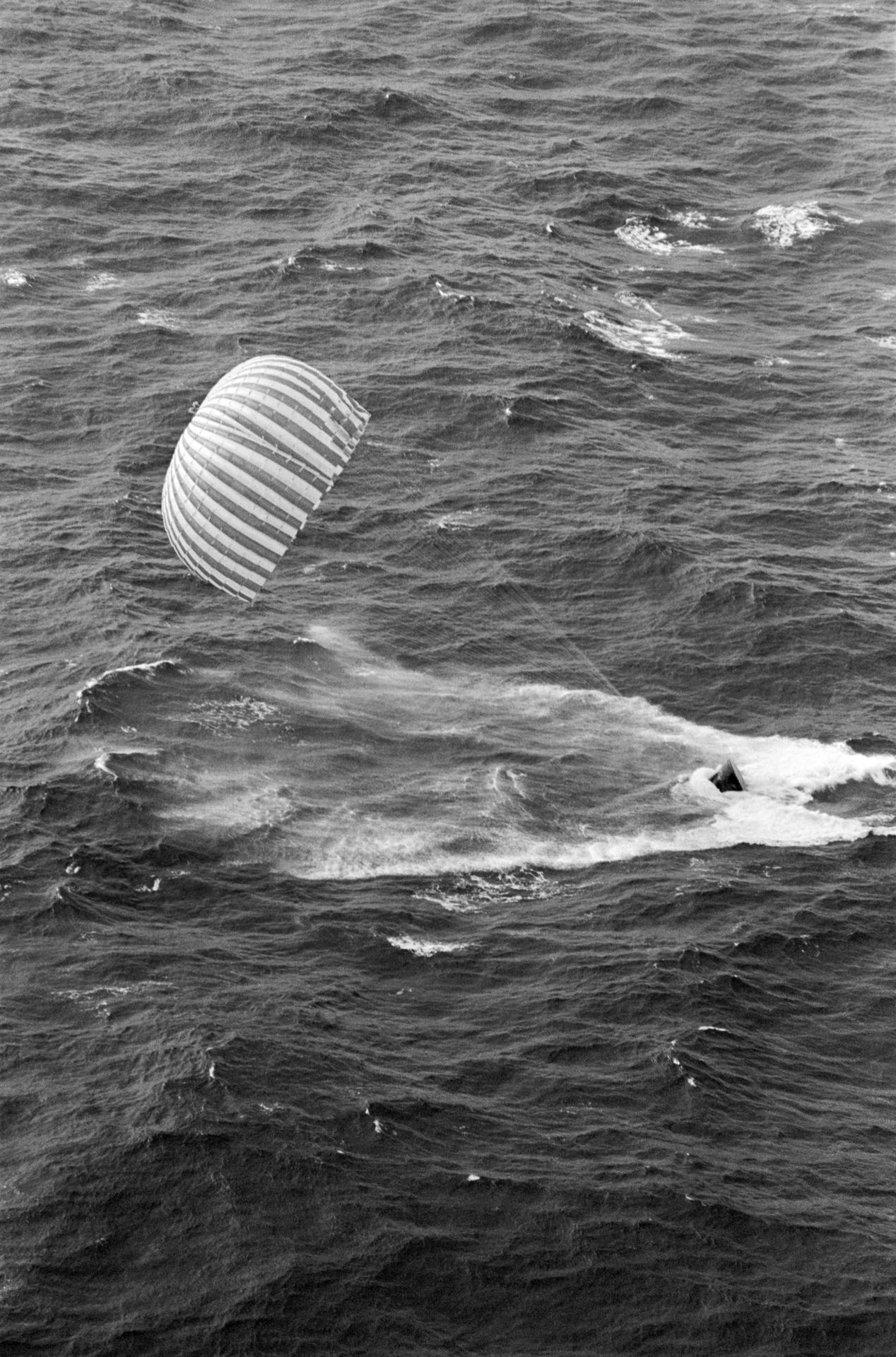
During revolution fifty-nine, Gemini XII began its automatically controlled re-entry. Retrofire occurred on 15 November at 1:46:31 p.m. EST. Everything worked cleanly until the spacecraft reached peak gravity load. At that instant a pouch of books, filters and small pieces of equipment came loose from the Velcro on the cabin sidewall and landed in Lovell's lap. The pilots had released the D-rings that activated the ejection seats and were holding them between their legs. Lovell suppressed the impulse to grab at the pouch for fear of seizing the ring and pulling it: had he done so, commander and pilot would have been fired out into the atmosphere on their ejection seats. As he put it, he had no wish at all to be popping out right in the middle of the heating region. Instead he squeezed his knees together and trusted that the pouch would go no further. It did not. The rest of the re-entry was smooth until the moment of contact, when the spacecraft hit the ocean hard.
The USS Wasp and the curtain
Splashdown came at 2:21:04 p.m. in the western Atlantic, at 24.58 degrees north and 69.95 degrees west, only 4.8 kilometres from the aim point and 5.5 kilometres from the carrier Wasp. A helicopter set the astronauts down on the deck of the prime recovery vessel twenty-eight minutes after contact with the water, at 2:49; the spacecraft was picked up at 3:28. The total elapsed mission time was ninety-four hours, thirty-four minutes and thirty-one seconds.
There, on 15 November 1966 at 2:21 p.m. EST, the curtain fell on the Gemini manned flight programme. The Gemini flag and pennant that had flown over the Manned Spacecraft Center during each of the missions since Gemini IV were lowered for the last time.
The postflight medical examination revealed nothing abnormal in either astronaut. Both were slightly fatigued and dehydrated because of the problems with the water supply system, which had forced them to reduce their fluid intake on the final day, and Lovell had a mild conjunctivitis. The mission was supported by 9,775 personnel, 65 aircraft and 12 ships of the United States Department of Defense.
The experiments
Gemini XII carried a set of scientific, medical and technological experiments. Those successfully performed were frog egg growth in zero gravity, synoptic terrain photography, synoptic weather photography, nuclear emulsions, airglow horizon photography, ultraviolet astronomical photography and dim sky photography. Two micrometeorite collection experiments and three space phenomena photography experiments were not fully completed.
-12_-_Agena_Target_Docking_Vehicle_on_tether.jpg)
The ultraviolet photography deserves a mention of its own because it was what occupied Aldrin on two of the three excursions: he mounted the camera, reloaded it in vacuum and reinstalled it, and on the third hatch opening he photographed constellations. It was an early demonstration of something that would be taken for granted decades later: that an astronaut can operate delicate scientific instruments outside the spacecraft if he has adequate restraints.
What Gemini XII left behind
The manned Gemini flights had begun in 1965. The programme had succeeded in bringing manned spaceflight to something like a routine basis, as envisaged in the project development plan of 1961. The achievement did not go unnoticed. President Lyndon B. Johnson declared that in that programme of the past twenty months two men had been placed in orbit around the Earth ten times in the world's most advanced spacecraft, and ten times brought home; that the flight of that day was the culmination of a great team effort reaching back to 1961 and directly involving more than 25,000 people in NASA, the Department of Defense and other government agencies, in universities and other research institutions and in American industry. He recalled that in early 1962 John Glenn had made his historic orbital flight and America had reached into space, and that almost five years later, with Gemini complete, it was known that America was in space to stay.
Being in space to stay rested, in part, on the shoulders of a team that now had experience in planning, developing, managing and operating a spaceflight programme that had gone far beyond the short flights and simple missions of Mercury. Gemini was only the second phase of American manned flight, but its importance should not be minimised: it had dispelled most of the doubts about the human capacity to endure weightlessness, to operate in free space outside the spacecraft and to seek out and locate another vehicle in orbital flight. Apollo, the third and most ambitious stage, waited in the wings, and the complexity of that programme dwarfed the scope of Gemini as Gemini had dwarfed Mercury. Only three years remained to meet the goal President John F. Kennedy had set of landing a man on the Moon and returning him safely to Earth before the decade was out.
.jpg)
Of the three obstacles Gemini had to clear for Apollo - human endurance over long stays, rendezvous and docking in orbit, and work outside the spacecraft - the third was the one that nearly went unresolved. Gemini XII resolved it, and did so without any new technology: with a swimming pool, forty-four restraints, a better-conceived task order and a dozen two-minute rests. It is probably the cheapest and most durable lesson the programme left behind.
A note on Apollo
When Gemini XII was being planned, there had been some consideration of flying it jointly with the first Apollo mission, which was tentatively scheduled for the last quarter of 1966. In May of that year, the delays in preparing Apollo alone, added to the extra time that making it compatible with the Gemini would have required, made the idea impracticable. The question was settled when the delay in the availability of the Apollo spacecraft caused the last quarter of 1966 target to be missed and the mission was rescheduled for 21 February 1967.
There was in addition a less visible but very real continuity between the two programmes. Christopher Kraft had directed the flight control team through the first rendezvous mission, as he had proposed, and then stepped back to apply the lessons learned to Apollo preparations. From the sixth Gemini flight onward, Apollo personnel followed mission operations far more closely, attending spacecraft systems and mission planning meetings, observing flight control and taking part in the debriefings and evaluations after each flight. And Bates's experiment as a full-time experiments officer in the main control room became standard practice in Apollo.
The capsule today
The Gemini XII spacecraft spent several years at the Museum of Transport and Technology in Auckland, New Zealand, before returning to the United States. It is displayed today at the Adler Planetarium in Chicago, Illinois. Lovell and Aldrin were reunited with it on 9 November 2006, during the opening of the Adler's "Shoot for the Moon" exhibition, almost forty years after the mission's launch.
Images
Elsewhere
- Smithsonian National Air and Space MuseumMirror, EVA, Wrist Mount, Gemini 12 ↗
- Smithsonian National Air and Space MuseumHatch Closing Device, Gemini 12 ↗
- Smithsonian National Air and Space MuseumPower Supply, Static, Gemini XII ↗
- Smithsonian National Air and Space MuseumPouch, S-11 Experiment, Gemini XII ↗
- Space.comSpace History Photo: Gemini 12 Splashdown ↗
- NASAAstronaut Edwin E. Aldrin Jr. photographed with pilot's hatch open ↗
- NASAAstronaut Edwin E. Aldrin Jr. stands up in the open hatch during EVA ↗
- Naval History and Heritage CommandGemini 12 and NASA ↗
- Google Arts & CultureGemini 12 Space Capsule ↗
- Google Arts & CultureRoundup - Gemini XII - Recovery ↗
- FlickrLovell and Aldrin on Deck ↗
- FlickrGemini End - Jim Lovell and Buzz Aldrin ↗