Belgium
Stampe et Vertongen
Stampe et Vertongen was a Belgian aircraft builder based at Deurne airfield outside Antwerp, founded by two veterans of the First World War's military aviation, Jean Stampe and Maurice Vertongen. It began as a flying school and became a factory almost at once: unable to locate a suitable trainer on the market, the partners commissioned one from a young engineer, Alfred Renard, and the RSV 32/90 of 1923, whose initials stand for the three men, opened a line of training biplanes that equipped the Belgian military air arm through the twenties. After Renard's departure the engineer Yuri Ivanov gave the firm its defining product, the SV-4 of 1933, a trainer and touring biplane that, redesigned in 1937 as the SV-4B for the aviatrix Elza Leysen, became one of Europe's most celebrated aerobatic trainers. The company was never large: only a few dozen SV-4s had left Deurne when the German invasion halted production in May 1940, and the bulk of the type's thousand-odd examples were later built under licence in France. The factory did not survive the war. With Vertongen unwilling to start over, Stampe teamed up again with Renard in 1947 as Stampe et Renard, which built the Belgian Air Force's SV-4Bs and the SR.7 Monitor monoplane before closing in 1970. The name outlived the company: in many countries the SV-4 is known simply as the Stampe, and since 1995 a museum devoted to the firm has stood at Antwerp airport surrounded by airworthy biplanes.
History
Two of the King's pilots
Jean Stampe was born at Molenbeek on 17 April 1889, the only child of a couple who kept a café in Ixelles. A mechanic by trade with a passion for motorcycles, he came to flying through the war: after qualifying as a civil pilot at Hendon near London and as a military one at Étampes in July 1916, he spent the whole conflict with the 6th Belgian observation squadron on BE-2Cs, RE-8s, Nieuports and Spads. Badly wounded in March 1918, he refused to be invalided out and returned to the front; in the closing months he several times carried King Albert I over the lines, and the king kept him as one of his personal pilots for four years after the armistice. It was at Hendon that Stampe met Maurice Vertongen, and in evening conversations at Étampes the two sketched a plan to open a flying school once peace returned. Stampe won the 1920 Belgian air circuit with Victor Boin as his crewman, and in 1922, aware that a volunteer without a staff college would never rise above lieutenant, he asked for an audience with the king to announce that he was leaving the army to start a school at Deurne.
Renard and the RSV biplanes
The Stampe & Vertongen company was formally constituted on 17 October 1923, its first business being the agency for the Bristol F.2B Fighter. With no trainer on the market that suited them, the partners were introduced to a young engineer, Alfred Renard, who drew a two-seat biplane of 90 hp: the RSV 32/90, whose letters stand for the three men's initials and whose numbers give the wing area of 32 square metres and the engine power. King Albert watched the first trials at Evere in May 1923 and insisted on flying in the machine on its third test; the military air arm ordered nineteen. Between 1923 and 1932 about fifty RSV 32s left Deurne in seven versions with a variety of engines. They were followed by the RSV 26/180, of which 35 were built after military orders in 1926 and 1929 for night and blind-flying training, and by a batch of twenty RSV 22/180 advanced aerobatic trainers ordered in 1928 to replace the Morane-Saulnier MS.35; that same year Edmond Thieffry and Philippe Quersin used one in a fresh attempt to fly to the Congo that ended in the marshes near Nîmes. Renard also entered the 1926 competition for a metal fighter with his Épervier monoplane, one of whose two prototypes was built in the Stampe & Vertongen shops and was lost in October 1928 when the test pilot had to bale out of a spin.
The Deurne school
The school was always the heart of the business. From 1930 it grew with the arrival of Nagaut, a former military aviator, and between 1923 and 1939 it trained 450 pupils, nearly 300 of them taught by Stampe himself. The manufacturing side fared less well. In 1928 Renard decided to strike out on his own, and the partners, deprived of their design talent, went to London to obtain from Geoffrey de Havilland the exclusive agency for his aircraft, which let them import more than thirty machines. The English Wikipedia places Renard's departure in the early 1930s, when he founded the Société Anonyme d'Avions et de Moteurs Renard with his brother Georges; whatever the date, the designations dropped the R and became simply SV.
Ivanov and the SV series
On the recommendation of Léon Stampe, Jean's son and a military pilot, the firm engaged a young engineer of Russian origin, Yuri Ivanov. Three projects were opened in 1932: the SV.1 and SV.2 touring aircraft, which never left the drawing board, and a trainer called the ST-26, a one-off name that betrays the confusion left by Renard's exit. After a stylistic exercise on a modified RSV 32 known as the SV.3, Ivanov took advantage of a new order for RSV 22s with the 215 hp Lynx engine to modernise the airframe and, borrowing several de Havilland solutions, produced the SV.4: compared with the RSV 32 of 1923 it shed eight square metres of wing and 80 kilograms while gaining 30 hp. Jean Stampe flew it for the first time on 17 May 1933 and Léon made the second flight. Five were built, six according to the English Wikipedia, and they served as demonstrators and trainers at the Antwerp and Brussels schools.
The SV.5 Tornado and the SV.10 disaster
In 1933 the military air arm called for a fully aerobatic two-seat biplane for fast liaison and training. Ivanov reworked the RSV 22 in under five months, and the resulting SV.5 Tornado was registered on 27 September 1933 and entered for the competition on 16 October. By contemporary accounts it outclassed every rival in the handling trials and was also the cheapest, yet the British Avro 645 was chosen. In 1934 the army dropped the Avro and, twelve months later, ordered twenty SV.5s; ten more were sold to Latvia. The triumph was short-lived. That same year the firm entered the programme for a three-seat twin-engined «aerial cruiser» with the SV.10, powered by two 780 hp Gnome-Rhône radials. Jean and Léon Stampe made the first two flights at Deurne; on the third, with Léon and Ivanov aboard, the aircraft spun in from low level. Both men were killed outright, and Stampe and Vertongen resolved to design no more aeroplanes.
Elza Leysen and the SV.4B
It took a woman to reopen the drawing office. In 1937, with the first international aerobatic contests under way, Elza Leysen, a pilot of the Antwerp Aviation Club who flew an SV.32, decided that Belgium should not stand aside and asked Stampe for an aerobatic SV.5. He flatly refused; she persisted for three months until she had rekindled his appetite for flying. Convinced that the SV.5 was no mount for her, Stampe sat down with his new engineer, Demidoff, compared the SV.4 with the Tiger Moth and reworked the aircraft about all three axes. The result was the SV.4 bis, SV.4B in everyday use, whose first example was registered OO-JAN in honour of Jan Olieslagers. The military, seeking a successor to the Avro 504N, took notice: at the evaluation contest of September 1937 Leysen's aircraft outclassed the field, but the order for thirty did not come until April 1939, after a long series of tests and changes on the prototype OO-ATC. On 9 July 1939 at the Brussels international meeting Lieutenant Philippart closed the show in that machine before more than 100,000 spectators. The first production SV.4B left the works in December 1939; on 17 November Farman had signed with Stampe a licence to build 400 for the Armée de l'Air and 200 for the French army's artillery spotting.
The war
The German invasion ended production on 10 May 1940. The completed aircraft were crated and on 5 June sailed from Caen for Morocco, where they were scattered among the Free French air forces; five went to the Force Publique of the Belgian Congo, and the French order for 600 aircraft was left hanging. SV.4B No. 4, OO-ATD, sold to the fighter pilot Thierry d'Huart, carried Mike Donnet and Léon Divoy on their escape to Britain on 5 July 1941. Jean Stampe took refuge in Paris as technical adviser to Farman and, with the engineer Louis Bonte, worked for the resistance, passing to the RAF the intelligence that allowed the destruction of the hangar where the Heinkel He 274 bomber was being assembled.
Stampe et Renard
Back in Belgium, Stampe found the Deurne works flattened by RAF bombing and by V1s and V2s. Maurice Vertongen had no wish to start again, and Stampe, holding a letter of intent from the Air Force for twenty SV.4Bs, turned to his old partner Alfred Renard, who still had his workshops at Evere: the Société Stampe et Renard was created on 17 February 1947. The aircraft, painted bright orange and coded V1 to V20, were built to an impeccable standard under the partners' close eye, and Stampe, despite his years, usually made the first flight and the delivery himself. On 4 March 1950 a further batch of 45 was ordered. In France, meanwhile, the state had entrusted SNCAN with building 700 SV.4Cs at Sartrouville; the first came off the line on 4 June 1945 and Stampe flew it himself on its third flight, and in all 856 Stampes re-equipped the French training centres. The English Wikipedia states that the company was renamed Stampe et Renard on merging with Renard's firm and that it closed in 1957; the Vieilles Tiges biography of Stampe puts the merger in 1947 and the closure in 1970.
Twilight: the SR.7 and the closure
In the mid-sixties the Air Force studied a replacement for its SV.4Bs, and Stampe, now past seventy, put two proposals to the staff together with Renard. The SV.4D was a modernisation kit fitted to the company's own aircraft, OO-SRS, in two versions, with a 165 hp Continental or with a 210 hp engine for competition aerobatics; despite the price, the staff showed no interest. The other route was the family of SR.7 Monitor IV monoplanes, which had won several international aerobatic competitions and on which Biancotto had set an inverted-flight endurance record in 1957. The Marchetti SF-260 won instead. Renard still studied the SR.10, a lightened single-seater of 280 hp, and the SR.11, a biplane with the same engine, which was never built because the company closed. Stampe et Renard ceased trading in January 1970 by mutual agreement. Jean Stampe made his last two flights on 5 May 1970 at the age of 81 and died in Brussels on 15 January 1978.
Legacy and the Antwerp museum
The movement that keeps his aircraft flying was already born before his death. In France Réginald Jouhaud founded the first Club Stampe in 1974 and drew 47 crews, 17 of them in SV.4s, to its first gathering. In Belgium Danny Cabooter restored his own OO-GWB, recovered the wreck of SV.4C No. 478 in England in 1987 and turned it into OO-GWA, and in 1991 bought in the United States No. 1 of the French series, which flies again at Deurne in its 1945 livery. A group of Antwerp owners, backed by Karel Bos and the Flemish Region, built a museum honouring the three great Flemish pioneers, Elza Leysen, Jan Olieslagers and Jean Stampe. Founded in 1995 and run by volunteers, the Stampe & Vertongen museum lives at Antwerp airport, whose 1930 terminal building is still in use; it shows replicas of Great War aircraft, a T-6 Texan, a Fouga Magister from the Diables Rouges and a V-1, and from its «workshop» visitors look into the hangar where a private fleet of SV-4s still gives pleasure flights. Deurne, birthplace of the Stampes, is their home once more.
Catalog — Aircraft
- —
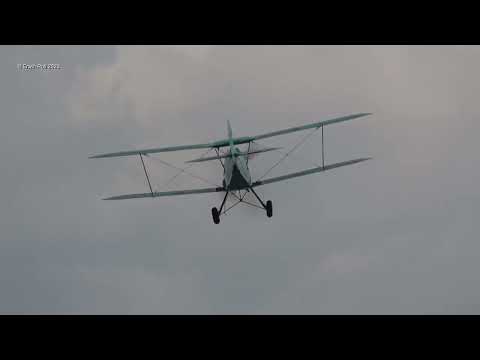
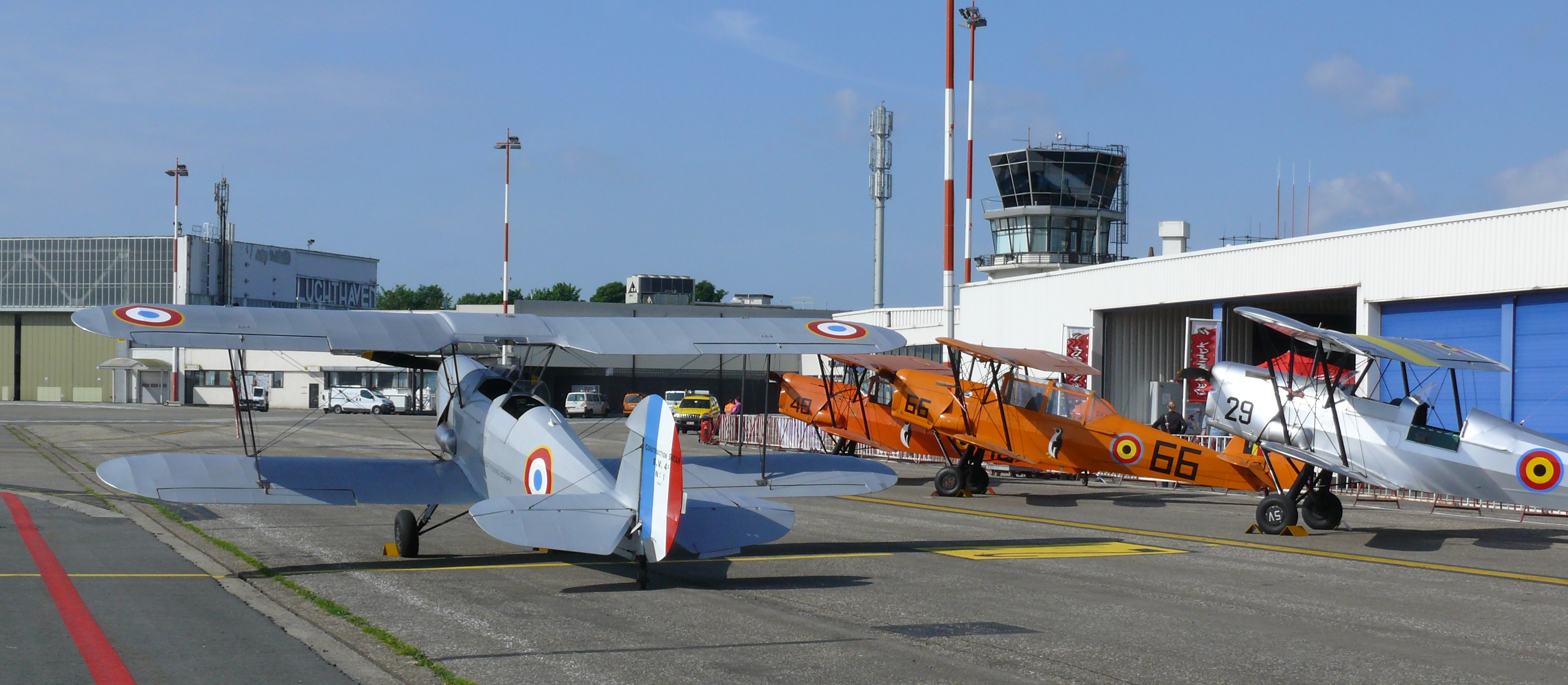
Stampe SV-4
The Stampe SV-4 is a two-seat biplane trainer and touring aircraft designed at Antwerp by the Belgian firm Stampe et Vertongen. First flown on 17 May 1933 with Jean Stampe at the controls, it reached its definitive form in 1937 as the SV-4B, an aerobatic trainer with swept wings, ailerons on all four planes and a de Havilland Gipsy Major engine. It was a thoroughly conventional aeroplane of wood and fabric, yet its balanced handling and its willingness to fly inverted made it one of the most admired training biplanes in Europe. Only a few dozen had been completed in Belgium when the Second World War stopped production, but a French order placed in 1939 and a licence granted to Farman set the stage for the type's real career. After the liberation the French state chose the Renault-powered SV-4C as its standard basic trainer for military and civil schools: SNCAN at Sartrouville and the Atelier Industriel de l'Aéronautique at Algiers turned out roughly 850 between 1946 and 1950, while the reconstituted Stampe et Renard company delivered 65 SV-4Bs to the Belgian Air Force. Depending on the source, total production is given as somewhere between 940 and 1050 aircraft. The Stampe trained French military and civilian pilots into the sixties, mounted the Patrouille d'Étampes and carried the aerobatic champions of Saint-Yan, and served the Belgian Air Force until 1975. Sold off cheaply to flying clubs, it became the archetypal vintage biplane of French-speaking Europe: it still gathers in numbers at annual meetings, has appeared in several films, and forms the heart of the museum named after its builders at Antwerp-Deurne airport.