Sweden · 1937–
Saab
Saab AB is Sweden's aerospace and defence group: its registered office is in Stockholm, while aircraft development and manufacturing are concentrated in Linköping. Its original name, Svenska Aeroplan Aktiebolaget, described what the firm was for decades — a military aircraft house — and today its catalogue reaches from fighters and radars to airborne early warning systems, infantry weapons, missiles and submarines. The company was created in 1937 at the initiative of AB Bofors, which turned the aero-engine division of NOHAB in Trollhättan into a proper aircraft manufacturer; in 1940 it absorbed its rival ASJA of Linköping, whose design bureau is the real technical ancestor of today's Saab. Sweden's inability to buy modern fighters abroad as the Second World War began made domestic design a matter of state policy, and that policy has never been abandoned. Outside Sweden, Saab is known for an unbroken line of combat jets — Tunnan, Lansen, Draken, Viggen and the JAS 39 Gripen — and for the Erieye and GlobalEye airborne surveillance systems. It also built cars and lorries: the car division was spun off as Saab Automobile in 1990, and the merger with Scania-Vabis, in force since 1968, was undone in 1995. Its last civil aircraft were the Saab 340 and Saab 2000 regional turboprops.
Saab in the news
_(7181173713).jpg)
Saab has presented the first GlobalEye airborne early warning and control (AEW&C) aircraft for the Swedish Air Force. The aircraft will now undergo testing and verification before its maiden flight…
%2C_Tus_Airways%2C_Rhodes.jpg)
Saab is evaluating the possibility of establishing a GlobalEye production line in Canada, expanding the program's industrial capacity and strengthening Canadian participation in…
.jpg)
First GlobalEye for Sweden's Air Force unveiled, to replace Saab 340 AEW jets transferred to Ukraine
Yesterday, 15 October, Saab presented the first GlobalEye airborne early warning and control (AEW&C) aircraft intended to equip the Swedish Air Force…

Elbit Systems Sweden announced on October 14, 2026 that it plans to establish in Sweden the first European center of Elbit Systems dedicated to the production and maintenance of warning…
Saab has presented the first GlobalEye airborne early warning and control (AEW&C) aircraft ordered for the Swedish Air Force.
_(7181173713)-1600.webp)
%2C_Tus_Airways%2C_Rhodes-800.webp)
-1600.webp)


History
Two candidates for the same monopoly
Saab was born out of an industrial fight. AB Bofors, already working with the Swedish Air Force on aircraft weaponry, had bought the NOHAB aero-engine works in Trollhättan in 1935 and reshaped it in 1937 into an aircraft manufacturer, openly aiming to capture future military orders. The trouble was that another firm already held that ground: ASJA, set up in 1931 in Linköping as the aeroplane department of the Swedish railway workshops and successor to Svenska Aero, whose chief designer Sven Blomberg — author of the Jaktfalken fighter — had joined it in 1930. In 1932 ASJA also bought Svenska Aero outright, design portfolio included, becoming the country's leading aircraft builder.
The deal struck in 1937 created a joint parent company, AB Förenade Flygverkstäder, which never worked: both plants went on competing for the same contracts. Trollhättan won a few, such as licence production of the Junkers Ju 86 bomber in 1938, but ASJA took most of them — licences for the Hawker Hart and the Northrop Model 8, and above all the competitions that produced the Saab 17 and the Saab 18. In March 1939 the consortium was scrapped and ASJA was reconstituted as the SAAB group: Trollhättan became SAAB/T, and Linköping, with the design bureau, became SAAB/L and headquarters.
Domestic design as state policy
The war settled the matter. Sweden was trying to buy modern combat aircraft abroad and not receiving them — most notoriously a batch of Seversky P-35 fighters that the United States never delivered — so the government resolved to design and build its military aeroplanes at home. The group's first own design was the Saab 17 light dive bomber, first flown on 18 May 1940, followed by the Saab 18 fast bomber in 1942 and the single-seat Saab 21 fighter in 1943, the latter the first aircraft in service with a modern ejection seat, fired by gunpowder rather than the compressed air used by its German contemporaries.
Cars, lorries and computers
With the war over, the company looked for civilian markets. Europe had no cars — American factories had been building tanks, and afterwards the US market absorbed their whole output — so Saab opened a car division in Trollhättan whose first model, the Saab 92, derived from the Ursaab prototype, entered full-scale production on 12 December 1949; around 1950 the brand stopped being written in capitals. The late fifties brought Datasaab, born of the need for a computer small enough to fly as navigation equipment: it yielded the CK 37 flight computer fitted to the Viggen in 1971, while the commercial computing business was sold to Sperry UNIVAC in 1975. In May 1965 the firm renamed itself Saab AB to reflect that spread of activities, and in 1968 it merged with the lorry and bus maker Scania-Vabis to form Saab-Scania.
Untangling, Gripen and the present day
The industrial knot was undone in two stages. General Motors bought 51 % of Saab Automobile in 1990 and the remainder a decade later; Investor AB took over the whole of Saab-Scania in 1991 through a leveraged buyout and split it in 1995 into two independent companies, Scania AB and Saab AB, since the original rationale for the merger had gone. That same year Saab and British Aerospace formed a joint venture to build, market and support the Gripen internationally, widened in 2001 with Gripen International; the British partner was Saab's largest shareholder from 1998, cut its holding to 20 % in 2005, sold half of that stake to Investor AB in 2010 and left the register in June 2011. In 2010 the company was reorganised from fifteen business units into five broad areas, and its work today spans aeronautics, missiles and infantry weapons, surveillance and electronic warfare, support services and the submarines of Saab Kockums. In May 2019 it announced a plant of its own next to Purdue University in the United States for final assembly of the T-7 Red Hawk advanced trainer developed with Boeing.
.jpg)
Catalog — Aircraft
- 1940
Saab 17 Sheet pending
Variants (6)
- B 17A
- B 17B
- B 17C
- L 10
- S 17BL
- S 17BS
- 1942
Saab 18 Sheet pending
Variants (7)
- B 18A
- B 18A Dubbelkommando
- B 18B
- B 18B Dubbelkommando
- S 18A
- Saab 18 (prototype)
- T 18B
- 1943
SAAB 21 Sheet pending
Variants (3)
- J 21A-1
- J 21A-2
- J 21A-3 (A 21A)
- 1945
Saab 91 Safir Sheet pending
Variants (6)
- 91A
- 91B
- 91B-2
- 91B-D
- 91C
- 91D
- 1946
Saab 90 Scandia Sheet pending
Variants (1)
- Saab 90A
- 1947
Saab 21R Sheet pending
Variants (4)
- A 21RA
- A 21RB
- J 21RA
- J 21RB
- 1948
Saab 29 Tunnan Sheet pending
Variants (11)
- A 29B
- A 29E
- A 29F
- J 29A1
- J 29A2
- J 29B
- J 29D
- J 29E
- J 29F
- J 29 (prototype)
- S 29C
- 1952
Saab 210 Sheet pending
- 1952
Saab 32 Lansen Sheet pending
Variants (5)
- A 32A
- J 32B
- J 32D
- J 32E
- S 32C
- 1955
Saab 35 Draken Sheet pending
Variants (11)
- J 35A
- J 35B
- J 35D
- J 35F
- J 35J
- S 35E
- Saab 35H
- Saab 35Ö
- Saab 35XD
- Saab 35XS
- SK 35C
- 1963
Saab 105 Sheet pending
Variants (10)
- Saab 105G
- Saab 105Ö
- Saab 105 (prototype)
- Saab 105XT
- SK 60A
- SK 60B
- SK 60C
- SK 60D
- SK 60E
- SK 60W
- 1967
Saab 37 Viggen Sheet pending
Variants (17)
- AJ 37
- AJ37
- AJS 37
- AJSF 37
- AJSH 37
- JA 37
- JA37
- JA 37C
- JA 37D
- JA 37DI
- SF 37
- SF37
- SH 37
- SH37
- SK 37
- SK37
- SK 37E
- 1971
Saab Safari Sheet pending
Variants (3)
- MFI-15 Safari
- MFI-17 Supporter
- Saab Safari TS
- 1983
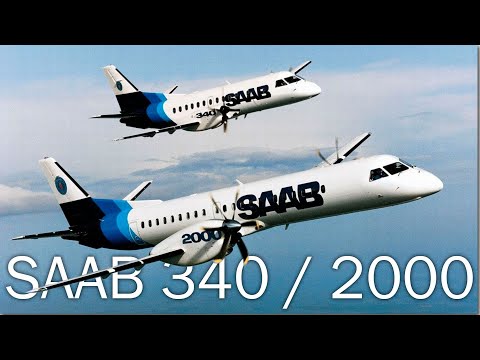
Saab 340
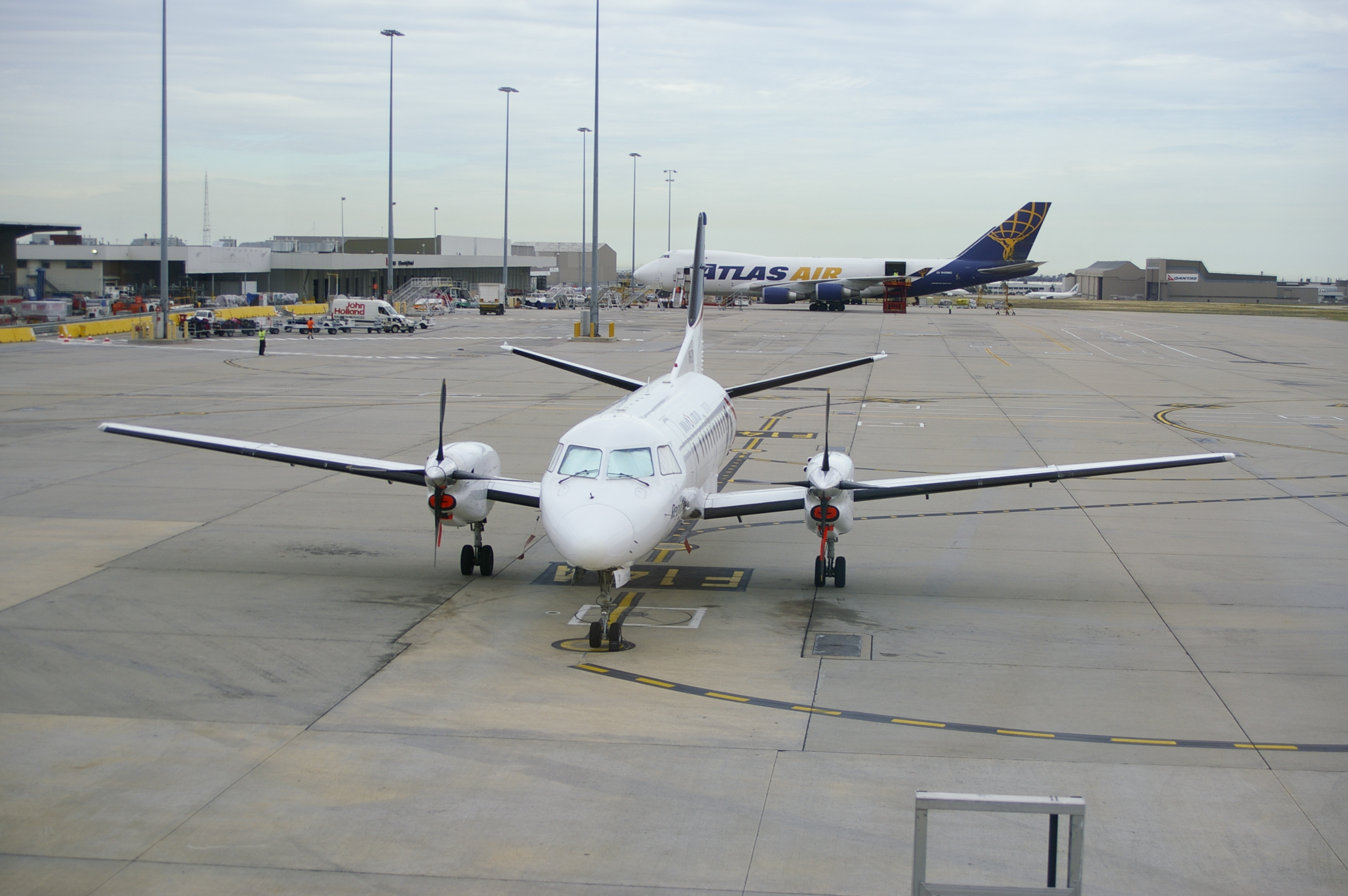
The Saab 340 is a Swedish regional airliner: a pressurised twin-engine turboprop laid out for 30 to 36 passengers, developed by Saab AB together with the American manufacturer Fairchild. It was the first major civil aeroplane of a company whose identity had been built almost entirely on military aircraft, and it made its maiden flight from Linköping on 25 January 1983. Its arrival on the market in 1984 met the regional feeder business that the 1978 Airline Deregulation Act had opened up in the United States, and shortly after launch the type became the best-selling commuter aircraft in the world. The programme ran through three generations: the original 340A with General Electric CT7-5A2 engines, of which 159 were built; the 340B of 1989, with more powerful CT7-9B engines, of which 200 were built; and the 340B Plus delivered from 1994, adding active noise control and extended wingtips over a further 100 airframes. Crossair was the launch customer in June 1984, and American Eagle, which ordered 50 aircraft in 1989, the largest United States buyer. Competition from regional jets and the collapse in turboprop demand led Saab to announce the end of production on 24 December 1997; the last 340 was delivered on 8 June 1999 after 459 aircraft, and by 2005 the company had left civil aviation altogether. The type nonetheless enjoyed a long second life as a freighter, a leasing asset and a mission platform: around 250 remained in service as of 2023, and the airframe carries the Erieye airborne early warning system as the Swedish S 100B Argus, as well as maritime surveillance fits.
- 1988
Saab JAS 39 Gripen Sheet pending
Variants (7)
- Gripen NG
- JAS 39A (Gripen A)
- JAS 39B (Gripen B)
- JAS 39C (Gripen C)
- JAS 39D (Gripen D)
- JAS 39E (Gripen E)
- JAS 39F (Gripen F)
- 1992
Saab 2000
The Saab 2000 is a twin-engined, low-wing, pressurised regional turboprop built at Linköping in Sweden and conceived in the late 1980s as the next size up from the successful Saab 340. Saab committed to the design in December 1988 and launched the programme in May 1989 with 46 firm orders and options on a further 147 aircraft. The guiding idea was straightforward and ambitious: give regional carriers a fifty-seat aeroplane able to string together short and medium sectors with block times close to those of a jet, while keeping the fuel burn and operating economics of a propeller. Final assembly was Swedish, but the industrial share-out was European, with CASA building the wings, Short Brothers the rear fuselage and Valmet the tail surfaces. It was far more than a stretched 340. The aircraft kept its predecessor's fuselage cross-section, and with it the two-plus-three cabin layout, but added 7.55 metres of length and introduced an entirely new wing whose span grew from 21.44 to 24.76 metres. Allison AE 2100A engines, in what remained their only civil application, drove six-blade composite Dowty propellers turning unusually slowly to keep the noise down, and brought the first dual FADEC on a turboprop, governing engine and propeller from a single lever. The type cruised as high as 9,450 metres (31,000 feet), altitudes previously reserved for regional jets, reached 685 km/h, and offered a Collins Pro Line 4 glass cockpit alongside an active noise-cancellation system of 72 microphones and 36 loudspeakers that was genuinely unusual for its day. The prototype first flew on 26 March 1992, but an interaction between the propeller slipstream and the mechanical elevator control system delayed certification by almost two years, until March 1994. Its airline career was short and lopsided. The type entered service in 1994 with Switzerland's Crossair, which nicknamed it the "Concordino" and eventually operated thirty-four examples, more than half of all production. The trouble was not the aeroplane but the market: while it was being built, regional carriers switched to the fifty-seat jets of Bombardier and Embraer, which passengers preferred, and the Saab's speed advantage over rival turboprops stopped being the decisive argument. Too expensive to undercut conventional turboprops and carrying the wrong badge to fight jets on image, Saab closed the line in 1999 after 63 aircraft, against the more than four hundred and fifty Saab 340s of the previous decade. The interesting part came afterwards. With low residual values, the type found on the used market the niche it had never won new: thin routes, short runways and mountainous terrain, from Loganair's Shetland services to PenAir's Aleutian network, by way of Darwin Airline, Eastern Airways, Carpatair and Braathens Regional. Its safety record is unremarkable in the best sense, with four hull losses and a single fatality, in the 2019 runway overrun at Unalaska in Alaska, where the NTSB traced the accident to mis-wired anti-skid transducer harnesses and issued recommendations reaching well beyond this one design. In parallel, Saab gave the airframe a military second life: the Saab 2000 Erieye AEW&C, carrying the PS-890 electronically scanned radar in a dorsal fairing, with more than nine hours of endurance and a surveillance area of over 500,000 km², serves with Pakistan and Saudi Arabia, and spawned a whole surveillance family covering signals intelligence, maritime patrol and flight inspection before the product line moved to newer platforms. A third life arrived through the cargo door. Sweden's Täby Air Maintenance developed the Saab 2000F freighter, offering 55.4 m³ of hold volume and a maximum payload of 6,622 kg; the first converted aircraft flew in March 2023, and the supplemental type certificate was approved in Europe in December 2025 and in the United States in 2026, more than thirty years after the prototype's maiden flight. That trajectory sums up the aeroplane's place in regional aviation history: commercially ill-timed and technically excellent, its very strengths — speed, range, ample power and short-field capability — were not enough to sell airliners, yet they are exactly what a surveillance platform or an overnight express freighter is looking for.






![Sweden's First Modern Aircraft | SAAB 17 [Aircraft Overview #25]](https://i.ytimg.com/vi/XwA1NIG8Vio/hqdefault.jpg)