Brazil · 1969–
Embraer
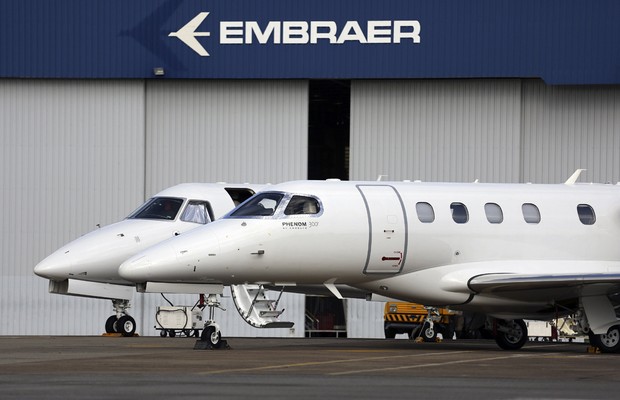
Embraer S.A. is a Brazilian multinational aerospace corporation that develops and manufactures aircraft and aviation systems, and also provides leasing, equipment and technical support services. It is the world's third largest producer of civil aircraft after Boeing and Airbus, and holds a significant position in military aviation that ranks it among the world's top 100 defence contractors. It is headquartered in São José dos Campos, in the state of São Paulo, with offices and operations in China, the Netherlands, Portugal, Singapore and the United States. Founded on 19 August 1969 by Ozires Silva and funded by the Brazilian government, which promoted it as a national champion for domestic aerospace technology, it began by supplying military aircraft to the Brazilian Air Force. In the 1980s it turned towards a series of commuter and regional airliners aimed at export. It was privatised in 1994 and went public in 2000 with simultaneous listings in New York and Brazil. Today the company is organised into commercial, executive, military and agricultural aviation divisions, and also runs an incubator for aerospace technologies and businesses. It is best known for the single-aisle ERJ and E-Jet airliner families and for its business jet line, led by the Phenom 300. It employed 18,997 people in 2024 and reported revenue of US$5.27 billion in 2023. As of May 2024 it had delivered more than 9,000 aircraft, of which 1,800 were E-Jets.
Embraer in the news

FlightSafety will design and build an Embraer E190-E2 Level D simulator for Azul Brazilian Airlines' training center in Campinas, Brazil. Continue reading Read more at HANGAR X
.jpg)
American Airlines announces new route between Miami and Barcelona, Venezuela, with three weekly flights operated by an Embraer 175 starting in January
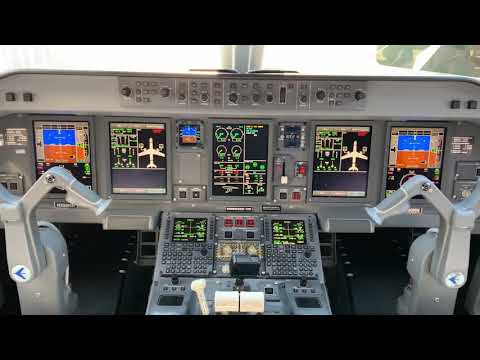
The route will begin on January 15, 2027, with three weekly frequencies on Embraer 175s. With it, the US airline will add 24 weekly flights to the country.
.jpg)
The route will begin on January 15, 2027, with three weekly frequencies on Embraer 175s. With it, the US airline will add 24 weekly flights to the country.

KLM Cityhopper received the Innovation Airline Award 2026, presented by the European Regions Airline Association (ERAA), during a ceremony held on 8 October in Belfast, Ireland…

-1600.webp)

-1600.webp)

History
Founded as a state company
The Brazilian government had spent decades trying to build a domestic aircraft industry, but it was not until 1969, under the military dictatorship established after the 1964 coup, that Empresa Brasileira de Aeronáutica — shortened by syllabic abbreviation to Embraer — was created as a government-owned corporation. Its first president, Ozires Silva, was a government appointee. It settled in São José dos Campos, home since 1950 to the Technological Institute of Aeronautics.
Early products and growth
The government fed the start-up with production contracts, and until 1975 the company sold solely to the domestic market. Through the 1970s and early 1980s military products dominated — the AT-26 Xavante and the EMB 312 Tucano — but the house had already debuted the regional EMB 110 Bandeirante turboprop, which first flew in 1968, and launched the EMB 120 Brasilia in 1985. That export-oriented EMB family opened the run of regional airliners that would define the company. From 1974 it also built light aircraft under licence from the United States' Piper: nearly 2,500 of them between 1974 and 2000. In 1987 it acquired Aerotec, a firm founded in 1962 that was already supplying it with components.
Privatisation and public listing
Embraer began its privatisation in 1992, part of the liberalising policy of Fernando Collor's government. It was sold to private investors on 7 December 1994, a move that spared it a looming bankruptcy; the state kept golden shares carrying veto power. In 2000 it made simultaneous initial public offerings on the New York and Brazilian stock exchanges.
Regional jets, business jets and defence
In the mid-1990s it refocused its catalogue on 70- to 110-seat regional jets and business jets. At Farnborough it unveiled the Legacy 600 in 2000, in service from 2002; in 2005 it created Embraer Executive Jets, and in 2008 introduced the Phenom 100, the basis of the later Phenom 300. In 2016 it delivered its 1,000th executive jet with a 17 percent market share by volume, and in October 2018 announced the Praetor 500 and 600. In defence it developed the C-390 Millennium, a twin-jet transport able to carry up to 23 tons, which has become an export success. In March 2026 it rolled out the first Gripen produced in Brazil, the fruit of technology transfer agreements signed with Sweden in 2014.
The failed Boeing deal
In July 2018 a joint venture was announced under which Boeing would have taken 80 percent of Embraer's commercial aviation division, leaving the business jets and defence activity in Brazilian hands. Boeing cancelled the acquisition in April 2020, hit by the aviation crisis of the COVID-19 pandemic and by the 737 MAX groundings.
Catalog — Aircraft
- 1968
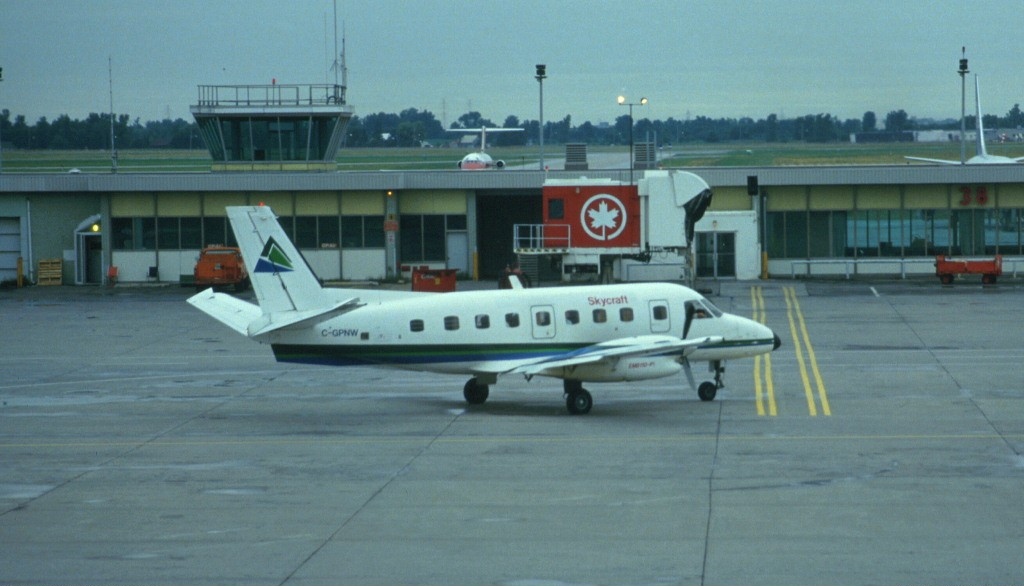
Embraer EMB 110 Bandeirante
The Embraer EMB 110 Bandeirante is a Brazilian twin-turboprop light transport aircraft designed for both civil and military use. Its name recalls the bandeirantes, the Portuguese settlers who pushed ever deeper into the interior of what is now Brazil during the sixteenth and seventeenth centuries. It was designed by the French engineer Max Holste to the specification issued under the IPD-6504 programme by the Brazilian Ministry of Aeronautics in 1965, which called for a reliable general-purpose aircraft with low operating costs, matched to the country's existing airport infrastructure. The YC-95 prototype flew on 26 October 1968 with José Mariotto Ferreira at the controls and flight engineer Michel Cury on board, landing after roughly fifty minutes. Its promising performance led to production being approved in mid-1969 and to the founding of Embraer, which took over manufacture on 2 January 1970. The original eight-seat layout was redesigned as the EMB 110 with greater capacity; certified in late 1972, it entered service on 16 April 1973 with the Brazilian airline Transbrasil. In a typical configuration it carries between 15 and 21 passengers and a crew of two, and lends itself to many adaptations: aerial observation, maritime patrol, search and rescue, air ambulance, radio-navigation calibration and geophysical survey. Production ran for twenty-two years and ended in 1990, when Embraer concentrated its resources on the larger, pressurised EMB 120 Brasilia.
- 1970
Embraer EMB 202 Ipanema Sheet pending
Variants (8)
- EMB-200
- EMB-200A
- EMB-201
- EMB-201A
- EMB-201R
- EMB-202
- EMB-202A
- EMB-203
- 1976
Embraer EMB 121 Xingu Sheet pending
Variants (5)
- EC-9
- EMB 121A1 Xingu II
- EMB 121A Xingu I
- EMB 121B Xingu III
- VU-9
- 1980
Embraer EMB 312 Tucano Sheet pending
Variants (8)
- EMB-312A
- EMB-312F
- EMB-312G1
- EMB-312H
- EMB-312S
- Tucano AT-27
- Tucano T-27
- Tucano YT-27
- 1983
Embraer EMB 120 Brasilia Sheet pending
Variants (6)
- EMB 120
- EMB 120ER
- EMB 120FC
- EMB 120QC
- EMB 120RT
- VC-97
- 1990
Embraer/FMA CBA 123 Vector Sheet pending
- 1995
Embraer ERJ family Sheet pending
Variants (16)
- B.LL.2
- C-99A
- EMB 145H
- EMB 145SM
- ERJ 135ER
- ERJ 135LR
- ERJ 140ER
- ERJ 140LR
- ERJ 145EP
- ERJ 145ER
- ERJ 145EU
- ERJ 145LI
- ERJ 145LR
- ERJ 145LU
- ERJ 145MP
- ERJ 145XR
- 1999
Embraer EMB 314 Super Tucano Sheet pending
- 2001
Embraer Legacy 600 Sheet pending
Variants (2)
- Legacy 600
- Legacy 650
- 2002
Embraer E-Jet family Sheet pending
Variants (6)
- E170
- E175
- E190
- E190F
- E195
- VC-2
- 2007
Embraer Phenom 100 Sheet pending
Variants (6)
- Phenom 100
- Phenom 100E
- Phenom 100EV
- Phenom 100EX
- Phenom T1
- U-100
- 2007
Embraer Lineage 1000 Sheet pending
Variants (2)
- Lineage 1000
- Sea Sultan
- 2012
Embraer Legacy 450/500 and Praetor 500/600 Sheet pending
Variants (4)
- EMB-545 Legacy 450
- EMB-550 Legacy 500
- Praetor 500
- Praetor 600
- 2015
Embraer C-390 Millennium Sheet pending
Variants (3)
- C-390
- C-390 IVR
- KC-390
- 2016
Embraer E-Jet E2 family Sheet pending
Variants (3)
- E175-E2
- E190-E2
- E195-E2
- —
Embraer R-99 Sheet pending
Variants (3)
- EMB 145 MP
- R-99A (E-99)
- R-99B
- —
Embraer Phenom 300 Sheet pending
Variants (3)
- Phenom 300
- Phenom 300E
- Phenom 300MED