Airshows
Duxford Battle of Britain Air Show 2025
September 6, 2025 – September 7, 2025Held
Fifteen airworthy Spitfires and eight Hurricanes gathered on a single airfield: that was the headline figure of the 2025 Duxford Battle of Britain Air Show, held on 6 and 7 September at IWM Duxford to mark the 85th anniversary of the Battle of Britain. Among them flew several combat veterans, such as the Spitfire that crash-landed on the beach at Dunkirk, recovered from the sand, restored and known for its appearance in the 2017 film "Dunkirk".
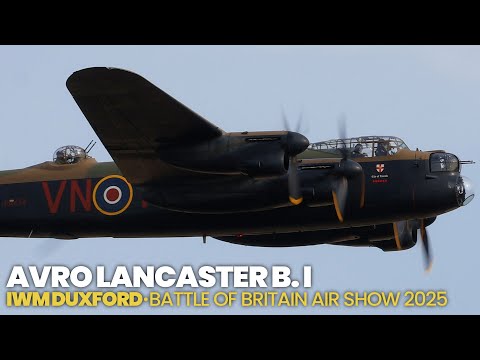
The show moved forward to the first weekend of September, whereas previous editions had taken place later in the month. The line-up exceeded fifty aircraft and mixed the current with the historic: the Royal Air Force Typhoon shared the programme with the Battle of Britain Memorial Flight Lancaster, several marks of Spitfire and Hurricane, Mustangs and a B-17G Flying Fortress. As is the custom at Duxford, the closing act was the Duxford Big Wing, the mass formation of Spitfires and Hurricanes that recalls the tactic rehearsed from this very airfield in 1940. The flying took place on Saturday and Sunday afternoons; in the morning visitors toured the museum hangars, from the Vulcan to the TSR-2, and an apron covered with trade, catering and aviation society stalls.
This edition's line-up
Flying display


History
History of the show, shared by all its editions.
An airfield that was in the battle
The Duxford that hosts this show was not picked for convenience: it is the airfield where part of what the show commemorates actually happened. The site was chosen in 1917 as a Royal Flying Corps training aerodrome and became a fighter station in 1925. In August 1938 the third production Spitfire, K9789, was handed over there to No. 19 Squadron RAF, the first unit to receive the Supermarine fighter — which is why the Spitfire's silhouette sits so close to Duxford's name.
By July 1940 Duxford was a sector station of Fighter Command's No. 12 Group. That same month No. 310 (Czechoslovak) Squadron arrived with Hurricanes, manned by pilots who had escaped from France; No. 302 (Polish) Squadron and No. 611 Auxiliary Squadron followed. From this field Douglas Bader, commanding No. 242 Squadron, developed the «Big Wing» tactic: putting three, and later five, squadrons of Spitfires and Hurricanes into the air together to meet German formations with a mass of fighters rather than with scattered units. The idea was contested inside Fighter Command itself and eventually triggered changes at the top. On 15 September 1940, the day now remembered as Battle of Britain Day, Duxford's squadrons took off twice to repulse German aircraft heading for London.
From RAF station to museum
The last operational flight from Duxford took place in July 1961 and the station closed as an RAF base. In 1968 the field served as a location for the film «Battle of Britain», and in 1969 the Ministry of Defence declared it surplus. Permission finally came in February 1976: Duxford became the Imperial War Museum's first outstation. The first air show had already been held in 1973, and the audience grew fast — a June 1976 display drew 45,000 people, the 1977 season closed with 167,000 visitors and 1978 with 340,000.
That growth rests on the collections that live on the field. IWM itself holds nearly 200 aircraft alongside vehicles, artillery and naval vessels; the Duxford Aviation Society, formed in 1975, keeps the civil collection with Concorde and the Comet; and to them are added private operators such as The Fighter Collection and the Aircraft Restoration Company. It is that concentration of airworthy machines that lets a single September weekend at Duxford gather more Spitfires than are seen together anywhere else.
The aerodrome still has an 880 m grass runway and a 1,503 m concrete runway aligned 060/240. Its record is not free of accidents: in 2002 a privately operated Aero L-39 Albatros suffered a braking failure on landing, overran the runway and came to rest on the M11 motorway, the student pilot being killed after ejecting at ground level. That did not happen during this show, but it did lead to the usable runway length being cut from 1,350 m to 1,200 m for safety margin.
When this particular show was born
Duxford has been staging displays for half a century, but what is now called the Duxford Battle of Britain Air Show is a single-theme and comparatively recent fixture. Its documented forerunner is the Battle of Britain Anniversary Air Show of 19 and 20 September 2015, mounted for the battle's 75th anniversary. Sources disagree on exactly when the run begins: some place in 2015 the moment the Battle of Britain became the fixed theme of the September show, others put it at 2017. For that reason this record declares no first-edition year — a stated gap is preferable to picking one of the two versions.
What has been constant since then is the formula. The show occupies a September weekend — the month of the battle — is run by the Imperial War Museum itself, and is built around three things: the gathering of Spitfires and Hurricanes flown in by operators from across the United Kingdom, the period atmosphere on the ground (live music, a traditional steam fair, living-history groups dressed for 1940), and a closing set piece, the Duxford Big Wing, which puts back into the air the mass formation Bader rehearsed from this very field. The RAF's Battle of Britain Memorial Flight is a regular visitor, and its aircraft — Lancaster, Dakota, Spitfire and Hurricane — supply the link to the official commemorative unit.
It should not be confused with the other dates on Duxford's flying calendar: the Summer Air Show in July, the Flying Evening in August and the Flying Finale in October are separate events with their own line-ups; the September one is the battle's own.
Memorable editions
The 2015 anniversary show opened with a recreated scramble, pilots running to their waiting aircraft; it pitted a Buchón and an Me 108 as intruders against a Spitfire and a Hurricane, put the newly restored Blenheim up in formation with three Hurricanes, and closed with 17 Spitfires in formation followed by a tail chase. The Red Arrows finished the Sunday.
In 2019 the closing formation reached 15 Spitfires and the script recreated scenes from the 1969 film.
The 2020 edition was cancelled because of the covid-19 pandemic.
The 2021 show, on 18 and 19 September, coincided with the Spitfire's 85th anniversary and marked it in style: 17 different aircraft of nine marks, from the Merlin-powered Mk I to the Griffon-powered Mk XIV — fourteen civilian-operated plus three from the Battle of Britain Memorial Flight — with an opening formation of Mk I, Mk IX and Mk XIV that, according to the show's reviewers, had not been seen before. It also drew the biggest Duxford air show audience of that season.
In 2022, on 10 and 11 September, the finale gathered 16 Spitfires and 4 Hurricanes, and the edition saw the first return of Czech Air Force helicopters to Duxford since the post-war years; the weekend drew around 30,000 visitors.
In 2023, on 16 and 17 September, the Battle of Britain Memorial Flight formed up with the B-17G «Sally B» for the first time in 28 years, and there was a tribute to the pilot Carolyn Grace.
In 2024, on 14 and 15 September, 14 Spitfires flew and a Saab B 17 appeared at a British air show for the first time in nearly two decades.
The 2025 edition, brought forward to 6 and 7 September, assembled more than fifty aircraft, from the RAF Typhoon to the Battle of Britain Memorial Flight's Lancaster, with the Big Wing again as the closing act.
The 2026 edition
On 12 and 13 September 2026 the show is built around another anniversary: 90 years since the Spitfire's first flight. IWM bills it as the largest gathering of Spitfires in the UK that year. Alongside the Big Wing of Spitfires and Hurricanes come the B-17, the Avro Anson and the Battle of Britain Memorial Flight with a Dakota III, a Spitfire and a Hurricane IIc; the Red Arrows fly on the Saturday only, with seven Hawk T1s. The line-up is completed by a P-38 Lightning, a B-25J Mitchell, a P-51D Mustang, an F4U-4 Corsair, an F8F-2 Bearcat, a Catalina, a Lysander, a Blenheim and several Buchones, plus two continental rarities: a Polish MiG-17F flying on the Sunday only and a French Breguet Alizé. Al Lockwood is flying display director. On the ground the live music, the steam fair and the living-history groups continue, with the D-Day Darlings as the musical draw. Tickets are advance-only: none are sold on the day.
Images


Videos


Show the 15 more


In previous editions
Supermarine Spitfire · Saab B 17