Airliner · Civil · Russia
Tupolev Tu-134
- July 29, 1963
- First flight
- 1967
- Introduced
- In service
- Status
- 854
- Units built
_(8664118358)-1600.webp)

_RA-65906_(3280346895)-800.webp)

_Tupolev_Tu-134-A_BUD_010891-800.webp)


The Tupolev Tu-134 is a twin-engined Soviet narrow-body jet airliner with rear-mounted engines and a T-tail, built for short and medium-haul routes between 1966 and 1989. The original version was distinguished by the glazed nose inherited from the Tupolev bomber tradition and, like other Russian airliners of its generation, it could operate from unpaved airfields. Its NATO reporting name was Crusty. It was one of the most widely used aircraft in the former Comecon countries and saw long-term service in some 42 countries, with European airlines scheduling as many as twelve daily takeoffs and landings per aircraft. Besides regular passenger work it was used in air force, army and navy support roles, for pilot and navigator training, and in aviation research and test projects. In recent years a number have been converted into VIP transports and business jets. A total of 854 Tu-134s were built across all versions, including test-bed examples. Aeroflot was the largest user: by 1995 the type had carried 360 million passengers for that airline alone. The number of active aircraft has fallen steadily because of operational safety concerns and the noise restrictions imposed on its engines.
Related sheets
Category
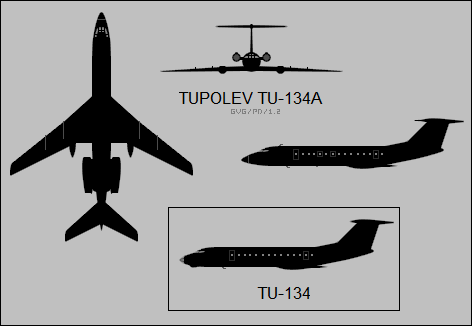
Three-view drawing
History
The rear-engine fashion
The Tu-134 is a direct product of a revolution in layout. After the French Sud Aviation Caravelle introduced engines mounted on pylons on the rear fuselage, airliner manufacturers around the world rushed to adopt the arrangement. Its advantages were clear: clean wing airflow undisturbed by nacelles or pylons, and reduced cabin noise. In exchange, placing heavy engines that far back complicated the position of the centre of gravity relative to the centre of lift at the wings, and forced the tailplanes onto the fin, which had to be stronger and therefore heavier, compounding the tail-heavy arrangement. The Tu-134 was developed from the Tu-124 and first flew on 29 July 1963. Series production was handled by the Kharkiv factory.
International certification and exports
In September 1967 the Tu-134 made its first scheduled flight, from Moscow to Adler. It was the first Soviet airliner to receive international certification from the International Civil Aviation Organization, which allowed it to be used on international routes; for that reason Aeroflot assigned most of its fleet to such services. The first export customers came in 1968: Interflug of East Germany, LOT Polish Airlines and Malév Hungarian Airlines. In 1969 the aircraft was displayed at the Paris Air Show. From 1972 Aeroflot also began placing it on domestic routes out of Sheremetyevo to Baku, Yerevan, Kyiv, Kishinev, Krasnodar, Leningrad, Omsk, Riga and Sochi.
Variants
The second series, the Tu-134A, brought upgraded engines and improved avionics with seating for up to 84 passengers; every Tu-134A was built with the distinctive glass nose and chin radar dome, though some were later modified to B standard with the radar moved to the nose radome. The 80-seat Tu-134B dispensed with the glazing by carrying the radar in the nose radome, and some examples received long-range fuel tanks under the fuselage, visible as a sizeable bulge. The Tu-134A-3 was powered by two updated Soloviev D-30 turbofans. There were also military training variants such as the Tu-134BSh, fitted with a Tu-22M radar in the nose.
Decline and last flight
In its early years the Tu-134 earned a reputation for reliability and efficiency, especially against earlier Soviet designs. Tougher ICAO noise standards introduced in 2002 saw it banned from most western European airports. In early 2006, 245 Tu-134s were still in operation, 162 of them in Russia. After a fatal accident in March 2007, and at the instigation of Russian Transport Minister Igor Levitin, Aeroflot announced it would retire its fleet, and the last aircraft was removed from service on 1 January 2008. In June 2011, responding to RusAir Flight 9605, which killed 47 people, President Dmitry Medvedev ordered preparations to take the Tu-134 out of use by 2012. The final passenger flight of a Tu-134 in Russia took place on 22 May 2019.
Variants
| Tu-124A | Tu-134 | Tu-134A | Tu-134A-2 | Tu-134A-3 | Tu-134A-5 | Tu-134AK | Tu-134B | Tu-134B-1 | Tu-134B-2 | Tu-134B-2-3 | Tu-134B-3 | Tu-134BSh | Tu-134BV | Tu-134D | Tu-134G | Tu-134LK | Tu-134M | Tu-134S | Tu-134Sh-1 | Tu-134Sh-2 | Tu-134SKh | Tu-134UBK | Tu-134UBL | Tu-134V | |
|---|---|---|---|---|---|---|---|---|---|---|---|---|---|---|---|---|---|---|---|---|---|---|---|---|---|
| First flight | July 29, 1963 | August 14, 1965 | April 22, 1969 | — | — | — | — | — | — | — | — | — | — | — | — | — | — | — | — | — | — | — | — | — | — |
| Aircraft type | Short-haul airliner prototype | Short-haul airliner | Short-haul airliner | Projected short-haul airliner | Short-haul airliner | Short-haul airliner | Short-haul airliner in VIP configuration | Short-haul airliner | Short-haul airliner | Projected short-haul airliner | Projected short-haul airliner | Short-haul airliner | Tu-22M crew trainer | Automatic landing test laboratory | Projected short-haul airliner | Projected short-haul airliner | Flying laboratory for cosmonaut training | Projected short-haul airliner | Projected convertible cargo aircraft | Bomber crew trainer | Tactical aviation navigator trainer | Agricultural survey aircraft | Naval aviation crew trainer | Strategic bomber crew trainer | Projected short-haul airliner |
| Powerplant | 2 × Soloviev D-20P-125 turbofans, 56.9 kN (5,800 kgf) each | 2 × first-series Soloviev D-30 (D-30-I) turbofans, 61.8 kN (6,300 kgf) each, without thrust reversers; braking was completed with a tail parachute | 2 × second-series Soloviev D-30 (D-30-II) turbofans, 66.68 kN (6,800 kgf) each, with thrust reversers and lower fuel burn; the drag-chute bay was reused for the TA-8 APU | 2 × Soloviev D-30M turbofans (planned powerplant; the project was never built) | 2 × third-series Soloviev D-30 (D-30-III) turbofans, 68 kN (6,930 kgf) each, with a fifth stage added to the low-pressure compressor | 2 × Soloviev D-30 turbofans (the sources consulted do not state the series fitted to this version) | 2 × second-series Soloviev D-30 (D-30-II) turbofans, 66.68 kN (6,800 kgf) each | 2 × second-series Soloviev D-30 (D-30-II) turbofans, 66.68 kN (6,800 kgf) each | 2 × second-series Soloviev D-30 (D-30-II) turbofans, 66.68 kN (6,800 kgf) each — the powerplant of the Tu-134B it derives from | 2 × second-series Soloviev D-30 (D-30-II) turbofans, 66.68 kN (6,800 kgf) each | 2 × third-series Soloviev D-30 (D-30-III) turbofans, 68 kN (6,930 kgf) each | 2 × third-series Soloviev D-30 (D-30-III) turbofans, 68 kN (6,930 kgf) each | 2 × second-series Soloviev D-30 (D-30-II) turbofans, 66.68 kN (6,800 kgf) each — the powerplant of the Tu-134B it derives from | 2 × second-series Soloviev D-30 (D-30-II) turbofans, 66.68 kN (6,800 kgf) each — the powerplant of the Tu-134B it derives from | 2 × second-series Soloviev D-30 (D-30-II) turbofans, 66.68 kN (6,800 kgf) each — the powerplant of the Tu-134A the redesign was based on | 2 × Soloviev D-30M turbofans (the powerplant planned for the Tu-134V from which this project derived) | 2 × second-series Soloviev D-30 (D-30-II) turbofans, 66.68 kN (6,800 kgf) each — the powerplant of the Tu-134A it derives from | 2 × Progress D-436T1-134 turbofans (the powerplant planned for the upgrade) | 2 × second-series Soloviev D-30 (D-30-II) turbofans, 66.68 kN (6,800 kgf) each — the powerplant of the Tu-134A it was based on | 2 × second-series Soloviev D-30 (D-30-II) turbofans, 66.68 kN (6,800 kgf) each | 2 × second-series Soloviev D-30 (D-30-II) turbofans, 66.68 kN (6,800 kgf) each | 2 × second-series Soloviev D-30 (D-30-II) turbofans, 66.68 kN (6,800 kgf) each | 2 × second-series Soloviev D-30 (D-30-II) turbofans, 66.68 kN (6,800 kgf) each — the powerplant of the Tu-134UBL it derives from | 2 × second-series Soloviev D-30 (D-30-II) turbofans, 66.68 kN (6,800 kgf) each | 2 × Soloviev D-30M turbofans (planned powerplant; the project was never built) |
| Powerplant | 2 × Soloviev D-20P-125 | 2 × Soloviev D-30-I | 2 × Soloviev D-30-II | 2 × Soloviev D-30M | 2 × Soloviev D-30-III | 2 × Soloviev D-30 | 2 × Soloviev D-30-II | 2 × Soloviev D-30-II | 2 × Soloviev D-30-II | 2 × Soloviev D-30-II | 2 × Soloviev D-30-III | 2 × Soloviev D-30-III | 2 × Soloviev D-30-II | 2 × Soloviev D-30-II | 2 × Soloviev D-30-II | 2 × Soloviev D-30M | 2 × Soloviev D-30-II | 2 × Progress D-436T1-134 | 2 × Soloviev D-30-II | 2 × Soloviev D-30-II | 2 × Soloviev D-30-II | 2 × Soloviev D-30-II | 2 × Soloviev D-30-II | 2 × Soloviev D-30-II | 2 × Soloviev D-30M |
| Thrust per engine | 56.9 kN | 61.8 kN | 66.7 kN | — | 68 kN Best value in this row | — | 66.7 kN | 66.7 kN | 66.7 kN | 66.7 kN | 68 kN Best value in this row | 68 kN Best value in this row | 66.7 kN | 66.7 kN | 66.7 kN | — | 66.7 kN | — | 66.7 kN | 66.7 kN | 66.7 kN | 66.7 kN | 66.7 kN | 66.7 kN | — |
| Length | — | — | 37.1 m Best value in this row | — | — | — | — | — | — | — | — | 37.1 m Best value in this row | — | — | — | — | — | — | — | 37.1 m Best value in this row | 37.1 m Best value in this row | 37.1 m Best value in this row | — | 37.1 m Best value in this row | — |
| Wingspan | — | — | 29 m Best value in this row | — | — | — | — | — | — | — | — | 29 m Best value in this row | — | — | — | — | — | — | — | 29 m Best value in this row | 29 m Best value in this row | 29 m Best value in this row | — | 29 m Best value in this row | — |
| Height | — | — | 9 m | — | — | — | — | — | — | — | — | 9 m | — | — | — | — | — | — | — | 9.1 m Best value in this row | 9.1 m Best value in this row | 9 m | — | 9.1 m Best value in this row | — |
| Wing area | — | 127 m² Best value in this row | 127 m² Best value in this row | — | — | — | — | — | — | — | — | — | — | — | — | — | — | — | — | 127 m² Best value in this row | 127 m² Best value in this row | 127 m² Best value in this row | — | 127 m² Best value in this row | — |
| Empty weight | — | — | 27,960 kg Best value in this row | — | — | — | — | — | — | — | — | — | — | — | — | — | — | — | — | — | — | 27,960 kg Best value in this row | — | 29,000 kg | — |
| MTOW | — | — | 47,600 kg | — | — | — | — | — | — | — | — | 47,600 kg | — | — | — | — | — | — | — | 47,000 kg | 47,000 kg | 43,000 kg | — | 49,000 kg Best value in this row | — |
| Top speed | — | — | 950 km/h Best value in this row | — | — | — | — | — | — | — | — | — | — | — | — | — | — | — | — | — | — | — | — | 890 km/h | — |
| Cruise speed | — | 870 km/h | 850 km/h | — | — | — | — | — | — | — | — | 880 km/h | — | — | — | — | — | — | — | 885 km/h | 885 km/h | 900 km/h Best value in this row | — | — | — |
| Cruise altitude | — | 11,000 m | — | — | — | — | — | — | — | — | — | — | — | — | — | — | — | — | — | — | — | — | — | — | — |
| Service ceiling | — | 12,000 m | 12,100 m Best value in this row | — | — | — | — | — | — | — | — | — | — | — | — | — | — | — | — | 11,900 m | 11,900 m | — | — | 11,800 m | — |
| Initial climb rate | — | — | 14 m/s | — | — | — | — | — | — | — | — | — | — | — | — | — | — | — | — | — | — | — | — | — | — |
| Range | — | — | 3,000 km | — | — | — | — | — | — | — | — | 2,020 km | — | — | — | — | — | — | — | 1,890 km | 1,890 km | 1,900 km | — | 3,200 km Best value in this row | — |
| Ferry range | — | — | 3,200 km | — | — | — | — | — | — | — | — | — | — | — | — | — | — | — | — | 3,400 km Best value in this row | — | — | — | — | — |
| Combat radius | 0 km Best value in this row | 0 km Best value in this row | 0 km Best value in this row | 0 km Best value in this row | 0 km Best value in this row | 0 km Best value in this row | 0 km Best value in this row | 0 km Best value in this row | 0 km Best value in this row | 0 km Best value in this row | 0 km Best value in this row | 0 km Best value in this row | — | 0 km Best value in this row | 0 km Best value in this row | 0 km Best value in this row | 0 km Best value in this row | 0 km Best value in this row | 0 km Best value in this row | — | — | 0 km Best value in this row | 0 km Best value in this row | 0 km Best value in this row | 0 km Best value in this row |
| Endurance | — | — | — | — | — | — | — | — | — | — | — | — | — | — | — | — | — | — | — | 265 min | — | — | — | — | — |
| Range conditions | Test prototype; no operational range figures were published. | Cruises at 11,000 m. Seventy-nine base-version aircraft were built, including the two Tu-124A prototypes and four pre-production examples. | Range up to 3,000 km and 3,200 km ferry; about 1,900 km with maximum payload. | Project with no published range figures. | The third series holds its higher thrust to warmer outside temperatures, easing take-off weight limits at hot or high airfields. | No range figures specific to this version have been published. | Range equivalent to the Tu-134A it derives from. Used mainly by the air force and for government flights. | Some aircraft carried underfuselage long-range tanks, recognisable by their bulged fairing, which extended the range. | Shares the powerplant and tankage of the Tu-134B. | Project with no published range figures. | Project with no published range figures. | About 2,020 km of range at an 880 km/h cruise, burning 45.2 g per passenger-kilometre. | Retains the Tu-134B tankage; the sources consulted publish no range figures of its own. | Used on test flights; no range figures of its own published. | Cancelled project with no published range figures. | Project with no published range figures. | Used on test and training flights; no range figures of its own published. | Project with no published range figures. | Project with no published range figures. | About 1,890 km on a training sortie and up to 3,400 km maximum range, with roughly four and a half hours of endurance. | About 1,890 km on a training sortie, with an 11,900 m operating ceiling. | About 1,900 km of range at a 900 km/h cruise. Besides crop survey it flew ice patrols and fisheries research. | Shares the powerplant and tankage of the Tu-134UBL. | Up to 3,200 km of range on 14,400 litres of internal fuel, with an 11,800 m operating ceiling. | Project with no published range figures. |
| Armament | None | None | None | None | None | None | None | None | None | None | None | None | — | None | None | None | None | None | None | Training bomb racks for up to eight bombs of 50 to 250 kg; Rubin-1 radar in the nose | Initiative-2 radar in the nose and the training bomb racks of the Tu-134Sh airframe | None | None | None | None |
| Max weapons load | 0 kg Best value in this row | 0 kg Best value in this row | 0 kg Best value in this row | 0 kg Best value in this row | 0 kg Best value in this row | 0 kg Best value in this row | 0 kg Best value in this row | 0 kg Best value in this row | 0 kg Best value in this row | 0 kg Best value in this row | 0 kg Best value in this row | 0 kg Best value in this row | — | 0 kg Best value in this row | 0 kg Best value in this row | 0 kg Best value in this row | 0 kg Best value in this row | 0 kg Best value in this row | 0 kg Best value in this row | — | — | 0 kg Best value in this row | 0 kg Best value in this row | 0 kg Best value in this row | 0 kg Best value in this row |
| Payload | — | — | 8,200 kg | — | — | — | — | — | — | — | — | — | — | — | — | — | — | — | — | — | — | — | — | — | — |
| Cargo capacity | Experimental aircraft never operated commercially: two were built, one of them for static testing. | Initial series seated 64, later raised to 72. Glazed nose with a navigator's station. | Up to 84 seats (76 in the usual layout) and 8,200 kg of payload. The fuselage was stretched 2.1 m over the base version. | Projected development of the Tu-134A with a redesigned glazed nose and a 0.75 m fuselage stretch. | Tu-134A airframe with the third-series powerplant; cabin layout unchanged from the Tu-134A. | Latest version of the Tu-134A family; the sources consulted give no cabin details. | First-class cabin seating 24 plus a 13-seat luxury saloon. A second passenger door with built-in airstairs; some aircraft carried secure communications equipment. | Eighty seats and a crew cut to three: the glazed navigator's nose gives way to a nose radome housing the Groza-134 radar. New rear emergency exits and a redesigned hold. | Tu-134B variant with the cabin rearranged for higher seating density. | Projected 100-seat Tu-134B. Never built. | Third-series-powered version of the 100-seat project. Never built. | Eighty seats, a crew of three and 9 t of payload; fuel load rises to 14.4 t against the Tu-134A's 13.2 t. | Tu-134B airframe with a Tu-22M bomber radar in the nose for training its crews. | Cabin given over to test instrumentation for the Vympel automatic landing system of the Buran shuttle. | Projected redesign of the Tu-134A with an elliptical-section fuselage, revised wing and a more powerful APU. Studied from 1973 to 1976 and cancelled in favour of the Yakovlev Yak-42. | Projected 86-seat version derived from the Tu-134V. Never built. | Cabin fitted out as a flying laboratory for space-programme work and cosmonaut training. | Projected modernisation of the Tu-134B with new engines and systems, drawn up in 1993. Never built. | Projected convertible cargo/passenger version based on the Tu-134A. Never built. | Cabin fitted with twelve working stations for group training in flying and bombing as applied to the Tu-22 and Tu-22M. | Twelve cabin working stations for training front-line aviation navigators. | Cabin given over to survey consoles; removable underwing pods carry radar to measure crop condition, temperature, humidity and fertiliser needs. Twelve were built for the Ministry of Agriculture. | Naval version of the Tu-134UBL; a single example was built. | Lengthened nose with a radar-transparent radome reproducing that of the Tu-160; cabin with twelve stations for instructors and trainees. About ninety were built between 1981 and 1984. | Projected development of the Tu-134A with nose radar and a three-man crew, dropping the glazed navigator's station. |
| Crew | — | — | 3 Best value in this row | — | — | — | — | 3 Best value in this row | 3 Best value in this row | — | — | 3 Best value in this row | — | — | — | — | — | — | — | 3 Best value in this row | 3 Best value in this row | 3 Best value in this row | — | 4 | 3 Best value in this row |
| Passengers | — | 72 | 84 | — | — | — | 37 | 80 | — | 100 Best value in this row | 100 Best value in this row | 80 | — | — | — | 86 | — | — | — | 12 | 12 | — | — | — | — |
| Units built | 2 | 79 | — | — | — | — | — | — | — | — | — | — | — | — | — | — | — | — | — | — | — | 12 | 1 | 90 Best value in this row | — |
Images