Tupolev Tu-134 variant
Tupolev Tu-134
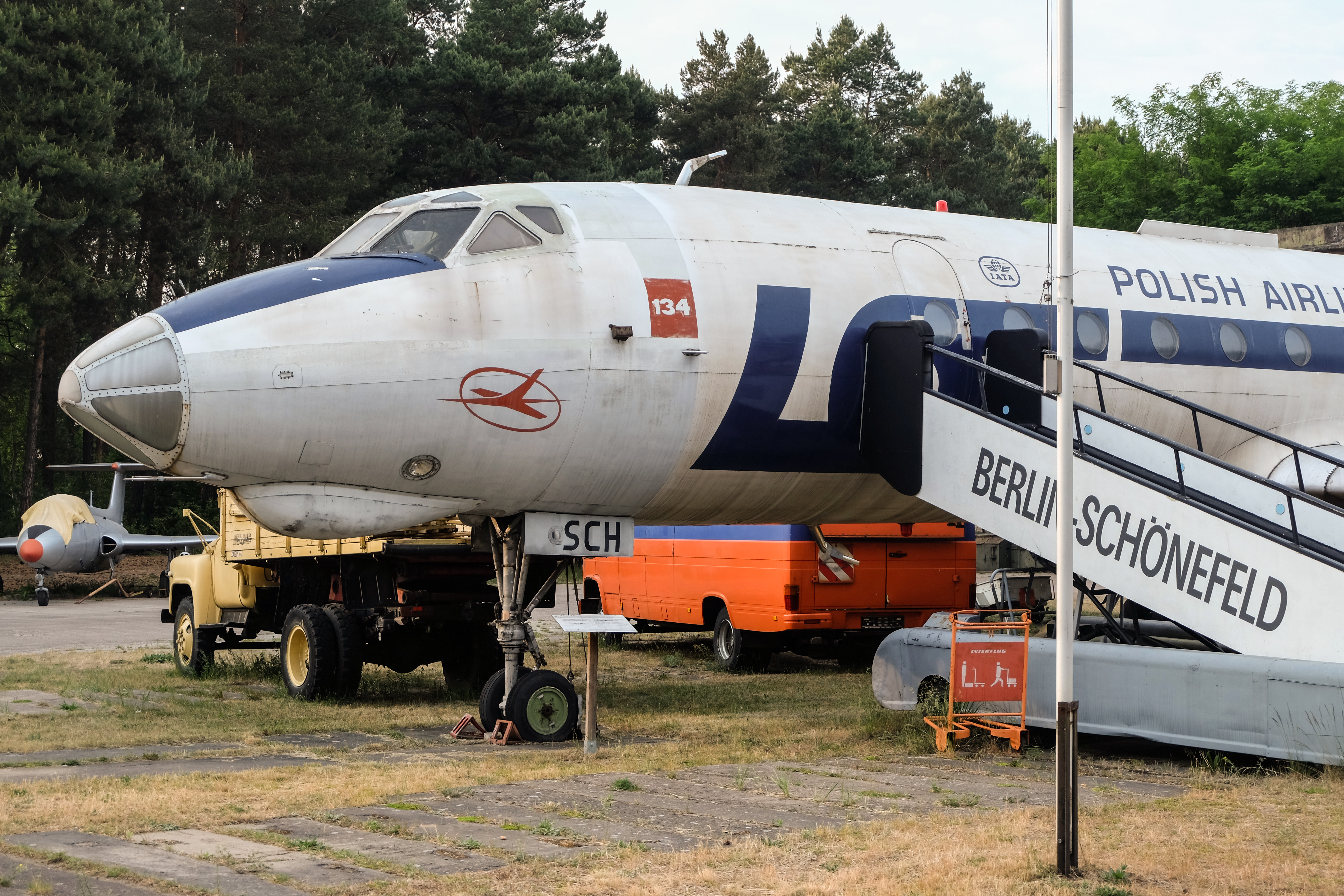
The first-series Tu-134 is the original version of Tupolev's short-haul twinjet: a glazed nose housing the navigator, Soloviev D-30 series I engines without thrust reversers, and a braking parachute. Born as the Tu-124A project, it was built in Kharkiv from 1966 to 1970, opened commercial service with Aeroflot in September 1967 and was the first Soviet airliner to earn international certification; 78 or 79 were built depending on the source, some 30 of them for East Germany and Poland.
_RA-65906_(3280346895)-800.webp)
- August 14, 1965
- First flight
- 79
- Units built
- 72
- Passengers
History
From Tu-124A to Tu-134
In the early 1960s, short-haul flying in the USSR and the socialist countries relied on the piston Il-14, carrying up to 36 passengers, while the only Soviet jet airliner, the Tu-104, was kept for international and the busiest domestic routes. What was needed was a jet with a range of about 2000 km, an 800-900 km/h cruise and at least 40 seats that could use short runways. On 1 August 1960 the USSR Council of Ministers approved secret resolution No. 826-341 for a fast passenger aircraft designated Tu-124A. According to the Spanish Wikipedia, part of the impetus came from Nikita Khrushchev, who that same year had been struck by how quiet the cabin of the French Caravelle, with its tail-mounted engines, was.
The Tu-134 was not a clean-sheet design but a deep modification of the Tu-124, with the turbofans moved to the rear fuselage, a stretched fuselage and a T-tail. The Tu-124A project was defined in 1961, the year Aeroflot raised its payload and seating requirements. Work was led first by D. S. Markov and then by Leonid Selyakov, who came from the Myasishchev bureau.
Prototypes and testing
The prototype, CCCP-45075, assembled in the first half of 1963, flew on 29 July 1963 with test pilot A. D. Kalina at the controls. The crash of the British BAC One-Eleven on 22 October 1963, caused by a deep stall in an aircraft of similar layout, led to a 30% enlargement of the tailplane. On 20 November 1963 the aircraft was officially renamed Tu-134 (the Russian Wikipedia places the renaming in 1965), although the prototype kept the Tu-124A designation. Its trials ended on 6 November 1964; on 9 September that year the second aircraft, CCCP-45076, built in Kharkiv still with the old tail and a 64-seat cabin, had flown. This 'understudy' was shown at the Paris Air Show at Le Bourget in June 1965 and was lost on a test flight on 14 January 1966, killing eight people including its commander, S. V. Yevseyev.
The growth in weight and size called for more thrust than the D-20P-125 engines (2 × 5800 kgf, about 56.9 kN) the aircraft had been designed around. The Soloviev bureau derived the D-30 from them: the Kharkiv plant delivered only three Tu-134s with D-20P-125s, and from No. 0004 (CCCP-65602) onwards all had D-30s. High-angle-of-attack stall testing followed from October 1966 to February 1967, using the second production aircraft fitted with an anti-spin parachute and the enlarged tailplane; the second phase of state trials with the civil aviation research institute ran from March to July 1967, and operational trials of early-series aircraft at 45 t maximum weight with 72 seats from April to August 1967. The pre-series numbered nine aircraft (CCCP-65600 to 65608) according to the Russian Wikipedia and airwar.ru; other sources give four or five.
Features of the initial series
This version is recognisable by its glazed nose with the navigator's station, used for dead reckoning, and by the ventral airbrake under the centre section inherited from the Tu-124. Its D-30 series I engines, rated at 6300 kgf (about 61.8 kN) each, had no thrust reversers and were started electrically by two STG-18MO starter-generators. All production aircraft with these engines (CCCP-65609 to 65644) therefore carried a braking parachute, which in practice was used only on short runways, long landings or slippery surfaces, since the ventral airbrake was usually enough. The Tu-134 was also the first Soviet jet whose rudder was driven by rigid rods with a hydraulic booster instead of cables, and its low-pressure tyres let it operate from unpaved strips. The first production aircraft seated 64 passengers, for example 16 in first class and 48 in tourist, a figure later raised to 72 when first class was dropped on domestic routes. At 35 m long and 45 t maximum weight, its ferry range was 3100 km.
Service
The first production aircraft reached Aeroflot in 1966 and the first commercial flight, Moscow-Adler, took place in September 1967. It was the first Soviet airliner with international certification, so for almost three years it flew mainly on international routes; according to the Russian Wikipedia, it only began serving Moscow-Leningrad and Moscow-Kiev in the summer of 1969. On 9 November 1969 the Polish state inspectorate granted it certificate BB-051 of compliance with the British BCAR airworthiness requirements. The first export customers arrived in 1968: Interflug of East Germany and LOT of Poland, and also Malév according to the English Wikipedia; in 1969 the aircraft returned to Le Bourget. Yugoslavia's Aviogenex also flew the initial series, documented at Düsseldorf in June 1969. There were early mishaps: Malév's HA-LBC suffered a landing gear collapse at Schiphol on 7 October 1969, and Interflug's DM-SCA was written off after a heavy landing in October 1972.
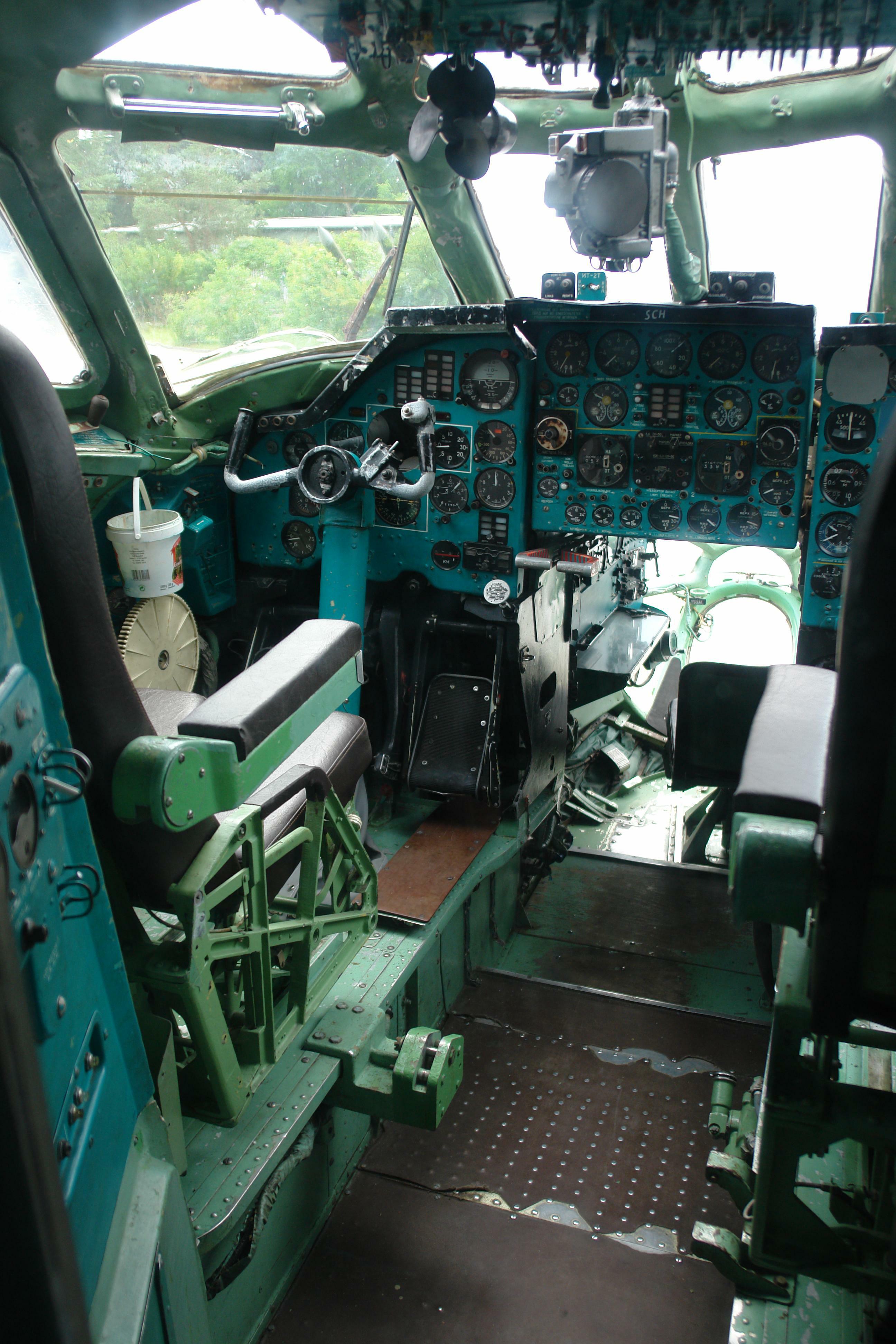
In 1970 the Tu-134A replaced it in production. The Russian Wikipedia counts 79 Tu-134s of the basic version and airwar.ru 78, both including the two prototypes; around 30 were exported to East Germany and Poland. Preserved examples include Interflug's DDR-SCH at the Finowfurt museum and Malév's HA-LBH at the Technik Museum Sinsheim.
Multimedia


_%E2%80%94_Andre_Gerwing_Collection_016878-1600.webp)
_%E2%80%94_Andre_Gerwing_Collection_016877-1600.webp)
_1994-04-01_Andre_Gerwing_Collection_ID_030061-1600.webp)

_%E2%80%94_Andre_Gerwing_Collection_016867-1600.webp)
_%E2%80%94_Andre_Gerwing_Collection_016866-1600.webp)
-1600.webp)
_pic2-1600.webp)
-1600.webp)
_%E2%80%94_Andre_Gerwing_Collection_016875-1600.webp)
_%E2%80%94_Andre_Gerwing_Collection_016874-1600.webp)
_%E2%80%94_Andre_Gerwing_Collection_016872-1600.webp)
