Fighter · Military · Russia
Sukhoi Su-27
- May 20, 1977
- First flight
- In service
- Status

-1600.webp)
-1600.webp)


_22.jpg)
-800.webp)
-1600.webp)
-800.webp)
-1600.webp)
_15-800.webp)
_01.jpg)

-800.webp)
-800.webp)


-800.webp)
-800.webp)

-800.webp)
-1600.webp)
_17.jpg)
-1600.webp)
-800.webp)
-800.webp)

_08-800.webp)
_01-800.webp)
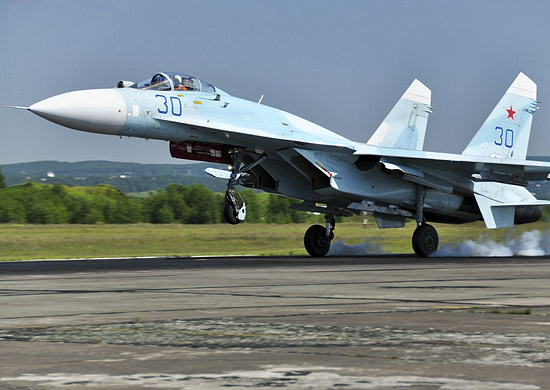
The Sukhoi Su-27, given the NATO reporting name "Flanker", is the twin-engine heavy fighter with which the Soviet Union set out to answer, aircraft for aircraft, the American generation led by the F-15 Eagle and the F-14 Tomcat. Conceived for long-range air superiority, it gathered into a single airframe what had until then been divided among several types: enough endurance to escort heavy bombers or patrol the enormous Soviet periphery, a generous weapons load, complex avionics and extreme low-speed agility. It was born paired with the MiG-29, which would cover the light end of the same programme, and it reached frontline units in 1985, although its formal adoption was not signed until the government decree of 23 August 1990. Its development was far more troubled than the elegance of the result suggests. The programme began formally in early 1971 under the internal designation T-10, whose first prototype flew on 20 May 1977 with Vladimir Ilyushin at the controls. Testing showed that this aircraft failed to meet its specification and fell short of the F-15 in several respects: the avionics weighed more than planned, the AL-31 engine burned more fuel than calculated, the radar did not work, and the aerodynamics had been designed without adequate computing tools. The Sukhoi bureau then took a decision rare in any aircraft industry: to rebuild the aeroplane almost from scratch. The result, the T-10S, flew on 20 April 1981 and bore only a superficial resemblance to its predecessor. The road cost lives: Evgeny Solovyov died in the T-10-2 on 7 July 1978 and Aleksandr Komarov in the T-10-12 on 23 December 1981. Technically the Su-27 was a break with what came before. It adopted the so-called integral layout, in which fuselage and wing form a single continuous lifting body, with widely spaced engine nacelles and a tunnel between them that contributes additional lift. It flew with deliberate longitudinal instability — of the order of 3 to 5 per cent of the mean aerodynamic chord in subsonic flight — and introduced the Soviet Union's first operational fly-by-wire control system, derived from the bureau's experience with the T-4 bomber. To that it added a Phazotron N001 Myech coherent pulse-Doppler radar with track-while-scan and look-down/shoot-down capability, an OLS-27 infrared search and track set housed just forward of the cockpit with a range of 80 to 100 km (50 to 62 miles), a 30 mm (1.18 in) GSh-30-1 cannon in the starboard wingroot and up to ten hardpoints for R-27 and R-73 missiles. Published figures for the export Su-27SK give a length of 21.9 m (71 ft 10 in), a span of 14.7 m (48 ft 3 in), a wing area of 62 m2 (670 sq ft), an empty weight of 16,380 kg (36,112 lb), a maximum take-off weight of 33,000 kg (72,753 lb) and a range of 3,530 km (2,190 miles) at cruising altitude. Production was concentrated at the plant in Komsomolsk-on-Amur, which began tooling up in 1976, completed the first production Su-27S in 1980 and reached mass production in 1982. By 1992 something of the order of 600 aircraft had come out of that factory; adding the fourteen Su-27M built between 1992 and 1996 and the fifty Su-27SK and SKM built between 1992 and 2010, the total number of production Su-27s comes to roughly 664. A whole family grew on that airframe: the Su-27UB conversion trainer, the Su-27P interceptor of the Air Defence Forces, the Su-27SK and Su-27UBK export versions, the Russian Su-27SM and Su-27SM3 upgrades, the naval branch designated Su-27K and later Su-33 and, beyond the scope of this entry, the Su-30, Su-34 and Su-35 that remain in production today. In service the Flanker accumulated a long and uneven record. It became Russia's standard tool for intercepting Western reconnaissance flights, collided with a Norwegian P-3 Orion over the Barents Sea on 13 September 1987, flew in Abkhazia, over South Ossetia in 2008 and in Syria from 2015. China bought it first — 76 Soviet and Russian-built aircraft — and ended up producing it under licence as the Shenyang J-11. Ethiopia used it in the type's only documented air-to-air combat, against Eritrean MiG-29s, and Ukraine inherited between 66 and 70 airframes from the Soviet break-up that have, since February 2022, been fighting Russian Su-27s. Two images of the Su-27 travelled well beyond military circles: the world time-to-climb records of the P-42, a stripped airframe reduced to 14,100 kg (31,100 lb) that took marks from the American Streak Eagle between 1986 and 1988, and Viktor Pugachyov's Cobra, the dynamic deceleration to a 120-degree angle of attack with which the aircraft introduced itself to Western audiences. Four decades after its first flight, the T-10S airframe is still the basis of Russia's most modern combat aircraft.
Category
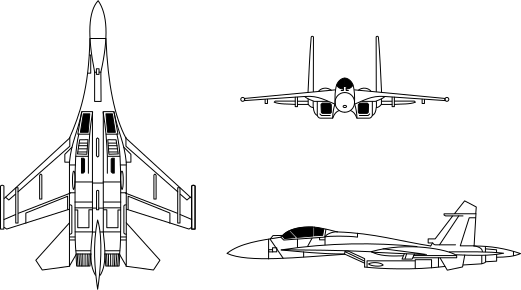
Three-view drawing
History
Starting point: in the shadow of the F-15
The Su-27 story begins outside the Soviet Union. In the mid-1960s the United States Air Force began considering a successor to the F-4C Phantom tactical fighter; in March 1966 the FX (Fighter Experimental) programme was launched, and design against refined requirements got under way in 1969, the year the aircraft received the F-15 Eagle designation. On 23 December 1969 the prototype contract went to McDonnell Douglas, and the first production F-15A and F-15B appeared in 1974. That same year of 1969, the Soviet leadership learned of the "F-X" programme and understood that the new American fighter would confer a serious technological advantage over anything then in Soviet service.
The response was a requirement for a Perspektivny Frontovoy Istrebitel (PFI), literally "advanced frontline fighter". The specification was deliberately ambitious: long range, good short-field performance including rough strips, excellent agility, speeds above Mach 2 and heavy armament. The aerodynamic work fell largely to TsAGI, the central aerohydrodynamics institute, working with the Sukhoi design bureau. Three design bureaux entered the competition. Sukhoi was not a participant at first, but it had already carried out preliminary studies on the PFI theme in 1967, and in early 1971 the official decision was taken to begin work on the T-10 product.
Two scientific and technical councils were held in 1972 with representatives of Sukhoi, Yakovlev and Mikoyan; their conclusions eliminated the Yak-45 and Yak-47 projects. It was the MiG bureau's management that proposed splitting the PFI programme in two and developing a heavy and a light fighter in parallel, with the greatest possible commonality of equipment, arguing that this would make production cheaper and faster and would give the country two fleets each matched to its own tasks. The specification duly divided into LPFI (light PFI) and TPFI (heavy PFI). The first led to the Mikoyan MiG-29, a relatively short-range tactical fighter; the second was assigned to Sukhoi, which eventually produced the Su-27 and all its descendants.
The technical requirement for the new machine was explicitly aimed at beating the F-15. The projected air combat tactics included close-in manoeuvring combat, which by then had once again been recognised as the principal element of fighter employment; that premise shaped everything that followed in the design.
T-10: the prototype that fell short
For the aircraft coded T-10, an integral layout was chosen in which fuselage and wing merge into a single lifting body. To improve manoeuvring qualities it was given an aft centre of gravity in the subsonic regime — that is, deliberate longitudinal static instability — with an electric pitch control channel and no mechanical linkage between stick and stabilator. The prototype had a wing with a curved leading edge, without deflecting leading-edge devices and with a broad root extension, a solution intended to favour supersonic cruise. The two fins were mounted on the upper surfaces of the engine nacelles.
The first experimental aircraft, designated T-10-1 and fitted with AL-21F-3 engines, took to the air on 20 May 1977 with Vladimir Ilyushin — Merited Test Pilot and Hero of the Soviet Union — at the controls. General handling, stability and control were tested on it; 38 test flights were completed, after which a set of modifications was introduced, among them rod-shaped anti-flutter counterweights on the wingtips and fins. The first aircraft carried no weapon system. It finished its test programme in November 1983 and was donated to the Soviet Air Force museum in late 1985.
The T-10-2 was built in 1978 and first flew on 16 May of that year. On 7 July 1978, on a flight to check the gearing coefficients of the longitudinal control channel, the aircraft flown by Hero of the Soviet Union Evgeny Solovyov entered a divergent longitudinal oscillation and broke up; the pilot was killed. The Western account agrees in substance: the aircraft exceeded its load-factor limit and broke up in flight after behaving unpredictably when the stick was pulled.
Western intelligence dubbed these prototypes "Ram-K", having spotted them by satellite at Ramenskoye airfield in Zhukovsky, home of the Flight Research Institute; they later received the NATO name "Flanker-A". From 1978 the Komsomolsk-on-Amur factory built the second batch, comprising the T-10-3 and T-10-4, the first to carry the intended powerplant — the Lyulka AL-31 turbofan — with nacelles redesigned accordingly. The T-10-3 was initially devoted to propulsion testing and flew on 23 August 1979 after engine problems delayed it; in 1982 and 1983 it carried out land-based trials of the ramp take-off method for naval aviation. The T-10-4 served for avionics and weapons testing with the Myech radar. Work with the T-10-4 and the later T-10-10 revealed serious deficiencies in that radar. A third batch of AL-21-powered "T-10-5 type" aircraft — T-10-5, T-10-6, T-10-9, T-10-10 and T-10-11 — was allocated to avionics testing; the T-10-6 was lost in October 1980 in a ground fire caused by a leaking fuel line.
By 1979 three aircraft were in trial operation and an installation batch had been started at Komsomolsk: five machines called "Su-27 type T-10-5", used for flight testing and for developing equipment and armament. It was at that point that reliable data on the American F-15 began to arrive, and the verdict was devastating: the machine did not meet its technical requirement and fell significantly behind its rival. The tendency towards degraded characteristics had already been noted in 1976, during wind tunnel testing of T-10 models at SibNIA. Theoretical work on aeroelasticity, flutter included, already validated at TsAGI, could not be applied in full to the project for want of high-performance computing: the research results lagged far behind the pace at which the aircraft was being built. Beyond that, those responsible for the electronic equipment did not keep within the allotted mass and volume margins, which would have given the aircraft a forward centre of gravity; the specified fuel consumption was not achieved; and the radar did not function normally. Western accounts summarise the failure in three items: avionics weight, AL-31 fuel consumption and inadequate aerodynamics.
An uncomfortable dilemma followed: finish the machine to production standard and deliver it to the customer as it stood, or undertake a radical reworking of the entire aircraft. The decision was to start practically from zero and not put into series production an aircraft that trailed its main competitor.
The redesign: the T-10S
In very short order a new machine was developed incorporating the experience of the T-10 and the experimental data obtained. Sukhoi accepted a far closer collaboration with SibNIA, which carried out extensive wind tunnel testing, and contemporary Western aircraft were examined for ideas. The T-10S bore only a superficial resemblance to the T-10; its design was completed in 1980, and it was the direct precursor of the production Su-27.
On 20 April 1981 the experimental T-10-7 — also designated T-10S-1 — flown by V. S. Ilyushin took to the sky. Almost every assembly had been created anew. Where the T-10 had rounded wingtips and root extensions in the manner of the MiG-29, the T-10S had a fully trapezoidal wing with deflecting leading edges, sharply angled root extensions and flaperons in place of separate flaps and ailerons. The anti-flutter counterweight role on the wing panels passed to the air-to-air missile launchers. The number of hardpoints grew from eight to ten. The fins, previously mounted above the engines, were moved to the sides as on the F-15, and the AL-31F engines had their accessories relocated to the upper position. The nose gear leg was moved three metres aft so that spray from the wheel would not enter the intakes. The airbrakes, previously on the underside of the fuselage, caused vibration when deployed; on the T-10S a single airbrake was fitted behind the cockpit. The canopy no longer slid rearwards but opened upwards and back, again as on the F-15. And the contours of the forward fuselage were changed.
The data obtained in testing showed that an aircraft had been created that did not yield to the F-15 and surpassed it in some parameters. But the process again exacted a high price. The T-10-7 crashed on 3 September 1981 after a critical in-flight failure; the pilot ejected and survived, but the project chief was replaced and the flight engineer dismissed. The T-10-12, or T-10S-2, completed by the Komsomolsk factory in March 1981 for fire-control system testing, broke up in flight on 23 December 1981: at 2,300 km/h and in a critical regime the forward part of the aircraft disintegrated and test pilot Aleksandr Sergeyevich Komarov was killed. After that accident Sukhoi's general designer was dismissed.
On 16 July 1983, near Akhtubinsk, during structural strength testing at 1,000 m and an indicated airspeed above 1,000 km/h, the leading-edge device and part of the wing panel of the aircraft flown by N. Sadovnikov were destroyed. Only the test pilot's great skill — he was later made a Hero of the Soviet Union in 1988 and held world records in 1987 and 1988 — brought the flight to a safe end: holding the aircraft at 350 km/h, nearly 100 km/h above landing speed, Sadovnikov put down at the airfield a damaged machine missing much of a wing panel and with a truncated fin, and thereby handed the designers material of incalculable value. The cause was the high hinge moment of the leading-edge device; the wing structure and the airframe as a whole were strengthened and the area of that device reduced. The T-10-21 was lost in similar circumstances on 25 May 1984, the pilot ejecting.
The Komsomolsk factory produced further batches in 1982 — T-10-15 and T-10-17 to T-10-22 — and in 1983 — T-10-23 to T-10-27. The T-10-17 was the first airframe built to full production standard and flew on 26 May 1982; in 1983 it landed after losing part of a wing and a tail fin to structural failure. The aircraft continued to undergo numerous modifications, some of them already during series production.
Komsomolsk-on-Amur: production
Series manufacture of the T-10 was planned from the outset at the aircraft factory in Komsomolsk-on-Amur, named after Yuri Gagarin and subordinate to the 1st Main Directorate of the USSR Ministry of Aviation Industry; its open designation at the time was post-office box M-5873. Preparation for production of the T-10 product began there in 1976. The first production Su-27S was built in 1980 and made its first flight in April 1981. Mass production began in 1982.
Over the ten years to 1992, something of the order of 600 aircraft were built. Fourteen Su-27M were built between 1992 and 1996, and fifty Su-27SK and Su-27SKM between 1992 and 2010, so that the total number of production Su-27s stands at roughly 664 machines. Later, and in small series, came the Su-30, Su-33 and Su-35, which are separate chapters. Series production of the AL-31F engine was established at two aero-engine plants: the Moscow machine-building enterprise Salyut and the Ufa engine-building association, UMPO.
Manufacturing difficulties explain one of the type's paradoxes: although the production Su-27 — sometimes designated Su-27S, and "Flanker-B" to NATO — began entering operational service with the air forces in 1985, it did not appear in significant numbers until 1990.
Adoption, designations and first units
The Soviet Air Force began receiving Su-27s in June 1985. The first frontline unit to operate the type was the 831st Fighter Aviation Regiment, based at Myrhorod in the Ukrainian Soviet Socialist Republic, in November 1985. Formal adoption, however, did not come until the government decree of 23 August 1990, when all the main deficiencies identified in testing were deemed eliminated; by then the aircraft had been flying with combat units for five years.
Adoption fixed the designations: in the Air Force the aircraft became the Su-27S, from "serial", and in Air Defence Forces aviation the Su-27P, from "perekhvatchik", interceptor. The latter carried somewhat simplified equipment on board and could not be used to attack ground targets. Operational conversion was carried out on the Su-27UB two-seater — from Uchebno Boevoy, "combat trainer" — designated "Flanker-C" by NATO, with the pilots seated in tandem. The Su-27 served both with the Air Defence Forces and with Frontal Aviation.
Configuration, systems and armament
In aerodynamic conception the Su-27 resembles the MiG-29, but it is substantially larger. The wings are attached to the centre of the fuselage at the leading-edge extensions and adopt a semi-delta planform with the tips cropped for missile rails or ECM pods; strictly speaking it is a tailed delta configuration, since it retains conventional horizontal tailplanes. The tunnel between the two widely spaced engine nacelles acts as an additional lifting surface and also shields the ordnance from radar view, a solution the F-14 Tomcat had explored earlier.
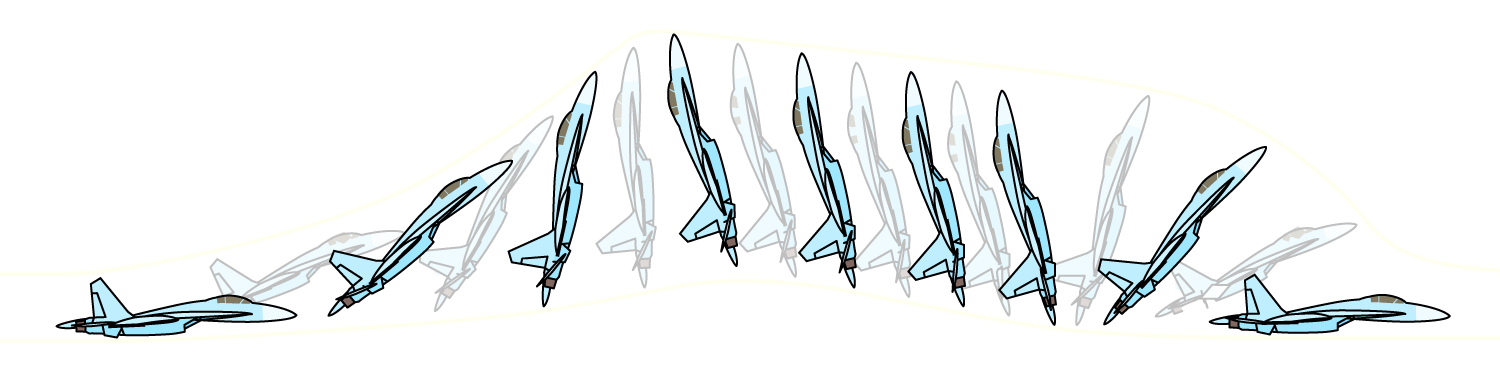
The Su-27 introduced the Soviet Union's first operational fly-by-wire control system, based on the Sukhoi bureau's experience with the T-4 bomber project. Combined with relatively low wing loading and powerful basic flight controls, it makes for an exceptionally agile aircraft, controllable even at very low speeds and high angles of attack. That behaviour became famous at air shows through the Cobra manoeuvre — or dynamic deceleration — in which the aircraft briefly sustains level flight at a 120-degree angle of attack. Controlled manoeuvring at high angle of attack, known as supermanoeuvrability, was emphasised after a 1980s study by teams from the Sukhoi bureau and TsAGI demonstrated its effectiveness in close combat. The integral layout itself had been defined in search of optimum performance with longitudinal static instability of 3 to 5 per cent of the mean aerodynamic chord in the subsonic regime, together with fly-by-wire controls designed for future heavy fighters; stability problems analogous to those that appeared in programmes such as the YF-22 and the Gripen were resolved during the development of those controls by limiting normal load factor and angle of attack.
Detection rests on a Phazotron N001 Myech coherent pulse-Doppler radar with track-while-scan and look-down/shoot-down capability, complemented by an OLS-27 infrared search and track system in the nose just forward of the cockpit with a range of 80 to 100 km (50 to 62 miles). Sales literature for the export version describes a pulse-Doppler radar able to search for and track airborne targets, including against ground or sea clutter, at 100 km, and to track ten aerial targets simultaneously while prioritising and attacking the most dangerous. The optical system is completed by a laser rangefinder and designator and by a helmet-mounted system.
Fixed armament is a single 30 mm Gryazev-Shipunov GSh-30-1 automatic cannon installed in the starboard wingroot with 150 rounds. To that are added up to ten hardpoints under the wings and fuselage. The standard air-to-air fit mixes R-73 missiles — "AA-11 Archer" in Western nomenclature — and R-27 missiles — "AA-10 Alamo" — the latter in extended-range and infrared-homing forms. Export documentation details up to six semi-active radar-homing R-27R1 or R-27ER1, up to two infrared-homing R-27T1 or R-27ET1, up to six active-radar medium-range missiles and six short-range R-73E; against surface targets, bombs of 500, 250 and 100 kg, cluster bombs, incendiary tanks and S-8, S-13 and S-25 rockets in their respective launchers.
Published figures for the Su-27SK give a length of 21.9 m (71 ft 10 in), a span of 14.7 m (48 ft 3 in), a height of 5.92 m and a wing area of 62 m2 (670 sq ft); an empty weight of 16,380 kg (36,112 lb), a gross weight of 23,430 kg and a maximum take-off weight of 33,000 kg (72,753 lb), with 9,400 kg of internal fuel. The powerplant is two Saturn AL-31F turbofans of 75.22 kN dry and 122.6 kN (27,600 lbf) with afterburner. Maximum speed is quoted as 2,500 km/h at altitude — Mach 2.35 — and 1,400 km/h at sea level; the service ceiling as 18,500 m clean and 17,750 m with some load; the initial rate of climb as 300 m/s; and the structural limit as +9 g. Declared range is 3,530 km (1,910 nmi) at cruising altitude carrying two R-27R1 and two R-73E launched at half distance, and 1,340 km at sea level. Wing loading runs from 377.9 to 444.61 kg/m2 depending on fuel state, and thrust-to-weight from 1.07 with 56 per cent internal fuel to 0.91 with full tanks. The ten pylons accept up to 4,430 kg (9,770 lb) of ordnance.
It is worth noting that sources do not agree. Against those values, an American reference sheet credits the Su-27 with a maximum weight of 30,000 kg, 6,350 kg of internal fuel, a 6,000 kg payload, a ceiling between 15,240 and 18,000 m and a maximum range of 4,000 km with a typical combat radius of 1,500 km; it also gives the radar the Western codename "Flash Dance" and rates each AL-31F at 12,550 kg of thrust. These belong to a different generation of estimates and should not be mixed with manufacturer figures without saying so.
The P-42 and the climb records
One of the redesign prototypes, the T-10S-3, was converted into a record-breaking machine under the official designation P-42. All armament, the radar and operational equipment were removed; the fin tips, the tail sting and the wingtip launch rails were deleted; the composite radome was replaced by a lighter metal one; the paint was stripped, the surface polished and every drag-producing gap and joint sealed. The engines were modified to deliver 1,000 kg (2,200 lb) more thrust, bringing the thrust-to-weight ratio close to 2:1. Weight came down to 14,100 kg (31,100 lb).
Between 1986 and 1988 the P-42 set and took several marks from the Streak Eagle, an equally stripped F-15 that had established its records in 1975. On 27 October 1986 test pilot Viktor Pugachyov climbed to 3,000 m in 25.4 seconds. On 15 November 1986 he reached 6,000 m in 37.1 seconds, 9,000 m in 47 seconds and 12,000 m in 58.1 seconds. On 11 March 1987 Nikolai Sadovnikov reached 15,000 m in 76 seconds. Several of those marks — those to 3,000, 6,000, 9,000 and 12,000 m — still stood as of 2019.
The Su-27UB two-seater and the trainer family
The Su-27UB was the initial production two-seat operational conversion trainer, with tandem seating and the NATO designation "Flanker-C". Its role was not confined to instruction: being a fully capable combat aircraft, it also served as a testbed and as a platform for later developments. Indeed, when the Soviet Air Force was evaluating a replacement for the Su-24 "Fencer" strike aircraft, the Sukhoi bureau concentrated its studies on adaptations of the Su-27UB; but the planners preferred the Su-24's side-by-side cockpit, better suited to the high workload and long-duration strike missions. From that came the Su-27IB in 1983 — from Istrebitel Bombardirovshchik, "fighter-bomber" — whose first production airframe flew in early 1994 renamed Su-34.
The export version of the two-seater, the Su-27UBK, was developed in 1991 alongside the single-seat Su-27SK at the Komsomolsk and Irkutsk facilities; the "K" in both designations stands for "Kommercheskiy", commercial. There were also national upgrades of the two-seater: the Russian Su-27UBM, the Kazakh Su-27UBM2 and the Ukrainian Su-27UB1M, the last a product of the Zaporizhzhia upgrade programme.
Su-27SK and Su-27SKM: export
The Su-27SK is the export version of the Su-27S, in series production since 1991. Its principal distinguishing feature is landing gear reinforced for a maximum take-off weight of 33 tonnes, a Chinese requirement intended to permit air-to-ground missions; in exchange, the jamming pod was downgraded to the L203 and L204 models. It was exported to China in the 1990s and to Indonesia in 2003.
Manufacturer literature describes it as a single-seat multi-role fighter intended to win air superiority by destroying manned and unmanned aircraft with guided missiles, in medium-range engagements as well as close combat, operating singly or in groups, and to strike surface targets on land and at sea with all types of ordnance, starting with precision weapons and in any weather. Its principal features, according to that same source, are high manoeuvrability derived from a high thrust-to-weight ratio and fly-by-wire longitudinal control, long range owing to the aerodynamics and internal fuel capacity, an integrated weapon control system with two independent complementary channels — radar and optical with helmet sight — and a navigation, communications and countermeasures suite modern for its time.
The Su-27SKM is an evolution of the SK: a single-seat multi-role export fighter with an advanced cockpit, more sophisticated self-defence electronic countermeasures and an in-flight refuelling system. Alongside them were the Su-27PD, a single-seat demonstrator incorporating improvements such as the refuelling probe, and the Su-30KI, a proposed single-seat air-superiority variant derived from the Su-27SMK with N001E radar, refuelling probe and R-77 missiles, offered to Indonesia on a 1997 letter of intent for twelve aircraft and cancelled by the Asian financial crisis of that same year.
China: first customer, and the J-11
China was the Su-27's first export customer and the only one to be offered and sold the type before the collapse of the Soviet Union. It received a total of 76 Soviet and Russian-built aircraft: 36 Su-27SK and 40 Su-27UBK.
Negotiations began in June 1990 and initially concerned the MiG-29 and the Su-24; by October China was interested in the more capable Su-27. Beijing called the purchase "906 Project". In February 1991 a Su-27 gave a flight demonstration at Beijing's Nanyuan airport. In May 1991 China ordered 24 aircraft, weapons and a flight simulator; 70 per cent of the payment was in barter with poor-quality light industrial goods and food, the poor state of the Soviet economy having strengthened China's negotiating position. A 1995 estimate put the cost between 1.3 and 1.5 billion US dollars. The first twelve aircraft — eight Su-27SK and four Su-27UBK — were delivered in late 1991 and another twelve in 1992; the first batch was stationed at Wuhu Air Base. Those aircraft carried the N001E radar and could engage one target at a time; later batches used the N001P and could engage two. In December 1999 China ordered 28 Su-27UBK as trainers, of which the first twelve arrived in December 2000 and the rest by September 2009. Through 2012, limitations in their fire-control systems prevented Chinese Su-27s from firing the R-77 missile.
In 1995 the terms of payment and the scope of the agreement changed: China agreed to pay only in US dollars and Russia agreed to allow it to licence-produce the Su-27 as the J-11, although the Russian negotiators were not authorised by their government to concede the latter. In 1995 and 1996 China received a further 18 Su-27SK and 6 Su-27UBK. Since 1998 the export Su-27SK has been produced in China as the Shenyang J-11 under licence: the first licence-produced aircraft, assembled at Shenyang from Russian-supplied kits, was flight tested on 16 December 1998. One hundred of these licence-built aircraft were completed, designated J-11A; the following model, the J-11B, made extensive use of Chinese-developed systems on the Su-27SK airframe.
The Russian upgrades: Su-27SM, SM2 and SM3
From 2004 the Russian Air Force undertook a major mid-life upgrade of the original Soviet-era Su-27 fleet. The resulting versions were designated Su-27SM, from "Seriyny Modernizirovanny", "serial modernised". The upgrade improved air-to-air capability by integrating the active-radar R-77 missile, and greatly extended strike capability with the Kh-29T/TE/L and Kh-31P and Kh-31A missiles and the KAB-500KR and KAB-1500KR guided bombs. In the cockpit, multi-function displays replaced analogue instruments; the navigation system was improved, a new fire-control system with a slightly improved radar and an electro-optical sighting system was fitted, along with a more advanced mission computer. That allowed the radar to be used in synthetic-aperture terrain mapping mode and to detect maritime targets. The SPO-15 Beryoza radar warning receiver gave way to the Pastel, and the Sorbtsiya wingtip jamming pods to the more modern Khibiny. Twenty-four Su-27SM also received slightly uprated engines. The result falls within the so-called 4+ generation.
The Su-27SM2, designated "Flanker-J", was a proposed block upgrade incorporating Su-35BM technology, with Irbis-E radar and uprated engines and avionics; it never entered service on cost grounds. The Su-27SM3, by contrast, did: it is an upgrade package for existing Su-27SM that modernises the airframe and gives the fire-control system compatibility with the long-range R-77-1 missile. It brings AL-31F-M1 engines, a three-tonne increase in maximum take-off weight, two extra wing stations and a substantially reinforced airframe, along with new avionics, a wider range of usable ordnance and multi-function cockpit displays. According to Russian figures, the aircraft's effectiveness against aerial and ground targets was multiplied by two and three respectively against the baseline Su-27.
Outside Russia there were national upgrades of their own: the Kazakh Su-27M2 and Su-27UBM2, the Su-27BM2 — a Belarusian upgrade of the Su-27P for the Kazakh air force — and the Ukrainian family of Su-27S1M, Su-27P1M, Su-27UB1M and Su-27UP1M.
The naval branch: from T-10K to Su-33
The carrier-borne Flanker originated in the inadequacy of the Yakovlev Yak-38, the Soviet Navy's only operational fixed-wing carrier aircraft in the 1970s, unable to fulfil its role because of its short range and small payload, which severely limited the capability of the Project 1143 carriers. It was decided to develop a larger and more powerful ship able to operate short take-off aircraft. Several carriers were studied during the evaluation: Project 1160 could have operated MiG-23s and Su-24s but was abandoned on budgetary grounds; effort then concentrated on Project 1153, which would have accommodated Su-25s and the proposed MiG-23K and Su-27K, and which likewise failed to secure adequate funding; finally the Navy considered a fifth Project 1143 ship, larger and modified to operate the Yak-141, MiG-29K and Su-27K.
To prepare for those operations, work went into the steam catapult, arresting gear and optical and radio landing systems, and pilots were trained at a new complex in Crimea called NITKA. In 1981 the Soviet government ordered the catapult system abandoned as part of a general downsizing of Project 1143.5, which also included cancelling the fifth Project 1143 ship and the Varyag. A take-off ramp was installed at the complex, later modified into a ski-jump profile, and both Sukhoi and Mikoyan adapted prototypes to validate it. Three Sukhoi T-10s — the −3, −24 and −25 — together with an Su-27UB, were used for take-offs from the simulated ramp; the first trials were flown by Nikolai Sadovnikov on 28 August 1982.
Conceptual design of the Su-27K began in 1978. On 18 April 1984 the Soviet government instructed Sukhoi to develop an air-defence fighter and Mikoyan a lighter multi-role fighter. Full-scale design began as "T-10K" under Konstantin Marbyshev, with Sadovnikov appointed chief test pilot for the programme. In November 1984 the conceptual design passed its critical review and detailed design was completed in 1986; the two prototypes were built together with the Komsomolsk factory in 1986 and 1987.
The T-10Ks carried canards, an arresting hook, carrier landing avionics and a retractable in-flight refuelling probe, but not yet the landing gear and folding wings needed for genuine deck operations. The first prototype, flown by Viktor Pugachyov — the same pilot who in 1989 first demonstrated the Cobra with an Su-27 — made its maiden flight on 17 August 1987 at the NITKA facility, with test take-offs from the land-based ski-jump deck at Saki on the Black Sea coast; the second flew on 22 December. The first aircraft was lost in an accident in 1988.
Because the Soviets were building their first generation of carriers, lacked experience with steam catapults and did not want to delay the ships entering service, they opted for a catapult-free take-off method: the aircraft built up to maximum thrust against a blast deflector until it broke the restraints holding it to the deck, accelerated along the run and got airborne from the ski jump.
The production Su-27K incorporated strengthened landing gear with a twin-wheel nose leg, folding stabilators and wings, outboard ailerons of greater travel with inboard double-slotted flaps, enlarged leading-edge devices for slow carrier approaches, modified root extensions with canards, a modified ejection seat angle, improved fly-by-wire and hydraulics, an arresting hook and a retractable refuelling probe with a pair of deployable lights in the nose to illuminate the tanker at night.
On 1 November 1989 Pugachyov became the first Russian pilot to make a conventional carrier landing. It was then found that the ship's blast deflectors sat too close to the exhausts when raised to 60 degrees, so a workaround was improvised by holding them at 45 degrees; even so, if the aircraft remained in front of them for more than six seconds, the water pipes in the shield burst. On that occasion Pugachyov throttled back, which accidentally retracted the restraints and let the fighter move forward; the aircraft was quickly stopped and the pilot took off afterwards without deflectors or restraints. From then on a Kamov Ka-27PS search and rescue helicopter was kept flying near the carrier in case of an accident. Carrier trials had begun in November 1989 aboard the first Soviet carrier, then named Tbilisi, and formal deck operations began in September 1991. Over a three-week period, 227 sorties and 35 deck landings were accumulated. On 26 September 1991 naval pilots began testing the Su-27K, and by 1994 the aircraft had passed its state acceptance trials. Seven production aircraft were completed in 1990 and 1991.
Su-33: service, numbers and combat
With the break-up of the Soviet Union the Russian Navy shrank drastically and many shipbuilding programmes stopped. Had the Varyag, the Oryol and the Ulyanovsk entered service, 72 production airframes would have been built and the carrier-borne early warning and MiG-29K programmes would have gone ahead. Only 24 aircraft were built by the time the Varyag was sold to China.
The Su-27K was introduced in the mid-1990s and, between December 1995 and March 1996, the Admiral Kuznetsov cruised the Mediterranean with two Su-25UTG, nine Ka-27 and thirteen Su-27K aboard. The aircraft formally entered service on 31 August 1998 under the new designation "Su-33"; the 279th Independent Shipborne Assault Aviation Regiment, based at Severomorsk-3, was the first unit to operate it. The NATO designation "Flanker-D" covers both the Soviet Su-27K and the post-1991 Russian Su-33.
Fleet numbers are contradictory between sources. In 2009 it was announced that the Russian Navy would acquire 24 MiG-29K to replace its fleet of about 19 Su-33; in 2015, by contrast, Naval Aviation chief Major General Igor Kozhin announced that a second fighter regiment would be formed with the MiG-29K and that the 19 existing Su-33 would be repaired to keep flying. In 2017 the United Engine Corporation announced that it had resumed production of improved series 3 AL-31F engines for the 18 remaining Su-33. Yet an operator tally credits the Russian Navy with more than 40 Su-33 in service as of 2022. The divergence is considerable and the available sources do not resolve it.
In 2010 Sukhoi developed an improved version of the Su-33, whose flight testing began in October of that year, intended to compete with a possible indigenous Chinese version — the Shenyang J-15 — and to encourage Russian Navy orders. The principal improvements were more powerful AL-31-F-M1 engines of 132 kN (29,800 lbf) and greater weapons capacity; radar and armament improvements were not possible at the time for lack of funds. In September 2016 it was announced that the Su-33 would receive the SVP-24 sighting and computing system, which allows unguided bombs to be used with accuracy comparable to guided weapons by computing the optimum trajectory from the aircraft's position, flight parameters, target data and ambient conditions.
On 15 November 2016, during Russian operations against terrorist groups in Syria, Su-33s operated from the Admiral Kuznetsov in the type's first combat use, striking Islamic State and Al Nusra facilities in Idlib and Homs provinces with 500 kg precision munitions. According to the Russian Ministry of Defence, at least thirty militants, among them three field commanders, were killed in those strikes. Shortly afterwards an Su-33 fell into the Mediterranean when the arresting cable broke on its second landing attempt after a combat sortie; the pilot ejected and survived unhurt, and the Russian Navy moved the carrier's remaining aircraft to a land base in Syria while the problem was resolved. The available sources date that accident to 3 December 2016 in one place and 5 December in another, and it is not possible to determine which is correct.
Su-33 exports never materialised. Rosoboronexport negotiated with China for an order of 50 aircraft worth 2.5 billion US dollars, which would have begun with two aircraft valued at 100 million for testing and options on a further 12 to 48. At the sixth Zhuhai air show in late 2006, Lieutenant General Aleksander Denisov publicly confirmed that China had approached Russia about a purchase and that negotiations would start in 2007; on 1 November 2006 the Xinhua news agency reported that China planned to introduce the Su-33. The talks stalled: Shenyang sought to reduce the Russian content of the aircraft while Sukhoi wanted to secure revenue from future J-11 improvements. It was also reported that China had obtained one of the T-10K prototypes of the Su-33 from Ukraine, possibly to study and reverse-engineer it; photographs of Shenyang designers posing in front of a T-10K strongly suggest that the J-15 is directly related to it. India also considered the Su-33 for its carrier INS Vikramaditya — the former Admiral Gorshkov, sold in 2004 — but chose the MiG-29K because of the Sukhoi's dated avionics and the difficulties its size posed on smaller decks.
The published characteristics of the Su-33 set it clearly apart from the Su-27SK: a length of 21.19 m, a span of 14.7 m — 7.40 m with wings folded — a height of 5.93 m and a wing area of 67.84 m2; an empty weight of 18,400 kg, a gross weight of 29,940 kg and a maximum take-off weight of 33,000 kg, with 9,500 kg of internal fuel. Its two AL-31F3 give 74.5 kN dry and 125.5 kN (28,200 lbf) with afterburner. Maximum speed is 2,300 km/h at 10,000 m — Mach 2.17 — while stall and landing speed is 240 km/h; range is 3,000 km; the ceiling 17,000 m; the structural limit +8 g; the rate of climb 246 m/s; wing loading 483 kg/m2 and thrust-to-weight 0.83. It has twelve hardpoints for up to 6,500 kg (14,300 lb) of ordnance, including eight R-27 and four R-73E, Kh-31A and Kh-41 anti-ship missiles and Kh-25MP and Kh-31P anti-radiation missiles.
The carrier-borne two-seater had a history of its own. The Su-27KUB — from Korabelny Uchebno-Boyevoy, "shipborne combat trainer" — began in 1989 with the idea of building a dual-purpose airframe for the Navy and the Air Force, suited to reconnaissance, aerial refuelling, maritime strike and electronic jamming. It had a reworked forward fuselage to accommodate two side-by-side seats, entered by a ladder in the nose gear well, and enlarged canards, stabilators, fins and rudders; the wings gained hardpoints and the fold line moved outboard. The centre fuselage was strengthened for a maximum gross weight of 45 tonnes (99,000 lb) and internal volume grew by 30 per cent. The first prototype, the T-10V-1, flew in April 1990 and carried out in-flight refuelling trials and simulated approaches to the Tbilisi; the second, the T-10V-2, was built in 1993 with larger internal tanks, an enlarged spine, a lengthened tail and tandem twin-wheel main gear. Under the name Su-33UB the two-seater first flew in April 1999, crewed by Viktor Pugachyov and Sergey Melnikov, on a forty-minute flight near Ramenskoye airport; its improvements over the Su-33 included a revised forward fuselage and leading-edge devices and larger wings and stabilators. There was also a projected carrier fighter, the Su-27KM, with reverse-swept wings, whose ideas ended up feeding into the Su-47.
Soviet and Russian service: interceptions and conflicts
For decades the Su-27 was Russia's standard tool for intercepting reconnaissance aircraft. The most cited incident occurred on 13 September 1987 over the Barents Sea, when a fully armed Soviet Su-27, bort number 36, flown by Senior Lieutenant V. V. Tsimbal, intercepted a Norwegian Lockheed P-3 Orion maritime patrol aircraft. The fighter made several close passes and on the third collided with the Norwegian aircraft, according to the Russian account striking the propellers of its fourth engine with the top of its own tail while preventing the dropping of sonobuoys in an area where Soviet submarines were operating. Sources diverge on the outcome: one relates that the Su-27 disengaged and both aircraft landed safely at their bases; the other, that propeller fragments punctured the Orion's fuselage and depressurised it, and that its crew called for help from F-16 fighters under whose escort it made a forced landing.
The type's first employment in an operational zone came with the war in Abkhazia. On 5 October 1992 four Russian Su-27s prevented the landing of Georgian reinforcements carried by three helicopters at Gantiadi and forced them down; the fighters belonged to the 171st air regiment, based at Bombora, some eight kilometres from Sukhumi. On 19 March 1993 an Su-27 took off from Gudauta airfield to intercept two aerial targets, presumably a pair of Georgian Su-25s, without detecting them; while turning to return, the aircraft was lost and its pilot, Major Vatslav Aleksandrovich Shipko, was killed. Here too the versions differ: some sources record him shot down by friendly fire from an S-75M Dvina system, others by a surface-to-air missile in the Shroma area, and others speak of an accident involving collision with the ground. During the war the Georgian side twice claimed that Russian Su-27s had shot down two of its attack aircraft, which the Russian Ministry of Defence did not confirm.
On 7 June 1994 a pair of Russian Su-27s forced an American L-100-20 Hercules transport to land at Adler; it was flying on behalf of the United States government with cargo for its embassy in Georgia, had entered Russian airspace without authorisation and had not answered radio calls. After three hours of negotiation it was allowed to continue to Tbilisi and a note of protest was issued. On 15 January 1998 a pair consisting of an Su-27UB, bort number 61 — crewed by V. Shekurov and S. Nesynov — and an Su-27P, bort number 10 — flown by A. Oleynik — forced an Estonian L-29 registered ES-YLE to land at Khrabrovo airfield; the interception was made at very low speeds and the crew, the British military pilots Mark Jeffries and Clive Davidson, were detained. On 1 September 1998 a Russian Su-27 shot down a drifting reconnaissance balloon over the White Sea.
From February 2003 the United States attempted, for the first time since Soviet days, to use the U-2 for reconnaissance, with flights crossing Georgian territory towards the Russian border; Su-27s took off to prevent violations. In the 2008 Georgian war, Su-27s together with MiG-29s controlled the airspace over South Ossetia and its capital, Tskhinvali. After the Russian annexation of Crimea in 2014, NATO reconnaissance flights increased sharply on the southern flank and the Su-27 and Su-30 became the principal interception fighters: in the first eight months of 2017 Su-30SMs intercepted some 120 reconnaissance aircraft, and since 2014 Su-27s and Su-30s have intercepted more than 500 without ever opening fire. On 24 January 2019 a Russian Su-27 intercepted a Swedish Gulfstream reconnaissance aircraft over the Baltic that was flying with its transponder switched off.
On 7 February 2013 two Su-27s briefly entered Japanese airspace off Rishiri Island near Hokkaido, flying south over the Sea of Japan before turning back north; four Mitsubishi F-2 fighters were scrambled to confirm them visually and warn them by radio, and the Japanese Ministry of Defense released a photograph taken by one of its pilots. Russia denied the incursion, saying the jets were making routine flights near the disputed Kuril Islands.
In November 2015 a squadron of Su-27SM3 was deployed to Syria as part of the Russian military intervention in the Syrian civil war. On 25 March 2020 a Russian Su-27 crashed into the Black Sea in unexplained circumstances; the pilot was never found after a large-scale rescue effort hampered by bad weather involving four helicopters, eleven civilian and military vessels and several drones; the aircraft's last known position was some 50 km from the city of Feodosia. On 10 March 2023 a Russian Su-27 was damaged in a partisan attack on Uglovoye airfield in Primorsky Krai, and video of the burning aircraft was posted by the Freedom of Russia Legion. Four days later, on 14 March 2023, a Russian Su-27 intercepted an American MQ-9 Reaper drone over international waters of the Black Sea, made several passes dumping fuel onto it and finally collided with its propeller, forcing the operator to ditch the aircraft in the sea.
Russia plans in the long term to replace the Su-27 and the MiG-29 with the Sukhoi Su-57, a fifth-generation twin-engine multi-role fighter.
Ethiopia, Eritrea and Angola: the Flanker in air combat
Ethiopia ordered its first Su-27s in 1998, under a deal signed with Russia for eight surplus aircraft — two of them Su-27UB trainers — for 150 million US dollars, as part of a modernisation drive during its war with Eritrea. The first was disassembled at Krasnodar, loaded onto an Antonov An-22 in December and delivered later that same month. The first batch of Ethiopian pilots was trained at Debre Zeit by Russians and, after a second batch had been trained, the 5th Fighter Squadron was officially re-raised there. The first accident in Ethiopian service occurred in December 1998, when Flight Lieutenant Abaniyeh crashed during a night flying exercise and was killed. A second loss came on 6 January 1999, when an Su-27US flown by retired Russian Colonel Vyecheslaw Myzin, an instructor, crashed during a post-assembly check flight; the pilot ejected safely and the aircraft was replaced within days from Russian Air Force stocks through Promexport. In Ethiopia the Su-27 replaced the ageing MiG-21, the country's main air superiority fighter between 1977 and 1999.
During the war between Ethiopia and Eritrea, Ethiopian Su-27s scored the type's only documented air-to-air kills. They are confirmed to have shot down two Eritrean MiG-29s and damaged another in February 1999 — one damaged on the 21st, one shot down on the 25th and one on the 26th — and claimed two more in May 2000, which Eritrea denies. Ethiopia claims a total of seven MiG-29s downed during the conflict, although only two to four are confirmable; a Russian source speaks of three Eritrean MiG-29s shot down and a fourth possibly written off through damage, with no losses of its own. The Su-27s were also used for combat air patrol, suppression of air defences and escort of bombing and reconnaissance missions. On 29 August 1999 an Ethiopian Air Force Su-27 claimed to have shot down a South African Learjet 35A registered N350JF with an R-73 missile.
More than two decades later the Ethiopian government again used its Su-27s in the Tigray War, this time for bombing: they were photographed armed with unguided OFAB-250 bombs over the skies of Mekelle. On 25 August 2022 Ethiopian authorities claimed that an Su-27 scrambled to investigate an airspace violation incoming from Sudan intercepted and shot down an An-26.
In Angola the Su-27 entered service in mid-2000, during the civil war. One is reported to have been shot down while landing on 19 November 2000 by 9K34 Strela-3 man-portable missiles fired by UNITA forces.
Indonesia and other operators
Indonesia took delivery of Su-27SKs in 2003 and operated them in a mixed fleet with Su-30s. Four Indonesian Flanker-type fighters including Su-27s took part for the first time on 27 July 2012 in the biennial Exercise Pitch Black in Australia: on arrival at Darwin the two Su-27s and two Su-30s were escorted by two F/A-18 Hornets of No. 77 Squadron, Royal Australian Air Force. Pitch Black ran from 27 July to 17 August 2012 and involved 2,200 personnel and up to 94 aircraft from Australia, Indonesia, Singapore, Thailand, New Zealand and the United States.
Kazakhstan maintains Su-27P, Su-27BM2 and Su-27UBM2 split between the Taldykorgan and Aktau bases, with replacement by the Su-30SM planned since 2015, and Vietnam has operated Su-27SK and Su-27UBK with the 923rd, 929th and 937th fighter regiments based at Tho Xuan, Da Nang and Phan Rang. There is also the possibility, raised by Admiral Samuel Paparo, commander of United States Indo-Pacific Command, that North Korea will receive an unknown number of Su-27 and MiG-29 aircraft from Russia in exchange for sending troops for the war in Ukraine; other analysis considers such a transfer unlikely, at least in the short term.
Ukraine: Soviet inheritance, upgrade and war
The Ukrainian Air Force inherited about 66 to 70 Su-27s after the dissolution of the Soviet Union. Lack of funds together with the type's high maintenance requirements led to a shortage of spare parts and inadequate servicing: roughly 34 aircraft were in service as of 2019. Ukraine received no new Su-27 after 1991 and, between 2007 and 2017, sold abroad as many as 65 combat jets, nine of them Su-27s. In 2009, amid declining relations with Russia, the air force began to have difficulty obtaining spare parts from Sukhoi; according to a Russian source, Moscow banned the sale of spares to Ukraine after it sold two Su-27s to the United States and one to the United Kingdom. At the time of the Russian annexation of Crimea and the subsequent war in Donbas in 2014, only 19 Su-27s were serviceable; after the invasion, an increased military budget allowed stored aircraft to be returned to service.
The Zaporizhzhia aircraft repair plant "MiGremont" began upgrading the Su-27 to NATO standards in 2012, involving a minor overhaul of the radar and of the navigation and communications equipment. Aircraft so modified are designated Su-27P1M and Su-27UB1M. The Ministry of Defence accepted the project on 5 August 2014 and the first two aircraft were officially handed over to the 831st Tactical Aviation Brigade in October 2015. Despite the upgrade, the avionics and missiles of Ukrainian Su-27s were, by the assessments cited, still two generations behind those of the Russians.
On 3 March 2014, during the annexation of Crimea, a Ukrainian Su-27 was scrambled to intercept Russian fighters over the Black Sea. With no aerial opposition and other aircraft available for ground attack, Ukrainian Su-27s played only a small role in the war in Donbas until 24 February 2022, confined to low passes, top cover, combat air patrols and the escort or interception of civil traffic over eastern Ukraine; videos of those flights show them armed with R-27 and R-73 missiles. The Su-27s of the 831st brigade did take part in the fighting in eastern Ukraine in the summer of 2014, on cover, reconnaissance and strike missions.
Two fatal crashes occurred in 2018. On 16 October an Su-27UB1M flown by Colonel Ivan Petrenko crashed during the Ukraine-USAF exercise "Clear Sky 2018" based at Starokostiantyniv Air Base; the second seat was occupied by Lieutenant Colonel Seth Nehring, a pilot of the 144th Fighter Wing of the California Air National Guard. Both were killed; the crash happened at about five in the afternoon local time in Khmelnytskyi province, in the west of the country. On 15 December another Su-27 crashed on final approach about two kilometres from Ozerne Air Base in Zhytomyr Oblast after a training flight, killing Major Fomenko Alexander Vasilyevich.
In the years before the invasion, Ukrainian Su-27s took part in exercises with American strategic aviation: on 29 May 2020 they flew for the first time with B-1B bombers in the Black Sea region under the Bomber Task Force deployment, and on 4 September 2020 three B-52 bombers of the 5th Bomb Wing, from Minot Air Force Base, conducted integration training with Ukrainian MiG-29s and Su-27s inside Ukrainian airspace.
Since 24 February 2022 the Su-27 has flown on both sides of the same war. On that first day a Ukrainian Su-27 and a refuelling vehicle were burned out by fire after a Russian attack on Ozerne Air Base in Zhytomyr District. The next day another Su-27 was shot down over Kyiv by a Russian S-400 system; its pilot, Colonel Oleksandr Oksanchenko, was killed, and residents recorded the fall on their mobile phones. A third aircraft was lost over Kropyvnytskyi in central Ukraine, its pilot also killed. On 7 May 2022 a pair of Ukrainian Su-27s conducted a high-speed, low-level bombing run against Russian-occupied Snake Island; the attack was filmed by a Bayraktar TB2 drone and, in the Russian account, destroyed an ammunition dump or fuel tanks. On 7 June 2022 the Su-27 with bort number 38 blue was shot down flying at low altitude near Orikhiv in Zaporizhzhia Oblast, without it being established whether the cause was an enemy air-to-air missile or friendly fire. On 21 August 2022 another aircraft was reported lost in combat with the pilot killed, and on 13 October 2022 one of the 39th Tactical Aviation Brigade was lost on a combat mission over Poltava Oblast, again with the pilot killed.
The war turned the Ukrainian Su-27 into a platform for Western weapons. In September 2022 one was photographed carrying American AGM-88 HARM anti-radiation missiles, and in August 2023 it emerged that they had begun carrying JDAM-ER guided bombs. On 17 May 2024, during the Russian offensive towards Kharkiv, a Ukrainian Su-27 was shot down in the vicinity of Metalivka, Chuhuiv Raion; its pilot, Lieutenant Colonel Denys Vasyliuk, was killed, and the aircraft was an upgraded Su-27UP2M still undergoing tests before the invasion. In July 2024 an Iskander missile strike on the Ukrainian airfield at Myrhorod completely destroyed two Su-27s and damaged four more. On 28 April 2025 another aircraft was lost in an accident "while repelling a drone attack", the pilot ejecting safely and a commission being established to investigate. As of 24 October 2025, Ukraine had lost 17 Su-27s and Russia 3.
Accidents and safety
The exact number of accidents and serious incidents involving Su-27 type aircraft is not known. Between 1988 and 1992 the Soviet and Russian air forces lost 22 aircraft, and as of 10 June 2016 some 28 accidents and catastrophes resulting in the loss of the aircraft had been described.
Several of the best-remembered losses occurred at air shows. On 9 September 1990 a Soviet Su-27 crashed at the Salgareda airshow after pulling a loop at too low an altitude; the Lithuanian pilot Rimantas Stankevičius and a spectator were killed. On 12 December 1995 two Su-27s and an Su-27UB of the Russian Knights demonstration team crashed into terrain outside Cam Ranh, Vietnam, killing four team pilots: six Su-27s and an Ilyushin Il-76 support aircraft were returning from the Langkawi International Maritime and Aerospace Exhibition, flying in echelons right and left of the Il-76 on their way to Cam Ranh to refuel, when during the landing approach the transport passed too close to the terrain and the three right-echelon fighters crashed. The cause was controlled flight into terrain, with pilot error, mountainous terrain and poor weather as contributing factors.
The gravest accident in the type's history, and in the history of any air show, occurred on 27 July 2002, when a Ukrainian Su-27 crashed while performing an aerobatic display and killed 77 spectators; both pilots ejected and suffered only minor injuries. On 15 September 2005 a Russian Su-27 crashed near the Lithuanian city of Kaunas; the pilot ejected unhurt and the investigation attributed the incident to pilot error. On 16 August 2009, while practising for the MAKS air show, two Su-27s of the Russian Knights collided in mid-air above Zhukovsky airfield south-east of Moscow, killing the team leader, Igor Tkachenko; one of the jets crashed into a house and started a fire. According to the Russian Defence Ministry the accident may have been caused by a "flying skill error". On 30 August 2009 a Belarusian Su-27UBM, number black 63, crashed while performing at the Radom air show.
As for the naval branch, on 17 July 2001 a Russian Navy Su-33 crashed during a display in the Pskov region, killing its pilot, Major General Timur Apakidze. On 5 September 2005 an arresting cable broke after a high-speed landing on the Admiral Kuznetsov in the North Atlantic; the pilot ejected and was recovered. It was initially intended to destroy the aircraft with depth charges to prevent recovery of classified equipment, but this was not done because the aircraft carried nothing sensitive.
Reputation and comparisons
The Su-27's reputation was built as much in the air as in conference rooms. Some commentators judge the comparative capabilities of the F-15 and the Su-27 from the visit of pilots of the Russian Air Force combat employment and retraining centre at Lipetsk to the American base at Langley in August 1992, the reciprocal visit of American pilots to Lipetsk in September of that year and the meetings at Savasleyka air base in 1996. "Joint manoeuvring" was arranged there between F-15D and Su-27UB, from which the Russian pilots concluded that the F-15 yields in manoeuvrability at subsonic speeds.
Comparison with the MiG-29, its programme stablemate, is more contested. Specialists point out that the two machines are too different for direct comparison and that they have different task sets; even so, comparative analysis of characteristics and training air combats show, according to some Russian assessments, complete superiority for the Su-27, which on equal terms gets onto the MiG's tail within one and a half or two turning circles despite its greater mass. That reading collides head-on with that of the MiG bureau's chief pilot, Valery Menitsky, who in his book "My Heavenly Life" described those combats flown at Lipetsk in the second half of the 1980s and gave grounds for thinking that the Su-27 won only when artificial limitations were imposed, including on extreme angles of attack. The divergence is unresolved and worth bearing in mind when reading any categorical claim on the subject.
The Flanker family and the legacy
The Su-27 had, as an initial design, very high growth potential, and that allowed the bureau to open work on improved versions almost from the start: the aircraft absorbed additional avionics and fuel without drama. Hence it became the precursor of an entire family. The nomenclature, however, is bewildering: variants receive one designator as prototypes and another on entering service, and general designer Mikhail Simonov assigned prototype numbers with no recognisable pattern, renumbering some versions as well. Worse, the same designation was applied to completely different aircraft, as with the Su-35 and the Su-35BM.
Among NATO names, "Flanker-A" corresponds to the T-10, "Flanker-B" to the production Su-27S and Su-27SK, "Flanker-C" to the Su-27UB, Su-27UBK and Su-30 two-seaters, and "Flanker-D" to the navalised Su-27KUB, Su-33 and Su-33UB. The family then continues with the Su-27M and Su-35 as "Flanker-E", the Su-37 as "Flanker-F", the Su-30MKK and Su-30MK2 as "Flanker-G" and the Indian Su-30MKI as "Flanker-H". Reporting names are selected by the Air and Space Interoperability Council, made up of representatives of Australia, Canada, New Zealand, the United Kingdom and the United States, and its taxonomy does not always match the manufacturers'.
After the collapse of the USSR in 1991, Russia began developing the advanced versions: the Su-30, a two-seat multi-role derivative of the Su-27PU and Su-27UBK that evolved into two main export branches — the Chinese Su-30MKK, which flew in 1999, and the Indian Su-30MKI, delivered in 2002; the naval Su-33; the Su-34, derived from the Soviet Su-27IB; and the Su-35, previously presented as the Su-27M, Su-27SM2 and Su-35BM and today in service as the Su-35S. The Su-37 was a technology demonstrator derived from Su-35 prototypes, with titanium rather than steel thrust-vectoring nozzles and an updated airframe with a high proportion of carbon fibre and aluminium-lithium alloy; only two were built and in 2002 one crashed, effectively ending the programme, although its improvements passed to later variants such as the Su-35S and the Su-30MKI. All those branches lie outside the scope of this entry and have entries of their own.
The Su-27's balance sheet is that of an aircraft that came close to being born mediocre and was saved by a brave decision: to throw away a design that was already flying and start again. What emerged from that second attempt was an airframe so sound and with so much margin in hand that four decades later it remains the basis of Russian fighter aviation, from the carrier deck to the export market, and the starting point for aircraft that did not exist even on paper at the time.
T-10S flight testing: the wing that failed and the fixes that followed
The Russian Ugolok Neba monograph on the Su-27 makes it possible to follow the least documented stretch of the programme: the long joint state trials that ran in parallel with the start of series production and with the type's arrival in operational units. A fleet of prototypes and early production airframes took part, each identified by its works number -T10-17, T10-18, T10-20, T10-21, T10-22, T10-24, T10-25, T10-26, T10-27- and each with its own assignment. The OEPS-27 electro-optical sighting system with its new Ts100 computer was developed on T10-18 and T10-22; group tactics for a formation of fighters were worked out on T10-20 and T10-22, an aspect Soviet doctrine trusted as much as the individual performance of the aircraft.
Not everything went smoothly. On a 1983 flight, T10-17, flown by test pilot Nikolai Fyodorovich Sadovnikov, lost part of an outer wing panel while flying a low-level, high-speed leg, and the shed fragments damaged the vertical tail. Sadovnikov brought the aircraft home and landed it missing most of a wing panel and with a truncated fin, handing the engineers an irreplaceable body of evidence about the structure at its limit. That flight also explained a nearly simultaneous event: one of the first production Su-27s, T10-21 (construction number 05-03), had run into a comparable situation during trials at the LII, but there the aircraft was lost and the pilot ejected.
The answer was a sequence of structural reinforcements. The forward fuselage and the wing were strengthened; fighters already delivered received external reinforcing straps, while aircraft still on the line left the factory with a beefed-up load-bearing structure and skin panels. The tips of the vertical tails were reshaped as well. It is a useful corrective to the image of the Flanker as an airframe with structural margin to spare: it reached that condition by fixing faults found in flight, not by getting everything right the first time. (Source: airwar.ru, Su-27.)
The industrial chain: Komsomolsk, Irkutsk and the engine plants
Series production of the single-seater went to the aircraft factory at Komsomolsk-on-Amur, reorganised in 1989 as the KnAAPO production association. The two-seat Su-27UB, by contrast, was mass-produced at the Irkutsk aircraft factory, later IAPO and then Irkut, while the first trainers were built at Komsomolsk and given their final assembly at the design bureau's experimental plant in Moscow. AL-31F engines were split between two manufacturers, Salyut in Moscow and UMPO in Ufa. The subcontractor network is equally telling about the scale of the effort: the RLPK-27 radar sighting complex came from Ryazan, the OEPS-27 electro-optical system from the Ural Optical and Mechanical plant, and the GTDE-117 turbine starters from the Krasny Oktyabr works. In 1997 the collective work on the Su-27 was awarded the State Prize of Russia; the recipients included Pavel Sukhoi posthumously, Mikhail Simonov, Pogosyan, Knyshev, Antonov, Avramenko, Ilyushin and Kashafutdinov. (Source: airwar.ru, Su-27.)
How the West found the Flanker
Western tracking of the programme began in 1977, when satellite imagery of Zhukovsky revealed two unidentified aircraft that received the provisional labels Ram-K and Ram-L. The Pentagon made their existence public in March 1979, and from 1982 the NATO name Flanker took hold. Western estimates were, as the Russian source itself concedes, remarkably good on several counts: the wingspan was quoted to the centimetre, and so were speeds, radar range and the identity of the plant building production aircraft; analysts even predicted a carrier version for the large ship then under construction at Nikolayev. There were striking errors too. The engines were credited to the Tumansky bureau, a confusion fed by the R-32 designation the Soviet side declared to the FAI when registering the 1986 records of the P-42, the stripped-down Su-27. The aircraft was not officially declassified until early 1989. (Source: airwar.ru, Su-27.)
The international debut and the display years
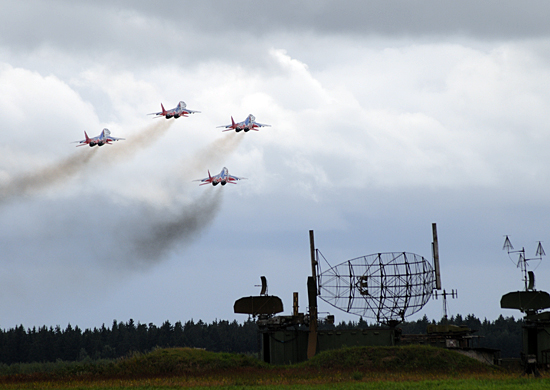
After the success of the MiG-29s at Farnborough in the autumn of 1988, the Soviet leadership decided in February 1989 to send several Sukhoi combat aircraft to the Paris show for the first time. Among them were a single-seat Su-27 -construction number 24-04, works code T10-41, flown with tail number 41, later replaced by the display number 388- in the hands of Viktor Pugachev, and a two-seat Su-27UB. The manoeuvre that became known as Pugachev's cobra had first been shown at the LII on 28 April 1989, having been worked up since March on T-10U-1. The bitter side of the episode came shortly before: LII test pilot Alexander Shchukin, a member of the cosmonaut group training for the Buran shuttle, failed to return from a test flight in the light Su-26M aerobatic aircraft. In the years that followed the Flanker became a fixture of air displays: the first Mosaeroshow was held at Zhukovsky in August 1992 with Su-27P, Su-27PU, Su-27UB and Su-27IB in the flying programme, and since 1993 the family has appeared at every MAKS. In 1990, on the way back from a display, two Su-27s stopped at New Delhi and were presented to the Indian armed forces leadership. (Source: airwar.ru, Su-27.)
The Nitka complex and the choice between catapult and ski-jump
The story of the naval Flanker starts before the naval aircraft itself. The Russian Su-33 article reconstructs a chain of aborted carrier projects: the NPKB studies led by A. B. Morin from 1968; project 1160, a nuclear-powered ship of up to 80000 tonnes whose air group was to combine Su-27K and MiG-23A fighters with anti-submarine aircraft; and project 1153, with catapults and arresting gear for the Su-27K, MiG-23K and Su-25K. The deaths of defence minister Grechko and shipbuilding minister Butoma killed both. As early as 1973 the Sukhoi bureau had produced preliminary studies of a shipborne T-10 under the works code T-12, and in 1978 it prepared a full outline design: normal take-off weight of 22.8 tonnes rising to 26.6 with weapons, two K-73 and six K-27E missiles, 150 rounds for the TKB-687 gun, 7.68 tonnes of fuel, a combat radius of 1150 to 1270 km and at least two hours on station 250 km from the ship.
When the catapult was dropped in 1981, the alternative put forward by Sukhoi and Mikoyan, backed by the LII and TsAGI, was a short take-off from a ski-jump, exploiting the high thrust-to-weight ratio of fourth-generation fighters. The Russian source lays out the trade-off without rhetoric: a catapult accelerates the aircraft to around 300 km/h over a piston stroke of about 90 metres, at the cost of longitudinal accelerations of up to 4.5 g that pilots tolerate poorly, whereas a ski-jump allows unstick at 180-200 km/h after a run of 100 to 180 metres, leaving the pilot fully in control, though it demands more thrust and better stability and handling, and cannot launch an aircraft at maximum weight in a flat calm or from a standing start.
Trials were run at the Nitka shore complex in Crimea, fitted with the experimental T-1 ski-jump, hold-back gear, the Svetlana-2 cable arrester, the Nadezhda emergency barrier net and the shipboard landing aids: the Rezistor radio system for automatic, semi-automatic and director approaches by day and night, Luna-3 for visual daylight approaches and Glissada-N for night work. The third Su-27 prototype of the original configuration, T10-3, began its runs on 24 July 1982 with Sadovnikov at the controls and made its first ski-jump launch on 28 August; Pugachev followed on 9 September. By 17 September 1982 that airframe had completed 27 take-offs, 17 of them from the ramp: at 18200 kg the run measured 230 metres and unstick came at 232 km/h, and under the best conditions those figures fell to 142 metres and 178 km/h at 18000 kg, with a maximum tested take-off weight of 22000 kg. The results forced a redesign of the ramp profile, which changed from a circular arc to a third-order curve.
In 1983 attention turned to arrested landings, first with a modified MiG-27 and then with T10-3 itself, by then out of flight hours and used for roll-in engagements without flying. Between August and October 1983 the programme accumulated 174 arrestments on the Svetlana gear at weights from 11 to 26 tonnes and entry speeds of 180 to 240 km/h. In 1984 T10-25, one of the first production Su-27s (number 06-03), joined the effort with strengthened landing gear, an arrester hook and enlarged flaperons: on 30 August Pugachev made the first engagement of the arresting block with it, and Sadovnikov repeated the feat the same day. The new T-2 ramp -5.6 metres high, 53.5 long, 17.5 wide, with an exit angle of 14.3 degrees- an exact replica of the bow of the ship under construction, saw its first launch on 25 September 1984. Between August and October that year T10-25 flew 160 touch-and-go approaches, 44 of them automatic, plus 9 arrested landings and 16 ramp launches. Its career ended on 11 November 1984, when a hydraulic line in the rudder control circuit burst during a flight at the Akhtubinsk range and Sadovnikov ejected inverted from 1000 metres; the aircraft was destroyed and the pilot was unhurt.
The programme continued with T10-24 (Su-27 number 07-01), by then fitted with canards to study their influence on ramp take-off dynamics, but only six flights were flown: on 20 January 1987 the aircraft crashed and its pilot, A. Puchkov of the air force test institute, ejected. Its replacement was T-10U-2, a Komsomolsk-built Su-27UB (number 02-01) equipped with in-flight refuelling and a hook, on which five pilots flew twelve sorties in two months to work out night approaches using Glissada-N. Nitka later cleared the first two Northern Fleet aviators, colonels Timur Apakidze and P. L. Yakovlev, for unsupervised deck landings. Flying continued until December 1991; with Ukrainian independence the complex fell outside Russia and its use lapsed until the two governments agreed to operate it jointly. (Source: airwar.ru, Su-33.)
T-10K: the carrier fighter prototypes
The decree formally ordering a shipborne air-defence fighter, the Su-27K, on the basis of the Su-27 was issued on 18 April 1984, and the outline design of the aircraft, works code T-10K, was approved by the air force and navy commanders in February 1985. General designer Mikhail Simonov led the work; from 1984 the project chief was Konstantin Khristoforovich Marbashev, who from 1989 became chief designer for naval aviation, with Mikhail Aslanovich Pogosyan as his deputy in charge of all technical documentation for the carrier fighter. Airframe assemblies came from Komsomolsk and were assembled at the Moscow experimental plant.
The changes from the land-based single-seater went far deeper than the folding wing usually cited: canards previously tested on T10-24, with the leading-edge root extensions reshaped and the fly-by-wire and hydraulic systems reworked accordingly; strengthened main and nose gear, the nose leg now telescopic and twin-wheeled, with tie-down and towing fittings on every leg and a three-colour indicator that told the landing signal officer where the aircraft sat on the glide path and how fast it was coming; deletion of the braking parachute from the central tail boom and relocation of the chaff and flare dispensers; and an in-flight refuelling system. A full-size mass and dimensional mock-up was built, followed by a structural and technological mock-up, the T-10KTM, converted from one of the first production Su-27s, T10-20 (number 05-05). The structural reinforcement demanded by no-flare deck landings, with sink rates and load factors far above those of a runway arrival, increased empty weight and cost performance. To guarantee a bolter after a missed wire, a version of the AL-31F was planned with a special rating briefly raising thrust to 12800-13000 kgf. In the navigation suite the A-317 system gave way to the airborne element of the ship's Rezistor. The weapons system, by contrast, was essentially that of the production Su-27, with the same N001 radar, although hardpoints rose to 12 and maximum weapon load to 6500 kg.
The first aircraft, T-10K-1 with tail number 37, flew on 17 August 1987 with Pugachev at the controls, still carrying the non-folding wing and tail of a land-based Su-27; the lead test engineer was G. G. Smotritsky. The second, T-10K-2 with tail number 39 and the definitive naval wing, was first flown by Sadovnikov on 22 December 1987. T-10K-1 received folding wings in the summer of 1988 and flew in that configuration on 25 August, only to be lost barely a month later, on 28 September 1988. By Sadovnikov's own account, at 2000 metres and 1270 km/h a warning of falling pressure lit for one hydraulic system and, moments later, for the other. The accident commission ordered hydraulic modifications and the failure never recurred, but that flight ended the career of Sadovnikov, Hero of the Soviet Union and world record holder, who was left with serious injuries. The testing burden then fell on T-10K-2, on which Pugachev logged some 300 flights over the following year. (Source: airwar.ru, Su-33.)
The T-10U two-seater as the Russian source tells it
The Russian article on the Su-27UB adds precision about the two-seater. Design work under the works code T-10U began in the late 1970s, before the first aircraft of the revised configuration had even flown, and the outline design was ready in 1980. Training was not the only motive: given the Su-27's range and endurance, a second crew member was in some cases positively preferable. A static test airframe was completed in 1984 and the first flying example, T-10U-1, was taken up by Sadovnikov on 7 March 1985, joined in 1986 by T-10U-2 and T-10U-3. The first Irkutsk-built production machine, T-10U-4, was flown by factory test pilots G. E. Bulanov and N. N. Ivanov on 10 September 1986. The differences from the single-seater are measurable: tandem cockpits under a single canopy hinged upward and aft, the rear seat raised, with reshaped forward fuselage and dorsal spine contours; fin area increased by 3.1 square metres through 420 millimetre inserts at the root of each fin, raising static height from 5.932 to 6.357 metres; airbrake area enlarged from 2.6 to 3.0 square metres with a reduced maximum deflection; empty weight up from 16000 to 17500 kg and maximum take-off weight from 28000 to 30500 kg. An export variant, the Su-27UBK, was developed. (Source: airwar.ru, Su-27UB.)
Su-27SK and Su-27SM in the Russian documentation
The Russian articles on the two variants confirm and qualify what is set out above. The Su-27SK is described as the export model built by KnAAPO, an air superiority fighter with a secondary unguided air-to-ground capability, intended for patrol and air defence of national territory and for escorting strike aircraft on long-range raids, powered by two AL-31F of 12500 kgf maximum thrust and equipped with an automatic control system tied into navigation, weapons control and ground-controlled interception: it stabilises attitude and altitude, recovers the aircraft to level flight from any position, flies programmed climbs and descents and a preset route, and brings the aircraft home and onto the approach using radio beacons. The Su-27SM article dates the first flight to 27 December 2002 and itemises the upgrade: an L-150 radar warning receiver and a reworked SUV-27E weapons control system able to employ RVV-AE (R-77) air-to-air missiles and Kh-29T and Kh-29TE, Kh-29L, Kh-31P and Kh-31A air-to-surface weapons, together with KAB-500KR and KAB-1500KR guided bombs. A caveat is in order: the same text mixes the history of the original T-10 into the SM's, going so far as to claim that Su-27SM was the classified name of the T-10 project, which is plainly an error on the source's part, since the SM is a 2000s upgrade and not a cover designation for a 1970s programme. (Sources: airwar.ru, Su-27SK and Su-27SM.)
What the Russian material settles and what it leaves open
The recovered material pins down one of the divergences noted above. The collision with the Norwegian maritime patrol aircraft did not take place in the Baltic: the Russian source places it on 13 September 1987 in the Barents Sea, some 260 km south-east of Vardø and around 90 km from Soviet territory, and states that the P-3B landed at Banak at 11:57 and that both aircraft returned to their bases, attributing the event to flying indiscipline by the Soviet pilot. That account contradicts the Western version in which propeller fragments depressurised the Orion and F-16s had to escort it; the divergence over consequences stands, but the date and location are now established.
The others remain open. The Russian material does not address the loss of the Su-33 in December 2016, nor the circumstances of the friendly-fire shoot-down described above, so the competing versions in those sections are still unresolved. Two new cautions emerge as well. The first concerns nomenclature: the designation P-42 appears in Russian sources with two entirely unrelated meanings, the shipborne anti-submarine aircraft the Beriev bureau was designing for the project 1160 carrier and the stripped-down Su-27 used for the climb records, and the two should not be confused. The second concerns figures: the R-32 engine designation declared to the FAI in 1986 corresponds to no actual engine of the aircraft, and it was precisely that declaration that led Western analysts to credit the powerplant to a different design bureau. (Sources: airwar.ru, Su-27 and Su-33.)
Variants
| T-10 | T-10S | Su-27S | P-42 | Su-27BM2 | Su-27M2 | Su-27P | Su-27P1M | Su-27PD | Su-27S1M | Su-27SK | Su-27SKM | Su-27SM | Su-27SM3 | Su-27UB | Su-27UB1M | Su-27UBK | Su-27UBM2 | Su-27UP1M | |
|---|---|---|---|---|---|---|---|---|---|---|---|---|---|---|---|---|---|---|---|
| First flight | May 20, 1977 | April 20, 1981 | June 2, 1982 | — | — | — | — | — | — | — | — | — | — | — | — | — | — | — | — |
| Aircraft type | — | — | Heavy air-superiority fighter | — | — | — | — | — | — | — | — | — | — | — | — | — | — | — | — |
| Powerplant | — | — | 2 × Saturn AL-31F afterburning turbofans rated at 122.6 kN each in afterburner | — | — | — | — | — | — | — | — | — | — | — | — | — | — | — | — |
| Powerplant | 2 × Lyulka AL-21 | 2 × Lyulka AL-31 | 2 × Saturn AL-31F | 2 × turbofan | 2 × turbofan | 2 × turbofan | 2 × Saturn AL-31F | 2 × turbofan | 2 × Saturn AL-31F | 2 × turbofan | 2 × Saturn AL-31F | 2 × Saturn AL-31F | 2 × Saturn AL-31F | 2 × Saturn AL-31F-M1 | 2 × Saturn AL-31F | 2 × turbofan | 2 × Saturn AL-31F | 2 × turbofan | 2 × turbofan |
| Thrust per engine | — | — | 123 kN Best value in this row | — | — | — | — | — | — | — | 123 kN Best value in this row | — | 123 kN Best value in this row | — | 123 kN Best value in this row | — | — | — | — |
| Length | — | — | 21.9 m Best value in this row | — | — | — | — | — | — | — | 21.9 m Best value in this row | — | 21.9 m | — | 21.9 m Best value in this row | — | — | — | — |
| Wingspan | — | — | 14.7 m Best value in this row | — | — | — | — | — | — | — | 14.7 m Best value in this row | — | 14.7 m Best value in this row | — | 14.7 m Best value in this row | — | — | — | — |
| Height | — | — | 5.9 m | — | — | — | — | — | — | — | 5.9 m | — | 6.4 m Best value in this row | — | 6.4 m | — | — | — | — |
| Wing area | — | — | 62 m² Best value in this row | — | — | — | — | — | — | — | 62 m² | — | 62 m² Best value in this row | — | 62 m² Best value in this row | — | — | — | — |
| Empty weight | — | — | 16,300 kg | 14,100 kg Best value in this row | — | — | — | — | — | — | 16,000 kg | — | 17,000 kg | — | 17,500 kg | — | — | — | — |
| MTOW | — | — | 30,000 kg | — | — | — | — | — | — | — | 33,000 kg Best value in this row | — | 33,000 kg Best value in this row | — | 30,500 kg | — | — | — | — |
| Top speed | — | — | 2,500 km/h Best value in this row | — | — | — | — | — | — | — | 2,430 km/h | — | 2,500 km/h Best value in this row | — | 2,125 km/h | — | — | — | — |
| Max speed altitude | — | — | 11,000 m | — | — | — | — | — | — | — | — | — | — | — | 11,000 m | — | — | — | — |
| Service ceiling | — | — | 18,500 m Best value in this row | — | — | — | — | — | — | — | 18,000 m | — | 18,000 m | — | 17,250 m | — | — | — | — |
| Initial climb rate | — | — | 300 m/s | — | — | — | — | — | — | — | — | — | — | — | — | — | — | — | — |
| Range | — | — | 3,680 km | — | — | — | — | — | — | — | 3,680 km | — | 3,900 km Best value in this row | — | 3,600 km | — | — | — | — |
| Ferry range | — | — | 4,000 km | — | — | — | — | — | — | — | — | — | — | — | — | — | — | — | — |
| Combat radius | — | — | 1,500 km | — | — | — | — | — | — | — | — | — | — | — | — | — | — | — | — |
| Range conditions | — | — | 3,680 km practical range at altitude on 9,400 kg of internal fuel; 1,370 km at sea level. GlobalSecurity quotes a 1,500 km typical combat radius and a 4,000 km maximum range | — | — | — | — | — | — | — | — | — | — | — | — | — | — | — | — |
| Armament | — | — | 1 × 30 mm GSh-30-1 cannon with 150 rounds; up to 6,000 kg on ten hardpoints, with up to six medium-range R-27 air-to-air missiles and up to four short-range R-73s | — | — | — | — | — | — | — | — | — | — | — | — | — | — | — | — |
| Max weapons load | — | — | 6,000 kg | — | — | — | — | — | — | — | 8,000 kg Best value in this row | — | 8,000 kg Best value in this row | — | 6,000 kg | — | — | — | — |
| Payload | — | — | 0 kg | — | — | — | — | — | — | — | — | — | — | — | — | — | — | — | — |
| Cargo capacity | — | — | No civil payload capability: a pure fighter, with no passenger cabin or hold | — | — | — | — | — | — | — | — | — | — | — | — | — | — | — | — |
| Crew | 1 Best value in this row | 1 Best value in this row | 1 Best value in this row | 1 Best value in this row | 1 Best value in this row | 1 Best value in this row | 1 Best value in this row | 1 Best value in this row | 1 Best value in this row | 1 Best value in this row | 1 Best value in this row | 1 Best value in this row | 1 Best value in this row | 1 Best value in this row | 2 | 2 | 2 | 2 | 2 |
| Passengers | — | — | 0 | — | — | — | — | — | — | — | — | — | — | — | — | — | — | — | — |
Images