Sukhoi Su-27 variant
Sukhoi Su-27SM
The Su-27SM ("seriyny modernizirovanny", serial modernised) is the mid-life upgrade that turned Russia's Soviet-built Su-27s into 4+ generation multirole fighters. The prototype flew on 27 December 2002 and the first five aircraft were handed over at Lipetsk on 26 December 2003. It brings a fire-control system able to use the R-77 missile and guided air-to-surface weapons, a cockpit with multi-function displays, the L-150 radar warning receiver and in-flight refuelling. Units received 45 aircraft by 2009 and a further 12 by 2011, and the export Su-27SKM and the later Su-27SM3 both descend from it.
-800.webp)
- December 27, 2002
- First flight
- 3,900 km
- Range
History
Origin and development
The production Su-27 inherited by the Russian Air Force after the Soviet collapse was a pure interceptor: its fire-control system knew only the air-to-air mode and its guided weapons were limited to the R-27 and R-73 missiles. Through the 1990s Sukhoi had tested on the Su-27M demonstrator and in export programmes a set of improvements that never reached Russian units for lack of money. When, early in the 2000s, the budget allowed something to be done about the fleet, the design bureau and the Komsomolsk-on-Amur plant (KnAAPO) proposed not to build new aircraft but to apply a serial modernisation package to the existing airframes — hence the SM suffix, "seriyny modernizirovanny", rendered in English sources as "Serial Modernized".
The main lines of the upgrade were worked out on a production Su-27, airframe No. 38-02 with tactical number 56, taken straight from a fighter regiment that shared the Dzemgi airfield with the factory. Conversion was completed at the end of 2002 and on 27 December 2002 Sukhoi test pilot Yevgeny Frolov took it up for the first time. After a few flights at Komsomolsk and then at Zhukovsky, the lead Su-27SM moved to Akhtubinsk for state trials. Early in 2003 it was joined by a second aircraft, No. 40-02, which since 1998 had served as the testbed for the export Su-27SK modernisation and had already received a refuelling probe and improved navigation equipment, a period in which it was known as the Su-30KI; wearing tactical number 305, it became the reference aircraft for the modernised export single-seater, the Su-27SKM. According to Russian Wikipedia the first stage of state trials was passed in 2004, the year English Wikipedia gives as the official start of the programme.
Differences from the basic Su-27
The deepest change lies in the fire-control system. The original SUV-27E was reworked into the SUV-VESh, which allows up to six R-77 (RVV-AE) active-radar air-to-air missiles to be carried and adds the Kh-31A anti-ship missile. The radar sighting complex became the RLPK-27VESh, a development of the Su-27SK's RLPK-27E with an air-to-surface channel added: the N001V radar can map terrain by real beam and by synthetic aperture at medium and high resolution, detect and track ground and naval targets, pick out moving targets — a tank travelling at 15 to 90 km/h — and, in long-range detection mode, see a fighter at more than 150 km. English Wikipedia describes the same leap as a slightly improved radar, a new electro-optical sighting system and a more advanced mission computer, which together enable synthetic-aperture mapping and the detection of maritime targets.
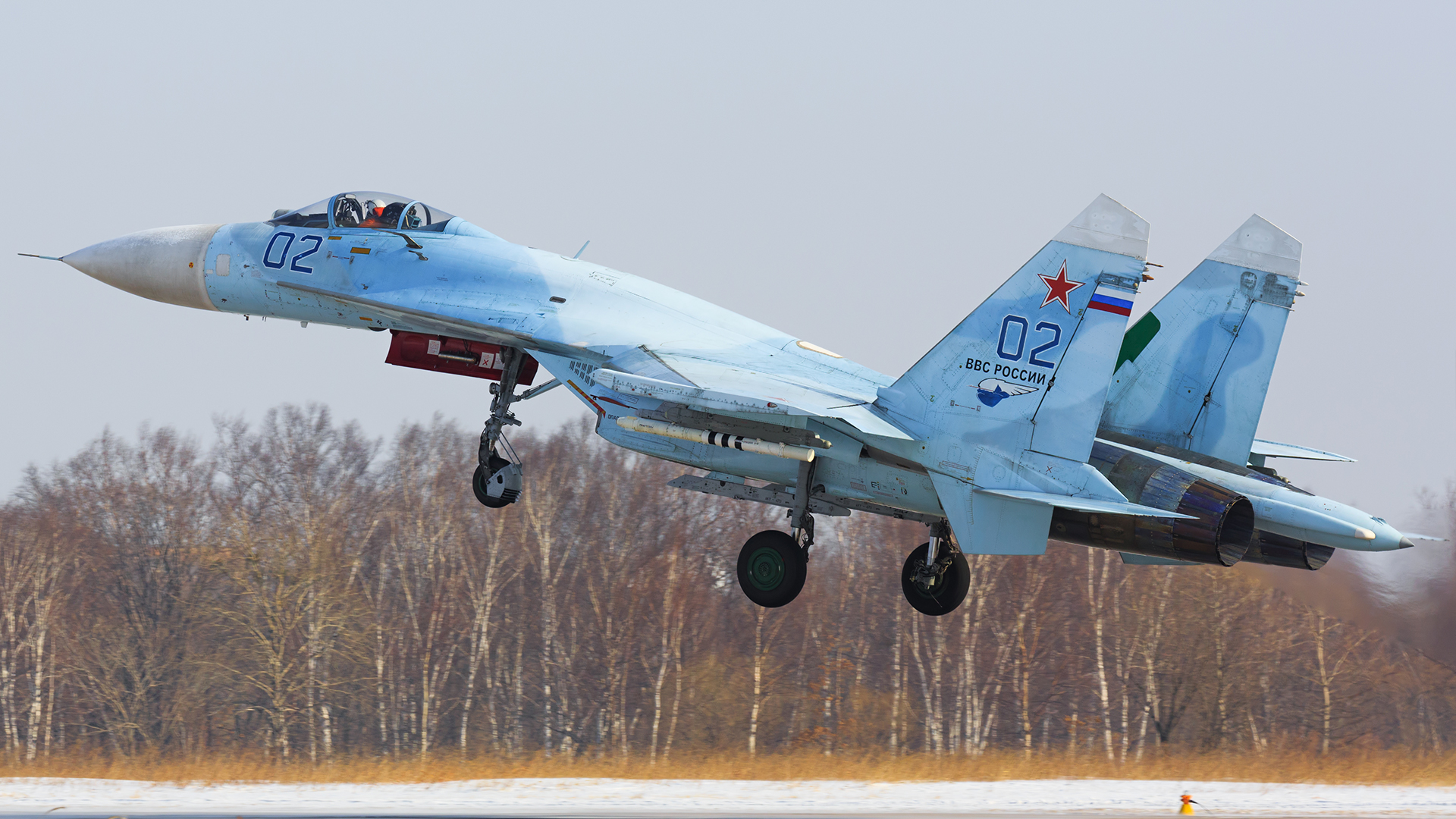
The electro-optical system was upgraded to the OEPS-27MK, with the new OLS-27MK optical-locator station and the Sura-K helmet-mounted sight, and the head-up display became the SILS-27ME. The cockpit shed its analogue instruments: three colour liquid-crystal multi-function displays concentrate flight, navigation and weapons information. The avionics were hardened to survive intense electronic countermeasures: a new radar warning receiver, the L-150, was fitted — English Wikipedia identifies the new receiver as the Pastel, replacing the SPO-15 Beryoza of the original aircraft — and the Sorbtsiya wingtip jamming pods gave way to the Khibiny. An in-flight refuelling system, an improved ejection seat and a better navigation system were added. A batch of 24 Su-27SMs also received slightly uprated engines.
In terms of weapons the Su-27SM adds the Kh-29T (TE) and Kh-29L air-to-surface missiles, the Kh-31P anti-radar missile and the KAB-500KR and KAB-1500KR guided bombs to the R-77 air-to-air missile. The Airwar entry details that, on its 10 hardpoints, it can carry up to 8 R-27 or RVV-AE missiles and up to 6 R-73s; in the strike role, 6 Kh-29T, Kh-29L, S-25LD or KAB-500Kr, 4 Kh-31P or Kh-25MP anti-radar missiles, or 2 medium-range Kh-59M missiles, in every case with an external weapons-control pod. Maximum warload rises to 8,000 kg, the gun remains the 30 mm GSh-301 with 150 rounds, and maximum take-off weight becomes 33,000 kg (17,000 kg empty, 23,700 kg normal take-off). The two AL-31F engines, with 7,770 kgf dry and 12,500 kgf in afterburner, keep the family's performance: 1,400 km/h at sea level, 2,500 km/h (Mach 2.35) at altitude, an 18,000 m ceiling, 3,900 km practical range and a 9 g load factor. Dimensions are unchanged: 14.70 m span, 21.93 m length, 6.36 m height and 62.04 m² of wing area. NATO naming has not been consistent: some lists call it Flanker-B Mod. 1, others Flanker-E.
Production
Even before trials of the two prototypes were complete, KnAAPO began the serial modernisation of line fighters early in 2003 on Air Force order. On 26 December 2003 the first five Su-27SMs were handed over and flew to the Combat Employment and Aircrew Conversion Centre at Lipetsk: it was the first time in the history of the Russian air arm that a group of combat aircraft upgraded to 4+ generation level had joined a line unit. By 2009 the troops had received 45 aircraft; in 2008 work began on the backlog of export Su-27SK airframes left without a buyer, and a further 12 aircraft came from it by 2011. In 2012 half of the Su-27 fleet was reported as modernised, and in January 2014 the Russian Air Force counted 70 Su-27SMs and 12 Su-27SM3s alongside 225 unmodernised Su-27s and 52 Su-27UBs.
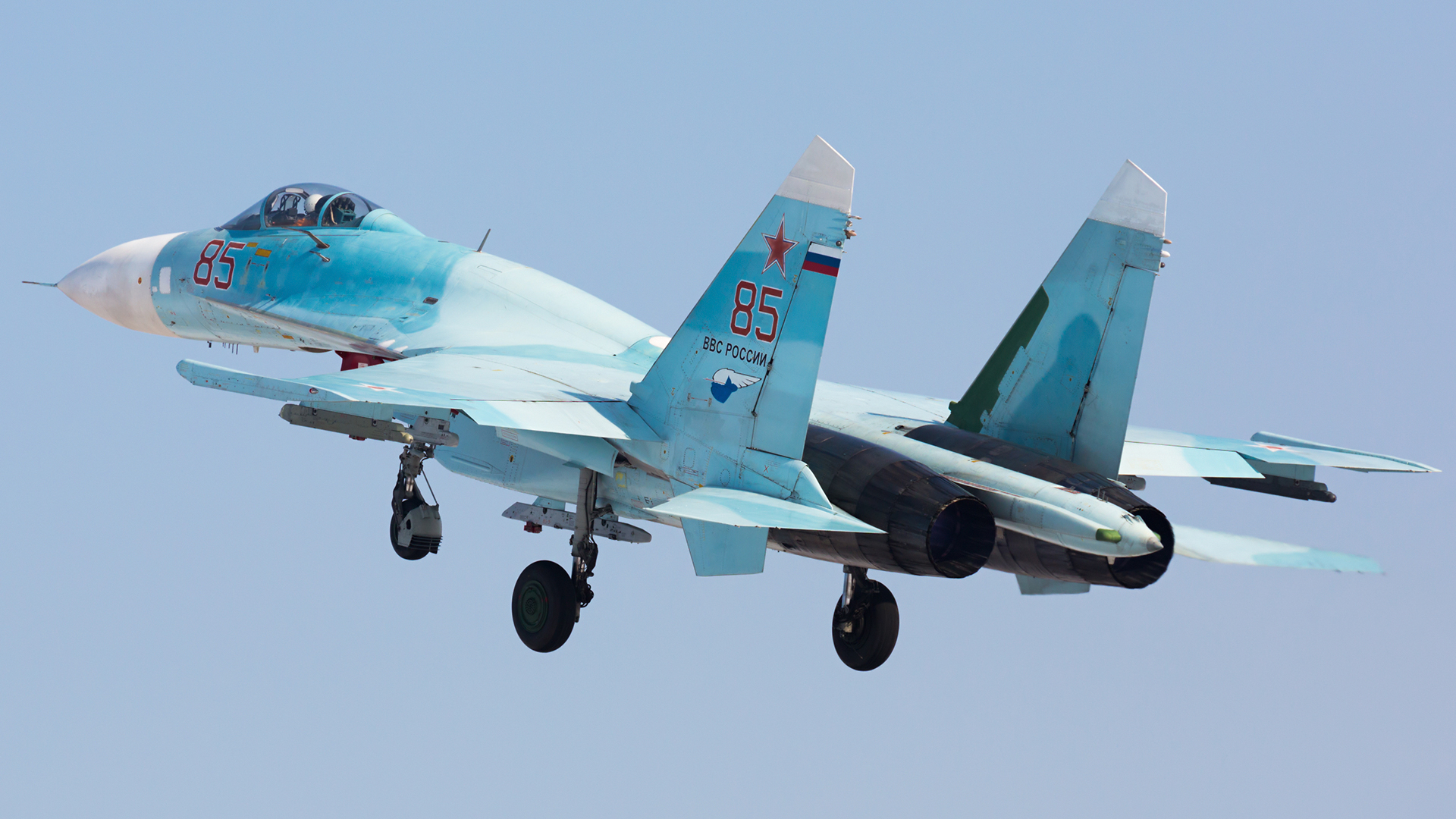
From the Su-27SM came the Su-27SKM, an export version that first flew in 2002 and whose performance approaches that of the Su-30MKK and Su-30MK2; it adds an advanced cockpit, more sophisticated electronic countermeasures and a refuelling probe. Indonesia received three in 2010 and in 2016 brought its two Su-27SKs up to the same standard. Sukhoi also proposed a Su-27SM2 with technology from the Su-35BM — Irbis-E radar, uprated engines and avionics — which never entered service on cost grounds; the name Su-27SM2 was even applied to the Su-35 itself before its final designation.
Operational service
The Su-27SMs were spread among the fighter regiments of the Air Force and later the Aerospace Forces, where they have served alongside original Su-27s and the newer members of the family. The L-150 warning receiver and the weapons system carried over unchanged to the SM2 and SM3 stages, and the Su-27SM itself is the base on which the Su-27SM3 package is applied. The Military Balance 2024 credits the Aerospace Forces with 47 Su-27SMs and 24 Su-27SM3s, together with 12 Su-27s and 18 Su-27UBs.
Legacy
The Su-27SM was the first Russian programme to turn an inherited fleet into multirole fighters rather than replace it, and it proved that the Su-27 airframe could take a full air-to-surface weapons system without any change to its aerodynamics. Its development fed the Su-27SKM exported to Indonesia and served as the bridge to the Su-27SM3 and, ultimately, to the Su-35S.
Multimedia


-1600.webp)
-1600.webp)
-1600.webp)
-1600.webp)
-1600.webp)
-1600.webp)
-1600.webp)


-1600.webp)
-800.webp)
-1600.webp)
-800.webp)
-800.webp)


-1600.webp)
-1600.webp)


-800.webp)
-800.webp)
-1600.webp)
-1600.webp)
-1600.webp)
-1600.webp)