Airliner · Civil · Sweden
Saab 2000
- March 26, 1992
- First flight
- 1994
- Introduced
- In service
- Status
- 63
- Units built


_SE-LSB-800.webp)
-1600.webp)



-1600.webp)


_de_Freight_Runners_Express%2C_N506FR-1600.webp)


-1600.webp)


The Saab 2000 is a twin-engined, low-wing, pressurised regional turboprop built at Linköping in Sweden and conceived in the late 1980s as the next size up from the successful Saab 340. Saab committed to the design in December 1988 and launched the programme in May 1989 with 46 firm orders and options on a further 147 aircraft. The guiding idea was straightforward and ambitious: give regional carriers a fifty-seat aeroplane able to string together short and medium sectors with block times close to those of a jet, while keeping the fuel burn and operating economics of a propeller. Final assembly was Swedish, but the industrial share-out was European, with CASA building the wings, Short Brothers the rear fuselage and Valmet the tail surfaces. It was far more than a stretched 340. The aircraft kept its predecessor's fuselage cross-section, and with it the two-plus-three cabin layout, but added 7.55 metres of length and introduced an entirely new wing whose span grew from 21.44 to 24.76 metres. Allison AE 2100A engines, in what remained their only civil application, drove six-blade composite Dowty propellers turning unusually slowly to keep the noise down, and brought the first dual FADEC on a turboprop, governing engine and propeller from a single lever. The type cruised as high as 9,450 metres (31,000 feet), altitudes previously reserved for regional jets, reached 685 km/h, and offered a Collins Pro Line 4 glass cockpit alongside an active noise-cancellation system of 72 microphones and 36 loudspeakers that was genuinely unusual for its day. The prototype first flew on 26 March 1992, but an interaction between the propeller slipstream and the mechanical elevator control system delayed certification by almost two years, until March 1994. Its airline career was short and lopsided. The type entered service in 1994 with Switzerland's Crossair, which nicknamed it the "Concordino" and eventually operated thirty-four examples, more than half of all production. The trouble was not the aeroplane but the market: while it was being built, regional carriers switched to the fifty-seat jets of Bombardier and Embraer, which passengers preferred, and the Saab's speed advantage over rival turboprops stopped being the decisive argument. Too expensive to undercut conventional turboprops and carrying the wrong badge to fight jets on image, Saab closed the line in 1999 after 63 aircraft, against the more than four hundred and fifty Saab 340s of the previous decade. The interesting part came afterwards. With low residual values, the type found on the used market the niche it had never won new: thin routes, short runways and mountainous terrain, from Loganair's Shetland services to PenAir's Aleutian network, by way of Darwin Airline, Eastern Airways, Carpatair and Braathens Regional. Its safety record is unremarkable in the best sense, with four hull losses and a single fatality, in the 2019 runway overrun at Unalaska in Alaska, where the NTSB traced the accident to mis-wired anti-skid transducer harnesses and issued recommendations reaching well beyond this one design. In parallel, Saab gave the airframe a military second life: the Saab 2000 Erieye AEW&C, carrying the PS-890 electronically scanned radar in a dorsal fairing, with more than nine hours of endurance and a surveillance area of over 500,000 km², serves with Pakistan and Saudi Arabia, and spawned a whole surveillance family covering signals intelligence, maritime patrol and flight inspection before the product line moved to newer platforms. A third life arrived through the cargo door. Sweden's Täby Air Maintenance developed the Saab 2000F freighter, offering 55.4 m³ of hold volume and a maximum payload of 6,622 kg; the first converted aircraft flew in March 2023, and the supplemental type certificate was approved in Europe in December 2025 and in the United States in 2026, more than thirty years after the prototype's maiden flight. That trajectory sums up the aeroplane's place in regional aviation history: commercially ill-timed and technically excellent, its very strengths — speed, range, ample power and short-field capability — were not enough to sell airliners, yet they are exactly what a surveillance platform or an overnight express freighter is looking for.
Related sheets
Category
History
From the 340 to the 2000: Sweden's bet on a turboprop with a jet's soul
Since the 1970s Saab had been turning over the idea of building civil airliners rather than just fighters, convinced there was room for a short-haul regional aircraft seating around thirty, powered by turboprops that were far cheaper to operate than jets. That conviction, combined with an alliance with the American company Fairchild, produced the Saab-Fairchild 340, which entered service in 1983; when Fairchild pulled out of the aviation business in 1985, after forty aircraft, the programme passed entirely into Swedish hands and went on to grow to 459 aircraft built.
That success pushed Saab to aim higher. In the late 1980s the company — still Saab-Scania at the time — spotted a demand nobody was fully serving: a fifty-seat turboprop able to climb quickly and string together short and medium routes with block times comparable to a jet's, while keeping the fuel burn and operating costs of a propeller aircraft. The decision to develop that aircraft was taken in December 1988, and the programme was formally launched in May 1989 with an order book that looked solid at the time: 46 firm orders and options on a further 147 aircraft. The application filed with the Swedish civil aviation authority was opened on 28 April 1989, a date the type certificate data sheet still records as the reference point for determining the applicable requirements.
Final assembly was concentrated at the Linköping plant in southern Sweden, but the industrial split was European: CASA built the wings, Short Brothers the rear fuselage, and Valmet the tail surfaces. The design work was carried out using CATIA, the three-dimensional computer-aided design tool that was cutting-edge at the time, and the result was, in practice, a new aircraft rather than a stretch of the 340.
On the commercial side, the launch rested on Crossair, the Swiss regional carrier majority-owned by Swissair: the type's first operator, recipient of the first production aircraft in August 1994 and, in time, the model's biggest user. It was also Crossair that coined the nickname that best sums up the aircraft's character, "Concordino," a nod to Concorde that the trade press later rendered as "the Concorde of turboprops."
The design: a stretched 340 that was really a different aircraft
The starting recipe was a familiar one. The Saab 2000 kept the 340's fuselage cross-section — which preserved the two-plus-three seating layout per row — but stretched it by 7.55 metres, a gain that translated into seating for 50 passengers at a comfortable 32-inch pitch, or up to 58 in a high-density layout at 30 inches. The more restrictive European type certificate data sheet caps the certified seating at 53 with two cabin crew. It is a low-wing, pressurised twin designed for short and medium routes, 27.3 metres long, 7.7 metres tall, with a wing area of 55.7 square metres.
The wing, by contrast, was entirely new. Span grew 15% over the 340, from 21.44 to 24.76 metres, with a straight, high-aspect-ratio planform that improved low-speed and altitude behaviour while preserving the short-field capability that regional operators expect as a matter of course. The engines were mounted on the wings, as on the 340, but moved outboard to push the propeller discs further from the fuselage and cut cabin noise.
That same attention to acoustic comfort carried through to the cabin with a solution that was unusual then and still rare today: an active noise control system built from 72 microphones and 36 loudspeakers that generated anti-phase sound to cancel out the characteristic propeller drone. On the flight deck, Saab fitted a glass cockpit built around the Collins Pro Line 4 avionics suite, with six colour cathode-ray-tube displays — state-of-the-art electronic flight instrumentation for a propeller aircraft of that era.
The whole design followed one guiding idea: to close in on jet-like performance without giving up propeller efficiency. The aircraft was designed for a maximum cruise speed of Mach 0.62 and to fly up to a pressure altitude of 9,450 metres (31,000 feet), territory until then reserved for regional jets.
The powerplant: the AE 2100A and six-blade Dowty propellers
The aircraft's heart came from Indianapolis. On 11 July 1989 Saab-Scania selected the GMA 2100 from Allison Engine Company — at the time a division of General Motors, hence the initials — in a deal valued at $500 million. When Allison was folded into Rolls-Royce, the engine was renamed the AE 2100, and the Saab 2000 became the first commercial aircraft to carry it, in its sole civil variant, the AE 2100A.
The engine was not built from a clean sheet: it derives from the AE 1107C-Liberty turboshaft (Rolls-Royce T406) and shares with it — and with the AE 3007 turbofan — the same high-pressure core, with parts commonality above 80%, designed to keep maintenance and life-cycle costs down. It also inherits the fourteen-stage axial compressor of the veteran Allison T56, with variable inlet guide vanes and variable vanes on the first five stator stages, a sixteen-nozzle air-blast annular combustor, a two-stage turbine driving the compressor — with single-crystal blades on the first stage — and a separate two-stage free power turbine that drives the propeller through an inner shaft and a reduction gearbox. Above all, it was the first turboprop to use a dual FADEC — full-authority digital engine control — governing both engine and propeller together, so that a single lever set both. Before it ever flew on the Swedish aircraft, it was tested from 23 August 1990 on a Lockheed P-3 Orion flying testbed fitted with a 4.11-metre-diameter Dowty R373 propeller, in a campaign that logged more than fifty hours between flight and ground running.
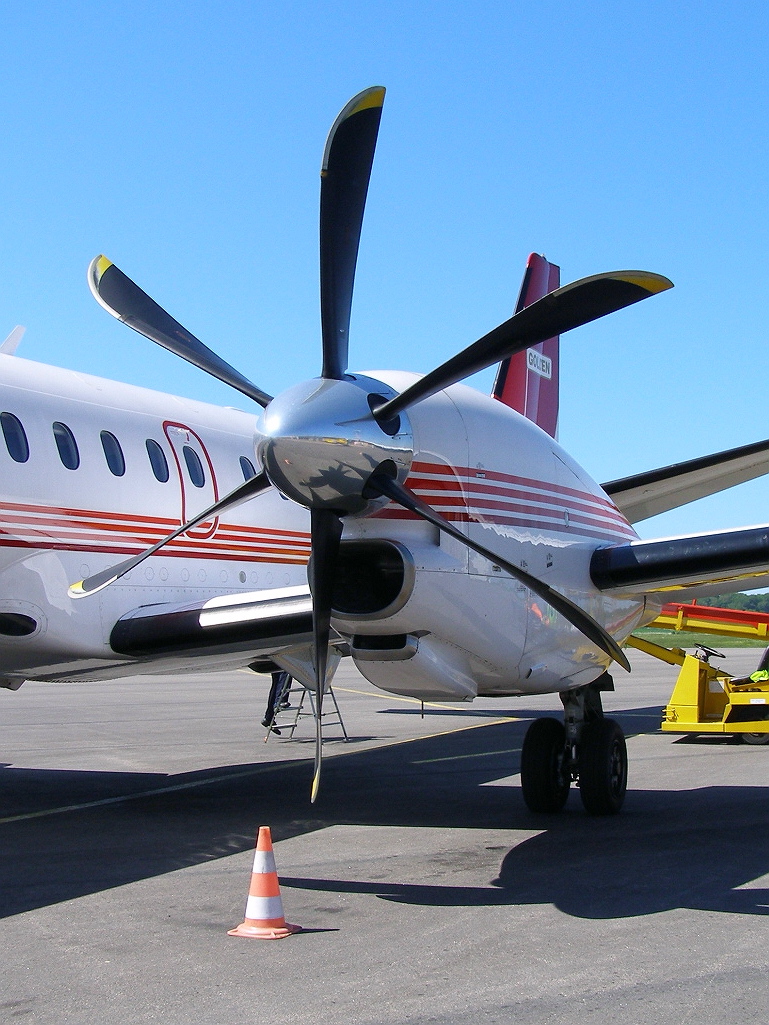
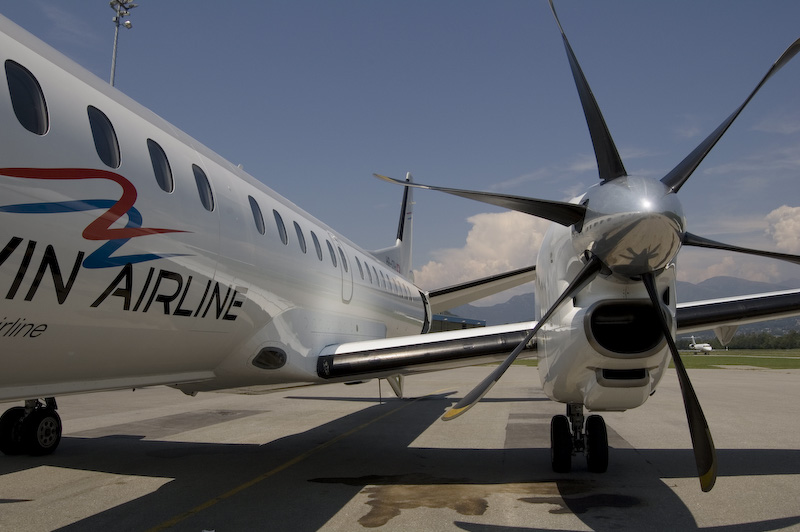
The figures the type certificate data sheet lists for the Saab 2000 are 2,788 kW (3,738 shp) for normal and maximum continuous takeoff power, and 3,097 kW (4,152 shp) for maximum takeoff power, with a power-turbine-to-propeller reduction ratio of 13.98 to 1. The propeller is a six-blade, composite Dowty R.381/6-123-F/5, 3.81 metres in diameter, variable-pitch, feathering and reversible, with no diameter reduction permitted. Its defining trait is how slowly it turns: around 1,100 rpm at takeoff and 950 in cruise, a low regime that helps keep both noise and blade-tip effects in check.
The result lived up to the marketing. With that power the Saab 2000 reached a maximum speed of 685 km/h and cruised at around 665 km/h — several sources also cite 682 km/h as maximum cruise — roughly 100 km/h faster than its direct rivals: the ATR 42, the Fokker 50 and the Dash 8-300. Hence the label that stuck with it throughout its commercial life: one of the fastest turboprops ever built.
From first flight to certification: two years of fighting the elevator control
The prototype took off for the first time on 26 March 1992, with test pilots Eric Sjöberg and Lennart Nordh at the controls and flight test engineers Sture Rodling and Anders Bergstrand on board; Bergstrand himself would later recall that flight as the experience of a lifetime for a young engineer. The euphoria did not last long. The flight test campaign uncovered a serious control problem: the airflow that the large six-blade propellers threw over the horizontal stabiliser was significantly affecting the mechanical elevator control system (MECS), an effect that traced directly back to the power of the Allison engines and the size of the propellers.
Engineers tried numerous configurations over several months and, although there were improvements, Saab was not satisfied; the definitive fix came when Allison redesigned a large part of the propeller. The price was delay: almost exactly two years passed between the first flight and the signing of the certificates.
European certification came through the Joint Aviation Authorities in March 1994, and American certification through the FAA in April of the same year. The type certificate data sheet for EASA.A.069, whose tenth issue is dated 27 June 2018, records the process in precise detail: application filed with the State of Design authority on 28 April 1989 and type certificate issued on 31 March 1994, originally granted by the Swedish authority as LFV TC A 1/94 and later superseded by the European certificate, with Saab AB in Linköping as the holder. The certification basis was JAR 25 at Amendment 13, including the ice protection and ditching provisions, plus JAR AWO at Amendment 1 for automatic landing and low-visibility operation, which gave the aircraft all-weather capability in Category III.
The document also shows just how much the aircraft forced the authorities to write bespoke special conditions: on propeller position during minimum control speed demonstrations, on stall speeds, on torque factors, on the propeller reversing system, and on the electronic pitch control system, among others. Minimum crew was set at two pilots, and the certified maximum weights at 22,999 kg at takeoff — 22,800 kg after Modification 5949, which increases fuel capacity — with a landing weight of 22,000 kg. With the paperwork in order, the Saab 2000 entered scheduled commercial service in September 1994, a few months after certification.
Entering service: Crossair's "baby Concorde" against the regional jets
The Saab 2000 entered service on 30 August 1994 and began flying scheduled routes in September of that year, months after receiving its type certificates. Its launch customer was Crossair, the Swiss regional airline majority-owned by Swissair, which went on to operate thirty-four examples between 1994 and 2005 and which popularised the nickname the aircraft is still remembered by: the "baby Concorde". The nickname captures the programme's commercial promise well. Saab was not selling a cheaper turboprop, but a turboprop able to link regional airports to the major connecting hubs in block times close to those of a jet, while keeping the fuel burn of a propeller powerplant. For a carrier like Crossair, which fed Swissair's network from short-runway Alpine airfields, that combination had obvious value.
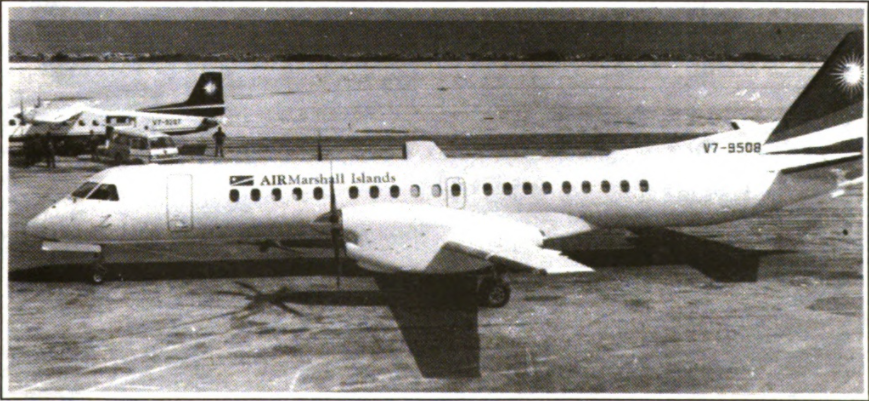
The early years brought a scattered and varied customer base, more a matter of niches than of large fleets. The French carrier Regional Airlines, based in Nantes, received its first Saab 2000 in Paris in 1995 and assigned it to the Lyon–Madrid route; in 1996 it took delivery of its fifth example, assigned that August to the Marseille–Amsterdam route. The government of the Marshall Islands committed to buying two aircraft, with an option on two more, and the first was delivered to Air Marshall Islands to serve the Micronesian region of the Pacific between 1995 and 1998; the aircraft was then leased to Air Vanuatu to fly between Fiji and Vanuatu, the contract was terminated in March 1999, and the aircraft ended up sold to a European operator. Outside scheduled service, General Motors operated several units in a thirty-six-seat configuration as a corporate shuttle from its Detroit headquarters between 1995 and 2007, and went as far as negotiating with the start-up carrier Pro Air the creation of a regional subsidiary to feed Detroit's municipal airport: General Motors offered the free lease of three Saab 2000s in exchange for free flights for its employees and a share of revenue. The FAA grounded Pro Air on 18 September 2000, and the NTSB rejected its bid to resume flying on 28 September, so the deal never closed; one of those General Motors aircraft passed in April 2008 to the flight department of Penske Corporation, in service with its NASCAR team.
The problem was not that the aircraft disappointed, but that the market it targeted changed its tastes while it was being built. In the mid-1990s, regional airlines began to favour short-haul jets — the Bombardier CRJ and the Embraer ERJ 145 family — which offered better perceived passenger comfort and, above all, better operating economics. Fifty- and seventy-seat regional jets came to dominate most regional fleets in the second half of the decade, and against them the Saab 2000's speed advantage over other turboprops stopped being the decisive argument: buyers were no longer comparing propellers against propellers, but propellers against turbines. The "baby Concorde" ended up trapped in the most awkward spot in the catalogue, too expensive to compete on price with conventional turboprops and wearing the wrong label to compete on image with jets.
The line closes in 1999, with 63 aircraft built
Saab 2000 production ran between 1992 and 1999 and stopped at sixty-three aircraft. The last newly built example was delivered to Crossair on 29 April 1999, a symmetrical close to a commercial career that had begun and ended with the same customer. Saab wound the line down simply because demand no longer supported it.
The figures explain the outcome better than any argument could. At the programme's launch the company had gathered forty-six firm orders and options for a further one hundred and forty-seven; of that portfolio of intentions, barely the first part ever materialised. That Crossair operated thirty-four of the sixty-three aircraft built, more than half of all production, captures the problem precisely: the type never built a broad customer base, and the programme's health depended on a handful of operators. The comparison with its predecessor is even more telling, since more than four hundred and fifty examples of the Saab 340 were built. The same manufacturer, the same market segment and the same sales network had worked a decade earlier.
The causes of the failure all point the same way. The first is competition from the Embraer and Bombardier regional jets, which stripped the Swedish type of the international visibility it needed to sell in volume. The second is one of positioning: the Saab 2000 paid in weight, complexity and purchase price for the performance that made it fast, and that performance only paid for itself on a particular kind of network — medium stage lengths with many daily rotations and demanding airports — which was not the one growing fastest. The third is timing: the aircraft reached the market just as passenger perception was turning against the propeller, a commercial factor no technical improvement could reverse. The result was that Saab built a remarkable aircraft for a demand that evaporated while it was being delivered, leaving the 2000 with a short production run and a technical reputation far ahead of its sales record.
A second life: from the used market to the hard runways
The end of production was not the end of the aircraft. With sixty-three airframes in circulation and low residual values, the Saab 2000 found on the second-hand market the niche it had never won as a new-build: thin routes, short runways, mountainous terrain, charter traffic and niche operations where speed and field performance made up for the fleet's age. The list of operators that have flown it in scheduled passenger service is long and heavily European — Deutsche BA, Blue1, Malmö Aviation, Moldavian Airlines, Carpatair, FlyLAL, OLT Express Germany, PGA Portugália with aircraft operated by OMNI Aviation, SkyWork Airlines, Polet Flight, Flybe, TUS Airways, Loganair, Air France via CityJet and via Regional Airlines — and to that list can be added its government and military operators.
In Sweden the type passed through Golden Air and its successor, Braathens Regional Airlines (BRA), which at one point operated ten examples and also transferred them to Scandinavian Airlines. BRA withdrew its ten Saab 2000s from service in June 2017, a couple of years ahead of schedule, on maintenance costs and the advantage of running one fewer type; the resale was entrusted to Anders Källsson, tasked, through Golden Air and Erik Thun AB, with placing them quickly on a leasing market that looked promising. It was not. At the turn of 2017–2018, of the roughly fifty-plus Saab 2000s then in circulation, nineteen were parked with no work, six of them from BRA. Behind that backlog lay a chain of crises: first SkyWork's in Switzerland, then Adria Airways Switzerland's — formerly Darwin Airline — which grounded all its Saab 2000s, and finally the retrenchment of PenAir in Alaska, which had been set to take on more of BRA's aircraft and ended up cutting everything except its subsidised routes, chiefly those to the Aleutians. On top of that came the aircraft that had been stranded in Voronezh after the Russian carrier Polet's 2014 bankruptcy, two of which Saab managed to repatriate. Three units were leased that summer to Tus Airways in Cyprus, but returned soon after, replaced by Fokker 70s. Of the seven Källsson managed, three ended up going to SkyWorks, three to another European company he could not name at the time, and one was sold to Saab; of the remaining three, owned by Rockton Aviation, one was parked in the United States and two went to SkyWorks. With that, the type disappeared entirely from Sweden. Källsson's own reading of the situation proved accurate: the Saab 2000 would no longer be seen much at major airports, but on short runways and in mountainous countries it still had a future.
The post-Crossair Swiss story was written by Darwin Airline, which flew the type under its own brand and, from 2014, also in Etihad Regional colours, before being renamed Adria Airways Switzerland; its last examples were placed in storage in September 2019. In the United Kingdom the Saab 2000 earned a reputation as a low-cost-of-ownership aircraft: Eastern Airways introduced it in 2004, was operating six by 2008 on domestic flights and in support of the southern North Sea energy industry, and expanded the fleet to nine in 2014; that same year Loganair adopted it for its links between Shetland and mainland Scotland. In Romania, Carpatair used it for years on a network the Aviation Safety Network's occurrence record places at Budapest, Timișoara, Iași, Craiova and Florence. In the United States, PenAir took delivery of its first Saab 2000 in 2015 precisely to reinforce its service to Unalaska with a larger aircraft, added examples in 2016 that had previously served NASCAR teams, and was the first American carrier to use the type in scheduled passenger operations under Part 121.
There was also a non-commercial civil career. Japan's Civil Aviation Bureau (JCAB) received two Saab 2000FI flight-inspection aircraft, registered JA003G and JA004G, which it used for flight-inspection duties until their retirement: both aircraft, with serial numbers 2000-051 and 2000-054, were struck off the Japanese register in early September 2019 and re-registered in the United States as N201JA and N202JA, and JCAB's flight-inspection unit continued on with three Cessna 525Cs and a DHC-8-300.
Today the aircraft survives in a handful of very specific fleets. Estonia's NyxAir bought two examples from Loganair in August 2020 to work with Air Leap in Sweden, linking Malmö and Ängelholm-Helsingborg with Stockholm-Bromma, and from May 2021 also assigned them to Finland on the Kemi-Kokkola-Helsinki and Jyväskylä-Helsinki routes; by May 2021 it was operating four examples. In July 2024, four of those aircraft moved to the Danish operating certificate of Frost Air, a charter carrier founded on 17 March 2021 that had begun flying on 2 May 2022 under NyxAir's certificate and obtained its own from the Danish authority in May 2024, based at Malmö. In Alaska, the joint venture between Sterling Airways and Alaska Seaplanes operates the type under the Aleutian Airways brand: it received authorisation in 2022, began with charter flights that September, launched scheduled service to Unalaska on 16 November 2022, and in 2023 extended its network to Sand Point, Cold Bay and, seasonally, King Salmon. Air Charter Express, the passenger division of Milwaukee-based Freight Runners Express, took delivery of its first Saab 2000 in October 2021 and uses it for on-demand charters for sports teams, corporate shuttles and government contracts. Texas-based Meregrass operates it as a thirty-seat private charter aircraft. And Saab kept examples of its own, among them the one that has flown the company's staff shuttle since April 1999. According to Wikipedia's count as of October 2024, thirty-one Saab 2000s remained active in civil or military service; ch-aviation fleet data from the middle of that same year put the figure lower, at twenty-two. Activity, in any case, was not shrinking: Cirium's schedule data recorded 4,044 scheduled flights with the type in 2024, against 2,251 in 2023.
Accidents and incidents
Overall, the Saab 2000's safety record is unremarkable in the good sense. The Aviation Safety Network's index for the type lists nearly fifty occurrences spread across thirteen countries, with Switzerland (eleven entries), the United Kingdom (six), and Sweden and Lithuania (five each) at the top, and the vast majority of them are incidents with no casualties: minor runway excursions, technical problems on the ground and faults resolved without damage. A count published in February 2024 put the type's hull losses at four, with a single fatality overall, though production lists by serial number identify at least five airframes struck off following an accident.
The first of those lost aircraft was not even flying. On 8 October 1999, a Saab 2000 registered SE-LSF and named "Eir Viking" was being taxied by two technicians at Stockholm-Arlanda Airport when it struck the closed doors of a hangar; the damage exceeded the aircraft's repair value. On 10 July 2002, Swiss International Air Lines flight 850, registered HB-IZY, was forced into an emergency landing at the German airfield of Werneuchen because of severe weather. One of the sixteen passengers on board suffered minor injuries, but the aircraft was declared an economic write-off after striking an embankment laid across the runway whose markings did not meet the applicable standards. Two further losses followed, both without fatalities: Carpatair's YR-SBK, written off after the occurrence at the start of the flight in Craiova on 13 February 2012, and HB-IZG, operated by Etihad Regional under lease from Darwin Airline, declared a total loss after the landing accident at Paris-Charles de Gaulle on 28 January 2014.
Loganair flight 6780, on 15 December 2014, deserves separate mention because it exposed a quirk of the aircraft. The aircraft was struck by lightning while approaching Sumburgh Airport in Shetland. When the captain applied nose-up input, the aircraft failed to respond as expected; after reaching 4,000 feet it pitched down as far as 19 degrees nose-down, exceeded its applicable maximum operating speed by 80 knots, recorded a maximum rate of descent of 9,500 feet per minute, and descended from 4,000 down to 1,000 feet. The crew had tried to take control without realising the autopilot was still engaged. They declared an emergency and returned to Aberdeen; none of the thirty-three occupants was injured. The investigation by the UK's AAIB found that the aircraft's autopilot could not be overridden by pilot control input, a feature that made it unusual among aircraft in service, and led to safety action on the operation of the autopilot, the issuing of a notice to crews (NOTAC 123/14), and a review of autopilot standard operating procedures. The case was dramatised in the first episode of season 21 of the series Mayday, titled "North Sea Nightmare".
The type's only fatal accident occurred on 17 October 2019, when PenAir flight 3296 — operated by Peninsula Aviation Services — ran off the end of runway 13 at Unalaska Airport, Alaska, registration N686PA, serial number 2000-017. The crew had gone around from their first approach to that runway and re-entered the circuit to try again on the same runway heading. Shortly before landing they learned that the wind at midfield was blowing from 300 at 24 knots, meaning an appreciable tailwind component that would have favoured landing in the opposite direction, on runway 31; the pilots kept to their plan. The NTSB's subsequent calculations established that the tailwind at the moment of touchdown was 15 knots. The captain reported that initial braking was normal, but that the aircraft then went "brakeless" despite maximum application. The aircraft overran the end of the runway and the adjacent 300-foot safety area, coming to rest outside the airport grounds with significant damage. Of the three crew members and thirty-nine passengers on board, one passenger was killed and another seriously injured; eight suffered minor injuries, most during the evacuation, and the remaining thirty-two occupants were uninjured.
The NTSB investigation, recorded as DCA20MA002, identified the probable cause as incorrect wiring of the left main landing gear's wheel-speed transducer harnesses, carried out by the landing gear manufacturer during an overhaul. That error prevented the anti-skid system from functioning as intended, caused the left outboard tyre to burst and a substantial loss of braking capability, and with it the runway excursion. As contributing factors the board cited Saab's design of those harnesses, which did not account for or guard against human error during maintenance; the FAA's failure to take the dimensions of Unalaska's safety area into account when authorising Saab 2000 operations there; and the crew's inappropriate decision, attributed to plan-continuation bias, to land with a tailwind exceeding the limit set by the manufacturer. The safety margin, it added, had been further narrowed because PenAir had not properly applied its airport-specific captain qualification policy, which allowed the captain to operate into one of the network's most demanding airfields with limited experience both at that airport and on the type.
The recommendations reached far beyond the specific case. The NTSB asked the FAA and the European Union Aviation Safety Agency to review the safety assessments of landing gear systems on all certificated transport aircraft, to check whether they addressed and mitigated the human error capable of producing a wiring cross-connection in anti-skid system components, and to require corrective action from manufacturers whose assessments did not; it also asked that such assessments be made mandatory in the certification of future designs. It recommended that Saab redesign the Saab 2000's wheel-speed transducer harnesses to physically prevent incorrect installation. It recommended that both authorities require a safety management system from organisations that design, manufacture and maintain aircraft. And it further recommended that the FAA circulate the case among certificate oversight teams and formalise handover procedures for those teams when the operator being overseen goes through a deep organisational change — bankruptcy, acquisition or merger — circumstances PenAir had been accumulating for more than two years before the accident, as well as adding the design code of the intended runway to the criteria for authorising a scheduled carrier to operate routinely into a certificated airport.
The report's conclusions were not unanimous at the international level. The Swedish accident investigation authority (SHK) and the British AAIB submitted a letter setting out their dissenting opinion: in their view, the accident's primary cause was not the wiring cross-connection, but a series of operational factors. The disagreement is not a minor one, since it shifts the weight of responsibility from the manufacturer and maintenance towards the decision to land with a tailwind at an airport with a narrow margin, and it was recorded as such without either side changing its position.
The Saab 2000 Erieye AEW&C: the radar that gave the turboprop a second life
The Saab 2000's most significant transformation came not from the airline world but from airborne surveillance. Saab turned the regional turboprop into an airborne early warning and control platform by fitting the Erieye PS-890 radar to the fuselage — an active electronically scanned array housed in a rectangular fairing mounted along the aircraft's spine. Rather than the large rotating radome that characterises classic AWACS aircraft, the Swedish solution relies on a fixed, double-sided antenna that scans electronically to both sides: less drag, less weight, and no rotating mechanism to maintain, in exchange for two blind zones ahead of and behind the aircraft.
The conversion was far from superficial. The outer wing sections and the fuselage crown were strengthened to bear the weight of the antenna and its housing, and the vertical stabiliser's area was enlarged to recover the stability the dorsal fairing took away. Inside, the main cabin houses five operator consoles along the right-hand side, where the windows were removed; the rear section holds supplementary fuel tanks, the electronic-warfare equipment and the Erieye's own power units. The system can start working three minutes after take-off, already during the climb, and covers an effective surveillance area of more than 500,000 km² horizontally and up to 60,000 feet vertically. The radar — an active-antenna pulse-Doppler set operating in the S-band between 3.1 and 3.3 GHz — has an instrumented range of 450 km and can detect a fighter at around 350 km even in dense electronic-warfare environments. It is backed by a full self-protection suite, with radar, laser and missile-approach warners plus chaff and flare dispensers distributed under the wingtips and the fuselage belly.
The airliner's performance is still there, and it is precisely what Saab sells: more than nine hours of endurance, a range of over 2,000 nautical miles (3,705 km) and the ability to climb to 9,144 m in a quarter of an hour, with a maximum take-off weight of around 23,000 kg and a take-off run of about 1,400 m. It is an aircraft that arrives early, stays a long time and does not need a long runway.
The first customer was Pakistan. The Pakistani Air Force signed a contract in June 2006 worth 6.9 billion Swedish kronor — about 933 million dollars — which the government renegotiated in May 2007, in the midst of the financial crisis, down to 1.35 billion kronor, around 194 million. The first aircraft rolled out of the workshop in April 2008 and entered service in October 2009; the second was delivered in April 2010. In May 2020 Saab announced an order worth 1,553 million kronor — about 160 million dollars — from an unidentified customer, with deliveries staggered between 2020 and 2023. Available counts currently put nine aircraft in service with Pakistan, out of ten acquired, and two with the Royal Saudi Air Force.
It is worth drawing the distinction with the smaller sibling. The Saab 340 AEW&C, designated S 100B Argus in Sweden, carried the same Erieye before the 2000 did and has its own separate entry; the comparison matters here only to show what the larger aircraft added. The 340 flies with a crew of six, holds out for a little over five hours and has a service ceiling of 7,620 m; the 2000, with its stretched fuselage, its AE 2100A engines and its ability to operate on high airways, nearly doubles time on station and adds the interior space needed for five operator stations, extra fuel and mission equipment. The Erieye, in short, is the same system; the Saab 2000 is the platform that carries it farther and for longer.
This military career also has a harsher operational side. In August 2012, an assault by nine Tehrik-e-Taliban militants on the Pakistani air base at Minhas ended, according to published accounts, with a Saab 2000 Erieye destroyed on the ground. The fleet returned to the headlines during the 2025 India–Pakistan conflict: following a BrahMos missile strike on Bholari air base, the Indian Air Force claimed the destruction of a Saab 2000 AEW&C, something Pakistani authorities denied.
The other special versions: signals intelligence, maritime patrol and an offer to India
Around the Erieye, Saab built an entire airborne-surveillance family on the same airframe, with platform commonality as an explicit sales pitch: a customer buying an early-warning aircraft could add a signals-intelligence or maritime-patrol variant sharing maintenance, training and logistics.
The two signals-intelligence versions Saab documented, SIGSTAR and AIRTRACER, are described with the same text and the same list of capabilities: a complete SIGINT system with communications-intelligence and electronic-intelligence subsystems, electronic support measures, self-protection, satellite communications and data links, aimed at reconnaissance, target designation and national-security missions. A representative mission profile involved transiting 100 nautical miles from base, patrolling for eight hours and returning, with reserves for a fifteen-minute hold at 5,000 feet and a 100-mile diversion; the maximum endurance quoted was over nine and a half hours, the range 2,000 nautical miles, maximum cruise speed 350 knots true, patrol speed 160 knots indicated, service ceiling 31,000 feet and take-off run 1,350 m. That both names describe a virtually identical product suggests a commercial rebranding rather than two distinct aircraft, though the source material does not clarify this.
The Saab 2000 MPA applied the same recipe to the sea. Conceived as a multi-mission maritime-domain-awareness platform, it combined a 360° surveillance radar, a multi-mode electro-optical sensor, a command-and-control system, automatic ship identification, identification friend-or-foe, electronic support measures, self-protection and satellite links, with the stated intention of operating either alone or alongside an Erieye AEW&C from the same manufacturer. Its reference mission profile placed it 200 nautical miles inside an exclusive economic zone, patrolling for five and a half hours at 2,000 feet; its applications ranged from maritime surveillance and reconnaissance to border control, anti-smuggling operations, search and rescue, fisheries inspection and oil-spill detection. Speed was its differentiating argument: a top speed of 350 knots allows it to reach an incident quickly and then remain on station for a long time, something slower twin-turboprops cannot offer.
Outside the strictly military realm, the catalogue also lists the Saab 2000FI, a flight-inspection version developed for the Japanese civil aviation authority for flight-inspection missions.
India was the market where this family came closest to succeeding. In January 2011 Saab confirmed it had offered the Saab 2000 MPA to the Indian Navy for its medium-range maritime reconnaissance programme, alongside a Saab 340 proposal for the Coast Guard under its medium-range maritime patrol programme. The offer resurfaced at the Paris Air Show that same June, this time in an armed configuration aimed at the Indian Navy. Neither approach resulted in an order.
This line's descendants ultimately left the Saab 2000 airframe behind. When Saab relaunched its maritime patrol and anti-submarine warfare product under the Swordfish name, at Singapore Airshow in February 2016, it did so on the Bombardier Global 6000 and the Q400 turboprop, not on its own regional airliner. The Global 6000 offered a larger cabin, more redundancy, growth margin in weight, power and cooling, weapons capability and around 70% commonality with the GlobalEye, the Erieye's successor. It was the natural endpoint of the Saab 2000's military path: not a failure of the aircraft, but the generational handover of a product line that moved on to newer platforms.
The Saab 2000F: the turboprop becomes a freighter
The Saab 2000's second civilian life came courtesy of Täby Air Maintenance, a Swedish maintenance and modifications company specialising precisely in Saab and ATR regional aircraft, which already ran the Saab 340's freighter-conversion programme. Extending that experience to the larger model was, in its management's words, the logical next step.
Work began in January 2022 at TAM's workshops at Örebro Airport, with Miami-based lessor Jetstream Aviation Capital as the launch customer. The aircraft spent the following autumn in the hangar undergoing a deep rebuild — on top of a general overhaul and an avionics upgrade — and rolled out onto the ramp on Monday 6 March 2023. The Saab 2000F's first flight was, strictly speaking, a post-maintenance flight focused on systems checks: forty-five minutes with pilots Petter Lundquist and Åke Wargh at the controls, everything working as expected, with the rest of the scheduled trials to follow in the coming weeks. TAM's own managing director, Pär Gulle, publicly acknowledged that the process had accumulated delays.
The conversion offers 55.4 m³ of cargo volume and a maximum payload of 6,622 kg, with a floor-loading limit of 730 kg per unit area; in US operations under Part 135 of the federal regulations, payload is capped at 3,402 kg. The cargo hold features a reinforced carbon-fibre floor with an integrated ball-roller system for cargo handling and LED lighting. Its natural market is express courier services, e-commerce distribution and time-sensitive logistics networks: compared with the Saab 340 freighter, the 2000F offers greater capacity and speeds up to 30% higher, which extends the radius reachable within a single overnight shift.
The supplemental type certificate was approved by the European Union Aviation Safety Agency in December 2025, with the first approved aircraft awaiting delivery at the Örebro facility. TAM subsequently filed the same certificate with the US administration, which approved it on 24 March 2026, opening freighter sales in the United States in addition to Europe.
Verdict: an aircraft too good for its niche
The Saab 2000 holds a peculiar place in the history of regional transport: that of the turboprop that wanted to play in the jets' league. Its brochure figures say it all — 370 knots cruise, a 31,000-foot ceiling, a 1,200 m runway, a thousand nautical miles in three hours — and its manufacturer still boasts that it climbs from zero to 9,000 m in eight minutes and one second, a record for its category. It was fast, quiet thanks to an active noise-cancellation system with seventy-two microphones and thirty-six speakers that was pioneering in the early nineties, and able to operate on high airways closed to its rivals. And yet production ended in 1999, barely five years after it entered service.
The explanation lies not in the aircraft but in the market that shifted beneath it. The Saab 2000 was designed to offer jet performance at turboprop cost just as fifty-seat regional jets were starting to offer turboprop cost with jet performance, and in that race passengers ended up choosing the absent propeller over the clock. The sophistication that made it attractive — powerful engines, six-bladed propellers, modern avionics, an acoustically treated cabin — was also what made it more expensive than its more modest competitors.
What stands out is what came afterward. An aircraft whose factory production run lasted five years has spent decades finding work by other means. The Erieye version entered service through conversion of the airframe itself and still flies early-warning missions in Pakistan and Saudi Arabia; the surveillance family derived from it — signals intelligence, maritime patrol — kept the type in defence catalogues long after the last airframe left Linköping. And when that military path handed the baton to newer platforms, a third life appeared: the freighter conversion, certified in Europe in late 2025 and in the United States in 2026, more than thirty years after the prototype's first flight.
There is a logic to it. The very virtues that were not enough to sell airliners — high speed, long endurance, the ability to operate from short runways, a spacious fuselage with power to spare — are exactly what a surveillance aircraft needs when it has to arrive early and stay on station, or what an express freighter needs to close out the night between two logistics nodes. The Saab 2000 was a commercially ill-timed and technically excellent aircraft, and it is that second half of the sentence that has ended up sustaining its working life.
Variants
| Saab 2000 | Saab 2000F | Saab 2000 AEW&C (Erieye) | Saab 2000 Airtracer | Saab 2000FI | Saab 2000 MPA | |
|---|---|---|---|---|---|---|
| First flight | March 26, 1992 | March 6, 2023 | — | — | — | — |
| Aircraft type | Regional turboprop airliner | Turboprop freighter | Airborne early warning and control turboprop | Signals intelligence turboprop | Flight inspection turboprop | Maritime patrol turboprop |
| Powerplant | 2 × Rolls-Royce (Allison) AE 2100A turboprops, 3,096 kW (4,152 shp) each at maximum take-off power, driving six-bladed Dowty composite reversible-pitch propellers of 3.81 m diameter. | 2 × Rolls-Royce (Allison) AE 2100A turboprops, 3,096 kW (4,152 shp) each, unchanged from the passenger aircraft. | 2 × Rolls-Royce (Allison) AE 2100A turboprops, 3,096 kW (4,152 shp) each — the airliner's powerplant unchanged — with six-bladed Dowty propellers. | 2 × Rolls-Royce (Allison) AE 2100A turboprops, 3,096 kW (4,152 shp) each, with six-bladed Dowty propellers. | 2 × Rolls-Royce (Allison) AE 2100A turboprops, 3,096 kW (4,152 shp) each, with six-bladed Dowty propellers. | 2 × Rolls-Royce (Allison) AE 2100A turboprops, 3,096 kW (4,152 shp) each, with six-bladed Dowty propellers. |
| Powerplant | 2 × Rolls-Royce (Allison) AE 2100A | 2 × Rolls-Royce (Allison) AE 2100A | 2 × Rolls-Royce (Allison) AE 2100A | 2 × Rolls-Royce (Allison) AE 2100A | 2 × Rolls-Royce (Allison) AE 2100A | 2 × Rolls-Royce (Allison) AE 2100A |
| Power per engine | 4,152 hp Best value in this row | 4,152 hp Best value in this row | 4,152 hp Best value in this row | 4,152 hp Best value in this row | 4,152 hp Best value in this row | 4,152 hp Best value in this row |
| Length | 27.3 m Best value in this row | 27.3 m Best value in this row | 27.3 m Best value in this row | 27.3 m Best value in this row | 27.3 m Best value in this row | 27.3 m Best value in this row |
| Wingspan | 24.8 m Best value in this row | 24.8 m Best value in this row | 24.8 m Best value in this row | 24.8 m Best value in this row | 24.8 m Best value in this row | 24.8 m Best value in this row |
| Height | 7.7 m Best value in this row | 7.7 m Best value in this row | 7.7 m Best value in this row | 7.7 m Best value in this row | 7.7 m Best value in this row | 7.7 m Best value in this row |
| Wing area | 55.7 m² Best value in this row | 55.7 m² Best value in this row | 55.7 m² Best value in this row | 55.7 m² Best value in this row | 55.7 m² Best value in this row | 55.7 m² Best value in this row |
| Empty weight | 13,800 kg Best value in this row | — | 14,500 kg | — | — | — |
| MTOW | 22,800 kg | 22,800 kg | 23,000 kg Best value in this row | — | 22,800 kg | — |
| Top speed | 685 km/h Best value in this row | — | — | 648 km/h | — | 648 km/h |
| Max speed altitude | 7,620 m | — | — | — | — | — |
| Cruise speed | 665 km/h Best value in this row | — | 629 km/h | — | — | — |
| Cruise altitude | 7,620 m | — | — | — | — | — |
| Service ceiling | 9,450 m Best value in this row | 9,450 m Best value in this row | 9,144 m | 9,450 m Best value in this row | 9,450 m Best value in this row | 9,450 m Best value in this row |
| Initial climb rate | 11.4 m/s | — | — | — | — | — |
| Range | 2,869 km | — | 3,705 km Best value in this row | 3,705 km Best value in this row | — | 3,705 km Best value in this row |
| Combat radius | 0 km | 0 km | 0 km | 0 km | 0 km | 370 km Best value in this row |
| Endurance | — | — | 570 min Best value in this row | 570 min Best value in this row | — | 570 min Best value in this row |
| Range conditions | 2,869 km (1,549 NM) range. EASA TCDS A.069 caps the maximum operating altitude at 9,450 m (31,000 ft), and the maximum cruising speed of 682 km/h (368 kt) is reached at 7,620 m (25,000 ft): some 100 km/h faster than the regional turboprops of its generation. | Keeps the Saab 2000 airframe and its performance: 2,869 km range and a 9,450 m (31,000 ft) maximum operating altitude. | 3,705 km (2,000 NM) range and more than 9.5 hours endurance. Ceiling of 9,144 m (30,000 ft), reached in fifteen minutes, and a patrol speed of 296 km/h; surveillance coverage exceeds 500,000 km². | More than 3,705 km (2,000 NM) range and over 9.5 hours endurance. The reference mission profile places the aircraft 185 km (100 NM) from base with more than eight hours on station; the 9,450 m (31,000 ft) ceiling gives a radio horizon of about 390 km against ground emitters. | Standard Saab 2000 airframe, with a 9,450 m (31,000 ft) maximum operating altitude. | More than 3,705 km (2,000 NM) range and over 9.5 hours endurance, with a 648 km/h (350 kt) transit dash. The reference profile takes the aircraft 370 km (200 NM) from base to patrol for 5.5 hours at 610 m (2,000 ft) and return. |
| Armament | None | None | None: it is an unarmed surveillance platform. | None: its only defence is the electronic self-protection system. | None | No settled configuration: Saab offered India an armed Saab 2000 MPA in 2011 and rebranded the proposal as Swordfish for the British market in 2012, but the programme never moved beyond an offer and no aircraft was ever built. |
| Max weapons load | 0 kg Best value in this row | 0 kg Best value in this row | 0 kg Best value in this row | 0 kg Best value in this row | 0 kg Best value in this row | — |
| Payload | 5,500 kg | 6,622 kg Best value in this row | 5,500 kg | — | — | — |
| Cargo capacity | Pressurised cabin seating 50 in the standard layout and up to 58 in high density; EASA TCDS A.069 certifies a maximum of 53 passengers with two cabin crew. Maximum payload 5,500 kg, with the rear hold limited to 1,200 kg. | Freighter conversion developed by Täby Air Maintenance on used airframes: strengthened carbon-fibre floor with a roller system and LED lighting, 55.4 m³ of hold volume and a maximum payload of 6,622 kg. Under US Part 135 operations the payload is capped at 3,402 kg. | The passenger cabin gives way to a mission compartment with five operator consoles and a total crew of seven. The dorsal Erieye antenna, an S-band active electronically scanned array, sits above the fuselage. | No civil cargo capacity: the cabin becomes a listening station with integrated COMINT and ELINT systems, electronic support measures, self-protection and SATCOM/datalink solutions. Saab offered the same fit under the Sigstar name. | Two flight inspection aircraft, serial numbers 051 and 054, delivered to the Japan Civil Aviation Bureau to calibrate navigation aids; EASA TCDS A.069 names those two airframes explicitly in the equivalent safety finding on aisle width. Both left the Japanese register in 2019. | No civil cargo capacity: a mission station with 360° maritime surveillance radar, multi-mode electro-optical sensor, Automatic Identification System (AIS), IFF, electronic support measures, self-protection and SATCOM/datalink solutions. |
| Crew | 2 Best value in this row | 2 Best value in this row | 7 | — | 2 Best value in this row | — |
| Passengers | 58 | — | — | — | — | — |
| Units built | 63 Best value in this row | — | — | — | 2 | — |
Images
Elsewhere
- FlightGlobalDespiece numerado (cutaway) del Saab 2000, lámina del archivo de Flight International ↗
- Wikimedia CommonsSaab 2000 Erieye (versión militar AEW&C) en vuelo ↗
- Wikimedia CommonsSaab 2000 Erieye con radar dorsal en tierra ↗
- Wikimedia CommonsSaab 2000 AEW&C, matrícula SE-045 ↗
- Wikimedia CommonsCabina de mando del Saab 2000 ↗
- Wikimedia CommonsCabina de mando de un Saab 2000 de Swiss International Air Lines ↗
- Wikimedia CommonsSaab 2000 de OLT Express, matrícula D-AOLB ↗
- Wikimedia CommonsDetalle del motor y hélice de un Saab 2000 ↗
- Wikimedia CommonsSaab 2000 de Eastern Airways en aproximación ↗
- Wikimedia CommonsSaab 2000 de Eastern Airways en Sumburgh ↗
- Wikimedia CommonsSaab 2000 de Eastern Airways, matrícula G-CDKA ↗
- Wikimedia CommonsSaab 2000 de Crossair, matrícula HB-IYA, en Zúrich ↗
Show the 14 more
- Wikimedia CommonsSaab 2000 de Crossair, matrícula HB-IYA, rodaje en Zúrich ↗
- Wikimedia CommonsSaab 2000 de Crossair en Birmingham ↗
- Wikimedia CommonsSaab 2000 de PenAir, matrícula N680PA ↗
- Wikimedia CommonsSaab 2000 de PenAir en tierra ↗
- Wikimedia CommonsSaab 2000 de Carpatair ↗
- Wikimedia CommonsSaab 2000 de Carpatair, matrícula YR-SBA, en Düsseldorf ↗
- Wikimedia CommonsSaab 2000 de BRA Braathens Regional Airlines en Helsinki ↗
- Wikimedia CommonsSaab 2000 sueco, matrícula SE-LOM ↗
- Wikimedia CommonsSaab 2000 de Deutsche BA, matrícula D-ADSB, en Zúrich ↗
- JetPhotosSaab 2000 de Carpatair, matrícula YR-SBL (JetPhotos, captura de archivo) ↗
- JetPhotosSaab 2000 de Frost Air, matrícula OY-FSB (JetPhotos, captura de archivo) ↗
- Planespotters.netSaab 2000 de PenAir, matrícula N686PA (Planespotters.net, captura de archivo) ↗
- Planespotters.netSaab 2000 de Carpatair, matrícula YR-SBK (Planespotters.net, captura de archivo) ↗
- ABPicGalería de fotografías del Saab 2000 en ABPic (captura de archivo) ↗