Saab 2000 variant
Saab 2000 AEW&C (Erieye)
Airborne early warning and control version of the Saab 2000, fitted with the dorsally mounted Erieye PS-890 AESA radar. In service with Pakistan and Saudi Arabia since 2009, it is the most numerous military variant of the type.
-800.webp)
- 3,705 km
- Range
History
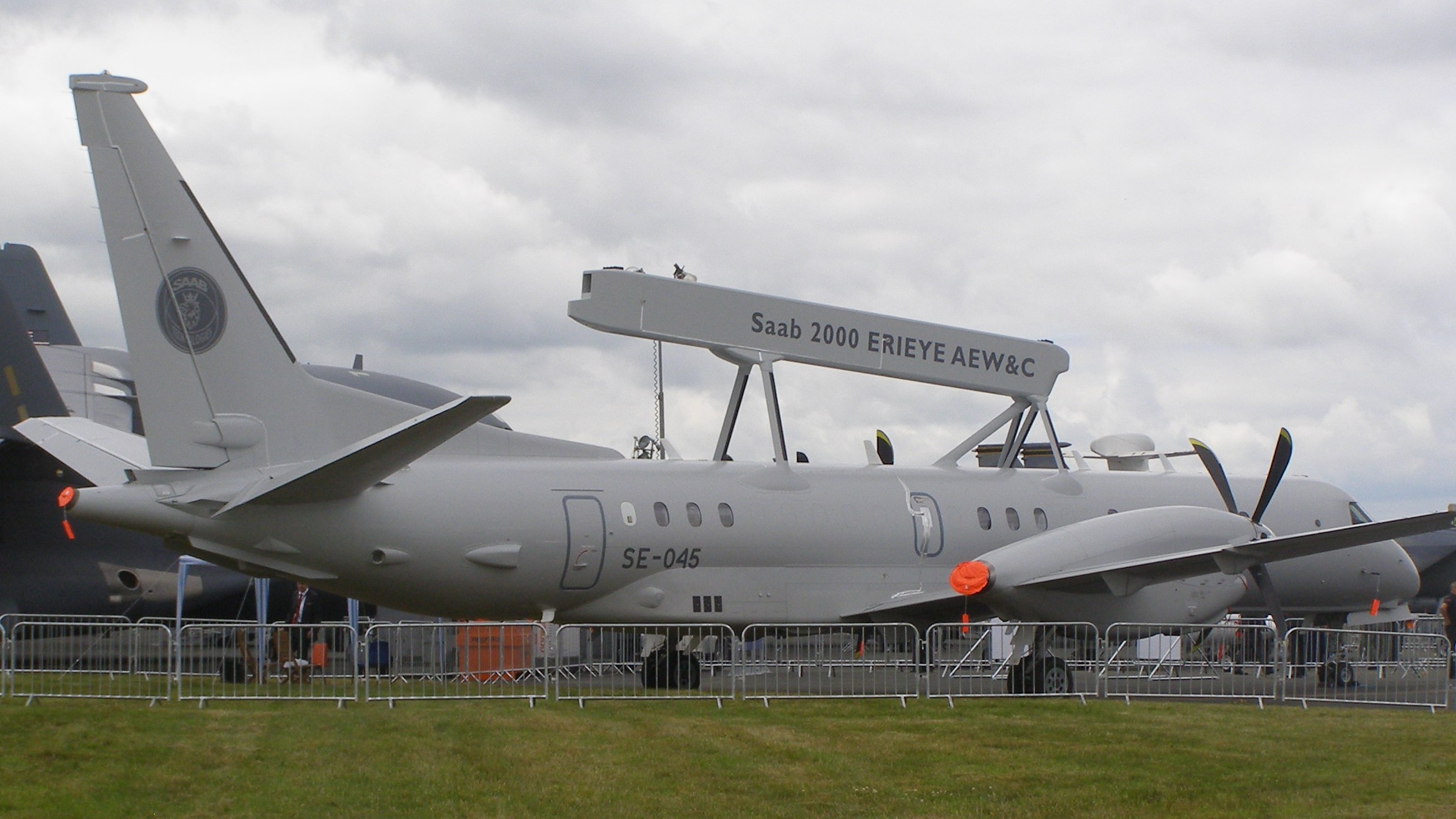
The Saab 2000 AEW&C, marketed by Saab as the "Saab 2000 Erieye AEW&C", is the conversion of the Saab 2000 regional turboprop into an airborne early warning and control platform. Its defining feature is the Erieye PS-890 radar, a dual-sided active electronically scanned array (AESA) housed in a rectangular fairing mounted dorsally along the fuselage spine instead of the circular rotodome of classic AWACS aircraft. The Erieye system had been operational since 1996 on the Saab 340 (the Swedish Air Force's S 100B Argus) and on the Embraer R-99 and EMB-145, so the Saab 2000 inherited a mature mission suite on a longer, faster and longer-legged airframe.
Saab Surveillance Systems was the lead contractor for the programme; Saab Aerotech developed and carried out the modification of the airframe, and six other business units of the group supplied major elements. The conversion was substantial: the outer wing sections and the fuselage roof were strengthened to carry the weight of the antenna and its housing, and the vertical tail area was enlarged to restore stability. The main cabin holds five mission operator consoles on the starboard side, where the windows were removed; it is air-conditioned and fitted with an active noise-cancellation system. Two auxiliary fuel tanks sit immediately aft of the consoles, and the rear cabin accommodates the electronic warfare equipment, the Erieye electronics and its power units. The consoles handle sensor management, mission planning and simulation, track data processing, asset allocation and identification, with digital maps on high-resolution colour flat panels with touch input.
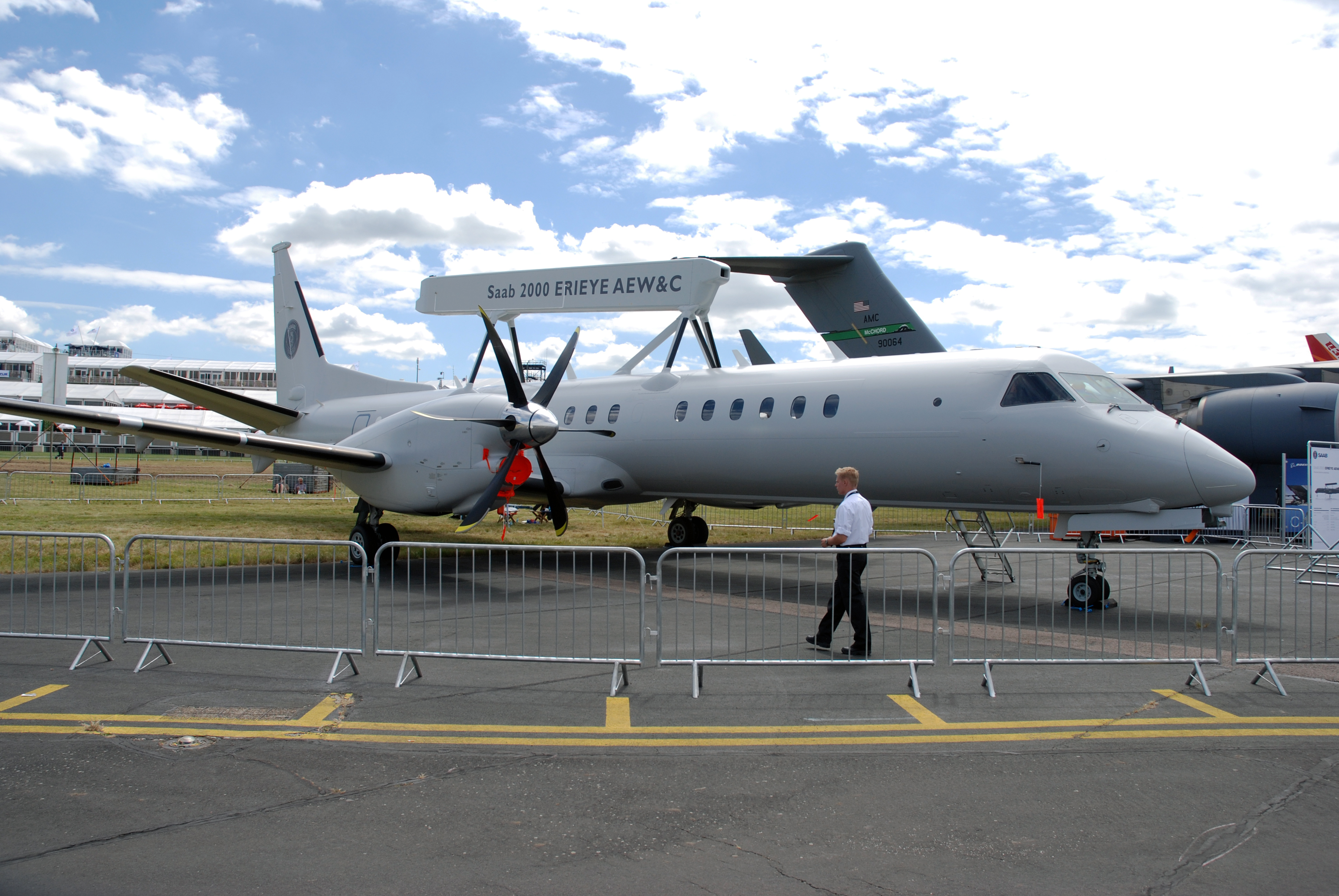
The radar, whose lead contractor was Saab Microwave Systems (formerly Ericsson), is an active phased-array pulse-Doppler set operating in S band between 3.1 and 3.3 GHz, with an integrated IFF interrogator and secondary surveillance radar. It is operational three minutes after take-off and during the climb, and provides an effective surveillance area of over 500,000 km² horizontally and 60,000 ft vertically. Instrumented range is 450 km, with a detection range of 350 km against a fighter-sized target at low altitude in a dense hostile electronic-warfare environment; it tracks multiple air and sea targets beyond the horizon with 360° coverage and sea-surveillance capability. Saab stresses that the radiated energy can be spread across a wide area or concentrated on a prioritised sector, and that from high altitude the aircraft can detect anything from fighters and hovering helicopters to cruise missiles and jet-ski-sized sea targets, with a steady flow of information regardless of weather and clutter.
The electronic warfare suite is built around the Saab Avitronics HES-21: electronic support measures (ESM) with digital wide-band and narrow-band receivers and interferometer arrays giving 360° coverage and close to 100% probability of intercept, able to build the electronic order of battle on board, plus a self-protection system with radar, laser (LWS-310) and missile-approach warners (MAW-300, tracking up to eight threats simultaneously) and BOL and BOP chaff and flare dispensers: two BOL electromechanical dispensers of 160 cartridges each, housed in the fairings under the wingtip radar-warning pods, and six BOP pyrotechnic dispensers under the rear fuselage, aft of the wing.
Power comes from two Rolls-Royce AE 2100A turboprops rated at 3,095 kW with FADEC, the same engines as the airliner. Published performance includes a maximum cruise speed of 629 km/h, a patrol speed of 296 km/h, 15 minutes to climb to 9,144 m, a range of 3,705 km (over 2,000 nautical miles, "a flight from Iceland to Rome" in Saab's words), a maximum endurance of 9.5 hours, a take-off run of 1,400 m, an empty weight of around 14,500 kg and a maximum take-off weight of 23,000 kg.
The launch customer was the Pakistan Air Force, which in June 2006 signed a SKr6.9 billion ($933 million) contract for six Erieye-equipped aircraft. Pakistan's financial crisis forced a renegotiation in May 2007: the deal was cut to five aircraft, four of them with radar, and its value fell to SKr1.35 billion ($194 million). The first aircraft was rolled out and presented to Pakistani officials in Sweden on 3 April 2008 and entered service in October 2009; the second was delivered in April 2010. Production records show that the conversions were made on second-hand airline airframes built between 1995 and 1999: the first four Pakistani aircraft were converted between 2009 and 2011. Thailand announced the selection of the Saab 2000 AEW&C in June 2007, although it eventually received the Saab 340 AEW&C. On 16 August 2012 Tehrik-e-Taliban militants assaulted PAF Base Minhas; all nine attackers were killed, along with two Pakistani security personnel, and one Saab 2000 Erieye was allegedly destroyed.
Follow-on Pakistani orders were placed in 2017 and 2020, expanding the fleet: production lists record AEW conversions in 2018, 2020 and up to 2021, and an airframe delivered in March 2024. As of August 2024 the Pakistan Air Force had nine Saab 2000 AEW&C out of ten acquired. The second operator is the Royal Saudi Air Force, with two aircraft (serials 6001 and 6002) converted to AEW configuration by September 2012 and delivered in May and June 2014. In May 2020 Saab announced a SKr1.6 billion (about $165 million; SKr1.553 billion according to another source) order from an undisclosed customer, with deliveries scheduled between 2020 and 2023.
The Pakistani Saab 2000 Erieye fleet was used during the 2025 India–Pakistan conflict. Following a BrahMos missile strike on PAF Base Bholari, the Indian Air Force claimed to have destroyed a Saab 2000 AEW&C, which Pakistan denied; on 9 August 2025 the Indian Air Force chief further claimed to have shot down a "large aircraft" at 300 km during the conflict, a claim without independent verification and dismissed by Pakistan. Saab today presents the Saab 2000 Erieye as a proven system in continuous spiral development, also capable of border and economic-zone surveillance, air policing, emergency air traffic control, disaster coordination and search and rescue; the same Erieye radar, in eight different configurations, has been sold to eight countries. Production data indicate that twelve Saab 2000s in total have been converted to the AEW&C configuration.
Multimedia


-800.webp)