Helicopter · Civil · Germany
MBB Bo 105
- February 16, 1967
- First flight
- In service
- Status


-1600.webp)
-1600.webp)

-800.webp)
-1600.webp)
_(8185339022)-1600.webp)
-1600.webp)

.jpg)
-1600.webp)
-1600.webp)
-1600.webp)

.jpg)




-1600.webp)


The MBB Bo 105 is a light twin-engined multipurpose helicopter designed in West Germany by Bölkow, part of Messerschmitt-Bölkow-Blohm (MBB) from 1969, and later produced by Eurocopter, today Airbus Helicopters. It first flew on 16 February 1967 at Ottobrunn near Munich, was certified on 13 October 1970 and became the first post-war German helicopter to achieve international success. Its defining feature is the "Bölkow rotor": the world's first rigid, hingeless rotor head, made of titanium, with four glass-fibre-reinforced plastic blades bolted directly to the hub. That architecture cut maintenance, gave the aircraft unprecedented agility, making it the first helicopter able to loop and the only one with aerobatic certification, and by 1991 had logged more than six million hours without a single rotor failure. Two Allison 250 turboshafts and fully redundant systems made it ideal for air ambulance, police and low-level tactical work. In Germany it underpinned the air rescue network of the ADAC, the DRF and the Interior Ministry, equipped the state police forces and, as the Bo 105 P (PAH-1) with six HOT missiles and the Bo 105 M (VBH), served Army Aviation with 312 aircraft until retirement in December 2016. Spain built it under licence at CASA for the FAMET in ATH, GSH and LOH versions, operational at Almagro until the end of 2017; it was also manufactured in Indonesia, the Philippines and Canada, and flew with the Netherlands, Sweden, Mexico, South Korea and dozens of other operators. Production ended in 2001 with 1,404 aircraft built in Germany and some 1,640 in all, delivered to operators in 55 countries. Its direct successor is the EC 135, born as the Bo 108, and Airbus regards it as the technological pioneer of today's H135 and H145.
Related events
Related sheets
Category
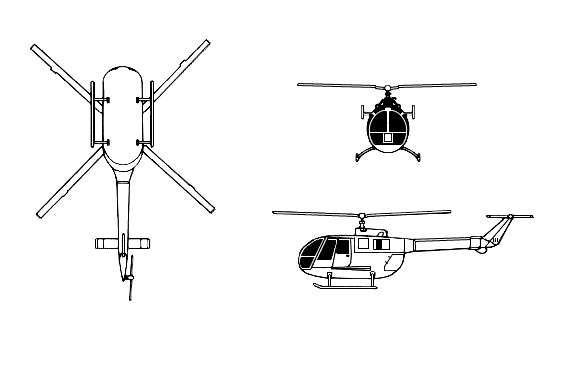
Three-view drawing
History
A gap in the market: origins of the programme
The Bo 105 was born in post-war West Germany, at a time when aircraft construction had only recently been permitted again after years of Allied prohibition and the country's industry had to make up an enormous technical deficit at a stroke. Ludwig Bölkow, who had founded Bölkow Entwicklungen KG in 1955 at Ottobrunn near Munich, turned to helicopters together with engineer Emil Weiland. The German-language sources place the first studies of what became the Bo 105 in 1961; the English-language account dates the formal start of development to 1964, while acknowledging that work on the hingeless rotor predated it. Against the established manufacturers of the United States and France, the small Bavarian design office sought a niche nobody occupied: a light helicopter made safe by two engines and by redundancy of every critical system, with a high-set tail rotor to protect ground crews, easy to fly, suited to medical rescue and cheap to maintain.
Sixty per cent of the development capital came from federal government loans, repayable if the aircraft succeeded commercially. Bölkow also spread the risk among its suppliers: transmission specialist ZF Friedrichshafen designed the main gearbox and supplied it free of charge for the prototypes, and other vendors did likewise with their systems. The company became Bölkow GmbH in 1965 and, before series production got under way, merged in 1969 with Messerschmitt and Hamburger Flugzeugbau (Blohm) to form Messerschmitt-Bölkow-Blohm, or MBB, the name under which the helicopter became famous.
Prototypes and first flight
The test programme was split into stages because everything was new at once: airframe, rotor and engines. The first prototype, V1, was tested in 1966 with a main rotor borrowed from the British Westland Scout, but was destroyed in a ground-resonance incident. The second, V2, carried the Bölkow rigid rotor and two Allison 250-C18 turboshafts instead of the engines intended for production. Chief test pilot Wilfried von Engelhardt flew it at Ottobrunn on 16 February 1967, the type's maiden flight, lasting 18 minutes; the first public demonstration followed in May of that year. Sud Aviation cooperated in the development and fitted an Alouette II with the Bo 105 rotor to explore its envelope. The third prototype, V3, flew on 20 December 1967 with the MAN Turbo 6022 turboshafts originally planned for the series; in the end production standardised on the Allison, and the MAN-powered Bo 105 B was never built. The pre-series V4 and V5 first flew on 1 May 1969, and six pre-production aircraft, V1 to V6, were completed in all.
On 13 October 1970 the German aviation authority certified the Bo 105 A, and the first deliveries went to the ADAC air rescue service and to the Bavarian police. In 1972 the American FAA and British CAA followed suit, opening the way to export orders.
The Bölkow rotor: the decisive innovation
What sets the Bo 105 apart from everything before it is its main rotor. It was the first helicopter in the world with a rigid, hingeless rotor head: a solid titanium-alloy hub to which the four blades are bolted directly, with internal elastomer elements to damp flapping and tapered roller bearings for pitch change. The motions that other helicopters absorb through hinges are absorbed here by the flexibility of the blades themselves, made of glass-fibre-reinforced plastic; this was also the first series use of that technique for rotor blades, and the assembly became known as the "Bölkow rotor".
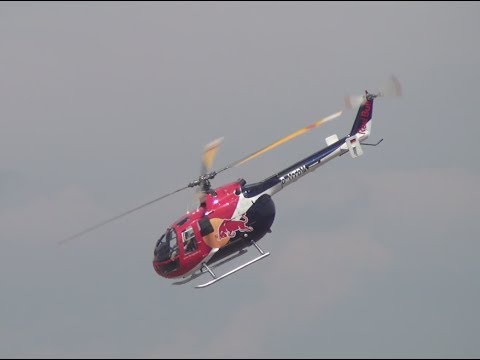
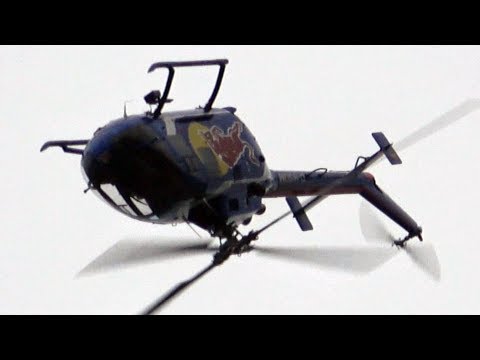
The advantages were many. Removing moving parts simplified maintenance and lowered operating cost; the Spanish magazine Defensa noted in 1979 that the blades had a life of 10,000 hours. Reliability proved exceptional: by 1991 the fleet had accumulated more than six million flight hours without a single rotor-system failure. And control response was immediate and precise, making the Bo 105 the first helicopter able to perform a complete loop and even to fly inverted. According to MBB, the airframe is cleared for +3.5 g and -1 g. That agility, together with resistance to dynamic rollover on take-off and the safety of twin engines, suited it equally to nap-of-the-earth tactical flying and to air ambulance work. In 2005 the Bo 105 CB received aerobatic certification, the only one ever granted to a helicopter; Red Bull's Flying Bulls operate two in Europe and two in the United States, with pilots such as Rainer Wilke and Aaron Fitzgerald.
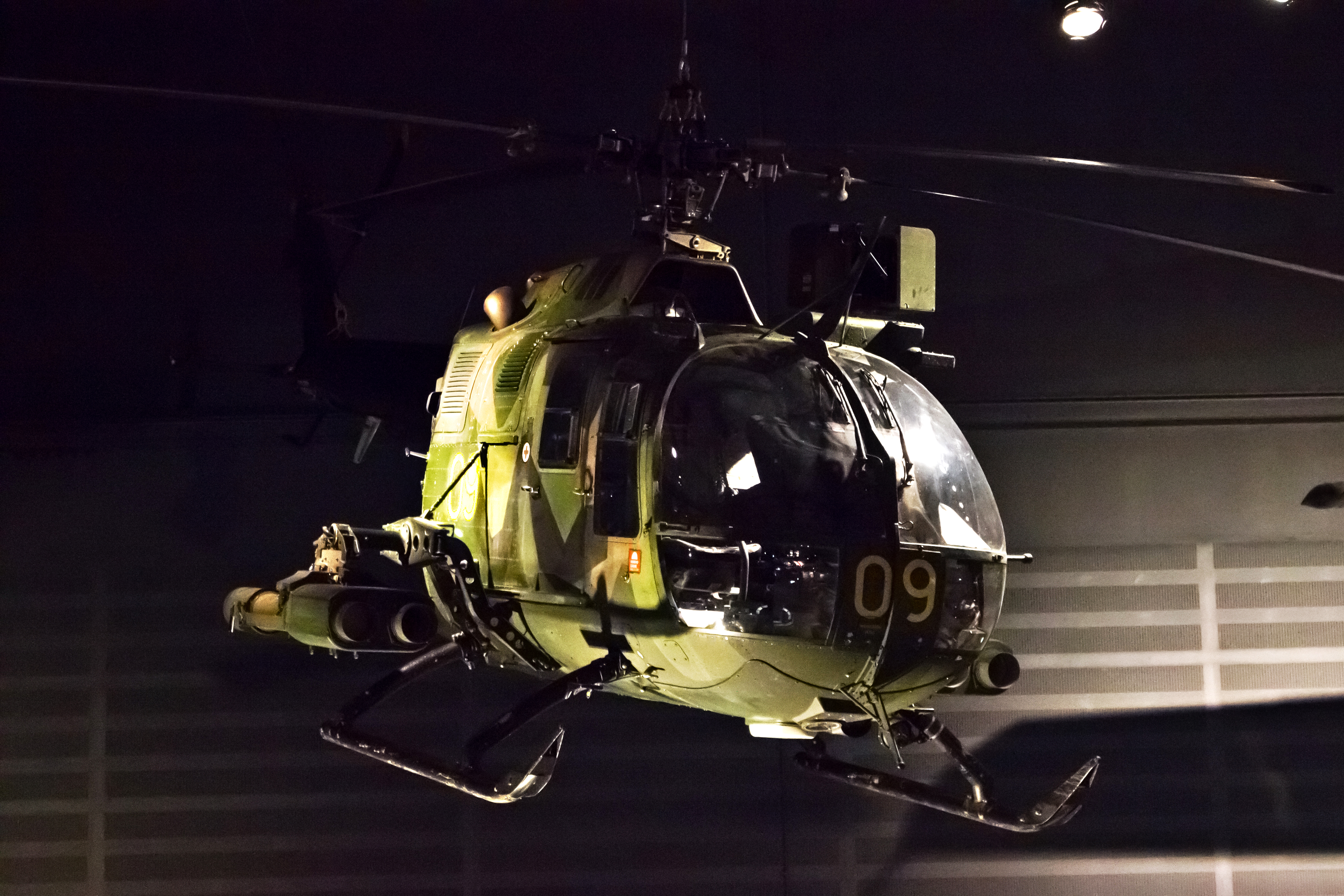
In design terms the Bo 105 is a two-tonne-class twin with a conventional light-alloy semi-monocoque fuselage. The cabin seats two pilots and three passengers on a removable rear bench, or takes a stretcher patient loaded through the rear clamshell doors; the stretched version carries up to two stretchers. With auxiliary tanks endurance approaches five hours, and after an engine failure flight can continue at reduced speed and range. For maritime use emergency floats, a life raft, folding blades and high skids were offered.
Evolution of the civil family
The initial Bo 105 A had two 235 kW Allison 250-C18s. In 1972 the Bo 105 C with 298 kW Allison 250-C20s replaced it, and from 1975 the Bo 105 CB with 313 kW 250-C20Bs became the main production model, its maximum weight rising from 2,100 to 2,300 kg. The Bo 105 CS, stretched by 25 cm for executive transport, was delivered from 1977, and the Bo 105 CBS, with the same lengthened cabin and an extra window, appeared in 1980 for the American medical market, where it was marketed as the "Twin Jet"; Boeing Vertol was the partner for production and sales in the United States and, with Carson Helicopters, built under licence the Executaire, a version stretched by 24.5 cm that sold poorly. The Bo 105 D was the British CAA-certified variant, and the designation CDN denotes aircraft built by Eurocopter Canada.
The Bo 105 LS of 1984 combined the CBS airframe with 373 kW Allison 250-C28C engines for hot-and-high operation; the LS A3 was certified in July 1986 at a maximum weight of 2,600 kg, and in 1995 the "Superlifter" raised the mission weight to 2,850 kg. Its certification programme was flown in the Chilean Andes, and production passed to Eurocopter Canada, which delivered the last LS A3 in May 2009. In 1994 came the Bo 105 CBS-5, also called the EC Super Five, with a more efficient rotor inherited from a Bundeswehr upgrade programme and the ZF FS 72E transmission, at a maximum weight of 2,500 kg.
Some derivatives went nowhere. The Bo 106, with a widened seven-seat cabin, flew on 25 September 1973 but remained a single example (D-HDCI, serial number 84), which the DRF bought in 1981 and converted into a Bo 105 CB-2. Between 1973 and 1975 MBB ran the HGH high-speed programme with the fourth prototype, D-HAPE: on 25 September 1973 it reached 200 knots (373 km/h) without wings, and on 4 March 1975, fitted with aerodynamic fairings, auxiliary wings of 6.20 m span and short skids, it achieved 404 km/h in a shallow descent, beating the 400 km/h goal set for a rigid-rotor helicopter. The same aircraft is preserved today in the Deutsches Museum in Munich.
The helicopter that taught West Germany to rescue
Germany's air rescue network was built on the Bo 105 from the 1970s onwards. "Christoph 1", the first regularly operated rescue helicopter in the Federal Republic, was a Bo 105 A, and in the early years almost every air ambulance in the country was of this type, flown by the ADAC, by the Federal Interior Ministry with its civil-protection helicopters, and by the Deutsche Rettungsflugwacht (DRF). Compared with its contemporaries the cabin was relatively roomy and allowed the patient to lie flat with medical equipment aboard, though the patient's legs were out of reach in flight; the CBS, 25 cm longer, eased that problem and left room for newer devices. In the United States, Flying magazine credited MBB in 1998 with 35 per cent of the emergency medical services market between the Bo 105 and the BK 117, a later design derived from it. Scotland's first Bo 105 air ambulance entered service in 1989 and Britain's last was retired in November 2015.
.jpg)
Withdrawal from German rescue work was forced by regulation: the Bo 105 could not meet the performance requirements of JAR-OPS 3, phased in from 1 October 1998, and from 2010 it could no longer be used in commercial operations. The ADAC replaced its last example, at Senftenberg, at the end of 2007; the Interior Ministry completed its renewal in 2008 and the DRF at the end of 2009. The EC 135 and the BK 117 took over.
State police squadrons
Redundancy and low maintenance made the Bo 105 attractive to Germany's police forces, which until then flew French single-engined types (Alouette II and III, Gazelle) dependent on foreign spares. Bavaria began operating a leased Bo 105 on 17 June 1971 and eventually had eight until 2006; Hesse took its first on 25 June 1973; Baden-Württemberg received its own on 24 April 1974 and Rhineland-Palatinate on 6 June 1974. After an Alouette III crash in June 1978, the North Rhine-Westphalia police decided to fly only twins over the densely populated Ruhr and operated six Bo 105s from November 1978 until 2006. Hamburg, Saxony-Anhalt and Thuringia also used it, the last until 2019.
German Army Aviation: VBH and PAH-1
In 1973 German Army Aviation received its first ten Bo 105 Cs for trials. After four years of evaluation, in 1975 the decision was taken to procure an armed anti-tank version carrying up to six Euromissile HOT wire-guided missiles, the Bo 105 P or PAH-1 (Panzerabwehrhubschrauber), and in 1977 the Defence Ministry chose the Bo 105 C as the basis of the VBH liaison and observation helicopter, the Bo 105 M, with a strengthened transmission and a higher-thrust tail rotor, to replace the Alouette II. A total of 312 aircraft were delivered: 100 Bo 105 Ms and 212 Bo 105 Ps, the latter between 1979 and 1984 at a planned rate of six a month.
_(8185339022).jpg)
The PAH-1 had a reinforced airframe, a Singer AN/ASN-129 Doppler radar and the roof-mounted, gyro-stabilised SFIM APX M397 sight with magnifications of 3.2 and 10.8, through which the commander aimed the HOTs carried in three tubes on each side. Defensa described the HOT in 1979 as a second-generation missile of 32 kg, 4,000 m range and 260 m/s. Tactics envisaged swarms of four aircraft approaching in formation through forest clearings, refuelling at forward sites (with 560 litres the radius of action was about 230 km, roughly two hours' flying) and attacking from maximum range at treetop height before withdrawing after launch. Its weakness was vulnerability: it had no protection against artillery or infantry weapons. The army itself regarded it as an interim solution, dissatisfied with its inability to fight at night and with its self-protection, and from that requirement the Eurocopter Tiger emerged. AN/APR-39 radar warning receivers were fitted in 1983, and the upgrade contracted in 1986 produced the PAH-1A1, fielded from 1991 with staggered HOT launchers, a digitised guidance system, engine intake protection and blades giving 10 per cent more performance. The Stinger-armed escort project (BSH) and the night thermal sight for HOT-2 (PAH-1 Phase 2) were cancelled in 1993.
The Tiger progressively replaced the PAH-1A1 until 2013; during exercise Griffin Strike at the end of August 2013, at the artillery school in Idar-Oberstein, a Bundeswehr Bo 105 fired a live HOT for the last time. The Bo 105 Ms had been retired in 2004, leaving a gap in liaison and training that was filled by disarming 67 PAH-1s between 2006 and 2014 to create the Bo 105 P1M. These flew to the end at the international training centre at Celle, and on 13 December 2016 Army Aviation bade the type farewell with an 18-aircraft formation after 37 years of service and more than 1.38 million flying hours; its crews called themselves "Bohicans". A dozen surplus Bo 105 Ms were overhauled as Bo 105 E-4s at Donauwörth, where the first flew on 25 January 2007; the first two landed at Tirana on 24 April 2007 for the Albanian air force under a contract worth 10 million euros. In Sweden the Bo 105 served as the Hkp 9 (20 aircraft) in anti-tank and rescue roles, and the Netherlands operated 30 Bo 105 Ms until 2006.
Spain: the Bölkows of the FAMET
Spain was one of the Bo 105's major customers and one of the countries that built it under licence. In the 1970s the Spanish Army chose it as the backbone of its Army Airmobile Forces (FAMET): the purchase, worth about 200 million Deutschmarks, comprised 60 new aircraft plus some twenty second-hand examples delivered earlier to train engineers, mechanics and crews, and the agreement with MBB stipulated that Construcciones Aeronáuticas S.A. (CASA) would assemble and test-fly them at Getafe, with around 30 per cent Spanish content as offset. The first 14 were flown in from Germany; one was brought over at Christmas 1981 by Captain José Antonio Borrego Serrano from Lübeck, via Berlin, Luxembourg, Lyon, Marseille, Gerona, Zaragoza and Colmenar Viejo. All CASA-built aircraft carry "S4" serial numbers; 115 left Getafe in total, and those not destined for the FAMET went mostly to the Iraqi army or to the United States.
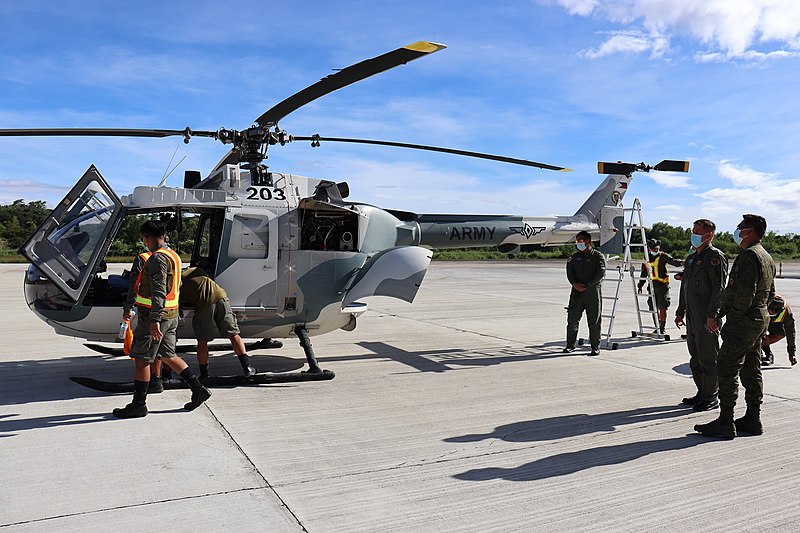
The FAMET received three versions: the Bo 105 ATH (HA.15), an anti-tank helicopter with six HOT missiles and the most numerous; the Bo 105 GSH (HR.15), an armed reconnaissance version with a 20 mm Rheinmetall Rh 202 cannon under the fuselage, 525 rounds and taller skids to accommodate it; and the Bo 105 LOH observation helicopter, initially unarmed. They served with Attack Helicopter Battalion I (BHELA I) at the "Coronel Sánchez Bilbao" base at Almagro in Ciudad Real until 31 December 2017, after 37 years of activity and some 113,000 flight hours, when the Tigre took over. Some airframes with hours remaining passed to the Guardia Civil, which already operated the type, and others are used to train mechanics at the Fuenlabrada campus of Rey Juan Carlos University. A Bo 105 ATH/GSH has been displayed since 1 July 2016 in the gardens of the Army Museum in Toledo, marking the 50th anniversary of Spanish Army light aviation.
Licences and customers around the world
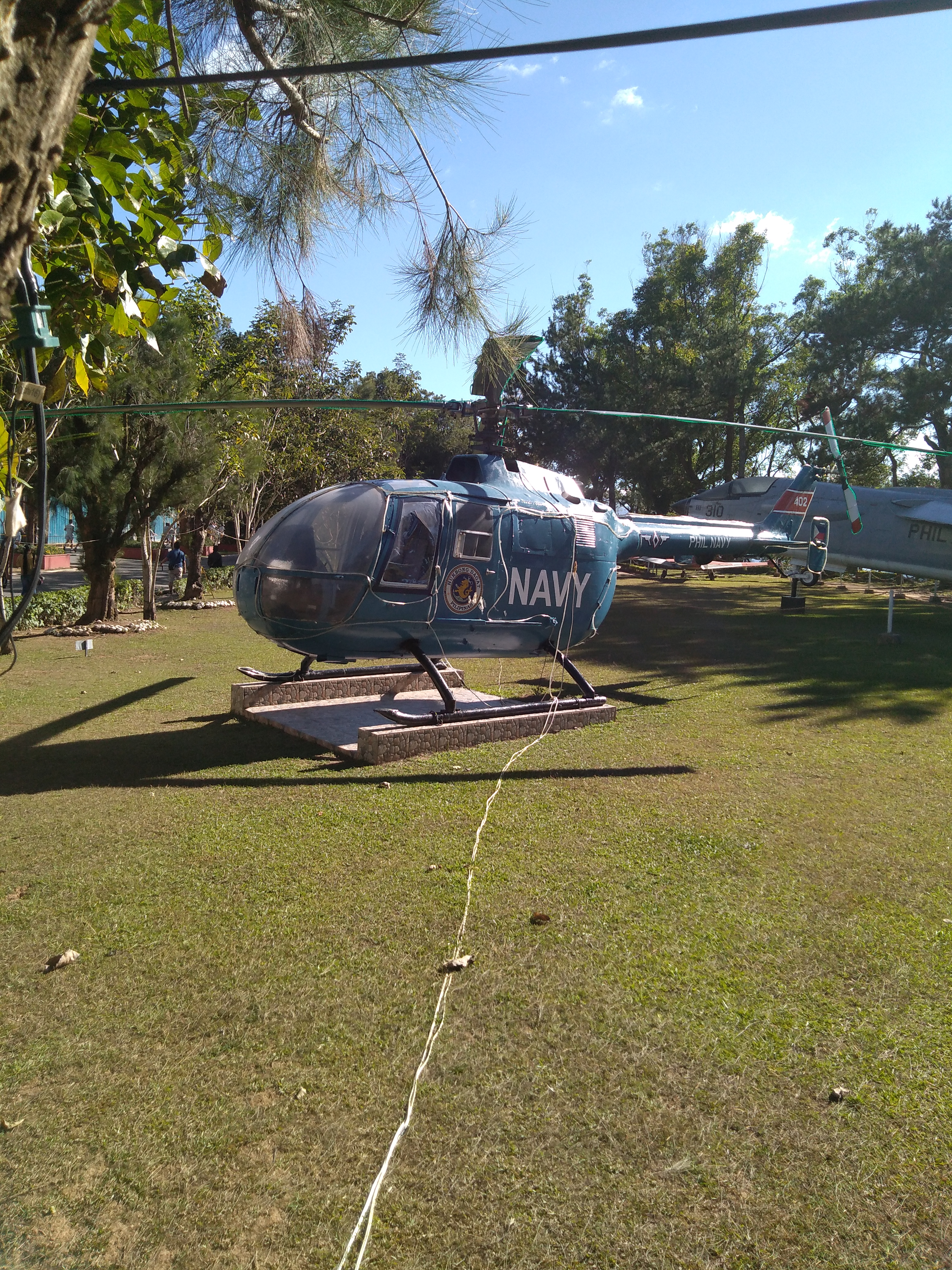
Export success led to assembly lines outside Germany. In Indonesia MBB granted a licence in the 1970s to IPTN (today Indonesian Aerospace) as part of a programme to develop the country's aviation industry; within ten years manufacture of the NBO-105 had been fully localised, and 122 were built, most for the Indonesian armed forces, before the line closed in 2009. In the Philippines the Philippine Aerospace Development Corporation produced 44 aircraft between 1977 and 1997. As early as 1979 Defensa recorded that the type had been chosen by the police of five German states and by the Netherlands, the Philippines, Argentina, Chile and Spain, with an order book approaching a thousand.
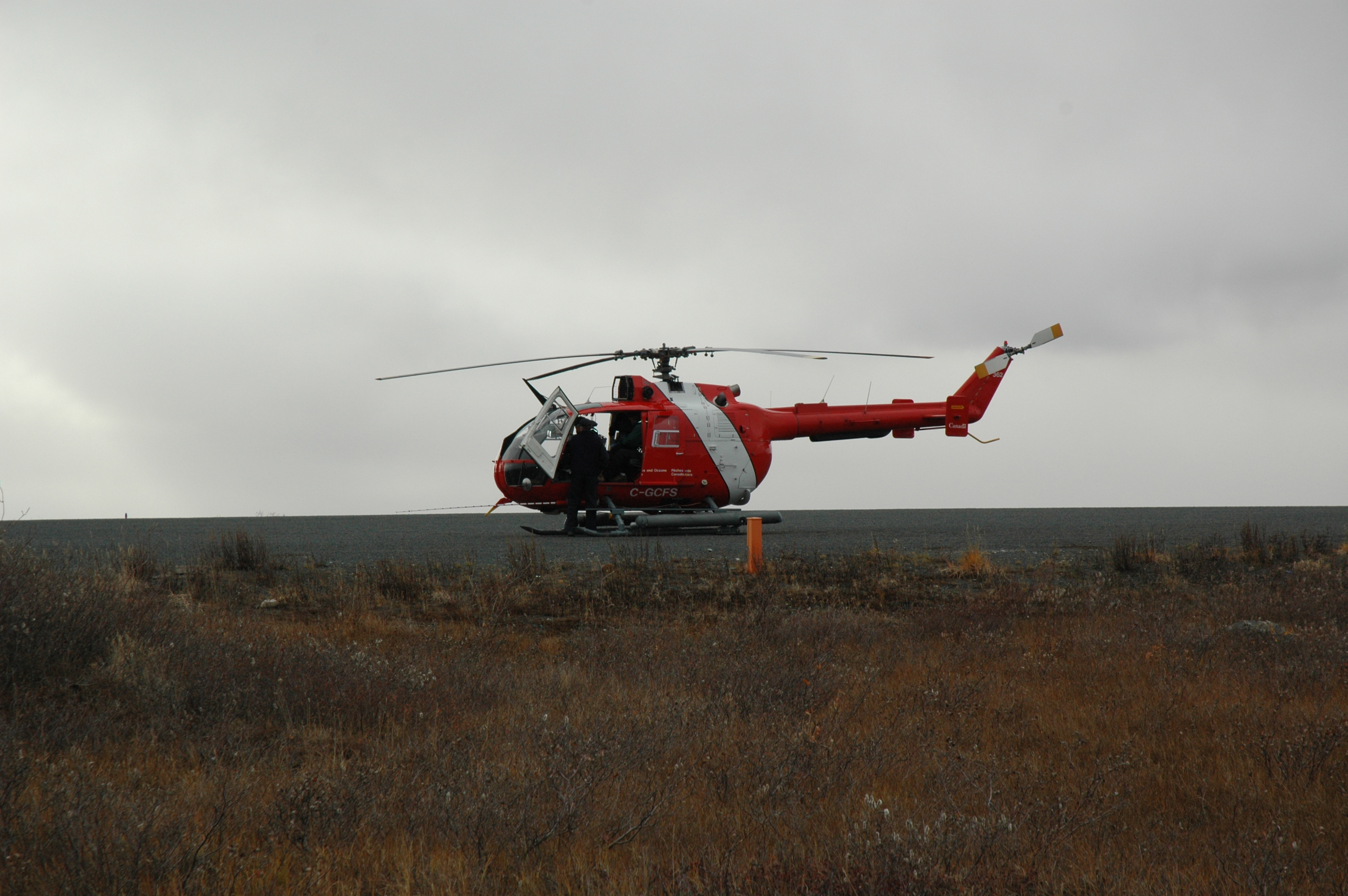
The Mexican Navy flew armed Bo 105s on maritime reconnaissance from its Uribe-class patrol vessels acquired in the early 1980s; in 2005 it completed the modernisation of 11 of them with FLIR, GPS, search radar, new blades and weapon mounts, and in November 2014 Jet Rescue inaugurated the country's first civilian helicopter air ambulance with a Bo 105. In the late 1990s South Korea acquired a combat version of the CBS-5 co-produced by Eurocopter and Korea Aerospace Industries, the KLH, with Korean mission equipment; 12 are in service, and the last ten Bo 105s built in Germany went to that customer. The list of military and government operators runs from Bahrain, Brunei, Colombia, Peru and Uruguay to Kenya, Nigeria, Sierra Leone, Jordan, the United Arab Emirates and Trinidad and Tobago.
End of production and legacy
Production at MBB and Eurocopter Deutschland lasted more than thirty years. MBB was absorbed by DASA in 1989, and in 1992 the helicopter division merged with that of France's Aérospatiale to form Eurocopter, renamed Airbus Helicopters in 2013. The last German deliveries were 17 CBS-5s for the Interior Ministry, single aircraft for the Russian and Greek police in 1997 and for Baden-Württemberg in 2001, and the ten Korean KLHs; production formally closed in 2001, with 1,404 aircraft built in Germany and some 1,640 including the licences in Canada, Spain, Indonesia and the Philippines, delivered to operators in 55 countries. The last Bo 105 produced, a Canadian LS, was bought in 2009 by the Canadian air ambulance company Dam Helicopters.
Its direct successor was the EC 135, developed initially as the Bo 108 from Bo 105 technology and taking the hingeless rotor a step further to a bearingless one. Airbus Helicopters describes the H135 and H145 as technological heirs of the Bo 105. By May 2014 the fleet had passed 8 million flight hours with some 700 aircraft still active; in February 2017, fifty years after the first flight, Airbus put the number still in service at around 400, among them the longest-serving example, doing aerial work in the Falkland Islands. In 2011 a Bo 105 in the ADAC's yellow livery was erected as part of an installation by the artist Alfred Gockel at the Kamen motorway interchange. The type has also featured in darker episodes: on 27 June 2017 a hijacked Bo 105 of the Venezuelan judicial police attacked the Supreme Court and the Interior Ministry in Caracas, and on 8 September 2026 a Bo 105 of the Malaysian Flying Doctors crashed near Long Lellang with five dead.
Technical data (Bo 105 CB)
According to Jane's, the Bo 105 CB is 11.86 m long overall with rotors turning and 3.00 m high, with a 9.84 m diameter main rotor of NACA 23012 section. Empty weight is 1,276 kg and maximum take-off weight 2,500 kg, with 570 litres of fuel. Power comes from two Allison 250-C20B turboshafts of 313 kW each. Maximum speed is 242 km/h, cruising speed 204 km/h and never-exceed speed 270 km/h; range is 657 km on standard fuel and 1,112 km with auxiliary tanks, endurance three and a half hours, service ceiling 5,200 m and rate of climb 8 m/s. Optional armament includes SNEB or SNIA rocket pods, six HOT, eight TOW or four Stinger air-to-air missiles.
Variants
| Bo 105 V1-V6 | Bo 105B | Bo 106 | Bo 105E-4 | Bo 105A | Bo 105ATH (HA.15) | Bo 105C | Bo 105CB | Bo 105CBS | Bo 105CBS-5 Super Five | Bo 105CS | Bo 105GSH (HR.15) | Bo 105HGH | Bo 105LOH | Bo 105LS A1 | Bo 105LS A3 | Bo 105LS A3 Superlifter | Bo 105LS B-1 | Bo 105M (VBH) | Bo 105P1M | Bo 105P (PAH-1) | Bo 105P (PAH-1A1) | IAe Bumblebee-001 | NBO-105 | |
|---|---|---|---|---|---|---|---|---|---|---|---|---|---|---|---|---|---|---|---|---|---|---|---|---|
| First flight | February 16, 1967 | December 20, 1967 | September 25, 1973 | January 25, 2007 | — | — | — | — | — | — | — | — | — | — | — | — | — | — | — | — | — | — | — | — |
| Powerplant | 2 × Allison 250-C18 | 2 × MAN Turbo 6022 A3 | 2 × Allison 250-C20B | — | 2 × Allison 250-C18 | 2 × Allison 250-C20B | 2 × Allison 250-C20 | 2 × Allison 250-C20B | 2 × Allison 250-C20B | 2 × Allison 250-C20B | 2 × Allison 250-C20 | 2 × Allison 250-C20B | — | 2 × Allison 250-C20B | 2 × Allison 250-C28C | 2 × Allison 250-C28C | 2 × Allison 250-C28C | 2 × PW105B | 2 × Allison 250-C20B | 2 × Allison 250-C20B | 2 × Allison 250-C20B | 2 × Allison 250-C20B | — | 2 × Allison 250-C20B |
| Power per engine | — | — | — | — | 235 kW | — | 298 kW | 313 kW | 313 kW | 313 kW | — | — | — | — | — | 373 kW Best value in this row | 373 kW Best value in this row | — | 298 kW | — | 298 kW | — | — | — |
| Length | — | — | — | — | — | — | — | 11.9 m | — | — | — | — | — | — | — | — | — | — | 11.9 m | — | — | — | 12.6 m Best value in this row | — |
| Wingspan | — | — | — | — | — | — | — | — | — | — | — | — | 6.2 m | — | — | — | — | — | — | — | — | — | — | — |
| Height | — | — | — | — | — | — | — | 3 m | — | — | — | — | — | — | — | — | — | — | 3 m Best value in this row | — | — | — | — | — |
| Empty weight | — | — | — | — | — | — | — | 1,276 kg Best value in this row | — | — | — | — | — | — | — | — | — | — | 1,670 kg | — | — | — | — | — |
| MTOW | — | — | — | — | — | — | 2,300 kg | 2,500 kg | 2,400 kg | 2,500 kg | — | — | — | — | — | 2,600 kg | 2,850 kg Best value in this row | — | 2,400 kg | — | — | — | 2,500 kg | — |
| Top speed | — | — | — | — | — | — | — | 242 km/h | — | — | — | — | — | — | — | — | — | — | 270 km/h Best value in this row | — | — | — | — | — |
| Cruise speed | — | — | — | — | — | — | — | 204 km/h | — | — | — | — | — | — | — | — | — | — | 220 km/h Best value in this row | — | — | — | — | — |
| Service ceiling | — | — | — | — | — | — | — | 5,200 m | — | — | — | — | — | — | — | — | — | — | — | — | — | — | — | — |
| Initial climb rate | — | — | — | — | — | — | — | 8 m/s Best value in this row | — | — | — | — | — | — | — | — | — | — | 8 m/s Best value in this row | — | — | — | — | — |
| Range | — | — | — | — | — | — | — | 657 km Best value in this row | — | — | — | — | — | — | — | — | — | — | 320 km | — | — | — | 555 km | — |
| Ferry range | — | — | — | — | — | — | — | 1,112 km | — | — | — | — | — | — | — | — | — | — | — | — | — | — | — | — |
| Payload | — | — | — | — | — | — | — | — | — | — | — | — | — | — | — | — | — | — | 691 kg | — | — | — | — | — |
| Crew | — | — | — | — | — | — | — | 1 | — | — | — | — | — | — | — | — | — | — | — | — | — | — | — | — |
| Passengers | — | — | — | — | — | — | — | 4 | — | — | — | — | — | — | — | — | — | — | — | — | — | — | — | — |
| Units built | 6 | 1 | 1 | 12 | — | — | — | — | — | — | — | — | 1 | — | — | — | — | — | 100 | 67 | 212 Best value in this row | — | — | 122 |
Images
Elsewhere
- Airliners.netMBB BO-105CB-4 – The Flying Bulls (Red Bull), London 2008 ↗
- Airliners.netMBB BO-105CBS – PHI Petroleum Helicopters, Alabama ↗
- Airliners.netMBB BO-105P (PAH-1) – Germany Army, Ingolstadt-Manching ↗
- JetPhotosMBB Bo105 D-BO-105 – ADAC Luftrettung ↗
- JetPhotosBölkow Bo.105C EC-DXD – España, Policía Nacional ↗
- ABPicMBB Bo.105 8054/5054 – Ejército de Alemania Occidental ↗
- ABPicMBB Bo.105S EI-LIT – Irish Helicopters Ltd. ↗
- FlickrMBB Bo 105 P1M VBH 87+73 – Heer, Tag der Bundeswehr ↗
- FlickrADAC Luftrettung BO-105 D-HILF "Christoph 1" ↗
- Planespotters.netD-HDRA Flymed – MBB Bo 105 ↗
- Planespotters.net87+28 Ejército de Alemania – MBB Bo 105 ↗
- The-Blueprints.comMBB Bo-105 three-view line drawing ↗
Show the 1 more
Videos
 Démonstration au plus grand meeting aérien d'hélicoptères d'Europe | Bell Cobra et BO 105 | L'HEL...


Show the 93 more
 Un tour d'hélicoptère défiant la gravité laisse la foule sans voix Red Bull Bo-105 Une incroyable...
 European Helicopter Show 2014 - EC120, AH1 Cobra, Enstrom 480B, BO105, EC135, B206, CH77, Mi2, Mi8..
 Medical Helicopter makes Emergency Autorotation. Alouette III, MBB BO-105, Safety Report Pittsburgh.






![[FlightGear] Bo 105 Aerobatics in Bolzano](https://i.ytimg.com/vi/IEJVV05uG1g/hqdefault.jpg)