Helicopter · Military · France
Eurocopter EC665 Tiger
- April 27, 1991
- First flight
- In service
- Status


-1600.webp)


-800.webp)


-800.webp)

-1600.webp)


-1600.webp)
-1600.webp)
-1600.webp)

-1600.webp)
-1600.webp)

-1600.webp)

-1600.webp)

-1600.webp)


._D%C3%ADa_de_las_Fuerzas_Armadas._Gij%C3%B3n._24-05-2024._(53759324082)-1600.webp)


_-_Paris_Air_Show_2025-1600.webp)
-1600.webp)
%2C_imagen_de_archivo%3A_Academia_General_del_Aire%2C_San_Javier%2C_2018-1600.webp)


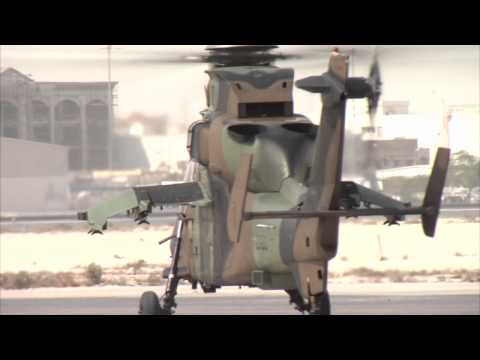
The Eurocopter EC665 Tiger is a twin-engined, four-bladed attack helicopter developed jointly by France and Germany and built today by Airbus Helicopters, the successor to Eurocopter. It was the first all-composite helicopter designed in Europe and the first European attack helicopter to be exported, and since 2003 it has formed the spearhead of army aviation in France, Germany and Spain, as well as serving in Australia. Its gestation was long. It emerged from a 1984 Franco-German requirement for an anti-tank helicopter able to stop Soviet armour, survived a de facto cancellation on cost grounds in 1986 and the end of the Cold War, which forced its redefinition as a multi-role machine, and first flew on 27 April 1991. Firm orders came in 1999 and the first production aircraft rolled out at Donauwörth in 2002. It exists in several versions: the French HAP support and escort helicopter, the German UHT/KHT with the Osiris mast-mounted sight, the HAD support and destruction variant adopted by Spain and France with more powerful engines and Spike-ER or Hellfire missiles, and the Australian ARH armed reconnaissance helicopter. It saw its baptism of fire in Afghanistan in 2009 with French HAPs, followed by Libya in 2011, the German and Spanish deployments to Afghanistan in 2012 and 2013, and French and German operations in Mali from 2013. With the Spanish HAP-Es retired in 2020 and the French fleet being converted to HAD standard, the programme now faces its major upgrade, the Tiger Mk III agreed by France and Spain in 2022, while Australia has announced the retirement of its ARHs in favour of the AH-64E Apache Guardian.
History
Origins: a tank killer for the Cold War
The Tiger grew out of a shared requirement. In 1984 the governments of France and West Germany jointly called for an advanced anti-tank helicopter, intended to blunt a Soviet armoured thrust into Central Europe; the French also wanted a variant dedicated to escort and anti-helicopter work. The initial numbers were large. West Germany planned to buy 212 examples of the anti-tank version, designated PAH-2 (Panzerabwehrhubschrauber), with deliveries to start at the end of 1992, while France sought 75 support and escort helicopters, the HAP "Gerfaut", and 140 anti-tank HAC "Tigre" machines.
Industry answered with a partnership between Aérospatiale and MBB, which was chosen as the preferred supplier. The start was anything but smooth: in 1986 the programme was effectively cancelled as costs spiralled, after official calculations showed that equipping the German forces with an equivalent number of American AH-64 Apaches would have been cheaper. Paris and Bonn then reorganised the project around fixed-price contracts that shifted more of the financial risk onto the companies, and Thomson-CSF took over most of the electronics work, including the vision systems and sensors. In November 1989 Eurocopter signed the agreement that financially secured most of the development through to series production, with two assembly lines planned: Aérospatiale's plant at Marignane and MBB's facility at Donauwörth.
Prototypes and lean years
The first prototype, PT1, registered F-ZWWW, took off on 27 April 1991 for a maiden flight lasting half an hour. It was an aerodynamic airframe with basic avionics and mock-ups of the mast- and roof-mounted sights, the nose gun and the weapon pods; a demonstrator was shown at the Paris Air Show that same year. PT2 (F-ZWWY), rolled out on 9 November 1992, flew on 22 April 1993 in HAP configuration; PT3 (F-ZWWT), the first machine with the full core avionics including navigation and autopilot, followed on 19 November 1993; PT4 (F-ZWWU) took off on 15 December 1994 as the first Tiger with a live weapons system, carrying the roof sight, a HUD and the Topowl helmet sight; and PT5, the prototype of the German version with the Osiris mast-mounted sight, first flew on 21 February 1996. Several of these aircraft were later rebuilt to HAP or UHT standard to keep testing systems.
_-_Paris_Air_Show_2025.jpg)
While the prototypes were flying, the world the Tiger had been designed for was vanishing. The end of the Cold War and the defence cuts of the 1990s cast doubt on the whole programme, and in 1992 there was speculation that the German defence ministry might walk away. That same year Aérospatiale and MBB merged into the Eurocopter group, consolidating both the industry and the project. In 1993 Germany abandoned the pure anti-tank PAH-2 in favour of a multi-role support helicopter, the UHT, and late that year France dropped the "Gerfaut" name from its HAP. A bilateral agreement in December 1996 finally cemented the Tiger's future.
Orders, first production aircraft and service entry
On 18 June 1999 France and Germany publicly ordered a first batch of 160 helicopters, 80 for each country, worth €3.3 billion. On 22 March 2002 the first production Tiger was rolled out at the Donauwörth factory in a large ceremony, and the type entered service in 2003. France's 40 HAPs were all delivered by 2012, at a cost of €27 million per aircraft in that year's prices. Final qualification of the HAP and UHT versions was completed in December 2008, clearing the way for overseas deployments, and in May 2009 the Tiger passed trials off Toulon that cleared it for operations from ships.
In Germany the introduction was slower and more contentious. In August 2009 Der Spiegel reported that the ten Tigers then operational with the Heer were only fit for pilot training and that others had not been accepted because of defects; in May 2010 Berlin suspended deliveries over "serious defects particularly with wiring". The original plan split 32 aircraft each between Fritzlar and Roth, but the fleet was eventually concentrated at Attack Helicopter Regiment 36 "Kurhessen" at Fritzlar in northern Hesse. In October 2013 the UHT designation gave way to KHT (Kampfhubschrauber Tiger); 68 aircraft had been delivered to the Bundeswehr by 2025.
Exports: Australia and Spain
The Tiger was the first European attack helicopter to win orders beyond its home countries. On 21 December 2001 Eurocopter won the Australian Army's AIR 87 programme for 22 aircraft of the ARH (Armed Reconnaissance Helicopter) version, a development of the HAP with upgraded MTR390 engines, a laser designator built into the Strix sight, new communications and avionics and Hellfire missiles, meant to replace the OH-58 Kiowa and the UH-1 "Bushranger" gunships. The first two reached Australia on 15 December 2004. The fleet achieved final operating capability on 18 April 2016, yet the Defence White Paper of that same year already announced its replacement in the mid-2020s, citing the lack of commonality with other Tigers, the high maintenance cost of the engines and the time needed to ship parts to Europe. In January 2021 Canberra announced the purchase of 29 AH-64E Apache Guardians as the successor; in June 2024 Ukraine expressed interest in the Australian fleet, in December 2025 talks on gifting it were reported, and in April 2026 the Australian government brought the Tiger's withdrawal forward to the end of that year.

Spain selected the Tiger in September 2003 and in December 2004 placed an order for 24 aircraft of the HAD (Helicóptero de Apoyo y Destrucción) version, powered by Enhanced MTR390 engines for heavier payloads; in the same order France bought 40 HADs, priced at €35.6 million each in 2012 prices. To bring the type into service sooner, Spain first took six HAP-Es, operational from 2005 and decommissioned at the end of 2020, followed by 18 HAD-Es. In June 2006 Madrid chose the Israeli Spike-ER over the Trigat as its anti-tank missile, and in May 2008 its integration on the HAD was certified with a firing by Spanish personnel at the INTA facilities at Mazagón, Huelva.
Other export campaigns came to nothing. In the 1990s the Tiger competed in the large British and Dutch tenders without success; in July 2006 Saudi Arabia signed a €6.9 billion contract for 142 helicopters including 12 Tigers, cancelled in late 2007 for reasons never made public; in 2007 the aircraft entered the Indian Air Force's competition for 22 attack helicopters, although in late 2009 it emerged that it would miss the field trials because it was being upgraded; and in 2012 it bid for a South Korean contract for up to 20 aircraft that Seoul awarded to the AH-64 in April 2013.
Baptism of fire: Afghanistan, Libya and the Sahel
In July 2009 three HAPs of the French 5th Combat Helicopter Regiment, based at Pau, arrived at Kabul International Airport: the Tiger's first deployment to an active combat zone, where it flew armed reconnaissance and fire support for coalition ground troops. In 2011, during the intervention in Libya (Opération Harmattan for France), ALAT Tigers operated from the amphibious assault ship Tonnerre and struck targets ashore from 4 June 2011 alongside British Apaches; in that campaign they used their cannon against T-72 tanks, wrecking antennas and sighting optics, and fired six Mistral 2 missiles at ground targets, at least three of them successfully.

Germany deployed four UHTs to Afghanistan in December 2012, flying reconnaissance, ground support and convoy protection from Mazar-i-Sharif; the aircraft had first been upgraded to the ASGARD standard (Afghanistan Stabilization German Army Rapid Deployment), which added new defensive systems among other changes. Spain sent three HADs to the same theatre in March 2013 to support its ground forces. In January 2013, with Opération Serval in northern Mali, France took the Tiger to the Sahel; the first production HADs (Block 1) joined in November 2014 after being declared combat capable, and in March 2017 German Tigers rotated into the same country.
Modernisation: an all-HAD French fleet and the Mk III
In December 2015 France decided to bring its entire fleet to HAD standard by 2025; the first HAD-F Mk II, an upgraded HAD-F, was delivered on 25 October 2024. With the Spanish HAP-Es retired at the end of 2020 and the French HAP-Fs being converted, the HAP version disappears from inventories from 2026 onward.
In January 2016 it was announced that France was working with Australia, Germany and Spain to define a deeper upgrade, the Tiger Mk III, built around a common anti-tank missile together with avionics and self-protection improvements. In March 2022 Airbus announced its agreement with France and Spain to launch the programme: 42 French helicopters would be upgraded with deliveries from 2029 and 18 Spanish ones from 2030, with the prototype's first flight expected in 2025. Each country's Mk III will differ slightly to reflect national requirements; in France it will replace the Hellfire with MBDA's future Multi-Role Combat Missile.
Design
The Tiger is a twin-engined, four-bladed helicopter flown by a crew of two in tandem, the pilot in front and the gunner behind, either of whom can take over flying or the weapons. It was the first all-composite helicopter developed in Europe: the fuselage is 80% carbon-fibre-reinforced polymer and Kevlar, 11% aluminium and 6% titanium, and the whole tail section, including the one-piece tail boom, is composite. Survivability rests on reduced visual, radar, infrared and acoustic signatures, on agility and on a high tolerance to damage: redundant and segregated systems, rotors and shafts designed to withstand ballistic hits, and a gearbox able to run for 60 minutes without lubrication.
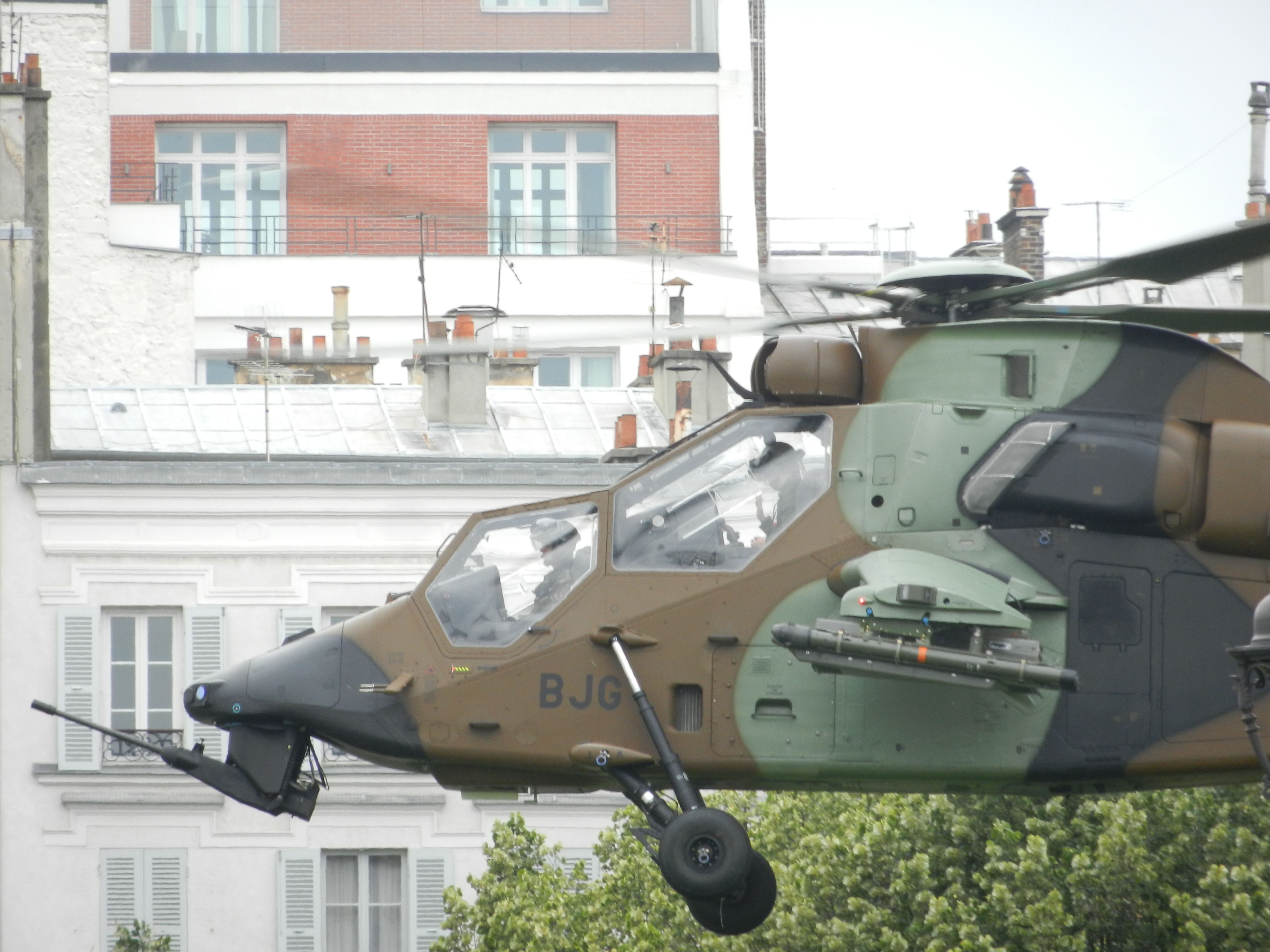
The avionics are built around the EUROGRID battlefield management system, integrated communications with data links and satellite, a high-authority digital flight control system, redundant MIL 1553 buses and two mission computers. Each crew member has two multifunction displays plus a helmet-mounted display, and on the German versions the main sensor is the Osiris mast-mounted sight, with television and thermal cameras and a laser rangefinder and designator; the HAP, HAD and ARH carry the Strix roof-mounted sight instead. Armament includes the nose turret with a 30 mm Nexter cannon, external gun pods, launchers for 70 and 68 mm rockets on the stub wings, Mistral or Stinger air-to-air missiles and anti-tank weapons: HOT 3 and PARS 3 LR in Germany (four on each inboard station, with a reach of up to seven kilometres), Hellfire on the HAD and ARH (eight missiles) and Spike-ER on the Spanish HAD. Power comes from two MTR390 turboshafts, in Enhanced form on the HAD.
Published figures for the type give a fuselage length of 13.85 m and a height of 3.84 m without the top-mounted sensors; empty weight is 3060 kg, gross weight 5090 kg and maximum take-off weight 6600 kg, with 1105 kg of internal fuel and 1689 kg with external tanks. Maximum speed is 290 km/h and cruising speed 271 km/h; combat range, armed and with standard tanks, is 740 km and ferry range, unarmed with external tanks, 1130 km, with a standard mission endurance of two and a half hours rising to five with an external tank; service ceiling is 4000 m and rate of climb 10.7 m/s. Costs vary by version: the Australian ARH was priced at A$68 million per aircraft and the latest HAD is estimated at US$44–48 million.
Variants
| PT1 | PT2 | PT3 | PT4 | PT5 | UHT/KHT | HAP | ARH | HAC | HAD | HAD-E | HAD-E Mk III | HAD-F Mk I | HAD-F Mk II | HAD-F Mk III | HAP-E | HAP-F | HCP | PAH-2 | PT6/PT7 | UHT Mk III | |
|---|---|---|---|---|---|---|---|---|---|---|---|---|---|---|---|---|---|---|---|---|---|
| First flight | April 27, 1991 | April 22, 1993 | November 19, 1993 | December 15, 1994 | February 21, 1996 | August 2, 2002 | March 26, 2003 | — | — | — | — | — | — | — | — | — | — | — | — | — | — |
| Aircraft type | — | — | — | — | — | Support and attack helicopter | Support and escort helicopter | Armed reconnaissance helicopter | — | Support and destruction helicopter | — | — | — | — | — | — | — | — | — | — | — |
| Powerplant | — | — | — | — | — | 2 × MTR390-2C turboshaft | 2 × MTR390-2C turboshaft | 2 × uprated MTR390 turboshaft | — | 2 × MTR390-E turboshaft, 1,092 kW each (1,322 kW contingency) | — | — | — | — | — | — | — | — | — | — | — |
| Powerplant | — | — | — | — | — | 2 × MTR390-2C | 2 × MTR390-2C | 2 × MTR390 (uprated) | — | 2 × MTR390-E | 2 × MTR390-E | 2 × MTR390-E | 2 × MTR390-E | 2 × MTR390-E | 2 × MTR390-E | 2 × MTR390-2C | 2 × MTR390-2C | — | — | — | — |
| Power per engine | — | — | — | — | — | — | — | — | — | 1,092 kW | — | — | — | — | — | — | — | — | — | — | — |
| Length | — | — | — | — | — | — | 13.9 m Best value in this row | — | — | 13.9 m Best value in this row | — | — | — | — | — | — | — | — | — | — | — |
| Wingspan | — | — | — | — | — | — | 13 m Best value in this row | — | — | 13 m Best value in this row | — | — | — | — | — | — | — | — | — | — | — |
| Height | — | — | — | — | — | — | 3.8 m Best value in this row | — | — | 3.8 m Best value in this row | — | — | — | — | — | — | — | — | — | — | — |
| Wing area | — | — | — | — | — | — | 133 m² Best value in this row | — | — | 133 m² Best value in this row | — | — | — | — | — | — | — | — | — | — | — |
| Empty weight | — | — | — | — | — | — | — | — | — | 3,060 kg | — | — | — | — | — | — | — | — | — | — | — |
| MTOW | — | — | — | — | — | 6,100 kg | — | — | — | 6,600 kg Best value in this row | — | — | — | — | — | — | — | — | — | — | — |
| Top speed | — | — | — | — | — | 268 km/h | — | — | — | 290 km/h Best value in this row | — | — | — | — | — | — | — | — | — | — | — |
| Cruise speed | — | — | — | — | — | — | — | — | — | 271 km/h | — | — | — | — | — | — | — | — | — | — | — |
| Service ceiling | — | — | — | — | — | — | — | — | — | 4,000 m | — | — | — | — | — | — | — | — | — | — | — |
| Initial climb rate | — | — | — | — | — | — | — | — | — | 10.7 m/s | — | — | — | — | — | — | — | — | — | — | — |
| Range | — | — | — | — | — | 725 km | — | — | — | 740 km Best value in this row | — | — | — | — | — | — | — | — | — | — | — |
| Ferry range | — | — | — | — | — | — | — | — | — | 1,130 km | — | — | — | — | — | — | — | — | — | — | — |
| Endurance | — | — | — | — | — | 150 min Best value in this row | — | — | — | 150 min Best value in this row | — | — | — | — | — | — | — | — | — | — | — |
| Range conditions | — | — | — | — | — | 725 km range and 2:30 h endurance according to Bundeswehr data | — | — | — | 740 km combat range armed with standard tanks; 1,130 km ferry range unarmed with external tanks; 2.5 h standard mission and up to 5 h with external tank | — | — | — | — | — | — | — | — | — | — | — |
| Armament | — | — | — | — | — | No gun turret; 12.7 mm gun pods; up to 8 PARS 3 LR or HOT 3 anti-tank missiles; 70 mm FZ rocket pods (19 and 7 rounds); 4 FIM-92 Stinger air-to-air missiles | GIAT 30 mm AM-30781 cannon in chin turret (450 rounds); 68 mm SNEB rockets in 22- and 12-round pods; 20 mm cannon pods; 4 Mistral air-to-air missiles | Nexter 30 mm cannon in chin turret; AGM-114 Hellfire II missiles on M299 launchers; 70 mm FZ rockets (APKWS kit trialled); 4 Stinger air-to-air missiles | — | 30 mm cannon in chin turret (450 rounds); up to 8 AGM-114 Hellfire II (France) or Spike-ER (Spain) missiles; 68 mm SNEB or 70 mm FZ rockets; 4 Mistral air-to-air missiles | — | — | — | — | — | — | — | — | — | — | — |
| Payload | — | — | — | — | — | 0 kg Best value in this row | 0 kg Best value in this row | 0 kg Best value in this row | — | 0 kg Best value in this row | — | — | — | — | — | — | — | — | — | — | — |
| Crew | 2 Best value in this row | 2 Best value in this row | 2 Best value in this row | 2 Best value in this row | 2 Best value in this row | 2 Best value in this row | 2 Best value in this row | 2 Best value in this row | 2 Best value in this row | 2 Best value in this row | 2 Best value in this row | 2 Best value in this row | 2 Best value in this row | 2 Best value in this row | 2 Best value in this row | 2 Best value in this row | 2 Best value in this row | 2 Best value in this row | 2 Best value in this row | 2 Best value in this row | 2 Best value in this row |
| Passengers | — | — | — | — | — | 0 Best value in this row | 0 Best value in this row | 0 Best value in this row | — | 0 Best value in this row | — | — | — | — | — | — | — | — | — | — | — |
| Units built | 1 | 1 | 1 | 1 | 1 | 68 Best value in this row | — | 22 | 0 | — | 18 | — | — | — | — | 6 | 40 | 0 | 0 | 2 | 0 |
Images
Elsewhere
- militaryaircraft.deEurocopter EC-665 Tiger UHT (74+54), Hinterstoisser AB Zeltweg, Airpower22 ↗
- militaryaircraft.deEurocopter EC-665 Tiger UHT (74+54), rodaje en pista, Airpower22 Zeltweg ↗
- militaryaircraft.deEurocopter EC-665 Tiger UHT (74+52), Hinterstoisser AB Zeltweg, Airpower24 ↗
- militaryaircraft.deEurocopter Tigre HAP (BHC), Ejército francés, NATO Tiger Meet 2011, Cambrai-Épinoy ↗
- militaryaircraft.deEurocopter Tiger UHT (74+15), Ejército alemán, ILA Berlin Airshow 2014 ↗
- militaryaircraft.deEurocopter Tigre HAD (BJC), Ejército francés, ILA Berlin Airshow 2014 ↗
- ShutterstockEurocopter Tiger, helicóptero del ejército a contraluz ↗
- ShutterstockEurocopter Tiger EC665, helicóptero de ataque bimotor ↗
- Getty ImagesEurocopter Tiger del Ejército francés (ALAT), colección fotográfica ↗
- Ejército de Tierra (España)Eurocopter Tigre HAD (HA.28), ficha oficial del Ejército de Tierra español ↗
- AirbusTiger, helicóptero de combate, página oficial de Airbus Helicopters ↗
- airpower.gv.atAirbus (Eurocopter) EC-665 Tiger en AIRPOWER24, Zeltweg (Austria) ↗




![EC665 Tiger [Airpower22]](https://i.ytimg.com/vi/xTYpSAavgws/hqdefault.jpg)










![Paris Air Show - EC665 Tiger Attack Helicopter Full Aerial Flight 2017 [1080p]](https://i.ytimg.com/vi/Qd4_n_6YB8g/hqdefault.jpg)

![Eurocopter EC665 Tiger (test) [4K]](https://i.ytimg.com/vi/LvsrWep6wv0/hqdefault.jpg)
![[web série] Furtivité: Hélicoptère de combat Tigre (3/5)](https://i.ytimg.com/vi/zuGtHu3vhos/hqdefault.jpg)




![[Salon du Bourget : le Tigre hélicoptère de combat]](https://i.ytimg.com/vi/dM__tNWkSFU/hqdefault.jpg)