Reconnaissance · Military · United States
Lockheed U-2
- August 1, 1955
- First flight
- 1956
- Introduced
- In service
- Status
- 104
- Units built
-1600.webp)
-1600.webp)
.jpg)
_en_tierra-800.webp)



_en_vuelo-1600.webp)

-1600.webp)
-1600.webp)


-1600.webp)
-1600.webp)

-1600.webp)
-1600.webp)


-1600.webp)


The Lockheed U-2 is a high-altitude strategic reconnaissance aircraft: a single-seater with enormously long, narrow wings, one jet engine and a structure pared down to the lightest airframe its designers could get away with, conceived in the mid-1950s to solve a problem that had no other answer. The United States needed to know what was inside the Soviet Union — how many bombers, how many missiles, where — and there was no legal or safe way to find out. Lockheed's solution was very nearly a powered glider: take it above 21,000 metres, where fighters, radars and anti-aircraft batteries were believed unable to reach it, and hang beneath it a camera able to resolve objects a few centimetres across from that height. Seventy years later it is still flying, which none of its creators would have bet on. The programme grew out of a request for proposals written in 1953 by Air Force officer John Seaberg for an aircraft able to operate at 70,000 feet over its target. The competition, code-named "Bald Eagle", was deliberately aimed at small companies; Lockheed heard about it and submitted an unsolicited design. Its author was Clarence "Kelly" Johnson, the engineer behind the P-38 and the P-80, who worked in a separate division informally known as the Skunk Works. His CL-282 gave up conventional landing gear and combat load factors in exchange for altitude. The Air Force rejected it in June 1954 — General Curtis LeMay walked out of the presentation saying he had no interest in an aeroplane with no wheels and no guns — but a group of civilian advisers, among them Edwin Land and James Killian, persuaded President Eisenhower that the aircraft should exist and that the CIA, not the military, should fly it: a military aircraft over Soviet territory could be read as an act of war. Approval came in November 1954 and the contract, $22.5 million for the first twenty aircraft, in March 1955. Johnson delivered on time and under budget. Flying the U-2 was never comfortable. At operating altitude the margin between never-exceed speed and stall speed was about ten knots: the "coffin corner", where straying above or below meant losing the airflow over wing or tail. Down low, by contrast, dense air and the absence of powered controls made it brutally hard work, and the ground effect of those wings meant it refused to land until fully stalled half a metre above the runway. Bicycle gear instead of a tricycle arrangement, two auxiliary wheels — the "pogos" — that drop away on take-off, titanium skids at the wingtips, and a chase car racing down the runway calling out the pilot's remaining height. In a cockpit that is only partly pressurised, the pilot wears a pressure suit and breathes pure oxygen for an hour before take-off to purge nitrogen from the blood; on an eight-hour mission he may lose up to 5% of his body mass. Its operational history is the history of the century. On 4 July 1956 a U-2 overflew the Soviet Union for the first time; the photographs of the following years showed that the "bomber gap" agonising Washington did not exist. On 1 May 1960 an SA-2 missile brought down Francis Gary Powers's aircraft near Sverdlovsk, the weather-research cover story collapsed when Khrushchev revealed the pilot was alive, Eisenhower refused to apologise and the Paris summit fell apart before it began. In October 1962 it was a U-2 that photographed the Soviet missiles in Cuba, and another U-2 that was shot down over the island with Major Rudolf Anderson aboard, at the tensest moment of the crisis. Then came the Taiwanese pilots of the Black Cat Squadron over mainland China, Vietnam, the Middle East, the Balkans, Iraq and Afghanistan. The platform was remade several times. The original U-2A was followed by models with more powerful engines, two-seat versions, air-refuellable variants and even one adapted for carrier operations; in 1967 came the U-2R, an airframe nearly 30% larger, and in 1981 a third production batch christened TR-1A and later returned to the U-2R designation. Since the mid-1990s the fleet has flown as the U-2S with the General Electric F118 turbofan, with the two-seat TU-2S as trainer, while NASA operates two ER-2s for atmospheric science and Earth observation. The U-2 outlived the SR-71, retired in 1998, and a very long list of announced and then cancelled retirement dates: 2007, 2012, 2015, 2019, 2025, 2026. It remains the only manned high-altitude strategic reconnaissance aircraft in the United States Air Force, and its latest death sentence is not firm either.
Category
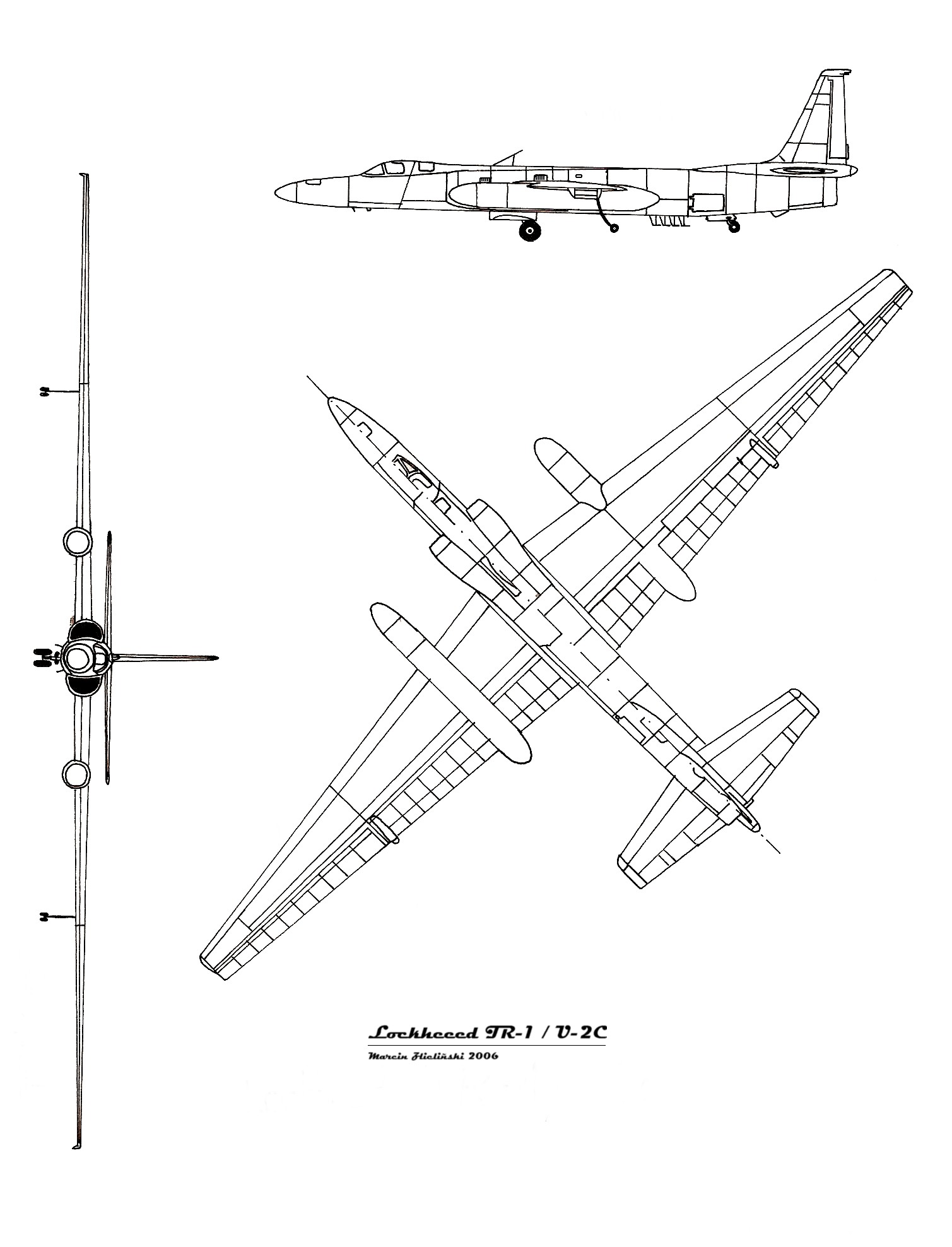
Three-view drawing
History
A hole in the map
In the years after the Second World War, the United States knew less about the Soviet Union than about almost anywhere else on earth. Soviet territory was closed, official information was propaganda, and the intelligence community's estimates of bombers, missiles and nuclear complexes rested on little more than inference. At a time when a surprise nuclear attack was discussed as a realistic scenario, that ignorance was itself a danger: without data, any boast from Moscow counted for as much as a report.
The obvious answer was aerial photography, and the obvious answer did not work. Available aircraft could not climb high enough. Light bombers were modified for altitude — the RB-57D of 1955 reached about 64,000 feet after the development command imposed changes to make it more durable — but the Soviet Union — unlike either the United States or Britain — had greatly improved its radar since the war and could track aircraft above 65,000 feet. Every gain in altitude was cancelled by an equivalent gain in detection.
The calculation that finally framed the problem was easy to state and hard to meet: at 70,000 feet an aircraft would sit above anything Soviet fighters, missiles or radar could touch. Around that figure Air Force officer John Seaberg wrote a request for proposals in 1953: an aircraft able to hold that altitude over the target with an operational radius of some 1,500 nautical miles. The competition, code-named "Bald Eagle", was deliberately aimed at smaller manufacturers, on the theory that they would give it more attention than the giants. Bell, Martin and Fairchild received study contracts. Lockheed was not invited.
The CL-282 and the Skunk Works
Lockheed found out anyway and decided to submit an unsolicited proposal. Executive John Carter suggested the idea that changed everything: if altitude was what mattered, the design should give up its landing gear and the load factors combat demands. The company handed the job to Clarence "Kelly" Johnson.
Johnson was by some distance its best aeronautical engineer. He had signed the P-38 Lightning and the P-80, America's first operational jet fighter, developed in under six months; also the Constellation. He worked with a small team in a separate division known in-house as the Skunk Works, and had a reputation for delivering ahead of schedule. His motto, KISS — keep it simple, stupid — describes well what he did with the assignment. The CL-282 was based on the XF-104: short fuselage, very long thin wings, take-off from a special cart and landing on its belly. It was, in practice, a jet-powered glider, calculated to reach 73,000 feet with a radius of around 1,600 miles.
The Air Force rejected it in June 1954 in favour of the Bell X-16 and the modified B-57. The reasons were textbook: no landing gear, a General Electric J73 engine instead of the better-proven Pratt & Whitney J57, and a single engine where doctrine held two to be more reliable. General Curtis LeMay, head of Strategic Air Command, walked out of the presentation saying he was not interested in an aeroplane without wheels or guns. It was not an eccentricity: for Johnson, guns and missiles were dead weight and, worse, a route to detection.
Aquatone: why the CIA flew it
What saved the CL-282 was a group of civilians. Trevor Gardner, aide to the Secretary of the Air Force, saw greater altitude and a smaller radar cross-section in the design and recommended it to the CIA's Office of Scientific Intelligence. The Intelligence Systems Panel, a civilian advisory group, had already concluded in 1954 that the RB-57D would not reach the 70,000 feet its member Allen F. Donovan considered the minimum for safety. And Donovan, a sailplane enthusiast, liked precisely what the Air Force saw as flaws: a single engine and a light structure were the marks of a glider, and a glider was exactly what was needed.
Edwin Land, the inventor of instant photography, proposed through Richard M. Bissell Jr. that the CIA should fund and operate the aircraft. His reasoning was political before it was technical: if the military rather than a civilian agency flew it in peacetime, an incident could become a casus belli. Land and James Killian of MIT put the case directly to Eisenhower, who agreed. Allen Dulles, the CIA director, was reluctant — he preferred human to technical intelligence — and eventually accepted. Final approval of the joint Air Force–CIA project, the first time the agency took charge of sophisticated technology, came in November 1954, with Seaberg's condition that it use the J57 engine. Lockheed, busy with other programmes, had to be persuaded to accept its own contract.
Bissell ran the project on covert funds, on the strength of the fact that the CIA's director is the only federal employee who can spend unvouchered money. The March 1955 contract was worth $22.5 million for the first twenty aircraft; the first payment of $1.26 million was mailed to Johnson's home in February so that work would not stop while terms were negotiated. The company promised the first aircraft by July and the last by November 1956, and delivered, $3.5 million under budget.
Secrecy ran through everything. When Johnson ordered altimeters calibrated to 80,000 feet from a company whose instruments stopped at 45,000, the CIA invented a cover story about experimental rocket aircraft. Shell developed a low-volatility fuel that would not evaporate at altitude, and manufacturing several hundred thousand gallons of it in 1955 caused a nationwide insecticide shortage. The aircraft could not be tested at Burbank, so a dry lake bed in Nevada was chosen that would become Area 51; airframes were dismantled and flown in aboard cargo aircraft. In July 1955 the design was renamed U-2 — "U" for the deliberately vague "utility", since U-1 and U-3 already existed — and the first machine, Article 341, arrived at Groom Lake. The CIA gave the project the cryptonym AQUATONE.
A glider with a jet engine
The design that gave it its performance was also what made it difficult. Pilot Martin Knutson described it as the highest-workload aeroplane ever built: you wrestled with the aircraft and worked the cameras at the same time, with no spare attention for whether you were over Russia or over California.
The high-aspect-ratio wing gives it glider-like behaviour, roughly 23:1 with the engine shut down, a figure any sailplane of the period would have recognised. To hold their operating ceiling of 70,000 feet, the early U-2A and U-2C had to fly very close to their never-exceed speed, and at that altitude the gap to stall speed was barely ten knots. This is the "coffin corner": breaching either limit was likely to separate the airflow over wing or tail. For most of a typical mission the U-2 flew less than five knots above the stall.
Down low the problem inverts. The controls are designed for the thin air of the stratosphere and want gentle inputs up there; at low altitude, in dense air and with no power assistance, inputs must be extreme and real physical strength is required. The aircraft is very sensitive to crosswinds and tends to float over the runway, because those wings ride on so thick a cushion of ground effect that the aircraft simply stays up until the wing gives out altogether. The procedure is to descend to about two feet and provoke the stall so the aircraft drops from there; the gear is not designed to absorb the impact from much higher. Hence the chase car, driven by a second U-2 pilot, racing down the runway and calling the exact height over the radio.
The undercarriage is a bicycle arrangement: one set of main wheels behind the cockpit and another behind the engine, the latter coupled to the rudder for steering while taxiing. To stay balanced on the ground and during take-off, two auxiliary wheels — the "pogos" — are fitted under the wings and fall away as it lifts off; the wingtips carry titanium skids to protect them on landing. Once the aircraft has stopped, the ground crew refits the pogos before it taxis in. And because so little gear demands a perfect fuel balance, the U-2 carries a yaw string on the canopy — exactly as a sailplane does — to detect slip or skid on the approach.
The pilot inside the suit
At the altitude where it works, with a cockpit only partly pressurised — the equivalent of sitting at 28,000 feet — the pilot must wear a pressurised space suit, the S1034, which supplies his oxygen and protects him if cabin pressure is lost. Water and liquid food reach him from squeeze bottles through a self-sealing port in the mask, but on an eight-hour mission he typically loses up to 5% of his body mass.
The details of life aboard say a great deal about the programme. The first suit, used by Lockheed's test pilots, made no provision for urination; the next required the pilot to be catheterised before dressing, a method so uncomfortable that by the autumn of 1955 it had been replaced with an external bladder. To reduce the problem, pilots ate a low-bulk, high-protein diet the day before and the morning of each mission. Early on they were offered a cyanide pill; most declined, and after one pilot nearly swallowed one mistaking it for a sweet in December 1956 they were kept in boxes. In 1960 the CIA worked out that an ampoule bursting inside the cockpit would kill the man wearing it, so the pills were destroyed and replaced by a poisoned needle hidden inside a silver dollar. Only one was made: the agency assumed that if any pilot ever needed it, the programme would be cancelled anyway.
The physiological risk has not gone away with time. Pilots breathe pure oxygen for an hour before take-off to strip nitrogen from the blood, and use a portable supply during the ride to the aircraft. Even so, since 2001 more than a dozen have suffered effects of decompression sickness, with permanent brain damage in nine cases; the first symptoms are disorientation and an inability to read. Missions over Afghanistan made it worse: they were longer and demanded far more cockpit activity — talking to troops on the ground, real-time tasking — than classic photographic flying, which raises the body's oxygen demand and the formation of bubbles. Pilots now exercise during pre-breathing, and from 2012 the CARE programme raised cabin pressure to bring the equivalent altitude down to around 15,000 feet.
The first overflights
Eisenhower tried to avoid the problem diplomatically. At the Geneva conference of July 1955, with the U-2 still in development, he proposed the "Open Skies" plan: each country would let the other photograph its military installations. Khrushchev rejected it almost immediately, true to the Soviet policy of refusing international inspection of any kind. The president had expected as much. "I'll give it one shot," he had said; "then if they don't accept it, we'll fly the U-2."
The prototype ran ahead of every schedule. On 1 August 1955, during what was meant to be only a high-speed taxi test at Groom Lake, the wing did its work far too well and the machine lifted off at 70 knots, to the astonishment of test pilot Tony LeVier, who, as he later said, had no intention whatsoever of flying. The lake bed had no markings, the brakes were weak and the aircraft bounced once before stopping, with only minor damage. On the first intentional flight three days later LeVier again fought the landing; only on his sixth attempt did he find it better to touch down on the rear wheel first. On 8 August the U-2 reached 32,000 feet; on the 16th, 52,000, an altitude never before held in sustained flight; by 8 September, 65,000.
Pilot selection followed an equally peculiar logic. Eisenhower refused to let American military personnel fly it, and even preferred foreign pilots: seven Greeks and a Polish expatriate were trained, but the language barrier and a lack of suitable flying experience ended that route by late 1955. Air Force pilots had to resign their commissions and join the agency as civilians, a process called "sheep dipping"; they were never called pilots but "drivers". Since no two-seat trainer existed for the programme's first fifteen years, training happened on the ground and over the radio, and then you flew solo.
The first Eastern Bloc overflight took place on 20 June 1956 over Poland and East Germany. For the next step the CIA obtained British authorisation through MI6 while Eisenhower still hesitated. On 4 July 1956, Mission 2013 overflew the Soviet Union for the first time: Article 347, flown by Hervey Stockman, went after the submarine construction programme at Leningrad and counted Myasishchev M-4 "Bison" bombers. Soviet radar tracked it in real time from the moment it crossed East German airspace, and Khrushchev was informed at once; Moscow protested to the State Department the same day. The following day another flight photographed Moscow, the only images of the city the programme ever took.
The results cut both ways. On one hand, the eight overflights of communist territory showed that the bomber gap did not exist: there were no Bisons at the nine bases visited. On the other, the photographs themselves showed tiny images of MiG-15s and MiG-17s below, climbing, flipping over and falling away in failed interception attempts — proof that the Soviets could track the U-2 but not shoot it down. Eisenhower, worried that they were being tracked, suspended and resumed the overflights repeatedly across four years, personally authorising each flight plan and sometimes redrawing the route on the map. Meanwhile the aircraft worked the Mediterranean during the Suez Crisis — it allowed the United States to predict the Israeli-British-French attack three days in advance — discovered the Baikonur Cosmodrome in 1957, whose existence the CIA had not known of, and detected the construction of the Negev nuclear research centre in 1958, America's first notice of the Israeli nuclear programme.
1 May 1960
By 1960 the circumstances had changed. Soviet surface-to-air missiles had improved, and the CIA had itself concluded internally that they had "a high probability of successful intercept at 70,000 feet" given enough warning. The flights continued anyway: the U-2 was the main source of covert intelligence on the Soviet Union, had photographed roughly 15% of the country and had produced almost 5,500 intelligence reports.
Eisenhower authorised one more mission, to be flown no later than 1 May because the Paris summit began on the 16th. Operation GRAND SLAM was the twenty-fourth deep-penetration overflight and the most ambitious: crossing the Soviet Union from side to side, Peshawar to Bodø, when every previous flight had left the way it came in. The route took in Tyuratam, Sverdlovsk, Kirov, Kotlas, Severodvinsk and Murmansk — some 2,900 miles of Soviet airspace — and promised to settle the missile, nuclear and submarine questions in one pass. The pilot was Francis Gary Powers, the most experienced in the programme, with twenty-seven missions behind him.
Going on May Day was a mistake: it was a holiday, there was far less air traffic than usual and the U-2 stood alone on the radar screens. The Soviets began tracking it fifteen miles before the border. Four and a half hours later, over Sverdlovsk, one of three SA-2 missiles detonated close enough — at about 70,500 feet — to bring it down; another hit a Soviet interceptor trying to climb to the American aircraft. Powers survived, parachuted down and was quickly captured by the KGB. The aircraft was not destroyed in the crash and the Soviets were able to identify much of its equipment, including the camera system, which they put on public display in Moscow.
The diplomatic disaster came from the cover story. Convinced that nobody could survive an accident above 70,000 feet, project officials activated the prepared line: on 3 May NASA announced that one of its aircraft was missing on a high-altitude weather research flight over Turkey. Khrushchev stayed silent and let Washington commit itself to the story before revealing, on 7 May, that Powers was alive and had confessed. The civilian advisers Land and Killian had argued it would be better to acknowledge the overflights openly, "to guard against surprise attack"; they were overruled. On 11 May Eisenhower publicly took responsibility for the whole programme and explained that, absent an open-skies agreement, such flights were necessary for national defence and he intended to continue them.
That left Khrushchev with no way out. Doing nothing meant tacitly conceding an American right to spy; acting meant killing the summit and his own policy of peaceful coexistence. He demanded a formal apology and a commitment to stop the flights as a precondition for negotiating over Germany, Eisenhower refused, and the Soviet delegation walked out of Paris as the summit was about to open. Powers was tried in August, sentenced to three years in prison and seven of hard labour, and exchanged on 10 February 1962, together with the student Frederic Pryor, for the Soviet spy Rudolf Abel at the Glienicke Bridge. Two CIA investigations concluded he had conducted himself properly under interrogation. He ended up flying U-2s for Lockheed.
Overflights of the Soviet Union never resumed. The Corona satellites took over, at a resolution far worse than the U-2's — on the order of twenty to thirty feet against two to three — but with no pilot who could be captured.
Cuba, October 1962
The U-2 did not run out of work. From October 1960 Detachment G flew many missions over Cuba out of Texas, and as many as fifteen sorties supported the Bay of Pigs invasion in April 1961 — a use that deeply upset Land and Killian, who had conceived the aircraft as an instrument of scientific reconnaissance rather than covert action. In 1961 Lockheed converted six CIA aircraft to U-2F standard, capable of air refuelling, though pilot fatigue limited missions in practice to about ten hours.
In August 1962 a flight found Soviet SA-2 missile sites on the island, and later ones found more, along with MiG-21 interceptors. The thickening defences forced far more careful planning. After the last overflight to originate from Edwards, which ended in Florida on 14 October 1962, all Cuban operations moved to McCoy. And here a deeper change occurred: officials judged it preferable that, if anyone were shot down, it should be a military officer rather than a CIA civilian.
On 14 October 1962 Major Richard S. Heyser flew over western Cuba in a U-2F and brought back the first photographs of Soviet medium-range ballistic missiles at San Cristóbal. Those images opened the missile crisis. Strategic Air Command received permission to fly as many overflights as the situation required. On 27 October, the most dangerous day of the entire Cold War, an SA-2 shot down Major Rudolf Anderson's U-2F over Cuba; he was killed and posthumously received the first Air Force Cross ever awarded. Khrushchev wrote privately to Kennedy warning what was at stake: an intruding aircraft could easily be taken for a nuclear bomber, and that could push both sides to a fateful step.
The crisis completed a handover the CIA had feared. Its pilots never flew over Cuba again; Strategic Air Command kept those overflights, which continued into the 1970s under the code name OLYMPIC FIRE.
Black Cats, Vietnam and the handover to the Air Force
By then the U-2 had become a global tool flown under more than one flag. Britain joined in 1958: four RAF pilots trained in Texas — the first, Squadron Leader Christopher Walker, was killed in an accident that July, and the circumstances were not disclosed for over fifty years — and flew as part of Detachment B, with the aircraft formally transferred to the United Kingdom and their salaries paid from a secret MI6 account. Two of their Soviet missions were especially valuable: counting Bison bombers at the Saratov/Engels airfield settled the bomber gap controversy, and at one factory an unfamiliar bomber turned up with its two engines tucked against the root of the vertical tail: the Tupolev Tu-22.
In Taiwan the story was longer and far bloodier. In 1958 the United States and the Republic of China set up the 35th Squadron — the Black Cats — at Taoyuan air base, under cover of high-altitude weather research; in American paperwork it was Detachment H, and the US personnel posted there carried false identities as Lockheed employees, so their Taiwanese colleagues never knew their real names or which agency they worked for. Each operational mission required the prior approval of both presidents. Twenty-six of the twenty-eight pilots sent to train in Texas completed the course between 1959 and 1973. The main objective was China's nuclear capability, and the aircraft ranged as far as Gansu and other remote regions of the north-west. The last flight over mainland China was on 16 March 1968; after that, missions respected a buffer of at least twenty nautical miles around the country and were limited to electronic intelligence and long-range oblique photography from international waters. Over fifteen years the squadron flew some 220 missions and lost five aircraft shot down, with three pilots killed and two captured, another lost on an operational mission off the Chinese coast, and seven more in training accidents with six pilots killed. The two remaining U-2Rs were returned to the United States on 29 July 1974.
In South-East Asia, Strategic Air Command sent a detachment to South Vietnam in early 1964 and took over all missions in Indochina after the Gulf of Tonkin Resolution. In April 1965 U-2s photographed SA-2 sites near Hanoi and Haiphong harbour. The type's only loss during combat operations came on 9 October 1966, and not to enemy fire: Major Leo Stewart suffered mechanical trouble over North Vietnam, managed to reach the south and ejected before the aircraft came down in Viet Cong territory.
There were also experiments that sound improbable today. Between 1963 and 1969, under project Whale Tale, aircraft were adapted for carrier operations: arrester hooks were fitted, carrier-qualified naval aviators recruited, and trials aboard Ranger and America proved a U-2 could take off from and land on a deck. It was used operationally only twice, in May 1964, to observe from Ranger the development of the French atomic test range at Mururoa.
The institutional handover was completed in peacetime. In June 1976 the U-2s passed to the 9th Strategic Reconnaissance Wing at Beale Air Force Base, California, where they merged with SR-71 operations; when Strategic Air Command was dissolved in 1992 the wing moved to Air Combat Command as the 9th Reconnaissance Wing. Beale is still the U-2's home.
Variants: from the U-2A to the U-2S
The production list totals 104 aircraft and traces the programme's arc well. The original single-seat U-2A, with the Pratt & Whitney J57-P-37A, ran to 49 airframes. The U-2C and later the TR-1A used the more powerful J75, which lifted the ceiling by some 2,500 feet to 74,600. The U-2D, of which six were built, was a two-seater but not a trainer: it served various infrared detection programmes. The U-2F was the air-refuellable conversion that flew over Cuba, and the U-2G the carrier-capable version.
The real leap came in 1967 with the U-2R, a redesign nearly 30% larger, with underwing pods and much greater fuel capacity, which made its maiden flight that same year; twelve were built, plus one two-seat trainer. A third production batch opened in the 1980s under the TR-1A designation — "tactical reconnaissance" — carrying the ASARS-2 sideways-looking radar, a fresh avionics fit and better countermeasures: 33 aircraft, plus two TR-1B trainers. After the fall of the Soviet Union, in 1992, the designation reverted to U-2R.
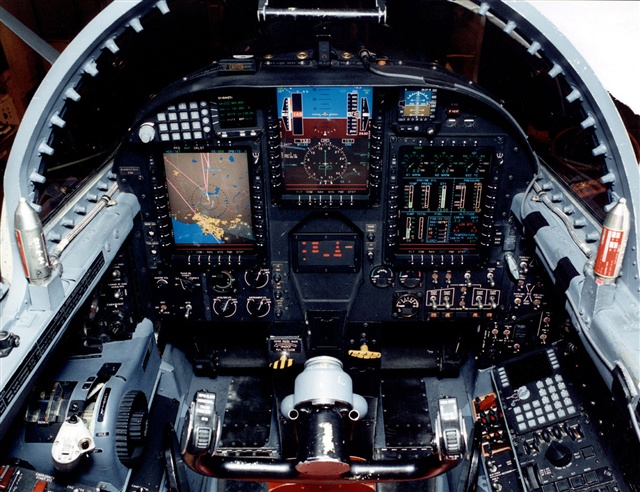
The conversion to U-2S in the 1990s consisted chiefly of replacing the turbojets with the General Electric F118 turbofan, with associated avionics work; the two-seater became the TU-2S. Today's Block 20 U-2S has a glass cockpit, digital autopilot, modernised electronic warfare systems and updated data links; its principal sensors are the ASARS-2A synthetic aperture radar, the SYERS-2C multispectral electro-optical and infrared system, and the ASIP signals intelligence payload. With a span of 105 feet, a length of 63, a maximum take-off weight of 40,000 pounds and an F118-GE-101A of 17,000 pounds of thrust, the published figures give it 410 mph, a range of more than 7,000 miles and a ceiling above 70,000 feet. Its open architecture allows new payloads to be fielded quickly, and the aircraft can gather imagery, signals and measurement intelligence simultaneously.
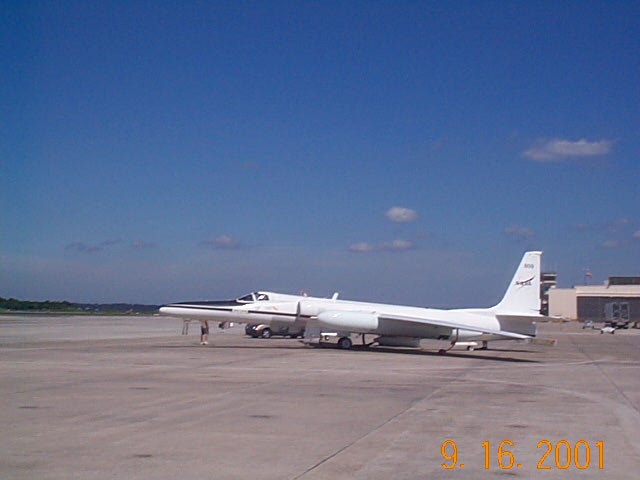
There is a civilian branch as well. Two aircraft — one newly built, one converted from a TR-1A — went to NASA as ER-2s, Earth resources research aircraft the agency operates for atmospheric science and Earth observation. An ER-2 set a world altitude record in horizontal flight for its weight class in November 1998, at 20,479 metres. In 2018 NASA used ER-2s carrying MODIS and ASTER instruments to map the Mendocino Complex Fire in the infrared. And there was an even stranger scientific use: in 1977 a U-2R was fitted with an upward-looking window to observe the cosmic microwave background, an experiment that made the first definitive measurement of our galaxy's motion relative to that background.
The aircraft that refuses to retire
The U-2 is still in front-line service seven decades after its first flight, and the reason is simple: it can change what it is looking at on very short notice, which a satellite in orbit cannot. It outlived its supersonic replacement, the SR-71, retired in 1998, and it has since outlived a succession of budgetary death sentences. A classified document approved by the Pentagon in December 2005 called for termination no earlier than 2012; in January 2006 Defense Secretary Donald Rumsfeld announced its retirement as a cost-saving measure, arguing that satellites and a growing fleet of RQ-4 Global Hawks would fill the gap. In 2009 the date moved to 2014 or later. In 2012 there was talk of extending it to 2023. In 2015 the RQ-4 was to replace it by 2019, while Lockheed maintained the aircraft could remain viable to 2050. In January 2018 the budget postponed retirement indefinitely.
The numbers explain much of the resistance. In early 2014 the Air Force put the U-2 at $2,380 per flight hour against $6,710 for the RQ-4, and critics pointed out that the unmanned aircraft's cameras and sensors were less capable and could not work in all weather. In 2014 Lockheed calculated that the U-2S fleet had used only a fifth of its design service life and was among the youngest in the Air Force. Congress intervened repeatedly to bar spending on retiring or storing them.
Meanwhile the aircraft has kept working and kept being modernised. It flew more than two hundred missions over Iraq, Afghanistan and the Horn of Africa by early 2010; it deployed to Cyprus in 2011 for the Libyan no-fly zone; from Osan in South Korea it provided imagery of the Japanese nuclear plant damaged by the earthquake and tsunami of March 2011. In 2020 it became the first military aircraft to integrate artificial intelligence into a mission, under a programme called ARTUμ. That same year the avionics refresh contract began, which among other things has equipped the whole fleet with SYERS-2C cameras and led in 2023 to a first flight with new cockpit, navigation and communications. On 3 February 2023 two U-2s intercepted and photographed the Chinese surveillance balloon that crossed the United States, the first operational use of the two-seat TU-2S; the photograph of the pilot looking down on the balloon, taken from the cockpit, went round the world. In 2025 the type flew surveillance missions along the Mexican border, and a TU-2S set an endurance record for its class with a fourteen-hour flight over all forty-eight contiguous states.
Retirement is on the table again, and again it is contested. Air Combat Command withdrew one TU-2S and three U-2S at the start of 2024, meaning it as the first step towards standing the type down, and budget plans pointed to 2026. By mid-2026, however, the argument was still live in Congress, with spending proposals that spared the aircraft from the axe. Seventy years after that involuntary hop over a dry lake bed in Nevada, Kelly Johnson's glider retains the habit of outliving whatever was going to replace it.
Variants
| U-2A | ER-2 | TR-1A | TR-1B | TU-2S | U-2B | U-2C | U-2CT | U-2D | U-2E | U-2F | U-2G | U-2H | U-2R | U-2R(T) | U-2S | WU-2 | |
|---|---|---|---|---|---|---|---|---|---|---|---|---|---|---|---|---|---|
| First flight | August 1, 1955 | — | — | — | — | — | — | — | — | — | — | — | — | — | — | — | — |
| Aircraft type | High-altitude strategic reconnaissance aircraft | NASA civilian high-altitude research aircraft | Tactical reconnaissance version with ASARS-2 radar | Two-seat TR-1 conversion trainer | Re-engined two-seat trainer | Converted missile warning patrol aircraft | Re-engined high-altitude reconnaissance aircraft | Two-seat conversion trainer | Two-seat infrared detection aircraft | Air-refuelable U-2B | Air-refuelable U-2C | Carrier-capable U-2C | Air-refuelable and carrier-capable variant | Redesigned, nearly thirty percent larger airframe | Two-seat U-2R trainer | High-altitude strategic reconnaissance aircraft | Atmospheric and weather research version |
| Powerplant | One Pratt & Whitney J57-P-37A turbojet | — | One Pratt & Whitney J75 turbojet | One Pratt & Whitney J75 turbojet | One General Electric F118-101 turbofan | One Pratt & Whitney J57 turbojet | One Pratt & Whitney J75-P-13 turbojet | — | — | One Pratt & Whitney J57 turbojet | One Pratt & Whitney J75-P-13 turbojet | One Pratt & Whitney J75-P-13 turbojet | — | One Pratt & Whitney J75 turbojet | One Pratt & Whitney J75 turbojet | One General Electric F118-101 turbofan | — |
| Powerplant | 1 × Pratt & Whitney J57-P-37A | — | 1 × Pratt & Whitney J75 | 1 × Pratt & Whitney J75 | 1 × General Electric F118-101 | 1 × Pratt & Whitney J57 | 1 × Pratt & Whitney J75-P-13 | 1 × turbojet | 1 × Pratt & Whitney J57-P-13B | 1 × Pratt & Whitney J57 | 1 × Pratt & Whitney J75-P-13 | 1 × Pratt & Whitney J75-P-13 | 1 × turbojet | 1 × Pratt & Whitney J75 | 1 × Pratt & Whitney J75 | 1 × General Electric F118-101 | 1 × turbojet |
| Thrust per engine | — | — | — | — | 76 kN Best value in this row | — | — | — | — | — | — | — | — | — | — | 76 kN Best value in this row | — |
| Length | — | — | 19.2 m Best value in this row | 19.2 m Best value in this row | 19.2 m Best value in this row | — | — | — | 15.1 m | — | — | — | — | 19.2 m Best value in this row | 19.2 m Best value in this row | 19.2 m Best value in this row | — |
| Wingspan | — | — | 31 m Best value in this row | 31 m Best value in this row | 31 m Best value in this row | — | — | — | 24.4 m | — | — | — | — | 31 m Best value in this row | 31 m Best value in this row | 31 m Best value in this row | — |
| Height | — | — | 4.9 m Best value in this row | 4.9 m Best value in this row | 4.9 m Best value in this row | — | 4.9 m Best value in this row | — | 4.7 m | — | — | — | — | 4.9 m Best value in this row | 4.9 m Best value in this row | 4.9 m Best value in this row | — |
| Wing area | — | — | 93 m² Best value in this row | 93 m² Best value in this row | 93 m² Best value in this row | — | — | — | — | — | — | — | — | 93 m² Best value in this row | 93 m² Best value in this row | 93 m² Best value in this row | — |
| Empty weight | — | — | — | — | — | — | — | — | — | — | — | — | — | — | — | 7,257 kg | — |
| MTOW | — | — | — | — | — | — | — | — | — | — | — | — | — | — | — | 18,144 kg | — |
| Top speed | — | — | — | — | — | — | — | — | 805 km/h | — | — | — | — | — | — | — | — |
| Cruise speed | — | — | — | — | — | — | — | — | — | — | — | — | — | — | — | 760 km/h | — |
| Cruise altitude | — | — | — | — | — | — | — | — | — | — | — | — | — | — | — | 22,000 m | — |
| Service ceiling | — | — | — | — | — | — | 22,700 m | — | 21,336 m | — | — | — | — | — | — | 24,000 m Best value in this row | — |
| Initial climb rate | — | — | — | — | — | — | — | — | — | — | — | — | — | — | — | 46 m/s | — |
| Range | 7,400 km | — | — | — | — | — | 7,400 km | — | 7,408 km | — | — | — | — | — | — | 11,280 km Best value in this row | — |
| Ferry range | — | — | — | — | — | — | — | — | — | 15,000 km Best value in this row | 15,000 km Best value in this row | — | — | — | — | — | — |
| Combat radius | — | — | — | — | — | — | — | — | — | — | — | — | — | — | — | 0 km | — |
| Endurance | — | 600 min | — | — | — | — | — | — | — | 840 min Best value in this row | 840 min Best value in this row | — | — | — | — | 720 min | — |
| Range conditions | — | Missions of more than ten hours and ranges above six thousand nautical miles | — | — | — | — | — | — | — | Aerial refuelling from the KC-97 or KC-135 extended range and endurance beyond fourteen hours | Aerial refuelling from the KC-97 or KC-135 extended range and endurance beyond fourteen hours | — | — | — | — | Twelve-hour endurance with a range above eleven thousand kilometres | — |
| Armament | None | None | None | None | None | None | None | None | None | None | None | None | None | None | None | None | None |
| Max weapons load | 0 kg Best value in this row | 0 kg Best value in this row | 0 kg Best value in this row | 0 kg Best value in this row | 0 kg Best value in this row | 0 kg Best value in this row | 0 kg Best value in this row | 0 kg Best value in this row | 0 kg Best value in this row | 0 kg Best value in this row | 0 kg Best value in this row | 0 kg Best value in this row | 0 kg Best value in this row | 0 kg Best value in this row | 0 kg Best value in this row | 0 kg Best value in this row | 0 kg Best value in this row |
| Payload | — | 1,179 kg | — | — | — | — | — | — | — | — | — | — | — | — | — | 2,300 kg Best value in this row | — |
| Cargo capacity | — | Maximum payload distributed between the equipment bay, nose area and wing pods | — | — | — | — | — | — | — | — | — | — | — | — | — | Sensor payload distributed between the equipment bay, the nose and the wing pods | — |
| Crew | 1 Best value in this row | 1 Best value in this row | 1 Best value in this row | 2 | 2 | 1 Best value in this row | 1 Best value in this row | 2 | 2 | 1 Best value in this row | 1 Best value in this row | 1 Best value in this row | 1 Best value in this row | 1 Best value in this row | 2 | 1 Best value in this row | 1 Best value in this row |
| Passengers | — | — | — | — | — | — | — | — | — | — | — | — | — | — | — | 0 | — |
| Units built | 49 Best value in this row | 2 | 33 | 2 | 5 | 1 | 13 | 2 | 6 | 0 | 5 | 2 | — | 12 | 1 | 31 | 1 |
Images
Elsewhere
- NASAU-2 en el Centro de Investigacion Lewis de la NASA (1973) ↗
- NASAEl piloto James Barrilleaux junto a un ER-2 en la rampa (1998) ↗
- NASADavid A. Wright en la cabina de un ER-2 (1999) ↗
- NASAER-2 de la NASA listo para volar a gran altitud (2016) ↗
- NASAER-2 numero 809 antes de un vuelo de la campana SOLVE (2000) ↗
- CIAMaqueta de U-2 utilizada por Francis Gary Powers, Museo de la CIA ↗
- CIATraje de presion y casco de piloto de U-2, Museo de la CIA ↗
- Smithsonian NASMLockheed U-2, fotografia de la coleccion del Smithsonian NASM ↗
- Smithsonian NASMLockheed U-2C en la coleccion del Smithsonian NASM ↗
- Smithsonian NASMCamara aerea Hycon 73B usada en misiones U-2 sobre Cuba en 1962, Smithsonian NASM ↗
- Lockheed MartinU-2 Dragon Lady, pagina oficial de Lockheed Martin ↗
- DVIDSPiloto de reserva vuela un U-2 por primera vez, Beale AFB (2020) ↗
Show the 8 more
- DVIDSEl comandante del Air Combat Command en una mision de reconocimiento U-2 (2019) ↗
- DVIDSTripulacion de avionica de un U-2 en Al Dhafra, EAU (2019) ↗
- DVIDSUn U-2 Dragon Lady aterriza en la base aerea de Al Dhafra (2019) ↗
- Internet ArchiveLockheed U-2, avion de investigacion desde 1956 (NASA, 1967) ↗
- Internet ArchiveLockheed U-2, avion de investigacion desde 1956 (NASA, 1967), otra vista ↗
- Internet ArchiveU-2 con marcas ficticias de la NASA presentado a la prensa en Edwards AFB (1960) ↗
- Wikimedia CommonsCategoria de Lockheed U-2 en Wikimedia Commons ↗
- Wikimedia CommonsCategoria en Wikimedia Commons sobre el incidente del U-2 de Powers en 1960 ↗