Lockheed U-2 variant
Lockheed U-2D
Two-seat version of the small-airframe U-2 built as a test bed rather than a trainer: an observer with no flight controls operated infrared detectors measuring the heat of aircraft and missiles in support of the MIDAS early-warning satellite programme. Airframe 56-6721 (Article 388) flew in Projects Low Card, Smokey Joe and Program 949 and is now displayed at Palmdale.
-1600.webp)
- January 7, 1958
- First flight
- 6
- Units built
- 7,408 km
- Range
History
A second seat to measure heat
The U-2D was the two-seat version of the small-airframe U-2, conceived not as a trainer but as a test platform: the large camera behind the pilot made way for a second crewman, an observer operating infrared radiation detectors able to measure the emissions of aircraft and missiles. The rear seat had only a few basic instruments and no flight controls, which sets it apart from the later dual-control trainers. A complicated mirror system, the so-called MIDAS array, was fitted in the fuselage cavity between the two cockpits, and a white sensor dome rose above the cockpit; the upper part of the aircraft was painted black so as not to confuse the sensor.
The purpose was the MIDAS programme (Missile Detection and Alarm System): to establish whether a rocket plume could be detected and tracked during its boost phase to give early warning of a Soviet nuclear attack, and so to develop the sensors that would eventually fly on satellites. According to the Flight Test Historical Foundation, Lockheed test pilot Bob Schumacher flew the first U-2D, 56-6710 (Article 377), on 7 January 1958.
How many there were
Sources disagree. Wikipedia's variant list gives six aircraft; the Edwards museum timeline describes a four-aircraft fleet at the Air Research and Development Center in 1960, two of them U-2Ds: 56-6721 (Article 388) and 56-6954 (Article 394), alongside U-2As 56-6701 (Article 368) and 56-6722 (Article 389). In 1966 56-6954 went to Van Nuys and was converted into a single-seat U-2C with a J75 engine, leaving 56-6721 as the only U-2D in service.
Article 388: from Cortez to Edwards
The best documented example is 56-6721, the forty-eighth U-2 airframe and the twenty-eighth U-2A built at Lockheed's Oildale plant in California. In October 1957 it was delivered to the 4080th Strategic Reconnaissance Wing at Laughlin AFB, Del Rio, Texas. On 3 August 1959, during a training flight, Taiwanese pilot Maj. Mike Hua suffered a flame-out at 70,000 ft (about 21 km); after gliding more than 320 km he belly-landed at Cortez, Colorado, because the dead engine could not supply enough hydraulic power to lock the gear down: the "Miracle at Cortez". While under repair the aircraft received the second seat and the infrared sensors and became a U-2D. In December 1959 it reached Edwards, assigned to the Special Projects Branch of the 6512th Test Group.
Low Card, Smokey Joe and Program 949
In 1960-1961 it flew in Project Low Card, later renamed Smokey Joe: operating from Patrick AFB it watched launches from Cape Canaveral and examined their exhaust plumes with optical spectrometer sensors, the kind that would later be installed on warning satellites. In those years it also flew from Hickam AFB, Hawaii, to track Corona reconnaissance satellite film capsules after re-entry, and in 1961 it used its infrared sensor to monitor an X-15 launch. In May 1968 it received new instruments for 31 test sorties under Program 949, a space-borne missile warning system, flying from Hanscom AFB, Massachusetts, and Patrick AFB until October 1968. In June 1969 Program 949 was renamed Program 647, the Defense Support Program (DSP), whose satellites detect launches and nuclear explosions by infrared. The aircraft was also used for thunderstorm research and for camera evaluations for NASA's TIROS and Nimbus weather satellites.
Final years and preservation
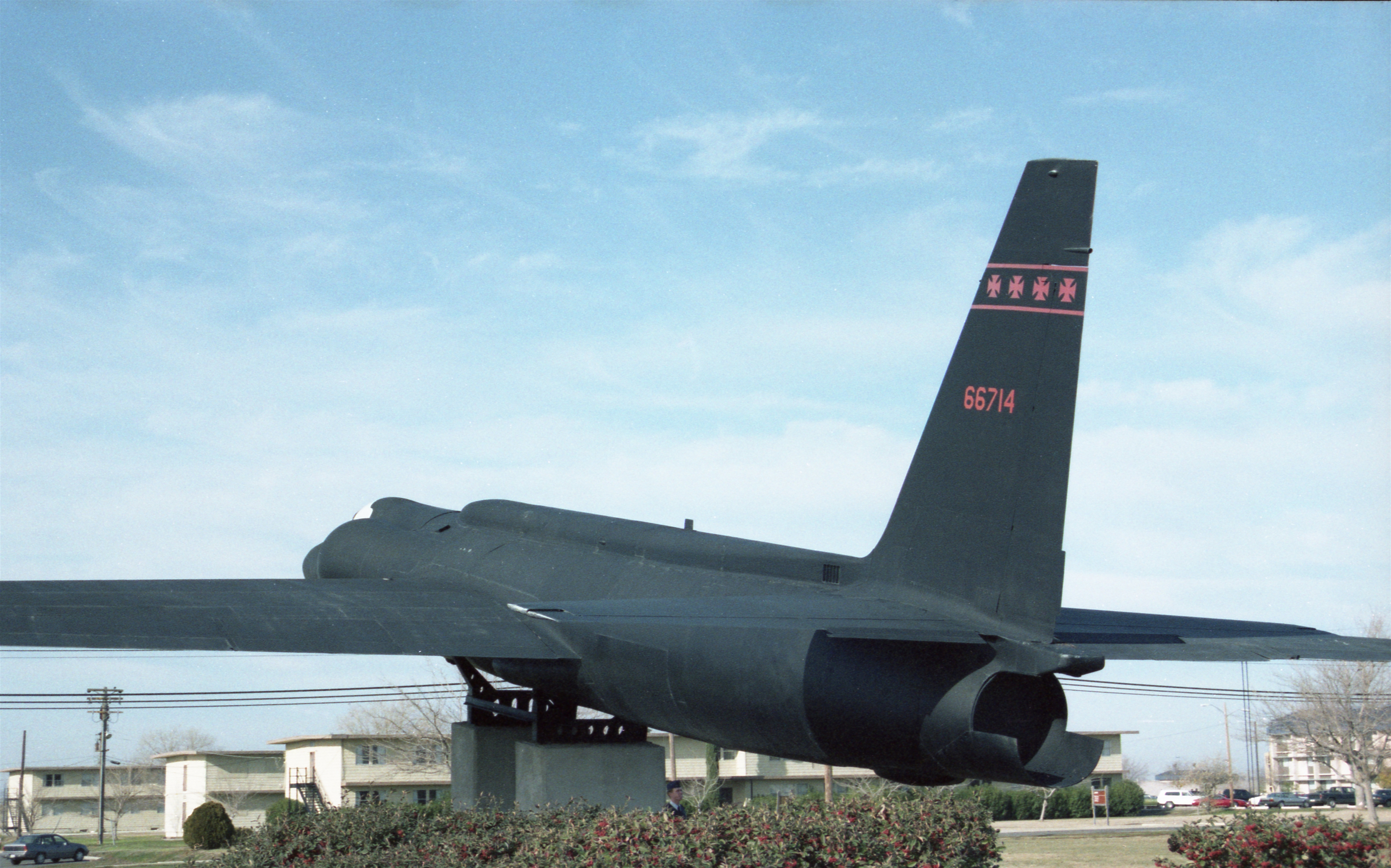
From about 1971 to 1977 it served as a chase plane for the Compass Cope reconnaissance drone programme, and students of the Air Force Test Pilot School at Edwards occasionally flew it. It never received the J75 engine fitted to most of the fleet. It was struck off charge in 1978 according to Aerial Visuals (the museum gives 1980 as its retirement year), was displayed at the March Field Air Museum in Riverside from 1980 to 1996, was restored at Lockheed Martin's facility at Air Force Plant 42 and since November 2001 has stood at the Blackbird Airpark in Palmdale, alongside an SR-71A, an A-12 and a D-21 drone. The museum presents it as the last surviving U-2D, although Wikipedia's list of preserved aircraft also assigns that designation to 56-6682 (Museum of Aviation, Robins AFB) and 56-6714 (Beale AFB).
Multimedia

-1600.webp)
-1600.webp)

-1600.webp)