Lockheed U-2 variant
Lockheed U-2 ER-2
The civil research version of the large-airframe U-2, flown by NASA since 1981 as a high-altitude flying laboratory. Taken from the TR-1A line, whose structure it keeps without the defensive systems or classified electronics, the ER-2 (Earth Resources 2) replaced the agency's U-2Cs and has flown Earth science, atmospheric chemistry, ozone, hurricane, wildfire and satellite-calibration work on six continents. NASA now keeps two, N806NA and N809NA, at Palmdale, California.

- 2
- Units built
History
Replacing the U-2Cs
NASA began flying U-2s of its own in 1971, when Ames Research Center at Moffett Field, California, received two rebuilt U-2Cs — former U-2Gs once modified for carrier operations — registered N708NA (56-6681) and N709NA (56-6682). The Airborne Science Program's first data-acquisition flight took place on 31 August 1971. In the late 1970s the Air Force needed more reconnaissance aircraft to supplement its U-2R fleet, and in 1979 Lockheed reopened U-2 production at Palmdale for a third time, now under the TR-1 designation. When Lockheed received the contract to restart production in 1980, NASA was quick to order one of the new aircraft and named it ER-2, for Earth Resources 2.
In 1981 the first TR-1A off the line, serial 80-1063, was delivered to Ames with the civil registration N706NA. With a wingspan of 104 ft 8 in (31.9 m) and a fuselage 63 ft 1 in (19.2 m) long, it spanned about 24 ft (7.3 m) more than the U-2C and was almost 14 ft (4.3 m) longer. As built it was almost identical to the Air Force TR-1As and U-2Rs, but without the defensive systems and classified electronics of the military aircraft: instead of reconnaissance sensors, its payload bays take scientific instruments. It is now powered by a General Electric F118-101 turbofan of 19,000 lb thrust (about 84.5 kN), the engine of the U-2S family.
Three aircraft, then two
In 1987 the first U-2C delivered to NASA (N708NA) was retired. To replace it the agency received a former Air Force TR-1A, 80-1069, on loan; converted to ER-2 standard and re-registered N708NA, it served with NASA until 1996, when it returned to the Air Force and was converted to a U-2S. In 1989 the remaining U-2C (N709NA) was also retired, and later that year the second NASA-owned ER-2, 80-1097, arrived and took the N709NA registration. For a time NASA thus operated three ER-2s at once. Sources differ on the origin of 80-1097: one describes it as a converted TR-1A, another as a second purpose-built ER-2. The two aircraft still in service fly today as N806NA (NASA 806, built 1981) and N809NA (NASA 809, built 1989).
From Ames to Palmdale
The U-2s, and later the ER-2s, were based at Ames until 1997, when the ER-2s and their operations moved to the Dryden Flight Research Center at Edwards Air Force Base (another source dates the move to 1998 and ties it to a cost-saving consolidation of NASA fleets). In January 2010 the aircraft moved to NASA's Palmdale facility, Building 703 of what is now the Armstrong Flight Research Center, where they remain part of the Airborne Science Program under the Science Mission Directorate.
A laboratory in the stratosphere
The ER-2 operates between 20,000 and 70,000 ft (6,096 to 21,336 m), above the great bulk of the atmosphere, and depending on weight reaches an initial cruise altitude of 65,000 ft (19,812 m) within 20 minutes. Typical cruise speed is 410 knots (759 km/h). A normal eight-hour mission covers about 3,000 nautical miles and yields seven hours of data collection at altitude; missions of more than ten hours can cover twice that distance. From 70,000 ft its effective horizon exceeds 480 km, so its sensors replicate the spatial, spectral and atmospheric characteristics of satellite data. Unlike the military U-2, it also works at low levels, down to about 8.5 km.
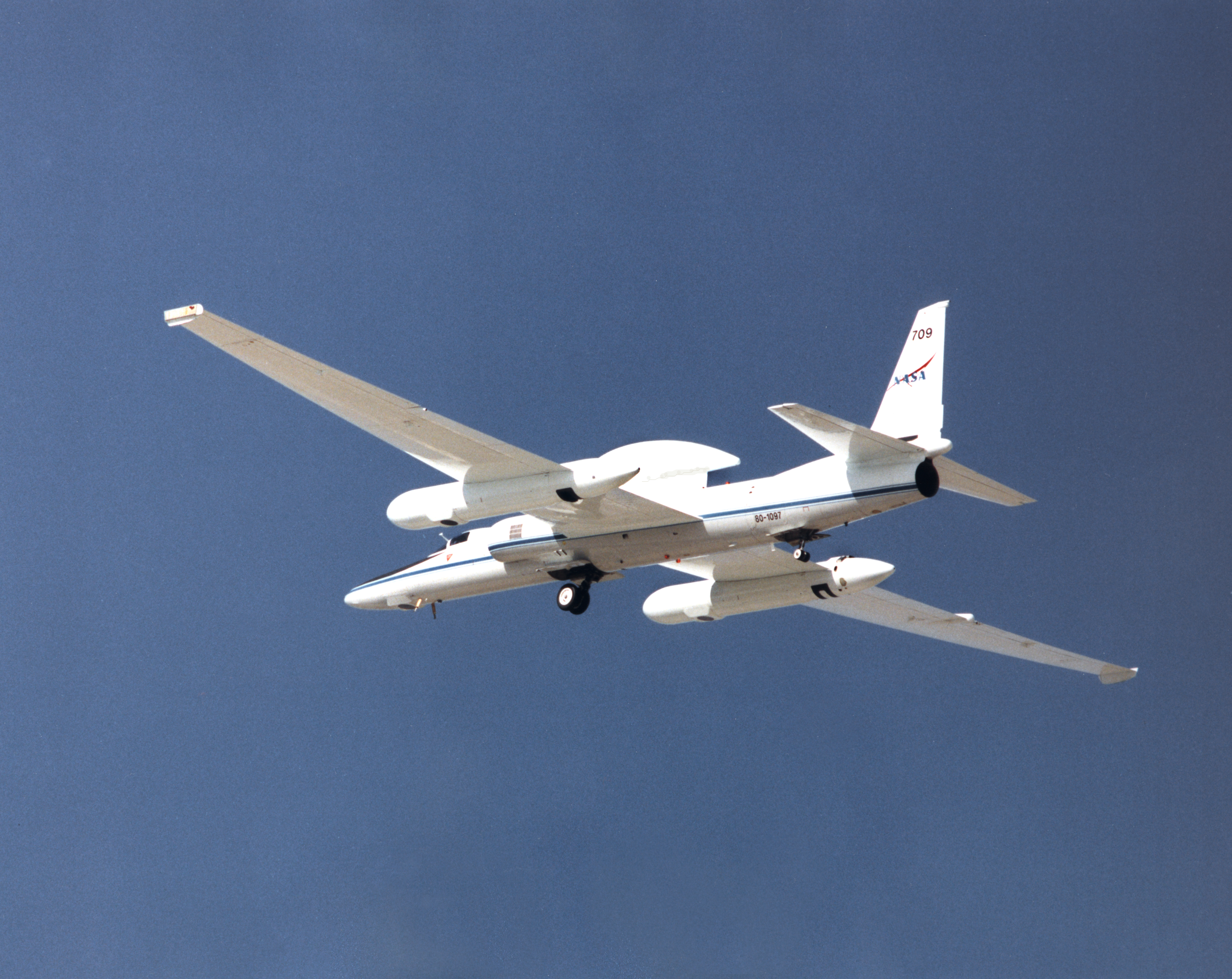
NASA gives a maximum payload of 2,600 lb (1,179 kg); the Airborne Science Program data sheet lists 2,900 lb of useful payload and a gross take-off weight of 40,000 lb (18,145 kg). Payload is spread between the nose, the equipment bay (Q-bay) behind the cockpit, the System 20 pod on the trailing edge of the right wing, the centreline pod and two five-segment wing 'superpods'; on the ER-2, unlike military U-2s, the forward two-thirds of those superpods can be pressurised. NASA also describes four large pressurised experiment compartments and a high-capacity AC/DC electrical system. Large Area Collectors can be fitted at the superpod attachment points; at 65,000 ft their doors open to trap cosmic dust on oil-coated pads. The modular design lets payloads be swapped quickly between missions.

The pilot has little to do with the instruments: beyond a switch to activate them and some reset procedures after a fault, the scientists control them. From 1995 to 1998 NASA borrowed the prototype U-2 Senior Spur satellite link, renamed STARLink and operational from 1997 in a dorsal pod on N709NA (80-1097), which transmitted data and images in real time and let instruments be tuned in flight; lack of funding meant it could not be kept, so most data are still recorded on board, with an Iridium phone for small exchanges.
Campaigns around the world
The ER-2s have deployed to six continents. In January and February 1986 aircraft 706 flew from Darwin, Australia, on a stratosphere project; in August and September 1987 an ER-2 flew from Chile over Antarctica; in April 1994 NASA 709 (80-1097) sampled air over the Southern Ocean from Christchurch, New Zealand; in 1999-2000 another, alongside NASA's DC-8 science aircraft, measured Arctic stratospheric ozone from Kiruna, Sweden; and in July 2005 one flew over several hurricanes from Central America. In the mid-1980s, under the HI-CAMP programme, the ER-2 carried an infrared sensor similar to that of the Teal Ruby satellite to measure atmospheric, ocean and terrain backgrounds; the satellite was ready in 1986 but was cancelled.
After the Gulf of Mexico oil spill in 2010 and the Mississippi floods in 2011 the ER-2s assessed the damage, and in the 2011 tornado season they flew over storms in the Southern Great Plains. They carry the Jet Propulsion Laboratory's 224-band AVIRIS spectrometer and Air-LUSI, which measures the Moon's spectral irradiance to calibrate satellites. In the summers of 2021 and 2022 the DCOTSS campaign, based at Salina, Kansas, carried twelve instruments to study how strong convection penetrates the lower stratosphere under the North American Monsoon Anticyclone, and over three winters the IMPACTS campaign, with the P-3 from Wallops, studied snow bands in storms over the eastern United States. The aircraft have also worked for the Forest Service, the Environmental Protection Agency, the Fish and Wildlife Service and the Army Corps of Engineers, and as a reimbursable service for the Department of Defense and manufacturers such as Boeing, Lockheed Martin and Northrop Grumman.
Record and operations
On 19 November 1998 a NASA ER-2 set the world altitude record in horizontal flight for its take-off weight class (26,455 to 35,275 lb, 12,000 to 16,000 kg). NASA gives the altitude as 68,700 ft; other sources record 20,479 m. Only former Air Force U-2 pilots with more than 1,000 hours on type can fly it; according to a feature reproduced in 2014 there were four, the two aircraft flew a combined 250 to 300 hours a year and had amassed 11,449 flight hours. As on any U-2, every landing is assisted by another pilot in a chase car running at more than 190 km/h. Since 31 August 1971 NASA's U-2s and ER-2s have completed more than 4,500 data missions and test flights; the agency charges science users 3,500 dollars per flight hour.
Multimedia


