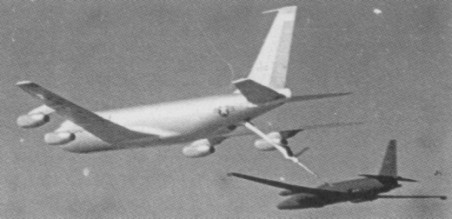
Lockheed U-2 variant
Lockheed U-2F
Air-refuelling version of the small-airframe U-2, produced by fitting J75-powered U-2Cs with receiving equipment. The modification, begun in May 1961 on CIA and USAF aircraft, let the U-2 take fuel from a KC-97 or KC-135 and nearly doubled its range, although pilot fatigue limited its use. A U-2F photographed the Soviet missiles in Cuba on 14 October 1962, and another was shot down over the island on 27 October, killing Major Rudolf Anderson.
%2C_1988-1600.webp)
- 5
- Units built
History
Range the pilot could not use
In May 1961, seeking to stretch the U-2's already considerable range, Lockheed fitted six CIA aircraft and several USAF machines with aerial refuelling equipment able to take fuel from either a Boeing KC-97 or a Boeing KC-135. On paper the gain was dramatic: range rose from roughly 4,000 to 8,000 nautical miles — about 7,400 to 15,000 kilometres — and endurance passed fourteen hours. Each modified aircraft also received an extra oxygen cylinder. The conversion produced two designations according to powerplant: J57-powered U-2Bs became U-2Es, while U-2Cs, already re-engined with the more powerful J75, were redesignated U-2F. The U-2F is therefore a small-airframe U-2C with a refuelling receptacle; it should not be confused with the U-2E, which kept the J57, nor with the U-2H, which combined refuelling with carrier capability.
Pilot fatigue
The modification solved a technical problem and ignored a human one. Nobody had reckoned with spending more than half a day in a pressure suit in a cramped cockpit, and pilot fatigue became the real limit: little use was made of the refuelling capability. Even so, it had an immediate operational effect. From October 1960 the CIA's Detachment G had been overflying Cuba from Laughlin Air Force Base, Texas; the U-2Fs allowed some of those missions to originate directly from Edwards, California, although fatigue still limited flights to about ten hours.
The missile crisis
The variant's best-known role came in October 1962. Once it was decided that Cuban overflights should be flown by a military officer rather than a CIA pilot, two Agency U-2Fs were placed under the Weather Reconnaissance Squadron Provisional (WRSP-4) at Edwards, painted with USAF insignia and tail numbers and flown by 4080th Strategic Reconnaissance Wing pilots. There Major Richard S. Heyser received hasty training on the U-2F, more powerful than the aircraft he knew. Early on Sunday 14 October 1962 he took off from Edwards in Article 342 — the second U-2 built, modified for in-flight refuelling and hastily repainted as 'USAF 66675' — on Mission 3101, dubbed Brass Knob. He crossed the Gulf of Mexico and the Yucatán Channel, flew over western Cuba without opposition and landed at McCoy Air Force Base, Florida, after exactly seven hours aloft. His photographs showed Soviet medium-range ballistic missiles at San Cristóbal for the first time and set the crisis in motion. From then on all Cuban missions were flown from a detachment at McCoy.
The loss of Rudolf Anderson
On Saturday 27 October 1962 Major Rudolf Anderson took off from McCoy on his sixth mission over Cuba in another U-2F, USAF serial 56-6676, former CIA Article 343. At 10:19 a.m. he was shot down over Banes by one of two S-75 Dvina (SA-2 Guideline) surface-to-air missiles fired at him, and was killed. He was posthumously awarded the first Air Force Cross. Wreckage of his U-2F is displayed in three Cuban museums: an engine intake at the Museo de la Lucha contra Bandidos in Trinidad; the engine and part of the tail at the Museum of the Revolution in Havana; and the right wing, another portion of the tail and the nose landing gear at La Cabaña fortress. After the crisis no CIA pilot flew over Cuba again, and Strategic Air Command kept those missions.
Individual airframes
The designation was often temporary and followed the airframe. Article 359 first flew at Burbank in October 1956 as a CIA U-2A, passed to the USAF in December 1960 as 56-6692, returned to the Agency in mid-1962 and was re-engined as a U-2C; a year later it received refuelling equipment and became a U-2F. With it, it made one of the longest flights by an original U-2, lasting 13 hours 20 minutes, and in the mid-1960s it overflew mainland China nine times in the joint operation with Taiwan's air force. In 1968 it returned to the USAF with the refuelling and CIA-specific systems removed, a U-2C once more; it is now preserved at Duxford. Article 347 (56-6680), the seventh U-2 built and delivered on 9 February 1956, also carried the refuelling probe for a time and flew as a U-2F; the National Air and Space Museum acquired it as a U-2C on 30 August 1982. Photographs survive of a U-2F refuelling from a KC-135Q, and film of a U-2E/F refuelling from a KC-97L.
How many
The figures disagree. Wikipedia's variant list credits the U-2F with five conversions, while its own narrative speaks of six CIA aircraft converted to U-2F standard in 1961, plus several USAF aircraft modified as U-2Es or U-2Fs. A full list of airframes and conversion dates is not given in the sources consulted.

Multimedia


-800.webp)