Lockheed U-2 variant
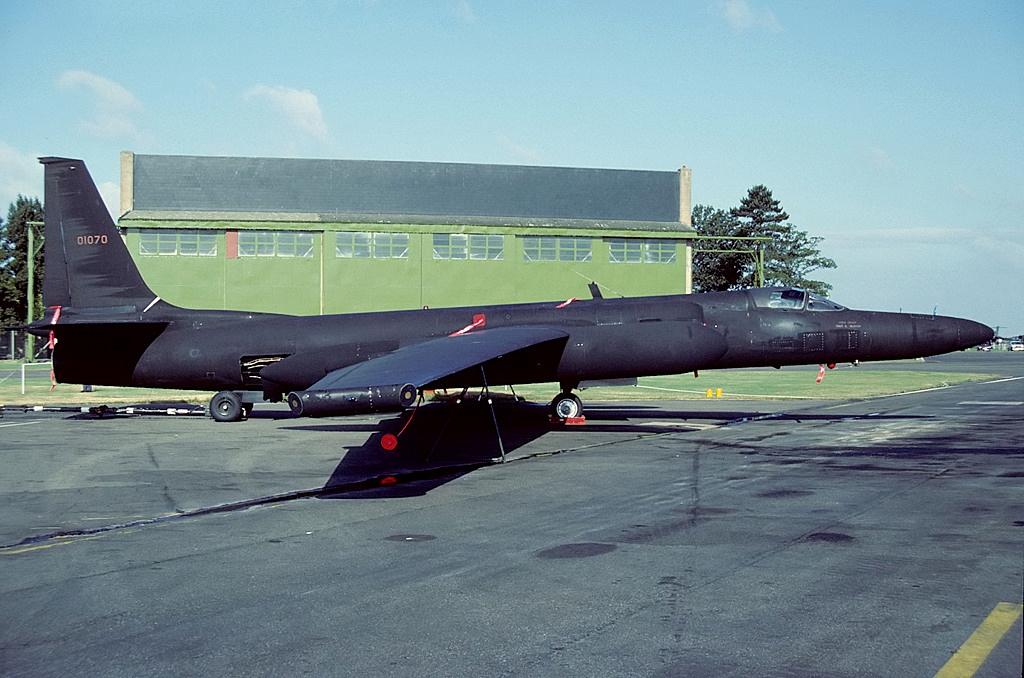
Lockheed U-2 TR-1A
Tactical reconnaissance version of the large U-2R airframe, built when production reopened in the early 1980s to watch the Warsaw Pact from outside its airspace with the ASARS-2 radar. It flew on 1 August 1981, served with the 17th Reconnaissance Wing at RAF Alconbury from 1983 to 1991 and then reverted to the U-2R designation.

- August 1, 1981
- First flight
- 33
- Units built
History
A U-2R by another name
The TR-1A was the third production batch of the U-2R airframe, the enlarged U-2 that had first flown on 28 August 1967. When Lockheed reopened the line in the early 1980s the aircraft came off it alternately: in the words of pilot Bruce Jinneman, "one aircraft of the line was a U-2 and the next, destined for England, a TR-1". It was structurally identical to the U-2R and kept its large "superpods" under each wing; what set the batch apart was its equipment: the ASARS-2 side-looking radar, new avionics and improved electronic countermeasures. It retained the Pratt & Whitney J75 turbojet of the earlier large-airframe versions.
TR stood for tactical reconnaissance. Sources agree that there were no significant differences between the two types and that the name was chosen to dissociate the aircraft from the politically sensitive CIA U-2 missions associated with Gary Powers, and to reflect the more tactical role of the aircraft that would operate from Europe, designed for standoff reconnaissance without penetrating enemy territory.
First flight and production
The first production TR-1A flew on 1 August 1981 and was delivered to the Air Force the following month. Deliveries of the TR-1/U-2R airframe ran from September 1981 to October 1989, when the USAF received the last U-2 and TR-1 aircraft. Even the pilots' survival kits came in a batch of their own: the kits made in 1967/1968 for the U-2R were joined by others made in 1980/1981 for the TR-1. The number built is not settled: the online encyclopedia entry on the U-2 gives 33 TR-1As, whereas the Federation of American Scientists fact sheet lists production as 25 TR-1A, 2 two-seat TR-1B and 2 ER-2 for NASA.
Alconbury: watching the Warsaw Pact
To manage operations, Strategic Air Command (SAC) activated the 17th Reconnaissance Wing at RAF Alconbury, Cambridgeshire, on 1 October 1982, with the 95th Reconnaissance Squadron as its flying component; the squadron, inactive since 1958, had been redesignated for reconnaissance on 20 January 1982. Mission tasking came from US Air Forces in Europe (USAFE). The first aircraft, 80-1068, arrived at Alconbury on 12 February 1983, flown non-stop from Beale AFB, California, by Capt Mark Spencer; 80-1070 followed a few days later. The wing flew tactical and strategic surveillance missions over Western Europe in support of NATO and received the P. T. Cullen Trophy, for "the greatest contribution to the intelligence gathering efforts of SAC", in 1989 and 1990.
The Gulf War
In 1990-91 the wing sent aircraft and personnel to Southwest Asia. After two U-2s deployed to King Fahad AB at Taif, Saudi Arabia, on 17 August 1990, two TR-1s from Alconbury arrived on 23 August; in all, six U-2s and six TR-1s were on strength during Desert Shield and Desert Storm, in the unit that on 21 September 1990 became the 1704th Reconnaissance Squadron (Provisional). The TR-1s brought the ASARS-II synthetic aperture radar to the desert; it could "see through" clouds, smoke or darkness and relay imagery in near-real time to a ground station, and because it provided tactical reconnaissance for the Army in Europe, the Army's tactical radar correlator (TRAC) van deployed with them. In theatre, parts and pilots were interchangeable with the U-2Rs.
End of the designation
The 17th Reconnaissance Wing was inactivated on 30 June 1991; the 95th Reconnaissance Squadron remained at Alconbury as a non-flying unit until 15 September 1993, and the aircraft were consolidated at Beale with the 9th Wing. With the transfer the TR-1s were redesignated U-2R: the Air Force monograph on the U-2 in Desert Storm places this in October 1991, while other sources date it to 1992. The TR-1B two-seater became the TU-2R. From 1994 the fleet was re-engined with the General Electric F118 turbofan and modernised to become the U-2S; the Air Force accepted the first one in October 1994. One of NASA's two ER-2s, serial 80-1097 (registered N809NA), is a converted TR-1A according to one source; another describes it as a second purpose-built ER-2.
Multimedia


