Lockheed U-2 variant
Lockheed U-2C
Single-seat conversion of existing U-2 airframes with the more powerful Pratt & Whitney J75-P-13 turbojet and enlarged intakes; thirteen aircraft, first flown in May 1959. It flew the last Soviet overflights — Powers's included —, the Taiwanese missions over China and scientific work for NASA.

- May 13, 1959
- First flight
- 13
- Units built
- 7,400 km
- Range
History
A more powerful engine for the same airframe
The U-2C was not a new-build aircraft: it was a conversion of existing airframes, which had their original Pratt & Whitney J57 turbojet replaced by the appreciably more powerful Pratt & Whitney J75-P-13. The change went beyond the engine itself: it required a marked enlargement of the fuselage air intakes, the feature that tells a U-2C from a U-2A at a glance. Wikipedia's list of versions puts the number of aircraft converted at thirteen, and historian Chris Pocock's timeline dates the first flight of a J75-powered U-2C to 13 May 1959.
According to the data gathered by This Day in Aviation, the U-2C was 15.113 m long, with a wingspan of 24.435 m, a height of 4.623 m and a wing area of 55.7 m². Its zero-fuel weight was 6,291 kg and its gross weight 10,873 kg. The J75-P-13B, a two-spool axial-flow turbojet with a 15-stage compressor (8 low- and 7 high-pressure stages) and a three-stage turbine, was rated at 17,000 lbf (75.62 kN) at sea level. The aircraft cruised at Mach 0.72 between 17,374 and 17,983 m, reached Mach 0.87 at 18,898 m although it was limited to Mach 0.80 in service, had a maximum range of 8,519 km and could operate at 23,165 m. The margins were still tight: to hold around 21,000 m, the early U-2A and U-2C had to fly very close to their never-exceed speed, only 19 km/h away from the stall — the so-called "coffin corner".
The last flights over the Soviet Union
U-2Cs flew the closing stretch of the Soviet overflights. On 9 April 1960 a U-2C of the CIA's special unit "10-10", flown by Bob Ericson, crossed the southern Soviet border over the Pamir Mountains and covered the Semipalatinsk nuclear test site, Dolon air base — home of Tu-95 bombers —, the surface-to-air missile test range near Saryshagan and the Tyuratam missile range. On 28 April pilot Glen Dunaway ferried another U-2C, Article 358, from Incirlik Air Base in Turkey to Peshawar airport in Pakistan.
On 1 May 1960, however, Francis Gary Powers took off on the Grand Slam mission in Article 360 (serial 56-6693). That aircraft had been built as a U-2A, the last of the initial production block; it was delivered to Groom Lake on 5 November 1956, used for test and development until May 1959 and then converted to the U-2C configuration. Flying at about 24,384 m near Sverdlovsk, it was hit by shrapnel from a Soviet S-75 missile; Powers bailed out and was captured. Pocock counts it as the 24th and last U-2 overflight of the Soviet Union. The wreckage of 56-6693 is displayed today at the Central Armed Forces Museum in Moscow.
Taiwan and the Black Cat Squadron
In 1958 Taiwanese and American authorities agreed to create the 35th Squadron, nicknamed the Black Cat Squadron, made up of two U-2Cs in an isolated part of Taoyuan Air Base and covered as a high-altitude weather research unit; in US documents it was known as Detachment H. In January 1961 the CIA provided the Republic of China with its first two U-2Cs. The sources disagree on the first mission over the mainland: Wikipedia places it in April of that year, while Pocock's timeline dates the first overflight of mainland China by a Taiwanese air force pilot to 13 January 1962. One of these aircraft, U-2C 56-6691 flown by Jack Chang, was shot down on 10 January 1965 northwest of Beijing; its reassembled wreckage is at the Military Museum of the Chinese People's Revolution. In 1968 the Taiwanese U-2C/F/G fleet was replaced by the U-2R.
Refuelling, carriers and further conversions
In 1961 Lockheed fitted six CIA U-2s and several USAF aircraft with in-flight refuelling equipment; the U-2Cs so modified were redesignated U-2F, and the list of versions counts five such conversions. The career of Article 359 shows how aircraft moved between standards: it flew as a U-2A for the CIA, passed to the USAF in December 1960 as serial 56-6692, returned to the Agency in mid-1962 and was re-engined, becoming a U-2C; a year later it received the refuelling probe and, as a U-2F, made one of the longest flights by a first-generation U-2, lasting 13 hours 20 minutes. On 5 August 1963 Lockheed test pilot Bob Schumacher took off from the aircraft carrier USS Kitty Hawk in a U-2C, in 98 m and without a catapult. In 1966 U-2D 56-6954 was converted at Van Nuys into a single-seat U-2C with a J75 engine. The type's military career ran on into the 1970s: on 2 May 1974 U-2C no. 6714 crashed near Davis-Monthan AFB, Arizona, and its pilot, Dan W. Riggs, survived. The most lasting legacy was the engine: when Lockheed redesigned the aircraft outright, the U-2R kept the J75-P-13B introduced on the U-2C.
Article 347 and scientific work
The National Air and Space Museum's aircraft, Article 347 (serial 56-6680), sums up the version's career. The seventh U-2 built, it was delivered on 9 February 1956 and on 4 July that year flew the first operational mission over the USSR, with Hervey Stockman at the controls. It began as a U-2A, was upgraded to U-2C with the J75-P-13B and the enlarged intakes and for a time carried a refuelling probe as a U-2F. With the CIA it flew unpainted apart from its three-digit production number, from Lakenheath (England), Wiesbaden and Giebelstadt (Germany), Akrotiri (Cyprus) and Edwards (California). According to the museum it was apparently lent to the Air Force in 1969 and flown over Vietnam; in 1974 the CIA transferred ownership to the USAF, which operated it until 1978, and the museum acquired it on 30 August 1982.

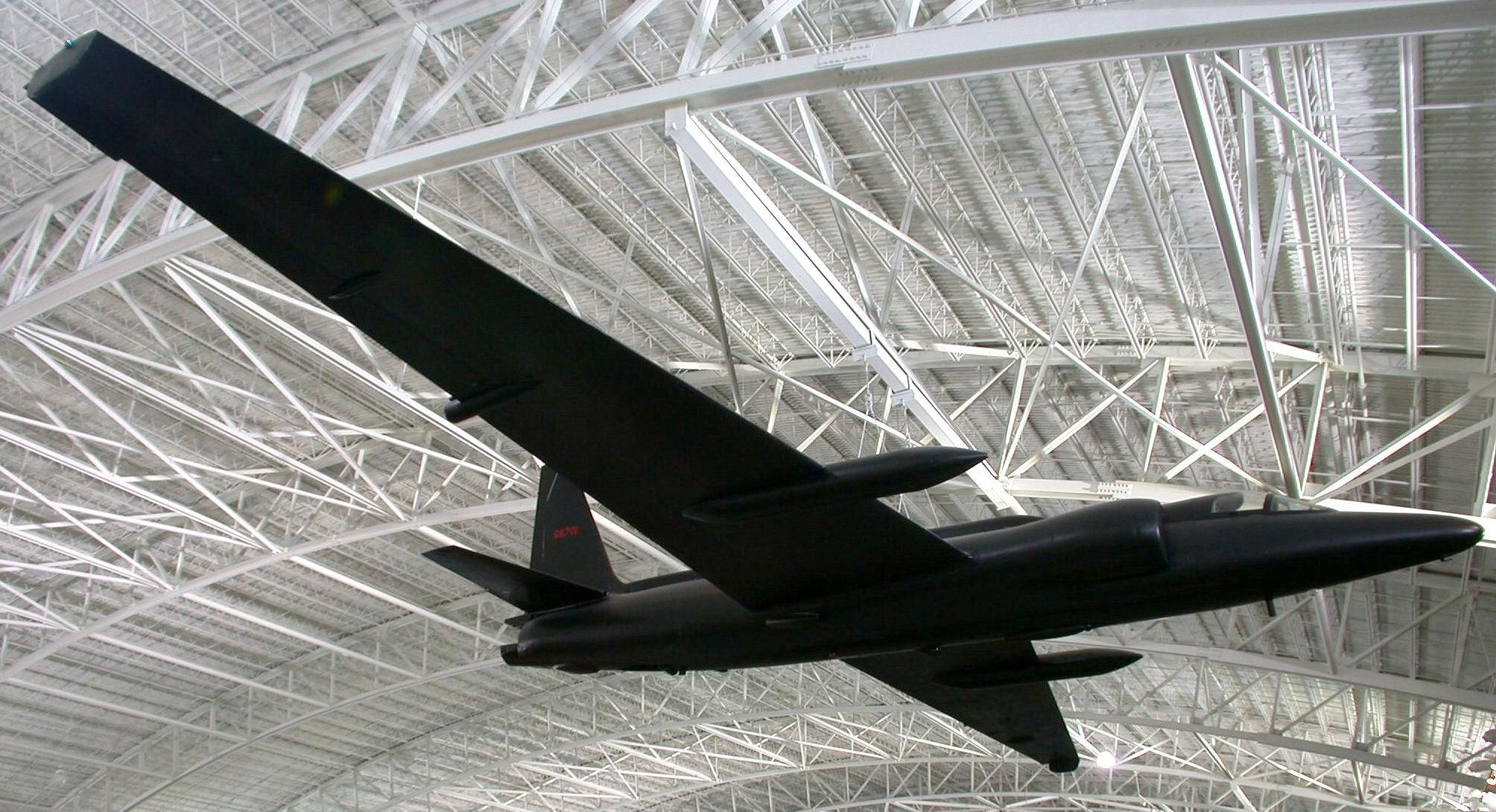
U-2Cs also served well away from espionage. NASA's High Altitude Missions Branch operated two U-2s on stratospheric sampling — notably gathering volcanic dust after the 1980 eruption of Mount St. Helens — and on natural disaster assessment and water and land use studies; the ER-2s derived from the TR-1A later flew alongside those U-2Cs. Besides the Washington museum aircraft, 56-6953 survives at the Norwegian Aviation Museum in Bodø, 56-6681 at the Moffett Field Museum in California and 56-6701 at the Strategic Air and Space Museum in Ashland, Nebraska.
Multimedia


_%E2%80%94_Museum_of_Aviation%2C_Warner_Robins-1600.webp)
