Reconnaissance · Military · United States
Lockheed SR-71 Blackbird
- December 22, 1964
- First flight
- 1966
- Introduced
- 1999
- Retired
- 32
- Units built


-1600.webp)


-1600.webp)


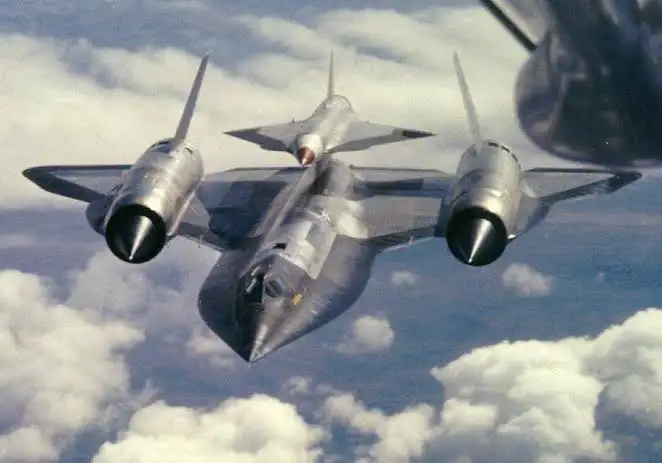
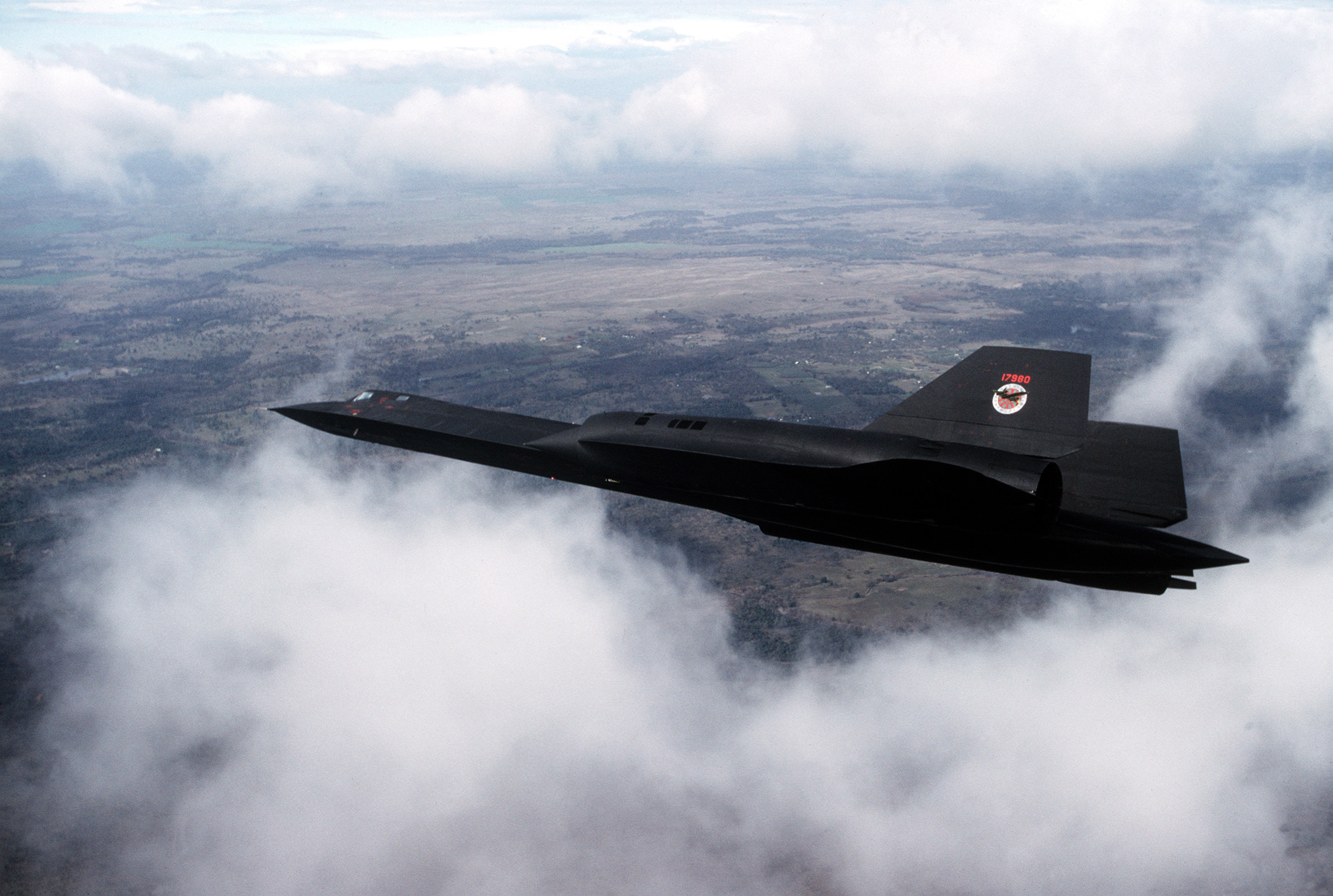
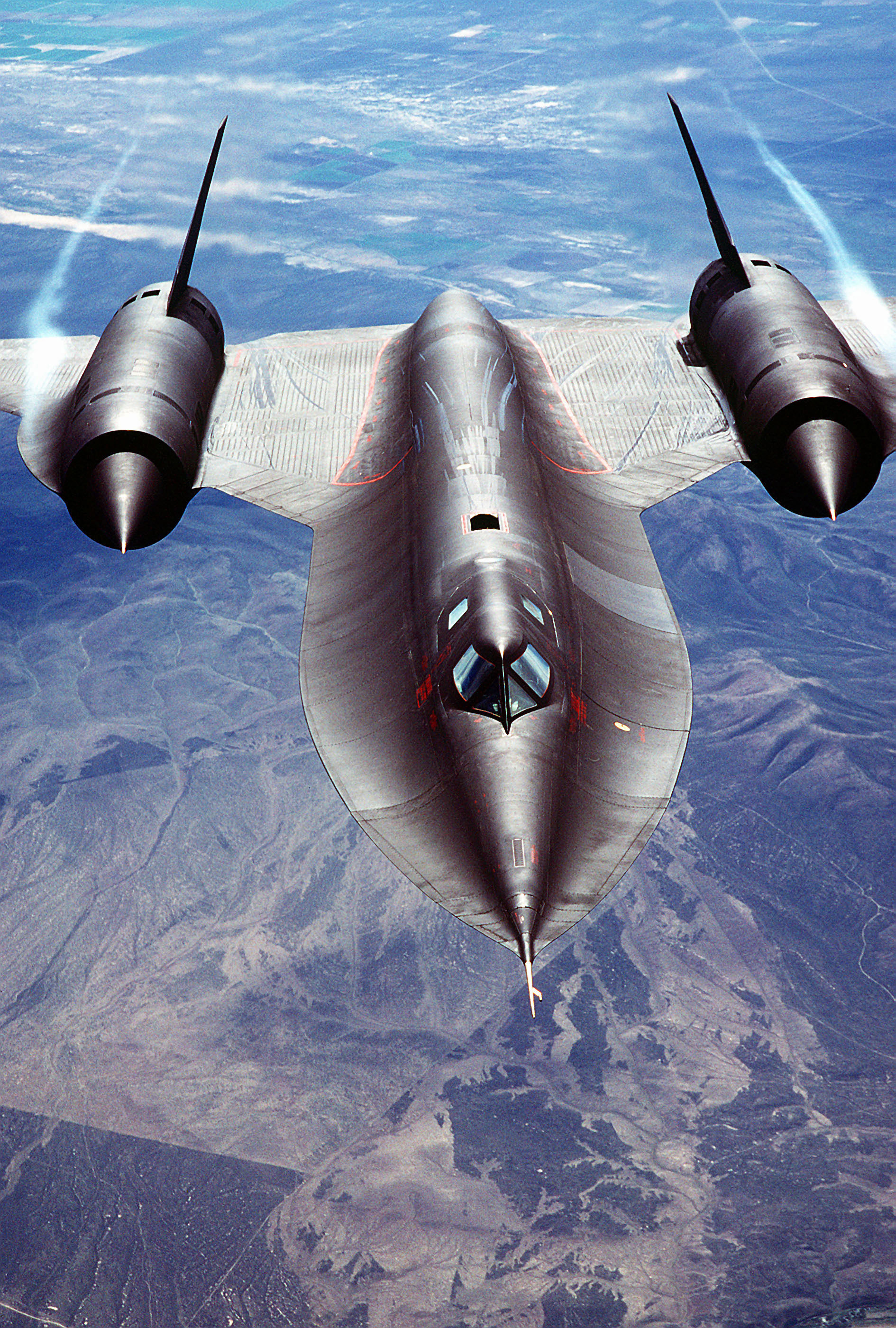
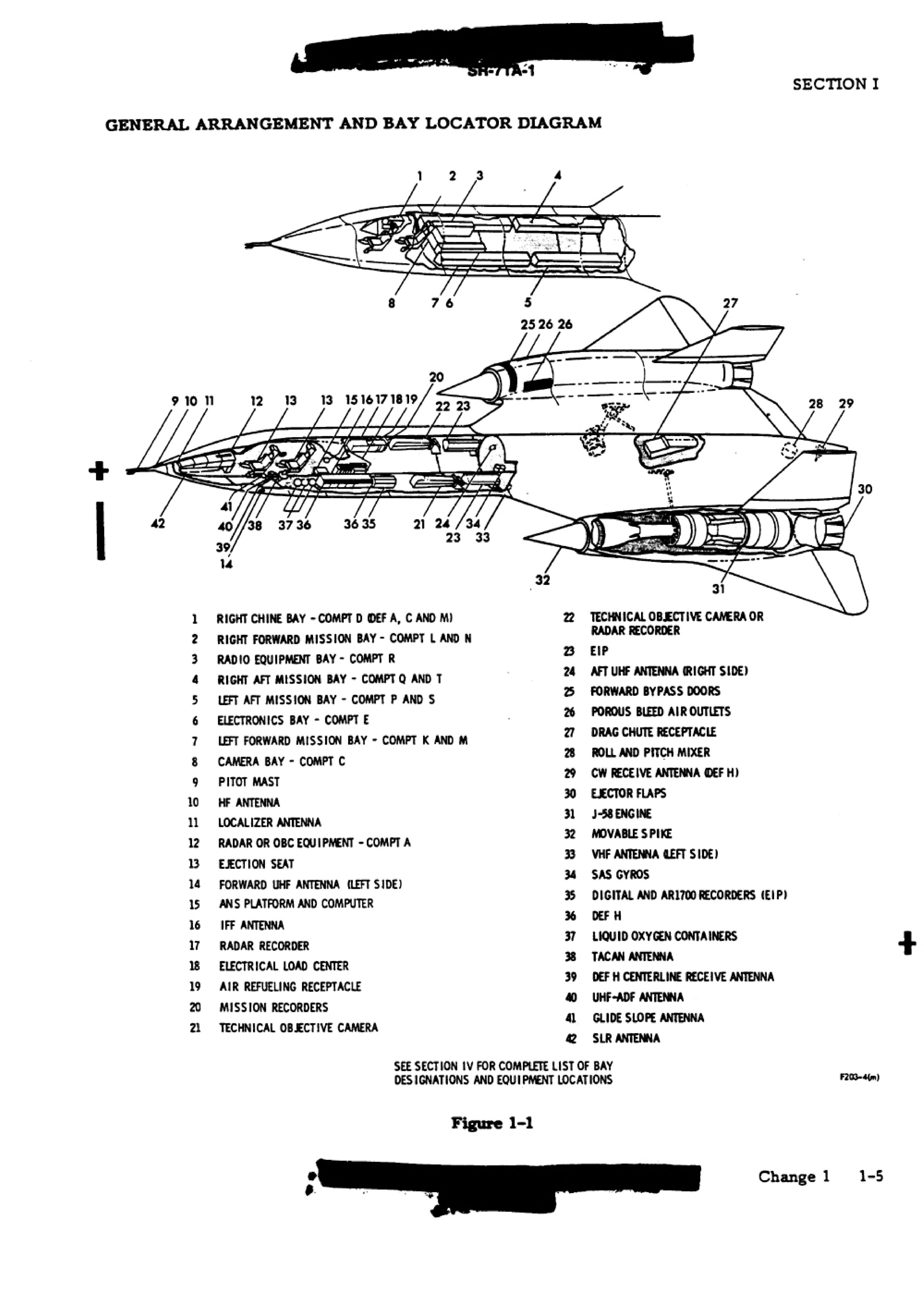
The Lockheed SR-71 "Blackbird" was the fastest and highest-flying reconnaissance aircraft ever to enter operational service: a two-seat machine able to cross continents above Mach 3 and beyond 80,000 feet, built to photograph hostile territory with no practical way of being intercepted. It came from Lockheed, and specifically from the advanced projects division run by Clarence "Kelly" Johnson that the world knows as the Skunk Works. It matters because it solved, with early-1960s technology, a problem that looked intractable: sustaining flight for hours at speeds where air friction heats an aircraft's skin to hundreds of degrees. The answer was an airframe built almost entirely of titanium, a fuel of its own (JP-7) so reluctant to ignite that a chemical starter was needed, a navigation system that tracked stars in daylight, and a powerplant — the Pratt & Whitney J58 with its translating inlet spike — that behaved in cruise more like a ramjet than a turbojet. The lineage predates the SR-71 itself. In 1957 the CIA was looking for a less vulnerable successor to the U-2 and hired Lockheed for project Archangel, which produced the A-12, first flown in April 1962. The Air Force asked for its own version: longer, heavier and crewed by two, the Lockheed R-12, which official designation turned into SR-71. The first aircraft flew on 22 December 1964 at Air Force Plant 42 in Palmdale with Bob Gilliland at the controls, and the type entered service at Beale AFB in January 1966. It flew from Kadena, Okinawa, over North Vietnam, Laos and North Korea from 1968, and from RAF Mildenhall over the Baltic and the Barents Sea from 1976; missions also covered Cuba, Nicaragua, Libya and the Middle East. None was ever shot down despite roughly 800 surface-to-air missiles fired at Blackbirds over Vietnam alone: the standard evasion was simply to accelerate. Of the 32 airframes built, twelve were lost in accidents and one crew member died. The Air Force retired the type in 1989, citing cost and the redundancy brought by satellites and unmanned aircraft; Congress funded the return of three aircraft in 1994, and military service ended for good in 1998. NASA, which flew the Blackbird as a high-speed research testbed at Dryden, closed the story with a final flight on 9 October 1999. The absolute speed and altitude records it set in July 1976 still stand.
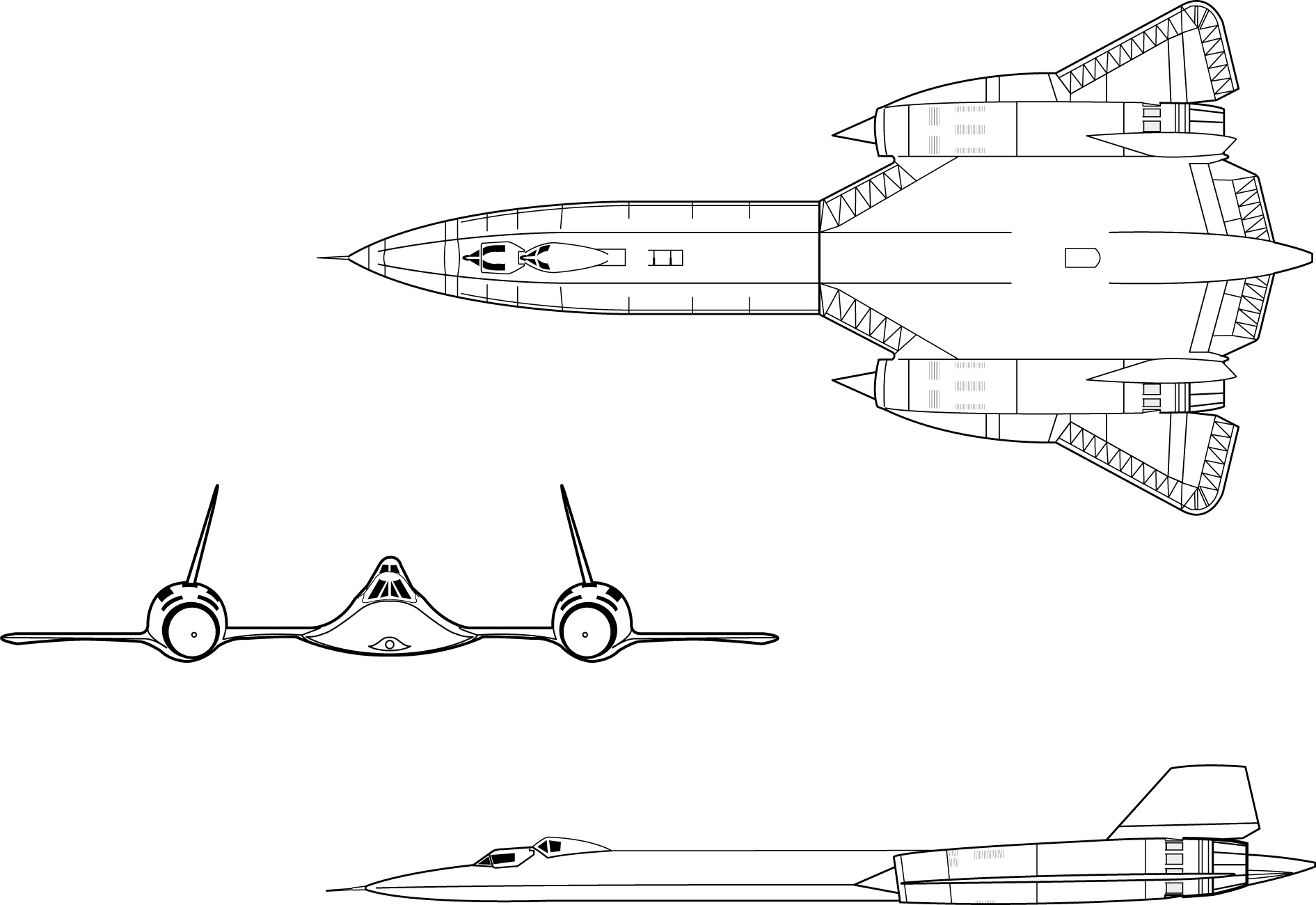
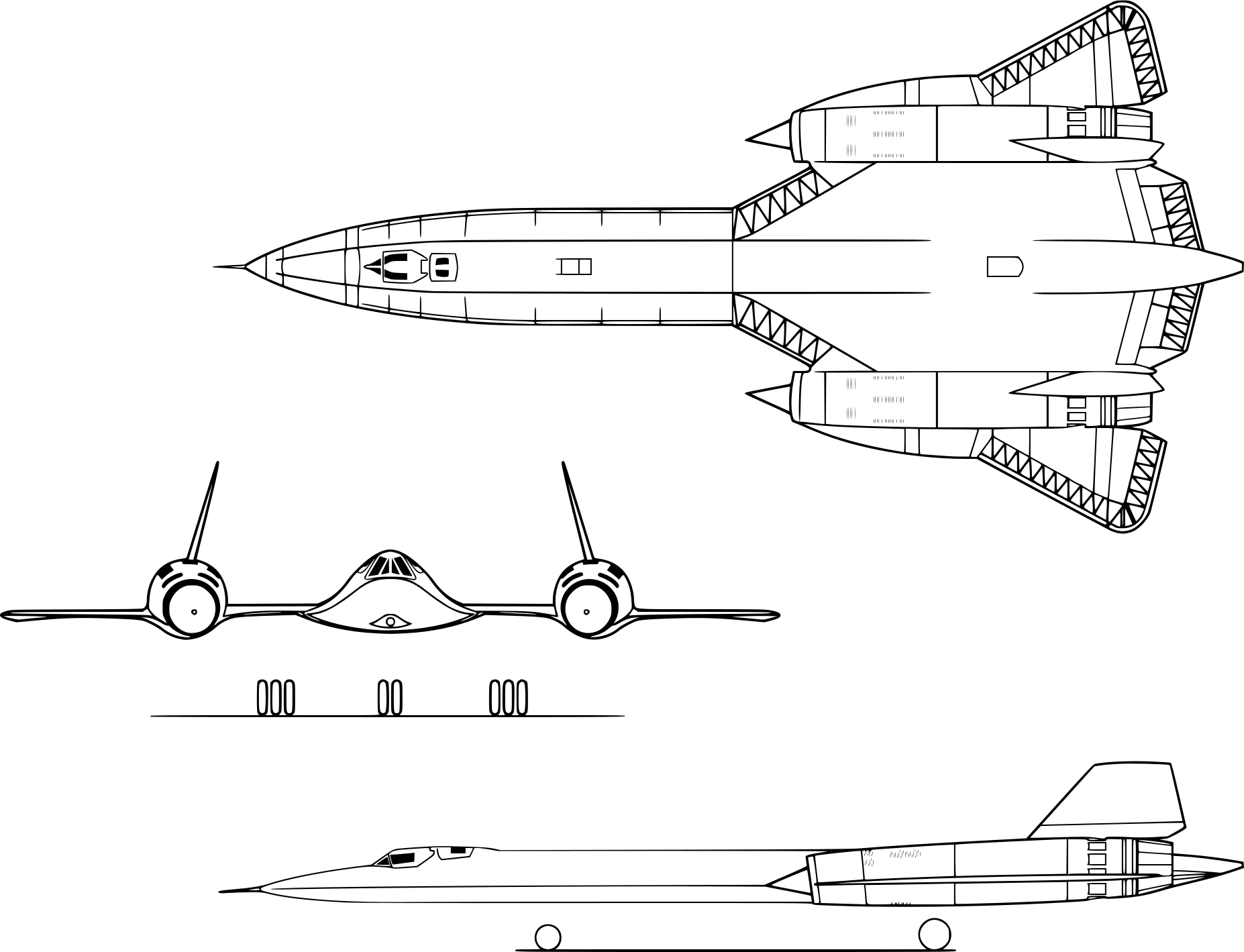
Three-view drawing
History
From the U-2 to project Archangel
In late 1957 the Central Intelligence Agency came to Lockheed with an awkward requirement: a spy plane that could be neither detected nor intercepted, because the slow and predictable U-2 was drifting into range of Soviet defences. The work, code-named Archangel, went to Kelly Johnson and his Burbank team from the second quarter of 1958. Eleven successive designs were drawn in ten months; the front-runner, "A-10", had a shape that gave it away on radar, and after a meeting with the agency in March 1959 the design was reworked to cut its radar cross-section by ninety per cent. On 11 February 1960 the CIA signed a US$96 million contract for a dozen A-12 aircraft. Three months later the shooting down of Francis Gary Powers's U-2 over the Soviet Union confirmed that the urgency was real.
The A-12 first flew at Groom Lake, Nevada, on 25 April 1962, and two derivatives grew from the same airframe: the YF-12 interceptor and the M-21 drone carrier. All were meant to use the Pratt & Whitney J58, but the engine ran late and the first aircraft flew on the less powerful J75 until J58s could be retrofitted. The A-12 flew missions over Vietnam and North Korea before its cancellation was announced on 28 December 1966, on budget grounds and because its Air Force derivative was already on the way.
From R-12 to SR-71: naming an aircraft that did not exist
The version the Air Force ordered in December 1962 was internally the Lockheed R-12: longer, heavier, carrying more fuel, crewed by two in tandem cockpits and with reshaped fuselage chines. The division of labour was clear from the start. The CIA's A-12 flew covert sorties and carried the better camera, because its single cockpit left room for it; the Air Force aircraft flew overtly, in USAF markings, its crews carrying Geneva Conventions identification cards.
The designation is a story in itself. The pre-1962 bomber series had ended with the XB-70 Valkyrie, and a bomber variant of the Blackbird was briefly given the B-71 designator, which survived the change of type to SR-71. During the 1964 campaign President Lyndon Johnson answered accusations of falling behind the Soviet Union by revealing the YF-12A interceptor, which doubled as cover for the still-secret A-12 and for the reconnaissance model. Air Force Chief of Staff General Curtis LeMay preferred the strategic reconnaissance initials and lobbied for the speech to say "SR-71" rather than "RS-71"; the press transcript still carried the older form in places, and from that came the enduring tale that the president had misread the name. Production totalled 32 aircraft: 29 SR-71As, 2 SR-71Bs and 1 SR-71C. In 1968, when Defense Secretary Robert McNamara cancelled the interceptor programme, the specialised tooling for both the YF-12 and the SR-71 was ordered destroyed: the line could never be reopened.
An aircraft made of titanium
Titanium accounted for 85 per cent of the structure, most of the remainder being polymer composites. To keep costs down Lockheed chose a more workable alloy that softened at a lower temperature, and even so had to invent fabrication methods that later served other aircraft: welded titanium had to be washed in distilled water, because the chlorine in tap water corrodes it, and cadmium-plated tools attacked it too. At one point eighty per cent of delivered titanium was rejected for metallurgical contamination.
Flight temperatures forced solutions that look like factory defects. Inboard wing skin sections were corrugated rather than smooth. Fuselage panels fitted only loosely on the ground and came into alignment as the airframe expanded by several inches in flight. Since no sealant could survive those thermal cycles, the aircraft dripped JP-7 on the ramp before take-off, to the irritation of ground crews — and contrary to popular belief the leak was not the reason for refuelling shortly after take-off, since the loss, measured in drops per minute, forced nothing. The outer windscreen was three layers of glass with cooling between them and could reach 600 °F, while the astro-navigation window was solid quartz ultrasonically fused to its titanium frame. The B.F. Goodrich tyres contained aluminium, were inflated with nitrogen and typically lasted twenty missions.
Shape was also an answer to radar. The SR-71 was the second operational aircraft, after the A-12, designed to be hard to see: flattened tapering sides to deflect energy away from the emitter, vertical surfaces canted inwards, radar-absorbing material in sawtooth skin sections and caesium fuel additives to soften the exhaust plume's signature. The result was an aircraft with about 1,800 square feet of wing area and a radar cross-section of roughly 110. The chines — the sharp edges running aft from the nose — began as an anti-radar device and turned out to be an aerodynamic discovery: their vortices added lift, allowed a lower wing incidence, lowered landing speed and made the planned canards unnecessary. Johnson later conceded that Soviet radar improved faster than the stealth measures used against it; the Blackbird's real protection was always the combination of height and speed.
The J58 and the art of the inlet
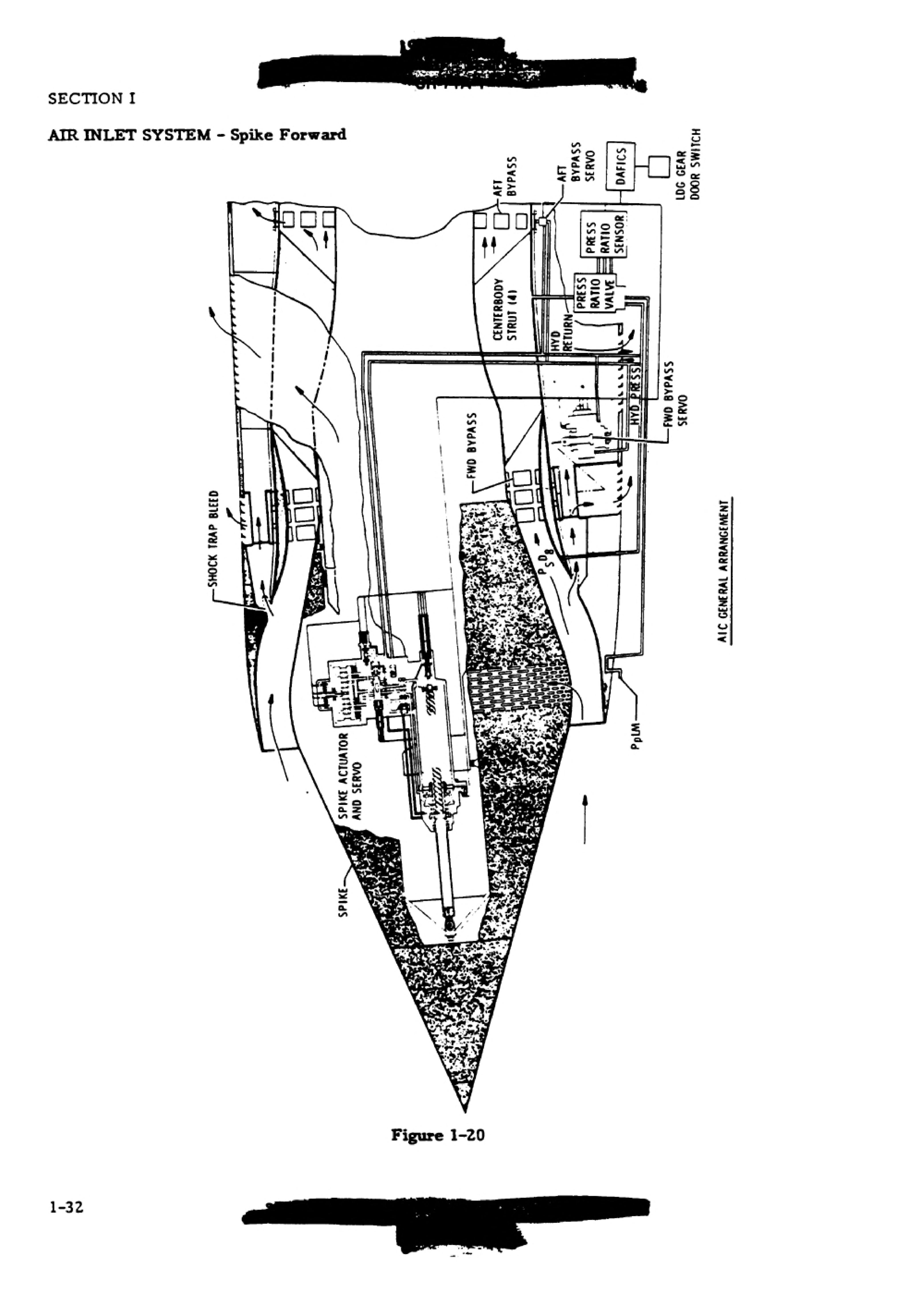
The SR-71 shared its powerplant with the A-12 and the YF-12, and it is not an engine so much as a three-part system: inlet, engine and nacelle, and ejector nozzle. Above Mach 3 in maximum afterburner the inlet produced 54 per cent of the thrust, the nozzle 28.4 per cent and the engine itself only 17.6 per cent. The J58 descended from the naval J58-P2, of which only the compressor and turbine aerodynamics survived; it had to accept compressor inlet air at 800 °F, run turbines 450 °F hotter than any previous experience and sustain continuous maximum afterburning. Pratt & Whitney engineer Robert Abernethy solved the compressor matching problem with six bleed tubes, prominent along the outside of the engine, which sent 20 per cent of compressor air straight to the afterburner and raised installed thrust by 47 per cent.
The inlet was a machine of its own, with a translating spike, bleed slots, "mice", bypass doors and louvres. When the shock system destabilised the result was the dreaded "unstart": the afterburner blew out, asymmetric thrust threw the aircraft into a violent yaw and crew helmets sometimes struck the canopy. After wind-tunnel work and computer modelling by NASA at Dryden, Lockheed fitted an electronic control that unstarted and restarted both inlets without pilot action, and from 1980 the analogue system gave way to the digital DAFICS, which largely tamed the problem.
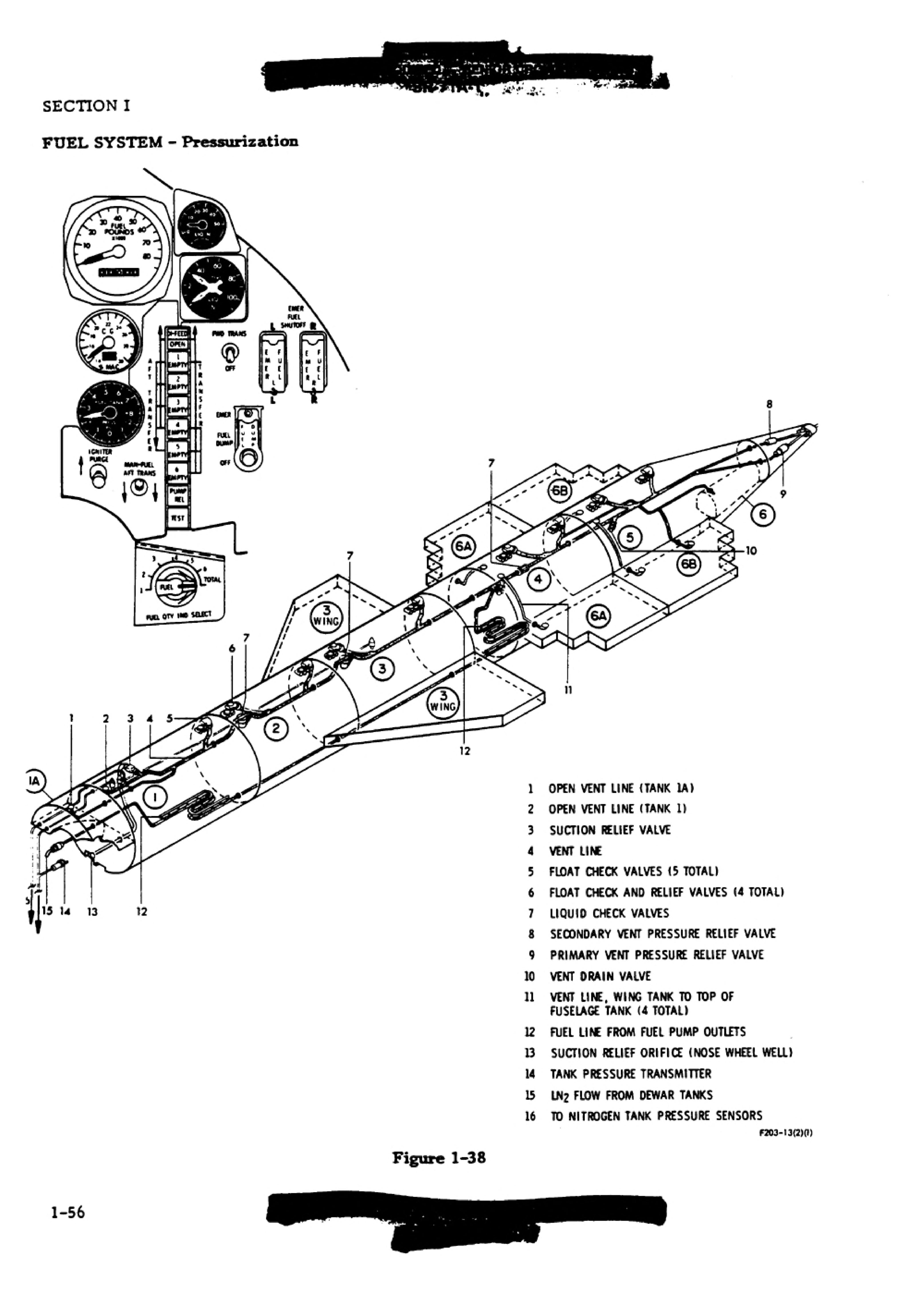
Fuel was another piece of the puzzle. JP-7 is so hard to ignite that starting required an injection of triethylborane, which burns on contact with air and produced the characteristic green flame; the fuel itself doubled as the heat sink cooling cockpit and electronics. In-flight refuelling was compulsory on any long mission — a supersonic leg rarely exceeded ninety minutes — and was flown with modified KC-135Q tankers carrying a high-speed boom and separate tanks for their own JP-4 and the Blackbird's JP-7.
Flying at Mach 3: navigation, sensors and survival
Above 43,000 feet ordinary masks cannot supply enough oxygen, so crews wore pressure suits built by the David Clark Company, the same lineage later used in spaceflight; ejection at Mach 3.2 would have exposed a crew member to some 450 °F, and the suit carried its own oxygen supply to stay pressurised through the descent. The cabin was cooled by dumping heat into the fuel before combustion.
Navigation was entrusted to a Nortronics astro-inertial system inherited from the Skybolt missile, correcting inertial drift by tracking stars through a circular quartz window on the upper fuselage. Its "blue light" star tracker worked by day as well as by night, and its digital ephemeris grew from 56 catalogued stars to 61. According to former pilot Richard Graham, the system held lateral drift to about 1,000 feet while cruising at Mach 3.
The sensor fit included optical and infrared cameras, side-looking airborne radar — first from Goodyear Aerospace, later Loral's ASARS-1 — electronic intelligence equipment in the chine bays and a battery of countermeasures known by letters. In its later years the aircraft could send data to a ground station from about 2,000 nautical miles of track coverage.
Kadena, Vietnam and the name Habu
The first SR-71 reached the 4200th (later 9th) Strategic Reconnaissance Wing at Beale AFB, California, in January 1966. Deployments to Kadena, Okinawa, began on 8 March 1968 under the code name "Glowing Heat", within a programme called "Senior Crown"; missions over North Vietnam were first "Black Shield" and then "Giant Scale". Majors Jerome F. O'Malley and Edward D. Payne flew the first operational sortie on 21 March 1968 in 61-7976, an aircraft that would accumulate 2,981 flight hours and 942 sorties, more than any other Blackbird, before going to the Air Force museum near Dayton in 1990.
The tempo was that of a demanding machine: roughly one sortie per aircraft per week, because missions returned with missing rivets, delaminated panels or inlets needing repair, and a month could pass before the next flight. Even so, by 1972 the fleet was flying nearly a sortie a day. North Vietnamese crews fired some 800 surface-to-air missiles at Blackbirds without a single hit; a few, launched unguided, passed within about 150 yards. On Okinawa the aircraft and its crews inherited from the A-12 the nickname Habu, after the local pit viper the aircraft was thought to resemble.
The Baltic Express
European operations ran from RAF Mildenhall from April 1976, on two weekly routes. One went up the Norwegian coast to the Kola Peninsula to watch the Soviet Northern Fleet's bases; there were several emergency landings in Norway, four of them at Bodø, and on one occasion an entire wing with its engine was replaced as the quickest way to get the aircraft flying again. The other, the "Baltic Express", crossed Jutland and the Danish straits, flew a thirty-minute counter-clockwise loop along the Soviet coast and returned along Sweden, slowing to Mach 2.54 to turn south of Åland without violating Swedish airspace.
The regularity of the route let both Swedes and Soviets prepare. Swedish radar watched Su-15s launch from Latvia and MiG-21s and MiG-23s from Estonia, but the serious threat came from the MiG-25s at Finow-Eberswalde: with the Blackbird at 72,000 feet, the Foxbat would close to 62,000 feet and about three kilometres astern before disengaging, a routine the Swedes read as a simulated kill. Sweden asserted its own neutrality with JA 37 Viggens; across 322 recorded Baltic Express sorties between 1977 and 1988, the Swedish Air Force claims missile lock on 51 of them.
The strangest episode came on 29 June 1987, when an SR-71 lost an engine to an explosion at 66,000 feet over the Baltic. The aircraft dropped, turned and entered Swedish airspace over Gotland; two unarmed Viggens on exercise were ordered to identify it, found it in clear distress and escorted it, relieved later by an armed pair, as far as Danish airspace. The event stayed classified for over thirty years; when the report was unsealed it emerged that several MiG-25s had scrambled with orders to shoot the aircraft down or force it to land, and that one achieved a missile lock but did not fire because of the escort. On 28 November 2018 the four Swedish pilots received United States Air Medals.
Records
On 28 July 1976 the SR-71 set the two absolute marks it still holds. Aircraft 61-7962, flown by then Captain Robert Helt, reached an absolute altitude record in horizontal flight of 85,069 feet (25,929 m); the same day 61-7958 set an absolute speed record of 1,905.81 knots (3,529.6 km/h), roughly Mach 3.3. Other aircraft have exceeded that altitude in zoom climbs, but not in sustained flight.
Earlier, on 1 September 1974, pilot James V. Sullivan and reconnaissance systems officer Noel F. Widdifield had covered the 3,461.53 miles from New York to London in 1 hour, 54 minutes and 56.4 seconds, an average of 1,806.964 miles per hour that includes decelerating for in-flight refuelling; the best Concorde time on the route was 2 hours 52 minutes. On 26 April 1971 majors Thomas B. Estes and Dewain C. Vick flew over 15,000 miles in ten and a half hours, a flight awarded the 1971 Mackay Trophy and the 1972 Harmon Trophy.
The last Senior Crown sortie, on 6 March 1990, was itself a set of records: Lieutenant Colonels Raymond E. Yeilding and Joseph T. Vida took 61-7972 from Los Angeles to Washington in 64 minutes 20 seconds at an average of 2,144.8 mph, on its way to the Smithsonian. That same day Senator John Glenn told the Senate that terminating the aircraft had been a grave mistake.
Retirement, reactivation and the end
The official reasons for the 1989 retirement were cost and redundancy against satellites and unmanned vehicles. Dick Cheney told the Senate Appropriations Committee that the aircraft cost $85,000 per flight hour, and opponents spoke of $400 to $700 million a year when the real figure was closer to $300 million. Colonel Richard Graham later argued that the Blackbird offered capabilities nothing else covered in the 1990s, and that a generational change of command — the "SR-71 generals" had all retired by the mid-1980s — weighed as heavily as the numbers. A genuine technical gap counted too: the aircraft had no data link, so its imagery waited for landing, while the U-2 had been upgraded to carry one. In 1988 Congress was persuaded to allocate $160,000 to keep six aircraft and a trainer in flyable storage, but the Air Force refused to spend it. The last missions were flown in October 1989 and the programme was formally terminated on 22 November that year.
The gap showed quickly: four months after retirement General Norman Schwarzkopf was told that the rapid reconnaissance an SR-71 could have provided was unavailable for Operation Desert Storm. With Bosnia and North Korea on the horizon, Congress reopened the question in 1993 and on 28 September 1994 voted $100 million to return three aircraft to service; the sum was cut to $72.5 million and the Skunk Works did the work for $72 million. The first reactivated aircraft returned to the Air Force on 28 June 1995 as Detachment 2 of the 9th Reconnaissance Wing, based at Edwards and fitted with a data link that sent ASARS-1 imagery to the ground in near real time. The reactivation never had its own budget or internal support; in October 1997 President Bill Clinton tried to use the line-item veto to cancel the $39 million allocated, the Supreme Court ruled that veto unconstitutional in June 1998, and in September the Air Force asked for the funds to be redistributed. Military retirement was permanent that year.
The NASA years: a laboratory at Mach 3
NASA's relationship with the Blackbird family began much earlier: between December 1969 and November 1979 three aircraft flew at Dryden in a joint programme with the Air Force — two YF-12As and an SR-71A given the fictitious designation "YF-12C" for political reasons. They were used to study aerodynamic and thermal loads, drag and skin friction, heat transfer, airframe and propulsion interaction, inlet control improvements, high-altitude turbulence and landing gear dynamics, as well as the physiology of crews in sustained high-speed flight. From February 1972 to July 1973 one YF-12A was tested in the centre's high-temperature loads laboratory up to the 800 °F reached on the surface during Mach 3 cruise.
In the 1990s the Air Force loaned NASA an SR-71A and the SR-71B trainer. Aircraft 61-7980 (NASA 844) arrived at Dryden on 15 February 1990, sat in storage until 1992 and served as a research platform until its final flight; SR-71B 61-7956 (NASA 831) arrived on 25 July 1991 and served for research and crew proficiency until October 1997. In October 1991 engineer Marta Bohn-Meyer became the first woman to fly as an SR-71 crew member.
The experiments exploited what no other aircraft offered. A laser air-data sensor measured airspeed and attitude without probes and, in passing, detected atmospheric particles above 80,000 feet. From March 1993 the aircraft carried an upward-looking ultraviolet camera for the Jet Propulsion Laboratory, observing celestial objects at wavelengths the atmosphere blocks. Researchers at UCLA used it to study the role of chlorine atoms in the ozone layer; Motorola used it as a surrogate satellite while developing the IRIDIUM network; and a dedicated programme worked on characterising and softening sonic boom overpressures.
The most spectacular experiment was LASRE, a 20-per-cent-scale half-span model of the X-33 fitted with eight thrust cells of a linear aerospike engine and mounted on the aircraft's back inside a fairing called the "canoe"; the whole pod was 41 feet long and weighed 14,300 pounds. The first flight came on 31 October 1997: take-off at 8:31, one hour and fifty minutes airborne, Mach 1.2 and a ceiling of 33,000 feet, with the rocket engine unlit. Seven research flights were completed before operations ended in November 1998; the in-flight firing never happened because of liquid oxygen leaks, but ground firings and cryogenic flow flights were enough to predict the plume effects. On 9 October 1999, 61-7980 flew the last SR-71 flight.
The Blackbird family: what counts as an SR-71 variant
Kinship and variant are worth separating, because the word "Blackbird" covers several different aircraft. Project Archangel produced the CIA's single-seat A-12, from which came the YF-12 interceptor and the M-21 carrier for the D-21 drone: those are types in their own right, with their own designations, contracts and operational histories, related to the SR-71 by design and powerplant but not versions of it. The SR-71 began life as a different aircraft — the Lockheed R-12 — with a longer fuselage, a crew of two and reshaped chines.
Within the SR-71 itself there were only three designations: the production SR-71A, the SR-71B trainer and the one-off hybrid SR-71C. Everything else is a configuration of an individual airframe rather than a production variant: 61-7959 flew from 3 December 1975 in the extended "big tail" configuration, and an SR-71A loaned to NASA hid its identity under the fictitious designation "YF-12C" for political convenience while remaining an SR-71A. The variant census on this sheet therefore holds three entries.
Legacy
The SR-71 left twelve airframes lost in accidents — eleven of them between 1966 and 1972 — and a single crew fatality, Jim Zwayer, a Lockheed flight-test reconnaissance and navigation specialist. No Blackbird was lost to enemy action. The whole family — A-12, YF-12 and SR-71 — accumulated 3,551 mission sorties, 17,300 total sorties, 11,008 mission flight hours and 53,490 total flight hours, of which 11,675 were spent above Mach 3.
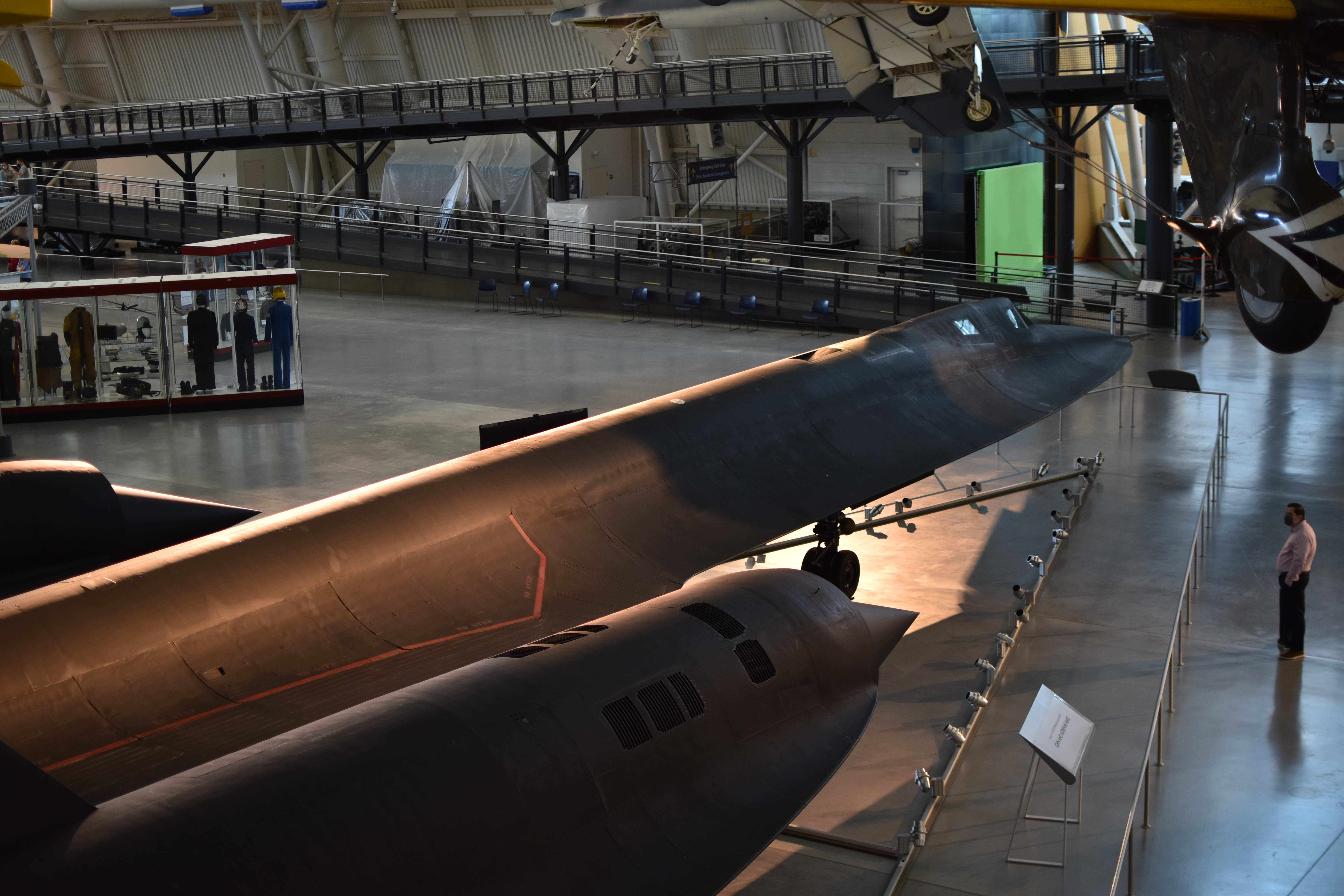
No aircraft ever replaced it. The mission passed to reconnaissance satellites and unmanned vehicles, with the known limitation that a satellite may take hours to reach the right orbit and its pass is predictable, so anything worth hiding can be hidden while it goes by. In 2013 it emerged that the Skunk Works was working on an unmanned successor, the SR-72, intended to fly twice as fast; it remains a concept. Surviving airframes are scattered among museums — 61-7972 at the Smithsonian's Steven F. Udvar-Hazy Center, SR-71B 61-7956 at the Air Zoo in Michigan, the sole SR-71C at the Hill Aerospace Museum in Utah, 61-7980 at NASA's own Armstrong centre — and the flight simulator, the only one of its kind, went in 2006 to the Frontiers of Flight Museum in Dallas.
Variants
| SR-71A | SR-71C | SR-71B | |
|---|---|---|---|
| First flight | December 22, 1964 | March 14, 1969 | — |
| Aircraft type | Strategic reconnaissance aircraft | Strategic reconnaissance conversion trainer | Strategic reconnaissance conversion trainer |
| Powerplant | 2 × Pratt & Whitney J58 (JT11D-20B) afterburning turbojets rated at 144.57 kN each (32,500 lbf). In supersonic cruise the engine itself supplied less than a fifth of total thrust: the inlet and its movable spike bypassed air straight to the afterburners and ejector nozzles, so the installation effectively worked as a ramjet. | 2 × Pratt & Whitney J58 (JT11D-20B) afterburning turbojets rated at 144.57 kN each (32,500 lbf) — the same powerplant as the rest of the family, despite the airframe's mixed parentage. | 2 × Pratt & Whitney J58 (JT11D-20B) afterburning turbojets rated at 144.57 kN each (32,500 lbf), identical to the SR-71A's: the trainer kept the full operational powerplant so that instruction took place in the same flight regime. |
| Powerplant | 2 × Pratt & Whitney J58 (JT11D-20B) | 2 × Pratt & Whitney J58 (JT11D-20B) | 2 × Pratt & Whitney J58 (JT11D-20B) |
| Thrust per engine | 145 kN Best value in this row | 145 kN Best value in this row | 145 kN Best value in this row |
| Length | 32.7 m Best value in this row | 32.7 m Best value in this row | — |
| Wingspan | 16.9 m Best value in this row | 16.9 m Best value in this row | — |
| Height | 5.6 m Best value in this row | 5.6 m Best value in this row | — |
| Wing area | 167 m² | — | — |
| Empty weight | 30,617 kg | — | — |
| MTOW | 78,018 kg | — | — |
| Top speed | 3,540 km/h | — | — |
| Max speed altitude | 24,384 m | — | — |
| Cruise speed | 3,219 km/h | — | — |
| Cruise altitude | 24,384 m | — | — |
| Service ceiling | 25,908 m Best value in this row | 25,908 m Best value in this row | — |
| Initial climb rate | 60 m/s | — | — |
| Range | 5,230 km | — | — |
| Ferry range | 5,230 km | — | — |
| Combat radius | 0 km | — | — |
| Range conditions | Unrefuelled range of about 5,230 km (2,824 nautical miles), with Mach 3 cruise sustained for more than an hour at a stretch. Operational sorties were extended by air refuelling from KC-135Q tankers, so the practical radius was set by the tanker network rather than by the tanks: internal capacity was 12,219 US gallons of JP-7 fuel in nine tanks. | Nicknamed "The Bastard", it was assembled after the loss of the second SR-71B by mating the rear fuselage of the first YF-12A to a nose taken from a static-test article. It first flew on 14 March 1969 and logged only 556.4 hours before being withdrawn from flying status in 1976. | Devoted to conversion training and currency flying, the SR-71B flew short tanker-supported profiles rather than maximum-range missions. One of the two aircraft was lost in a landing accident in January 1968; the other passed to NASA and flew as a research testbed until 1997. |
| Armament | None. The Blackbird flew unarmed and no airframe ever carried offensive or defensive weapons. Its protection was the flight envelope itself — Mach 3 cruise above 24 km — backed by an electronic countermeasures suite; on detecting a surface-to-air missile launch, the prescribed reaction was to accelerate and outrun it. | None. The single SR-71C built flew unarmed, as did the A and B models. | None. Like the rest of the family, the trainer flew unarmed. |
| Max weapons load | 0 kg Best value in this row | 0 kg Best value in this row | 0 kg Best value in this row |
| Payload | 0 kg Best value in this row | 0 kg Best value in this row | 0 kg Best value in this row |
| Cargo capacity | No civil cargo capacity. The SR-71 was a sensor platform rather than a carrier: it took up some 1,588 kg (3,500 lb) of mission equipment — Itek cameras, signals and electronic intelligence gear — spread between the nose, the chine bays and the mission compartments, with no hold and no transport role. | No civil cargo capacity. A one-off training airframe, it carried no mission equipment and had no hold. | No civil cargo capacity. The second cockpit, raised to give the instructor forward visibility, took the space of the mission equipment, so the SR-71B carried neither sensors nor any load. |
| Crew | 2 Best value in this row | 2 Best value in this row | 2 Best value in this row |
| Passengers | 0 | — | — |
| Units built | 29 Best value in this row | 1 | 2 |
Images
Elsewhere
- Smithsonian National Air and Space MuseumSR-71A Blackbird 61-7972 on display at the Steven F. Udvar-Hazy Center ↗
- National Museum of the United States Air ForceSR-71A Blackbird 61-7976 in the Cold War Gallery of the US Air Force museum ↗
- National Museum of the United States Air ForceLockheed YF-12A, the interceptor derived from the A-12 that preceded the SR-71 ↗
- National Museum of the United States Air ForceLockheed D-21B reconnaissance drone, carried by the M-21 version of the Blackbird ↗
- National Museum of the United States Air ForcePratt and Whitney J58 turbojet of the SR-71 on display at the US Air Force museum ↗
- The Museum of FlightLockheed M-21 60-6940 with its D-21 drone at the Museum of Flight in Seattle ↗
- SAC Aerospace MuseumSR-71A Blackbird on display at the Strategic Air Command and Aerospace Museum ↗
- Museum of AviationSR-71A Blackbird at the Museum of Aviation, Robins Air Force Base ↗
- Hill Aerospace MuseumSR-71C 61-7981, the only C model ever built, at the Hill Aerospace Museum ↗
- Flight Test MuseumSR-71A displayed beside the A-12 and the D-21 drone at the Blackbird Airpark ↗
- Pima Air & Space MuseumSR-71A Blackbird on display at the Pima Air and Space Museum in Tucson ↗
- March Field Air MuseumSR-71A Blackbird 61-7975 at the March Field Air Museum in Riverside ↗
Show the 28 more
- Evergreen Aviation & Space MuseumSR-71A Blackbird 61-7971 at the Evergreen Aviation and Space Museum ↗
- Intrepid MuseumLockheed A-12 on the flight deck of the aircraft carrier Intrepid ↗
- CIA MuseumProject OXCART and the A-12 in the CIA museum exhibit ↗
- Lockheed MartinThe Blackbird story told by Lockheed Martin, with Skunk Works factory photographs ↗
- NASASR-71 of NASA in the agency image gallery ↗
- NASASR-71B NASA 831 after retirement, in the NASA Where Are They Now feature ↗
- NASA History OfficeSR-71 Blackbird fact sheet on the NASA history server, with Dryden photographs ↗
- FlightGlobal ImagesSR-71 braking with its drag chute, from the Flight International archive ↗
- johnweeks.comSR-71A 61-7972 photographed in detail at the Udvar-Hazy Center ↗
- johnweeks.comSR-71A 61-7976 photographed at the US Air Force museum in Dayton ↗
- johnweeks.comM-21 60-6940 and its D-21 drone photographed at the Museum of Flight ↗
- johnweeks.comSR-71A photographed at the Strategic Air Command museum in Ashland ↗
- johnweeks.comSR-71B 61-7956, the only surviving trainer, photographed at the Air Zoo ↗
- johnweeks.comSR-71A photographed at the Pima Air and Space Museum ↗
- johnweeks.comSR-71A 61-7975 photographed at the March Field Air Museum ↗
- johnweeks.comSR-71C 61-7981 photographed at the Hill Aerospace Museum ↗
- johnweeks.comSR-71A 61-7971 photographed at the Evergreen Aviation Museum ↗
- johnweeks.comSR-71A 61-7980, the last Blackbird to fly, photographed at Edwards ↗
- johnweeks.comLockheed A-12 photographed on the deck of the Intrepid in New York ↗
- johnweeks.comSR-71A photographed at the Kansas Cosmosphere in Hutchinson ↗
- johnweeks.comSR-71A photographed at the Battleship Memorial Park in Mobile ↗
- johnweeks.comSR-71A 61-7968 photographed at the aviation museum in Richmond ↗
- johnweeks.comSR-71A photographed at the Museum of Aviation in Warner Robins ↗
- johnweeks.comSR-71A photographed at Beale Air Force Base, home of the Blackbird ↗
- johnweeks.comSR-71A photographed at the Castle Air Museum in Atwater ↗
- johnweeks.comSR-71A 61-7973 photographed at the Blackbird Airpark in Palmdale ↗
- johnweeks.comSR-71A photographed at the US Space and Rocket Center in Huntsville ↗
- johnweeks.comLockheed YF-12A photographed at the US Air Force museum in Dayton ↗
Videos
Show the 57 more
- ▶ DocumaniaTVVolando a través del tiempo: 11 - SR-71 Blackbird ↗
- ▶ Internet ArchiveSR-71A/YF-12A takeoff and flight (NASA Dryden film) ↗
- ▶ Internet ArchiveThe SR-71 (U.S. Air Force film) ↗
- ▶ Internet Archive"The Blackbirds Are Flying" - Lockheed SR-71 promotional film (SR-71A / SR-71B) ↗
- ▶ Internet ArchiveSR-71 Blackbird - found documentary footage ↗
- ▶ Internet ArchiveGeek Moment with the SR-71 Blackbird and STEM in 30 ↗