Bomber · Military · United States
Consolidated B-24 Liberator
- December 29, 1939
- First flight
- 1941
- Introduced
- 1968
- Retired
- 18,482
- Units built


_en_vuelo-1600.webp)


-1600.webp)


_en_vuelo-1600.webp)

-1600.webp)


The Consolidated B-24 Liberator is the most heavily produced heavy bomber in history and, at the same time, the American four-engined bomber of the Second World War that occupies the least space in popular memory. It was born out of a job its maker turned down: in 1938 the United States Army Air Corps asked Consolidated Aircraft, of San Diego, to build the Boeing B-17 under licence. Company executives, led by president Reuben Fleet, visited Boeing's Seattle plant and came back convinced they could offer something more modern. In January 1939 the Air Corps formally invited Consolidated, under Specification C-212, to submit a bomber with greater range, higher speed and a higher ceiling than the B-17; the requirement was written so that the company's Model 32 would win by definition. The XB-24 prototype flew on 29 December 1939, two days before the contract deadline expired, and the type entered service in 1941. What set the Liberator apart from its rival was, above all, a wing: the high aspect ratio aerofoil designed by David R. Davis, mounted high on a slab-sided fuselage that earned the aircraft the nickname "flying boxcar". Against the B-17 the B-24 had almost two metres more span but considerably less wing area, which translated into a wing loading some 35 per cent higher: more cruising speed, more range and more bombs, in exchange for an aeroplane heavy on the controls, unpleasant at low speed, hard to hold in tight formation and with a service ceiling of about 8,500 metres, appreciably lower than the Flying Fortress's. The Davis wing also picked up ice readily and absorbed battle damage less well. To those traits were added the twin tail inherited from the Consolidated Model 31 flying boat, two matched bomb bays each able to take 3,600 kg of ordnance, roller-type doors that retracted into the fuselage without adding drag, and tricycle landing gear, the first on an American heavy bomber. The other half of the B-24's story is industrial. It was built in five plants — Consolidated at San Diego and Fort Worth, Ford at Willow Run, North American in Texas and Douglas at Tulsa — under a scheme of licence production and knock-down kits that turned the bomber into the emblem of the "arsenal of democracy". Willow Run, designed by the architect Albert Kahn with Ford's chief engineer Charles Sorensen, grew to 330,000 m2 of factory floor and a mile-long line with a 90-degree turn; at its 1944 peak it delivered a Liberator an hour, and it closed on 28 June 1945 having completed 8,685 aircraft, besides thousands of kits trucked to Fort Worth and Tulsa. The total built is not a settled figure: reputable sources give 18,188, 18,482, 18,493 or "more than 18,500" depending on what is counted, and this record leaves the field blank rather than picking one by eye. In combat the Liberator served in every theatre and with every branch of the American armed forces. Over Europe it formed, alongside the B-17, the backbone of the daylight bombing offensive: fifteen of the Fifteenth Air Force's twenty-one bombardment groups flew B-24s, and for much of 1944 the type made up nearly half the heavy bomber strength in the European theatre. Its costliest day was 1 August 1943, when 177 Liberators attacked the Ploiești refineries at treetop height in Operation Tidal Wave and 53 did not come back. In the Atlantic, by contrast, it changed the course of a campaign: RAF Coastal Command's Very Long Range Liberators, with ASV Mk II radar and the Leigh light, were the only aircraft able to cover the mid-Atlantic gap where German submarines operated beyond air patrol, and their arrival in numbers contributed to the reversal of May 1943. They were credited, in full or in part, with the destruction of 93 U-boats. In the Pacific their range made them the standard heavy bomber and displaced the B-17 by mid-1943. The same airframe also produced the C-87 Liberator Express transport, the C-109 flying tanker, the naval PB4Y-1 and the single-finned PB4Y-2 Privateer, which was still serving in the Korean War. Outside the United States it was flown by the RAF with some 2,100 aircraft, the Royal Canadian Air Force with 1,200 and the Royal Australian Air Force with 287; the Indian Air Force, which rebuilt a fleet from airframes abandoned in the subcontinent, kept it in service until 1968. The end was as abrupt as the production had been vast: outclassed by the B-29, the Liberator was retired almost at once and most survivors were smelted into ingots at boneyards such as Kingman, in Arizona. Thirteen examples survive worldwide today, ten on display, one under restoration and two in flying condition.
Related events
- First flight of the Consolidated B-24 Liberator
- Service entry of the Consolidated B-24 Liberator
- The C-87 Liberator Express and the "Hump" route
- The B-24 Liberator and closing the Mid-Atlantic Gap
- The B-24 Liberator as the primary heavy bomber in the Pacific
- Operation Tidal Wave: the low-level raid on Ploiești
- Willow Run reaches one B-24 Liberator every 63 minutes
- End of B-24 Liberator production
- Retirement of the Consolidated B-24 Liberator
Related sheets
Category
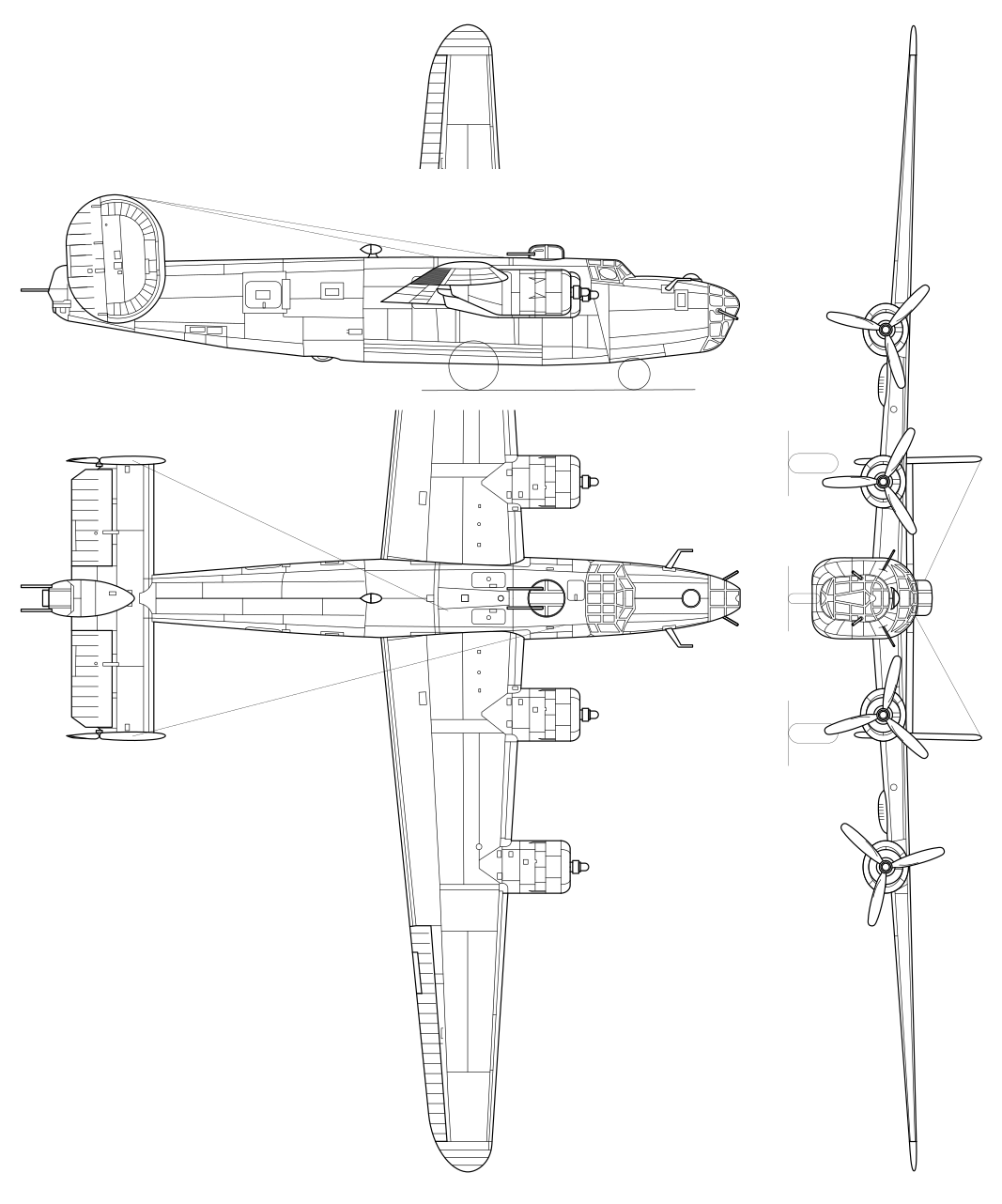
Three-view drawing
.png)
History
A rejected assignment and the birth of the Model 32
The Liberator's story begins with a polite refusal. In 1938 the Army Air Corps, pressed by European rearmament, wanted to multiply heavy bomber output and asked Consolidated Aircraft to build B-17s under licence at San Diego. A company delegation led by president Reuben Fleet toured Boeing's Seattle factory and came away with a different conclusion from the one expected: the B-17 was a mid-1930s design and Consolidated believed it could offer something better without starting from scratch. The proposal, known in-house as the Model 32, crossed three elements the firm already had to hand: David R. Davis's wing aerofoil, the twin tail of the Model 31 flying boat, and a new fuselage built around two matched bomb bays, each the size and capacity of the B-17's.
In January 1939 the Air Corps formalised its interest with Specification C-212, which called for a bomber with more range, more speed and a higher ceiling than the Fortress. The text was written so that the Model 32 met it almost by definition. The programme sat under the umbrella of "Project A", the intercontinental bomber requirement conceived in the mid-1930s; the B-24 did not reach those goals, but it was a step in that direction, and from the same root came the Boeing B-29 and Consolidated's own B-32 and B-36.
The XB-24 prototype contract was signed in March 1939 with a demanding condition: one example flying before the end of the year. Consolidated managed it with two days to spare, on 29 December 1939. Testing quickly showed the aircraft fell short of its contracted speed — 273 mph against the 311 specified — so the mechanically supercharged Pratt & Whitney R-1830-33s gave way to turbo-supercharged versions, the tailplane was widened and the pitot probes were moved from the wings to the fuselage. Redesignated XB-24B, that machine set the standard for everything that followed. Orders ran ahead of the first flight: thirty-six for the Air Corps, one hundred and twenty for France and one hundred and sixty-four for the RAF. When France fell in 1940 its aircraft were diverted to Britain, and it was the British who gave the Model 32 the name it carried into history: Liberator.
The Davis wing and the anatomy of a different bomber
David Davis's wing, of high aspect ratio and mounted high on the fuselage, is the technical key to the B-24 and the explanation for almost all its virtues and almost all its faults. Against the B-17's it had 1.8 metres more span but considerably less area: the result was a wing loading some 35 per cent higher. The relatively thick section allowed more fuel to be carried and generated more lift at speed, hence the high cruise and the long range that defined the aircraft's career. The price was paid in the air: pilots complained that fully loaded and at altitude the wing lost responsiveness, and that it collected ice with a readiness much feared on northern routes. A line that circulated among crews summed it up with black humour: the Davis wing would not hold enough ice to chill your drink. The wing also absorbed hits poorly, and that relative fragility weighed on the type's reputation.
Under the wing hung four Pratt & Whitney R-1830 Twin Wasps, fourteen cylinders in two rows, in cowlings borrowed from the PBY Catalina and flattened into an oval section to house oil coolers on either side of the engine; they turned three-bladed variable-pitch propellers. The tail, two oval fins on a rectangular tailplane, came from the Model 31. As early as 1942 it was known that a single fin improved handling: Ford tested it on the B-24ST and the arrangement was tried on the experimental XB-24K with good results, but apart from eight pre-production B-24Ns every Liberator was built with twin fins. The single-finned model intended for mass production was cancelled with over 5000 orders on the books when the war ended; the solution did reach production on the naval PB4Y-2 derivative.
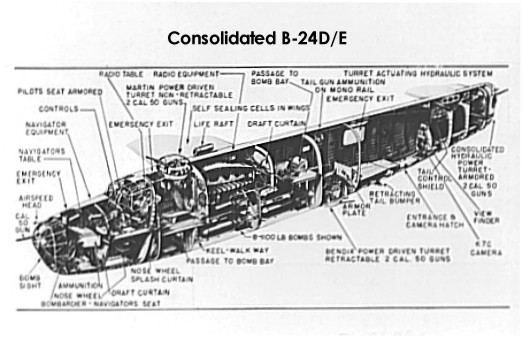
The tall, slab-sided fuselage held two central bomb bays of 3,600 kg capacity each, separated by a ventral catwalk barely 23 centimetres wide that also served as the structural keel. The doors were an uncommon piece of engineering: four metal roller panels that rolled up into the fuselage like the lid of a rolltop desk, without protruding into the airflow or requiring ground clearance. The crew ran to ten or eleven: pilots in a heavily glazed cockpit, navigator and bombardier in the nose — a glazed greenhouse on models before the B-24H, a twin 12.7 mm turret from then on — radio operator and flight engineer behind the pilots, and up to four gunners at the waist, in the retractable ball turret and in the tail. The tricycle undercarriage, the first on an American heavy bomber, eased take-off and loading but forced ground manoeuvring on brakes and throttles, which made taxiing laborious.
Willow Run and the factory that delivered a bomber an hour
No aircraft embodies American industrial mobilisation better. In December 1940 the government asked Ford to build 1,200 B-24s; Charles Sorensen, the company's chief engineer, answered with a then-untried scheme for building aeroplanes on an automobile line. On 18 April 1941, five weeks after an initial contract for subassemblies, ground was broken for what would end up the largest assembly plant on earth, on rural land owned by Henry Ford between Ypsilanti and Belleville, Michigan. The architect was Albert Kahn. Six months and 47 million dollars later Willow Run was ready to train its workforce, with 330,000 m2 of factory floor and a mile-long line including a distinctive ninety-degree turn. The first complete aircraft rolled out on 1 October 1942 and was christened "The Spirit of Ypsilanti".
The factory dragged a town along with it. In 1942 the federal government built the country's second freeway to move workers and materials; in 1943 it spent twenty million more raising an entire community beside the plant, with dormitories, small houses for three thousand people and a thousand trailer homes added in haste. By the end of 1943 more than 42,000 people worked there and Willow Village housed more than 15,000, with thirty dormitories, schools, shops and its own police and fire stations. At the 1944 peak the line delivered a Liberator an hour and some 650 a month, a rate that came to exceed the military's ability to absorb them. When production ceased on 28 June 1945, 8,685 complete aircraft had come off the line; up to December 1944 Ford had also built 7242 knock-down kits that travelled by rail or truck to the final lines at Fort Worth and Tulsa.
Willow Run was not alone. Consolidated tripled its San Diego plant and built another at Fort Worth; a government building put up at Tulsa with federal funds was leased to Douglas, which assembled 962 aircraft there in the D, E, H and J models; North American produced the B-24G at Grand Prairie, Texas, from 1943. Each factory had its identifying suffix — CO for San Diego, CF for Fort Worth, FO for Willow Run, NT for North American and DT for Douglas — and that dispersal had a cost: each plant's variants differed in detail and repair depots had to stock different parts for apparently identical models. The problem eased in the summer of 1944, when production was concentrated at San Diego and Willow Run. The final count is precisely where the sources stop agreeing: there are plant-by-plant tallies adding up to 18,493, general figures of 18,482 and of 18,188, and the round approximation of "more than 18,500" that popular accounts repeat. The discrepancy is not carelessness but a consequence of what is included — prototypes, knock-down kits, naval airframes, British aircraft — and that is why the units-built field on this record is left empty.
Over Europe: the Eighth, the Fifteenth and the combined offensive
The first deliveries to the Army Air Forces arrived in mid-1941, and within three years there were B-24 squadrons on every front. In Europe the Liberator went into combat with the Eighth Air Force in the autumn of 1942: the 44th Bombardment Group, one of the first two equipped with the type, flew the first of its 344 missions on 7 November 1942. The beginnings were brutal. Between that date and 8 March 1943 the 44th lost thirteen of its original twenty-seven B-24s. The first loss over German territory came on 26 February 1943, on a mission to Bremen in which Robert B. Post of The New York Times was killed, the only reporter assigned to a Liberator group under the scheme that put six journalists aboard the bombers; his aircraft was shot down by JG 1 fighters and only two of the eleven men aboard survived. The Germans and the British had already abandoned daylight bombing as unsustainable; the Americans persisted and paid for it.
From 1943 the B-24's weight in Europe grew fast. The provisional group formed from the remnants of the Halverson detachment became the 376th Bombardment Group, which with the 98th formed the nucleus of IX Bomber Command, first from Africa and then, as the Fifteenth Air Force, from Italy. Fifteen of the Fifteenth's twenty-one bombardment groups flew Liberators. Through much of 1944 the Liberator was the type that predominated in the American strategic air forces in Europe: nearly half the heavy strength in the theatre before August and most of the force based in Italy. Between them, thousands of Liberators put hundreds of thousands of tonnes of high explosive and incendiary bombs over German military, industrial and civilian targets.
The type also served as a testbed for electronic warfare and guided weapons. Specialised squadrons — search bomber, low altitude and radar countermeasures units — flew modified B-24s; the 36th Bombardment Squadron was the Eighth's only electronic warfare unit, jamming German VHF communications during large daylight raids and flying night missions with RAF Bomber Command's 100 Group. The Liberator was also the platform for Azon, the laterally guided radio-controlled munition the Eighth used in Europe between June and September 1944 and which the 493rd Bomb Squadron employed in early 1945 against the railway bridges of the Burma Railway. The "Carpetbaggers" deserve separate mention: B-24Ds painted glossy black which, from August 1943, dropped agents and supplies to the European resistance by night at low level, recovered more than 5,000 downed men and, in the summer of 1944, carried 822,791 gallons of petrol to the airfields supplying Patton's army when it outran its own logistics. The same domestic ingenuity produced the "assembly ships", veteran Liberators stripped of armament and painted in checks, stripes and polka dots to serve as a visual reference for forming up groups before returning to base.
Ploiești, 1 August 1943
The Ploiești refineries, thirty-five miles north of Bucharest, supplied around 30 per cent of Axis oil, and had been in American sights since 1942: that June thirteen B-24s of the Halverson project attacked them from Egypt, causing little damage but much alarm. Germany and Romania responded by building around the complex one of the best integrated air defence networks in Europe, the work of the Luftwaffe commander in the region, Alfred Gerstenberg: dozens of heavy 88 mm batteries and many more light guns concealed in haystacks, railway wagons and mock buildings, fifteen Würzburg radar stations for fire control, smoke generators, twenty-three barrage balloons and fifty-seven German and Romanian fighters within range.
Against that, Operation Tidal Wave was launched on 1 August 1943. Conceived by Colonel Jacob Smart, it broke with every strand of American doctrine: instead of high-altitude precision bombing, the Liberators would attack from between 200 and 800 feet, almost brushing the chimneys, to achieve surprise and concentrate the damage. They set out from Benghazi, in Libya, on a 1200-mile flight by way of Corfu and the Pindus mountains, in radio silence. Five bombardment groups of the Eighth and Ninth Air Forces — the 44th, 93rd and 389th loaned temporarily from England, plus the 98th and 376th — mustered 177 aircraft for the blow. Surprise never existed: the Germans had broken the American code and were waiting. A navigational error disordered the approach, alerted the defenders for good and stretched out the bomb run from the initial point.
The result was a partial tactical success at disproportionate cost. Both of the targets handed to the 44th were destroyed, at the price of eleven of the group's thirty-seven bombers and the men in them. In all, 53 aircraft and some 500 aircrew did not return, and the attack produced no curtailment of overall petroleum product output. One gunner on the mission, Ben Kuroki, remembered flames rising more than fifteen metres above his aircraft when a storage tank exploded beneath the formation. One of the Liberators shot down fell on a women's prison in Ploiești, and that single crash caused about half of the 101 civilian dead; 238 more were injured. Proportionally it was the costliest major Allied air raid of the entire war, and its date became known as "Black Sunday". Five Medals of Honor — two to Colonels Leon W. Johnson and John Riley Kane, who survived, and three posthumous, to Lieutenant Lloyd H. Hughes, Major John L. Jerstad and Colonel Addison E. Baker — and fifty-six Distinguished Service Crosses came out of that day.
Closing the Atlantic gap
If Ploiești is the B-24's best remembered mission, its decisive contribution came far from the headlines, over the sea. RAF Coastal Command, responsible for anti-submarine warfare since 1936, had suffered from the start of the conflict a chronic shortage of long-range aircraft: Bomber Command kept the best four-engined types and the maritime force got the cast-offs. In mid-ocean there was a belt beyond the reach of land-based aviation — the mid-Atlantic gap, the "black pit" — where convoys sailed without air cover and U-boats could attack on the surface without risk of being surprised.
The Liberator was the answer. The first British examples, judged too vulnerable for bombing Europe, proved ideal for maritime patrol thanks to their range and load: so were born the Very Long Range Liberators, the VLRs, which sacrificed armour and sometimes turrets to carry extra tanks in the bomb bay. Fitted with ASV Mk II radar and, from a certain point, the Leigh light, they could hunt submarines by day and by night. The effect of the light was so abrupt that many German crews preferred to stay surfaced in daylight so as at least to see the attacker coming and answer with their anti-aircraft guns.
For twelve months No. 120 Squadron RAF, with a handful of worn early-model Liberators operating from Iceland, was the only air cover over the gap. Its nine aircraft were a personal worry to Admiral Karl Dönitz. The VLRs proved their worth when intelligence failed: in September 1942 a 120 Squadron Liberator was overhead when convoy ON 127 was attacked, and the same squadron sank U-597 while protecting convoy ON 136 that October. Combined with shipborne high-frequency direction finding, they could also locate and drive off the submarines shadowing convoys before they attacked. The reversal of May 1943 in the Battle of the Atlantic had many causes, but the growing arrival of VLRs and escort carriers, and the solving of basing problems — Northern Ireland, Scotland, Iceland, Newfoundland and, from mid-1943, the Azores — are among the chief ones. On the other side of the ocean flew the Liberators of the Army Air Forces Antisubmarine Command, the Royal Canadian Air Force and, from October 1943, the US Navy's navalised PB4Ys, from Nova Scotia, Greenland, Bermuda, Puerto Rico, Trinidad, Panama or Ascension. The balance credits Liberators, in full or in part, with sinking 93 German submarines.
The Pacific, Asia and the advantage of range
In the Pacific the arithmetic of range decided matters on its own. The distances between bases and targets were such that an aircraft able to fly further with more bombs was worth more than a tougher one: the B-24 was faster than the B-17, went further and carried nearly a ton more, so it became the theatre's standard heavy bomber and, by mid-1943, the Flying Fortress was withdrawn from there to simplify logistics. The single B-24 stationed in Hawaii was destroyed in the attack on Pearl Harbor on 7 December 1941, before undertaking the very long-range reconnaissance mission for which it had been sent. The first American combat missions with the type were flown by twelve repossessed LB-30s of the 11th Bombardment Squadron from Java in mid-January 1942, and that June four LB-30s flying from Hawaii by way of Midway attempted to attack Wake Island without finding it. From then on Liberators operated from the Philippines, Australia, Espiritu Santo, Guadalcanal, Hawaii and Midway; peak overseas deployment was 45.5 bombardment groups in June 1944.
Asia gave the type its most extreme role. In the China-Burma-India theatre the derived C-87 transports and C-109 tankers crossed the Himalayan "Hump" to sustain the air offensive against Japan, and the bombers flew missions of almost implausible duration: in October 1944 two RAF Liberator squadrons, 357 and 358, deployed to Jessore in India to support British, American and French clandestine operations across South East Asia, stripped of most of their armament to carry fuel for return flights of up to twenty-six hours, such as those linking Jessore with Singapore.
The Commonwealth contribution was considerable. The Royal Australian Air Force received 287 aircraft in the D, J, L and M models from 1944, at the suggestion of General George C. Kenney; it equipped seven squadrons, an operational training unit and two special duties flights, and flew from the Northern Territory, Queensland and Western Australia against Japanese targets in New Guinea, Borneo and the Netherlands East Indies. The Liberator was the only heavy bomber the RAAF used in the Pacific; it lost 33 in action or accidents, with more than two hundred Australians killed, and kept the type until 1948. Qantas, for its part, put two converted LB-30s on the "Double Sunrise" link between Australia and Colombo in June 1944, the longest non-stop commercial air stage in the world at the time — 5,654 km in the version flown by the Catalina flying boats. The Liberators covered a shorter crossing of the Indian Ocean, 4,952 km from Learmonth, but did it in seventeen hours with a 2,500 kg payload, against the twenty-seven hours and barely 450 kg that the Catalinas' auxiliary fuel left them.
The comparison with the B-17: fame and figures
Few aeronautical rivalries are so unbalanced between memory and numbers. The B-17 won the affection of crews and of posterity; the B-24 was built in greater quantity than any other bomber, any other multi-engined aircraft and any other American military aeroplane in history. The reasons for the contrast are real and worth stating plainly. The Liberator flew faster — sixteen to twenty-four kilometres an hour faster in Eighth Air Force combat configuration — went further and carried more bombs, but reached between nine hundred and twelve hundred metres less altitude, which left it more exposed to flak. Its controls were heavy, it demanded a particular technique of getting "on step" before settling into the cruise, and it punished careless weight distribution. Fuel seepage was chronic: bomb bay doors were flown ajar to clear the vapour, and smoking was banned outright aboard many aircraft. A high wing and a keel-less fuselage made it a poorer candidate for surviving a ditching or a forced landing.
The official figures do not favour a simple reading either. The Army's Statistical Control group showed that the Eighth's B-24s suffered fewer casualties than its B-17s, but because they were given shorter and safer missions; and that, overall, the B-17s delivered more bombs onto the target. At the same time there were pilots who preferred the Liberator, and not out of caprice: test pilot Lindell Hendrix, who flew B-24s with the Eighth, maintained that a lightly loaded Liberator could out-turn a P-38 Lightning. The honest conclusion is that the General Staff and the crews valued different things. Command bought the aircraft that yielded more per dollar and per factory hour, with the range and load to cover a map running from Iceland to New Guinea; the men who flew preferred the one that forgave more mistakes and took more damage. Both were right within their own frame, and the outcome proves it: the B-24 won the industrial war and the B-17 won the memory.
Variants and derivatives: C-87, C-109, PB4Y-1 and Privateer
The bomber evolved continuously. After the XB-24 and YB-24 prototypes, the first B-24As and the Liberator I and II built to British specification — with a lengthened nose, self-sealing tanks, armour and up to fourteen guns — the first truly mass-produced series was the B-24D, with turbo-supercharged engines, more fuel and ten 12.7 mm machine guns; its maximum take-off weight of 59,524 pounds put it among the heaviest machines flying, on a par with the British four-engined bombers. In 1943 came what many consider the definitive Liberator, the B-24H, twenty-five centimetres longer, with a powered nose turret that reduced its vulnerability to head-on attack, an improved bombsight, autopilot and a new fuel transfer system. North American built the very similar B-24G, and in August 1943 all five plants switched to the near-identical B-24J, of which 6,678 were produced. The B-24L and B-24M, last of the line, were lightened versions differing mainly in defensive armament.
The C-87 Liberator Express transport arose in early 1942 from the want of a freighter that could outclimb and outrange the C-47: B-24Ds were sent from San Diego to Fort Worth for conversion, fitted with a hinged cargo door in the nose and others at the waist, a floor in the bomb bay, side windows and less powerful engines, with the turrets deleted. Some 287 were produced along with eight naval RY aircraft, and although they mattered greatly in the early years of the airlift, crews did not like them: they lost cockpit electrical power on take-off and landing, iced up as readily as the bomber, had a nose gear not designed to land under load and went out of trim easily if stowage was careless. Ernest K. Gann recounted in "Fate is the Hunter" how a badly stowed C-87 nearly took him into the Taj Mahal. As soon as C-54s and C-46s were available in numbers, the C-87 left the combat zones.
The C-109 was a flying tanker conceived to sustain the B-29s in China: it was not built but converted, stripping out the glazed nose, armament and bombing equipment and adding tanks for up to 11,000 litres and more than 22,000 pounds of fuel. Two thousand were planned and only 218 converted, because the capture of the Marianas made the effort unnecessary; flying the Hump in them was dangerous and many were lost. The Navy and Marine Corps used the B-24 as the PB4Y-1 for anti-submarine warfare, anti-shipping patrol and photographic reconnaissance, with a retractable radome in place of the ball turret and an Erco turret in the nose; they received 977 aircraft. Out of that experience came the PB4Y-2 Privateer in 1943, a fully navalised design with a longer fuselage, a single tall fin, two dorsal turrets, teardrop waist blisters and non-turbosupercharged engines optimised for low and medium patrol altitudes: 739 were built and they served on into the Korean War. As a direct successor to the bomber, Consolidated developed the B-32 Dominator, which reached production only in small numbers at the end of the conflict.
The abrupt end and the few survivors
The Liberator's military career ended almost with the war. Twelve thousand aircraft served with the Army Air Forces, with a peak inventory of 6,043 in September 1944; the RAF received about 2,100, the Canadians 1,200 and the Australians 287. But by 1945 the Boeing B-29 and other new-generation designs had left behind the bombers that started the conflict, and the B-24 was withdrawn from American service at a speed astonishing given the scale of its production. Thousands of practically new aircraft were sent to boneyards for storage, sale or scrapping; at Kingman Army Air Field in Arizona they were lined up by the hundred until they were melted into aluminium ingots. A few passed into civil aviation, and the Pacific saw others carrying cargo during the rebuilding of Japan, China and the Philippines.
There were notable exceptions. The US Navy kept the PB4Y-2 Privateer on maritime patrol into the Korean War. The Royal Australian Air Force flew Liberators until 1948, when Avro Lincolns replaced them. And above all the Indian Air Force provided the most improbable epilogue: after independence and the first Kashmir war, with an urgent need for bombers, Hindustan Aeronautics studied repairing the fleet of a hundred B-24s the British had disabled and abandoned in the subcontinent. With crude repairs — engines salvaged from C-47s, undercarriage doors and parts of the hydraulics removed — and the help of British and American technicians, India recovered 42 aircraft and put 39 into service in 1949 with Nos. 5 and 6 Squadrons. In 1957 No. 5 converted to the Canberra and the remaining Liberators were rebuilt as maritime patrol and reconnaissance aircraft, with ASV-15 radar in a retractable radome where the ball turret had been, sonobuoys and depth charges. They dropped leaflets during Operation Vijay, flew reconnaissance in the Sino-Indian war and stood on alert during the 1965 Indo-Pakistani conflict without seeing combat. They retired in 1968.
That late retirement explains much of what can be seen in museums today: six of the fourteen B-24s surviving in India were acquired when the fleet left service. Of the most-produced bomber in history, thirteen examples remain in the world, ten on display, one under restoration and two in flying condition, among them the Commemorative Air Force's "Diamond Lil", which is in fact the twenty-fifth Liberator built: destined for France in 1940, accepted by the British in 1941, damaged in a training accident and afterwards converted into the C-87 prototype, it survived as an executive transport for a container manufacturer and then for the Mexican oil concern PEMEX before being bought in 1968 and returned to the colours of the 98th Bombardment Group, the unit that flew over Ploiești. Thirteen survivors out of more than eighteen thousand: few figures sum up the B-24 better, an aeroplane conceived to be produced in industrial quantities, spent in a war and to disappear along with it.
Variants
| XB-24 | AT-22 / TB-24 | B-24 | B-24A | B-24C | B-24D | B-24E | B-24G | B-24G-1 | B-24H | B-24J | B-24L | B-24M | B-24ST | BQ-8 | C-87A | C-87B | C-87C | C-87 Liberator Express | F-7 | F-7A | F-7B | Liberator B Mk.I | Liberator B Mk.III | Liberator B Mk.IIIA | Liberator B Mk.II / LB-30 | Liberator B Mk.IV | Liberator B Mk.V | Liberator B Mk.VI | Liberator B Mk.VIII | Liberator C Mk.I | Liberator C Mk.II | Liberator C Mk.IX | Liberator C Mk.VI | Liberator C Mk.VII | Liberator C Mk.VIII | Liberator GR Mk.I | Liberator GR Mk.III | Liberator GR Mk.IIIA | Liberator GR Mk.V | Liberator GR Mk.VI | Liberator GR Mk.VIII | P5Y | PB4Y-1 | PB4Y-1P | PB4Y-2 Privateer | R2Y | RB-24L | RY-1 | RY-2 | RY-3 | TB-24L | XB-24B | XB-24F | XB-24K | XB-24N | XB-24P | XB-24Q | XB-41 | XC-109 / C-109 | XF-7 | YB-24 / LB-30A | YB-24N | |
|---|---|---|---|---|---|---|---|---|---|---|---|---|---|---|---|---|---|---|---|---|---|---|---|---|---|---|---|---|---|---|---|---|---|---|---|---|---|---|---|---|---|---|---|---|---|---|---|---|---|---|---|---|---|---|---|---|---|---|---|---|---|---|---|
| First flight | December 29, 1939 | — | — | — | — | — | — | — | — | — | — | — | — | — | — | — | — | — | — | — | — | — | — | — | — | — | — | — | — | — | — | — | — | — | — | — | — | — | — | — | — | — | — | — | — | — | — | — | — | — | — | — | — | — | — | — | — | — | — | — | — | — | — |
| Aircraft type | Heavy bomber prototype | — | — | Early-production heavy bomber | — | Four-engine heavy bomber | — | — | — | Four-engine heavy bomber | Four-engine heavy bomber | Lightened heavy bomber | Heavy bomber, final production model | — | — | — | — | — | Long-range heavy transport | Long-range photographic reconnaissance aircraft | — | — | — | — | — | Heavy bomber to British specification | — | — | — | — | — | — | — | — | — | — | — | — | — | Maritime patrol and anti-submarine aircraft | — | — | — | Maritime patrol bomber | — | Long-range maritime patrol bomber | — | — | — | — | — | — | — | — | — | — | — | — | — | Fuel-carrying tanker transport | — | — | — |
| Powerplant | Four Pratt & Whitney R-1830-33 Twin Wasp 14-cylinder mechanically supercharged radials, 1,200 hp (890 kW) for take-off and 1,000 hp (750 kW) at 14,500 ft (4,400 m). | — | — | — | — | Four Pratt & Whitney R-1830-43 Twin Wasp turbo-supercharged 14-cylinder radials, 1,200 hp (890 kW) each. | — | — | — | — | Four Pratt & Whitney R-1830-35 Twin Wasp 14-cylinder two-row air-cooled turbo-supercharged radials of 1,200 hp (890 kW) each — also R-1830-41 or R-1830-65 depending on batch — driving 3-bladed Hamilton Standard constant-speed fully-feathering propellers of 3.53 m diameter. | — | — | — | — | — | — | — | — | — | — | — | — | — | — | — | — | — | — | — | — | — | — | — | — | — | — | — | — | — | — | — | — | — | — | Four non-turbosupercharged Pratt & Whitney R-1830 radials, optimised for low- and medium-altitude patrol work and for weight saving. | — | — | — | — | — | — | — | — | — | — | — | — | — | — | — | — | — |
| Powerplant | 4 × Pratt & Whitney R-1830-33 Twin Wasp | 4 × piston | 4 × piston | 4 × Pratt & Whitney R-1830-33 Twin Wasp | 4 × piston | 4 × Pratt & Whitney R-1830-43 Twin Wasp | 4 × Pratt & Whitney R-1830-65 Twin Wasp | 4 × piston | 4 × piston | 4 × Pratt & Whitney R-1830-65 Twin Wasp | 4 × Pratt & Whitney R-1830-35 Twin Wasp | 4 × piston | 4 × piston | 4 × piston | 4 × piston | 4 × Pratt & Whitney R-1830-45 Twin Wasp | 4 × piston | 4 × piston | 4 × Pratt & Whitney R-1830-43 Twin Wasp | 4 × piston | 4 × piston | 4 × piston | 4 × piston | 4 × piston | 4 × piston | 4 × piston | 4 × piston | 4 × piston | 4 × piston | 4 × piston | 4 × piston | 4 × piston | 4 × piston | 4 × piston | 4 × piston | 4 × piston | 4 × piston | 4 × piston | 4 × piston | 4 × piston | 4 × piston | 4 × piston | 2 × piston | 4 × piston | 4 × piston | 4 × piston | 4 × piston | 4 × piston | 4 × piston | 4 × piston | 4 × piston | 4 × piston | 4 × Pratt & Whitney R-1830-41 Twin Wasp | 4 × piston | 4 × piston | 4 × piston | 4 × piston | 4 × piston | 4 × piston | 4 × piston | 4 × piston | 4 × piston | 4 × piston |
| Power per engine | 1,194 hp Best value in this row | — | — | — | — | 1,194 hp Best value in this row | — | — | — | — | 1,194 hp Best value in this row | — | — | — | — | — | — | — | — | — | — | — | — | — | — | — | — | — | — | — | — | — | — | — | — | — | — | — | — | — | — | — | — | — | — | — | — | — | — | — | — | — | 1,194 hp Best value in this row | — | — | — | — | — | — | — | — | — | — |
| Length | — | — | — | — | — | — | — | — | — | — | 20.5 m | — | — | — | — | — | — | — | — | — | — | — | — | — | — | — | — | — | — | — | — | — | — | — | — | — | — | — | — | — | — | — | — | — | — | — | — | — | — | — | — | — | — | — | — | — | — | — | — | — | — | — | — |
| Wingspan | — | — | — | — | — | — | — | — | — | — | 34 m | — | — | — | — | — | — | — | — | — | — | — | — | — | — | — | — | — | — | — | — | — | — | — | — | — | — | — | — | — | — | — | — | — | — | — | — | — | — | — | — | — | — | — | — | — | — | — | — | — | — | — | — |
| Height | — | — | — | — | — | — | — | — | — | — | 5.4 m | — | — | — | — | — | — | — | — | — | — | — | — | — | — | — | — | — | — | — | — | — | — | — | — | — | — | — | — | — | — | — | — | — | — | — | — | — | — | — | — | — | — | — | — | — | — | — | — | — | — | — | — |
| Wing area | — | — | — | — | — | — | — | — | — | — | 97.4 m² | — | — | — | — | — | — | — | — | — | — | — | — | — | — | — | — | — | — | — | — | — | — | — | — | — | — | — | — | — | — | — | — | — | — | — | — | — | — | — | — | — | — | — | — | — | — | — | — | — | — | — | — |
| Empty weight | — | — | — | — | — | — | — | — | — | — | 16,556 kg | — | — | — | — | — | — | — | — | — | — | — | — | — | — | — | — | — | — | — | — | — | — | — | — | — | — | — | — | — | — | — | — | — | — | — | — | — | — | — | — | — | — | — | — | — | — | — | — | — | — | — | — |
| MTOW | — | — | — | — | — | — | — | — | — | — | 29,484 kg | — | — | — | — | — | — | — | — | — | — | — | — | — | — | — | — | — | — | — | — | — | — | — | — | — | — | — | — | — | — | — | — | — | — | — | — | — | — | — | — | — | — | — | — | — | — | — | — | — | — | — | — |
| Top speed | 439 km/h | — | — | — | — | — | — | — | — | — | 478 km/h Best value in this row | — | — | — | — | — | — | — | — | — | — | — | — | — | — | — | — | — | — | — | — | — | — | — | — | — | — | — | — | — | — | — | — | — | — | — | — | — | — | — | — | — | — | — | — | — | — | — | — | — | — | — | — |
| Max speed altitude | — | — | — | — | — | — | — | — | — | — | 7,600 m | — | — | — | — | — | — | — | — | — | — | — | — | — | — | — | — | — | — | — | — | — | — | — | — | — | — | — | — | — | — | — | — | — | — | — | — | — | — | — | — | — | — | — | — | — | — | — | — | — | — | — | — |
| Cruise speed | — | — | — | — | — | — | — | — | — | — | 346 km/h | — | — | — | — | — | — | — | — | — | — | — | — | — | — | — | — | — | — | — | — | — | — | — | — | — | — | — | — | — | — | — | — | — | — | — | — | — | — | — | — | — | — | — | — | — | — | — | — | — | — | — | — |
| Cruise altitude | — | — | — | — | — | — | — | — | — | — | 7,600 m | — | — | — | — | — | — | — | — | — | — | — | — | — | — | — | — | — | — | — | — | — | — | — | — | — | — | — | — | — | — | — | — | — | — | — | — | — | — | — | — | — | — | — | — | — | — | — | — | — | — | — | — |
| Service ceiling | — | — | — | — | — | — | — | — | — | — | 8,500 m | — | — | — | — | — | — | — | — | — | — | — | — | — | — | — | — | — | — | — | — | — | — | — | — | — | — | — | — | — | — | — | — | — | — | — | — | — | — | — | — | — | — | — | — | — | — | — | — | — | — | — | — |
| Initial climb rate | — | — | — | — | — | — | — | — | — | — | 5.2 m/s | — | — | — | — | — | — | — | — | — | — | — | — | — | — | — | — | — | — | — | — | — | — | — | — | — | — | — | — | — | — | — | — | — | — | — | — | — | — | — | — | — | — | — | — | — | — | — | — | — | — | — | — |
| Range | — | — | — | — | — | — | — | — | — | — | 2,480 km | — | — | — | — | — | — | — | — | — | — | — | — | — | — | — | — | — | — | — | — | — | — | — | — | — | — | — | — | — | — | — | — | — | — | — | — | — | — | — | — | — | — | — | — | — | — | — | — | — | — | — | — |
| Ferry range | — | — | — | — | — | — | — | — | — | — | 6,000 km | — | — | — | — | — | — | — | — | — | — | — | — | — | — | — | — | — | — | — | — | — | — | — | — | — | — | — | — | — | — | — | — | — | — | — | — | — | — | — | — | — | — | — | — | — | — | — | — | — | — | — | — |
| Combat radius | — | — | — | — | — | — | — | — | — | — | 640 km | — | — | — | — | — | — | — | — | — | — | — | — | — | — | — | — | — | — | — | — | — | — | — | — | — | — | — | — | — | — | — | — | — | — | — | — | — | — | — | — | — | — | — | — | — | — | — | — | — | — | — | — |
| Endurance | — | — | — | — | — | — | — | — | — | — | 390 min | — | — | — | — | — | — | — | — | — | — | — | — | — | — | — | — | — | — | — | — | — | — | — | — | — | — | — | — | — | — | — | — | — | — | — | — | — | — | — | — | — | — | — | — | — | — | — | — | — | — | — | — |
| Range conditions | — | — | — | — | — | — | — | — | — | — | Range of 2,480 km at 381 km/h and 7,600 m with normal fuel and maximum internal bomb load, equivalent to about 6 h 30 min in the air; 6,000 km ferry range. Bomb load scaled with mission radius: 3,600 kg at 640 km, 2,300 kg at 1,300 km and 1,200 kg at 1,900 km. | — | — | — | — | — | — | — | — | — | — | — | — | — | — | — | — | — | — | — | — | — | — | — | — | — | — | — | — | — | — | — | — | — | — | — | — | — | — | — | — | — | — | — | — | — | — | — | — | — | — | — | — |
| Armament | Three 0.5 in (12.7 mm) and four 0.30 in (7.62 mm) machine guns; bomb load of eight 1,000 lb (450 kg) bombs. | — | — | — | — | Up to ten .50 in (12.7 mm) Browning machine guns: Martin dorsal turret, Consolidated A-6 tail turret, waist positions and — depending on the block — a Bendix belly turret, a tunnel gun or a retractable Sperry ball turret; late aircraft added cheek guns beside the nose. | — | — | — | Electrically powered Emerson A-15 nose turret, Martin A-3 dorsal turret with enlarged high-hat dome, tail turret with larger windows and enclosed, laterally offset waist positions; ten .50 in (12.7 mm) machine guns. | Ten .50 calibre (12.7 mm) M2 Browning machine guns in four turrets — nose, dorsal, Sperry ventral ball and tail — plus two waist positions. Bomb load of up to 3,600 kg on short-radius missions. | Two .50 in (12.7 mm) machine guns on a floor ring mount replacing the Sperry ball turret; M-6A tail turret in place of the A-6B, and on late aircraft tail armament installed at a depot: 190 with an A-6B or M-6A turret, 42 with a hydraulically assisted twin mount and the remainder with a manually operated twin mounting. | Lightened version of the A-6B tail turret, open waist positions and the reintroduced retractable Sperry ventral ball turret. | — | — | — | — | — | None in the standard version; the early C-87A carried a single .50 in (12.7 mm) Browning in the tail, and the projected C-87B with nose guns, dorsal turret and tunnel gun was not produced. | No offensive armament: the bomb load is replaced by cameras; the defensive guns of the parent airframe are retained. | — | — | — | — | — | Boulton Paul tail turret with four .303 in (7.70 mm) machine guns and Boulton Paul dorsal turret on British aircraft; on the American LB-30s, .50 in Browning M2 guns in the nose, waist and ventral tunnel, a twin manual tail mount and a Martin dorsal turret. | — | — | — | — | — | — | — | — | — | — | — | — | — | Defensive armament to the Mk.III pattern, plus eight zero-length rocket launchers on some aircraft — four under each wing — and, on others, stub-wings on either side of the lower forward fuselage carrying eight RP-3 rails. | — | — | — | — | — | — | — | — | — | — | — | — | — | — | — | — | — | — | — | None: armament, turrets and bombing equipment were removed to save weight. | — | — | — |
| Max weapons load | 3,600 kg Best value in this row | — | — | — | — | 3,600 kg Best value in this row | — | — | — | — | 3,600 kg Best value in this row | — | — | — | — | — | — | — | 0 kg | 0 kg | — | — | — | — | — | — | — | — | — | — | — | — | — | — | — | — | — | — | — | — | — | — | — | — | — | — | — | — | — | — | — | — | — | — | — | — | — | — | — | 0 kg | — | — | — |
| Payload | 0 kg Best value in this row | — | — | — | — | 0 kg Best value in this row | — | — | — | — | 0 kg Best value in this row | — | — | — | — | — | — | — | — | — | — | — | — | — | — | — | — | — | — | — | — | — | — | — | — | — | — | — | — | — | — | — | — | — | — | — | — | — | — | — | — | — | — | — | — | — | — | — | — | — | — | — | — |
| Cargo capacity | — | — | — | — | — | — | — | — | — | — | None: the B-24J is a pure bomber with no cargo hold or passenger accommodation (0 kg payload, 0 passengers). Transport duties were covered by dedicated derivatives, the C-87 Liberator Express and the C-109 tanker. | — | — | — | — | — | — | — | Accommodation for 20 passengers; the C-87A VIP transport had sleeping berths for 16 and R-1830-45 engines instead of the -43. | No cargo or passenger capacity: the bomb bay houses the camera installation. | — | — | — | — | — | — | — | — | — | — | — | — | — | — | — | — | — | — | — | — | — | — | — | — | — | — | — | — | — | — | — | — | — | — | — | — | — | — | — | Storage tanks installed in the fuselage and bomb bays in place of conventional cargo. | — | — | — |
| Crew | 7 | — | — | 7 | — | 10 | — | — | — | 10 | 11 | 10 | 10 | — | — | — | — | — | 5 | 8 | — | — | — | — | — | 8 | — | — | — | — | — | — | — | — | — | — | — | — | — | 8 | — | — | — | 11 | — | 11 | — | — | — | — | — | — | — | — | — | — | — | — | — | 4 Best value in this row | — | — | — |
| Passengers | 0 | — | — | 0 | — | 0 | — | — | — | 0 | 0 | 0 | 0 | — | — | 16 | — | — | 20 Best value in this row | 0 | — | — | — | — | — | 0 | — | — | — | — | — | — | — | — | — | — | — | — | — | 0 | — | — | — | 0 | — | 0 | — | — | — | — | — | — | — | — | — | — | — | — | — | 0 | — | — | — |
| Units built | 1 | — | 1 | 9 | 9 | 2,696 | 801 | 25 | 405 | 3,100 | 6,678 Best value in this row | 1,667 | 2,593 | 1 | — | 0 | 0 | — | 287 | — | — | — | 20 | 156 | — | 165 | 0 | — | — | — | 9 | — | — | — | — | — | — | — | — | — | — | — | 0 | 976 | — | 739 | — | — | — | — | — | — | 1 | 1 | 1 | 1 | 1 | 1 | 1 | — | — | 7 | 7 |
Images
Elsewhere
- Wikimedia CommonsB-24 Liberator - Consolidated-Vultee Plant, Fort Worth Texas ↗
- Wikimedia CommonsHow the Consolidated B-24 Liberator flew in bombing the Ploesti Field, Romania, 1943 ↗
- Smithsonian National Air and Space MuseumConsolidated B-24 Liberator (Rudy Arnold Photo Collection) ↗
- Smithsonian National Air and Space MuseumConsolidated "Liberator" B-24 Heavy Bomber, U.S. Army Air Force ↗
- Smithsonian National Air and Space MuseumConsolidated B-24 "Liberator" U.S. Army - Long Range Bomber ↗
- Australian War MemorialGroup portrait of the crew of a Consolidated B-24 Liberator bomber, No. 21 Squadron RAAF ↗
- Australian War MemorialGroup portrait of a crew of eleven beside a Consolidated B-24 Liberator bomber, No. 21 Squadron RAAF ↗
- Australian War MemorialNose art on B-24 Liberator aircraft 'Pluto', 90th Bombardment Group ↗
- Pima Air & Space MuseumConsolidated B-24J Liberator ↗
- Collings FoundationConsolidated B-24J Liberator "Witchcraft" ↗
- FlickrB-24 Liberator 42-41154 "Black Cat" over Blythe CA, 12-15-1943 ↗
- FlickrInterior of B-24 Bomber, panorama ↗
Show the 10 more
- FlickrConsolidated B-24J Liberator interior ↗
- FlickrB-24 Liberator "Witchcraft" ↗
- FlickrB-24 Liberator interior at Livermore ↗
- FlickrB-24 Liberator Interior - Collings Foundation Wings of Freedom Tour ↗
- FlickrB-24 Liberator Cockpit ↗
- FlickrConsolidated B-24 Liberator "Stevonovitch II" ↗
- FlickrConsolidated B-24 Liberator "The Goon" B-24D-20-CO ↗
- The National WWII MuseumConsolidated B-24 Liberator - US Freedom Pavilion ↗
- RAF MuseumConsolidated B-24L-20-FO Liberator ↗
- RAF MuseumConsolidated Liberator B.VIII ↗