Transport · Civil · Canada
Canadair CL-415
- December 6, 1993
- First flight
- In service
- Status
Canadair CL-415 in the news
August 17, 2026
Wildfires are raging in Spain, France, Greece, Croatia and Germany. The EU is reinforcing its fleet with new Canadair DHC-515s, while a new aircraft signals the future of aerial firefighting.

August 7, 2026
.jpg)
Persistent drought and severe wildfires are keeping many regions around the world on edge. With the DHC-515, Canada is offering a new firefighting aircraft that will also be deployed on a large…
August 6, 2026
.jpg)
De Havilland Canada has resumed production of the DHC-515 Firefighter amphibious aircraft, the latest evolution of the historic Canadair family, marking the return of production of this…
Canadian firm De Havilland Aircraft has shown progress on assembly of the first DHC-515 firefighting aircraft, the new amphibious aircraft acquired by half a dozen European countries, including…
-800.webp)
August 5, 2026
Aviación Digital, Sp.- The renewal of Europe's large amphibious aircraft fleet depends on an industrial line restarted after years without building new Canadairs. Assembly of the first DHC-515s…


-1600.webp)


_septembre_2024_10-1600.webp)


_septembre_2024_1-1600.webp)
_septembre_2024_22-1600.webp)
_septembre_2024_12-1600.webp)
_septembre_2024_11-1600.webp)

_septembre_2024_5-1600.webp)
-1600.webp)


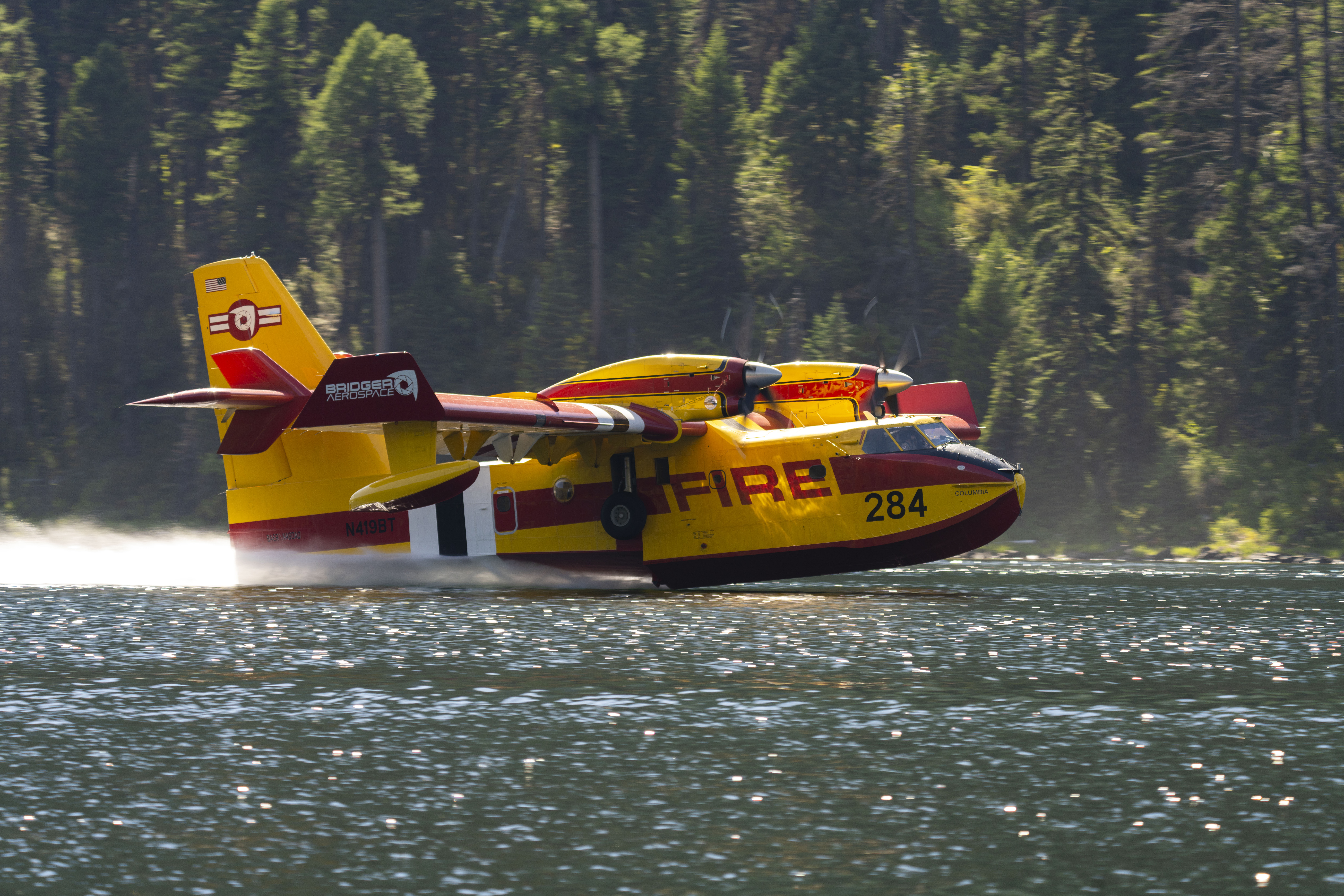
The Canadair CL-415 is a twin-turboprop amphibious aircraft designed specifically for aerial firefighting: it scoops up to 6,137 litres of water in about twelve seconds while skimming a lake or the sea, mixes it in flight with foam or retardant and drops it on the fire without returning to base. A direct successor to the CL-215, also known as the Bombardier 415 and the "Super Scooper", it first flew on 6 December 1993 and entered service in November 1994. The project grew out of the CL-215T re-engining programme, which replaced the CL-215's piston engines with Pratt & Whitney Canada PW123AF turboprops. On that basis Canadair, absorbed by Bombardier in 1986, built a new, strengthened airframe with an electronic-display cockpit, four drop doors, winglets and tail finlets. The result is a rugged flying boat, tolerant of salt water and able to operate from runways or from the water, which was also offered in a maritime patrol and search-and-rescue version, the CL-415MP. Between 1993 and 2015, 95 aircraft were built at North Bay, Ontario, almost all of them for the Mediterranean basin and Canada: France was the launch customer with 12 aircraft for the Sécurité civile, Italy assembled the world's largest civil fleet for its fire service, Greece took the strengthened CL-415GR variant, Croatia operates six and Spain assigned its four CL-415s to the Air Force's 43 Grupo. In the United States, aircraft leased from Quebec fly each autumn for Los Angeles and San Diego counties. Bombardier closed the line in October 2015 and sold the programme in 2016 to Viking Air, today De Havilland Aircraft of Canada, which has relaunched it as the DHC-515 Firefighter with a digital cockpit and 7,000-litre tanks. Driven by worsening fire seasons, a European order for 22 aircraft, including seven for Spain, and purchases by Canadian provinces have brought the reference amphibious water bomber back into production three decades on, with the first delivery expected in 2028.
Related events
Category
History
Origins: the CL-215 inheritance
The Canadair CL-415 was not designed from scratch. It grew out of the CL-215, the first aircraft ever conceived from the outset as a water bomber. Introduced in 1966, that amphibian had spent more than two decades proving that a rugged flying boat able to refill its tanks by skimming a lake or the sea was the most productive tool against forest fires. A total of 125 were built, the last one delivered in May 1990, and by then the market was asking for what the Pratt & Whitney R-2800 piston engines could not give: more power, better reliability and lower maintenance.
The interim answer was the CL-215T. In 1987 Canadair began re-engining 17 CL-215 airframes with Pratt & Whitney Canada PW123AF turboprops, which offered roughly 15 percent more power than the original pistons together with better safety margins. The conversion went well beyond the engines: it added powered flight controls, cockpit air conditioning, upgraded electrical and avionics systems and, most visibly, a set of aerodynamic additions on the wings and tail. Company officials admitted that demand for the CL-215T alone was marginal and did not justify an all-new aircraft, yet the programme served as a full-scale test bed. In practice the CL-215T was the conceptual prototype of the CL-415.
Development and first flight
With the conversion validated, Canadair decided in the early 1990s to launch a new production series built on fresh airframes with a strengthened structure to allow higher maximum weights. The CL-415 made its maiden flight on 6 December 1993, and the first deliveries began in November 1994. A year later an aircraft owned by the Quebec Government set off on a 180-day sales tour through 21 countries, and Bombardier, which had absorbed Canadair in 1986, announced a six-point improvement plan intended to broaden the aircraft's roles beyond firefighting.
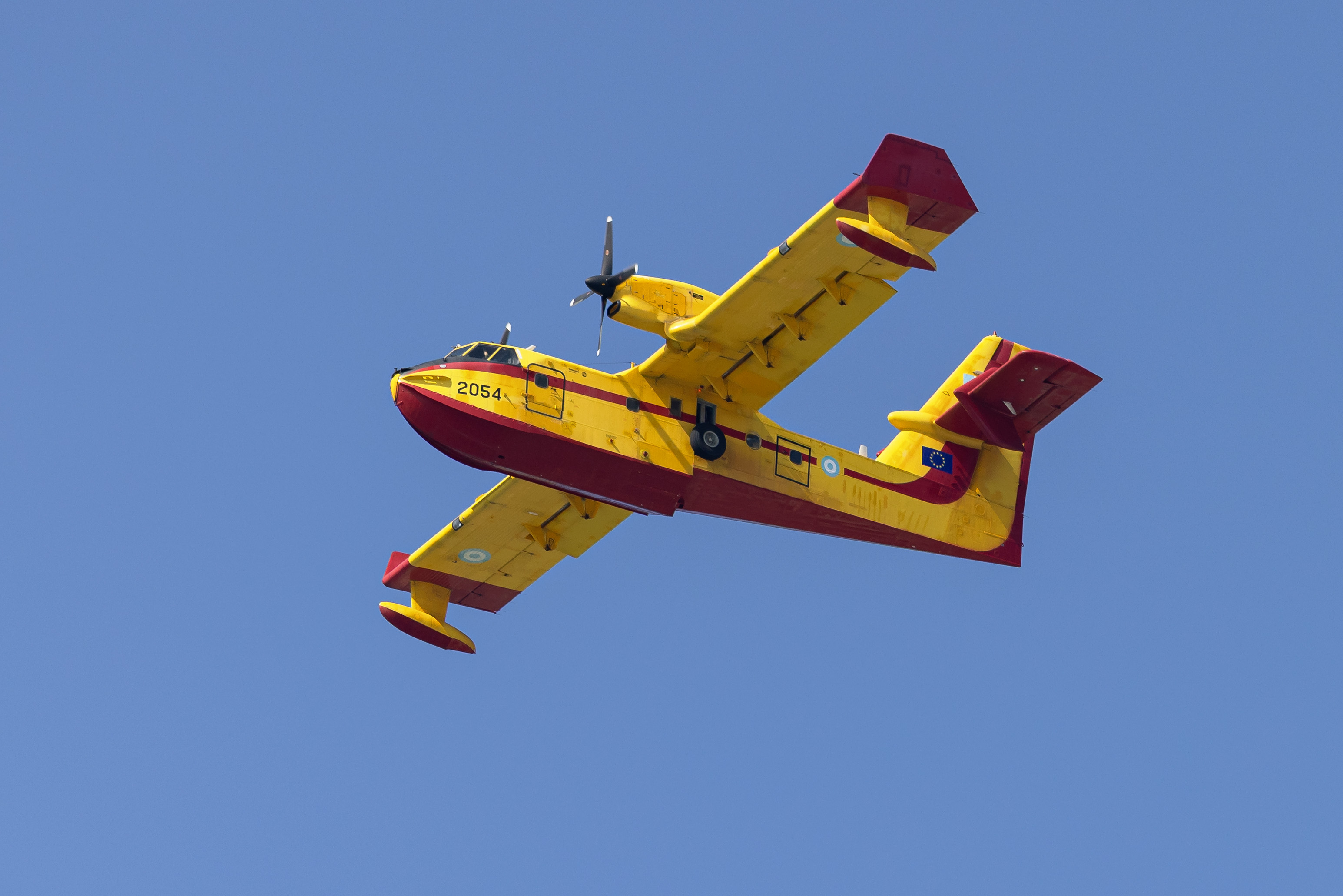
Orders arrived quickly, in a mix of purchases and leases: by July 1996 there were 37 aircraft in service in Canada, France, Italy and Spain. From 1998 assembly moved to Bombardier Aerospace's plant beside Jack Garland Airport in North Bay, Ontario, with water trials carried out on Lake Nipissing. By 1999 the order book stood at 51.
Design: a flying boat built for fire
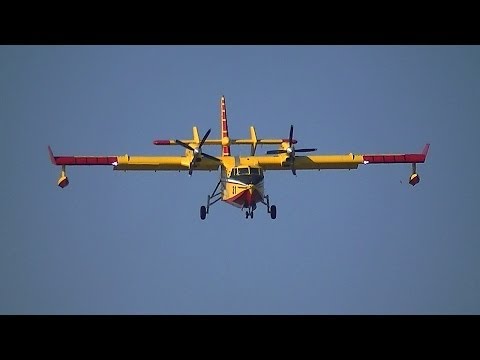
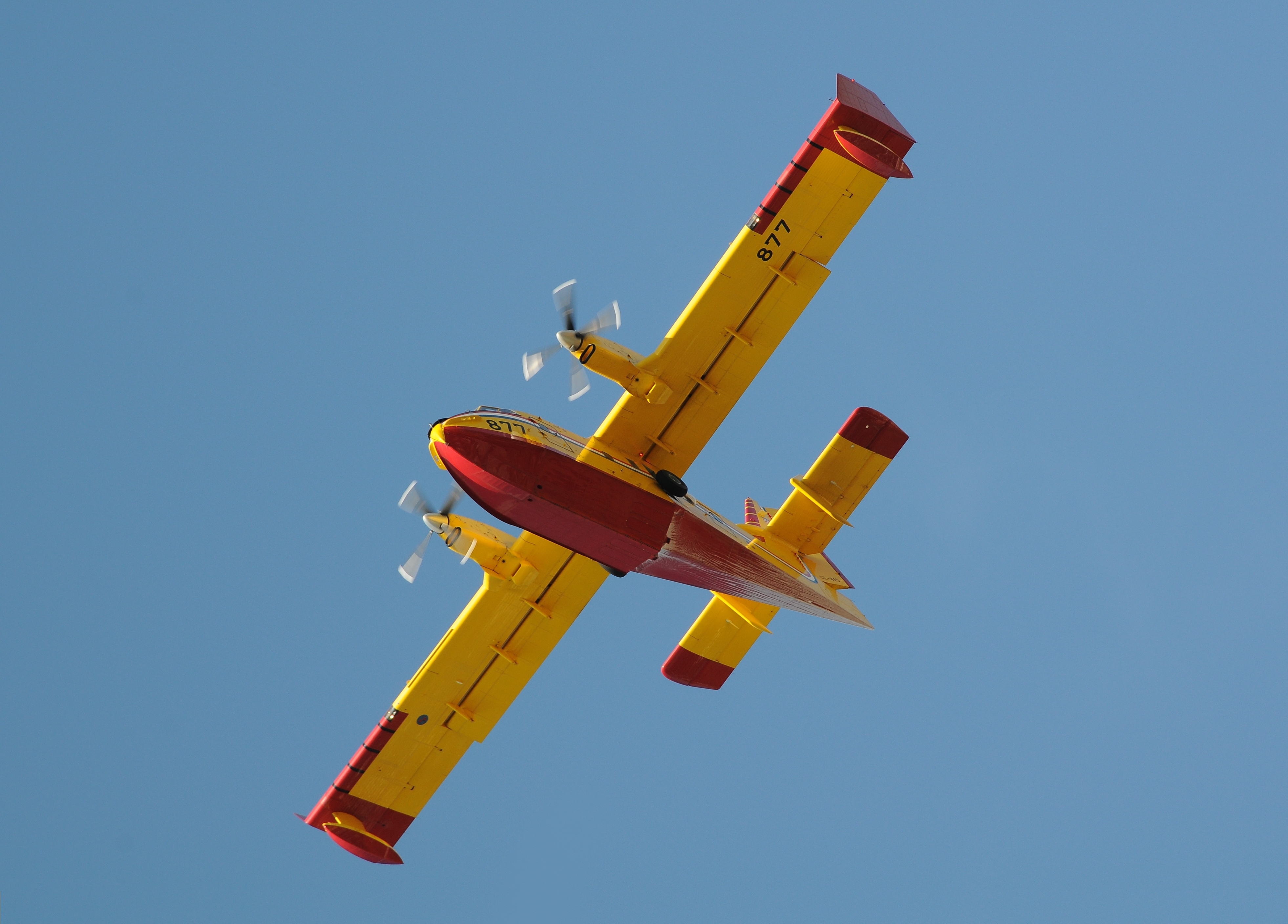
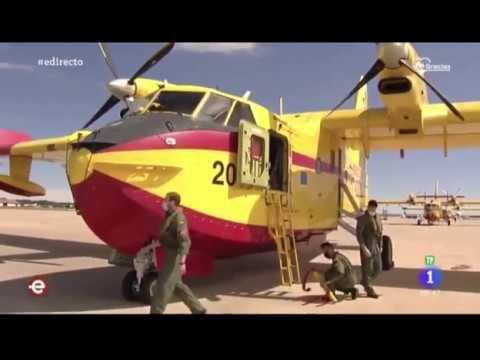
The CL-415 keeps the CL-215's layout, with a high wing, an all-metal central hull, stabilising floats under the wings and a tricycle undercarriage whose main wheels remain exposed beneath the wing when retracted, but the changes go far beyond the powerplant. Each of the two PW123AF turboprops is flat-rated at 1,775 kW (2,380 shp) and drives a four-blade, fully reversible Hamilton Standard 14SF-19 propeller of 3.97 m diameter. Because the engines are more powerful, they were mounted closer to the fuselage than on the CL-215; on its own that would have reduced lateral stability, so a small inverted fixed slat was added ahead of the right-hand horizontal stabiliser. Winglets and the tail finlets inherited from the CL-215T improve directional stability.
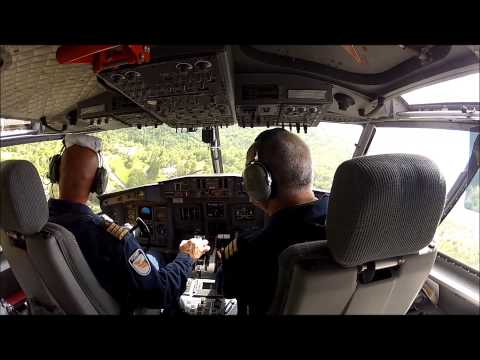
The flight deck was modernised around a Honeywell EDZ-605 electronic display suite, and the drop system grew from two doors to four, allowing pilots to select different release patterns and sequences from a water status panel built into the instrument panel rather than relying on a separate operator. A manual emergency dump lever bypasses the whole system. The tanks, with a combined capacity of 6,137 litres, sit mostly below the cabin floor inside the hull, with a header tank on each side of the fuselage; the water can be mixed in flight with foam or retardant carried in small tanks beneath the two rows of folding seats.
_septembre_2024_22.jpg)
The airframe is built for a long life: treated aluminium and corrosion-resistant materials allow daily operation in salt water, and the structure is cleared to +3.25 and −1.0 g. In firefighting configuration the empty weight is 13,608 kg, the maximum take-off weight from land 19,890 kg and the maximum weight after scooping 21,319 kg. The aircraft is 20.4 m long, spans 28.38 m and stands 9.01 m high, with 100 square metres of wing area. It cruises at 333 km/h with a maximum of 359 km/h, and its ferry range is 2,427 km. Without water, the 35.6 cubic metre cabin can take up to 18 paratroops or 2,903 kg of cargo, which opens the door to search-and-rescue and utility transport roles.
The scooping run
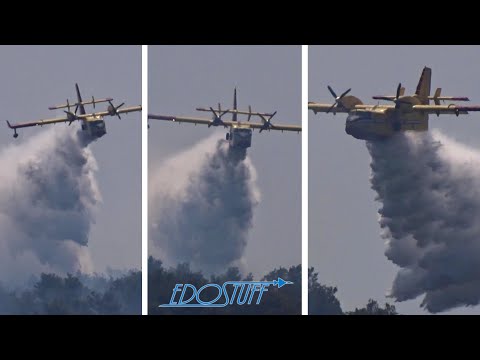
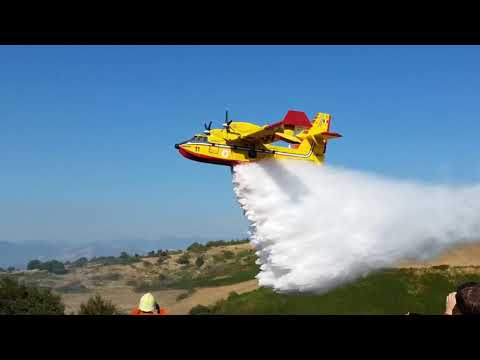
What sets the CL-415 apart from a conventional air tanker is that it does not fly back to base to reload: it refills on any stretch of water of sufficient length and at least 1.4 m deep. The pilot descends until the hull touches the surface at about 70 knots and lowers two small retractable probes, barely 10 by 12 cm, located behind the step of the keel. Dynamic pressure fills the tanks in around 12 seconds over a run of roughly 410 m; counting the descent from 15 m and the climb back to that height, the whole manoeuvre needs about 1,340 m of clear water. The aircraft can also pick up partial loads on smaller lakes and can even turn while scooping. Bombardier claimed 6.9 drops per flight hour for the type; on a typical mission it stays aloft for three hours and delivers nine loads when the water source lies about 10 km from the fire. Where no water surface is available, filling ports on each side of the fuselage allow the tanks to be loaded on the ground.
The manoeuvre, which demands dedicated training, has also fed a persistent urban legend: the scuba diver found among the ashes of a forest fire after being "sucked up" by a Canadair. It is physically impossible, since the probes are tiny and fitted with grilles through which a finger barely passes, yet the tale has been retold in film and fiction and has an equivalent version involving helicopters with suspended buckets.
Production, sales and the end of the line
The CL-415 was built between 1993 and 2015. According to the manufacturer, 69 aircraft had been delivered worldwide by January 2009, including the maritime patrol version, and 49 of them were operating in the Mediterranean area alone, a figure that says a great deal about where the wildfire problem is concentrated and who has paid for the aircraft. Sales slowed during the 2010s, partly because the aircraft was expensive, with a unit cost of 36.9 million US dollars in 2014, and partly because the traditional customers had already completed their fleets. Bombardier, weighed down by the cost overruns of the CSeries airliner, closed the North Bay line in October 2015 after 95 aircraft, although it continued to market the type and support the existing fleet.
_septembre_2024_10.jpg)
In 2006 the aircraft received Spain's Batefuegos de Oro award from the APAS association, whose citation described it as the most efficient tool for the aerial fight against forest fires and the most sought-after aerial asset for more than thirty years. Between 2016 and 2019 some 164 CL-215 and CL-415 family aircraft were counted in service across 11 countries.
Variants
Of the CL-415 production run, 86 were the basic firefighting model. Three more were CL-415MP "Multi Purpose" aircraft, a maritime patrol and search-and-rescue version with surveillance radar, forward-looking infrared, side-looking airborne radar and enhanced communications, able to land on the water for a rescue, chase offending vessels or spot oil slicks: two went to the Malaysian Maritime Enforcement Agency, ordered in 2008 and delivered in December 2008 and November 2009, and one to the Hellenic Air Force. The six CL-415GR were built specifically for Greece with higher operating weights and greater payload.
The CL-415EAF "Enhanced Aerial Firefighter" stands apart: it is not a new airframe but a modernisation of old CL-215s to a standard equivalent to the 415, with Rockwell Collins Pro Line Fusion avionics. Bridger Aerospace of Bozeman, Montana, became its launch customer with a 204 million dollar contract for up to six aircraft announced in May 2018, and Morocco completed three conversions in 2021 to add to the five CL-415T it had received between 2011 and 2013.
Operators: the Mediterranean stage
France was the first customer. On 16 October 1991 the Sécurité civile ordered 12 aircraft to form three rotations of four and replace the 11 ageing CL-215s still in service; they were delivered between 1995 and 1997, five, six and one respectively. The "Pélicans", as they are known in France after their radio callsign, have suffered three losses, made good with an aircraft leased from Bombardier in 2004 and bought outright in 2006, another delivered in 2006 and a twelfth in 2007. Their replacement, first planned from 2015 and then pushed to a 2025-2033 horizon, has taken shape as four DHC-515s: two ordered in 2024 for delivery in 2028 and two in 2026 for 2032.
_septembre_2024_11.jpg)
Italy is the largest civil operator in the world. The 22 aircraft delivered to the Italian state, first under the Civil Protection Department and flown by the company SOREM, then from 23 April 2013 under the National Fire Corps with outsourced operation now in the hands of Avincis, have suffered four losses; the current fleet is around 18 aircraft, of which 13 cover the national territory, two are reserved for European missions and three rotate through maintenance. Greece took 10 aircraft (six CL-415GR, one CL-415MP and the rest standard) for 383 Squadron "Proteas" of 112 Combat Wing at Elefsina, and has lost three. Croatia flies six, all in service with its air force. In Canada the aircraft belong to provincial governments: nine in Ontario, eight in Quebec, four in Manitoba operated by Air Spray and six in Newfoundland and Labrador, one of them lost. Quebec also leases two aircraft each autumn to Los Angeles County and two more to San Diego County, while Aero-Flite owns four in the United States.
Spain: 43 Grupo
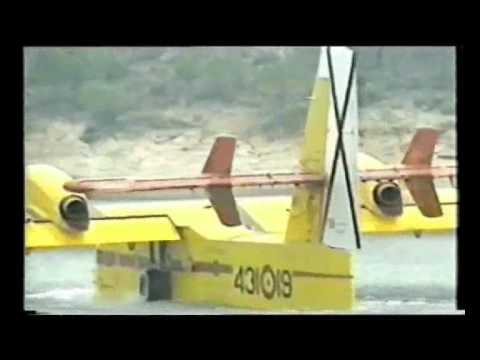
Spain was among the first four countries to operate the CL-415, already listed among its users in July 1996. The permanent fleet, however, consists of four CL-415s received in 2006 and assigned to 43 Grupo de Fuerzas Aéreas of the Spanish Air Force, the unit that flies Spain's amphibious water bombers; one of the four belongs to the Ministry of Agriculture. On 19 April 2024 Spain ordered seven DHC-515s within the European package, five funded by the state and two through the RescEU mechanism.
Accidents
Firefighting flying happens at low altitude, in smoke-reduced visibility, thermal turbulence and with weights that change abruptly on every scoop and drop, and the CL-415's loss record reflects it. The first came in November 1997, when the Sécurité civile's Pélican 43 crashed near La Ciotat with one fatality. It was followed by the Italian I-DPCN at Esine on 16 August 2003 (no casualties), Pélican 41 in Lake Sainte-Croix on 8 March 2004 (two dead), I-DPCK near Seravezza on 18 March 2005 (two dead) and Pélican 36, which broke up in flight over Corsica on 1 August 2005 (two dead). The Hellenic Air Force lost aircraft on 25 April 2006, on 23 July 2007 near Styra, the same day I-DPCX crashed at Roccapreturo in the Abruzzi killing its captain, and on 5 May 2014 while landing on water. Newfoundland lost C-FIZU on Moosehead Lake on 3 July 2013, and on 27 October 2022 an Italian fire service aircraft crashed at Linguaglossa on the slopes of Etna, killing both pilots. The Roccapreturo crash also triggered a debate in Italy over the extension of crews' weekly flying hours, which according to the press and pilots' unions had been doubled without prior approval from the aviation authority.
From Viking to De Havilland: the DHC-515
On 20 June 2016 it was announced that Viking Air, a British Columbia company that had started as a component manufacturer and in 2008 had already bought from Bombardier the rights to the entire out-of-production de Havilland range, was acquiring the type certificates of the CL-415, the CL-215 and the CL-215T. The deal closed on 3 October 2016. Viking took over fleet support, obtained EASA certification in December 2018 for a full-flight simulator able to reproduce scooping and dropping (Ontario had already operated a Mechtronix simulator at Sault Ste. Marie since May 2013) and began designing a modernised version, the CL-515, whose production it made conditional in 2018 on reaching a threshold of 25 orders.
Indonesia was the first official buyer: on 21 June 2019 its Ministry of Defence announced six CL-515s and one CL-415EAF for 2024, but the order was insufficient and the pandemic froze the project. The breakthrough came from Europe. In February 2022 Longview Aviation Capital gathered Viking and its sister companies under the De Havilland Aircraft of Canada name, and on 31 March 2022 the company relaunched the aircraft as the DHC-515 Firefighter with 22 letters of intent from European customers: 12 aircraft financed by the European Union through RescEU (two for each of six member states: France, Italy, Greece, Spain, Portugal and Croatia) and 10 paid for directly by Greece and Spain, five each. The intentions became firm orders in 2024, with Croatia on 14 March, Greece on 21 March under a 530 million dollar deal announced by prime ministers Mitsotakis and Trudeau, Spain on 19 April and Portugal on 18 July, and further customers followed: Manitoba with three aircraft in June 2025 and Alberta with five in February 2026.
The DHC-515 retains the CL-415 airframe and adds a fully digital cockpit with Universal InSight avionics, tanks enlarged to 7,000 litres that fill in 14 seconds, a larger cargo door for disaster response and interiors prepared for medical evacuation. Fuselage and wing parts are made in North Saanich, next to Victoria International Airport, and final assembly takes place in Calgary, where the CL-215 and CL-415 are already supported. In March 2026 De Havilland announced that assembly of the first aircraft had begun, with the first delivery expected in 2028 after several postponements.
Legacy
More than thirty years after its first flight, the CL-415 remains the reference amphibious water bomber, and the summer firefighting campaign around the Mediterranean is unthinkable without it. The worsening of fire seasons with global warming has brought demand back to a programme Bombardier had written off, and has encouraged rival projects in Europe, amphibious or land-based conversions of the ATR 72 and a new amphibian from the Bordeaux start-up Hynaero, which for now remain on paper while the DHC-515 takes shape in Calgary.
Variants
| CL-415 | CL-415EAF | CL-415GR | CL-415MP | DHC-515 Firefighter | |
|---|---|---|---|---|---|
| First flight | December 6, 1993 | March 12, 2020 | — | — | — |
| Powerplant | 2 × Pratt & Whitney Canada PW123AF | 2 × turboprop | 2 × Pratt & Whitney Canada PW123AF | 2 × Pratt & Whitney Canada PW123AF | 2 × turboprop |
| Power per engine | 2,380 hp | — | — | — | — |
| Length | 20.4 m | — | — | — | — |
| Wingspan | 28.4 m | — | — | — | — |
| Height | 9 m | — | — | — | — |
| Wing area | 100 m² | — | — | — | — |
| Empty weight | 13,608 kg | — | — | — | — |
| MTOW | 19,890 kg | — | — | — | — |
| Top speed | 359 km/h | — | — | — | — |
| Cruise speed | 333 km/h | — | — | — | — |
| Initial climb rate | 5.9 m/s | — | — | — | — |
| Ferry range | 2,427 km | — | — | — | — |
| Endurance | 180 min | — | — | — | — |
| Payload | 2,903 kg | — | — | — | — |
| Crew | 2 Best value in this row | — | 2 Best value in this row | 2 Best value in this row | — |
| Passengers | 18 | — | — | — | — |
| Units built | 86 Best value in this row | — | 6 | 3 | — |
Images
Elsewhere
- Planespotters.netCanadair CL-415 C-GQBE, Gouvernement du Québec ↗
- Planespotters.netCanadair CL-415 888, Fuerza Aérea de Croacia ↗
- Planespotters.netCanadair CL-415 F-ZBFW, Sécurité Civile (Francia) ↗
- JetPhotosCanadair CL-415 C-GQBG, Québec Service Aérien Gouvernemental ↗
- JetPhotosCanadair CL-415 I-DPCW, Vigili del Fuoco (Italia) ↗
- JetPhotosCanadair CL-415 F-ZBFX, Sécurité Civile (Francia) ↗
- Airliners.netCanadair CL-415, Ontario Ministry of Natural Resources ↗
- Airliners.netCanadair CL-415, Sécurité Civile (Francia) ↗
- Airport-data.comCanadair CL-415 I-DPCI, Vigili del Fuoco (Italia) — ficha y fotos ↗
- Airport-data.comCanadair CL-415 F-ZBFX, Sécurité Civile (Francia) — ficha y fotos ↗
- FlickrCanadair CL-415 811, Fuerza Aérea de Croacia ↗
- FlickrCanadair CL-415 N.º 48 F-ZBMG, Sécurité Civile (Francia) ↗
Show the 5 more
- FlightAwareCanadair CL-415 SuperScooper N392AC, Aeroflite ↗
- The-Blueprints.comCanadair CL-415 — plano de tres vistas (line drawing) ↗
- Hubert CanceCanadair/Bombardier CL.415 — vistas múltiples a color ↗
- FlightGlobal ImagesCanadair CL-415 — cutaway drawing (FlightGlobal) ↗
- Media StorehouseCanadair CL-415 — cutaway drawing (Media Storehouse / FlightGlobal) ↗












![Canadair CL-415 Lowpass & Water Drop | Hellenic Airforce Airshow Display Flight | AFW Airshow [4K]](https://i.ytimg.com/vi/aDwgJQxsnxg/hqdefault.jpg)
![CANADAIR CL415 [Believer - Imagine Dragons] Clip motivation | Pompiers & Sécurité Civile 🛩️🚒](https://i.ytimg.com/vi/SoQUqJSEygU/hqdefault.jpg)