Canadair CL-415 variant
Canadair CL-415 CL-415
The original and most numerous version of Canadair's amphibious firefighter: 86 airframes built between 1993 and 2015, first by Canadair and then by Bombardier, which marketed it as the Bombardier 415. It is the reference configuration of the type, with two PW123AF turboprops and tanks for 6,137 litres of water.
- December 6, 1993
- First flight
- 86
- Units built
- 18
- Passengers
History
The production version
The plain CL-415 is the original model of the family, the amphibious water-bomber configuration with which Canadair replaced the piston-engined CL-215. Of the 95 airframes that left the line between 1993 and 2015, 86 belong to this basic version; the remainder were split between the CL-415MP maritime patrol variant and the Greek CL-415GR. Once the programme passed to Bombardier, the manufacturer marketed it as the Bombardier 415, although the Canadair CL-415 designation remained the usual one among operators and the press. This is not a distinct variant, but the same aircraft under its new owner's brand.
The prototype first flew on 6 December 1993. Development had begun in the early 1990s, once the CL-215T retrofit programme had shown there was a viable demand for a turboprop derivative of the original amphibian. Besides the new engines, the production version introduced a modernised cockpit and aerodynamic refinements that improved performance over the CL-215.
Production at North Bay
From 1998 the aircraft was assembled at Bombardier Aerospace's facility near North Bay/Jack Garland Airport in Ontario and tested on Lake Nipissing. During the 2010s, according to Flight International, sales of the type fell, and in October 2015 Bombardier closed the production line after completing 95 aircraft, while continuing to market the type and support the existing fleet. On 20 June 2016 it was announced that Viking Air was purchasing the CL-415 type certificate from Bombardier, together with the older CL-215 and CL-215T; the acquisition was finalised on 3 October 2016 and opened the way to the CL-515 successor, today the DHC-515.
The Superscooper at work
The basic version can scoop up to 6,140 litres of water from a lake, a river or the sea, mix it with foam if desired and drop it on a fire without returning to base to refill. The tanks sit mostly beneath the cabin floor within the hull, with a header tank on either side of the fuselage. The airframe makes extensive use of corrosion-resistant materials, predominantly treated aluminium, so that it can operate in salt water.
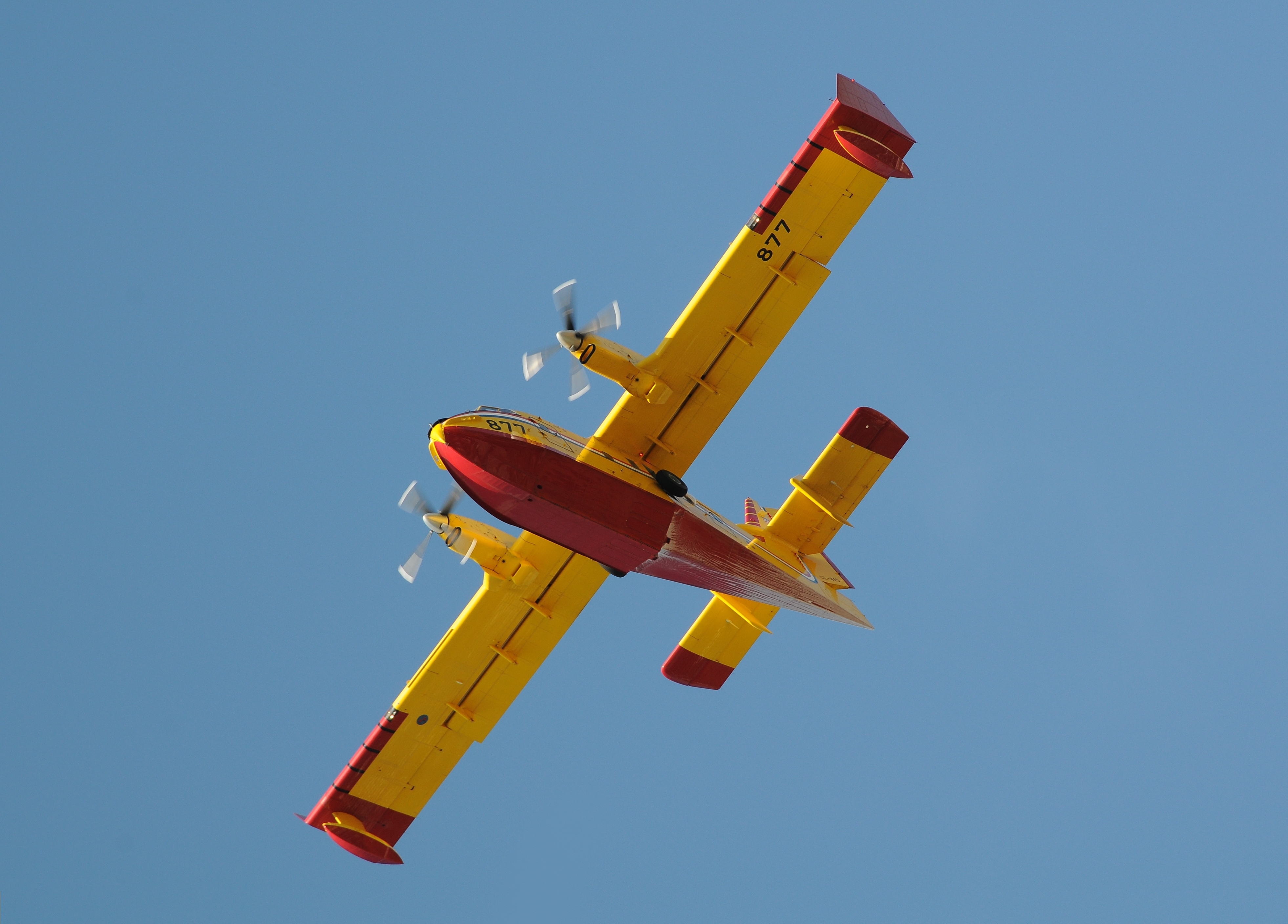
A full load requires about 1,340 m of flyable length: the aircraft descends from 15 m, scoops 6,137 litres during a twelve-second, 410 m run on the water at 70 knots, and climbs back to 15 m. It can also pick up partial loads in smaller areas and turn while scooping. Management of the water-bombing system is centralised on a water status panel in the flight instrumentation, with various dispersal patterns and sequences selectable and a manually operated emergency dump lever. Bombardier claimed the type performs 6.9 water drops for every flight hour.
In a typical mission the aircraft stays airborne for three hours, makes nine drops and refills from a source 10 km from the fire. The Italian source consulted notes that, compared with its predecessor, it has 15 per cent more power, a higher cruising speed and better control. Inheriting its predecessor's nickname, the aircraft is known as the Superscooper. In 2006 it received in Spain the Batefuegos de Oro of the Asociación para la Promoción de Actividades Socioculturales (APAS), whose citation described it as "the most efficient tool for the aerial combat of forest fires".
Users of the basic version
The production version is the one flown in Canada, France, Italy, Spain, Croatia and the United States, among others. France has operated it through the Sécurité civile, with twelve aircraft in service in July 2020 according to the Italian source; Italy received a fleet that in April 2013 passed from the Civil Protection Department to the national fire service; Spain received four CL-415s in 2006 for 43 Grupo of the Ejército del Aire, all in service in August 2020, and Croatia had received six, all in service in March 2019. According to manufacturer data, by January 2009 69 examples of the 415 had been delivered worldwide, including the MP version, with 49 operating in the Mediterranean area alone.
Multimedia
