Airliner · Civil · United States
Boeing 747
- February 9, 1969
- First flight
- 1970
- Introduced
- In service
- Status
- 1,574
- Units built


-1600.webp)


_ER-BAM_(DSC02596)-1600.webp)


_G-UNET_(DSC02215)-1600.webp)
-800.webp)

-800.webp)
_and_%23905_(right)_were_nose-to-nose_on_the_ramp_at_NASA_Dryden_in_this_1995_photo-1600.webp)


The Boeing 747 was history's first wide-body airliner and, for half a century, the very symbol of intercontinental flight. Nicknamed the "Jumbo", its partial double-deck silhouette made it the most recognisable aircraft ever built: ten-abreast economy seating, some 366 passengers in a three-class layout, a pronounced 37.5-degree wing sweep and a Mach 0.85 cruise. It was born in 1966 from a Pan Am order, when Boeing bet the company on an unprecedented leap in scale: an aircraft two and a half times the size of the 707 with a 30 per cent lower cost per unit of passenger-distance. Its two defining features, the nose door and the raised flight deck, came from a military competition Boeing lost, the CX-HLS. Building it required raising the world's largest building by volume at Everett, and the programme went from paper to first flight in barely 28 months, on 9 February 1969. It entered service with Pan Am on 22 January 1970 and cut seat-mile costs so sharply that it turned long-haul aviation into a mass phenomenon: the age of intercontinental tourism begins with it. The family grew from the original 747-100 to the heavier 747-200, the shortened ultra-long-range 747SP, the stretched-upper-deck 747-300, the two-crew 747-400 —the best-selling version, with 694 delivered— and the 747-8, the longest airliner in service. Its swing nose also made it the world's reference freighter and the basis of a family of derivatives with no equivalent: the Dreamlifter that carries 787 sections, NASA's two Shuttle Carrier Aircraft, the presidential VC-25As, the four E-4 airborne command posts and the flying observatory SOFIA. Production ended in 2023 after 1,574 aircraft delivered across a 54-year run, a record unmatched by any other commercial four-engine jet. The economics of long-range twinjets displaced it and the pandemic finished the job; yet its gradual retirement from passenger service has not dimmed its status: few machines have changed the way humanity travels as much.
Related events
Related sheets
Category
Three-view drawing
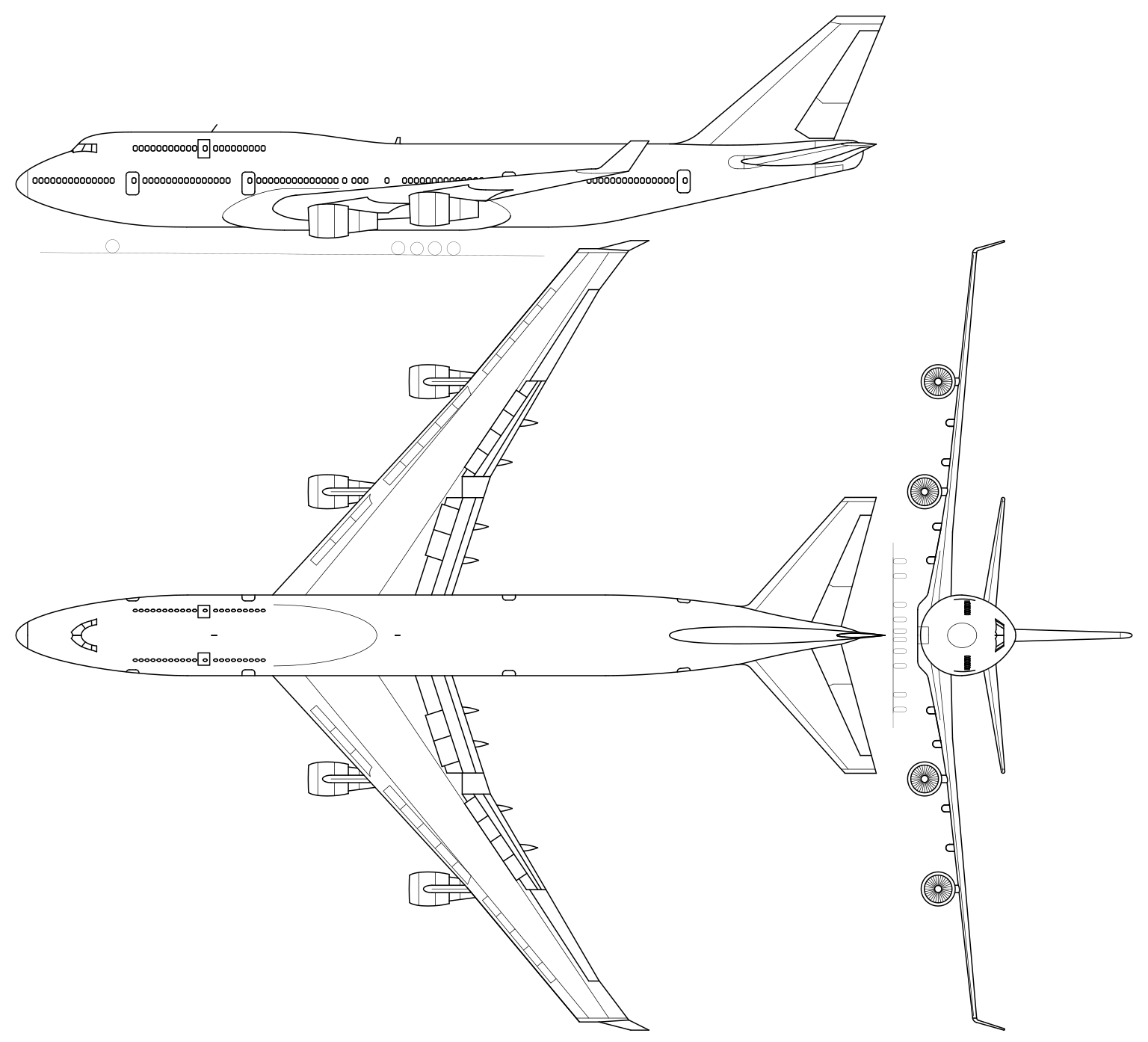
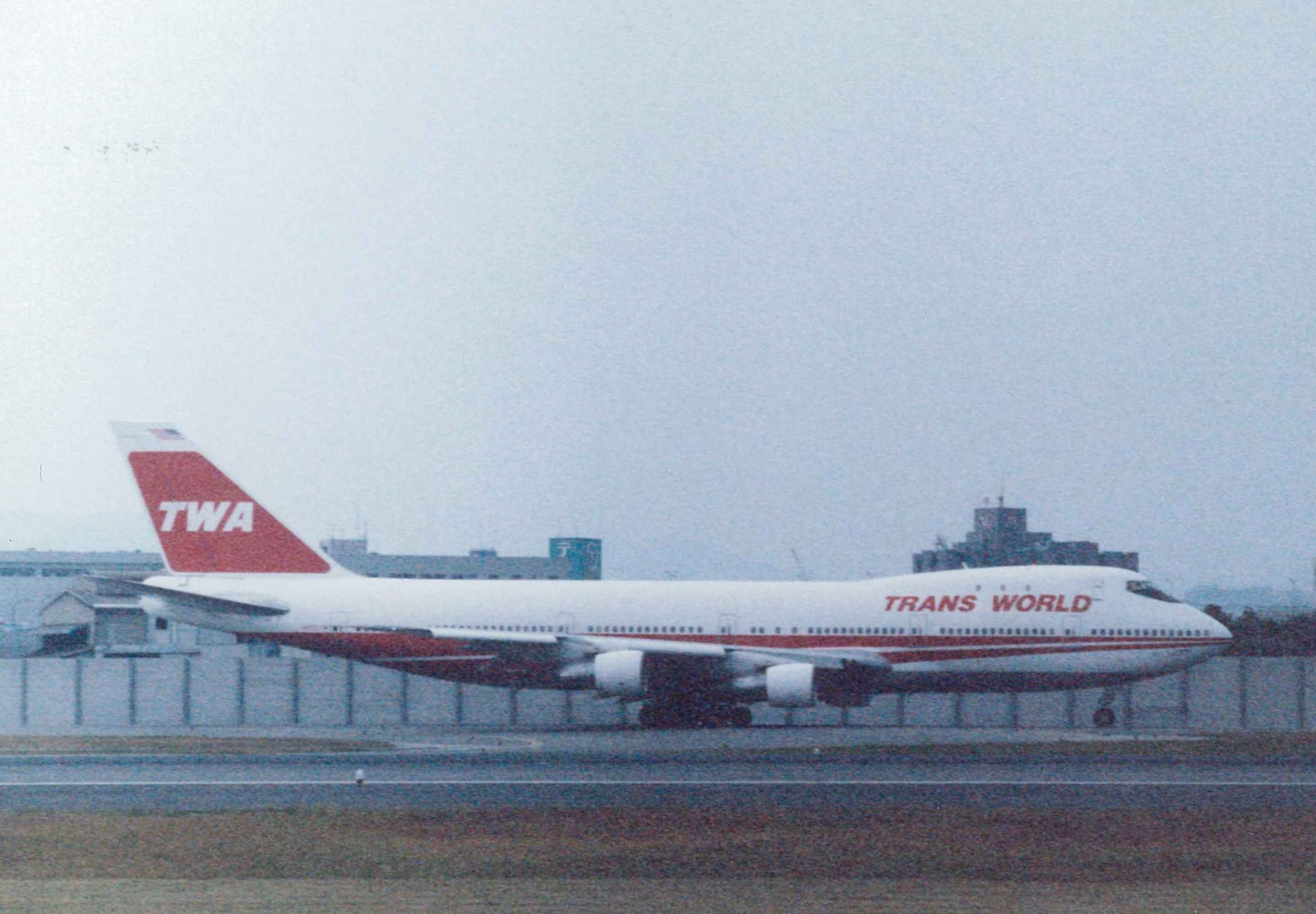
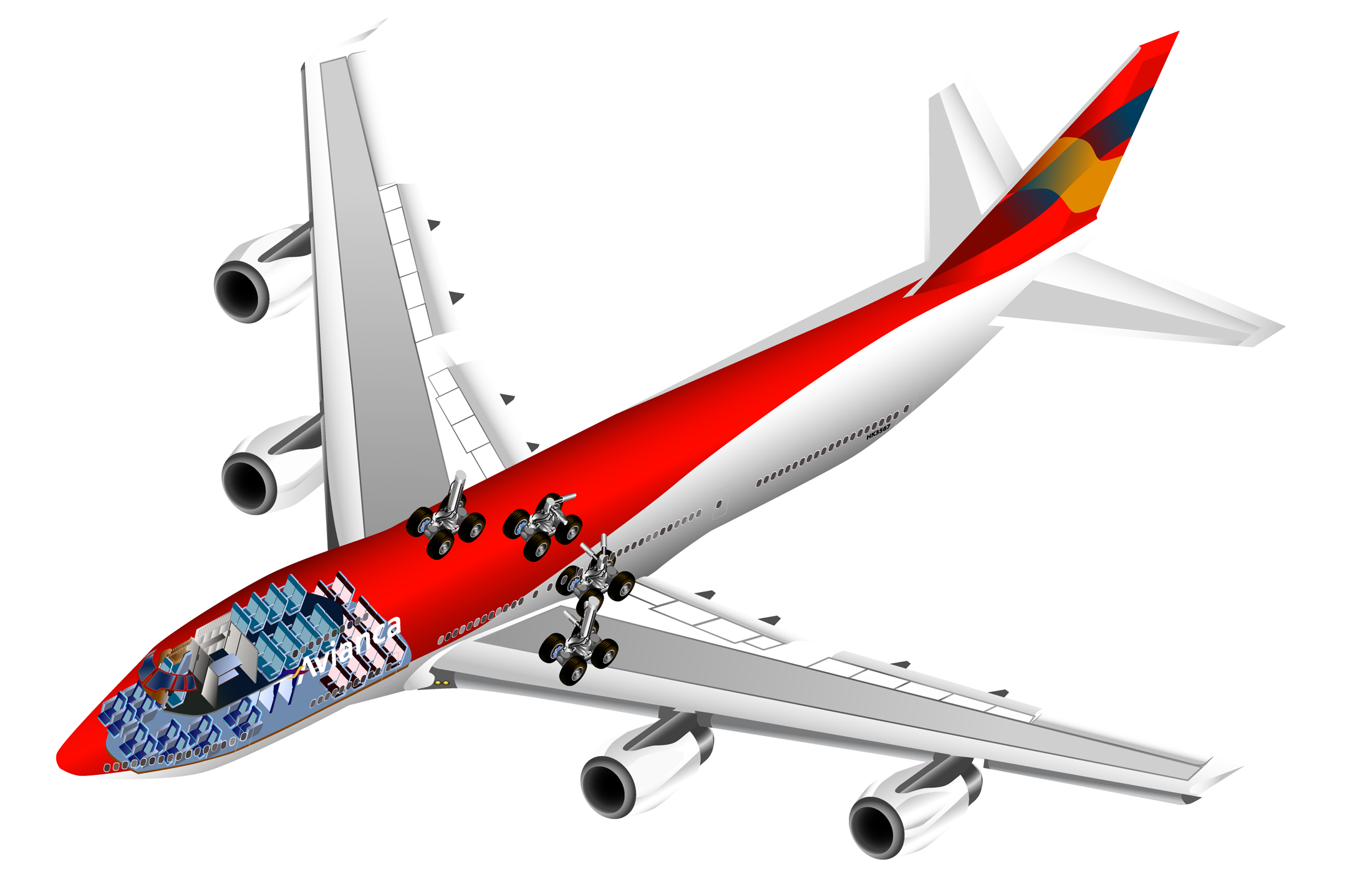
History
The 747 programme was born in 1966 from a Pan Am order and Joe Sutter's leadership. Its first flight, on 9 February 1969, opened the wide-body era and changed the scale of commercial aviation for good.
For five decades the 747 was the long-haul standard in both passenger and freight service. The line closed in January 2023 with a 747-8F, after 1,574 aircraft built over a 54-year production run.
An aircraft that began as a military freighter
The 747 was not conceived as an airliner. Its ancestry lies in a United States military competition: in March 1964 the requirements for the CX-Heavy Logistics System (CX-HLS) called for a load capacity of 180,000 pounds, a speed of Mach 0.75 and an unrefuelled range of 5,000 nautical miles (9,300 km) with a 115,000-pound payload. The cargo bay had to be 17 feet wide, 13.5 feet high and 100 feet long, with access through doors at front and rear.
That front-loading requirement forced a geometric problem: the door had to go where the flight deck normally sits. All three contenders moved the cockpit above the cargo area, each in its own way. Douglas used a small pod just forward of and above the wing; Lockheed ran a long spine the length of the aircraft with the wing spar passing through it; Boeing blended the two ideas into a longer pod running from just behind the nose to just behind the wing.
Boeing did not win the contract, and its high-winged CX-HLS design was never used for the 747, but the technologies developed for that bid influenced the airliner and, above all, two ideas travelled intact from the lost competition to the commercial aircraft: the nose door and the raised cockpit. Without them there would be no hump, and probably no wide-body freighter as we know it.
The shadow of the supersonic
By the mid-1960s the industry took it for granted that long-range subsonic airliners would eventually be superseded by supersonic transports. Boeing answered that forecast with an insurance policy: it designed the 747 so that it could be easily adapted to carry freight and stay in production even if passenger sales collapsed. The partial double deck, with its raised cockpit, exists precisely so that a front cargo door could be fitted and the aircraft turned into a freighter.
The paradox is that the same manufacturer was then building the rival meant to render it obsolete. The Boeing 2707 was a supersonic transport seating 250 to 300 passengers at a cruise of roughly Mach 3, intended to be far larger and faster than Concorde. Rising costs, environmental objections, noise and the absence of a clear market led to its cancellation in 1971, before the two prototypes were completed.
The design team therefore expected demand for passenger 747s to fall early, in the 1970s, and to fall because of the supersonic. The fall did come, but much later and for a different reason: the arrival of ETOPS rules, which let twinjets cross oceans. The wrong forecast nevertheless left the 747 with an unplanned virtue: it was an excellent freighter by design.
Juan Trippe, Pan Am and the 1966 order
The commercial push came from Juan Trippe, president of Pan American Airways and one of Boeing's most important airline customers. Trippe asked for a jet two and a half times the size of the 707 —the aircraft introduced in October 1958— with a 30 per cent lower cost per unit of passenger-distance and the ability to offer mass air travel on international routes. His other argument was congestion: he believed that increasingly saturated airports would be relieved by larger aircraft rather than by more of them.
In April 1966 Pan Am ordered 25 Boeing 747-100s for 525 million dollars of the day. At the ceremonial contract-signing banquet, held in Seattle during Boeing's fiftieth anniversary, Trippe predicted that the 747 would be a weapon for peace, competing with intercontinental missiles for mankind's destiny. As launch customer, and because of its involvement before any formal order was placed, Pan Am shaped the design and development of the aircraft to a degree no single airline has matched before or since.
Joe Sutter and the origin of the hump
In 1965 Boeing pulled Joe Sutter out of the 737 development team to run the design studies for the new airliner, which had already been assigned the model number 747. Sutter opened a joint study with Pan Am and other airlines to understand what they actually needed.
The starting design was a full-length double-deck fuselage, with eight-across seating and two aisles on the lower deck and seven-across seating and two aisles on the upper one. Sutter discarded it. In its place he proposed a single very wide passenger deck, ten seats abreast, and moved the flight deck onto a partial upper level: the solution freed the nose for a cargo door and, incidentally, gave the aircraft the most recognisable profile in aviation history.
Out of that came the aeroplane everyone knows: some 366 passengers in three travel classes, a pronounced 37.5-degree wing sweep allowing a Mach 0.85 cruise of around 900 km/h, and a weight carried on four main landing gear legs, each with a four-wheel bogie.
The Incredibles and the Everett factory
The agreed schedule left 28 months to design the aircraft, barely two-thirds of the normal time. The pace was so brutal that those who worked on the programme became known as "The Incredibles", and the technical and financial magnitude of the project prompted the remark that management had bet the company. Because of the aircraft's size, Boeing subcontracted the assembly of subcomponents: Northrop took fuselage parts, Grumman the trailing-edge flaps, Fairchild the tailplane ailerons and Ling-Temco-Vought other components.
There was no building in the world in which to assemble it. Boeing considered some fifty locations and chose a site about 30 miles (50 km) north of Seattle, adjoining the military base at Paine Field in Everett, Washington. It bought the 780-acre (320 ha) site in June 1966, and more than four million cubic yards —three million cubic metres— of earth had to be moved just to level the ground. Malcolm Stamper, then head of the company's turbine division, was put in charge of building the factory and starting 747 production. The result was the Everett Plant, the largest building in the world by volume.
The price of the bet was enormous. Boeing's debt exceeded two thousand million dollars, of which twelve hundred million was owed to the banks: a record for any company at the time. Allen himself later admitted the project had been too large for them. The gamble nonetheless paid off: Boeing held a monopoly in very large passenger aircraft production for many years.
Rollout, first flight and certification
On 30 September 1968 the first 747 was rolled out of the Everett assembly building before the world's press and representatives of the 26 airlines that had already ordered it. The following months went into preparing the first flight, which took place on 9 February 1969 with test pilots Jack Waddell and Brien Wygle at the controls and Jess Wallick at the flight engineer's station. Apart from a minor problem with one of the flaps, the flight confirmed that the aircraft handled extremely well.
The test campaign used five aircraft, one of which suffered serious damage and delayed the programme. Even so, the 747 was certified in December 1969, little more than three years after the Pan Am order was signed.
The JT9D, the engine that nearly stopped the programme
An aircraft of that size demanded an engine that did not exist. In late 1966 Boeing, Pan Am and Pratt & Whitney agreed to develop the JT9D, a high-bypass turbofan, and the project used a then-new methodology, fault tree analysis, which allowed the effect of a single part's failure to be traced through the other systems.
The difficulties came quickly: the engine suffered stalls caused by rapid throttle movements, and its turbine casings distorted after a short period of service. The problems delayed aircraft deliveries by several months, and up to twenty airframes sat stranded at Everett waiting for engines to be installed. In time the family gained alternatives —the General Electric CF6 and the Rolls-Royce RB211 on the original variants— and the choice of powerplant became one more commercial argument.
January 1970: Pan Am launches the Jumbo
Commercial service opened on 22 January 1970 on the New York–London route, and not without incident. The flight had been planned for the evening of the 21st, but engine overheating on the assigned aircraft, Clipper Young America (registration N735PA), forced a substitute to be found: Clipper Victor (N736PA) departed more than six hours late, the following day.
Once past that start, the introduction was remarkably smooth and dispelled fears that many airports would be unable to accommodate an aircraft that large. The market effect was immediate: the 747 multiplied seat supply and collapsed seat-mile costs, putting intercontinental flight within reach of the middle classes. Within a few years every major flag carrier operated the Jumbo, and its upper deck —with lounges and even piano bars in the early years— became the symbol of 1970s aerial glamour.
The first versions: -100, -100SR and -200
On top of the initial 747-100, Boeing developed the -100B, with a higher maximum take-off weight, and the -100SR (Short Range), intended for short sectors flown at high load factors. The -100SR had a strengthened body structure and landing gear to absorb the stress of a far greater number of take-offs and landings, with extra structural support built into the wings, fuselage and gear, and a 20 per cent reduction in fuel capacity. The initial order —four aircraft for Japan Air Lines— was announced on 30 October 1972; rollout followed on 3 August 1973 and the first flight on the 31st of the same month, with FAA certification and first delivery both on 26 September 1973. A later development, the -100BSR SUD, flew on 26 February 1986 and was certified and delivered on 24 March of that year; JAL operated it with 563 seats on domestic routes until retiring the type in the third quarter of 2006.
The 747-200 arrived in 1971 with uprated engines and a maximum take-off weight of 833,000 pounds (378 t), up from the initial 735,000 pounds (333 t), which raised maximum range from 4,620 to 6,560 nautical miles (8,560 to 12,150 km). Weight trials were conducted between October and November 1970 at Edwards Air Force Base with the 747-200B prototype, which on 12 November reached a take-off weight of 820,700 pounds (372.3 t) in flight, a record for the time until heavier airframes were built. On 1 November 1976 the first RB211-powered 747-200 set a world record for maximum mass lifted at NAS Lemoore, climbing to 6,562 feet (2,000 m) with 840,500 pounds (381.2 t).
The 200 series was built in passenger, freighter (-200F), convertible (-200C) and combi versions. The first -200C rolled out of the Everett factory on 28 February 1973, flew a month later and was delivered to launch customer World Airways on 27 April. Its ability to switch configuration according to the flow of passenger and freight traffic proved a genuine advantage in keeping operations profitable.
The 747SP: less aircraft to fly further
The 747SP (Special Performance) inverted the usual logic of commercial aviation: instead of stretching the fuselage it shortened it to gain range. At 184 feet 9 inches (56.31 m) long, it was 47 feet (14 m) shorter than the original variants. It first flew on 4 July 1975, was approved by the Federal Aviation Administration on 4 February 1976 and entered service that same year with Pan Am, which on 25 April 1976 flew it non-stop from New York to Tokyo.
It is the highest-flying subsonic passenger airliner, with a service ceiling of 45,100 feet (13,700 m), and it was the longest-range airliner available until the 747-400 entered service in 1989. Commercially, however, it failed: 200 units were expected and only 45 were built.
The 747-300 and the stretched upper deck
The next step chased capacity rather than range. The 747-300 was launched on 11 June 1980, with Swissair's interest a month later providing the decisive push. Earlier studies had rejected both inserting fuselage plugs and extending the upper deck along the whole length of the aircraft; the chosen solution stretched that upper deck, which could then seat up to 400 passengers in three classes when the variant entered service in 1983. The version carried several designations before settling down: 747SUD, for stretched upper deck, then 747-200 SUD and 747EUD. Passenger, short-range and combi versions were all produced.
The 747-400: two-crew flying and the commercial peak
Announced at the Farnborough show of September 1984 under the provisional name Advanced Series 300, the 747-400 targeted a 10 per cent cost reduction through more efficient engines and a range increase of 1,000 nautical miles (1,900 km). Northwest Airlines became the launch customer with an order for ten aircraft on 22 October 1985. The first example was rolled out on 26 January 1988, made its maiden flight on 29 April 1988, received type certification on 9 January 1989 and entered service with Northwest a month later, on 9 February 1989.
It retained the 747 airframe, including the -300's stretched upper deck, and added wingtip extensions of 6 feet (1.8 m) topped by winglets of another 6 feet (1.8 m), improving fuel efficiency by four per cent over previous versions. The deeper change, though, was inside: a glass cockpit designed for a crew of two instead of three, which cut the number of dials, gauges and knobs from 971 to 365 through the use of electronics. Development costs soared and production delays followed as airlines asked for new technologies to be incorporated.
The result justified the effort: 416 passengers in three classes, 7,285 nautical miles (13,492 km) of range and a maximum take-off weight of 875,000 pounds (397 t). Some 694 aircraft were delivered between 1989 and 2009 —442 of them passenger models— making it the most-delivered variant of the whole family; its closest competitors were the McDonnell Douglas MD-11 trijet and the Airbus A340 quadjet. There was also a -400M combi, rolled out in June 1989, and a -400D for the Japanese domestic market, without winglets, in service from 22 October 1991. In 1989 Qantas's VH-OJA flew non-stop from London Heathrow to Sydney, 18,001 km (11,185 miles), in 20 hours and 9 minutes, setting a world distance record for a commercial aircraft.
The 747-8, the last stretch
After several studies, Boeing launched the 747-8 on 14 November 2005 —it had initially been called the 747 Advanced— with a designation underlining its technological kinship with the 787 Dreamliner. The market forecast was 300 aircraft. The aeroplane adopted a smaller, more efficient version of the General Electric GEnx turbofan from the 787, recognisable by the chevron edges on its nacelles, and introduced a deeper, thicker wing with greater fuel capacity and larger raked wingtips.
The fuselage was stretched by 18 feet (5.5 m) to a total length of 250 feet (76 m), making it the longest airliner in service, and maximum take-off weight rose to 975,000 pounds (442 t), the heaviest Boeing airliner ever built. The first flight was made by the freighter, the 747-8F, on 8 February 2010; the passenger version, the 747-8I Intercontinental, followed on 20 March 2011. The freighter was delivered in October 2011 to Cargolux and the passenger variant entered commercial service in June 2012 with Lufthansa.
The programme never took off commercially. In February 2009 only one airline, Lufthansa, had ordered the passenger model, and Boeing announced it was reassessing the whole project; Cargolux confirmed at the time that it still intended to take its thirteen freighters. As of June 2021 the 747-8 had accumulated 155 orders, among them 106 for the -8F and 47 for the -8I. The freighter, with 16 per cent more payload capacity than its predecessor —seven more standard air cargo containers and up to 154 short tons (140 t) of cargo— kept the flip-up nose door plus side doors on the main deck and in the belly.
The Jumbo as a freighter
Sutter's bet on the swing nose made the 747 the world's reference intercontinental freighter for decades, and explains why the aircraft survived so long in production once passenger operators had abandoned it. Converting retired passenger airframes into freighters was a predictable business for years, but it no longer is: there is no viable economic model for turning retired passenger 747-400s into dedicated freighters, so most retired passenger aircraft will probably be scrapped. Boeing stopped performing those conversions, which used to cost close to 30 million dollars, and young -400s have been sold for 320 million yuan, around 50 million dollars. Of the 1,574 aircraft produced, 890 were already retired.
Special derivatives
No other commercial airframe has produced so many singular aircraft. The 747 Dreamlifter (Large Cargo Freighter) was created to move 787 sections between Italy, Japan and the United States: three conversions of passenger 747-400s were planned and a fourth was later added, with a bulging fuselage conceptually related to the Super Guppy and the Airbus Beluga. Its cargo volume, 65,000 cubic feet (1,840 m³), is three times that of a 747-400F. It first flew on 9 September 2006 and, by certification in 2007, had logged 437 hours of flight testing and 639 hours of ground testing; three were operational by June 2008 and the fourth in February 2010. The modifications were carried out by Evergreen Aviation Technologies in Taoyuan, Taiwan.
NASA's two Shuttle Carrier Aircraft ferried the Space Shuttle on their backs: N905NA was a 747-100 and N911NA a short-range 747-100SR. In the approach and landing tests of 1977 the test orbiter Enterprise was released from the carrier in flight and glided to a landing under its own control. N911NA entered NASA service in 1990 and was first used in 1991 to ferry the new shuttle Endeavour from Palmdale, California, to the Kennedy Space Center. Both are now retired.
United States presidential transport rests on two heavily modified 747-200Bs designated VC-25A, carrying tail numbers 28000 and 29000; strictly speaking the Air Force One call sign applies only while the president is aboard, though common usage has turned it into the aircraft's name. In February 2018 the White House announced an agreement with Boeing, worth 3.9 billion dollars, to convert two unsold 747-8s into the VC-25Bs that will replace them.
From the same military lineage came the four E-4s, airborne command posts derived from the 747-200B for the NEACP programme and known as Nightwatch: they are operated by the 1st Airborne Command and Control Squadron of the 595th Command and Control Group from Offutt Air Force Base, near Omaha, Nebraska, and in action are designated the National Airborne Operations Center.
The most exotic case was SOFIA, a 747SP converted into a stratospheric observatory. Its telescope saw first light on 26 May 2010 and the programme ended with the landing of the 921st and final science flight in the early hours of 29 September 2022; the aircraft is preserved on display at the Pima Air & Space Museum near Tucson, Arizona. To that list belongs a little-known capability of the airframe itself: a 747 can carry a fifth engine in a pod under the wing to ferry it to a stranded aircraft, although the load increases drag on the left side and obliges the crew to compensate with rudder to hold heading.
Safety and notable accidents
As of November 2023 the 747 had been involved in 173 accidents and incidents, including 65 hull losses —53 of them in flight— causing 3,746 fatalities; as of October 2025 those 65 losses represented 4.1 per cent of the fleet built.
The deadliest aviation accident in history, the Tenerife airport disaster, involved two 747s and was attributed to pilot error and a communications failure. The crashes of Japan Air Lines Flight 123 and China Airlines Flight 611 shared a cause: improper repair following a tail strike. Korean Air Lines Flight 007 was shot down in 1983 by a Soviet Su-15TM interceptor after spending more than twelve minutes inside Soviet airspace. Two bombings caused hull losses and heavy casualties: Air India Flight 182 in 1985 and Pan Am Flight 103 in 1988. TWA Flight 800, a 747-100, exploded in mid-air on 17 July 1996 because of sparking from old, cracked electrical wiring inside the fuel tank, where voltage exceeded the maximum limit and ignited the fuel vapours; the finding led the FAA to adopt a rule in July 2008 requiring inerting systems in the centre fuel tank of most large aircraft.
There were episodes of a different nature too. British Airways Flight 149, a 747-100, was abandoned in Kuwait in 1990 after invading Iraqi forces held its passengers and crew hostage. Pan Am Flight 73, another 747-100, was hijacked by four terrorists and the assault ended with twenty deaths. And not every serious event cost an airframe: on 30 July 1971 Pan Am Flight 845 struck approach lighting structures while taking off from San Francisco for Tokyo, dumped fuel and landed back.
Decline against the twinjets and the end of the line
What finished the 747 was not the supersonic that Sutter's team feared but the arithmetic of twin engines. ETOPS rules let two-engined aircraft cross oceans at lower operating cost, and the four-engined jet lost its rationale on most routes. Airbus contested the segment with the heaviest versions of the A340 and surpassed the 747 in size with the A380, delivered between 2007 and 2021, but the decisive competition was internal: the larger versions of the Boeing 777, such as the 777-300ER and the 777-9, ultimately superseded the last Jumbo variants.
On 29 July 2020 Boeing confirmed that the final 747 would be delivered in 2022, attributing the decision to market dynamics stemming from the COVID-19 pandemic in the words of chief executive David Calhoun. The last aircraft, a 747-8F destined for Atlas Air and registered N863GT, rolled off the production line on 6 December 2022 and was delivered on 31 January 2023, closing 54 years of production with 1,574 aircraft built.
Assessment
Few machines have altered a way of travelling so profoundly. The 747 was not merely the first wide-body: it was the aircraft that made intercontinental flight ordinary, and it did so with a formula —enormous capacity, low seat cost— that no other company could replicate for years, while Boeing kept its monopoly on very large passenger aircraft.
Joe Sutter himself, who admitted to the habit of watching 747s at airports from the mid-1980s onwards, once measured the scale of what he had designed: assuming each aircraft was at most 75 per cent full, the 55 Jumbos arriving at Narita Airport within a two-hour period would have carried as many as 20,000 people. That figure, more than any weight or distance record, explains why for half a century to say "Jumbo" was simply to say aeroplane.
Variants
| 747-100 | 747-200B | 747SP | 747-300 | 747-400 | 747-8 | |
|---|---|---|---|---|---|---|
| First flight | February 9, 1969 | October 11, 1970 | July 4, 1975 | October 5, 1982 | April 29, 1988 | February 8, 2010 |
| Aircraft type | Four-engine wide-body airliner, first production version | Four-engine long-range wide-body airliner | Four-engine wide-body airliner, shortened ultra-long-range version | Four-engine wide-body airliner with stretched upper deck | Four-engine long-range wide-body airliner | Four-engine wide-body airliner, final version of the family |
| Powerplant | 4 × Pratt & Whitney JT9D-7A turbofans of 205 kN each; the FAA type certificate also approves the JT9D-3, -3A, -7, -7F and -7J. | 4 × Pratt & Whitney JT9D-7R4G2 turbofans of 243.5 kN each; the variant was also certified with General Electric CF6-50E and CF6-80C2B1 and with Rolls-Royce RB211-524 engines. | 4 × Pratt & Whitney JT9D-7J turbofans of 216 kN each; the type certificate equally approves Rolls-Royce RB211-524 engines. | 4 × General Electric CF6-80C2B1 turbofans of 249 kN each; the variant was equally certified with Pratt & Whitney JT9D-7R4G2 and Rolls-Royce RB211-524 engines. | 4 × Pratt & Whitney PW4062 high-bypass turbofans of 282 kN each; the variant was also certified with General Electric CF6-80C2B1F and CF6-80C2B5F and with Rolls-Royce RB211-524G and RB211-524H engines. | 4 × General Electric GEnx-2B67 turbofans of about 300 kN each, derived from the GEnx designed for the 787; they come with raked wingtips in place of the 747-400 winglets. |
| Powerplant | 4 × Pratt & Whitney JT9D-7A | 4 × Pratt & Whitney JT9D-7R4G2 | 4 × Pratt & Whitney JT9D-7J | 4 × General Electric CF6-80C2B1 | 4 × Pratt & Whitney PW4062 | 4 × General Electric GEnx-2B67 |
| Thrust per engine | 205 kN | 244 kN | 216 kN | 249 kN | 282 kN | 300 kN Best value in this row |
| Length | 70.7 m | 70.6 m | 55.9 m | — | 70.7 m | 75.2 m Best value in this row |
| Wingspan | 59.6 m | 59.6 m | 59.6 m | — | 64.4 m | 68.4 m Best value in this row |
| Height | 19.3 m | 19.6 m | 20.1 m Best value in this row | — | 19.4 m | 19.5 m |
| Wing area | — | — | — | — | 525 m² | 554 m² Best value in this row |
| Empty weight | 162,400 kg | 170,142 kg | 152,906 kg Best value in this row | — | 178,755 kg | 220,128 kg |
| MTOW | 333,390 kg | 377,842 kg | 317,515 kg | 377,842 kg | 396,890 kg | 447,696 kg Best value in this row |
| Top speed | 967 km/h | — | — | — | 982 km/h Best value in this row | 956 km/h |
| Max speed altitude | — | — | — | — | 10,668 m | 13,137 m |
| Cruise speed | 895 km/h | — | — | — | 907 km/h | 908 km/h Best value in this row |
| Cruise altitude | — | — | — | — | 10,668 m | 13,137 m |
| Service ceiling | 13,716 m | 13,750 m Best value in this row | 13,750 m Best value in this row | 13,750 m Best value in this row | 13,746 m | 13,137 m |
| Initial climb rate | — | — | — | — | 7.6 m/s | — |
| Range | 9,800 km | 12,149 km | 10,797 km | 11,723 km | 13,490 km | 14,316 km Best value in this row |
| Combat radius | — | — | — | — | 0 km | — |
| Range conditions | With a full passenger load and its baggage the practical reach was around 4,620 nautical miles, tight for the longest transoceanic sectors; that limit is what brought about the 747-200B. | More powerful engines and a higher maximum takeoff weight pushed the reach to some 6,560 nautical miles, close to half again the 747-100 figure. | A shorter, lighter fuselage carrying the standard 747 fuel load lifted the reach to some 5,830 nautical miles, making it the longest-legged airliner of its day. | With 400 passengers and their baggage the reach settles at some 6,330 nautical miles, a little short of the 747-200B because of the added upper-deck weight. | About 13,490 km in the typical three-class layout; the tank housed in the horizontal stabiliser and the auxiliary cargo-bay tanks are what give this variant its reach. | Some 7,730 nautical miles with 467 passengers in three classes; the 747-8 cruises slightly faster than the 747-400 thanks to the new wing and the GEnx engines. |
| Armament | None: civil passenger transport aircraft. | None: civil passenger transport aircraft. | None: civil passenger transport aircraft. | None: civil passenger transport aircraft. | None: the 747-400 is a civil passenger and cargo transport. | None: civil passenger transport aircraft. |
| Max weapons load | 0 kg Best value in this row | 0 kg Best value in this row | 0 kg Best value in this row | 0 kg Best value in this row | 0 kg Best value in this row | 0 kg Best value in this row |
| Payload | — | — | 37,970 kg | — | 67,318 kg | 76,067 kg Best value in this row |
| Cargo capacity | Freight rides in the lower holds, in containers and as bulk, alongside the baggage of the 366 passengers of the typical three-class layout. | Lower holds for containers, pallets and bulk cargo on top of the baggage of the 366 passengers of the typical layout. | Up to 37,970 kg of total payload, with lower holds cut back in proportion to the shortened fuselage. | Same lower holds as the 747-200B; the stretched upper deck went to passenger seats, not to freight. | Up to 67,318 kg of structural payload. The lower holds take about 172.3 m³ in containers, pallets and bulk cargo, on top of the baggage of the 416 passengers of the typical three-class layout. | Up to 76,067 kg of structural payload on the passenger version, with lower holds for containers and bulk cargo. |
| Crew | 3 | 3 | 3 | 3 | 2 Best value in this row | 2 Best value in this row |
| Passengers | 366 | 366 | 331 | 400 | 416 | 467 Best value in this row |
| Units built | 167 | 393 | 45 | 81 | 694 Best value in this row | 155 |
Images
Elsewhere
- Museum of FlightBoeing 747-121 RA001 "City of Everett", el primer 747 construido ↗
- Pima Air & Space MuseumBoeing 747SP SOFIA, el observatorio volador retirado de la NASA ↗
- Technik Museum SpeyerBoeing 747-230 de Lufthansa "Schleswig-Holstein", exposición visitable ↗
- AviodromeBoeing 747-206B PH-BUK de KLM en la colección de Aviodrome ↗
- NASAShuttle Carrier Aircraft: el 747 modificado para transportar el transbordador espacial ↗
- NASA (Flickr Commons)Shuttle Carrier Aircraft con el transbordador espacial Atlantis ↗
- Boeing Media RoomEl último Boeing 747 sale de la fábrica de Everett (diciembre de 2022) ↗
- Boeing ImagesBoeing 747-8F con el morro de carga abierto ↗
- Boeing ImagesBoeing Dreamlifter (747-400 LCF), vista de la bodega de carga ↗
- DVIDSE-4B Nightwatch, el puesto de mando aéreo nacional (NAOC) ↗
- DVIDSBoeing VC-25A, el avión presidencial "Air Force One" ↗
- Pan Am Historical FoundationEl salón de la joroba del 747 de Pan Am, diseño de la era Global ↗