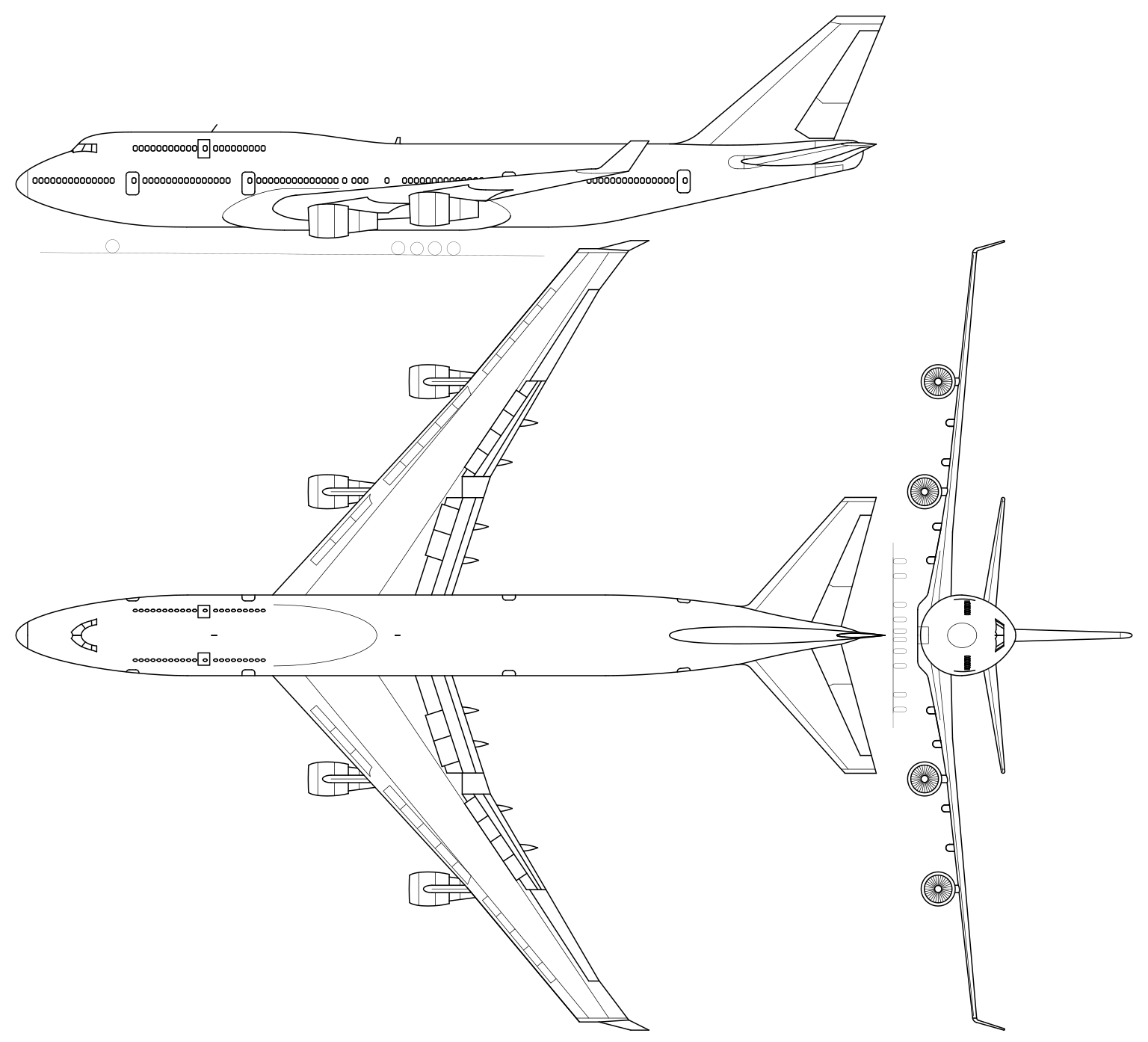
Boeing 747 variant
Boeing 747-400
The 747-400 is the best-selling version of the Jumbo, with 694 delivered between 1989 and 2009. It kept the 747-300's stretched upper deck and added longer wings with winglets, more efficient engines and a two-crew glass cockpit that did away with the flight engineer. It was offered in passenger, Combi, Domestic, freighter and extended-range versions and underpinned the Dreamlifter and the YAL-1 airborne laser.

- April 29, 1988
- First flight
- 694
- Units built
- 13,490 km
- Range
- 416
- Passengers
History
Origin and development
In the early 1980s the 747 was still a success, but it was ageing. Boeing had announced the 747-300 in 1980, making the stretched upper deck (almost twice the length of the original) a standard feature, but without adding range or modernising the flight deck or materials. In 1982 the company introduced a two-crew glass cockpit, new engines and advanced materials on its 757 and 767 twinjets; that same year combined sales of the 747 "Classics" (-100, -200, -300 and SP) passed 700, yet new orders slowed precipitously. Conventional flight controls, three-person crews and fuel costs made the aircraft expensive to operate, and the 747-300 did little to stem the decline.
By early 1984 Boeing had set five objectives for the next upgrade: new technologies, an enhanced interior, a 1,000-nautical-mile (1,900 km) range increase, more efficient engines and a 10 percent reduction in operating cost. The project was announced as the "Advanced Series 300" at the September 1984 Farnborough Airshow and officially launched on October 22, 1985, when Northwest Airlines ordered ten aircraft. Cathay Pacific, KLM, Lufthansa, Singapore Airlines and British Airways announced orders within months, followed by United, Air France, Malaysia Airlines and Japan Airlines. Seven early customers (British Airways, Cathay Pacific, KLM, Lufthansa, Northwest, Qantas and Singapore Airlines) formed a consultative group that pushed Boeing further than it intended: the manufacturer had proposed minimal changes to contain cost and retain commonality, but the airlines demanded a two-crew glass cockpit, and that is what they got.
Final assembly of the first 747-400 began at Everett in September 1987, with more than half the aircraft produced by subcontractors (Northrop supplied major structures, nacelles and sub-assemblies; Daewoo the upper-deck fuselage frames). The first aircraft, with PW4056 engines, rolled out on January 26, 1988, the same day Renton rolled out the first 737-400: the first double rollout in Boeing's history. By then the programme had more than 100 orders. The maiden flight on April 29, 1988, with James Loesch and Kenneth Higgins at the controls, came six weeks late owing to subcontractor delays and troubleshooting of the electronics; it took off from Paine Field and landed at Boeing Field after an uneventful 2 hours and 26 minutes. FAA certification followed on January 9, 1989 with PW4000 engines, May 18 with the CF6-80C2 and June 8 with the RB211-524G.
Differences from the 747-300
The 747-400 retains the 747 airframe, including the -300's stretched upper deck, but the wingspan grew by 17 feet (5.2 m) through wingtip extensions capped by 6-foot (1.8 m) winglets, which give a 3 percent gain in long-range cruise, better take-off performance and higher cruise altitudes. Despite the extra length the wings are 6,000 pounds (2,700 kg) lighter thanks to new aluminium alloys. The horizontal tail was redesigned to hold a 3,300-US-gallon (12,000 L) fuel tank adding 350 nautical miles of range, and rudder travel was increased to 30 degrees. The landing gear gained larger wheels and carbon brakes, saving 1,800 pounds (820 kg).
The engines offered were the Pratt & Whitney PW4056, General Electric CF6-80C2B1F and Rolls-Royce RB211-524G/H, with FADEC control, lower fuel burn and more thrust, plus a new Pratt & Whitney Canada APU using 40 percent less fuel. The glass cockpit, with CRT displays first used on the 757 and 767 and an EICAS system, removed the flight engineer's station and cut switches, lights and gauges by two-thirds compared with the Classic; a Honeywell flight management computer and a Rockwell-Collins central maintenance computer completed the package. In the cabin the ACESS entertainment system debuted, with 18-channel audio, and an eight-bunk crew rest was installed above the aft cabin. In a typical three-class layout the aircraft carries 416 passengers over 7,285 nautical miles (13,492 km) at an 875,000-pound (397 t) maximum take-off weight.
Production and versions
The first 747-400 (N661US) went to Northwest and the type entered service on February 9, 1989; on May 31 Singapore Airlines flew the first international service, from Singapore to London. Entry into Europe was not smooth: in May 1989, a week before the first delivery to KLM, the Joint Aviation Authorities refused certification over the upper-deck floor's resistance to collapse in a sudden decompression, and only a last-minute deal (a temporary certificate in exchange for a structural retrofit within two years) let KLM and Lufthansa take their aircraft. Early production also slipped by up to a month on the first 20 aircraft because of the unprecedented complexity of interior configurations, resolved by mid-1989.
Then came the versions. The 747-400M Combi, with a rear cargo door and a partitioned hold, first flew on June 30, 1989 and entered service with KLM on September 12 that year; 61 were sold, the last delivered to KLM on April 10, 2002. The 747-400D Domestic, a high-density model for Japan's internal market without winglets or wingtip extensions and seating up to 568 in two classes or 660 in one, first flew on March 18, 1991 and entered service with Japan Airlines on October 22, 1991; 19 were built, the last for All Nippon Airways on February 11, 1996. The 747-400F freighter, with the Classic's short upper deck, a nose door and a mechanised cargo system, was first delivered to Cargolux in May 1993; Boeing delivered 126, the last to Nippon Cargo Airlines on August 2, 2008. The 747-400ER, launched on November 28, 2000 with a Qantas order for six and known as the "910k" for its 910,000-pound (410 t) maximum take-off weight, introduced Marshall Aerospace body fuel tanks, the Signature Interior and LCD displays; Qantas, the only customer for the passenger version, took the first (VH-OEF) on October 31, 2002 to fly Melbourne–Los Angeles with full loads. The 747-400ERF, launched on April 30, 2001, was first delivered to Air France on October 17, 2002; 40 were built.
The passenger version, with 442 built, formed the bulk of production and officially ceased on March 15, 2007; the last passenger aircraft was the 1358th 747 (B-18215), delivered to China Airlines in April 2005. The very last 747-400, a -400ERF for Kalitta Air, was delivered on December 22, 2009. In all, 694 were delivered over 20 years, making it the most-delivered 747 variant. Conversions added to that: approximately 79 passenger aircraft became freighters, 50 through Boeing's 747-400BCF programme (the first entered service with Cathay Pacific Cargo on December 20, 2005) and 29 through Israel Aerospace Industries' 747-400BDSF, until demand dried up in the early 2010s.
Operational service
The 747-400 set records from the start. On June 27, 1988, during testing, the first aircraft took off at 892,450 pounds (404,810 kg) to simulate heavy-weight stalls, the heaviest airliner take-off to that date. In 1989 Qantas's VH-OJA flew non-stop from London to Sydney, 18,001 km in 20 hours and 9 minutes, on a delivery flight that remains the longest by a commercial aircraft. In the 2000s several operators tested alternative fuels: Air New Zealand made the first commercial flight on jatropha-derived fuel in 2008 and Continental tested it on January 7, 2009.
Decline came with long-range twinjets (777, 787 and A350) and the shift from hub-and-spoke to point-to-point flying; the 2008 financial crisis also sank resale values. United announced on January 11, 2017 that it would phase out its fleet and flew its last 747 on November 7 that year; Delta, the last US airline to operate the type, retired the aircraft inherited from Northwest in December 2017. The COVID-19 pandemic hastened the rest: KLM withdrew its -400s and Combis in March 2020 (though it reactivated three Combis a week later for cargo-only flights to Asia), Virgin Atlantic in May 2020, British Airways its 31 aircraft four years ahead of the planned February 2024 deadline, Qantas by the end of 2020 and China Airlines in February 2021. By September 2021 just 42 passenger aircraft remained across ten carriers. Air India retired its last four on April 29, 2022 and, after Asiana's announcement in March 2024, Air China was left as the last scheduled passenger operator in Asia.
The deadliest accident occurred on October 31, 2000, when Singapore Airlines Flight 006 struck construction equipment while attempting to take off from a closed runway at Taipei, killing 83 of the 179 people on board.
Legacy and survivors
Beyond airline service, the airframe underpinned some singular projects: the Dreamlifter, a conversion of four used 747-400s into an outsize freighter for 787 sections (the fourth flew in January 2010); the USAF's YAL-1 airborne laser on a 747-400F, retired in 2012; and the Global SuperTanker firefighting aircraft, certified on September 12, 2016 with a 19,600-US-gallon capacity. The C-33, a proposed military version of the 747-400F, was dropped in favour of more C-17s.
Several examples are preserved. Qantas's VH-OJA "City of Canberra" is displayed at the Historical Aircraft Restoration Society museum at Shellharbour, Australia; N661US, the first 747-400 built, is at the Delta Flight Museum in Atlanta; a former KLM aircraft (PH-BFB) was hauled 12.5 km across fields and roads in February 2019 to the Corendon Village Hotel at Badhoevedorp; and of British Airways' three heritage-liveried 747-400s, G-BNLY (Landor livery) and G-CIVW are kept at Dunsfold and G-CIVB (Negus livery) at Cotswold Airport, while G-BYGC (BOAC livery), preserved at St Athan from December 11, 2020, was dismantled in 2023.
Three-view drawing