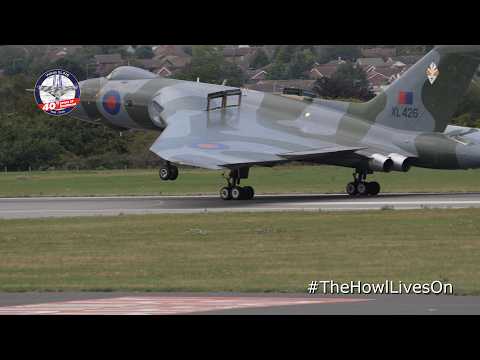
Avro Vulcan variant
Avro Vulcan B.2
The Vulcan B.2 was the second major version of Avro's delta bomber and the one that defined the type's career: a larger, thinner wing, elevon controls, second-generation Olympus engines, an alternating-current electrical system and a substantial electronic warfare fit housed in a bulged tail cone. Eighty-nine were built at Woodford. It was conceived to carry the Blue Steel stand-off missile and then Skybolt, and was later adapted to low-level penetration. It was the version that bombed Stanley airfield in 1982 and the basis for the maritime reconnaissance and tanker conversions. XH558, the first B.2 delivered to the RAF, was also the last Vulcan to fly.
- August 31, 1957
- First flight
- 89
- Units built
- 7,400 km
- Range
History
A new engine that needed a new wing
Bristol had begun work in 1952 on the BOl.6, later named Olympus 200, rated at about 16,000 lbf (71 kN). Simply fitting it to the B.1 would have brought back the wing buffet that had been so hard to cure, so the extra power meant redesigning the wing once more. That is the root of the B.2: not a detail improvement but an aircraft with a new wing, engines, electrics and electronic defences. When the decision was taken, the first B.2 was expected to be roughly the 45th of the 99 aircraft then on order. The 1957 Defence White Paper, which cut many British projects to concentrate on the nuclear deterrent, made the upgrade a priority.
Five trials aircraft
Development was spread across several airframes. The second prototype, VX777, was rebuilt with the larger, thinner phase 2C wing, improved control surfaces and Olympus 102 engines of 12,000 lbf (53 kN), flying in that form in August 1957. Four B.1s served as test beds: XA891 for the BOl.6 engine, XA893 for the new AC electrical system, XA895 for the countermeasures, with jammers in a bulged tail cone and a tail warning radar, and XA903 for Blue Steel work.
From XH533 to the production line
The first B.2, XH533, was the 46th production aircraft and flew in September 1958 with Olympus 200 engines. The second, XH534, flew in January 1959 and was the first truly representative of the production standard, with Olympus 201s of 17,000 lbf (76 kN), a refuelling probe and the ECM tail cone. Some later aircraft left the factory without probe or tail cone and had them retrofitted. The first ten kept the B.1's narrow intakes; from the eleventh, XH557, they were deepened in anticipation of still more powerful engines. Many early examples were retained for trials, and the twelfth, XH558, was the first delivered to the RAF, in July 1960. Production ended at Woodford with 89 aircraft, the last delivered in January 1965.
Wing, controls and cockpit
The phase 2C wing increased the span from 30.17 to 33.83 m and the area from 330.1 to 368.3 m². The B.1's four elevators and four ailerons gave way to eight elevons, and the aircraft kept six electrically operated three-position airbrakes. In the cockpit the pilots moved to Martin-Baker 3KS ejection seats, and a seventh seat was added opposite the sixth, ahead of the air electronics officer. The flight instruments were integrated into the Smiths Military Flight System, with two beam compasses, two director-horizons and a Mk.10A or Mk.10B autopilot. The bomb bay could take one or two extra fuel tanks.
Alternating current and emergency power
The B.1 relied on a 112 V DC main system, and its standby batteries, meant to give twenty minutes of flight, proved inadequate: XA891 and XA908 were lost as a result. Because the powered flying control units were electro-hydraulic with no manual reversion, a total electrical failure meant loss of control. The B.2 switched to a three-phase 200 V, 400 Hz system fed by four 40 kVA constant-speed alternators, with engines started by air from a ground Palouste compressor. For emergencies it carried a 17 kVA ram air turbine in the port wing, usable from high altitude down to about 20,000 ft (6,100 m), and a 40 kVA Rover gas turbine auxiliary power plant in the starboard wing, which could be started below 30,000 ft (9,100 m).
Navigation and electronic warfare
The initial radio fit resembled the B.1A's and eventually included an ARC-52, a PTR-175 transceiver and a Collins 618T single-sideband HF set. TACAN replaced GEE in 1964 and Decca Doppler 72 replaced Green Satin around 1969. The B.2s also received the HRS Mk.2 gyroscopic heading reference, derived from the Blue Steel inertial platform, which let the navigator trim the heading through the autopilot in tenths of a degree. From 1966 they carried the General Dynamics ARI 5959 terrain-following radar.
The original countermeasures suite comprised a Green Palm communications jammer, two Blue Divers, three Red Shrimps, a Blue Saga warning receiver, the Red Steer tail radar and chaff dispensers, nearly all in the tail cone, with a flat aerial plate between the starboard jet pipes. Later came an L-band jammer, the ARI 18146 X-band jammer, Red Steer Mk.2, infrared flares and the ARI 18228 warning receiver, whose aerials gave the fin its squared-off top.
Olympus 201, 202 and 301
Production B.2s flew with either Olympus 201s or Olympus 301s of 20,000 lbf (89 kN), distributed through the production run. The 201 became the 202 when fitted with a rapid air starter. XH557 and XJ784 were re-engined with the 301 for trials, and seven more aircraft were converted around 1963. The same engine later became the basis of the reheated Olympus for the TSR-2 and Concorde.
Blue Steel and Skybolt
XL317, the 26th B.2 and the first of a batch ordered in February 1956, was the first non-development Vulcan able to carry Blue Steel, and 33 aircraft were delivered in that form. The missile rode semi-recessed in the bomb bay and had an inertial navigator more advanced than the aircraft's own, so much so that crews could use it to plot their flight. Vulcans and Victors flew the trial rounds to the Woomera range in Australia in Operation Blue Ranger from 1960, and the weapon entered service in February 1963 with three B.2 squadrons.
When Blue Steel Mk.2 was abandoned in December 1959 in favour of the American Skybolt, two missiles per aircraft were planned, one under each wing, and the last 28 B.2s were modified on the line to take the pylons. The cancellation in November 1962 left many aircraft with Skybolt blisters that would serve an unexpected purpose twenty years later. Avro also demonstrated a bomb rack for 30 bombs of 1,000 lb instead of 21, which was not adopted.
Down low
By around 1966 Soviet defences forced a switch from high-level to low-level penetration. The B.2 received wing strengthening to preserve fatigue life, camouflage in place of anti-flash white and, in time, a common weapon, the WE.177; the remaining Blue Steels were adapted for release after a pop-up manoeuvre to about 300 m. From 1970, withdrawn from the strategic deterrent, it supported NATO forces in Europe. Nine B.2s were converted for maritime radar reconnaissance and six into tankers.
Black Buck, inside the aircraft
For the Falklands only aircraft with Olympus 301s were considered. Six were chosen, two from each Waddington squadron, and one was not used. The in-flight refuelling system, blocked off for years, had to be reinstated by replacing 4-inch non-return valves, twenty of which turned up on a shelf at RAF Stafford. Carousel inertial navigation was installed and, on the attachment points meant for Skybolt, improvised pylons carried AN/ALQ-101 countermeasures pods taken from Honington's Buccaneers. With bombs, fuel, a sixth crew member and fresh paint the aircraft exceeded their 204,000 lb maximum take-off weight, and in the heat of Ascension the Olympus engines had to run at 103 per cent of rated power. XM607 flew the first mission; for the anti-radar sorties AGM-45 Shrike missiles hung under the wings. XM597, diverted to Rio de Janeiro, dumped secret papers and its two remaining Shrikes, one of which failed to leave, and landed escorted by Brazilian F-5s with very little fuel.
XH558, first and last
XH558 first flew at Woodford on 25 May 1960 and on 1 July joined No. 230 Operational Conversion Unit at Waddington, which soon moved to Finningley. In 1968 it returned to the Waddington Wing; in August 1973 it was converted for maritime reconnaissance with No. 27 Squadron, and on 6 November 1975, taking off from Scampton, a seagull wrecked its No. 3 engine and blew a large hole through the starboard wing. The repairs grounded it for years, which is why the first B.2 to enter RAF service had flown fewer hours than almost all its stablemates. In 1982 it was one of the six tanker conversions and on 12 October rejoined No. 50 Squadron. Selected for the Vulcan Display Flight, it was returned to B.2 configuration in 1985 and made its debut at Bournemouth that May. In civilian hands it flew as G-VLCN, with an exemption allowing it to keep its RAF markings. Another B.2, XL318, is displayed in Hangar 5 at the RAF Museum in London.