Avião comercial · Civil · Reino Unido
BAe 146
- 3 de setembro de 1981
- Primeiro voo
- 1983
- Entrada ao serviço
- Em serviço
- Estado
- 387–394
- Unidades construídas

-1600.webp)


-1600.webp)

_Thai_Airways_Bangkok_1990-10-14_5955-1600.webp)


-1600.webp)
-1600.webp)
-1600.webp)

-1600.webp)
-1600.webp)
-1600.webp)
-1600.webp)


-1600.webp)
-1600.webp)
O BAe 146 é um jato regional britânico de quatro motores e asa alta que voou pela primeira vez a 3 de setembro de 1981 e entrou ao serviço com a Dan-Air em 1983. Em conjunto com a sua versão modernizada Avro RJ soma 394 unidades construídas e é o programa de avião comercial a reação mais bem-sucedido do Reino Unido.
Eventos relacionados
Fichas relacionadas
Categoria
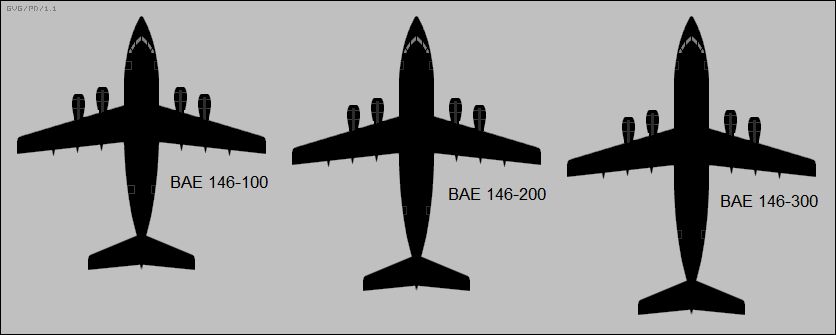
Desenho de três vistas
História
A origem do 146 está em agosto de 1973, quando a Hawker Siddeley lançou o projeto HS.146: um avião de linha de setenta lugares pensado para ocupar o vazio entre os turbo-hélices da época — o próprio HS.748, o Fokker F27 — e os jatos pequenos como o BAC One-Eleven ou o Boeing 737. A configuração escolhida, asa alta e cauda em T, procurava desempenho de campo curto, e o sistema propulsor eram quatro turbofans Avco Lycoming ALF 502H de 6.500 libras de impulso. O Governo britânico aceitou financiar metade do desenvolvimento em troca de uma participação nas receitas de cada avião vendido, mas em outubro de 1974, com a recessão desencadeada pela crise do petróleo, todo o trabalho parou. O projeto sobreviveu em lume brando até que, em 1978, a British Aerospace, sucessora da Hawker Siddeley, o relançou.
A decisão de montar quatro motores num avião tão pequeno foi polémica desde o início, e foi o motor que a impôs: o ALF 502, robusto, silencioso e de baixo consumo, não dava por si só a potência e o alcance que o conceito pedia. A British Aerospace transformou o inconveniente em argumento comercial, ao apresentar um «desempenho excecional com três motores» que interessava aos operadores de zonas montanhosas e de aeródromos quentes, elevados ou de piso deficiente. O resto do desenho foi concebido com uma simplicidade deliberada: asa alta de superfície superior contínua, sem dispositivos de bordo de ataque, cauda fixa e nenhum inversor de impulso — em vez disso, um grande aerofreio de duas valvas sob o leme, utilizável em voo, e spoilers de toda a envergadura que se abrem ao tocar o solo. Foi o segundo avião, depois do Concorde, a usar travões de carbono.
O primeiro aparelho descolou de Hatfield a 3 de setembro de 1981, seguido logo por outros dois protótipos, com resultados de descolagem e de subida melhores do que o previsto. O 146-200 custava então onze milhões de libras e o programa tinha consumido 350; a British Aerospace calculou em 1982 que precisava de vender 250 aviões para o amortizar. O certificado de aeronavegabilidade chegou a 8 de fevereiro de 1983 e em maio a Dan-Air voou o primeiro serviço comercial entre Londres-Gatwick e Berna. A imprensa saudou-o como o jato de linha mais silencioso do mundo e o fabricante vendeu-o como «Whisperjet».
Esse silêncio, aliado à capacidade de operar a partir de pistas curtas, abriu-lhe aeroportos que nenhum outro jato podia usar. Em 1985 a Aspen Airways inaugurou com um 146-100 o primeiro serviço regular a jato para Aspen, nas Rochosas, a partir de um aeródromo a 7.820 pés de altitude, e em janeiro de 1987 o tipo foi escolhido para estrear os voos a jato a partir de London City, com a sua aproximação pronunciada e a sua pista curta: durante anos foi o único jato convencional capaz de operar ali. A Pacific Southwest Airlines recebeu o primeiro dos seus vinte exemplares a 1 de julho de 1984, a Air Wisconsin substituiu com ele os seus Fokker F27 e na Austrália tornou-se o avião das rotas longas e de pouco tráfego, com dezoito aparelhos na Ansett em 1999 e uma carreira que se prolongou até a National Jet Express encerrar a operação de passageiros em junho de 2022, ao fim de 32 anos e 33 aviões do tipo. A Royal Air Force usou-o como transporte VIP de 1986 a 2022.
Em 1993 a série original deu lugar ao Avro RJ, fabricado em Woodford pela Avro International Aerospace: motores LF 507 de maior impulso em nacelas redesenhadas, cabina de pilotagem com ecrãs EFIS e três tamanhos equivalentes aos anteriores, RJ70, RJ85 e RJ100. A produção estava repartida por todo o país — fuselagem traseira em Chadderton, central em Filton, deriva em Brough, pilones em Prestwick — e fora dele: as asas fazia-as a Textron nos Estados Unidos e o estabilizador a Saab-Scania na Suécia. Os motores, porém, arrastaram problemas. Derivado do turboeixo T55 do helicóptero Chinook, o ALF 502 devia o seu silêncio a um fan com redutora que mantinha as pontas das pás abaixo da velocidade do som, mas a sua eletrónica podia sobreaquecer e provocar a paragem automática de um motor sem possibilidade de novo arranque em voo, e certas condições atmosféricas raras causavam perdas de impulso por formação interna de gelo. A isso somaram-se incidentes de fumos irritantes na cabina provenientes do sistema de pressurização.
O fim chegou com o RJX, uma terceira geração com turbofans Honeywell AS977 que prometiam menos 15 % de consumo e mais 17 % de alcance. O protótipo RJX85 voou a 28 de abril de 2001 e o RJX100 a 23 de setembro, mas a 27 de novembro a BAE Systems cancelou o programa e fechou o seu negócio de aviões regionais, com 1.669 despedimentos e um encargo de 400 milhões de libras; a divisão já lhe tinha custado um saneamento de mil milhões em 1992. Os últimos Avro RJ foram entregues no final de 2003. No total construíram-se 394 aviões: 221 BAe 146, 170 Avro RJ e os três RJX.
Encerrada a linha, o tipo continuou a voar. As versões de carga QT «Quiet Trader» e convertível QC encontraram o seu nicho nos aeroportos com restrições noturnas, os 146-200 e RJ85 retirados do transporte de passageiros foram transformados em aviões de combate a incêndios na América do Norte, e governos e forças aéreas mantiveram os seus exemplares VIP e de transporte. Em julho de 2020 continuavam ao serviço 54 aparelhos entre companhias aéreas e combate a incêndios, e o primeiro 146 construído continua a voar como laboratório atmosférico do FAAM britânico, com a intenção de o manter operacional até 2040.
Variantes
| BAe 146-100 | BAe 146-200 | BAe 146-300 | Avro RJ85 | Avro RJ100 | Avro RJX85 | Avro RJX100 | Avro RJ115 | Avro RJ70 | BAe 146-200QC «Quick Change» | BAe 146-200QT «Quiet Trader» | BAe 146-300QT «Quiet Trader» | BAe 146-301 ARA | BAe 146 / Avro RJ85 Airtanker | BAe 146 CC Mk2 (Queen's Flight) | BAe 146 C Mk3 | BAe 146M | BAe 146STA | |
|---|---|---|---|---|---|---|---|---|---|---|---|---|---|---|---|---|---|---|
| Primeiro voo | 3 de setembro de 1981 | 1 de agosto de 1982 | 1 de maio de 1987 | 23 de março de 1992 | 13 de maio de 1992 | 28 de abril de 2001 | 23 de setembro de 2001 | — | — | — | — | — | — | — | — | — | — | — |
| Tipo de aeronave | Regional jet airliner | Regional jet airliner | Regional jet airliner | Regional jet airliner | Regional jet airliner | Regional jet airliner | Regional jet airliner | Regional jet airliner | Regional jet airliner | Convertible passenger/freight regional jet | Regional jet freighter | Regional jet freighter | Atmospheric research aircraft | Firefighting air tanker | Military VIP transport | Military tactical transport | Multi-role military transport | Sideloading tactical airlifter (demonstrator) |
| Grupo motopropulsor | 4 × Avco Lycoming ALF 502R-5 turbofans of 31.0 kN each (6,970 lbf for take-off). Early airframes left the line with 30.0 kN ALF 502R-3s, and the type certificate allows R-3, R-3A and R-5 to be mixed provided the aircraft is flown at the lower rating. | 4 × Avco Lycoming ALF 502R-5 turbofans of 31.0 kN each (6,970 lbf for take-off), hung on pylons under the high wing. The geared fan keeps the blade tips below the speed of sound, which is where the aircraft's reputation for quietness comes from. | 4 × Avco Lycoming ALF 502R-5 turbofans of 31.0 kN each; the type certificate also approves four Textron Lycoming LF 507-1H of 7,000 lbf, with no intermixing allowed. A 7,500 lbf ALF 502R-7 with winglets was proposed, but the production Series 300 took neither. | 4 × Textron Lycoming LF 507-1F turbofans of 31.1 kN each (7,000 lbf for take-off; 6,548 lbf maximum continuous), in nacelles redesigned from the BAe 146 and fitted with FADEC. | 4 × Textron Lycoming LF 507-1F turbofans of 31.1 kN each (7,000 lbf for take-off). | 4 × Honeywell AS977-1A turbofans of 31.1 kN each (7,000 lbf), a two-spool design with dual FADEC. Against the Avro RJ's LF 507 it promised 5% more climb thrust, 15% lower fuel burn and 20% lower direct engine costs. | 4 × Honeywell AS977-1A turbofans of 31.1 kN each (7,000 lbf), two-spool with dual FADEC, in the integrated engine/nacelle/pylon package BAE Systems called IPPS. | 4 × Textron Lycoming LF 507-1F turbofans of 31.1 kN each (7,000 lbf for take-off). | 4 × Textron Lycoming LF 507-1F turbofans of 31.1 kN each (7,000 lbf for take-off, flat-rated to 23.3 °C), with single-channel FADEC and hydromechanical backup. Bypass ratio 5.0:1 and overall pressure ratio 13:1. | 4 × Avco Lycoming ALF 502R-5 turbofans of 31.0 kN each. | 4 × Avco Lycoming ALF 502R-5 turbofans of 31.0 kN each. It was precisely the low noise footprint that opened night-curfew airports to the QT. | 4 × Avco Lycoming ALF 502R-5 turbofans of 31.0 kN each. | 4 × Honeywell LF 507-1H turbofans of 31.1 kN each (7,000 lbf), the powerplant the type certificate approves on the Series 300. | 4 × Textron Lycoming LF 507-1F turbofans of 31.1 kN each on Avro RJ85 conversions; those built on the BAe 146-200 keep the 31.0 kN Avco Lycoming ALF 502R-5. The four engines are precisely the type's selling point for flying low over mountainous terrain. | 4 × Avco Lycoming ALF 502R-5 turbofans of 31.0 kN each. | 4 × Avco Lycoming ALF 502R-5 turbofans of 31.0 kN each (6,970 lbf for take-off). | 4 × Avco Lycoming ALF 502R-5 turbofans of 31.0 kN each — the engines of the second-hand 146-200 and 146-300 airframes the conversion was built on. | 4 × Avco Lycoming ALF 502R-5 turbofans of 31.0 kN each. |
| Motorização | 4 × Avco Lycoming ALF 502R-5 (o ALF 502R-3) | 4 × Avco Lycoming ALF 502R-5 | 4 × Avco Lycoming ALF 502R-5 (o Textron Lycoming LF 507-1H) | 4 × Textron Lycoming LF 507-1F | 4 × Textron Lycoming LF 507-1F | 4 × Honeywell AS977-1A | 4 × Honeywell AS977-1A | 4 × Textron Lycoming LF 507-1F | 4 × Textron Lycoming LF 507-1F | 4 × Avco Lycoming ALF 502R-5 | 4 × Avco Lycoming ALF 502R-5 | 4 × Avco Lycoming ALF 502R-5 | 4 × Honeywell LF 507-1H | 4 × Textron Lycoming LF 507-1F (Avro RJ85) o Avco Lycoming ALF 502R-5 (BAe 146-200) | 4 × Avco Lycoming ALF 502R-5 | 4 × Avco Lycoming ALF 502R-5 | 4 × Avco Lycoming ALF 502R-5 | 4 × Avco Lycoming ALF 502R-5 |
| Impulso unitário | 31 kN | 31 kN | 31 kN | 31,1 kN Melhor valor da linha | 31,1 kN Melhor valor da linha | 31,1 kN Melhor valor da linha | 31,1 kN Melhor valor da linha | 31,1 kN Melhor valor da linha | 31,1 kN Melhor valor da linha | 31 kN | 31 kN | 31 kN | 31,1 kN Melhor valor da linha | 31,1 kN Melhor valor da linha | 31 kN | 31 kN | 31 kN | 31 kN |
| Comprimento | 26,2 m | 28,6 m | 31 m Melhor valor da linha | 28,6 m | 31 m Melhor valor da linha | 28,6 m | 31 m Melhor valor da linha | 31 m Melhor valor da linha | 26,2 m | 28,6 m | 28,6 m | 31 m Melhor valor da linha | 31 m Melhor valor da linha | — | 26,2 m | 28,6 m | — | — |
| Envergadura | 26,3 m Melhor valor da linha | 26,3 m Melhor valor da linha | 26,3 m Melhor valor da linha | 26,3 m Melhor valor da linha | 26,3 m Melhor valor da linha | 26,3 m Melhor valor da linha | 26,3 m Melhor valor da linha | 26,3 m Melhor valor da linha | 26,3 m Melhor valor da linha | 26,3 m Melhor valor da linha | 26,3 m Melhor valor da linha | 26,3 m Melhor valor da linha | 26,3 m Melhor valor da linha | — | 26,3 m Melhor valor da linha | 26,3 m Melhor valor da linha | — | — |
| Altura | 8,6 m Melhor valor da linha | 8,6 m Melhor valor da linha | 8,6 m | 8,6 m Melhor valor da linha | 8,6 m | 8,6 m Melhor valor da linha | 8,6 m | 8,6 m | 8,6 m Melhor valor da linha | 8,6 m Melhor valor da linha | 8,6 m Melhor valor da linha | 8,6 m | 8,6 m | — | 8,6 m Melhor valor da linha | 8,6 m Melhor valor da linha | — | — |
| Área alar | 77,3 m² Melhor valor da linha | 77,3 m² Melhor valor da linha | 77,3 m² Melhor valor da linha | 77,3 m² Melhor valor da linha | 77,3 m² Melhor valor da linha | 77,3 m² Melhor valor da linha | 77,3 m² Melhor valor da linha | 77,3 m² Melhor valor da linha | 77,3 m² Melhor valor da linha | 77,3 m² Melhor valor da linha | 77,3 m² Melhor valor da linha | 77,3 m² Melhor valor da linha | 77,3 m² Melhor valor da linha | 77,3 m² Melhor valor da linha | 77,3 m² Melhor valor da linha | 77,3 m² Melhor valor da linha | 77,3 m² Melhor valor da linha | 77,3 m² Melhor valor da linha |
| Peso vazio | 23 288 kg | 23 882 kg | 24 878 kg | 24 600 kg | 25 600 kg | 24 500 kg | 25 450 kg | — | 23 900 kg | — | — | 23 126 kg Melhor valor da linha | 25 400 kg | — | — | — | — | — |
| MTOW | 38 101 kg | 42 184 kg | 44 225 kg | 43 998 kg | 46 039 kg Melhor valor da linha | — | — | 46 039 kg Melhor valor da linha | 43 091 kg | 42 184 kg | 42 184 kg | 44 225 kg | 42 000 kg | — | 38 101 kg | 42 184 kg | — | — |
| Velocidade máxima | 787 km/h | 783 km/h | 794 km/h Melhor valor da linha | 789 km/h | 789 km/h | — | — | 789 km/h | 789 km/h | — | — | — | — | — | — | — | — | — |
| Altitude da velocidade máxima | 9449 m | 9449 m | 9449 m | 10 668 m | 10 668 m | — | — | 10 668 m | 10 668 m | — | — | — | — | — | — | — | — | — |
| Velocidade de cruzeiro | 767 km/h | 767 km/h | 790 km/h Melhor valor da linha | 763 km/h | 763 km/h | — | — | — | 763 km/h | — | — | — | — | — | — | — | — | — |
| Altitude de cruzeiro | 9449 m | 9449 m | 9449 m | 10 668 m | 10 668 m | — | — | 10 668 m | 10 668 m | — | — | — | — | — | — | — | — | — |
| Teto de serviço | 9449 m | 9449 m | 9449 m | 10 668 m Melhor valor da linha | 10 668 m Melhor valor da linha | — | — | 10 668 m Melhor valor da linha | 10 668 m Melhor valor da linha | 9449 m | 9449 m | 9449 m | 10 668 m Melhor valor da linha | — | 9449 m | 9449 m | — | — |
| Razão de subida inicial | — | 9,1 m/s Melhor valor da linha | — | 9,1 m/s Melhor valor da linha | — | — | — | — | — | — | — | — | 5 m/s | — | — | — | — | — |
| Alcance | 3000 km | 2910 km | 2817 km | 2965 km | 2760 km | 3295 km | 3020 km | — | 3075 km | — | — | — | 3700 km Melhor valor da linha | — | — | — | — | — |
| Raio de ação | 0 km Melhor valor da linha | 0 km Melhor valor da linha | 0 km Melhor valor da linha | 0 km Melhor valor da linha | 0 km Melhor valor da linha | 0 km Melhor valor da linha | 0 km Melhor valor da linha | 0 km Melhor valor da linha | 0 km Melhor valor da linha | 0 km Melhor valor da linha | 0 km Melhor valor da linha | 0 km Melhor valor da linha | 0 km Melhor valor da linha | 0 km Melhor valor da linha | 0 km Melhor valor da linha | 0 km Melhor valor da linha | 0 km Melhor valor da linha | 0 km Melhor valor da linha |
| Autonomia | — | — | — | — | — | — | — | — | — | — | — | — | 360 min | — | — | — | — | — |
| Condições de alcance | 3,000 km on standard fuel and 1,630 km with maximum payload, always below the certified ceiling of 31,000 ft. | 2,910 km on standard fuel and 2,095 km with maximum payload; Flight International quotes 3,650 km on a 100-seat service. Cruise is flown at 31,000 ft, the highest altitude certified for the 146 series. | 2,817 km on standard fuel and 1,927 km with maximum payload; maximum operating speed Mach 0.73. | 2,965 km with full tanks and 2,130 km at maximum payload; cruise at 35,000 ft, the Avro RJ's certified ceiling. | 2,760 km with full tanks and 2,130 km at maximum payload, with a certified ceiling of 35,000 ft. | 3,295 km, up to 17% more than the RJ85 thanks to the AS977. It flew on 28 April 2001 and the programme was cancelled on 27 November of the same year: this was the only one completed. | 3,020 km. It flew on 23 September 2001; two were completed before the programme was cancelled on 27 November 2001. | Maximum take-off weight of 46,039 kg, the highest in the family; range was never published because the model never entered production. | 3,075 km with full tanks and 2,665 km at maximum payload. The certified ceiling rises to 35,000 ft against the 31,000 ft of the BAe 146. | 1,935 km on standard fuel in the freighter configuration. | Range matches the passenger 146-200, subject to the load carried. | Range matches the passenger 146-300, subject to the load carried. | Up to 3,700 km and 6 h airborne at minimum scientific payload with full tanks; at maximum scientific payload endurance falls to about 2 h. It can measure from 50 ft above the sea up to 35,000 ft. | The type pairs a good transit speed with excellent short-field and slow-flight performance on the drop run. By 2017 fourteen aircraft were in North American service across Conair, Neptune Aviation and Air Spray. | 146-100 range performance, with the certified ceiling of 31,000 ft. | 146-200 airframe range; the two aircraft entered service at Camp Bastion, Afghanistan, in April 2013 with No. 32 Squadron RAF. | Additional fuel tanks over the civil configuration, plus improved steep-approach and unpaved-runway capability. | The demonstrator carried a nose refuelling probe — a dummy on the display aircraft — and was shown at the 1989 Paris Air Show without winning orders. |
| Armamento | None | None | None | None | None | None | None | None | None | None | None | None | None | None | None; the aircraft carried an electronic self-protection suite for higher-risk sorties. | None; it carries infrared countermeasures, flare dispensers, an armoured flight deck and fuel tank inerting. | None; offered with defensive aids fitted. | None |
| Carga bélica máxima | 0 kg Melhor valor da linha | 0 kg Melhor valor da linha | 0 kg Melhor valor da linha | 0 kg Melhor valor da linha | 0 kg Melhor valor da linha | 0 kg Melhor valor da linha | 0 kg Melhor valor da linha | 0 kg Melhor valor da linha | 0 kg Melhor valor da linha | 0 kg Melhor valor da linha | 0 kg Melhor valor da linha | 0 kg Melhor valor da linha | 0 kg Melhor valor da linha | 0 kg Melhor valor da linha | 0 kg Melhor valor da linha | 0 kg Melhor valor da linha | 0 kg Melhor valor da linha | 0 kg Melhor valor da linha |
| Carga útil | 8612 kg | 11 233 kg | 11 781 kg | 11 233 kg | 11 781 kg | — | — | — | 8612 kg | 10 039 kg | 11 827 kg | 12 490 kg Melhor valor da linha | 11 000 kg | — | — | 10 659 kg | — | — |
| Capacidade de carga | Single-class cabin seating 70 five abreast at 84 cm pitch, 82 six abreast at the same pitch, or up to 94 six abreast at 74 cm pitch. Maximum payload 8,612 kg, carried with two underfloor holds. | Up to 112 seats six abreast at 74 cm pitch; the usual layout was 85 five abreast at 84 cm pitch. Maximum payload 11,233 kg between the two underfloor holds. | Fuselage stretched 2.34 m over the 146-200: up to 128 seats six abreast at 74 cm pitch, 116 six abreast or 100 five abreast at 84 cm pitch. Maximum payload 11,781 kg. | Up to 112 seats six abreast at 74 cm pitch; the typical layout is 85 five abreast at 84 cm pitch and 100 six abreast. Maximum payload 11,233 kg with 18.25 m³ of hold volume. | Up to 128 seats six abreast at 74 cm pitch; the usual layouts were 100 five abreast at 84 cm pitch and 116 six abreast. Maximum payload 11,781 kg with 22.98 m³ of hold volume. | Typical layout of 85 seats five abreast or 100 six abreast. The airframe is identical to the RJ85 apart from nacelles and pylons. | Typical layout of 100 seats five abreast or 112 six abreast. Operating empty weight 25,450 kg, around 227 kg less than the equivalent RJ100. | Same fuselage as the RJ100 but with a higher maximum take-off weight and different emergency exits — two Type III overwing hatches: 116 seats as standard and up to 128 in high density, with 124 maximum occupants including crew. It was marketed but never produced. | Single-class «Spaceliner» cabin: 70 seats five abreast at 84 cm pitch, 82 six abreast, or up to 94 six abreast at 74 cm pitch. Maximum payload 8,612 kg. | Convertible between passenger and freight layouts in a matter of hours, with a cargo door on the left side of the rear fuselage. Maximum payload 10,039 kg; Class E cargo compartment. | Pure freighter: six standard LD3 containers and a maximum payload of 11,827 kg. No passenger seating. | Pure freighter on the long fuselage: standard 2.74 × 2.24 m pallets or LD3 containers, with a maximum payload of 12,490 kg. Operating empty weight drops to 23,126 kg once the passenger cabin comes out. | The 146-300 prototype airframe (G-LUXE) converted by BAE Systems between 2001 and 2004: two pilots and one operator, 18 scientist stations and a maximum scientific payload of 11,000 kg, of which around 4,000 kg is typically flown. | Converted from retired airliners: the passenger cabin comes out and a pressurised retardant tank with drop doors is fitted under the fuselage. No commercial cargo capability. | 146-100 airframe with a bespoke interior: 19 passengers and six cabin crew, marketed by British Aerospace as the «Statesman». No commercial cargo capability. | Military conversion of two BAe 146-200QCs bought from TNT Airways: a 3.33 × 1.93 m side door, 94 passengers or 54 seats in a mixed layout, and a maximum load of 10,659 kg (23,500 lb). | Programme announced by BAE Systems in 2009 to convert civil 146-200s and 146-300s to military use, in passenger or freighter form. No rear cargo door was added. | Sideloading Tactical Airlifter derived from the 146QT freighter: it keeps the cargo door on the left side of the rear fuselage and adds an air-openable paratroop door. |
| Tripulação | 2 Melhor valor da linha | 2 Melhor valor da linha | 2 Melhor valor da linha | 2 Melhor valor da linha | 2 Melhor valor da linha | 2 Melhor valor da linha | 2 Melhor valor da linha | 2 Melhor valor da linha | 2 Melhor valor da linha | 2 Melhor valor da linha | 2 Melhor valor da linha | 2 Melhor valor da linha | 3 | 2 Melhor valor da linha | 2 Melhor valor da linha | 2 Melhor valor da linha | 2 Melhor valor da linha | 2 Melhor valor da linha |
| Passageiros | 94 | 112 | 128 Melhor valor da linha | 112 | 128 Melhor valor da linha | 100 | 112 | 128 Melhor valor da linha | 94 | — | — | — | — | — | 19 | 94 | — | — |
| Unidades construídas | 37 | 113 Melhor valor da linha | 71 | 87 | 71 | 1 | 2 | 0 | 12 | — | — | — | 1 | — | 3 | 2 | — | — |
Imagens
Noutros sítios
- FAAM Airborne LaboratoryBAe 146-301 ARA: especificaciones y fotografías del laboratorio volante del FAAM ↗
- de Havilland Aircraft MuseumBAe 146-100: el fuselaje del primer prototipo conservado en el de Havilland Aircraft Museum ↗
- FlightGlobalDespiece numerado (cutaway) del British Aerospace 146-100, lámina del archivo de Flight International ↗
- FlightGlobalDespiece numerado (cutaway) del BAe 146-300, la versión de fuselaje más largo, lámina del archivo de Flight International ↗