Family: Long March · CALT
Long March 8A
Launch statistics
- 10
- Launches (as of August 4, 2026)
- 3
- Successes
- 0
- Failures
- 100.0 %
- Success rate
_lifting_off-1600.webp)
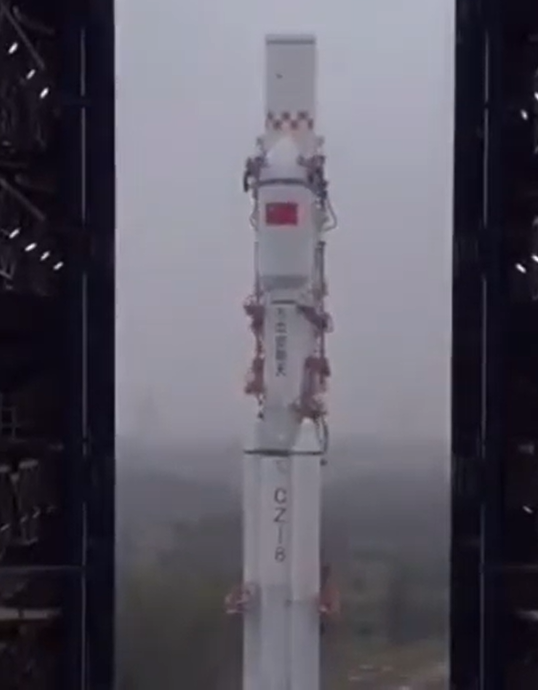

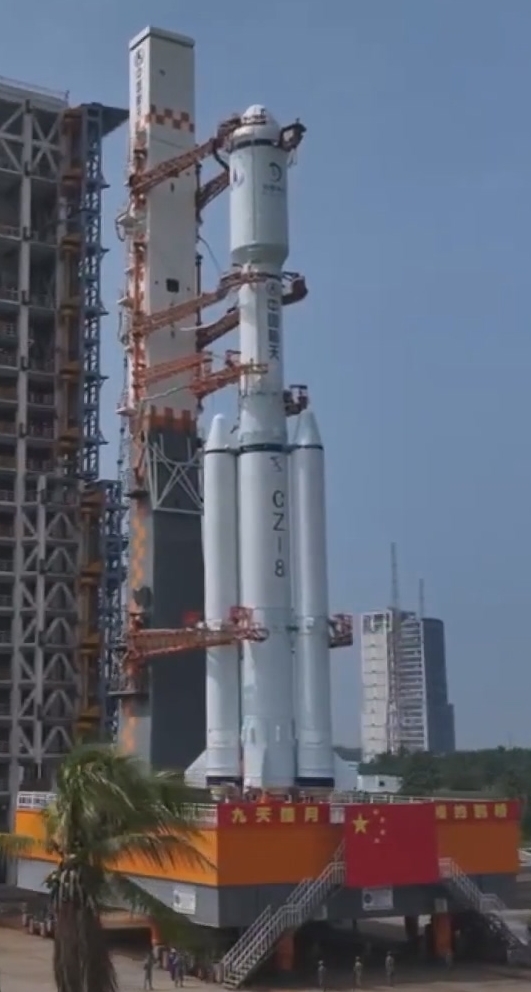






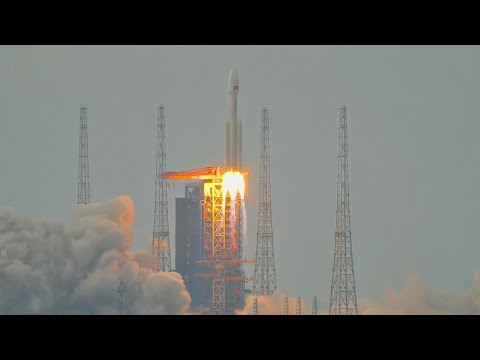
The Long March 8A (CZ-8A) is an upgraded version of the Chinese Long March 8 launcher — that is, a specific configuration of that family rather than a standalone rocket. The base vehicle, the Long March 8, was developed by the China Academy of Launch Vehicle Technology (CALT) from the Long March 7 — from which it inherits the twin-engine first stage and single-engine boosters — combined with the liquid-hydrogen stage used by the Long March 3A/3B/3C and 7A, which here serves as the second stage. What distinguishes the 8A is precisely that second stage. In the upgraded version it has a larger diameter, matched to the 3.35-metre core stage, and carries two YF-75H engines, an evolution of the YF-75D whose thrust was raised to 10 tonnes each through measures such as increased turbopump speeds. The result is a step up in performance: up to 7000 kg to a 700 km sun-synchronous orbit, against 5000 kg for the standard Long March 8. The 8A can also use a larger payload fairing, 5.2 metres in diameter. The vehicle is active. It debuted successfully on 11 February 2025 with a batch of Guowang megaconstellation satellites and has since been used mainly for deploying Chinese satellite internet constellations. It operates from the Wenchang launch site and the adjacent commercial complex.
Long March 8A in the news
HELSINKI — China completed its ninth and tenth launches of September, sending Guowang and Yaogan satellites into orbit, ahead of an intense finish to the year. A Long March 8A […] The post China…
History
The Long March 8 as a starting point
The Long March 8 was conceived as a medium-class launcher able to place up to 5000 kg into a 700 km sun-synchronous orbit. Its design is deliberately conservative in terms of components: it reuses the Long March 7 first-stage architecture and the cryogenic hydrogen-oxygen stage already flown on the Long March 3 series. The maiden flight came on 22 December 2020 from Wenchang. In February 2022 a 'core only' variant, omitting the two usual strap-on boosters, flew for the first time on a mission that set a national record for satellites launched at once.
Birth of the 8A variant
The aim of the upgraded version was to increase capacity toward sun-synchronous orbits and low Earth orbit constellations. To that end the liquid-hydrogen upper stage was redesigned, widened to the core's 3.35 metres and fitted with two higher-thrust YF-75H engines. With those changes the vehicle reaches 7000 kg to 700 km altitude, stands 50.5 metres tall and has a liftoff mass of 371,000 kg.
Debut and operations
The Long March 8A first flew on 11 February 2025 from Wenchang, placing the second group of Guowang megaconstellation satellites into orbit. Cadence ramped up quickly: the variant became one of the workhorses of China's internet constellations, alongside Qianfan deployments, and has accumulated nine flights since its debut, all successful according to the record consulted, the most recent on 5 July 2026.
Outlook
In June 2026, a public notice on China's procurement information platform revealed that the Chinese Academy of Sciences had applied for single-source procurement of a Long March launch vehicle for the enhanced X-ray Timing and Polarimetry observatory — likely an 8A launching in 2030 — for a prospective contract value of 245.2 million RMB. This suggests the variant is also positioning itself for science missions, not only constellation deployment.
Launch timeline
| Date | Launch site | Program | Outcome | Payload |
|---|---|---|---|---|
| Sep 23, 2026, 1:32 PM | Commercial LC-1 | — | Success | A batch of 9 Low Earth Orbit communication satellites for the Chinese state owned SatNet constellation operated by the China Satellite Network Group. The constellation will eventually consists of 13000 satellites. |
| Aug 4, 2026, 8:52 AM | Commercial LC-1 | — | Success | A batch of 9 Low Earth Orbit communication satellites for the Chinese state owned SatNet constellation operated by the China Satellite Network Group. The constellation will eventually consists of 13000 satellites. |
| Jul 5, 2026, 1:43 PM | Commercial LC-1 | — | Success | 20 Low Earth Orbit communication satellites with Ku, Q and V band payloads for the G60 constellation operated by Shanghai Spacesail Technologies with funding backed by the Shanghai local government. Initial constellation will consist of 1296 satellites by 2027 with long term plans to expand it to 12000 satellites. |
Images
![[#BQP134] CASC's Long March 8A rocket - 9 x SatNet LEO Group 23 (Xingwang Digui) launch.](https://i.ytimg.com/vi/xmAQDTFeLFc/hqdefault.jpg)


![[37th live stream] CASC's Long March 8A rocket - 9 x SatNet LEO Group 12 (Hulianwang Digui) launch.](https://i.ytimg.com/vi/iMVKXyG2h-4/hqdefault.jpg)