Family: Long March · CALT
Long March 7
Launch statistics
- 27
- Launches (as of July 27, 2026)
- 1
- Successes
- 0
- Failures
- 100.0 %
- Success rate
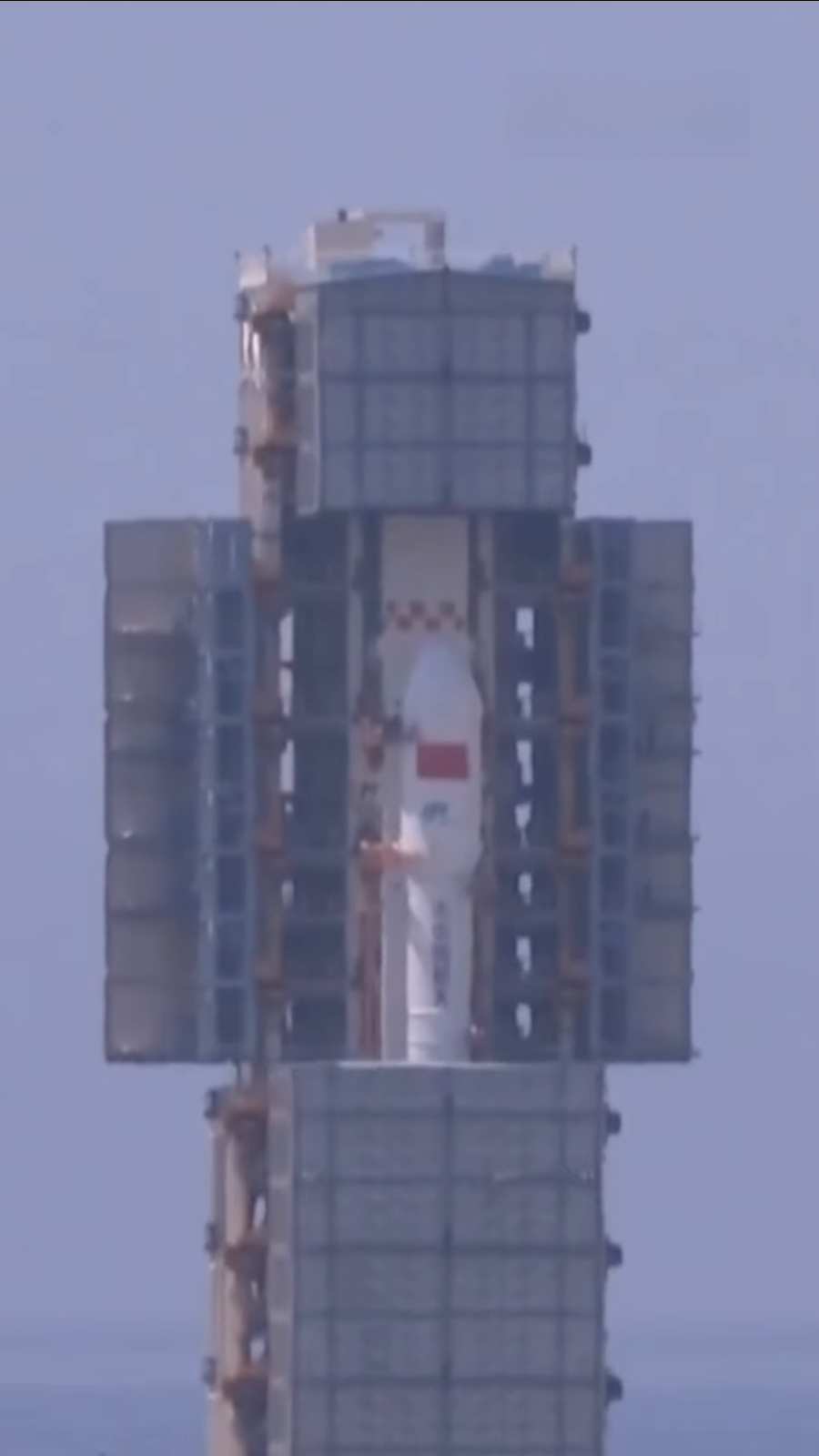
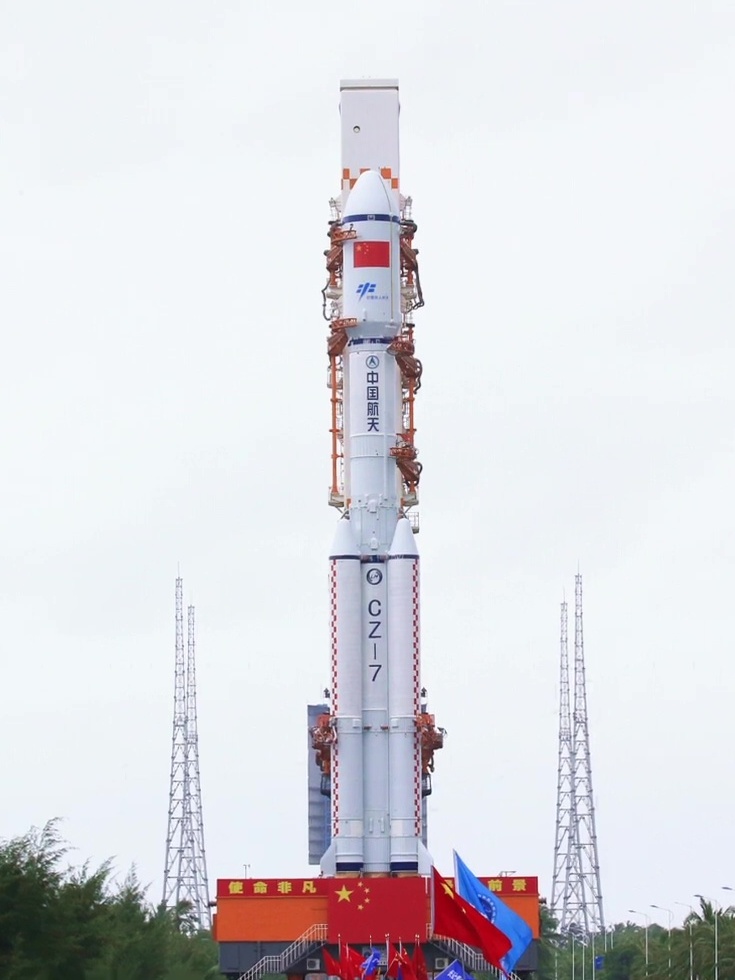
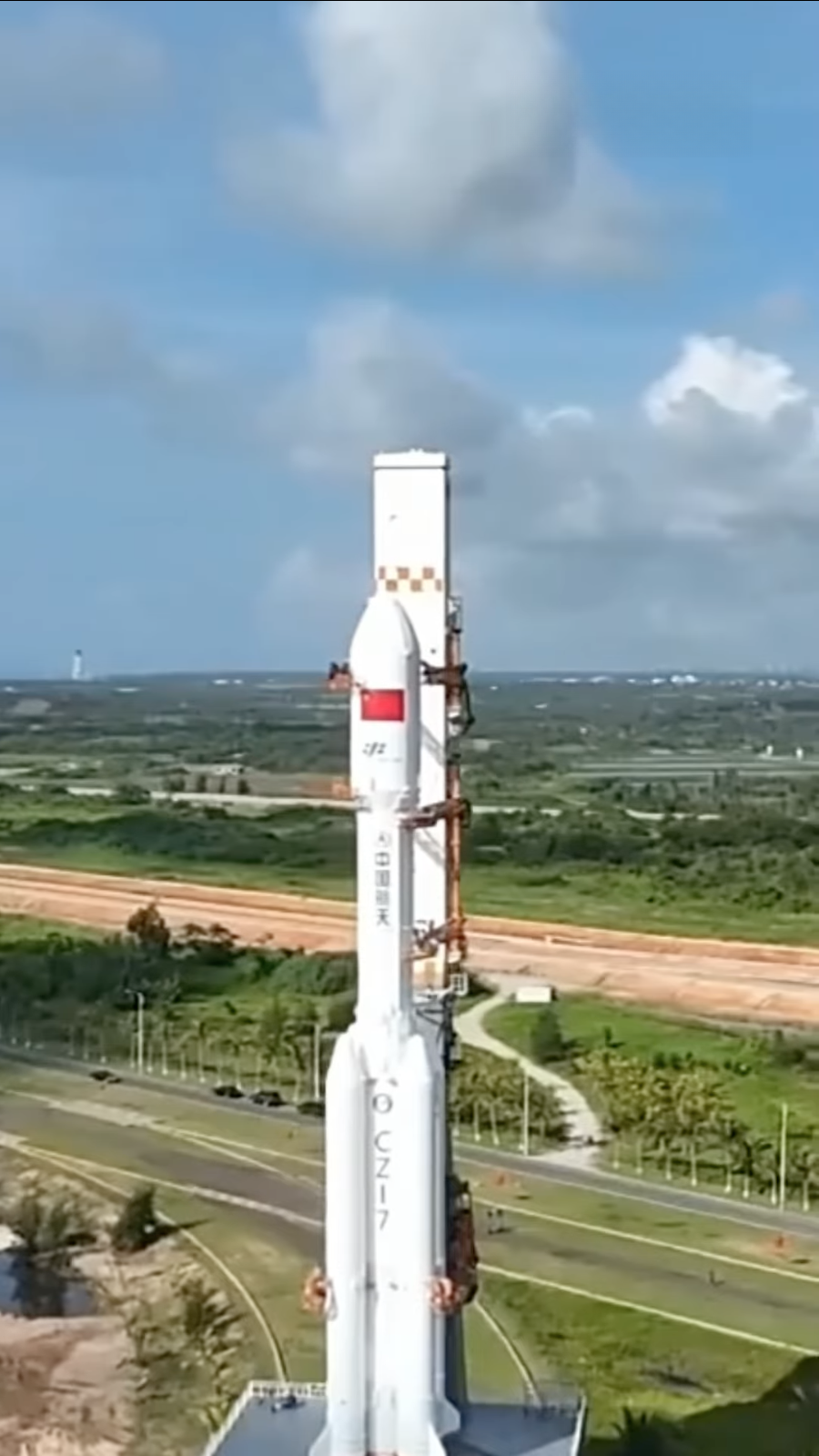
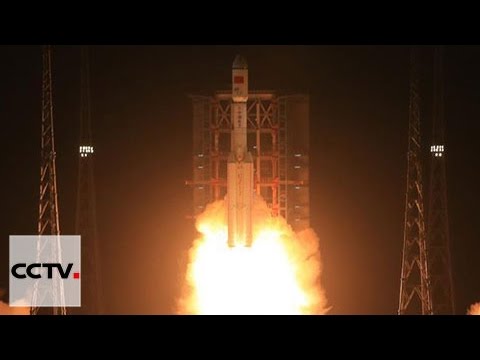
The Long March 7 (Chang Zheng 7 in pinyin, abbreviated CZ-7 inside China and LM-7 for export) is a Chinese liquid-fuelled medium-lift launch vehicle of the Long March family, developed by the China Aerospace Science and Technology Corporation. It began life under the provisional designation Long March 2F/H and carries the nickname Bingjian, "the Ice Arrow". Its inaugural flight took place on 25 June 2016 from pad LC-2 at the Wenchang Satellite Launch Center. Unlike older Chinese rockets, the CZ-7 abandons hypergolic propellants entirely: both of its base stages burn RP-1 kerosene and liquid oxygen. Six YF-100 engines fire at liftoff — one on each of the four strap-on boosters and two on the first stage — while the second stage uses four YF-115 engines. The core measures 3.35 m in diameter, a legacy of the Long March 2F that allows overland transport and therefore lets the rocket fly from any Chinese launch site, unlike the Long March 5, whose wider core requires shipment by sea. The vehicle is central to the Tiangong space station programme, as it launches the Tianzhou robotic cargo and resupply spacecraft. This entry covers the baseline two-stage configuration; the Long March 7A variant, flying since 2020, adds a cryogenic hydrogen-oxygen third stage with two YF-75 engines inherited from the Long March 3B and is tallied separately in the flight statistics.
History
From Long March 2F/H to Long March 7
The project started in 2008 with the formation of a development team at the China Academy of Launch Vehicle Technology (CALT). The original intent was merely to re-engine the Long March 2F: swap dinitrogen tetroxide and UDMH for kerosene and liquid oxygen using the new YF-100 and YF-115 engines, themselves the product of acquiring Russian RD-120 technology. That single change triggered a cascade of modifications that greatly increased the programme's complexity. At the same time the Long March 5 project envisaged heavy, medium and light versions; because the medium LM-5 overlapped heavily with the 2F/H, the two efforts were merged, marrying the 2F's flight-proven heritage to the new LM-5 technologies. In 2010 the programme was officially renamed Long March 7.
Innovation in product and process
According to deputy project manager Zhang Tao, development required eleven new major technologies. Project manager Wang Xiaojun stressed that the novelty was not only in the product: for the first time the entire process was carried out in digital 3D, feeding computer-aided design directly into computer-aided manufacturing. After the maiden flight, deputy chief control systems designer Song Zhengyu said the mission had proven fully indigenous avionics, including radiation-hardened dual-processor programmable logic controllers and a home-grown real-time operating system, built on a distributed architecture and designed from the outset with reusability in mind.
Maiden flight and operations
On 25 June 2016 at 12:00 UTC the first CZ-7 lifted off from Wenchang LC-2, also debuting the Yuanzheng-1A upper stage, and successfully completed a multi-orbit mission. The uncontrolled re-entry of one of its boosters produced a fireball visible from Utah, Nevada, Colorado, Idaho and California on 27 July 2016. Long March 7 and its variants were projected to become the workhorse of the Chinese fleet, accounting for around 70% of all national launches; its anticipated role as China's crew-rated launcher, however, had shifted by 2023 to the Long March 10A. The modular architecture accepts 0, 2 or 4 boosters plus optional upper stages, letting performance be dialled between 4000 kg and 13,500 kg to low Earth orbit. The design also spawned the Long March 8, which uses fewer boosters.
Launch timeline
| Date | Launch site | Program | Outcome | Payload |
|---|---|---|---|---|
| May 11, 2026, 12:14 AM | 201 | — | Success | Ninth cargo delivery mission to the Chinese space station. |
Versions
| CZ-724/SM | CZ-720 | CZ-720(HO) | CZ-720/SM | CZ-722 | CZ-722S(HO) | CZ-722/SM | CZ-722S/SM | CZ-724 | CZ-724S/SM | CZ-730 | CZ-732 | CZ-734 | |
|---|---|---|---|---|---|---|---|---|---|---|---|---|---|
| First launch | June 25, 2016 | — | — | — | — | — | — | — | — | — | — | — | — |
| Stages | 2 Best value in this row | 2 Best value in this row | 2 Best value in this row | 2 Best value in this row | 2 Best value in this row | 2 Best value in this row | 2 Best value in this row | 2 Best value in this row | 2 Best value in this row | 2 Best value in this row | 3 | 3 | 3 |
| LEO capacity | 13,500 kg Best value in this row | 2,000 kg | 5,500 kg | — | 7,500 kg | 7,500 kg | — | — | 13,500 kg Best value in this row | — | — | — | — |
| GTO capacity | — | — | 1,500 kg | — | — | 2,400 kg | — | — | — | — | 1,200 kg | 4,500 kg | 7,000 kg Best value in this row |
| Reusable | No | No | No | No | No | No | No | No | No | No | No | No | No |
Images






![[Liftoff : 1:12:57] China Space Station Launch LIVE | Tianzhou 2 cargo module Launch | Long March 7](https://i.ytimg.com/vi/hngePQmX-Y4/hqdefault.jpg)


![[Scrubbed] China Space Station Launch LIVE | Tianzhou 2 cargo module Launch | Long March 7 Launch](https://i.ytimg.com/vi/uGvMyPHlYbU/hqdefault.jpg)

![[Scrubbed] China Space Station Launch LIVE | Tianzhou 2 cargo module Launch | Long March 7 Launch](https://i.ytimg.com/vi/6Db1F7jOpTo/hqdefault.jpg)
![ROCKET LAUNCH TODAY LONG MARCH 7 [SCRUB] - Tianzhou-2](https://i.ytimg.com/vi/sEIhZ-TUK-Y/hqdefault.jpg)
![REPLAY LIVE 🔴 [REPORT] Lancement Long March 7 : Tianzhou 2 (FR) !](https://i.ytimg.com/vi/Ow4VBX0rxbI/hqdefault.jpg)