Family: Falcon · SpaceX
Falcon Heavy
Launch statistics
- 13
- Launches (as of August 30, 2026)
- 3
- Successes
- 0
- Failures
- 100.0 %
- Success rate

-1600.webp)
-1600.webp)

-1600.webp)

-1600.webp)

-1600.webp)

-1600.webp)

-1600.webp)
-1600.webp)

-1600.webp)

-1600.webp)


-1600.webp)
-1600.webp)


-1600.webp)
-1600.webp)
-1600.webp)
-1600.webp)
-1600.webp)

-1600.webp)

-1600.webp)


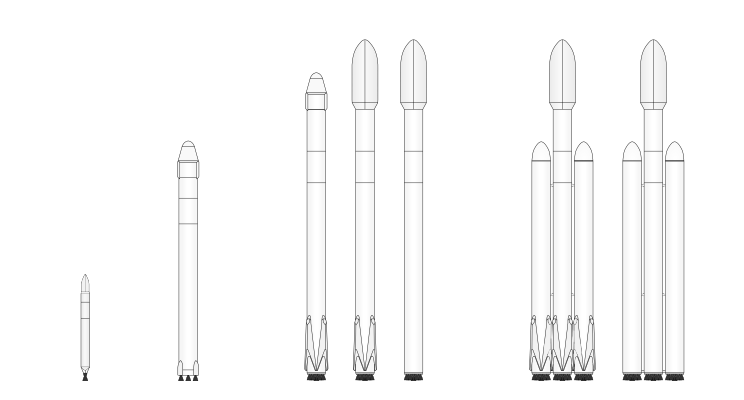
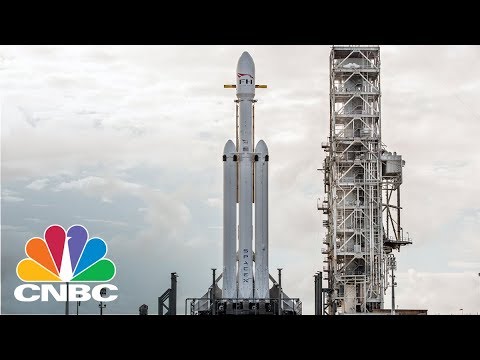
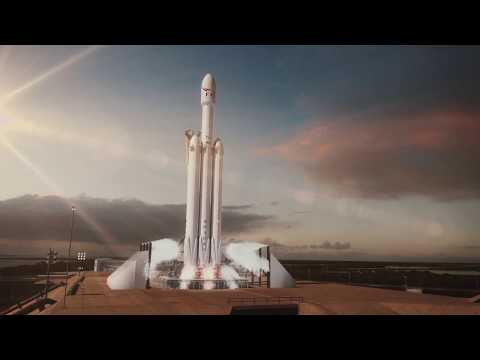
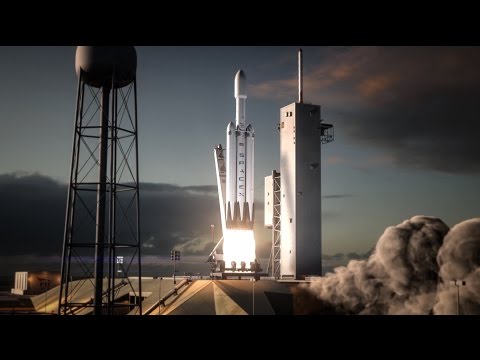
Falcon Heavy is SpaceX's heavy-lift launch vehicle and, for much of its career, the most capable operational rocket in the world behind only NASA's Space Launch System. Its architecture follows an idea that is simple on paper and fiendishly difficult in practice: take the Falcon 9 first stage, strengthen it structurally to serve as a centre core, and flank it with two further first stages capped by aerodynamic nose cones acting as strap-on boosters. On top of that triple first stage ride the standard Falcon 9 second stage and payload fairing, so the vehicle inherits almost its entire production line, its engines and its operating procedures from the rocket it derives from. With the twenty-seven Merlin 1D engines of its first stage firing together, Falcon Heavy delivers 22,819 kN of sea-level thrust at liftoff, a figure above five million pounds of force that only a handful of vehicles in history have matched. It stands 70 m tall with the standard fairing and its fuelled mass at liftoff is around 1,420 t. In fully expendable configuration it can inject 63,800 kg into low Earth orbit, 26,700 kg into geostationary transfer orbit and 16,800 kg onto a trans-Mars trajectory; recovering the two side boosters brings low-orbit capability down to some 57 t, and returning all three cores to the launch site reduces performance far more sharply. Formally announced in April 2011 with the promise of carrying more payload to orbit or escape velocity than any vehicle other than the Saturn V and the Soviet Energia, Falcon Heavy took seven years to fly. Elon Musk himself acknowledged that integrating three cores was far harder than expected and that much of the design was effectively impossible to validate on the ground. The maiden flight, on 6 February 2018 from Launch Complex 39A at the Kennedy Space Center, became one of the most widely watched space events of the decade: it carried Musk's personal Tesla Roadster as a dummy payload with a mannequin at the wheel, and ended with the simultaneous landing of both side boosters back at Cape Canaveral. Since then the vehicle has flown at a deliberately low cadence but with a very defined mission profile: high-mass communications satellites, classified United States Space Force payloads requiring direct injection into high orbits, and NASA science probes that no other commercial launcher could send within the available window. Psyche, in October 2023, was the first NASA science mission launched on a Falcon Heavy; Europa Clipper, in October 2024, required all three cores to be expended and was the heaviest interplanetary payload entrusted to the vehicle. Its real role has been that of a niche launcher within SpaceX's catalogue. Falcon 9 in expendable configuration ended up absorbing much of the geostationary business once assigned to Falcon Heavy, leaving the bigger rocket for what no two-stage single-core vehicle could do. Even so, its combination of raw thrust, booster recovery and a published price far below that of its heavy-lift competitors reshaped the heavy launch market and served as a proving ground for the recovery techniques SpaceX would later apply on a much larger scale.
Related events
- SpaceX announces the Falcon Heavy at a press conference
- Falcon Heavy test flight carries the Tesla Roadster
- Arabsat-6A: Falcon Heavy's first commercial flight
- STP-2: demonstration mission for the U.S. Department of Defense
- USSF-44: Falcon Heavy returns to flight after three years
- USSF-67: second national-security launch
- Launch of NASA's Psyche spacecraft
- USSF-52 (OTV-7): the first X-37B launched on a Falcon Heavy
- Launch of the Europa Clipper mission
- ViaSat-3 F3: the final piece of the ViaSat-3 constellation
Falcon Heavy in the news
.jpg)
NASA's SunRISE (Sun Radio Interferometer Space Experiment) mission will launch in mid-2027. This heliophysics mission will travel aboard a SpaceX Falcon Heavy rocket from the…
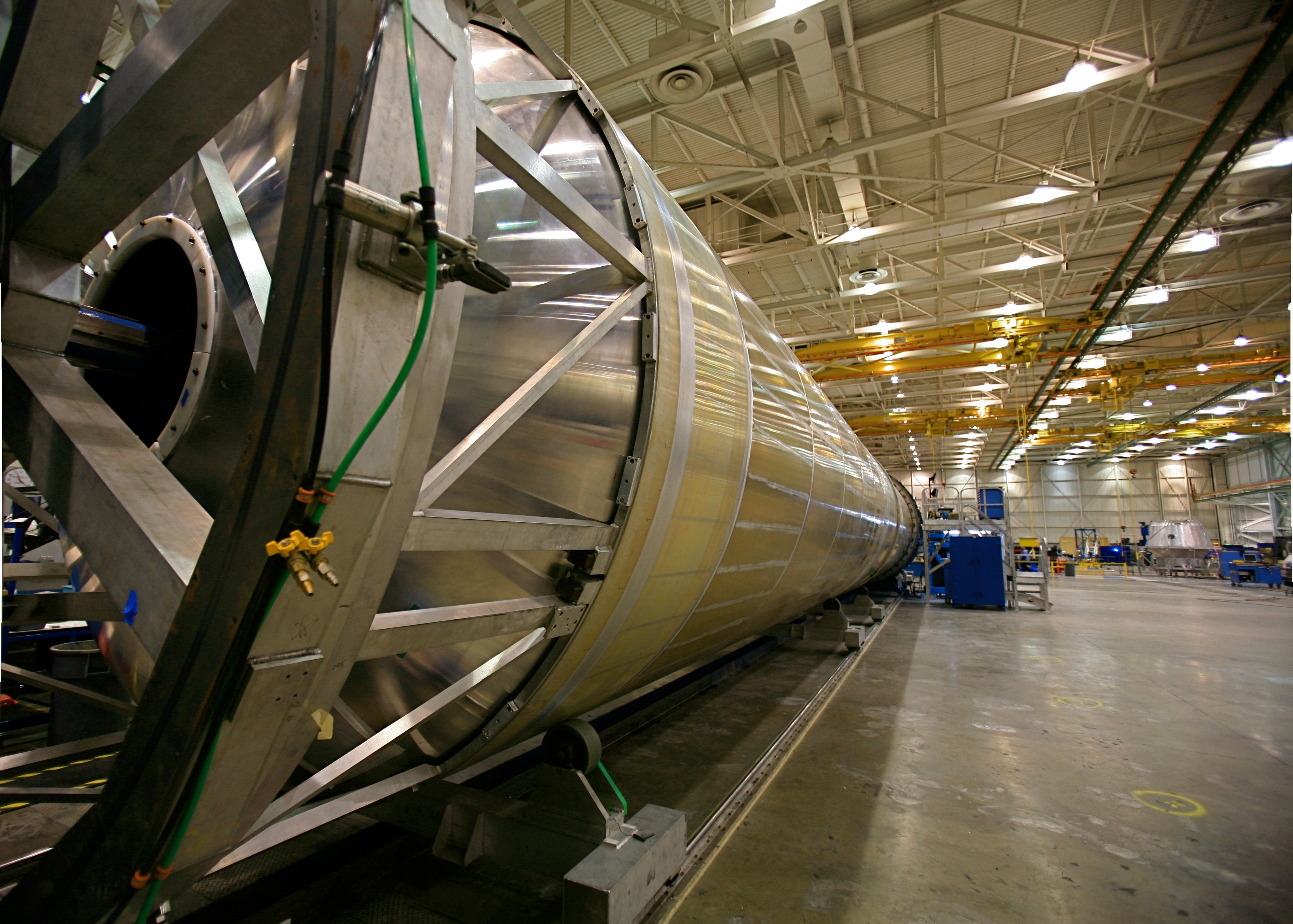
NASA’s SunRISE (Sun Radio Interferometer Space Experiment) mission will launch no earlier than mid-2027. The heliophysics mission will hitch a ride on a SpaceX Falcon Heavy rocket from the agency’s…
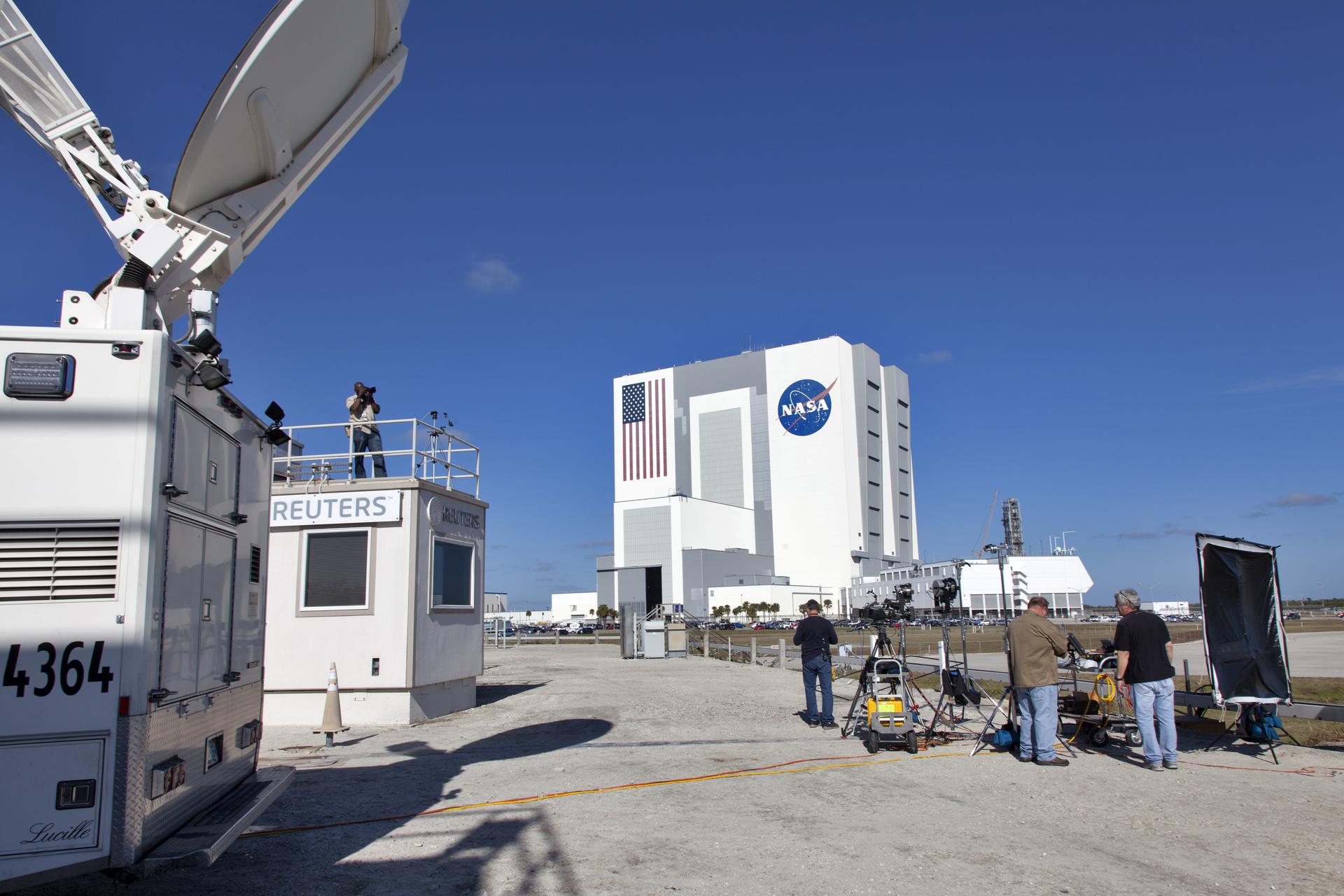
Falcon Heavy launched its first NRO mission while SpaceX landed four boosters in one day. The post SpaceX’s midnight spy satellite launch quietly set a new record appeared first on TESLARATI .
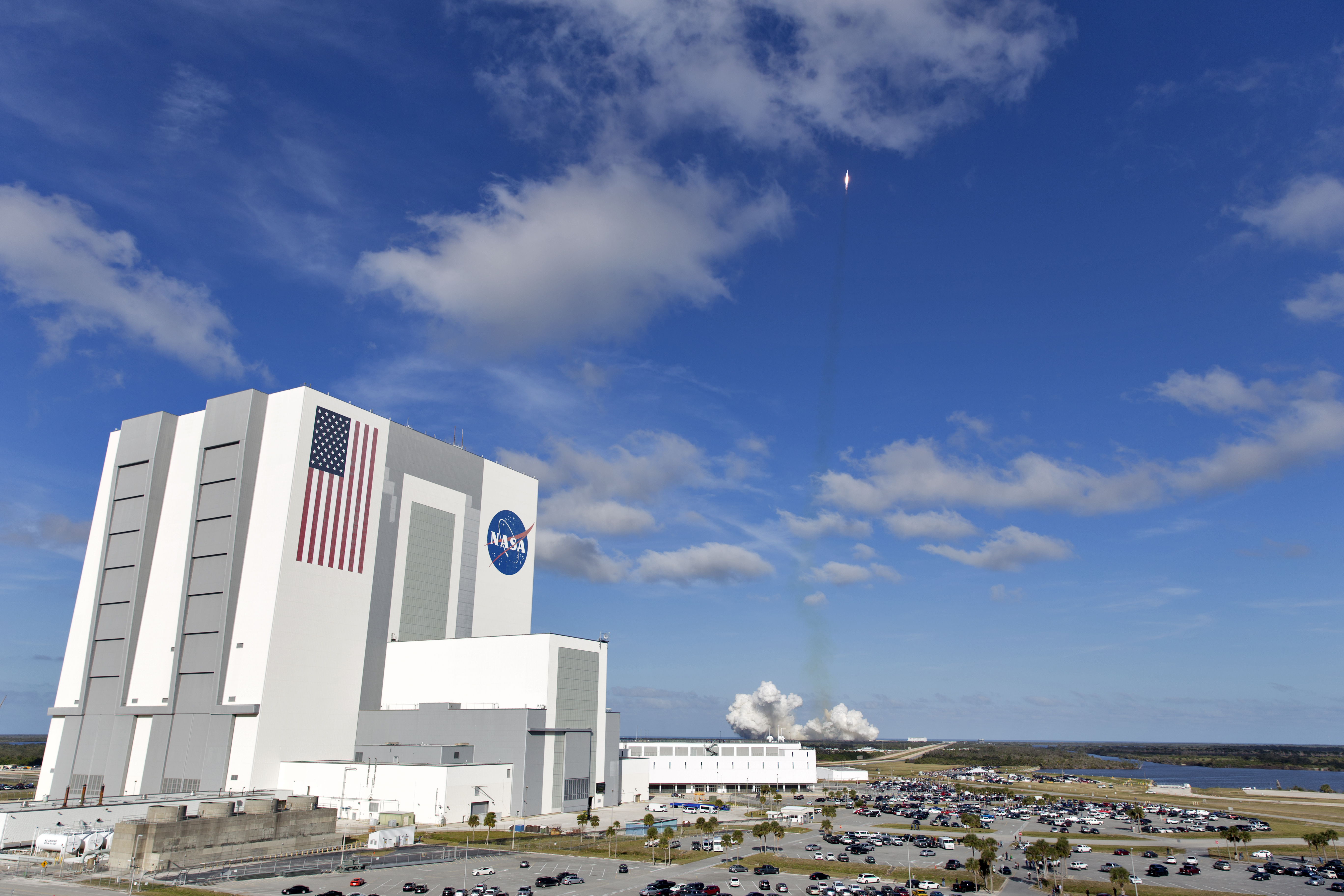
Late Thursday, the National Reconnaissance Office (NRO) and System Delta 80 under the U.S. Space Force’s Space Systems Command launched the NROL-97 mission, which the agency said marked its first […]
.jpg)
For the first time, the National Reconnaissance Office (NRO) has entrusted a payload of its own to SpaceX's Falcon Heavy. Classified as NROL-97 and carried out on behalf of an agency of the…

-1600.webp)
Powerplant
Falcon Heavy burns liquid oxygen and rocket-grade kerosene (RP-1) in both stages, the same combination as the Falcon 9 it derives from. The first stage consists of three cores, each with nine Merlin 1D engines arranged in the structure SpaceX calls Octaweb. Each Merlin 1D delivers 845 kN at sea level, so the twenty-seven engines together produce 22,819 kN of thrust at liftoff, equivalent to more than 5,130,000 pounds of force; as the vehicle leaves the dense atmosphere thrust rises to some 24.68 MN. Merlin is a gas-generator cycle engine, simpler than a staged-combustion design, with a regeneratively cooled nozzle and thrust chamber. Attitude control during ascent is exercised by gimballing the engines themselves, in pitch and yaw as well as roll. The thrust vector control system draws its hydraulic fluid from the high-pressure kerosene circuit rather than from a separate fluid reservoir, eliminating an entire failure mode. Engine ignition uses TEA-TEB, a pyrophoric mixture that burns spontaneously on contact with the oxidiser. One distinctive feature of the flight profile is centre core throttling. Shortly after liftoff, once the full thrust of all twenty-seven engines has been used for a few seconds, the centre core throttles down to consume less propellant and extend its burn beyond side booster separation. This is the solution SpaceX adopted after abandoning the propellant crossfeed planned in the original design. The second stage is the same as Falcon 9's: a single Merlin engine adapted for vacuum operation, with a 117:1 expansion ratio nozzle and a nominal burn time of 397 seconds, able to relight several times to place payloads in different orbits. Attitude control during coast phases is handled by nitrogen gas thrusters. On missions with long waits between burns the stage carries a mission-extension kit with strengthened COPV pressurisation tanks, additional TEA-TEB ignition fluid, and a grey band painted over the metal skin of the RP-1 tank that absorbs sunlight to keep the kerosene from freezing during the coast. The recovery systems are in practice part of the propulsive assembly: each core carries four deployable landing legs, locked against the tank during ascent, and four retractable grid fins at the top that extend after separation. Immediately after separating, three engines on each side booster keep burning for a few seconds to steer clear of the centre core's trajectory. Propellant reserved for those recovery manoeuvres can be reassigned to the primary objective if the mission requires it, which is why the heaviest flights have been flown in expendable configuration.
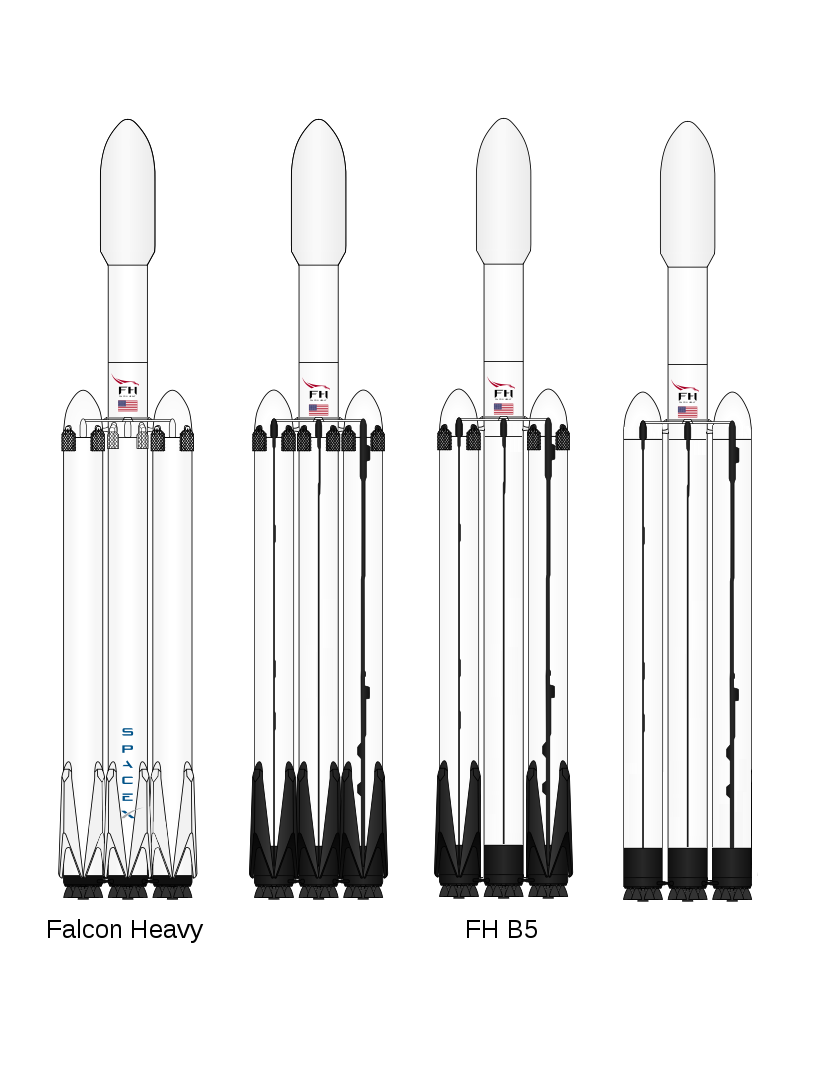
Three-view drawing
History
From a catalogue idea to a real programme
The Falcon family was conceived from the start with scaling in mind. As early as 2005 SpaceX was working with an internal concept called Falcon 9-S9 that envisaged some 24.75 t to low Earth orbit by clustering several cores. In 2008, with Falcon 9 still unflown and its first launch expected in 2009, Musk was talking about a "Falcon 9 Heavy" that would arrive "in a couple of years", and at that year's Mars Society Conference he suggested a hydrogen-fuelled upper stage would follow two or three years later, around 2013. Neither prediction held: the cryogenic stage was never built and the triple-core launcher would take a decade to exist.
The turning point came in April 2011. By then SpaceX had completed two Falcon 9 demonstration missions to low Earth orbit, one of which included a second-stage relight, and understood the vehicle's real behaviour far better. On 5 April 2011, at a press conference at the National Press Club in Washington, D.C., Musk introduced Falcon Heavy with the claim that it would carry more payload to orbit or escape velocity than any vehicle in history apart from the Saturn V and the Soviet Energia. That same year the company announced plans to expand manufacturing capacity towards producing a Falcon 9 first stage or a Falcon Heavy side booster every week and an upper stage every two weeks.
The promised performance figures moved a great deal during design, and that drift is itself part of the vehicle's story. In April 2011 the projection was up to 53 t to low Earth orbit and around 12 t to geostationary transfer orbit; later reports that same year raised it to 19 t to GTO, 16 t on a translunar trajectory and 14 t on a trans-Mars orbit. By late 2013 the GTO figure had risen to 21.2 t. In April 2017, with the design frozen, projected low-orbit capability went from 54.4 to 63.8 t, the number that still stands as the vehicle's reference in fully expendable configuration.
In 2015 SpaceX announced a series of changes to Falcon Heavy worked in parallel with the upgrade of Falcon 9 v1.1, so both vehicles advanced together in structure, engines and avionics. In December 2016 the company released a photograph of the Falcon Heavy interstage at its Hawthorne, California headquarters: the first public evidence that the hardware existed.
Testing: what cannot be proven on the ground
The vehicle's complexity forced the construction of dedicated infrastructure. By May 2013 a partly underground test stand was being built at SpaceX's Rocket Development and Test Facility in McGregor, Texas, designed specifically to take the three cores and twenty-seven engines of Falcon Heavy. In May 2017 the first static fire of a flight-design centre core took place there, and by September that year all three first-stage cores had completed their individual static fire tests.
In July 2017 Musk set out the underlying problem in public: a large part of the design of a three-core launcher is simply impossible to test on the ground and cannot be validated independently of actual flight. Aerodynamic loads on the stack, coupled vibration between cores, booster separation and the structural behaviour of the attachment points are only truly known in flight. At the International Space Station Research and Development meeting held that month in Washington, Musk lowered expectations to the point of saying there was a real chance the vehicle would not reach orbit, and that he would consider it a win if it simply got far enough from the pad to avoid damaging it.
The schedule reflected that difficulty. In April 2011 the first launch was planned from Vandenberg Air Force Base in California for 2013, with the Cape Canaveral debut set for late 2013 or 2014. The loss of the CRS-7 mission in June 2015 disrupted the whole programme: in September of that year the maiden flight was rescheduled to no earlier than April 2016, then slipped to late 2016, early 2017, summer 2017, late 2017 and finally February 2018. The launch also moved to Launch Complex 39A at the Kennedy Space Center, refurbished by SpaceX.
6 February 2018: the maiden flight
In December 2017 Musk announced that the dummy payload for the maiden flight would be his personal Tesla Roadster, fitted with three cameras to provide what he called epic views, and that the car would be sent into a solar orbit reaching that of Mars. On 28 December 2017 the vehicle rolled out to the pad for the static fire of all twenty-seven engines, expected on 19 January 2018; the partial United States government shutdown that began on 20 January delayed the operation, which finally took place on 24 January. Musk confirmed the test had gone well and the launch was set for 6 February.
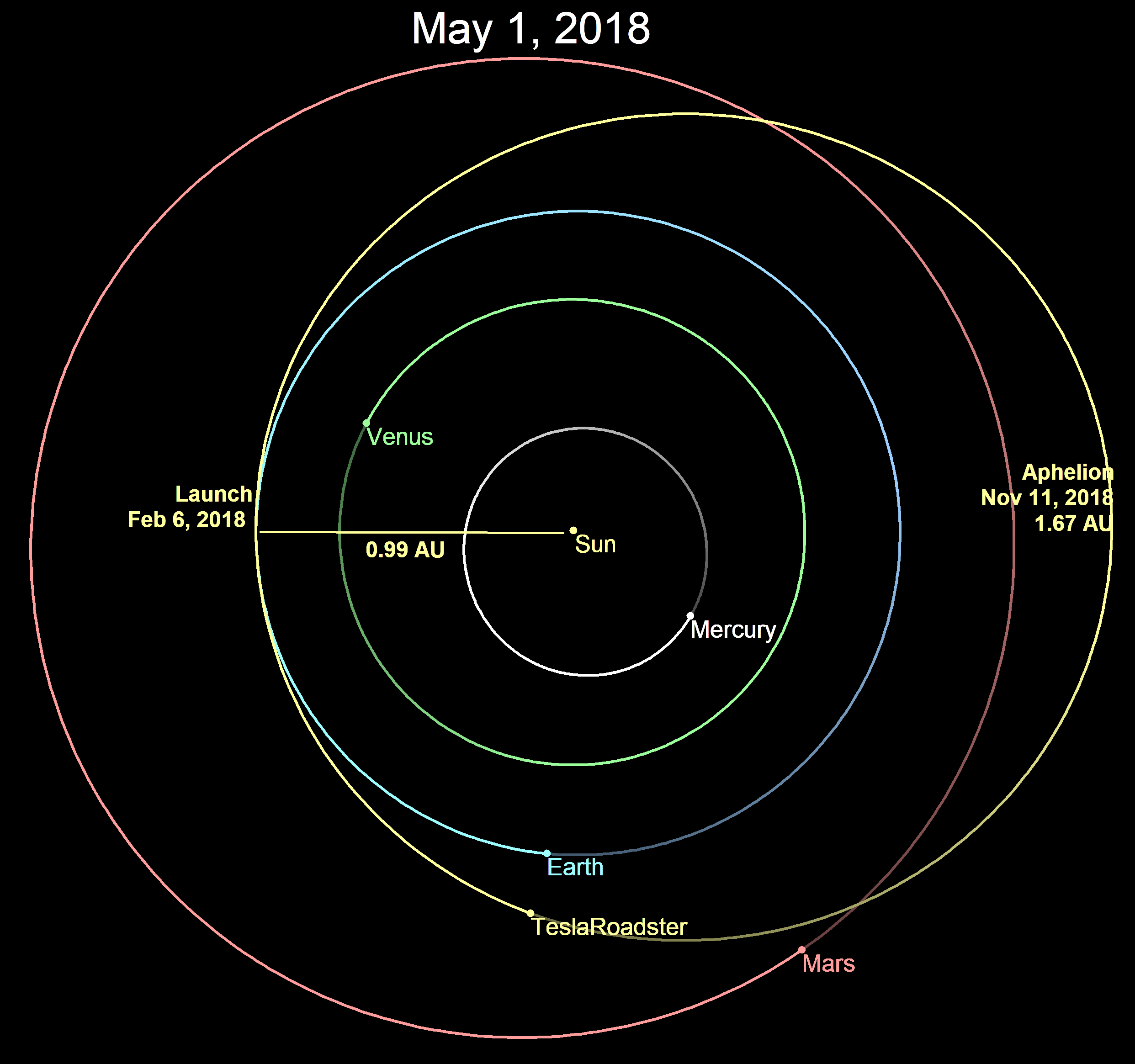
That day, after a delay of more than two hours due to high winds aloft, Falcon Heavy lifted off at 20:45 UTC. The two side boosters returned and landed cleanly on Landing Zones 1 and 2 a few minutes later, in one of the most reproduced images in recent spaceflight history. The centre core, however, was lost: of the three engines meant to relight for the descent burn only one ignited, and the booster struck the ocean at more than 480 km/h. Musk initially announced that the Roadster had overshot its planned heliocentric orbit and would reach the asteroid belt; later telescopic observations corrected that, showing the car's aphelion only slightly exceeds the orbit of Mars.
Beyond the spectacle, the flight did its job: it validated three-core integration, the booster separation sequence and the behaviour of the upper stage on a long-duration mission with multiple relights. A year after the demonstration flight SpaceX had signed five commercial contracts worth between 500 and 750 million dollars, enough to cover the rocket's development cost.
From commercial debut to national security missions
The second flight, and first commercial one, took place on 11 April 2019 with the Arabsat-6A communications satellite. It was the first time all three boosters landed successfully: the two side cores on land and the centre core on the Atlantic drone ship. The third flight followed on 25 June 2019 with STP-2, a United States Department of Defense Space Test Program mission whose payload comprised twenty-four small spacecraft and required several second-stage relights to place them in different orbits. Among the payloads were the Deep Space Atomic Clock, intended to enable autonomous navigation, the Air Force Research Laboratory's 500 kg DSX experiment, designed to measure the effect of very low frequency radio waves on space radiation, and the British Orbital Test Bed hosting several commercial and military experiments.
Meanwhile the market moved against the vehicle. Operational geostationary transfer missions for Intelsat and Inmarsat, planned for late 2017 on Falcon Heavy, were shifted to the Falcon 9 Full Thrust once that rocket proved powerful enough for such payloads in expendable configuration. The result was a very low flight rate for the heavy launcher and an implicit redefinition of its role: it would take on what Falcon 9 could not absorb.
Those missions arrived through the military route. In June 2022 the United States Space Force certified Falcon Heavy for its most sensitive satellites. The first of those missions, USSF-44, flew on 1 November 2022, and the second, USSF-67, only eleven weeks later in January 2023. USSF-52 followed in December 2023, carrying the uncrewed X-37B spaceplane on its seventh orbital mission. All share one technical trait: direct injection into high or geostationary orbits forces the centre core to be expended, since it cannot retain enough propellant to return, so only the side boosters are recovered.
In April 2023 Falcon Heavy also launched the terabit-class ViaSat-3 Americas satellite in a fully expendable configuration: neither the side boosters nor the core carried landing legs or grid fins, because the vehicle's entire capability was devoted to the payload.
Planetary science
The first NASA science mission launched on a Falcon Heavy was Psyche, which lifted off on 13 October 2023 bound for the metal-rich asteroid 16 Psyche. The profile recovered only the two side boosters and expended the centre core, a decision taken to create more tolerable margins for the mission. A year later, in October 2024, the vehicle launched Europa Clipper towards the Jupiter system in fully expendable configuration: the probe, the heaviest NASA has ever sent on a planetary mission, needed every joule the launcher could provide for its gravity-assist trajectory.
.jpg)
Falcon Heavy was also contracted to carry the Dragon XL cargo craft to the lunar Gateway and selected to launch the station's first two elements, the Power and Propulsion Element and the Habitation and Logistics Outpost. In March 2026 NASA announced it would pause Gateway development and reallocate the hardware, leaving that set of missions in doubt. In the debate around the Artemis programme the vehicle was repeatedly raised as a cheaper alternative to the Space Launch System, but NASA chose to reserve SLS exclusively for launching the Orion capsule.
Reusability, capability and price
Between 2013 and 2016 SpaceX developed the reusable Falcon 9 architecture in parallel, and much of it applies directly to Falcon Heavy. On this vehicle the two outer cores separate earlier than in a Falcon 9 profile and do so at lower velocity, which makes returning them to the launch site easier. The centre core, by contrast, separates much later and much faster, and its recovery has always been the fragile part of the system. SpaceX has also demonstrated routine fairing recovery, with fairing halves re-flown on a very large number of Falcon family missions.
The price of that reusability is paid in capability. Recovering all three cores brings geostationary transfer payload down to about 8 t; recovering only the two side boosters and expending the centre core yields roughly 16 t. In low Earth orbit the maximum 63.8 t requires a fully expendable profile; with the centre core expended and the side boosters recovered the estimated penalty is around 10 per cent, still leaving more than 57 t, while returning all three cores to the launch site cuts capability to some 30 t. On those numbers the partially reusable Falcon Heavy falls into the heavy-lift range, 20 to 50 t to low Earth orbit under the classification used by a NASA human spaceflight review panel, while the fully expendable version enters the super heavy-lift category.
.jpg)
Its published price has been one of its most forceful arguments: 97 million dollars in reusable configuration and 150 million expendable. For comparison, the Delta IV Heavy, the next most powerful rocket in service until April 2024, delivered 14.2 t to geostationary transfer orbit in fully expendable configuration and at far greater cost.
What Falcon Heavy never became
The original design included propellant crossfeed between cores: the centre core engines would be fed oxidiser and fuel from the two side boosters until their separation. The idea, proposed decades earlier by Vladimir Chelomei for the UR-700 system, would have allowed all twenty-seven engines to run at full power from liftoff while draining the side boosters first, separating them sooner to reduce the accelerated mass and leaving the centre core's propellant almost untouched. The complexity of the plumbing and interfaces led SpaceX to drop the concept in favour of a simpler solution: the centre core throttles down after liftoff to extend its burn time.
Nor was the hydrogen upper stage Musk had anticipated in 2008 ever built, and the vehicle was never certified for crewed flight despite having been designed, according to SpaceX, to meet or exceed the human-rating requirements then in force. Falcon Heavy thus settled into what it really is: a direct Falcon 9 derivative pushed to the limit of what its architecture allows, a niche launcher flying only a handful of times a year with a performance that for years no commercial competitor could match.
Launch timeline
| Date | Launch site | Program | Outcome | Payload |
|---|---|---|---|---|
| Oct 2, 2026, 3:54 AM | Launch Complex 39A | — | Success | Classified payload for the US National Reconnaissance Office. |
| Aug 30, 2026, 11:26 AM | Launch Complex 39A | — | Success | The Nancy Grace Roman Space Telescope is a NASA infrared space telescope with a 2.4 m (7.9 ft) wide field of view primary mirror and two scientific instruments. The Wide-Field Instrument (WFI) is a 300.8-megapixel multi-band visible and near-infrared camera, providing a sharpness of images comparable to that achieved by the Hubble Space Telescope over a 0.28 square degree field of view, 100 times larger than imaging cameras on the Hubble. The Coronagraphic Instrument (CGI) is a high-contrast, small field of view camera and spectrometer covering visible and near-infrared wavelengths using novel starlight-suppression technology. Roman objectives include a search for extra-solar planets using gravitational microlensing, and probing the expansion history of the Universe and the growth of cosmic structure, with the goal of measuring the effects of dark energy, the consistency of general relativity, and the curvature of spacetime. |
| Apr 29, 2026, 2:13 PM | Launch Complex 39A | — | Success | The ViaSat-3 is a series of three Ka-band satellites is expected to provide vastly superior capabilities in terms of service speed and flexibility for a satellite platform. Each ViaSat-3 class satellite is expected to deliver more than 1-Terabit per second of network capacity, and to leverage high levels of flexibility to dynamically direct capacity to where customers are located. |
Versions
| Fully reusable | Center core expendable | Fully expendable | |
|---|---|---|---|
| First launch | February 6, 2018 | November 1, 2022 | May 1, 2023 |
| Last launch | — | April 29, 2026 | October 14, 2024 |
| Powerplant | Twenty-seven Merlin 1D engines on the first stage, 22.819 kN at liftoff, and one 934 kN Merlin 1D Vacuum on the second. All three cores carry four deployable landing legs and four retractable grid fins. | Twenty-seven Merlin 1D engines on the first stage, 22.819 kN of thrust at liftoff, and one 934 kN Merlin 1D Vacuum on the second. Both side boosters keep legs and grid fins for the return; the center core flies lightened, without them. | Twenty-seven Merlin 1D engines on the first stage, with 22.819 kN (5.130.000 lbf) of sea-level thrust at liftoff, and one 934 kN Merlin 1D Vacuum on the second stage with a nominal burn time of 397 seconds. LOX and RP-1 propellants. No core carries landing legs or grid fins. |
| Propellant | LOX / RP-1 | LOX / RP-1 | LOX / RP-1 |
| Height | 70 m Best value in this row | 70 m Best value in this row | 70 m Best value in this row |
| Diameter | 3.7 m Best value in this row | 3.7 m Best value in this row | 3.7 m Best value in this row |
| Mass | 1,420,000 kg Best value in this row | 1,420,000 kg Best value in this row | 1,420,000 kg Best value in this row |
| Liftoff thrust | 22,819 kN Best value in this row | 22,819 kN Best value in this row | 22,819 kN Best value in this row |
| Stages | 2 Best value in this row | 2 Best value in this row | 2 Best value in this row |
| LEO capacity | 50,000 kg | 57,000 kg | 63,800 kg Best value in this row |
| GTO capacity | — | — | 26,700 kg |
| Reusable | Yes | Yes | No |
Images
Elsewhere
- TeslaratiSpaceX Falcon Heavy's breathtaking leap towards Mars, in photos ↗
- TeslaratiSpaceX's flawless Falcon Heavy Block 5 launch and landing in pictures ↗
- TeslaratiSpaceX's spectacular USSF-67 Falcon Heavy launch in photos ↗
- Flickr (Official SpaceX Photos)Falcon Heavy Demo - Payload ↗
- Flickr (Official SpaceX Photos)Falcon Heavy Demo Mission ↗
- Flickr (Official SpaceX Photos)Falcon Heavy Demo Mission - Payload ↗
- Space.comFalcon Heavy in Pictures: SpaceX's Huge Private Rocket (Gallery) ↗
- Space.comOut-of-This-World Photos from Falcon Heavy's Historic Debut Flight ↗
- Space.comSee Stunning Photos of SpaceX Falcon Heavy's First Night Launch ↗
- Everyday AstronautFalcon Heavy | USSF-67 ↗
- Everyday AstronautUSSF-52 | Falcon Heavy ↗
- SpaceNewsSpaceX gearing up for Falcon Heavy's second national security launch ↗
Videos





![[Annulation météo] LANCEMENT SPACEX FALCON HEAVY ViaSat-3 F3 (Lancement spatial FR )](https://i.ytimg.com/vi/i1CxERyJiUY/hqdefault.jpg)


Show the 59 more








![[LIVE REPLAY] Falcon Heavy launch with French commentary](https://i.ytimg.com/vi/N-k1PNIDlq0/hqdefault.jpg)



Did you know… about Falcon Heavy
- How much a rocket launch cost?
A launch is priced by capacity: about 7–8 million dollars for a small Electron, roughly 70 million for a Falcon 9 and close to 100 million for a Falcon Heavy…
- How much does the biggest rocket weigh?
The heaviest rocket ever built is SpaceX's Starship, which weighs close to 5,000 t fully fuelled on the pad; more than 90 percent of that is liquid methane…
- What are the biggest rockets?
By size and thrust, the biggest rockets are SpaceX's Starship (about 123 m tall, roughly 74 MN of liftoff thrust), NASA's Saturn V (110.6 m, 34.5 MN, 140 t to…