Family: Falcon 9 Vehicle Family · SpaceX
Falcon Heavy
Launch statistics
- 12
- Launches (as of July 27, 2026)
- 1
- Successes
- 0
- Failures
- 100.0 %
- Success rate

-1600.webp)
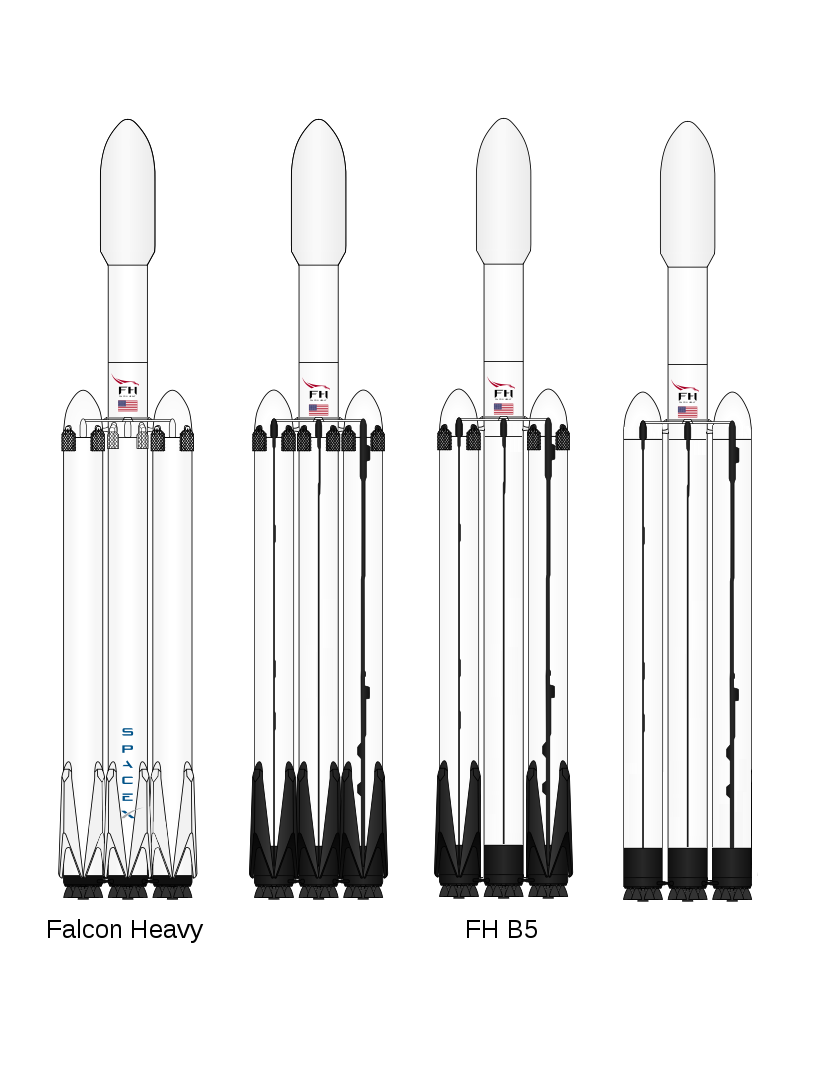
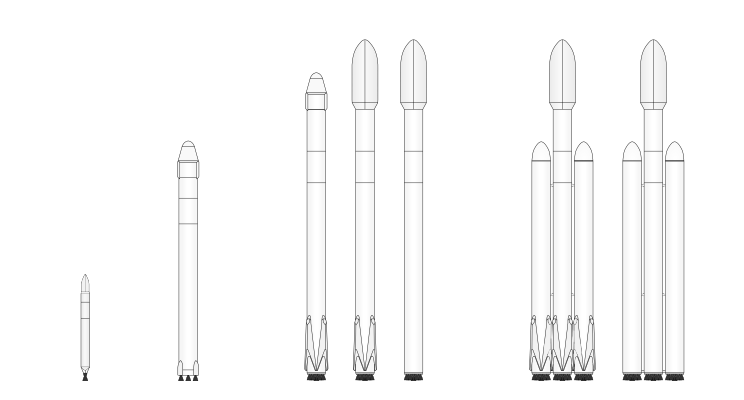
Falcon Heavy is a partially reusable super heavy-lift launch vehicle designed, manufactured and operated by the American company SpaceX. Its architecture consists of a center core onto which two Falcon 9-derived boosters are attached, with a second stage mounted on top of the core; Wikipedia's data sheet accordingly describes it as a 2.5-stage vehicle. Nine Merlin 1D engines fire on each of the three bodies at liftoff. It has the second highest payload capacity of any currently operational launch vehicle, behind NASA's Space Launch System, and the fourth-highest of any rocket ever to reach orbit, trailing only SLS, Energia and the Saturn V. Quoted capability reaches 63,800 kg to low Earth orbit when fully expended, 26,700 kg to geosynchronous transfer orbit and 16,800 kg to Mars. Recovering the boosters lowers that figure, and recovering the center core as well brings it below 50,000 kg. Its maiden flight on February 6, 2018 carried Elon Musk's Tesla Roadster as a dummy payload, with a mannequin dubbed "Starman" in the driver's seat. Although designed to be capable of carrying humans beyond low Earth orbit, SpaceX stated it does not intend to fly people on Falcon Heavy or to pursue human-rating certification for it. Both Falcon Heavy and Falcon 9 are expected to be eventually superseded by Starship.
History
A concept two decades old
The idea of a "heavy" Falcon made of three cores appeared as early as 2003, when a version using three Falcon 1 boosters with an approximate payload capacity of two tons to low Earth orbit was discussed. By 2005 the concept had moved to the then still-unflown Falcon 9 under the name Falcon 9 Heavy. SpaceX unveiled the Falcon Heavy plan publicly at a Washington, D.C. news conference in April 2011, with an initial test flight expected in 2013.
Seven years of delay
Several factors pushed the debut to 2018: two anomalies with Falcon 9 vehicles forced all engineering resources onto failure analysis and halted flight operations for months, and the structural challenge of combining three Falcon 9 cores proved far harder than expected. In July 2017 Elon Musk said as much: "It actually ended up being way harder to do Falcon Heavy than we thought. ... We were pretty naive about that".
Flights and certification
The maiden flight lifted off on February 6, 2018 at 20:45 UTC. The second Falcon Heavy flew on April 11, 2019 and all three boosters returned successfully to Earth; the third followed on June 25, 2019. The vehicle has since been certified for the U.S. National Security Space Launch programme. Notable payloads include Arabsat-6A, Boeing's X-37B, EchoStar XXIV, the Europa Clipper probe, the GOES-19 weather satellite, the Psyche mission and ViaSat-3. It operates from Launch Complex 39A at the Kennedy Space Center, with SLC-6 at Vandenberg planned as a second pad. List price was US$97 million in reusable configuration (2022) and US$150 million expendable (2017).
Launch timeline
| Date | Launch site | Outcome | Payload |
|---|---|---|---|
| Apr 29, 2026, 2:13 PM | Launch Complex 39A | Success | The ViaSat-3 is a series of three Ka-band satellites is expected to provide vastly superior capabilities in terms of service speed and flexibility for a satellite platform. Each ViaSat-3 class satellite is expected to deliver more than 1-Terabit per second of network capacity, and to leverage high levels of flexibility to dynamically direct capacity to where customers are located. |
Versions
| Fully reusable | Center core expendable | Fully expendable | |
|---|---|---|---|
| First launch | April 11, 2019 | November 1, 2022 | May 1, 2023 |
| Last launch | — | April 29, 2026 | October 14, 2024 |
| Height | 70 m Best value in this row | 70 m Best value in this row | 70 m Best value in this row |
| Diameter | 3.7 m Best value in this row | 3.7 m Best value in this row | 3.7 m Best value in this row |
| Mass | 1,420,000 kg Best value in this row | 1,420,000 kg Best value in this row | 1,420,000 kg Best value in this row |
| LEO capacity | 50,000 kg | 57,000 kg | 63,800 kg Best value in this row |
| GTO capacity | — | — | 26,700 kg |
| Reusable | Yes | Yes | No |
Images