Japan · 1884–
Mitsubishi Heavy Industries
Mitsubishi Heavy Industries (MHI) is Japan's great heavy-engineering conglomerate, headquartered in Tokyo, and, for the purposes of this portal, the country's leading aircraft and space manufacturer. Its lineage begins in 1884, when Mitsubishi founder Iwasaki Yatarō leased the government-owned Nagasaki shipyard, a site that had started life as a foundry built from 1857 by Dutch engineers at the request of the Tokugawa shogunate. Aviation came in through a Nagoya engine subsidiary created in 1920, renamed Mitsubishi Aircraft in 1928 and folded into the newly named Mitsubishi Heavy Industries in 1934. Its design offices produced some of Japan's best-known aircraft of the Second World War, among them the A5M carrier fighter, the A6M Zero, the G3M and G4M bombers and the Army's Ki-21 heavy bomber. After the war the break-up of the zaibatsu split the company into three in 1950, and the three pieces were merged back together in 1964. In the meantime MHI returned to aeronautics by building American fighters under licence and by designing its first post-war aircraft, the MU-2 twin turboprop. It went on to build 139 F-15J fighters, to produce the domestic T-2, F-1 and F-2, and to become a major supplier of large airframe structures to Boeing. In space, MHI is the prime contractor for Japan's liquid-fuelled launchers, from the H-II through the H-IIA and H-IIB to today's H3, and since 2007 it has run launches as a private operator. Its big civil gamble, the MRJ regional jet later renamed SpaceJet, ran into more than a decade of delays and was cancelled in February 2023, an episode that defines the company's recent history.
Mitsubishi Heavy Industries in the news
On October 8 in Kobe, Mitsubishi Heavy Industries held the naming and launching ceremony for a 3,000-tonne submarine intended for the Ministry of Defense. This ceremony is…
Mitsubishi Heavy Industries (MHI) held the launching ceremony for the seventh attack submarine of the new Taigei class destined for Japan's Maritime Self-Defense Force…

Mitsubishi Heavy Industries launched the JS Shogei (SS-519) at its Kobe shipyard on October 8, 2026,
Japanese satellite operator Synspective has signed a launch service agreement with Mitsubishi Heavy Industries for two StriX satellites, securing a launch aboard Japan’s H3 rocket in the second half…
.jpg)
In Japan, Mitsubishi Heavy Industries (MHI) and NEC have signed a memorandum of understanding to create an alliance in the defense industry sector. This partnership brings together the largest…


-1600.webp)
History
A shogunate shipyard
The story of Mitsubishi Heavy Industries begins on the Nagasaki waterfront. In 1857, at the request of the Tokugawa shogunate, a group of Dutch engineers including the naval engineer Hendrik Hardes arrived with machine tools and materials to build a Western-style foundry near the Dutch settlement of Dejima. The Nagasaki Yotetsusho, intended as Japan's first warship repair facility, was redesigned as an ironworks in 1860 under the name Nagasaki Seitetsusho and completed in 1861. The new Meiji government took it over in 1868, and its first dry dock opened in 1879.
1884: Mitsubishi arrives
The decisive step came in 1884. Mitsubishi founder Iwasaki Yatarō leased the works from the state, renamed them Nagasaki Shipyard & Machinery Works and moved into shipbuilding on a large scale. The yard's official chronology dates this foundation to 7 July 1884, and MHI itself traces its origin to that year. Mitsubishi bought the shipyard outright in 1887. Docks, slipways and cranes multiplied over the following decades, and in 1917 the business was transferred to a company of its own, Mitsubishi Shipbuilding & Engineering. This portal therefore uses 1884 as the founding year: it marks the birth of the organisation that, through a series of renamings, became today's MHI, whereas 1857 belongs to the shogunate's facility.
Nagoya engines and Mitsubishi Aircraft
The aviation branch grew separately. In 1920 Mitsubishi set up an internal-combustion engine subsidiary in Nagoya, Mitsubishi Nainenki, which signed a technology agreement with Germany's Junkers in 1925. A year later it was already one of Japan's largest aircraft makers, with an output of 69 aircraft and 70 engines. In 1928 it took the name Mitsubishi Aircraft to reflect its new role, and in 1932 it was drawn into the consolidation driven by the Imperial Japanese Navy's Aviation Arsenal.
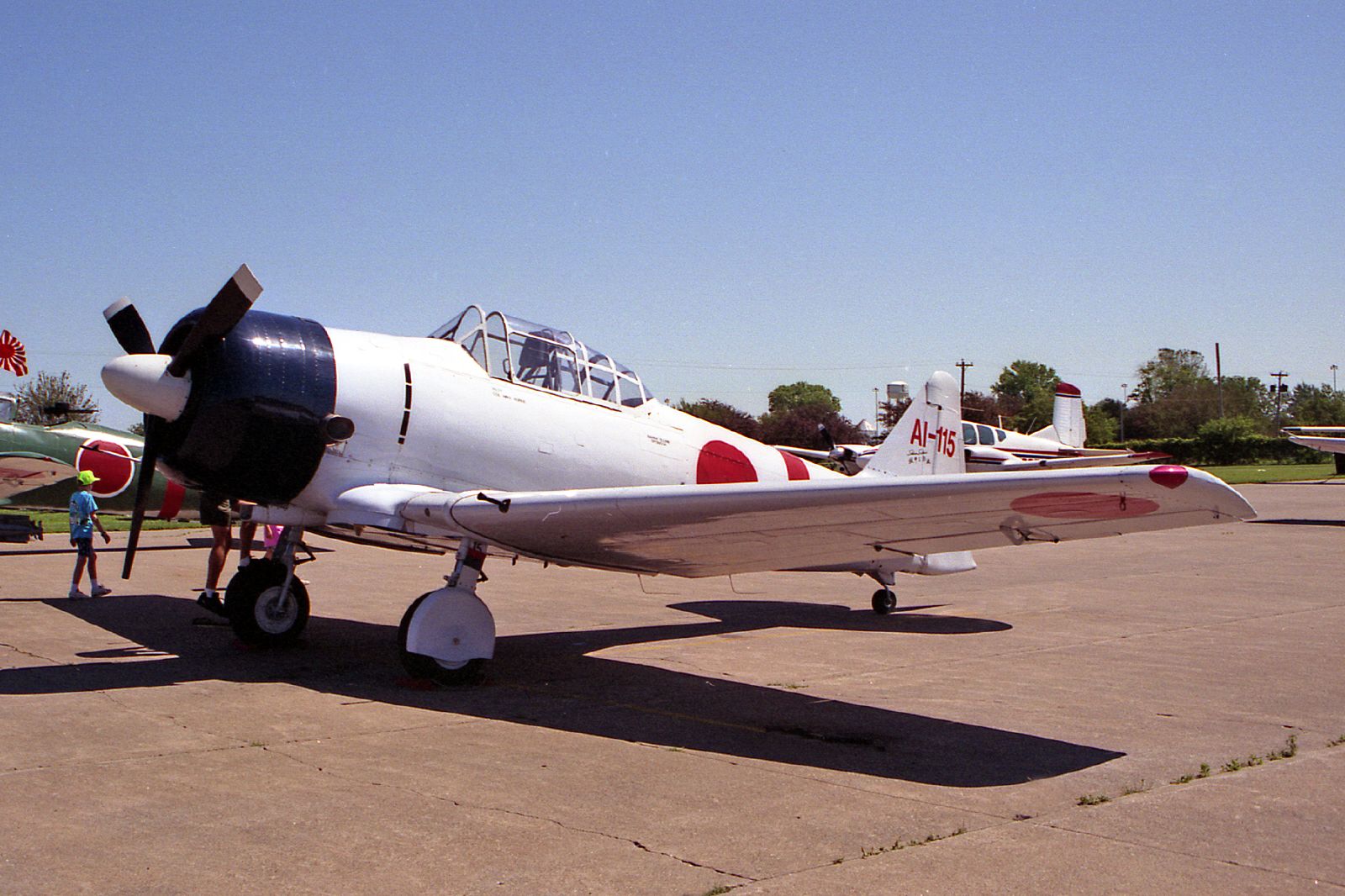
Its early designs included naval types such as the 1MF carrier biplane fighter of 1923 and the 1MT triplane torpedo bomber of 1922; the 1MF9 of 1927 lost out to the Nakajima A1N, and the 1MF10 of 1933 was already a monoplane.
1934: Mitsubishi Heavy Industries is born
The two branches came together in 1934. According to the company's Japanese history, Iwasaki Koyata, the fourth head of the group, decided to merge shipbuilding and aviation to restore the finances of loss-making subsidiaries: in April Mitsubishi Shipbuilding renamed itself Mitsubishi Heavy Industries, and in June it absorbed Mitsubishi Aircraft. The Japanese term for "heavy industries" is said to have been coined by Koyata himself from the English phrase. The Kobe shipyard joined that same year and the Yokohama dockyard was absorbed in 1935. The new company built ships, heavy machinery, aircraft and railway cars.
The aircraft of the Pacific War
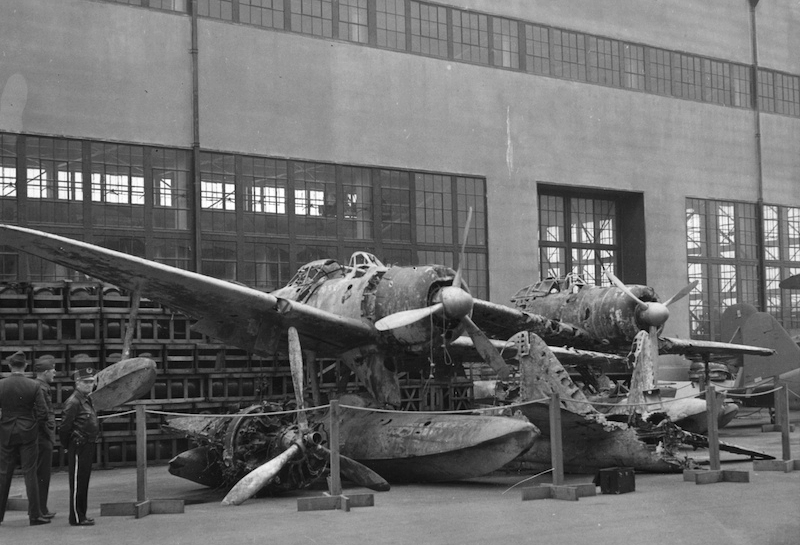
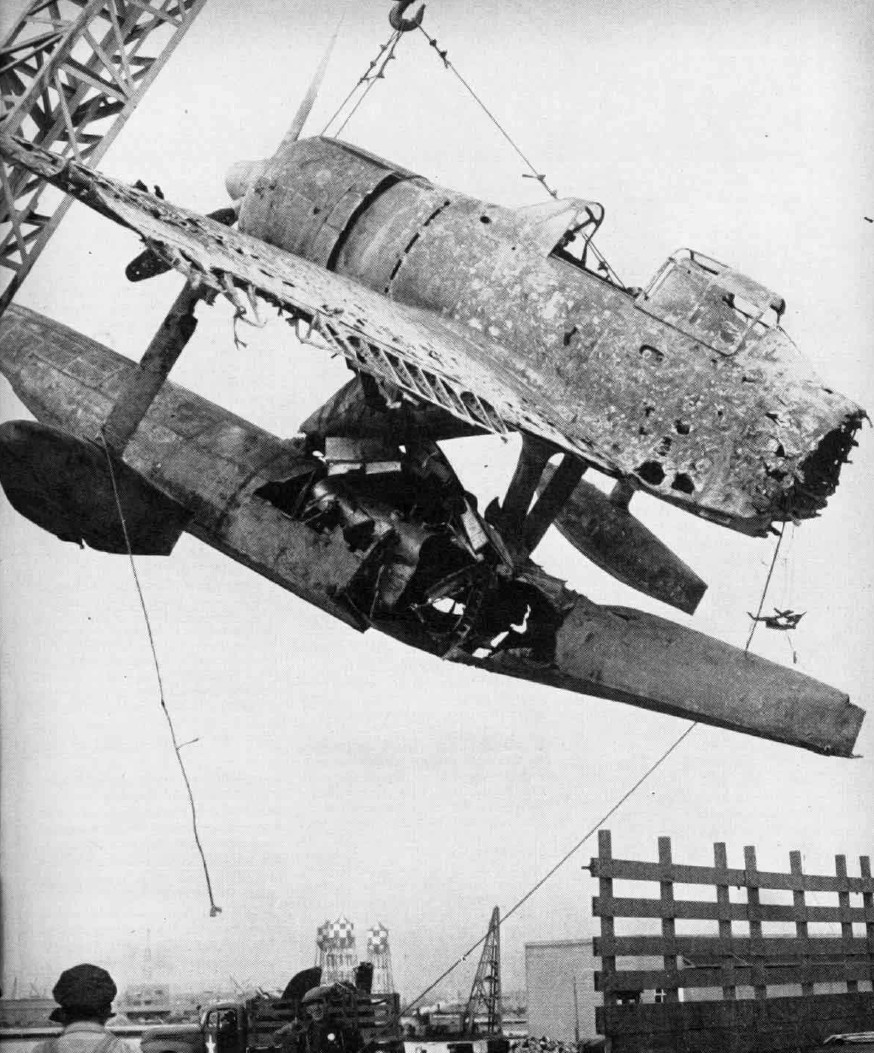
In the run-up to the war Mitsubishi became a pillar of Japanese military production, which rose from 400 aircraft in 1931 to 4,800 in 1941 and peaked at 24,000 in 1944. Some forty models for the Imperial Army and Navy came out of its design offices. The company's list of aircraft dates the G3M twin-engine medium bomber and torpedo bomber to 1935, and the A5M carrier fighter entered service in 1936; the Army received the Ki-21 heavy bomber and the Ki-30 light bomber in 1938. The year 1940 brought the long-range A6M Zero carrier fighter and the G4M bomber, 1941 the Ki-46 reconnaissance aircraft, 1942 the J2M Raiden and A7M Reppū fighters, and 1944 the Ki-67 Hiryū bomber. The Zero was developed at Komaki, the same site where the MRJ regional jet would be born decades later.

The Nagasaki yard, meanwhile, delivered the battleship Musashi in 1942, and the Kobe yard built the liner Argentina Maru, later converted into the aircraft carrier Kaiyo.
Break-up and reunification
Japan's defeat brought the dissolution of the zaibatsu. A break-up order was issued in June 1949, and in January 1950 MHI was split into three regional companies: West Japan Heavy Industries around Nagasaki, Central Japan Heavy Industries around Kobe and East Japan Heavy Industries around Yokohama. When the occupation ended on 28 April 1952 the ban on zaibatsu names was lifted, and on 7 May 1952 all three took the Mitsubishi name again. Their product lines increasingly overlapped and, despite criticism that it meant the return of the zaibatsu, the three merged in 1964 to form today's Mitsubishi Heavy Industries.
Back into aeronautics
During the 1950s the company re-entered the aerospace industry in earnest. For the Self-Defense Forces it built North American F-86 Sabre, Lockheed F-104 Starfighter and McDonnell Douglas F-4 Phantom II fighters under licence.
Work on the MU-2, Mitsubishi's first post-war design, started in 1956: a light twin turboprop for civil and military roles that first flew on 14 September 1963. That same year Mitsubishi granted Mooney the rights to assemble and sell it in North America; a line opened in San Angelo, Texas, in 1965, receiving major components from Japan, and in 1969, with Mooney in financial trouble, Mitsubishi took the plant over. US production ended in 1986 and the last Japanese-built aircraft was completed in January 1987, for a total of 704, making the MU-2 one of post-war Japan's most successful aircraft.
Fighters and helicopters for defence
In defence, MHI has built jet fighters for the Air Self-Defense Force and anti-submarine helicopters for the Maritime Self-Defense Force, as well as aero-engines, missiles and torpedoes. Its range includes the T-2 trainer and the F-1 and F-2 combat aircraft. From 1981 it built 139 F-15J fighters under licence, and from 1989 another 200 helicopters of the Sikorsky S-70 family, the Mitsubishi H-60. The company also plays an important part in Japan's ballistic missile defence programme.
A Boeing supplier
In commercial aviation MHI has established itself as a maker of large airframe components, including fuselage panels for the Boeing 777 and composite wing boxes for the 787. In June 2014 it joined four other major Japanese companies in an agreement to build parts for the 777X. Its aerospace facilities are in Nagoya, Komaki and Mississauga, Canada.
Launchers: from licence to H3
Space followed a path much like aviation. The N-I, N-II and H-I launchers were built under licence from McDonnell Douglas; then came the H-II and its successor, the H-IIA, developed and operated by MHI together with JAXA. The H-IIA made a successful debut from Tanegashima on 29 August 2001. On 1 April 2007 JAXA handed management and production over to MHI, and Flight 13, carrying the SELENE lunar orbiter, became the first mission under private operation. The rocket flew 50 times, with 49 successes and a run of 44 in a row between 2003 and 2025, before retiring on 28 June 2025. Its derivative, the H-IIB, with two LE-7A engines in the first stage, first flew on 10 September 2009 and was retired in 2020.
Its replacement is the H3, developed with JAXA and approved by the government on 17 May 2013. MHI is the prime contractor, oversees final assembly and developed the propulsion system with JAXA, built around the new LE-9 engine designed to cut launch costs. Problems with the LE-9 pushed the debut back from 2021: a first attempt in February 2023 was aborted on the pad, and the flight of 7 March 2023 was lost when the second stage failed to ignite. On 17 February 2024 the H3 achieved its first successful flight. MHI also sells launch services to customers such as JAXA, Korea's KARI, the Mohammed bin Rashid Space Centre and Inmarsat, and takes part in the International Space Station as a cargo spacecraft contractor; its space portfolio includes the Kibo module and the H-II Transfer Vehicle.
MRJ and SpaceJet: the failed gamble
On 28 March 2008 MHI formally launched the Mitsubishi Regional Jet, a 70-to-90-seat airliner, with an initial order from All Nippon Airways, and on 1 April 2008 it created the subsidiary Mitsubishi Aircraft Corporation to develop and build it at Komaki. It was the first Japanese airliner since the YS-11. Delays piled up: the first flight, at one point expected in 2012, did not happen until 11 November 2015, and much of the test campaign moved to Moses Lake, Washington. Four of the five postponements were caused at least in part by failures to document work for certification.
The aircraft was renamed SpaceJet and, to strengthen it, MHI announced on 25 June 2019 the purchase of Bombardier's CRJ programme, whose unit became MHI RJ Aviation Group. Losses in FY 2020 and the COVID-19 pandemic led to flight testing being halted in May 2020 and the programme being put on hold in October. On 6 February 2023 MHI cancelled the SpaceJet for good, abandoned its plans to enter the jetliner business and liquidated the subsidiary, renamed MSJ Asset Management Company in April 2023. The SpaceJet's cost even reached other businesses: in 2017 the company left the manufacture of SCMaglev magnetic-levitation train cars.
Catalog — Aircraft
- —
Mitsubishi A6M Zero
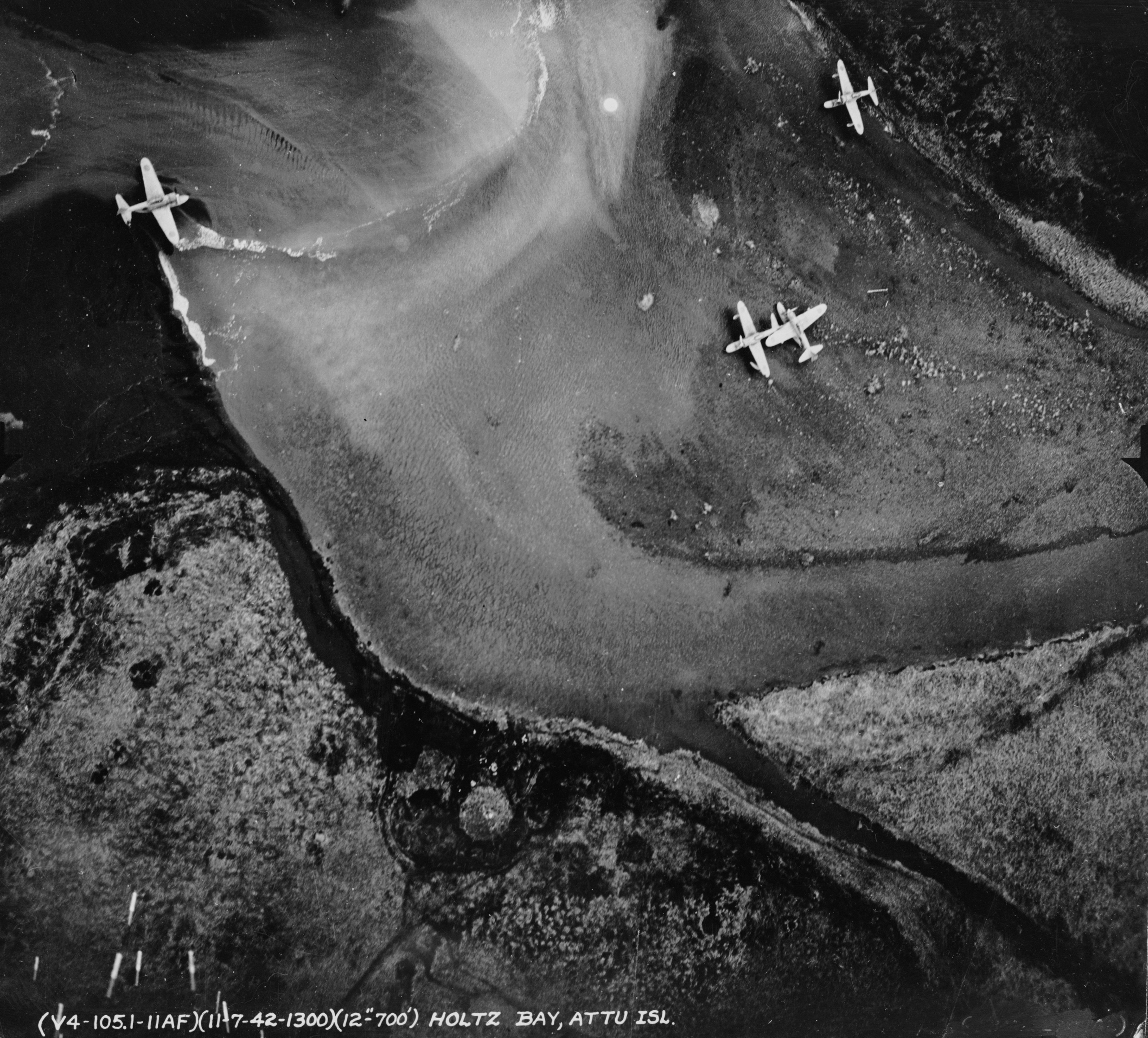
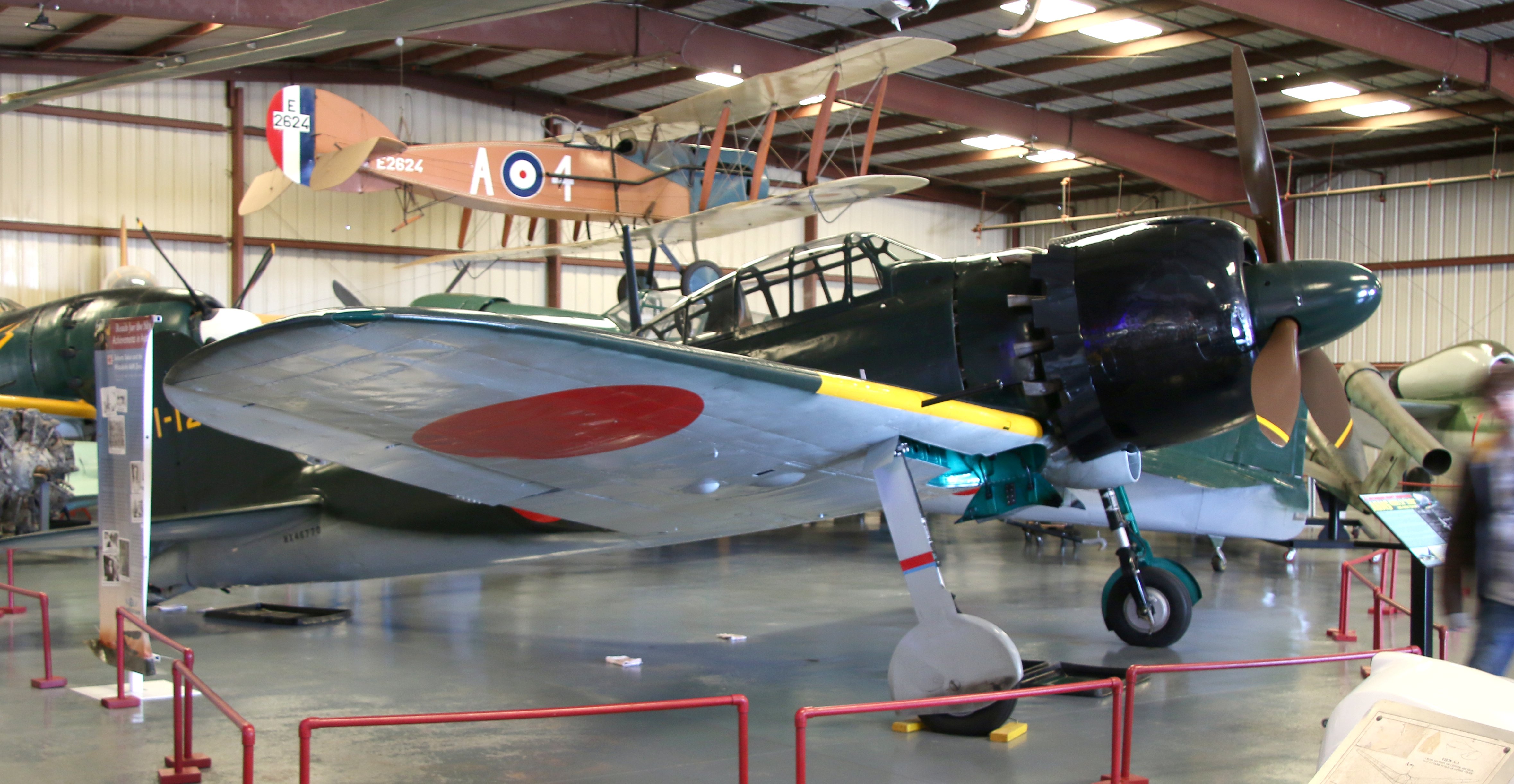
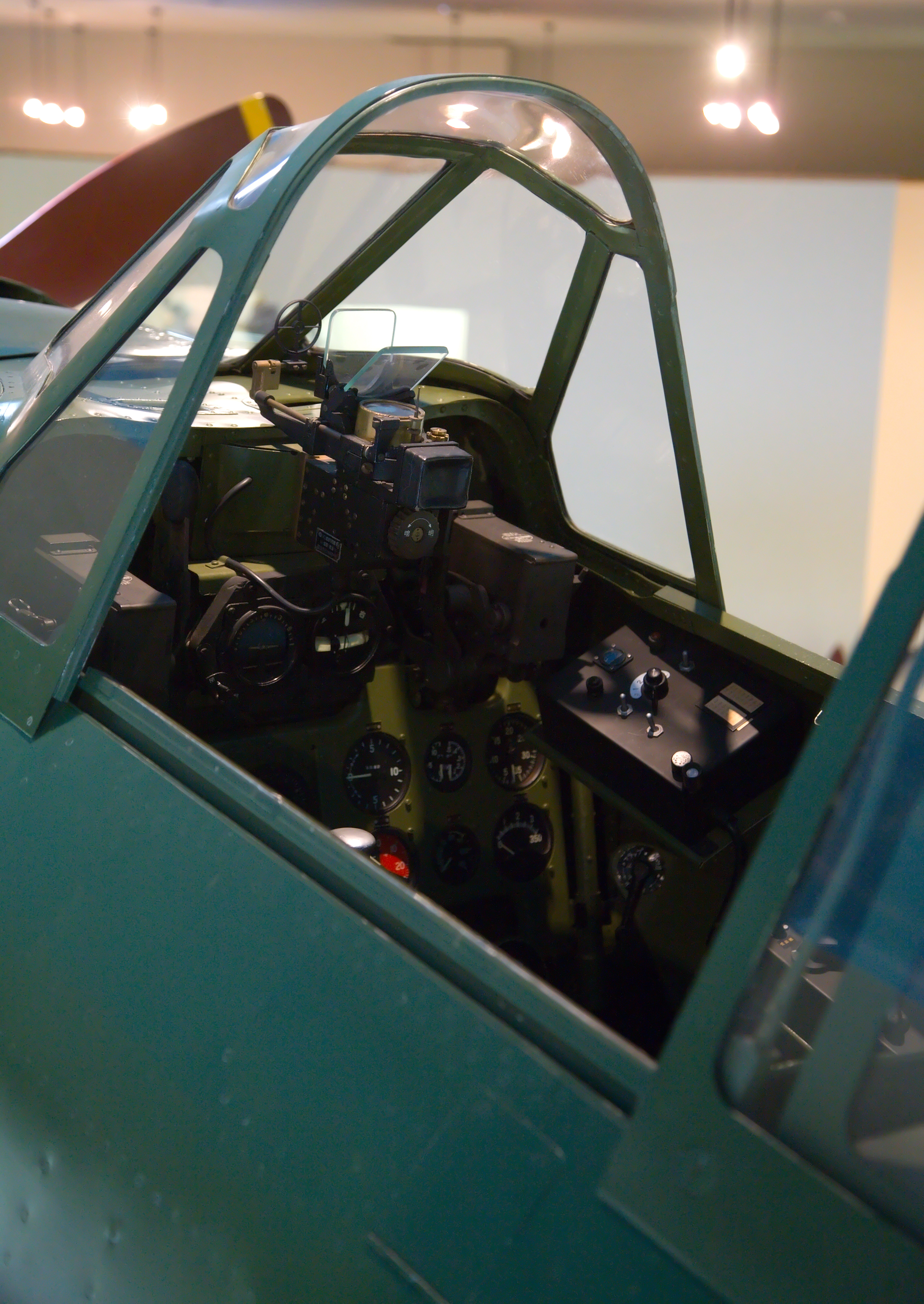
The Mitsubishi A6M was the carrier fighter with which the Imperial Japanese Navy fought the Pacific War from beginning to end. Its official designation was Type 0 carrier fighter (零式艦上戦闘機, rei-shiki kanjō sentōki); the zero came from the last digit of imperial year 2600 — 1940 — when it entered service, and its own pilots called it Reisen or Zero-sen. When the Allies introduced a code-name system for Japanese aircraft in 1942 they assigned it "Zeke", but the name that stuck in the West was simply "Zero". The programme began on 5 October 1937, when the Navy sent Mitsubishi and Nakajima the planning requirements for the 12-shi carrier-based fighter prototype; that same October it updated them in the light of what its predecessor, the A5M, had met in China: 500 km/h at 4,000 m, a climb to 3,000 m in 9.5 minutes, two 20 mm cannon and two 7.7 mm machine guns, a radio set and a direction finder for long-range navigation, manoeuvrability at least equal to the A5M's, and a wingspan under 12 m so the aircraft could operate from carriers. Mitsubishi's chief designer, Jiro Horikoshi, concluded the specification could be met only if the aircraft were made as light as possible, and that decision defined it: no armour was provided for the pilot, the engine or any other critical point, and the self-sealing fuel tanks then becoming standard among other combatants were left out. The result was an exceptionally agile fighter and one of the longest-ranged single-engine aircraft of the war — able to seek out an enemy hundreds of kilometres away, bring him to battle and return to base or carrier — but also one prone to catching fire when hit. The first two A6M1 prototypes, powered by the 580 kW (780 hp) Mitsubishi Zuisei 13 with a two-blade propeller, were completed in March 1939, and the first flew on 1 April. The Navy suggested fitting the third with the 700 kW (940 hp) Nakajima Sakae 12, and with that engine the A6M2, completed in January 1940, pushed performance well past the original specification. In July 1940 the first aircraft reached Manchuria and in August they entered combat over Chongqing, where they proved untouchable by the Polikarpov fighters that had given the A5M so much trouble; on 13 September 1940 thirteen A6M2s led by Lieutenant Saburo Shindo, escorting twenty-seven G3M bombers, engaged thirty-four Chinese I-15s and I-16s and claimed twenty-seven kills without loss to themselves. In its most widely used early form, the Model 21, the aircraft was 9.06 m long with a span of 12 m and a height of 3.05 m, 22.44 m² of wing area, 1,680 kg empty and 2,796 kg loaded; it reached 533 km/h at 4,550 m, cruised at 333 km/h, climbed at 15.7 m/s, had a ceiling of 10,000 m and a range of 1,870 km that extended to 3,100 km in ferry configuration with a drop tank. The advantage did not last. In early operations the Zero earned its reputation as an unbeatable dogfighter — the English Wikipedia credits it with a twelve-to-one kill ratio in that period — but by mid-1942 a combination of new tactics and better equipment let Allied pilots meet it on generally equal terms. Two assets counted for much: the weave developed by John Thach, which cancelled the Zero's turning advantage by working in pairs, and Petty Officer Tadayoshi Koga's A6M2 Model 21, which crash-landed on Akutan Island, Alaska, and was recovered essentially intact by the Americans in July 1942, allowing the fighter to be studied in detail. To these were added aircraft designed with the Zero in mind — the Grumman F6F Hellcat, the Vought F4U Corsair, the Lockheed P-38 Lightning — and the design's own limits: with no hydraulic boosting for ailerons and rudder it grew hard to manoeuvre at high speed. From mid-1943 the decline in Japanese naval fighter pilot training deepened the disadvantage, and in June 1944, at the Battle of the Philippine Sea, the Zero squadrons were destroyed by American carrier aviation. Mitsubishi tried to keep the aircraft current to the end: the A6M7, with a Sakae 31 of 1,130 hp and a centreline rack for a 250 kg bomb, was a thorough reworking meant to turn it into a carrier dive bomber. Its intended successor, the A7M Reppū, never arrived in time, so the Zero stayed in front-line service until 1945 and ended its career as a suicide-attack aircraft in the kamikaze operations of the war's final year. Total production is usually given as some 10,939 aircraft between Mitsubishi and Nakajima, which built it under licence, though Wikipedia also records the 10,934 of the USSBS report: no primary source breaking the total down by plant and variant has been located, and the figure should be treated as attributed. Of the aircraft that defined Japanese naval air power there remain museum pieces — the National Air and Space Museum holds an A6M5 Model 52 — and a persistent cultural presence, from the replicas built for Tora! Tora! Tora! to Horikoshi as a figure of fiction.
Catalog — Rockets
- 2026
H3-30
The H3-30 is a specific configuration of the H3, the Japanese medium-lift launch vehicle developed by JAXA and Mitsubishi Heavy Industries as the successor to the H-IIA and H-IIB. H3 configurations are identified by two digits and a letter: the first digit gives the number of LE-9 engines on the core stage (two or three), the second the number of SRB-3 solid rocket boosters fitted (zero, two or four), and the final letter specifies the fairing, short (S), long (L) or wide (W). The H3-30 is therefore the version with three LE-9 engines and no solid boosters. That combination makes it a singular case: by dispensing entirely with solid rocket boosters, the H3-30 is a fully liquid-propellant launcher, burning liquid hydrogen and liquid oxygen in both stages. Its liftoff mass is 271 tonnes, well below the 420 of the H3-22 or the 575 of the H3-24, and with the short fairing the vehicle stands 57 m tall on a 5.27 m diameter. The H3-30 was conceived as the family's low-cost variant, aimed primarily at government customers. It can carry up to 4,000 kg to Sun-synchronous orbit for about ¥5 billion, roughly half the cost of an H-IIA, with the declared intention of matching SpaceX's Falcon 9 on price. It flies from the LA-Y2 complex at the Tanegashima Space Center.
- —
H3-22 Sheet pending


