United Kingdom · 1909–
Handley Page
Handley Page Limited was a British aircraft manufacturer founded by Frederick Handley Page in 1909 and based at Radlett Aerodrome in Hertfordshire. It holds the distinction of being the first publicly traded aircraft manufacturing company in the United Kingdom, and its name became permanently attached to two specialities: heavy bombers and large airliners. Out of its works came the twin-engined O/100 and O/400 with which the Royal Navy struck at the German Zeppelin yards, the four-engined V/1500 designed with the range to reach Berlin, the Hampden bomber, the Halifax — the second most prolific British heavy bomber of the Second World War — and the Victor, one of the three jets that carried Britain's nuclear deterrent. On the civil side it produced Imperial Airways' luxurious H.P.42 biplanes, the Herald turboprop and the small Jetstream. The firm also left a lasting technical mark with the leading-edge slat that bears its name, whose licensing fees were for a time its principal source of income. Handley Page was the only one of the British majors to resist government pressure to merge, and that isolation finished it: the company went into voluntary liquidation in 1970 after sixty-one years trading under the same name.
History
The first listed manufacturer
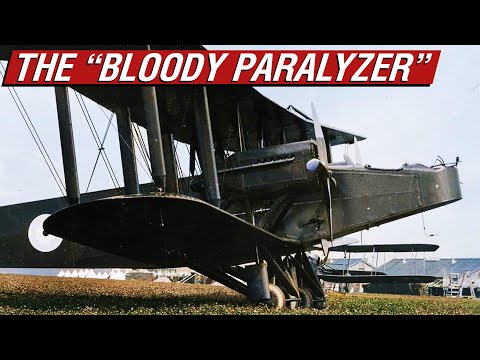
Frederick Handley Page experimented with biplanes and monoplanes at premises in Woolwich, Fambridge and Barking Creek before incorporating his company on 17 June 1909, the first British public company formed to build aircraft. In 1912 he moved the factory to Cricklewood, with an adjacent aerodrome from which newly completed machines flew and which the firm's own airline would later use; years afterwards that ground became the largest film studio in the country. The First World War defined the company's speciality when the Admiralty asked it for what has passed into history as "a bloody paralyser of an aeroplane": out of that request came the twin-engined O/100 in 1915, the O/400 and the enormous four-engined V/1500, intended to bomb Berlin in revenge for the Zeppelin raids on London, which had barely entered operational service when the war ended in 1918.
From the Atlantic to the Imperial routes
Early in 1919 a V/1500 named Atlantic was shipped to Newfoundland to attempt the first non-stop transatlantic flight, only to be beaten by Alcock and Brown's Vickers Vimy; the Handley Page machine eventually reached New York by way of Canada in October of that year, carrying the first airmail between the two countries. The company then converted several O/400s for passenger use and flew them on the London-Paris route with its own airline, Handley Page Transport, which in 1924 merged with two other carriers to create Imperial Airways as Britain's national airline. For those routes to Africa and India the firm developed large biplane airliners, among them the luxurious H.P.42. In parallel, Handley Page patented the leading-edge slat, an auxiliary aerofoil mounted ahead of and above the wing that improved airflow at high angles of attack and low-speed handling; the same device was designed simultaneously by the German aerodynamicist Gustav Lachmann, whom the company later employed. It was so successful that licensing fees charged to other manufacturers became its main source of income in the early 1920s. In 1929 Cricklewood Aerodrome closed and final assembly moved to Radlett, though parts and sub-assemblies continued to be built at the old site until 1964.
Hampden, Halifax and Victor
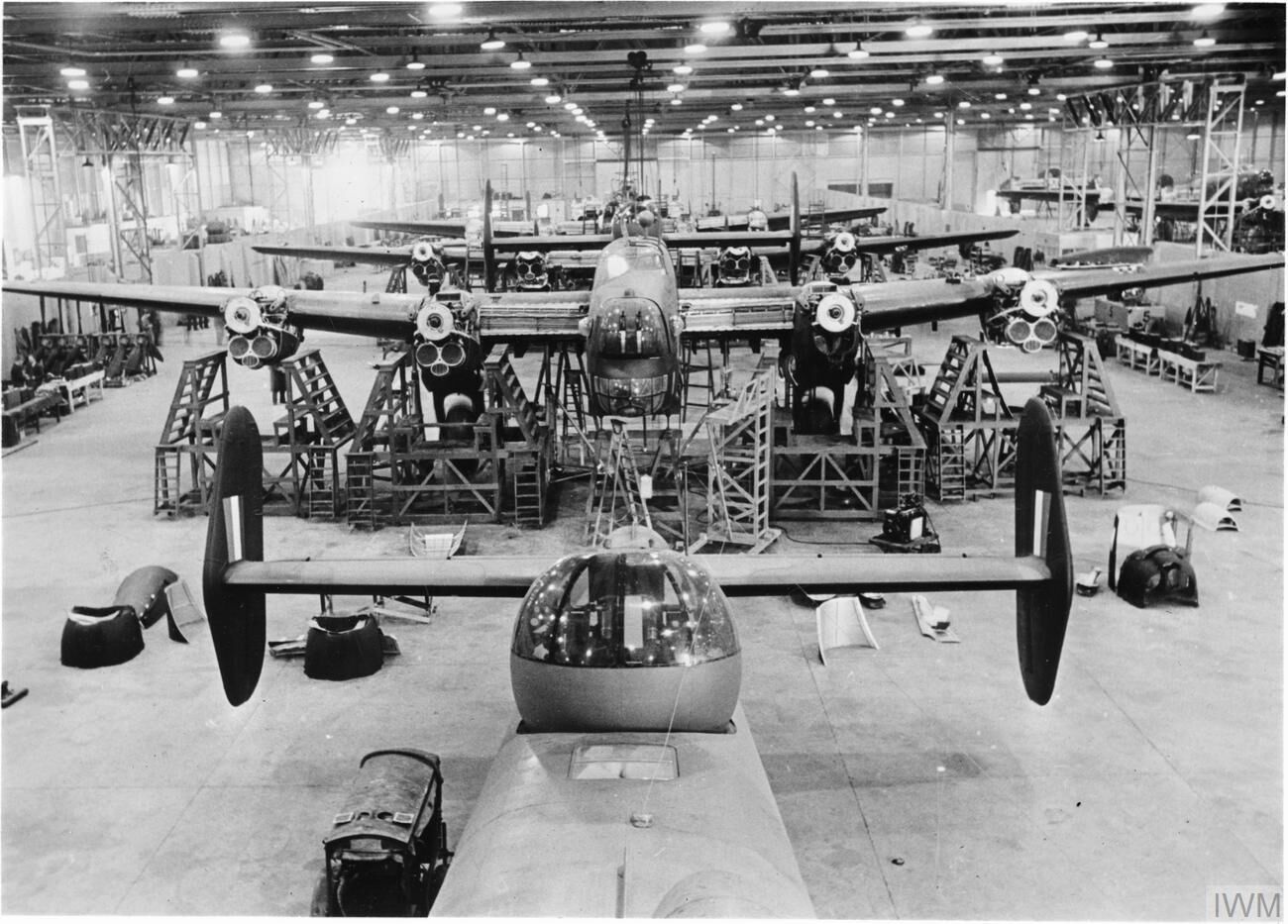
With war approaching, Handley Page designed the HP.52 Hampden, which took part in the first British raid on Berlin. Answering a 1936 government request for heavier, longer-ranged aircraft, the firm tendered the HP.56 powered by two Rolls-Royce Vultures; that engine proved so troublesome that the Air Staff decided the design should have four engines instead, and it was reworked before reaching prototype stage into the four-engined HP.57 Halifax. It became the second most prolific British heavy bomber of the war after the Lancaster and, though better in some respects such as crew survivability, fell short on altitude performance; towards the end of the conflict it was redeployed as a heavy transport and glider tug. After the war the government sought jet bombers to carry the national nuclear deterrent, and Handley Page's contribution was the HP.80 Victor, a four-engined crescent-winged design that went on serving as a tanker long after the company that created it had gone.
Reading, the Jetstream and liquidation
In 1947 Handley Page bought part of the assets of the bankrupt Miles Aircraft company: designs, tools and jigs — including those for the M.52 supersonic research aircraft — and the Miles site at Woodley, near Reading. The purchase produced Handley Page (Reading) Ltd, whose projects carried HPR designations thereafter and from which, out of an inherited design, came the Herald airliner. Unlike the other British majors, the firm refused to bow to official pressure to fold into a larger entity, so that by the late 1960s, with the industry divided between Hawker Siddeley and the British Aircraft Corporation, it found itself unable either to compete for government orders or to build large commercial aircraft. Its last notable design was the Jetstream, a small pressurised turboprop commuter aircraft seating twelve to eighteen and aimed chiefly at the American feederliner market. It was a success, but it came too late: the company went into voluntary liquidation in March 1970. The Jetstream outlived its creator, since the design was bought and produced by Scottish Aviation at Prestwick and stayed in production after British Aerospace absorbed that company in 1977.
Catalog — Aircraft
- 1910
Handley Page Type B Sheet pending
- 1912
Handley Page Type F Sheet pending
- 1913
Handley Page Type G Sheet pending
- 1915
Handley Page Type O Sheet pending
Variants (5)
- O/10
- O/100
- O/11
- O/400
- O/7
- 1918
Handley Page V/1500 Sheet pending
- 1919
Handley Page Type W Sheet pending
Variants (7)
- W.10
- W.8
- W.8b
- W.8e
- W.8f
- W.8g
- W.9a Hampstead
- 1921
Handley Page H.P.20 Sheet pending
- 1922
Handley Page Hanley Sheet pending
- 1923
Handley Page Type S Sheet pending
- 1923
Handley Page Hyderabad Sheet pending
- 1924
Handley Page HP.28 Handcross Sheet pending
- 1926
Handley Page H.P.31 Harrow Sheet pending
- 1926
Handley Page Hamlet Sheet pending
- 1927
Handley Page Hinaidi Sheet pending
Variants (4)
- HP.33 Clive I
- HP.33 Hinaidi I
- HP.35 Clive II
- HP.36 Hinaidi II
- 1930
Handley Page Heyford Sheet pending
Variants (5)
- H.P.38
- H.P.50 Heyford I
- H.P.50 Heyford IA
- H.P.50 Heyford II
- H.P.50 Heyford III
- 1930
Handley Page H.P.42 Sheet pending
Variants (2)
- H.P.42E
- H.P.42W
- 1932
Handley Page H.P.43 Sheet pending
- 1932
Handley Page H.P.46 Sheet pending
- 1934
Handley Page H.P.47 Sheet pending
- 1935
Handley Page H.P.51 Sheet pending
- 1936
Handley Page Hampden Sheet pending
Variants (3)
- Hampden Mk I
- Hampden Mk II
- Hereford
- 1936
Handley Page H.P.54 Harrow Sheet pending
Variants (2)
- Harrow Mk.I
- Harrow Mk.II
- 1939
Handley Page Halifax Sheet pending
Variants (26)
- Halifax A.III
- Halifax A.IX
- Halifax A.V
- Halifax A.VII
- Halifax B.III
- Halifax B.II Series I
- Halifax B.II Series IA
- Halifax B.II Series II
- Halifax B.II Series I (Special)
- Halifax B.I Series I
- Halifax B.I Series II
- Halifax B.I Series III
- Halifax B.V
- Halifax B.VI
- Halifax B.VII
- Halifax C.III
- Halifax C.VI
- Halifax C.VII
- Halifax C.VIII
- Halifax GR.II Series I
- Halifax GR.II Series IA
- Halifax GR.V
- Halifax GR.VI
- Halton I
- Halton II
- H.P.57
- 1943
Handley Page Manx Sheet pending
- 1945
Handley Page Hermes Sheet pending
Variants (5)
- HP.68 Hermes I
- HP.74 Hermes II
- HP.81 Hermes IV
- HP.81 Hermes IVa
- HP.82 Hermes V
- 1946
Handley Page Hastings Sheet pending
Variants (8)
- Hastings C1
- Hastings C1A
- Hastings C2
- Hastings C3
- Hastings C4
- Hastings Met.1
- Hastings T5
- HP.67 Hastings
- 1946
Handley Page Marathon Sheet pending
Variants (4)
- M.60 Marathon
- Marathon I
- Marathon T.11
- Miles M.69 Marathon II
- 1951
Handley Page HP.88 Sheet pending
- 1952
Handley Page Victor Sheet pending
Variants (10)
- HP.80
- Victor B.1
- Victor B.1A
- Victor B.1A (K.2P)
- Victor B.2
- Victor B.2RS
- Victor BK.1
- Victor BK.1A
- Victor B(SR).2
- Victor K.2
- 1955
Handley Page Herald
The Handley Page HPR.7 Dart Herald was a British regional airliner with a high wing, a pressurised cabin and two Rolls-Royce Dart turboprops, conceived in the mid-1950s as a replacement for the ubiquitous Douglas DC-3 on short routes and rough, poorly equipped airfields. It was born with the wrong engines. After extensive consultation with DC-3 operators, Handley Page chose four Alvis Leonides Major piston engines for the original HPR.3, which first flew from Radlett on 25 August 1955; at almost the same moment Fokker made the opposite choice and powered its F27 Friendship with two Darts. By the time the British company reversed course and converted the prototype into the HPR.7 Dart Herald, flown on 11 March 1958, the market had settled on the turboprop and the Dutch rival was months ahead. The rest of the story is one of a recovery that never came. The Series 200, stretched and seating up to 56 passengers, entered service with Jersey Airlines in 1961 and was the only version sold in any quantity; the attempt to sell the type to the RAF as a tactical transport foundered on the Ministry of Aviation's merger policy, and only eight examples of the military Series 400 were built, all for the Royal Malaysian Air Force. Production closed in 1968 with fifty aircraft, against more than 240 Friendships sold by Fokker. That commercial failure contributed to the end of Handley Page, which went into voluntary liquidation in August 1969. The aircraft outlived its maker: it flew passengers until 1987 and freight until 9 April 1999, with an excellent reputation among its crews for stability, docile slow-speed handling and the ability to work from short, unprepared strips.
- 1961
Handley Page HP.115 Sheet pending
- 1967
Handley Page Jetstream Sheet pending
Variants (7)
- Century III
- Jetstream 200
- Jetstream 3M
- Jetstream Mk 1
- Jetstream T.1
- Jetstream T.2
- Riley Jetstream
- —
Handley Page Hare Sheet pending
- —
Handley Page Type E Sheet pending
- —
Handley Page Type D Sheet pending
- —
Handley Page HP.14 Sheet pending
- —
Handley Page Basic Trainer Sheet pending
- —
Handley Page Gugnunc Sheet pending
- —
Handley Page Type A Sheet pending
- —
Handley Page H.P.22 Sheet pending
- —
Handley Page Hendon Sheet pending
Variants (3)
- Hendon I
- Hendon II
- Hendon III







![The British Bomber That Looked Utterly Ridiculous | Handley Page Heyford [Aircraft Overview #91]](https://i.ytimg.com/vi/A4tr_INSnjk/hqdefault.jpg)