Germany
Bücker Flugzeugbau
Bücker Flugzeugbau GmbH was a German aircraft manufacturer based in Berlin, specialising in sporting and training aeroplanes. It was founded by Carl Clemens Bücker, a naval aviator of the First World War who had spent more than a decade in Sweden running Svenska Aero and who, on his return to Germany, set up at the Johannisthal aerodrome; sources place the company's foundation in 1932 or 1933. In 1935 it moved to a new factory at Rangsdorf, south of the capital, designed by architects close to the Bauhaus. With the Swedish engineer Anders J. Andersson as chief designer, the firm produced three aircraft that made it famous: the Bü 131 Jungmann training biplane (1934), the aerobatic Bü 133 Jungmeister and the Bü 181 Bestmann monoplane (1939), which ended up as the Luftwaffe's standard trainer. Its aircraft were exported to many countries and built under licence in Switzerland, Czechoslovakia, Japan and Spain, and its pilots collected victories in the aerobatic competitions of the 1930s. Despite that reputation, relations with the Reich Air Ministry were difficult, and for years the company depended on exports and on licence work for other manufacturers. During the war it built components for the Ju 87, the Fw 190 and the Hs 293 glide bomb, using forced labour. In 1945 the works fell into the Soviet occupation zone, were seized and the company ceased to exist; the former Rangsdorf site, now a protected monument, is the subject of an urban conversion project.
History
A naval aviator in Sweden
Carl Clemens Bücker served as a pilot in German naval aviation during the First World War. After the war, with the Treaty of Versailles forbidding the construction of military aircraft in the Weimar Republic, he moved to Sweden, where in 1921 he founded Svenska Aero at Lidingö. The company was set up to build parts and aircraft of the Caspar works and of Heinkel under licence, and in time developed designs of its own. In those years Bücker met the Swedish engineer Anders J. Andersson, who would become his chief designer and later follow him to Berlin. At the end of 1932 Svenska Aero changed hands and Bücker decided to go home.
Johannisthal and Rangsdorf
Back in Germany, Bücker set up Bücker Flugzeugbau GmbH at the Berlin aerodrome of Johannisthal, the cradle of German aviation. Sources disagree on the date: the English and Spanish encyclopaedias describe a company founded in 1932 that opened its factory in 1934, while the German one places the foundation in 1933. In any event, the firm's first aircraft, the Bü 131 Jungmann training biplane, flew in 1934 and was an immediate success with the flying clubs.
.jpg)
Growth soon called for more room. In the autumn of 1935 the company opened a new factory at the newly created Reich sports airfield at Rangsdorf, south of Berlin. For the project Bücker turned to Heinkel's building department under Herbert Rimpl and to the architect Otto Meyer-Ottens, formerly one of Walter Gropius's closest collaborators, so that the complex was steeped in Bauhaus ideas. Between 1937 and 1940 the site was enlarged to plans by the Berlin architect Otto Werner, with a new flight-test hangar, a final-assembly hall and, in 1940, a special building for secret armaments contracts.
The aircraft
The firm's three great successes were Andersson's work. The Bü 131 Jungmann, a two-seat training biplane, was adopted as the Luftwaffe's primary trainer and built under licence in several countries. It was followed by the Bü 133 Jungmeister, a single-seat aerobatic aircraft that earned the reputation of being the best aerobatic aeroplane in the world: pilots such as Liesel Bach and Count Otto Heinrich von Hagenburg strung together victories at international contests and made the Rangsdorf name known everywhere. In 1936 Switzerland chose both types as its standard trainers after comparing them with many competitors, bought six of each and acquired the manufacturing rights; Dornier's Swiss works at Altenrhein went on to build 88 Bü 131s and 46 Bü 133s, which served for more than thirty years.
Andersson also designed the Bü 134 sporting monoplane, of which only one was built, and the Bü 180 Student, a light two-seater that set world records and of which the Luftwaffe eventually took a few. The Bü 182 Kornett, an economical advanced trainer of which only three were made, aroused no official interest. The last major design was the Bü 181 Bestmann, a low-wing monoplane in which, unusually for the time, instructor and pupil sat side by side; when in late 1937 and early 1938 the Air Ministry needed to replace its elementary trainers, the Bü 181 was designated the Luftwaffe's new standard training aircraft and was mass-produced with the help of two further factories. After the war it went on being built in Czechoslovakia and Egypt.
Bücker was ahead of his time in another respect: he was the first German manufacturer to entrust his aircraft to women pilots. Already at Johannisthal he hired the 24-year-old Luise Hoffmann as test, delivery and demonstration pilot; she died on 27 November 1935 after a serious accident on the way home from a tour of Greece, Turkey and Bulgaria. After her, Eva Schmidt and Beate Köstlin, later Beate Uhse, were given the same chance and scored victories in Bücker aircraft at various events.
A difficult relationship with the Air Ministry
Despite its commercial success, the company never fitted the plans of the Reichsluftfahrtministerium. An internal note of December 1933 stated that the technical office had no interest in Bücker either as a design firm or as a licence builder, citing foreign capital, secrecy concerns and an unwanted concentration of aircraft industry at Johannisthal. The procurement programme of 1934 did not mention the company, and a development meeting in December of that year expressly ruled out trainers of 60 to 80 hp, exactly the class of the Bü 131A. That decision probably prompted Bücker to re-engine the Jungmann with the 105 hp Hirth HM 504, the origin of the B version, which appears in the Rechlin records in 1936.
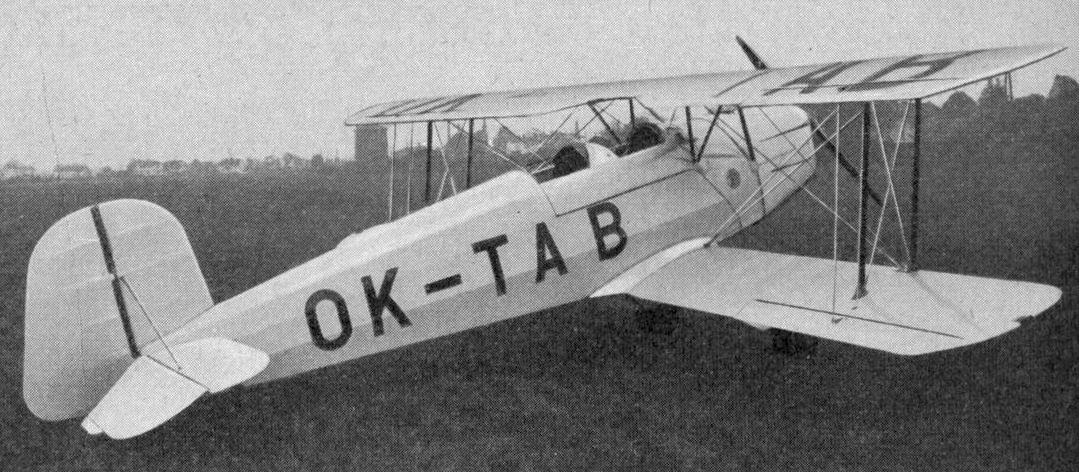
The Ministry did in the end order Jungmanns and Jungmeisters, most likely under the impression of their international success, but it squeezed the prices: it paid 12,000 marks for each Jungmann and 14,000 for each Jungmeister, against 17,500 for a Klemm Kl 35 or a Focke-Wulf Fw 44 and 16,000 for a Heinkel He 72. By March 1937 the Luftwaffe had taken delivery of 363 Bü 131s and a mere 14 Bü 133s, modest numbers next to the 653 He 72s and 1570 Fw 44s on its books; 85 of the latter had been built by Bücker itself under licence on Ministry order. In January 1937 a further meeting concluded that there would be no more development tasks for Bücker, Klemm, Fieseler and other smaller firms, which were advised to work on a people's aeroplane of 50 to 60 hp; the Bü 180 may have been the answer to that suggestion.
An accident illustrates how fragile production was: on 21 May 1939 an Fw 44 from the neighbouring flying school crashed onto Bücker's flight-test hangar and destroyed between 40 and 50 aircraft ready for delivery, which brought Bü 131 deliveries to zero for two months. To recover the pace, the Ministry ordered 200 Jungmanns under licence from the Aero factory in Prague, by then under the Protectorate of Bohemia and Moravia, which delivered them up to September 1941.
The war
During the conflict the work at Rangsdorf turned increasingly to war production. Besides its own trainers, the company built the Focke-Wulf Fw 44 and the DFS 230 assault glider under licence, and made components for the Junkers Ju 87 dive bomber, the Focke-Wulf Fw 190 fighter and the Henschel Hs 293 guided glide bomb. Forced labour was used in this work: up to 500 prisoners from the Soviet Union lived in poor conditions in a camp next to the factory, and there were also forced labourers from France, Italy and other countries. An almost unknown chapter is the development of a propeller-driven sledge, modelled on a captured Soviet example, which was demonstrated to specialists but never went into production.
After 1945
The end of the war meant the definitive end of the company. The Rangsdorf site, which had come through the bombing intact, lay in the Soviet occupation zone and was seized. Much of the infrastructure, including six hangars, was dismantled and shipped to the Soviet Union; the remaining production hall and the airfield served Soviet forces for engine maintenance and, from 1972, as a helicopter base, surrounded by new military buildings that local people came to call a small closed town. In the late 1950s Carl Clemens Bücker tried, together with the firm Josef Bitz of Augsburg, to restart small-scale production of the Jungmann and Jungmeister, still highly prized by enthusiasts, but without success.
Rangsdorf today
Soviet units left the former Bücker works in 1994. The land passed first to the federal government and in 1999 was divided between the municipality of Rangsdorf and the state of Brandenburg. The halls were listed as monuments and the municipality looked for new uses: a Polish investor tried to build Bü 131s again in the hangars, a scheme that failed against opposition from residents of the housing estates that had grown up around the site; in 2006 a couple of Berlin artists bought the canteen and the welfare building to convert them into a home and studio, and in 2018 the terraplan group of Nuremberg acquired the old hangars with the aim of creating a new district of housing and public facilities in the historic halls while keeping the airfield as a public park. Access to the site is closed to the public, but the Förderverein Bücker-Museum Rangsdorf, an association devoted to researching the company's history, offers regular guided tours.
Catalog — Aircraft
- —
Bücker Bü 131 Jungmann
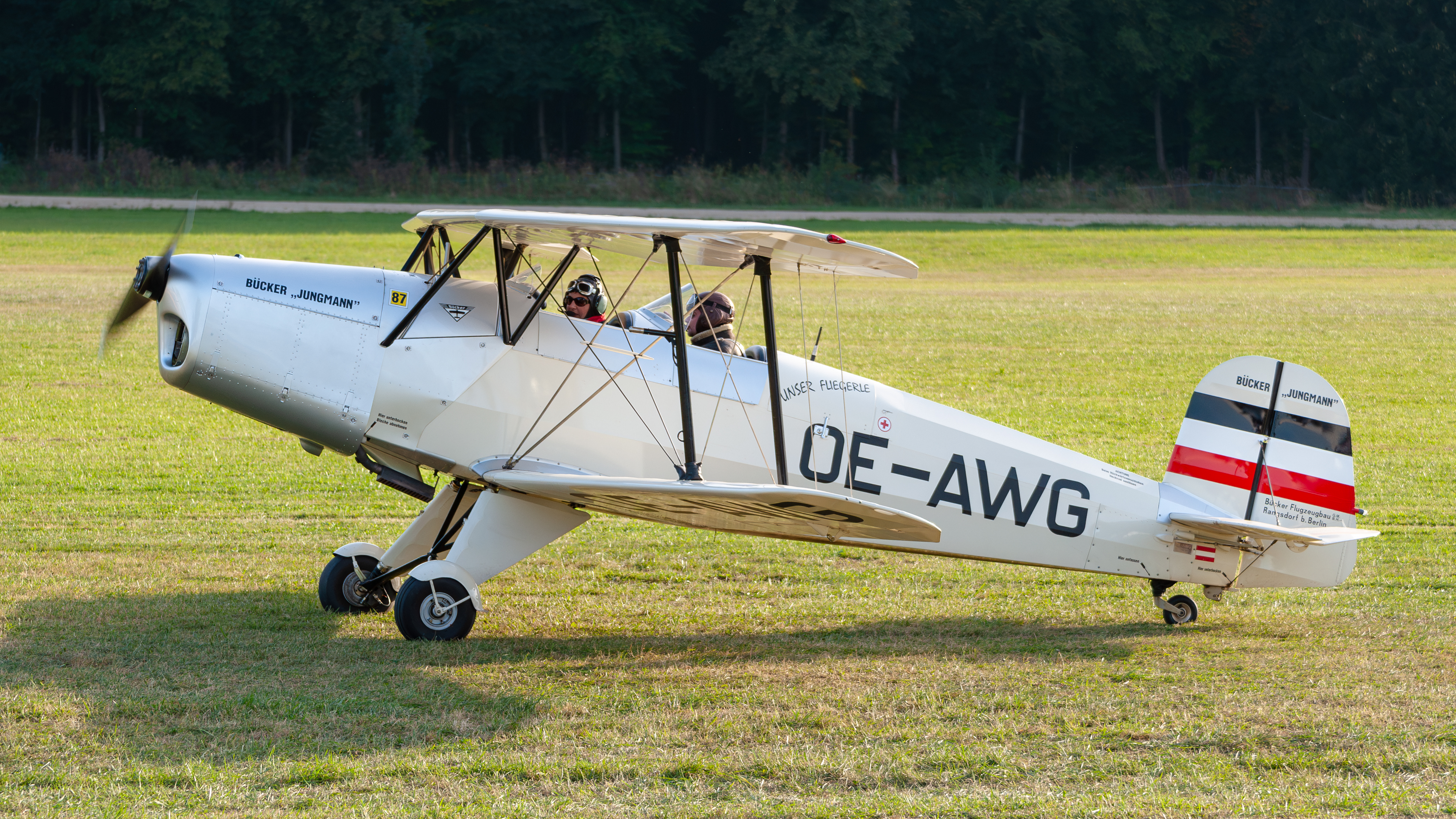
The Bücker Bü 131 Jungmann is a two-seat primary trainer biplane with open tandem cockpits and fixed undercarriage, unveiled in Berlin in 1934 by the newly founded Bücker Flugzeugbau. It was the company's first aircraft and, at the same time, the last biplane to be built in quantity in Germany. Designed by the Swedish engineer Anders J. Andersson for Carl Clemens Bücker, a former naval aviator who had spent the post-war years building aircraft in Sweden, it first flew on 27 April 1934 and quickly became the standard elementary trainer of the German flying clubs and of the new Luftwaffe. Its success spread well beyond Germany. Switzerland, Czechoslovakia, Japan and Spain built it under licence, and around 5,000 examples of all versions were produced, most of them during the Second World War. In Japan it gave rise to the Navy's K9W1 and the Army's Ki-86, and in Czechoslovakia it stayed in production after the war as the Aero C-4 and C-104. For Spanish aviation the Jungmann is very much a home-grown aircraft. It arrived with the Condor Legion in November 1936, CASA built it as the 1.131 in several batches, first with the German Hirth engine and later with the Spanish ENMASA Tigre, and under the military serial E.3B it was for decades the aircraft on which most Spanish Air Force pilots learned to fly; the last were struck off charge in the late 1980s. That longevity explains why a large share of the Jungmanns flying today are Spanish-built. Light, very agile and beautifully harmonised in its controls, with ailerons on all four wings and an airframe stressed for aerobatics, the Jungmann remains a much-loved classic at air displays and competitions. It has been rebuilt and re-engined in several countries and was put back into production in Poland and Spain in the 1990s and 2000s.