Bomber · Military · United States
North American B-25 Mitchell
- August 19, 1940
- First flight
- In service
- Status
- 9,816
- Units built


_launching_B-25_bomber_during_the_Doolittle_Raid_on_18_April_1942_(80-G-41197)-800.webp)
-800.webp)

-800.webp)

-800.webp)


-800.webp)


-800.webp)

-800.webp)


-800.webp)

-800.webp)


_at_Bradley_International_Airport%2C_Windsor_Locks%2C_Connecticut_LCCN2012630904-800.webp)


The North American B-25 Mitchell was the twin-engined medium bomber that filled the middle rank of American bombing aviation in the Second World War. Its design traces back to the late 1930s, when North American Aviation reworked its own NA-40B into the larger, heavier NA-62 proposal to meet a United States Army Air Corps requirement. The prototype first flew on 19 August 1940 with Vance Breese at the controls, and a redesigned gull wing soon cured the Dutch roll tendency that service pilots had reported in the preliminary flights. The type entered service with the USAAF in early 1941 and stayed in production throughout the war, reaching 9,816 aircraft: the most-produced American medium bomber and the third-most-produced American bomber of any class. Few aircraft spread their careers so widely. The B-25 was active in every theatre of the conflict, from the Pacific and the Second Sino-Japanese War to the campaigns in North Africa and Italy, and not only under American colours. The Royal Air Force was an early customer through Lend-Lease, operating the type as the Mitchell Mk II; the Soviet Union received 862 aircraft of the B, C, D, G and J models via the Alaska-Siberia ferry route; and the Dutch government-in-exile signed a contract on 30 June 1941 for 162 B-25Cs intended for the East Indies, machines that ended up serving with units such as No. 320 (Netherlands) Squadron RAF, formed from personnel who had escaped to England after the German occupation. The Marine Corps flew its own naval version, the PBJ-1, delivered from February 1943 and used by several Marine bombing (VMB) squadrons in the Pacific. The episode that fixed its name in public memory came early. The idea of striking the Japanese home islands in answer to Pearl Harbor took shape once it was shown that an Army twin-engined bomber could leave a carrier deck, something the B-25 had never been designed to do; two aircraft proved it without difficulty from USS Hornet on 3 February 1942. On 18 April 1942 sixteen B-25Bs, each with a crew of five, took off from that same ship for Japan. None came back aboard: fifteen were lost in crashes after the mission and one landed in Soviet territory. The physical damage was slight, and the crews knew it, but the raid achieved what its sponsors had asked of it, lifting American morale after Pearl Harbor and unsettling Japanese confidence in the safety of the homeland. That is the measure by which it should be judged. Behind the raid lies a trait of character that explains much of what followed. For its size the Mitchell was regarded as a relatively safe and forgiving aeroplane to fly, and durable under fire. That good behaviour, valued by the crews who took it into combat, also made it an excellent teaching machine. Most models served at some point in training, and the TB-25 family, including some six hundred B-25Js converted after the war, extended its working life well beyond 1945 alongside fast transport, weather reconnaissance and radar-control training duties. In the south-west Pacific the aircraft also found a trade its design had not anticipated. Frustrated by his bombers' poor showing against Japanese shipping, the Fifth Air Force commander pushed skip bombing: delayed-fuze bombs released just above the water, bouncing across the surface like flat stones until they struck the hull or detonated alongside it. That work demanded strafing first, which is how the solid gun noses improvised by Paul Gunn and Jack Fox on the B-25C and D came about, later standardised by the factory as the eight-gun strafer nose of the B-25J. The trend reached its limit in the gunships: from May 1943 the B-25G carried a hand-loaded 75 mm M4 cannon, the largest gun fitted to a production aircraft of its day, and from August 1943 the B-25H took the lighter T13E1 with four nose guns and no co-pilot, a deletion Doolittle himself had questioned. The gun proved arguable in practice: about four rounds could be fired in a strafing run, the recoil was substantial and the effect on ground targets limited, so it was often removed and replaced with more machine guns. There remains the name, which is no small matter. The aircraft was named in honour of Brigadier General William "Billy" Mitchell, a pioneer of American military aviation and an uncomfortable voice inside his own service: in 1925 his temporary general's appointment lapsed and, that same year, he was court-martialled for insubordination after accusing Army and Navy leaders of an "almost treasonable administration of the national defense". The B-25 was the first American military aircraft design named for a specific person, and the person was an officer convicted for saying aloud what he thought of his superiors.
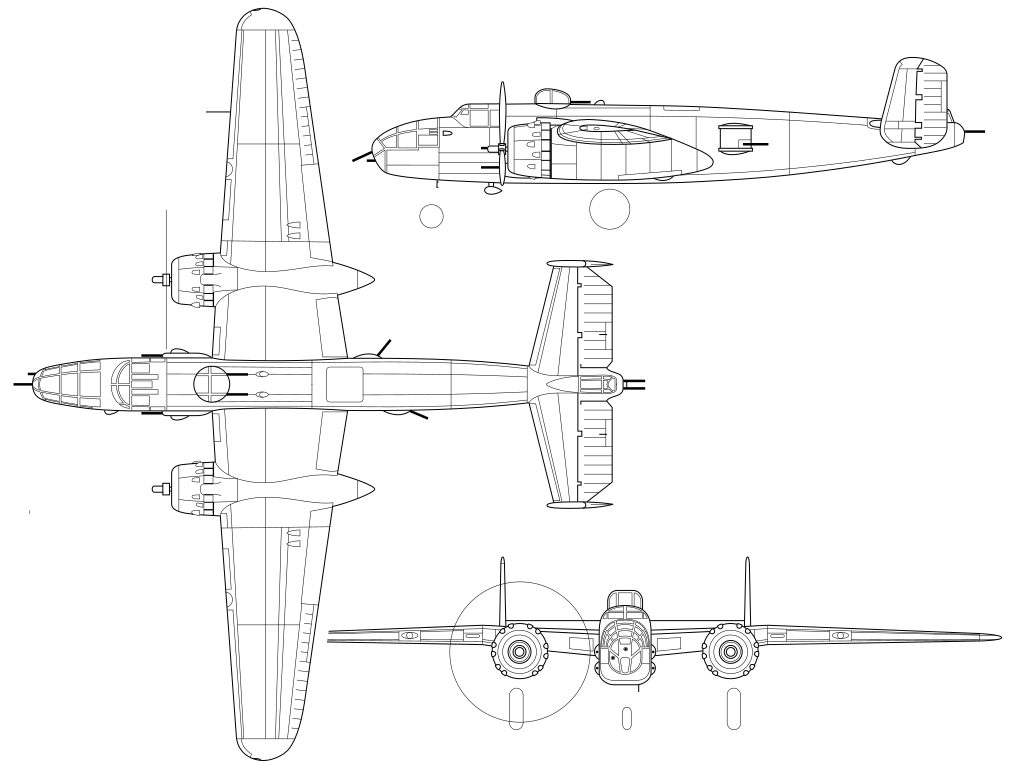
Three-view drawing
.png)
.png)
.png)
.png)
.jpg)
.jpg)
.png)
History
An awkward name
No other American military aircraft was named after a specific person, and the one that broke that rule took the name of an officer his own army had court-martialled. Ever since the end of the First World War, William "Billy" Mitchell had been pressing an argument the Navy found intolerable: that the aeroplane had made the battleship obsolete. His arithmetic was brutally simple and therefore hard to rebut in public — a thousand bombers cost the same as a single battleship, and those thousand bombers could sink it — and his conclusion was that a coastline could be defended more cheaply from the air than by combining coastal artillery with surface ships.
In February 1921, at his urging, Secretary of War Newton Baker and Secretary of the Navy Josephus Daniels agreed to a series of joint Army-Navy exercises, known as Project B, using surplus or captured warships as targets. The Navy consented grudgingly, and only after word leaked that it had already run tests of its own: on 1 November 1920 it had sunk the old battleship *Indiana* off Tangier Island, Virginia, with its own aircraft, and Daniels expected to close the matter by publishing a report drafted by Captain William D. Leahy stating that "the entire experiment pointed to the improbability of a modern battleship being either destroyed or completely put out of action by aerial bombs". When the *New-York Tribune* revealed that those "tests" had been conducted with sand-filled bombs and that the ship had finally been sunk by explosives placed aboard her, Congress introduced two resolutions demanding fresh trials and the Navy was cornered.
On 1 May 1921 Mitchell assembled the 1st Provisional Air Brigade at Langley Field in Hampton, Virginia: 125 aircraft and 1,000 men in six Air Service squadrons, from the SE-5 fighters of the Field Officers School to the Martin NBS-1, Handley-Page O/400 and Caproni CA-5 bombers of the 2nd Bombardment Group. The sinking of the German battleship *Ostfriesland* that summer gave Mitchell his headline and the Navy its humiliation. The Chief of the Air Corps even tried to relieve him a week before the trials began, reacting to naval complaints; the new Secretary of War, John W. Weeks, reversed the decision once Mitchell's public and press support became obvious.
Four years later Mitchell lost his temporary general's rank and was tried for insubordination after accusing Army and Navy leadership of an "almost treasonable" administration of the national defence. That the medium bomber with which the United States fought on every front should end up carrying his name, and that its most famous mission should launch from the deck of a Navy carrier, is one of those ironies aviation history makes no attempt to hide.
From the NA-40 to the NA-62
On 11 March 1939 the United States Army Air Corps issued Proposal No. 39-640, specifying a medium bomber able to carry 1,400 kg of bombs over 3,200 km at a top speed above 480 km/h. The requirement was demanding in industrial terms too: it stipulated the acceptable powerplants — the Wright R-2600-92 Twin Cyclone, R-2800 and R-3350 — and set a very short timetable, with selection within six months of the call and initial production deliveries within twenty-four months of the production contract being signed.
North American Aviation did not start from a blank sheet. It took its NA-40B, a twin-engined attack aircraft it had already built and flown, and refined it into the larger, heavier NA-62 proposal. The changes were fundamental: a wider fuselage to accommodate a larger bomb bay, a mid-mounted rather than high-mounted wing, a conventional cockpit with the two pilots seated side by side — the NA-40 had them in tandem — extended nacelle fairings and a twin-fin tail. The wing used a NACA 23017 section at the root and a NACA 4409-R at the tip. Against the rival Martin Model 179, North American's design emphasised something unglamorous but decisive in wartime: ease of maintenance and field repair. According to Avery, it "promised to be an easy aircraft to fly and posed no special requirements on pilot training programmes".
In August 1939 it was announced that, of the six proposals received, the rival Model 179 was superior to all the others, and Martin was awarded the initial contract for what became the B-26. North American's proposal had finished second, and that second place was not wasted: partly because of the urgency attached to the requirement and partly because Martin stated it would struggle to deliver 385 aircraft within its allotted time, North American received a production contract of its own, No. W353-ac-13258, for 184 aircraft powered by the Wright R-2600. The designation was B-25.
The instruction manual the AAF later handed its pilots told the same story in a different tone, with a few differing details. It dated the Army's request for designs to 25 January 1939 and put that first contract at 148 aircraft, signed — it said — nineteen days after Hitler marched into Poland. On the essentials it agreed, and it added a point the engineers of the day thought remarkable: the B-25 was the "daughter of a slide rule", conceived with neither wind-tunnel tests nor prototypes to study. Its performance was nothing more than a series of figures on an engineer's drawing board until the aircraft flew. In less than two months, following a number of modifications, the mock-up was approved; exhaustive tests by Army engineers followed; and in August 1940 the first B-25 was test-flown and its performance found to be better than the claims its designers had made for it.
The gull wing
On 19 August 1940 Vance Breese and North American test engineer Roy Ferren made the first test flight. Ferren noted a severe coupled roll-yaw condition. Preliminary flights by USAAC pilots confirmed a tendency towards Dutch roll, aggravated by wind and gusts, and the Army required a fix.
The first nine aircraft had been built with constant dihedral: the wing rose at a uniform angle from fuselage to tip. The solution was as simple as it was visually distinctive. Removing the dihedral from the outer panels flattened the outboard wing and produced the "gull wing" configuration that became the type's unmistakable signature from any angle, and the aerodynamic problem vanished. A test flight on 25 February 1941, part of the acceptance trials, confirmed that the redesigned wing had improved the flight characteristics. The vertical tail went through five variants before it was settled, with a more squared-off fin area in the definitive design. The trials were judged an overall success.
What emerged was a safe, forgiving aircraft for its size. On one engine it would accept turns of 60° bank into the dead engine, and control was easily maintained down to 230 km/h. Pilots had to remember one thing: after take-off and at low speed, directional control on one engine was held with the rudder; attempting it with the ailerons could put the aircraft into a spin and lose control altogether. The tricycle undercarriage gave excellent visibility while taxiing. The one significant complaint was noise: the engines were exceptionally loud and many pilots ended up with some degree of deafness. The Clayton S exhaust, introduced on the B-25C series to damp the exhaust flame, protruded from the cowling and, although lighter than the collector ring it replaced, cost 14 km/h through the fairings it required. "The increase in noise compared to collector rings exhausting on the outboard side of the nacelles was a general complaint of the crews," Avery summarised.
And it was extraordinarily rugged. The most-cited case is a B-25C of the 321st Bombardment Group nicknamed *Patches*, so called because its crew chief painted every flak-hole patch with bright yellow zinc chromate primer. By the end of the war that aircraft had completed more than 300 missions, had belly-landed six times and carried over 400 patched holes. Its airframe was so warped by battle damage that flying straight and level required 8° of left aileron trim and 6° of right rudder, making it crab across the sky sideways.
Production, crew and doctrine
The first large production order, for 1,025 B-25Cs, was placed in September 1940 and later extended by another 1,000 aircraft. In June 1941 came another big order, for 1,200 B-25Ds, later increased by a further 1,090. Despite that effort, only 130 B-25s had been delivered by the time of the attack on Pearl Harbor.
North American built more aircraft than any other company during the Second World War, and it has been argued that it was the first time a single firm produced trainers, bombers and fighters simultaneously: the AT-6/SNJ Texan/Harvard, the B-25 Mitchell and the P-51 Mustang. Mitchells came from two plants, the main one at Inglewood, California, and the Kansas plant at Fairfax Airport, which turned out a further 6,608 aircraft.
The instruction manual introduced the aircraft to the novice pilot with a list of firsts: first to see action on every fighting front, first Army aeroplane to sink an enemy submarine, first medium bomber to fly from a carrier deck, first warplane to carry a 75 mm cannon. Designed to carry 3,500 lb of bombs and a crew of five, it had operated with heavier loads and six crew. During the emergency evacuation work of the early months of the war one B-25 carried 26 men and their baggage 700 miles, and on one occasion 32 men with baggage and both main and auxiliary tanks full. Red-lined at 340 mph and cruising easily at 200 mph, the Mitchell exceeded 340 mph when emergencies demanded it, with no disastrous effects. Its low landing speed was a boon to crews who had to operate from jungle strips and airfields blasted out of mountainsides.
Combat experience rewrote the aircraft as it went: more firepower, spare fuel tanks, power-driven turrets and larger escape hatches, added to meet the need for quick exit from a damaged aeroplane. Arctic operations raised new heating and defrosting problems, which were overcome. Long over-water hops, with hours of precision instrument flying, brought the installation of the automatic pilot to ease the strain on crews. For action against the Japanese navy, torpedo racks were fitted. And in the early days of the submarine menace B-25s were equipped with special wing bomb racks, operating successfully in the submarine hunt.
The manual also insisted on something that was not technical at all: the B-25 did not have a pilot, it had an airplane commander. "The commander of the B-25 must be more than a pilot," the text opened. "As his title implies, he must be a leader of men — a leader in a special sense. He must not train his crew as automatons, but as a team which will use initiative and perform its tasks to one end only: the success of the mission." The copilot was the executive officer, chief assistant, understudy and strong right arm, required to be familiar enough with every one of the commander's duties to take over at any time, and he was also the engineering officer aboard. The practical questions closing each chapter — can the copilot take over in an emergency? do the gunners know how to unload and stow their guns? does the engineer know how to use the load adjuster? — sketch better than any figure what kind of crew aircraft the Mitchell was.
The early variants
The initial B-25s, twenty-four aircraft, had R-2600-9 engines of 1,350 hp and carried up to 1,600 kg of bombs with a defensive armament of three 7.6 mm guns in nose, waist and ventral positions plus one 12.7 mm in the tail; these were the machines that introduced the constant dihedral and forced the wing redesign. The B-25A, forty aircraft, added self-sealing tanks, crew armour and an improved tail gunner's station without changing the armament. The B-25B deleted that tail position and replaced it with a manned dorsal turret in the rear fuselage and a retractable, remotely operated ventral turret, each with two 12.7 mm guns; 120 were built, twenty-three of them delivered to the RAF as the Mitchell Mk I. It was this version that made history over Tokyo.
The B-25C was the first mass-produced model — 1,625 aircraft — with R-2600-13 engines, anti-icing and de-icing equipment, an astrodome for the navigator and nose armament increased to two 12.7 mm guns, one fixed and one flexible; it also served in Britain as the Mitchell Mk II and in Canada, China, the Netherlands and the Soviet Union. The B-25D, 2,290 aircraft, was near-identical to the C up to block 20; the difference was the factory, since the D came out of Kansas City and the C out of Inglewood.
Two lesser-known derivatives came from the D airframe. Forty-five aircraft were converted into F-10 photo-reconnaissance machines: all armament, armour and bombing equipment was removed and three K.17 cameras installed, one pointing down and two more obliquely in blisters on either side of the nose, with the option of a fourth vertical camera in the rear fuselage; although intended for combat operations, they were used mostly for mapping. In 1944 four more B-25Ds were converted for weather reconnaissance, and one of their later users was the 53rd Weather Reconnaissance Squadron, the unit known today as the Hurricane Hunters.
Before Tokyo: the Royce mission
The popular history of the B-25 begins on 18 April 1942, but the AAF manual reminded its pilots that something almost as improbable had happened a few days earlier. In April 1942, under Brigadier General Ralph Royce and Colonel John Davies, thirteen B-25s set out from an unidentified base for the island of Mindanao, 2,000 miles away. On what the manual called the longest bombing expedition in the history of aerial warfare, the aircraft flew those 2,000 miles to a secret base where a store of petrol had been hidden, hit the Japanese forces advancing on Bataan for two days, and headed home without loss.
The Doolittle Raid
On 21 December 1941, at a White House meeting, President Franklin D. Roosevelt told the Joint Chiefs of Staff that Japan had to be bombed as soon as possible to lift public morale after Pearl Harbor. Doolittle later put it in almost identical terms in his autobiography: "An attack on the Japanese homeland would cause confusion in the minds of the Japanese people and sow doubt about the reliability of their leaders. […] Americans badly needed a morale boost."
The concept came from the Navy. Captain Francis S. Low, assistant chief of staff for anti-submarine warfare, reported to Admiral Ernest J. King on 10 January 1942 that in his view twin-engined Army bombers could take off from a carrier; the idea had come to him on seeing several at Norfolk naval station's Chambers Field, where the runway was painted with the outline of a carrier deck for landing practice. Doolittle, a famous military test pilot, civilian aviator and aeronautical engineer before the war, was assigned to Army Air Forces headquarters to plan the raid.
The aircraft required had to have a cruising range of 2,400 nautical miles carrying 910 kg of bombs. Doolittle considered the B-25B Mitchell, the Martin B-26 Marauder, the Douglas B-18 Bolo and the Douglas B-23 Dragon. The B-26 had doubtful take-off characteristics from a deck. The B-18 and B-23 had greater wingspans than the B-25, reducing the number of aircraft that could be embarked and risking damage to the ship's superstructure. The B-25 had not yet entered combat and had a range of about 1,300 miles, but tests indicated it could meet the requirement if modified to carry nearly twice the fuel.
Doolittle's first report proposed that the bombers fly on after the attack to Vladivostok, where they could be handed over to the Soviet Union under Lend-Lease — a device to work around the neutrality pact Moscow had signed with Japan in April 1941 — but the Soviets refused. Planners turned to China instead, which added some 600 nautical miles to the flight. Despite his concern about Japanese reprisals, Chiang Kai-shek agreed to provide five refuelling points and a final destination at Chongqing. No fighter escort was possible, because no fighter had the necessary range.
Two B-25s were loaded aboard the carrier USS *Hornet* at Norfolk and took off from her deck without difficulty on 3 February 1942. The raid was approved at once. The crews would come from the 17th Bombardment Group (Medium), the first to receive B-25s and the most experienced unit in the type, all four of its squadrons flying it by September 1941. The group, then flying anti-submarine patrols out of Pendleton, Oregon, was transferred to Columbia Army Air Base in South Carolina under the pretext of patrolling the east coast; the move took effect on 9 February 1942, and there its combat crews were offered the chance to volunteer for an unspecified "extremely hazardous" mission.
Twenty-four B-25Bs were routed to the Mid-Continent Airlines modification centre in Minneapolis, in the maintenance hangar at Wold-Chamberlain Field, with the 710th Military Police Battalion mounting close security from nearby Fort Snelling. The modifications were an exercise in ruthless weight-versus-range arithmetic: the ventral turret was removed; de-icing and anti-icing equipment installed; steel blast plates fitted to the fuselage around the upper turret; the liaison radio set deleted to save weight; and a 610-litre collapsible neoprene auxiliary tank fitted above the bomb bay, plus mountings for further fuel cells in the bomb bay, the crawl tunnel and the ventral turret well, raising capacity from 2,445 to 4,319 litres. Broomsticks were installed in the tail cone as dummy guns. And the Norden bombsight was replaced by an improvised sight devised by Captain C. Ross Greening, dubbed the "Mark Twain", whose materials cost twenty cents.
Crews collected the modified aircraft in Minneapolis and flew them to Eglin Field, Florida, from 1 March 1942. There they received three weeks of concentrated training in simulated carrier take-offs, low-level and night flying, low-altitude bombing and over-water navigation, operating mostly from the more remote Auxiliary Field No. 1 at Eglin. Lieutenant Henry L. Miller, a Navy flight instructor from Naval Air Station Pensacola, supervised the take-off training and accompanied the crews to the launch; for this he is considered an honorary member of the Raiders. The training cost three aircraft: one was written off in a landing accident on 10 March, another was badly damaged in a take-off accident on 23 March, and a third was grounded by nose-wheel shimmy that could not be repaired in time.
On 25 March the remaining 22 B-25s left Eglin for McClellan Field, California, arriving two days later at the Sacramento Air Depot for inspection and final modifications. Sixteen flew to Naval Air Station Alameda on 31 March. Fifteen made up the mission force; the sixteenth was embarked under a last-minute arrangement with the Navy to take off shortly after leaving San Francisco, to demonstrate to the Army pilots that there was enough deck for a safe launch. Instead, that bomber ended up joining the mission.
On 1 April 1942 the sixteen modified bombers, their five-man crews and Army maintenance personnel — 71 officers and 130 enlisted men — were loaded aboard the *Hornet* at Alameda. Each aircraft carried four purpose-built 230 kg bombs: three high-explosive and one a bundle of incendiaries, long tubes wrapped together to fit the bay but designed to separate and scatter over a wide area after release. Five bombs had Japanese "friendship" medals wired to them, decorations awarded by the Japanese government to American servicemen before the war. Armament was cut back for range: each bomber went out with two 12.7 mm guns in the upper turret and one 7.62 mm in the nose. The aircraft were tied down close together on the *Hornet*'s deck in launch order.
The *Hornet* and Task Force 18 sailed from San Francisco Bay at 08:48 on 2 April with the sixteen bombers in plain view. At noon the next day the Navy blimp L-8 lowered to the forward deck the parts needed to complete modifications unfinished at McClellan. A few days later the carrier rendezvoused in the central Pacific north of Hawaii with Vice Admiral William Halsey Jr's Task Force 16: the carrier USS *Enterprise* and her escort of cruisers and destroyers. If the Japanese attacked, it would be the *Enterprise*'s fighters and scout aircraft that protected the formation, because the *Hornet*'s were struck below to make room for the B-25s. The combined force comprised two carriers, three heavy cruisers (*Salt Lake City*, *Northampton*, *Vincennes*), one light cruiser (*Nashville*), eight destroyers and two fleet oilers. The ships steamed under radio silence. On the afternoon of 17 April the slow oilers refuelled the force and withdrew east with the destroyers, while the carriers and cruisers ran west at 20 knots towards the planned launch point in enemy-controlled waters east of Japan.
At 07:38 on the morning of 18 April, with the force still some 650 nautical miles from Japan, it was sighted by the Japanese picket boat No. 23 *Nittō Maru*, a 70-ton patrol craft that radioed an attack warning. The *Nashville* sank her by gunfire. The petty officer commanding her took his own life rather than be captured; five of her eleven crew were picked up by the cruiser.
Doolittle and the *Hornet*'s captain, Marc Mitscher, decided to launch the B-25s immediately: ten hours earlier than planned and 170 nautical miles further from Japan. After repositioning the aircraft to start and run up engines, Doolittle's aircraft had 467 feet — 142 metres — of take-off run. None of the pilots, Doolittle included, had ever taken off from a carrier. All sixteen got away safely between 08:20 and 09:19, though witnesses saw Doolittle's bomber nearly touch the water before lifting its nose at the last instant. They flew towards Japan in groups of two to four and then, alone, at wave-top height to avoid detection.
The aircraft began arriving over Japan around noon Tokyo time, six hours after launch. They climbed to 1,500 feet and bombed ten military and industrial targets in Tokyo, two in Yokohama and one each in Yokosuka, Nagoya, Kobe and Osaka. Although some B-25s met light anti-aircraft fire and a few fighters — Ki-45s and prototype Ki-61s, the latter mistaken for Bf 109s — no bomber was shot down. Only Lieutenant Richard O. Joyce's aircraft suffered battle damage, minor flak hits. Bomber No. 4, flown by Lieutenant Everett W. Holstrom, jettisoned its bombs before reaching the target when attacked by fighters with its turret unserviceable. The Americans claimed three Japanese fighters shot down. Many targets were also strafed by the nose gunners. Doolittle later described the dummy tail guns as an effective deception: no aircraft was attacked directly from astern.
Fifteen of the sixteen aircraft then continued south-west, off the south-east coast of Japan and across the East China Sea, towards eastern China. One, Captain Edward J. York's, was so short of fuel that it turned for the Soviet Union rather than ditch mid-ocean. Several airfields in Zhejiang province were to guide the rest with homing beacons, receive them and refuel them for the leg to Chongqing; the main base was Zhuzhou, towards which all navigated, but Halsey never sent the planned alerting signal, apparently because of a possible threat to the task force.
The raiders then faced everything that could go wrong: night falling, fuel running out and the weather deteriorating fast. None would have reached China but for a tailwind that, on leaving the target, increased their ground speed by 25 knots for seven hours. All fifteen reached the Chinese coast after thirteen hours in the air and either crash-landed or their crews bailed out. One crewman, twenty-year-old Corporal Leland D. Faktor, a mechanic and gunner, was killed bailing out over China. The sixteenth aircraft, York's, landed 40 miles from Vladivostok at Vozdvizhenka; since the USSR was not at war with Japan and the neutrality pact was formally in force, the crew was interned and the aircraft confiscated. Months later they were moved to Ashgabat in the Turkmen SSR, 32 km from the Iranian border, and in mid-1943 were allowed to cross it; they presented themselves at a British consulate on 11 May 1943 with a cover story that York had bribed a smuggler, when in fact the escape had been staged by the NKVD, as declassified Soviet files later confirmed.
Doolittle also bailed out and landed in a manure pile in a paddy field near Quzhou, saving an already injured ankle from breaking; he and his crew were helped by Chinese soldiers and civilians. The mission was the longest ever flown in combat by a B-25 Mitchell: an average of about 2,250 nautical miles.
After Tokyo
Of the sixteen aircraft and eighty airmen, sixty-nine escaped capture or death and only three were killed in the action. Eight were captured. Two crews, those of Lieutenants Dean E. Hallmark and William G. Farrow, remained unaccounted for until 15 August 1942, when the United States learned through the Swiss consul general in Shanghai that eight of the missing were held at the city's police headquarters; two others, bombardier William J. Dieter and mechanic Donald E. Fitzmaurice, had drowned when their B-25 came down in the sea. The eight prisoners were tried and sentenced to death by a military court in China and moved to Tokyo, where the Ministry of War reviewed the case: five sentences were commuted and three men executed. The survivors were held in military confinement on a starvation diet; in April 1943 they were taken to Nanjing, where Robert J. Meder died on 1 December 1943. The remaining four were freed by American troops in August 1945. Of the eighty crewmen, three were killed in action, eight were captured and three died in captivity.
Doolittle told his crew immediately afterwards that the loss of all sixteen aircraft, set against the relatively minor damage inflicted, made the attack a failure, and that he expected a court-martial on his return. The opposite happened. The raid lifted American morale; Doolittle was promoted two grades to brigadier general on 28 April while still in China, skipping colonel, and Roosevelt presented him with the Medal of Honor on his return in June. All eighty raiders received the Distinguished Flying Cross, the dead and wounded the Purple Heart, and all were also decorated by the Chinese government. Doolittle went on to command the Twelfth Air Force in North Africa, the Fifteenth in the Mediterranean and the Eighth in England.
China paid the price. The Imperial Japanese Army launched the Zhejiang-Jiangxi campaign to prevent those coastal provinces being used again as a base and to take revenge on the population. An area of some 50,000 km² was laid waste. An estimated 10,000 Chinese civilians were killed during the search for Doolittle's men, and those who had helped the airmen were tortured before being murdered. The missionary Wendelin Dunker wrote of the destruction of the town of Ihwang: "They shot any man, woman, child, cow, hog, or just about anything that moved." The Japanese entered Nancheng, a city of 50,000, on 11 June, and what followed was named by missionaries "the rape of Nancheng"; less than a month later they set fire to what remained of the city. As they withdrew in August, Unit 731 left behind almost 140 kg of paratyphoid and anthrax pathogens in contaminated food and wells, and about 1,700 of the 10,000 Japanese soldiers who fell ill died when their own biological attack rebounded on them. Chinese records put the campaign's toll at more than 20,000 civilians murdered, a further 30,000 captured or missing, and more than 100,000 houses burned in Quzhou alone.
Materially the raid achieved little. Compared with the later B-29 attacks the damage was slight and all of it repairable: eight primary and five secondary targets hit, oil tanks, a steel mill and several power stations in Tokyo, and at Yokosuka at least one bomb from Lieutenant Edgar E. McElroy's aircraft struck the nearly completed light carrier *Ryūhō*, delaying her launch until November. Japanese casualties were established after the war at 87 killed, 151 seriously wounded and more than 311 lightly wounded.
Strategically it was another matter. The raid shocked Imperial General Headquarters. Japan attacked territory in China to prevent a repeat of shuttle missions; the high command withdrew substantial air assets from offensive operations to defend the home islands; and the Aleutian campaign was launched to deny the United States those islands as a bomber base, which required two carriers that would otherwise have been at Midway. The raid's greatest strategic achievement was, in the end, to force the Japanese high command into a highly inefficient disposition of its forces and into poor decisions, driven by fear of attack, for the rest of the war. Mitsuo Fuchida and Shigeyoshi Miwa called it "excellent strategy", noting that the bombers had evaded the Army fighters by flying "much lower than expected". It also demonstrated two technical points: that launching a B-25 from a carrier was easier than supposed, and that shuttle bombing was an effective tactic for a carrier force, since the ships did not have to wait for the aircraft to return.
The Pacific and flying on the deck
Most B-25s in American service were used against Japan in Asia and the Pacific: the Aleutians, Papua New Guinea, the Solomons, New Britain, China, Burma and the central Pacific island-hopping campaign. There the aircraft found a trade its 1939 requirement had never anticipated. The jungle environment reduced the usefulness of medium-altitude bombing and made low-level attack the better tactic.
Lieutenant General George Kenney, commanding the Fifth Air Force in New Guinea, ended 1942 frustrated by his bombers' performance against Japanese shipping. Level bombing from medium altitude was generally ineffective against moving targets: even large, slow transports dodged most bombs dropped from above 5,000 feet, and against fast, agile destroyers it was simply useless. They had to go lower. Going lower exposed them to light anti-aircraft fire that had to be suppressed; and conventional attack profiles, with the bomber approaching abeam of the ship, demanded exquisite timing to score a hit, and usually only one of several bombs dropped connected.
Kenney tasked Major Paul Gunn of the 90th Bombardment Squadron, 3rd Bombardment Group, with improving his bombers' ability to suppress anti-aircraft fire, and Gunn developed strafer versions of the A-20 and the B-25. In parallel, Major William Benn, commanding the 63rd Squadron with B-17Fs, was experimenting with skip bombing: he flew "on the deck", 200 to 250 feet above the sea, approached at high speed parallel to the ship and released bombs fused for five seconds, which struck the water and skipped across the surface like flat stones until they hit the hull and detonated on impact, or sank alongside and mined it. The variant was to hold the load until passing over the ship at mast height and release it there with a delayed fuse, so it penetrated deeply before exploding and gave the aircraft time to clear the blast.
Kenney realised the best aircraft for both techniques were not the B-17s but Gunn's A-20 and B-25 strafers: the twins were more agile than a four-engined bomber and more expendable. And the forward-firing guns of the Havocs and Mitchells solved the principal problem of low-level attack. The heavy 12.7 mm rounds swept decks clear of personnel and so suppressed the light flak, and they also punched through the decks and towers of Japanese destroyers, wreaking havoc inside. A Japanese destroyer's 127 mm guns, normally useless against aircraft at medium and high altitude, were quite capable of downing a twin-engined bomber coming at them low; a well-executed strafing pass silenced them.
Kenney set the A-20s of the 89th Squadron and the B-25s of the 90th to practise skip bombing against the wreck of the SS *Pruth*, a 4,700-ton steamer aground on Nateara Reef near Port Moresby since a storm in January 1924. The practice was not free: two aircraft were damaged by debris thrown up by the explosions and a third crashed after striking the wreck's mast. By late February the pilots were proficient and tended to combine the techniques — skip bombing with the first two bombs and mast-height bombing with the last two — sometimes scoring four hits with four bombs. In the end most crews preferred mast-height bombing: it was easier to master and the results were almost identical.
The opportunity came in early March 1943, when Japan tried to reinforce its garrison at Lae in New Guinea with a convoy of sixteen ships: eight transports escorted by eight destroyers. The Fifth Air Force fell on it in the Bismarck Sea. By 5 March all eight transports and four destroyers had been sunk. An ever-growing number of forward-firing weapons also made the B-25 a formidable strafing aircraft for the island war. The strafer models modified by Paul Gunn and Jack Fox, with four 12.7 mm guns, were the B-25C1 and D1; the factory would later standardise the eight-gun nose on the B-25J.
In Burma the work was different. Bridge-busting was the main task of the 341st Bombardment Group of the Tenth Air Force, operating B-25Cs and Ds. The most effective technique for the Burma Bridge Busters was a combination of glide and skip they called "glip bombing". The 341st ranged as far as the Formosa Strait, the eastern China coast and French Indochina.
The gunships and the 75 mm cannon
Seeking to expand its anti-shipping operations, the USAAF urgently needed hard-hitting aircraft, and North American answered with the B-25G. The 75 mm M4 cannon had been in development and testing since 1936; in 1938 it had been installed and successfully tested in a Douglas B-18 and in 1940 demonstrated at Eglin Field. Engineer George Wing was given the task of fitting it into a B-25 and found the obvious place: the bombardier's crawl tunnel, which offered ample room for the recoil and left space in the navigator's compartment to stow ammunition. To make it fit, the B-25's nose was shortened by 26 inches, the maximum considered aerodynamically acceptable, and even then the muzzle sat just behind the nose contour. A modified forward section was built to test the design and test firings were made with progressively larger propellant charges, strengthening the structure until it withstood sustained firing of overcharged rounds.
B-25C-1-NA serial 41-13296 was converted into the XB-25G. It flew to check its characteristics on 22 October 1942 and fired for the first time in the air the following day, with Edward Virgin at the controls. After trials by North American and the Air Corps at Eglin, 400 aircraft were ordered without the ventral turret; to those were added B-25Cs modified and redesignated G, mostly at the Kansas City modification centre, for a total of 463. The first aircraft was accepted on 8 May 1943 and the last on 24 August of the same year. In the B-25G the glazed nose and the bombardier-navigator's station disappeared, replaced by a short, blind nose with two fixed 12.7 mm guns and the manually loaded 75 mm M4 with 21 rounds — the largest weapon ever fitted to an American bomber.
It was not a popular aircraft. Firing the cannon could throw the navigation compass off by as much as 15 degrees. The ventral turret was never liked and was routinely removed in the field. The Hawaiian Air Depot replaced the cannon with the eight-gun nose on an unknown number of aircraft. And the B-25G has the dubious distinction, along with the B-25A, of being one of only two models with no known airframe surviving the war: those that remained were sold for scrap when it ended.
The B-25H continued the line and North American built 1,000 at Inglewood. It carried still more firepower: most exchanged the M4 for the lighter T13E1, designed specifically for the aircraft, though some twenty H-1 block machines completed at the Republic Aviation modification centre in Evansville retained the M4 and the two nose guns. The cannon fired at 720 m/s muzzle velocity, but its slow rate of fire — barely four rounds per pass — its relative ineffectiveness against ground targets and its considerable recoil meant it was often removed in the field, from both the G and the H, in favour of two more 12.7 mm machine guns.
The production H left the factory with four fixed forward-firing guns in the nose; four more in a pair of conformal packages under the cockpit, two per side; two in the manned dorsal turret, relocated forward just behind the cockpit, an arrangement that became standard on the J; one in each of the two new waist positions introduced along with the turret move; and a further pair in a new tail gunner's station. Company advertising boasted that the B-25H could "bring 10 guns to bear going in and 4 coming out, plus the 75 mm cannon, eight rockets and 1,360 kg of bombs". The cockpit was modified with single flight controls operated by the pilot: the copilot's station and controls were deleted and replaced by a smaller seat for the navigator-cannoneer, a deletion Doolittle himself had questioned. The radio operator sat behind the bomb bay with access to the waist guns. Removing the copilot saved weight, and moving the dorsal turret forward partly counterbalanced the waist guns and the manned tail turret. Two hundred and forty-eight of the thousand B-25Hs ended up with the Navy as PBJ-1Hs.
The B-25J and the eight-gun nose
The final and most numerous series, the B-25J, resembled the earlier ones less than its glazed bombardier nose — almost identical to that of the early subtypes — suggested: from the cockpit aft it followed the H configuration, with the dorsal turret forward and the rest of the armament and airframe advances. All Js included four light-barrel Browning AN/M2 12.7 mm guns in a pair of "fuselage packages", conformal containers on either side of the lower cockpit with two guns each, though by 1945 combat squadrons were removing them. The J restored the copilot's seat and dual controls.
For low-level attack, factory kits were made available through the air depot system to create the strafer-nosed B-25J-2. That configuration carried eighteen 12.7 mm guns in all: eight in the nose, four in the side packages, two in the dorsal turret, one in each waist position and two in the tail, of which fourteen pointed or could be pointed directly forward for strafing. Some aircraft also carried eight 127 mm high-velocity aircraft rockets. With 4,318 built, the J was the last production series of the B-25 and the most numerous of all.
The Mediterranean, Italy and Europe
The first B-25s reached Egypt and were flying independent operations by October 1942. They struck Axis airfields in Egypt and motorised columns in support of the ground action at the second battle of El Alamein, and afterwards took part in the North African campaign, the invasion of Sicily and the advance up Italy. From the Strait of Messina to the Aegean, the Mitchell flew maritime sweeps as part of the coastal air forces. In Italy it was used for ground attack, concentrating on roads and rail links in Italy, Austria and the Balkans. Its range, greater than that of the Douglas A-20 Havoc and the Douglas A-26 Invader, let it reach further into occupied Europe.
The five bombardment groups — twenty squadrons — of the Ninth and Twelfth Air Forces that used the B-25 in the Mediterranean theatre were the only American units to operate the type in Europe. In October 1943 the 340th of the Ninth moved from the African and Mediterranean theatre to England in support of the assault on Germany, and in November 1944 the medium bombers ended the use of electric locomotives along the Brenner Pass.
The Marines' PBJ
The US Navy designation for the B-25 was PBJ-1, with PBJ-1C and PBJ-1D corresponding to their Army equivalents. Under the pre-1962 naval designation system, PBJ-1 meant patrol (P) bomber (B) built by North American Aviation (J), first variant. Night-search PBJs carried a retractable radome for the APS-3 radar.
The PBJ originated in an inter-service agreement of mid-1942: the Navy gave the USAAF Boeing's Renton plant in exchange for the Kansas plant for B-29 Superfortress production, and the Boeing XPBB Sea Ranger flying boat, which competed for the B-29's engines, was cancelled in exchange for a share of Mitchell production at Kansas City. In early 1943 the Navy took an initial delivery of 706 B-25s, assigned to the Marine Corps for patrol and anti-submarine work, though the type soon shifted to attack with bombs, torpedoes and radar-directed rockets. On 1 March 1943 VMB-413 became the first of sixteen Marine squadrons equipped with the PBJ, all activated at Marine Corps Air Station Cherry Point. The large numbers of B-25Hs and Js received were known as PBJ-1H and PBJ-1J.
From 1944 Marine PBJs flew from the Philippines, Saipan, Iwo Jima and Okinawa. Their main mission was radar-directed night attacks on enemy shipping, with 127 mm HVAR rockets and the enormous 298 mm "Tiny Tim", used from 1945 by PBJ-1Hs. Long-range night operations demanded more fuel, and weight was cut by removing the upper turret and side blisters.
The Navy tested the cannon-armed G series during the war and carried out carrier trials with an H fitted with an arrestor hook. One PBJ-1H was modified with carrier take-off and landing equipment and successfully tested on USS *Shangri-La*, but the Navy did not pursue the development. After the war, some PBJs based at the Navy's rocket laboratory at Inyokern, California — today's China Lake — were used to test air-to-ground rockets and their launch arrangements; one of these was a twin-tube nose able to fire ten spin-stabilised 127 mm rockets in a single salvo.
The Allied users
The United Kingdom received 910 B-25s during the war, many of them returned afterwards. The RAF was an early customer through Lend-Lease: the first, designated Mitchell I, were delivered in August 1941 to No. 111 Operational Training Unit in the Bahamas and used exclusively for training and familiarisation, never becoming operational. The B-25C and D were designated Mitchell II, and 167 Cs and 371 Ds were delivered in all. By the end of 1942 the RAF had received 93 Mitchells. Some served with No. 2 Group squadrons, the tactical medium bomber force, including No. 139 Wing at Dunsfold. The first British operation with the Mitchell II took place on 22 January 1943, when six aircraft of No. 180 Squadron attacked oil installations at Ghent. After the invasion of Europe the four Mitchell squadrons moved to bases in France and Belgium — Melsbroek — in support of Allied ground forces, and in April 1945 they were joined by No. 342 (Lorraine) Squadron of the French air force. No. 305 (Polish) Squadron flew Mitchell IIs from September to December 1943 before converting to the de Havilland Mosquito, and in the Far East Nos. 681 and 684 Squadrons used them for photographic reconnaissance. The RAF tested the cannon-armed G series but adopted neither it nor the H.
The Dutch government in exile was another significant operator. On 30 June 1941 the Netherlands Purchasing Commission, acting from London, signed a contract with North American for 162 B-25Cs for the Netherlands East Indies to deter Japanese expansion in the region. In February 1942 the British Overseas Airways Corporation agreed to ferry twenty of these from Florida to Australia via Africa and India, and ten more by the South Pacific route from California; by March five had reached Bangalore and twelve Archerfield in Australia. The latter formed the nucleus of No. 18 (Netherlands East Indies) Squadron of the RAAF. In Europe, No. 320 (Dutch) Squadron RAF, formed in June 1940 from Royal Netherlands Naval Air Service personnel who had escaped to England, converted to Mitchell IIs and IIIs in March 1943, deployed to Belgium in October 1944 and disbanded in August 1945. The Australians received Mitchells in the spring of 1944: since the joint Australian-Dutch No. 18 Squadron had more than it needed, the surplus re-equipped No. 2 Squadron RAAF in place of its Beauforts.
The Royal Canadian Air Force used the Mitchell for training during the war and continued to operate most of its 162 aircraft afterwards. The first were diverted from RAF orders. No. 5 Operational Training Unit at Boundary Bay and Abbotsford, British Columbia, flew the B-25D alongside B-24 Liberators under the British Commonwealth Air Training Plan. In 1951 the RCAF received a further 75 B-25Js from USAF stocks to cover attrition, and did not retire the type until October 1963.
The Soviet Union received 862 B-25s of the B, C, D, G and J models under Lend-Lease via the ALSIB Alaska-Siberia ferry route; 870 were dispatched in total, so eight were lost in transit. Other damaged B-25s reached or crashed in the Russian Far East, and the Doolittle Raid aircraft that ran out of fuel landed there too; that machine, the only raid aircraft to reach the USSR in flyable condition, was lost in a hangar fire in the early 1950s during routine maintenance. The Soviets generally used it as a daylight tactical and ground-support bomber, as they did their Douglas A-20 Havocs, and it fought from Stalingrad — with the B, C and D models — until the German surrender of May 1945, by then with the G and J. Those remaining in postwar service were given the NATO reporting name "Bank".
Well over a hundred B-25Cs and Ds were supplied to Nationalist China during the Sino-Japanese War, and an unknown number were abandoned in the withdrawal to Formosa. Brazil received eighty aircraft, the first before December 1941. The RAF handed over at least 21 Mitchell IIIs to No. 342 Squadron, manned largely by Free French crews, which after the liberation passed to the new French air force as GB I/20 Lorraine; some were later converted into fast transports for officials and struck off charge in June 1947.
The long tail: postwar, trainers and last campaigns
In 1947 legislation created an independent United States Air Force, and by then the B-25 inventory numbered only in the hundreds. Some remained in service well into the 1950s in training, reconnaissance and support roles; their principal use was pilot training, radar-control instruction, weather reconnaissance and transport. Others were assigned to Air National Guard units for training in support of Northrop F-89 Scorpion and Lockheed F-94 Starfire operations.
Almost every B-25 model was used at some point as a trainer. The first trainers appeared under the AT-24 designation — AT-24A for the converted B-25D, of which 60 were made; AT-24B for the G; AT-24C for the C; AT-24D for the J — and were later redesignated TB-25D, TB-25G, TB-25C and TB-25J. A further six hundred B-25Js were converted into TB-25Js after the war. To these were added specific series: 117 TB-25Ks with the Hughes E1 fire-control system, 40 TB-25Ms with the Hughes E5, 90 TB-25Ls converted by Hayes for pilot training and 47 TB-25Ns for navigators. In 1952 the USAF contracted the TB-25L trainer to Hayes in Birmingham, Alabama, with reciprocating-engine pilot training as its main role. During this period many B-25s received the so-called "Hayes modification", in which the upper seven cylinders were gathered into a collector ring while the rest kept individual stacks: this is why so many surviving B-25s today have a half-ring exhaust. Other aircraft were converted into staff and VIP transports under the VB-25J designation; Henry H. Arnold and Dwight D. Eisenhower each used a converted B-25J as a personal transport.
The official last chapter has a date. TB-25J-25-NC serial 44-30854, the last B-25 in the USAF inventory, was assigned to March Air Force Base, California, in March 1960 and flew from Turner AFB, Georgia, to Eglin AFB, Florida, on 21 May 1960; it was the last flight of a US Air Force B-25. Brigadier General A. J. Russell, commander of SAC's 822nd Air Division at Turner, handed it over to Brigadier General Robert H. Warren of the Air Proving Ground Center, who in turn presented it to the mayor of Valparaiso, Florida, Randall Roberts, on behalf of the Niceville-Valparaiso chamber of commerce. Four of the original Tokyo Raiders attended the ceremony: Colonels David Jones and Jack Simms, Lieutenant Colonel Joseph Manske and retired Sergeant Major Edwin W. Horton. The aircraft was returned to the Air Force around 1974 for the Armament Museum and today wears the markings of Doolittle's 40-2344. The last active-service VB-25J was retired in May 1960 at Eglin.
Outside the United States the Mitchell went on fighting far longer. The Indonesian Air Force received 25 former Dutch B-25s at the end of the Indonesian National Revolution in 1950: five photo-reconnaissance B-25Cs, one transport, ten B-25J bombers and nine gunship Js. A pair of Js attacked a radio station in Ambon during the South Moluccas rebellion in August 1950; in 1958 they bombed rebel targets in the PRRI and Permesta rebellions, where one was hit by anti-aircraft fire and three more damaged by a strafing pass from a rebel-held B-26 Invader. To extend their lives they were sent to Hong Kong for overhaul in 1959-60, and returned to combat in Operation Trikora against the Dutch in 1962, strafing a Dutch warship and flying missions over the Moluccas. The last Indonesian B-25s were retired in 1974. In October 1967, during the Nigerian civil war, Biafra bought two Mitchells that bombed some targets in November and were out of action by December.
Accidents that made history
The B-25 also left its mark in the news pages. On 1 November 1941 one crashed near Benton Ridge, Ohio, on a training mission from Wright-Patterson. On 7 May 1944 a B-25C crashed and exploded a little over a mile and a half north of West Chester, Pennsylvania, caught in a thunderstorm, killing all seven servicemen aboard.
But the accident everyone remembers happened at 09:40 on 28 July 1945, when a USAAF B-25D flew into the north face of the Empire State Building in thick fog, between the 79th and 80th floors. Fourteen people died: eleven in what was then the world's tallest building and the three aboard the aircraft, including its pilot, Colonel William F. Smith. Betty Lou Oliver, a lift operator, survived both the impact and the subsequent fall of the lift car seventy-five floors to the basement.
The French general Philippe Leclerc was killed on 28 November 1947 when his personal B-25 Mitchell, *Tailly II*, crashed near Colomb-Béchar in French Algeria with no survivors. On 25 March 1953 a USAF B-25 crashed five kilometres south-east of Glen Burnie, Maryland, on approach to Friendship Airport, killing all three aboard, in the first fatal accident in the vicinity of today's Baltimore-Washington International Airport since it opened in 1950. And on 27 August 1967 a converted civilian B-25 mistakenly dropped eighteen parachutists over Lake Erie, some four or five nautical miles from Huron, Ohio: the controller had confused the bomber with a Cessna 180 following it to take photographs, and the pilot believed he was over the intended zone. Sixteen jumpers drowned and two were rescued; the NTSB report blamed the pilot and, to a lesser degree, the parachutists for jumping without sight of the ground, and the controller for the misidentification, and the United States was held liable for the controller's negligence.
What remained
The B-25 was not the fastest bomber, nor the longest-ranged, nor the one that carried the most bombs. It was something harder to measure and probably more valuable: an aircraft that accepted having its trade changed. In five years it went from runner-up in a competition to conventional medium bomber, from there to carrier-launched bomber for one night only, then to low-level strafer and ship-killer with bombs that skipped across the water, then to flying gunship with a 75 mm artillery piece in the nose, and finally to patient trainer for a whole generation of reciprocating-engine pilots. Each of those transformations came out of a concrete problem in a concrete theatre, and in nearly every case the answer arrived first from a field workshop — Pappy Gunn's in New Guinea, the Hawaiian Air Depot — rather than from a drawing board in Inglewood, with the factory afterwards simply standardising what already worked.
Its own manual said as much, in the rhetoric of the day and without being wrong about the essentials: the evolution of the Mitchell did not end there, and every day, as experience mounted and new tactics developed, the B-25 proved its versatility, ready "to run with the hare or hunt with the hounds". An aeroplane, it concluded, of which its pilots might well say: it does the job.
Variants
| NA-40 | AT-24/TB-25 | B-25A | B-25B | B-25C | B-25D | B-25G | B-25H | B-25J | B-25 (NA-62) | PBJ-1 | TB-25J/N | XB-25E | XB-25F | |
|---|---|---|---|---|---|---|---|---|---|---|---|---|---|---|
| First flight | January 29, 1939 | — | — | — | — | — | — | — | — | — | — | — | — | — |
| Aircraft type | — | — | — | — | — | — | — | Gunship medium bomber | Medium bomber | — | — | — | — | — |
| Powerplant | — | — | — | — | — | — | — | Two Wright R-2600-92 Twin Cyclone 14-cylinder two-row air-cooled radial piston engines, 1300 kW (1700 hp) each. | Two Wright R-2600-29 Cyclone 14-cylinder air-cooled radial piston engines, 1268 kW (1700 hp) each. | — | — | — | — | — |
| Powerplant | 2 × Pratt & Whitney R-1830 | 2 × Wright R-2600-13 | 2 × Wright R-2600-9 | 2 × Wright R-2600-9 | 2 × Wright R-2600-13 | 2 × Wright R-2600-13 | 2 × Wright R-2600-13 | 2 × Wright R-2600-92 Twin Cyclone | 2 × Wright R-2600-29 Cyclone | 2 × Wright R-2600-9 | 2 × Wright R-2600-13 | 2 × Wright R-2600-92 | 2 × Wright R-2600-13 | 2 × Wright R-2600-13 |
| Power per engine | — | — | 1,700 hp | 1,700 hp | 1,700 hp | 1,700 hp | 1,700 hp | 1,743 hp Best value in this row | 1,700 hp | 1,700 hp | 1,700 hp | — | — | — |
| Length | — | — | — | 16.1 m Best value in this row | 16.1 m Best value in this row | 16.1 m Best value in this row | 16.1 m Best value in this row | 16.1 m Best value in this row | 16.1 m Best value in this row | — | — | — | — | — |
| Wingspan | — | — | — | 20.6 m Best value in this row | 20.6 m Best value in this row | 20.6 m Best value in this row | 20.6 m Best value in this row | 20.6 m Best value in this row | 20.6 m Best value in this row | — | — | — | — | — |
| Height | — | — | — | — | 5 m Best value in this row | 5 m Best value in this row | — | 5 m Best value in this row | 5 m Best value in this row | — | — | — | — | — |
| Wing area | — | — | — | — | 56.7 m² | 56.7 m² | — | 57.4 m² Best value in this row | 56.7 m² | — | — | — | — | — |
| Empty weight | — | — | — | — | — | — | — | 8,836 kg Best value in this row | 8,836 kg Best value in this row | — | — | — | — | — |
| MTOW | — | — | — | — | 15,876 kg Best value in this row | 15,876 kg Best value in this row | — | 15,876 kg Best value in this row | 15,876 kg Best value in this row | — | — | — | — | — |
| Top speed | — | — | — | — | 457 km/h Best value in this row | 457 km/h Best value in this row | — | 438 km/h | 438 km/h | — | — | — | — | — |
| Max speed altitude | — | — | — | — | 4,000 m | 4,000 m | — | 4,000 m | 3,960 m | — | — | — | — | — |
| Cruise speed | — | — | — | — | 370 km/h Best value in this row | 370 km/h Best value in this row | — | 370 km/h Best value in this row | 370 km/h Best value in this row | — | — | — | — | — |
| Service ceiling | — | — | — | — | 7,380 m | 7,380 m | — | 7,400 m Best value in this row | 7,380 m | — | — | — | — | — |
| Range | — | — | — | — | 2,400 km Best value in this row | 2,400 km Best value in this row | — | 2,170 km | 2,170 km | — | — | — | — | — |
| Range conditions | — | — | — | — | — | — | — | — | Maximum range of 2170 km (1350 miles). No published combat radius, ferry range or endurance figures for this version. | — | — | — | — | — |
| Armament | — | — | — | — | — | — | — | Twelve to eighteen 12.7 mm machine guns and a 75 mm T13E1 cannon; racks for eight 127 mm HVAR rockets and up to 1361 kg (3000 lb) of bombs, or one Mark 13 torpedo on ventral shackles. | Thirteen 12.7 mm Browning machine guns and a load of up to 1361 kg (3000 lb) of bombs or depth charges. | — | — | — | — | — |
| Max weapons load | — | — | — | — | 1,361 kg Best value in this row | 1,361 kg Best value in this row | 1,361 kg Best value in this row | 1,361 kg Best value in this row | 1,361 kg Best value in this row | — | — | — | — | — |
| Payload | — | — | — | — | — | — | — | 0 kg Best value in this row | 0 kg Best value in this row | — | — | — | — | — |
| Cargo capacity | — | — | — | — | — | — | — | No transport capability: the crew is five and the bay carries ordnance only. | No transport capability: the bay carries only bombs or depth charges, and the six-man crew (pilot, co-pilot, bombardier/navigator, radio operator, flight engineer and tail gunner) leaves no passenger seats. | — | — | — | — | — |
| Crew | 3 Best value in this row | 3 Best value in this row | 5 | 5 | 5 | 5 | 4 | 5 | 6 | 5 | 5 | 3 Best value in this row | 5 | 5 |
| Passengers | — | — | — | — | — | — | — | 0 Best value in this row | 0 Best value in this row | — | — | — | — | — |
| Units built | 1 | — | 40 | 120 | 1,625 | 2,290 | 405 | 1,000 | 4,318 Best value in this row | 24 | 706 | — | 1 | 1 |
Images