North American B-25 Mitchell variant
North American B-25 Mitchell NA-40
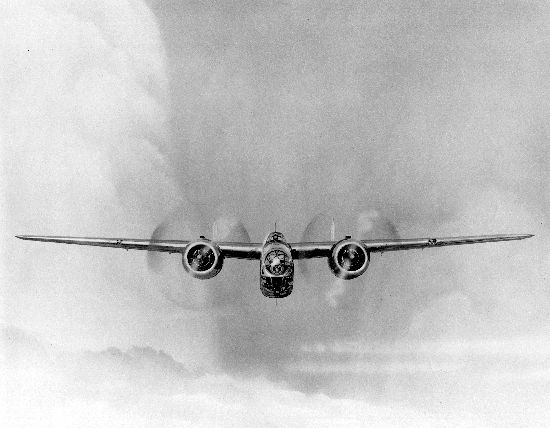
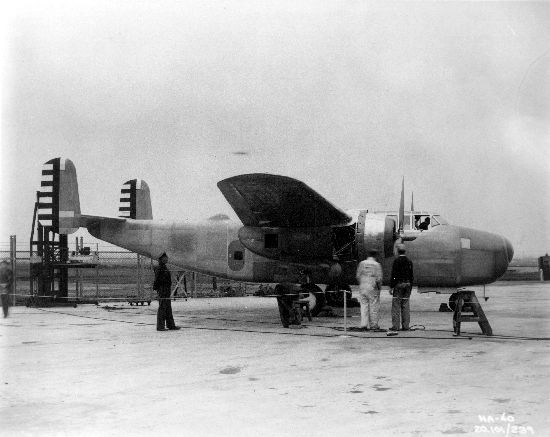
The North American NA-40 was the prototype attack bomber with which North American Aviation entered the United States Army Air Corps competition of 1939. It first flew on 29 January 1939, proved underpowered and unstable, and was rebuilt with Wright R-2600 engines as the NA-40B before being destroyed in a crash that April. It won no orders, but its design became the direct basis of the NA-62, which the Army bought off the drawing board as the B-25 Mitchell.
North American B-25 Mitchell sheet

- January 29, 1939
- First flight
- 1
- Units built
History
Origin and development
In March 1938 the United States Army Air Corps circulated specification 38-385, describing the attack bomber it wanted for the next generation: a payload of 1,200 lb (540 kg) carried over 1,200 miles (1,900 km) at more than 200 mph. Several manufacturers answered. Bell offered its twin-engined Model 9, Boeing-Stearman the Model X-100 with Pratt & Whitney R-2180 radials, Douglas the Model 7B with R-1830 Twin Wasps, Martin the Model 167F, and North American submitted the NA-40.
North American was not starting from scratch. In 1936 it had built the XB-21, company designation NA-39, a medium bomber that the Army had initially accepted and ordered before the order was cancelled. That partly successful programme gave the design team a foundation for the NA-40, a five-seat twin of unusual layout: a high shoulder-mounted wing with a continuous three-degree dihedral, a raised tandem cockpit, and two Pratt & Whitney R-1830-56C3G radials of 1,100 hp (820 kW). Wingspan was 66 ft (20.12 m) and length 48 ft 3 in (14.71 m). Defensive armament consisted of three flexible 0.30 in machine guns distributed between the nose, a turret and a ventral or waist position.

A single example was built, and it made its first flight at the end of January 1939, on the 29th. Early flying showed the aircraft to be both underpowered and unstable, and the company chose a thorough rebuild rather than piecemeal adjustment.
The NA-40B and the Army evaluation
The revised aircraft became the NA-40B, also known as the NA-40-2. The principal change was the replacement of the R-1830s with two Wright R-2600-A71-3 radials rated at 1,600 hp (1,193 kW) for take-off and 1,275 hp (951 kW) at 12,000 ft, together with numerous minor modifications. With that powerplant the prototype reached 309 mph (497 km/h) at 14,000 ft, and its gross weight was around 20,000 lb, a figure that would serve as the yardstick when the company designed its successor. The NA-40B flew in its new form on 1 March 1939, and that same month North American delivered it to the Air Corps for evaluation.
Its rivals in the competition were the Douglas 7B, the Stearman XA-21 and the Martin 167F, the Bell having never been built. The aircraft had originally been intended as an attack bomber for export to the United Kingdom and France, both of which had a pressing need for such machines as war approached in Europe. The Douglas 7B had already been lost in a January accident that injured a French observer, and France had nonetheless ordered it in revised form as the DB-7. On 11 April 1939, while under test, the NA-40B was destroyed in a crash. The accident was not blamed on any fault in the design, but the Army awarded the contest to the DB-7, which entered service as the A-20 Havoc. The NA-40 never won an order.
Legacy: from NA-40B to NA-62
Defeat proved productive. In March 1939 the Air Corps issued a new specification, this time for a medium bomber with a heavier load, longer range and a speed of 300 mph. North American took the NA-40B as its starting point and reworked it into the NA-62: a somewhat larger aeroplane with some ten square feet more wing area and a fuselage six feet longer, in which the raised tandem cockpit gave way to a side-by-side flight deck flush with the top of the fuselage and the wing dropped from the shoulder to a mid position. Because no YB-25 prototype existed for service trials, in September 1939 the Army ordered the NA-62 "off the drawing board" as the B-25, at the same time as it did the same with the Martin B-26 Marauder. The single NA-40 did not survive 1939, but its twin-engined, twin-finned outline is unmistakable in the nearly ten thousand Mitchells that followed.
Three-view drawing

Multimedia