Mikoyan MiG-29
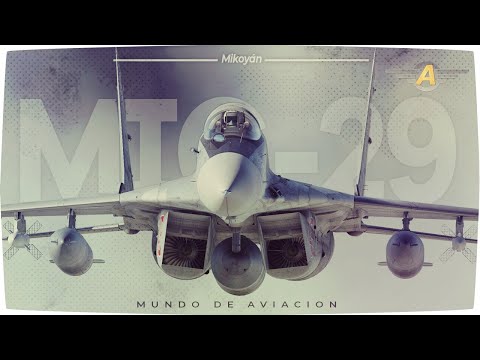
Video from the channel Mundo de Aviación about MiG-29, linked on its Above Ten Thousand entry. Duration: 10:26. Language: Spanish. Video type: Documentary.
What it's about
A video overview of the MiG-29: its origins in the Cold War, its development, the main versions, its technical characteristics and some of its operators.
Historical context
The video explains that the aircraft arose from the Soviet need to respond to the new American fighters born of the USAF's FX programme: the F-15 Eagle and, later, the F-16 Fighting Falcon. In 1969 the Soviet General Staff requested a highly manoeuvrable front-line fighter, capable of reaching Mach 2 and operating from unprepared runways. The aerodynamic study, carried out with the Sukhoi design bureau, concluded that two different aircraft were needed: a heavy one, the Su-27, and a lighter, cheaper one, the MiG-29, commissioned to Mikoyan. The air force wanted a fleet split of 30% heavy fighters and 70% light ones. Work began in 1974 and the first flight took place on 6 October 1977.
Key facts
It is a single-seat fighter with two Klimov RD-33 turbofans. It weighs up to 18 t at maximum takeoff, has a range of 1,430 km on internal fuel and reaches 2,400 km/h (Mach 2.25). It carries seven hardpoints for up to 4,000 kg of weapons and a 30 mm cannon with 150 rounds. The video highlights the auxiliary intake doors: they close the main intakes on takeoff and landing so that stones do not get into the engines. It also highlights the infrared search-and-track sensor, linked to the helmet-mounted sight; together with the R-73 missile, this made the aircraft an excellent close-combat fighter. It also reviews several versions: the MiG-29S, with R-27 and R-77 missiles and a dorsal hump; the naval MiG-29K, for the carrier Admiral Kuznetsov; and the MiG-29SMT, of which Russia ordered 16 units in 2014. India was the first international customer and used it in the 1999 Kargil War.